
VISION PART 2 Copyright Catherine M Burns 1
VISION PART 2 Copyright Catherine M. Burns 1
Visual Search w Idea that people look through the environment to detect certain things w Perspectives: n n n Eye movements (physical) Visual search (cognitive) Signal detection theory Copyright Catherine M. Burns 2
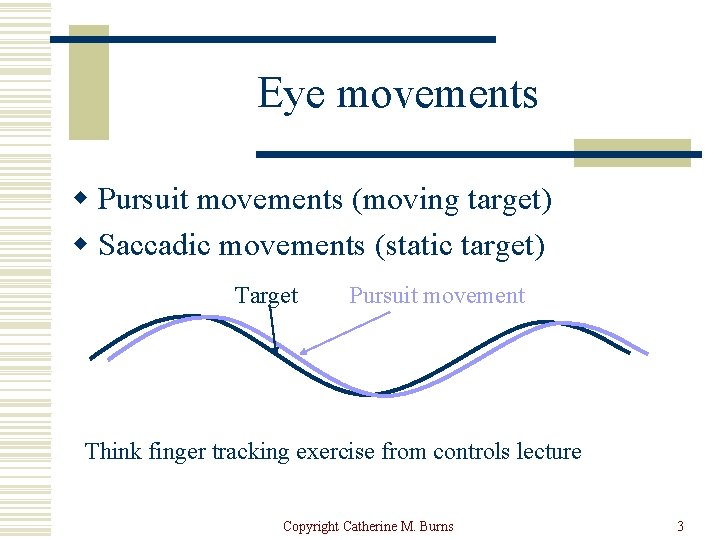
Eye movements w Pursuit movements (moving target) w Saccadic movements (static target) Target Pursuit movement Think finger tracking exercise from controls lecture Copyright Catherine M. Burns 3
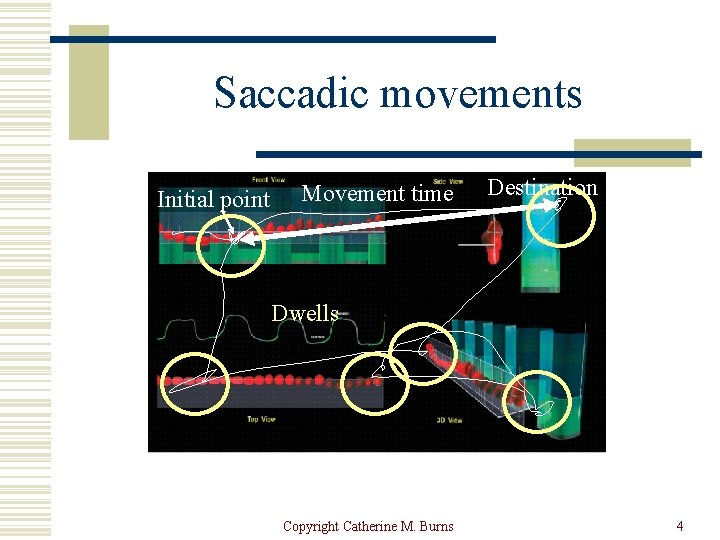
Saccadic movements Initial point Movement time Destination Dwells Copyright Catherine M. Burns 4
Key aspects w Movement times are very rapid (ms) w 3 -4 dwells per second w Destination reflects goals (top down) or salience (bottom up) w Dwell time reflects information content or extraction difficulty Copyright Catherine M. Burns 5

Visual Search w Identification of targets in a field of non-targets (distractors) w Time (1 target) = (number of items x inspection time)/2 n n n Average time, based on probability of finding a target Key points: more items=more time Only applies to very itemized searches (e. g. phone books) Copyright Catherine M. Burns 6
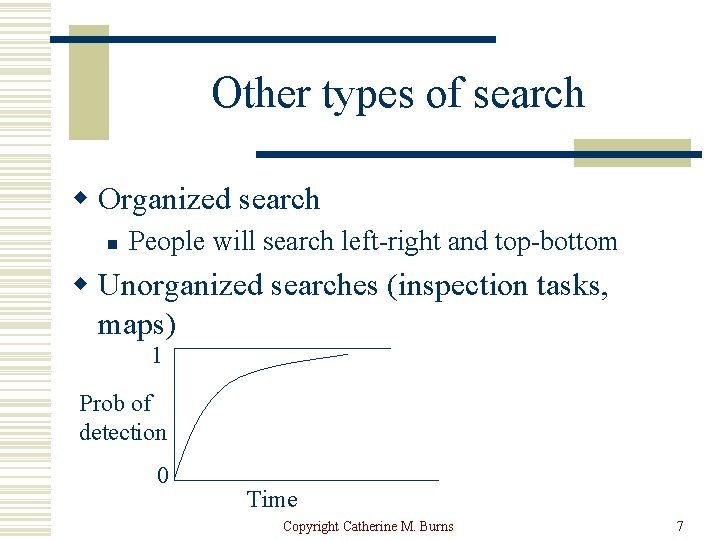
Other types of search w Organized search n People will search left-right and top-bottom w Unorganized searches (inspection tasks, maps) 1 Prob of detection 0 Time Copyright Catherine M. Burns 7
w Basic principles n n More items, search time takes longer But – diminishing returns with longer searches w Modify with n n Salience (conspicuity) Organization Copyright Catherine M. Burns 8
Signal detection theory w Adds to visual search by distinguishing between n n Target location Target identification w Applies to environments with signals and noise elements n Material inspection, baggage inspection, reading xrays Copyright Catherine M. Burns 9
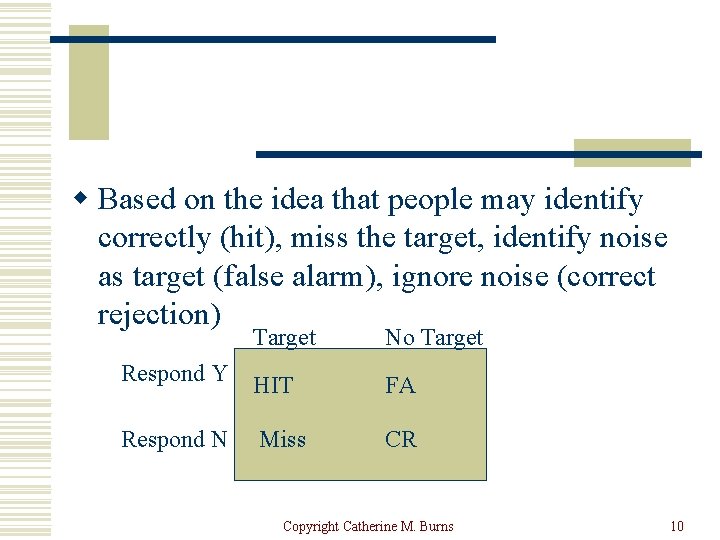
w Based on the idea that people may identify correctly (hit), miss the target, identify noise as target (false alarm), ignore noise (correct rejection) Target No Target Respond Y HIT FA Respond N Miss CR Copyright Catherine M. Burns 10
Lighting Ergonomics (not in text) Copyright Catherine M. Burns 11
Direct Lighting w light straight from a source n n n lamps, desk lights, "task lighting" high local luminance strong shadows tends to create glare if illumination is too high if people have to work with bright task lighting in a dim room they get a "relative" glare effect good to add illumination in already high illuminated areas Copyright Catherine M. Burns 12
Indirect Lighting w throw light onto the ceiling or walls then it is reflected back n n n diffuse light, no shadows low glare need bright ceilings and walls w Combining both n Filters (aka shades!) help diffuse light, remove shadows Copyright Catherine M. Burns 13
Incandescent Lighting w work by heating up a filament n n n primarily red-yellow spectrum (think of metal heating) alot of waste energy to heat "warm" light Copyright Catherine M. Burns 14
Fluorescent Lighting w electricity passes through a gas, or metal vapour (sodium vapour) n neon, yes like the signs argon mercury vapour (arenas, large facilities) w tube covered with a fluorescent phosphors converts uv rays to visible light n n low luminance, general non-directional lighting primarily yellow green spectrum Copyright Catherine M. Burns 15
Full Spectrum Lighting w simulates daylight n n less visual fatigue greater visual acuity improved mood/ Seasonal affective disorder colour, skin tones look better Copyright Catherine M. Burns 16
Determining lighting levels w generally all surfaces in visual field should be equally bright n n n luminance ratios (3: 1 in middle of visual field, 40: 1 across room) choose furnishings based on reflectance levels windows with blinds and curtains to reduce glare matt surfaces, not smooth shiny no source of light should be right in the visual field Copyright Catherine M. Burns 17
Lighting by Type of Work w Fine detailed work: n n needs high lighting levels light to the front to reduce shadows w Computer work n n indirect lighting is better to reduce glare lighting level should consider need to switch tasks Copyright Catherine M. Burns 18
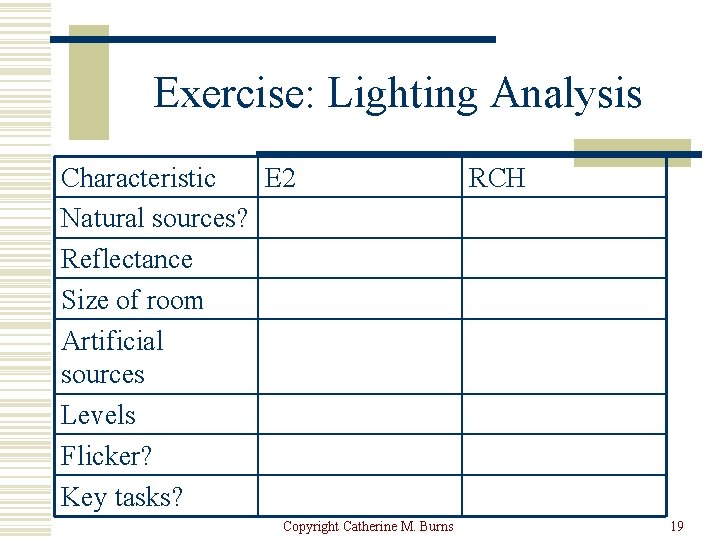
Exercise: Lighting Analysis Characteristic E 2 Natural sources? Reflectance Size of room Artificial sources Levels Flicker? Key tasks? Copyright Catherine M. Burns RCH 19
- Slides: 19