
VISION INTRODUCTION ACCESSORY STRUCTURES OF THE EYE STRUCTURE

- Slides: 62
VISION
• � INTRODUCTION � ACCESSORY STRUCTURES OF THE EYE � STRUCTURE OF THE EYE BALL � PHYSIOLOGY OF VISION Ø OVERVIEW OF LIGHT AND OPTICS Ø FOCUSING OF LIGHT ON THE RETINA Ø PHOTORECEPTORS AND PHOTOTRANSDUCTION Ø THE VISUAL PATHWAY Ø VISUAL PROCESSING
INTRODUCTION �Vision is our dominant sense �Up to 70% of all body sensory receptors are in the eye. �½ of cerebral cortex partakes in some form of visual processing �The adult eye is a sphere of about 2. 5 cm diameter. �Only the anterior 1/6 th of the eye is visible �The rest is enclosed in and protected by a cushion of fat in the bony orbit.
ACCESSORY STRUCTURES OF THE EYE �Eye brows �Eye lids �Conjunctiva �Lacrimal apparatus �Extrinsic muscles of the eye
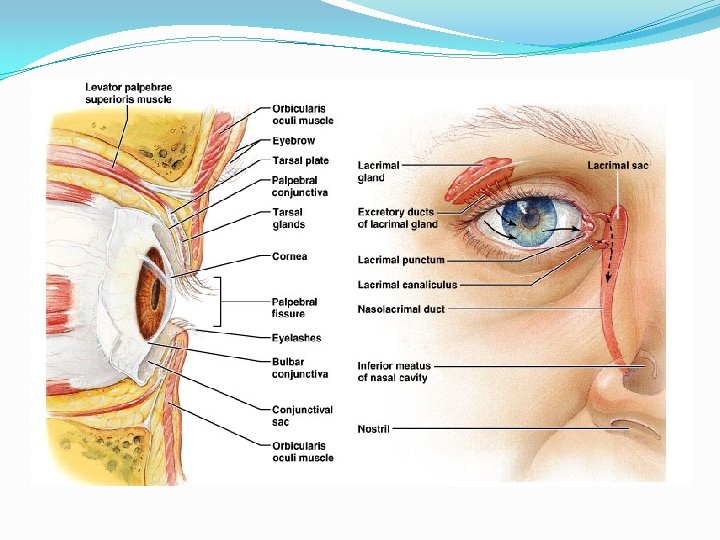
Eyebrows �Short coarse hairs over lying supra orbital margin �Sun shade �Keep out perspiration
Eyelids (palpebrae) �Palpebral fissure �Medial and lateral commissure �Lacrimal caruncle �Tarsal plates anchor the orbicularis oculi and levator palpebrae superioris muscles. �Reflex blinking – protects and moisturizes �Eyelashes (cilia) �Tarsal glands (Meibomian) – modified sebaceous – oily secretions �Ciliary glands – typical sebaceous, modified sweat �Chalazion �Sty
Conjunctiva �Palpebral conjunctiva �Bulbar conjunctiva �Conjunctiva sac – contact lens �Produces mucus �conjunctivitis
Lacrimal Apparatus �Lacrimal gland �Dilute saline solution – mucus, antibodies, lysozyme �Lacrimal gland nasolacrimal duct nasal cavity
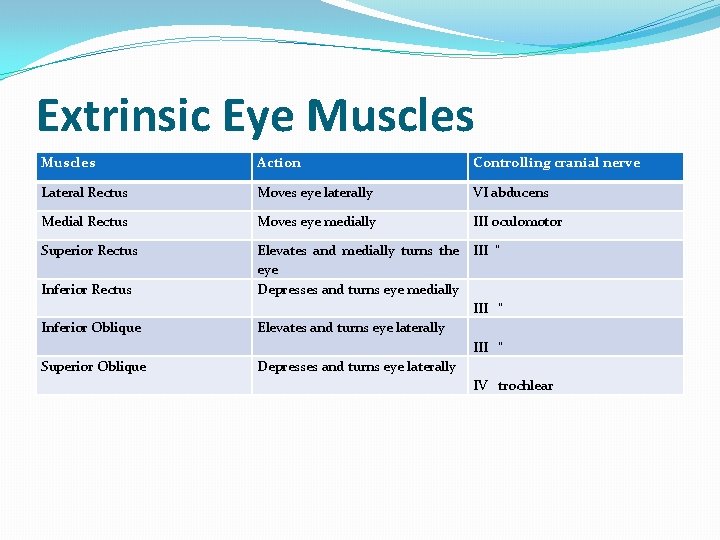
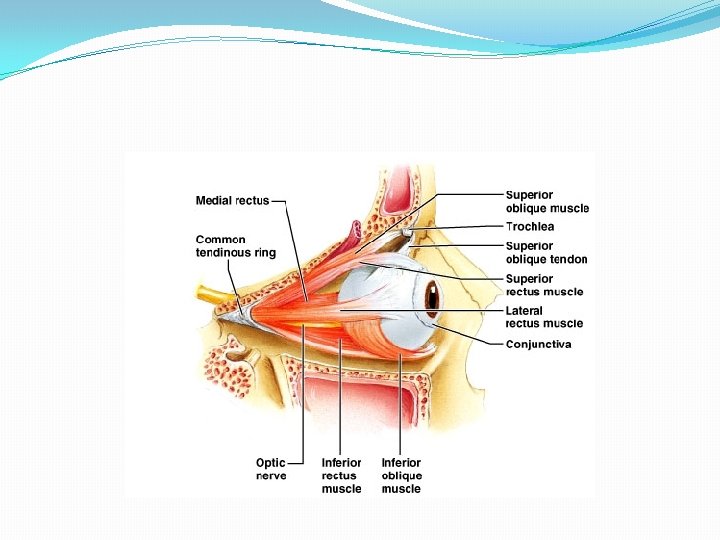
Extrinsic Eye Muscles Action Controlling cranial nerve Lateral Rectus Moves eye laterally VI abducens Medial Rectus Moves eye medially III oculomotor Superior Rectus Elevates and medially turns the eye Depresses and turns eye medially III “ Inferior Rectus III “ Inferior Oblique Elevates and turns eye laterally III “ Superior Oblique Depresses and turns eye laterally IV trochlear
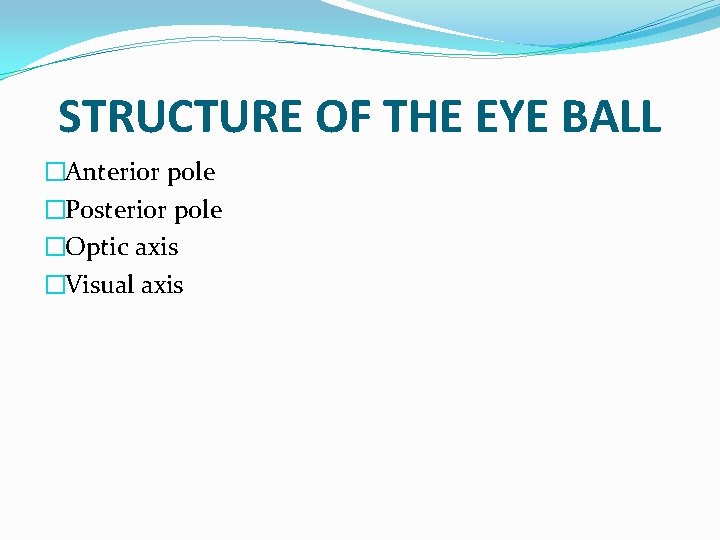
STRUCTURE OF THE EYE BALL �Anterior pole �Posterior pole �Optic axis �Visual axis
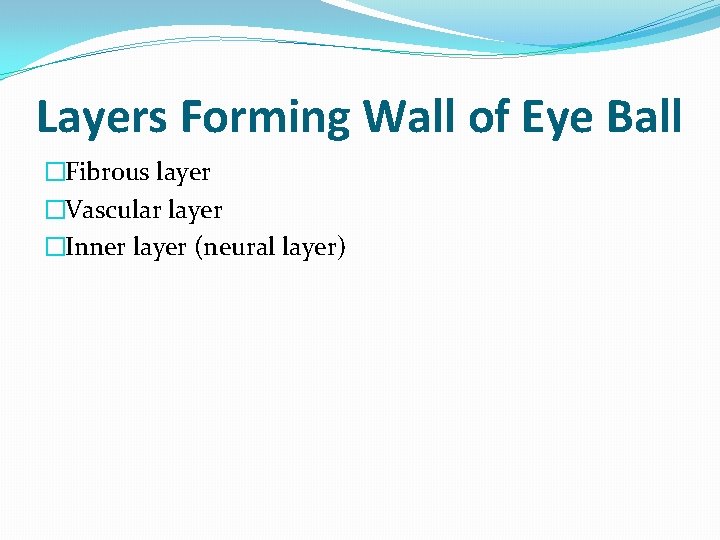
Layers Forming Wall of Eye Ball �Fibrous layer �Vascular layer �Inner layer (neural layer)
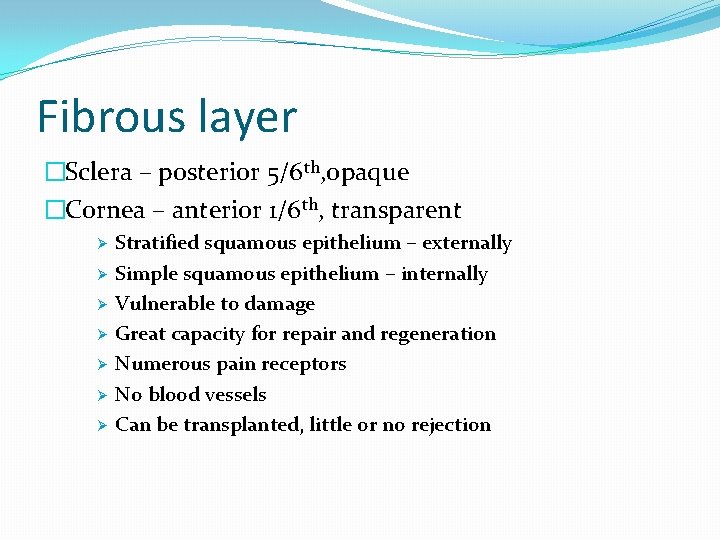
Fibrous layer �Sclera – posterior 5/6 th, opaque �Cornea – anterior 1/6 th, transparent Ø Ø Ø Ø Stratified squamous epithelium – externally Simple squamous epithelium – internally Vulnerable to damage Great capacity for repair and regeneration Numerous pain receptors No blood vessels Can be transplanted, little or no rejection
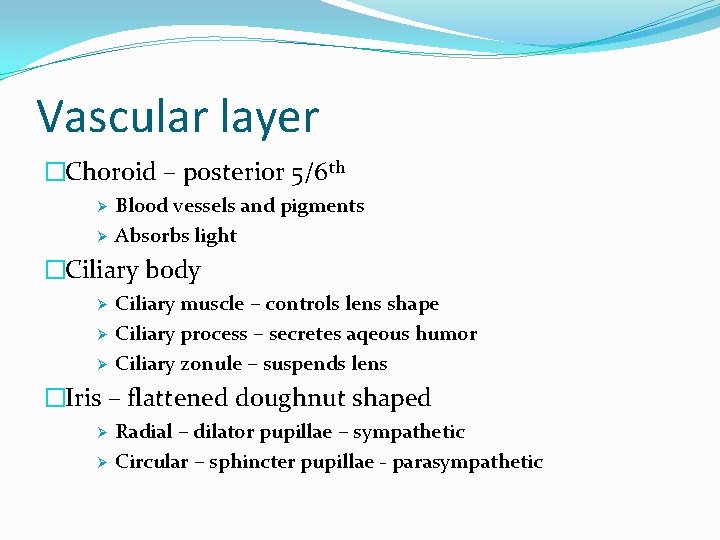
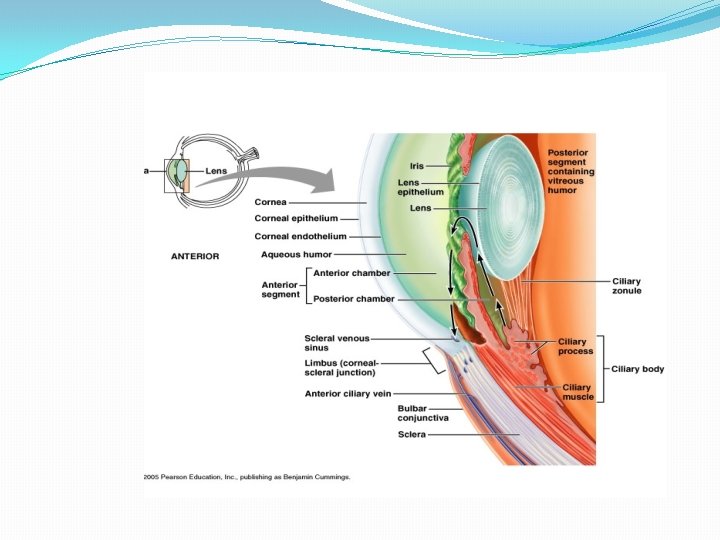
Vascular layer �Choroid – posterior 5/6 th Ø Ø Blood vessels and pigments Absorbs light �Ciliary body Ø Ø Ø Ciliary muscle – controls lens shape Ciliary process – secretes aqeous humor Ciliary zonule – suspends lens �Iris – flattened doughnut shaped Ø Ø Radial – dilator pupillae – sympathetic Circular – sphincter pupillae - parasympathetic
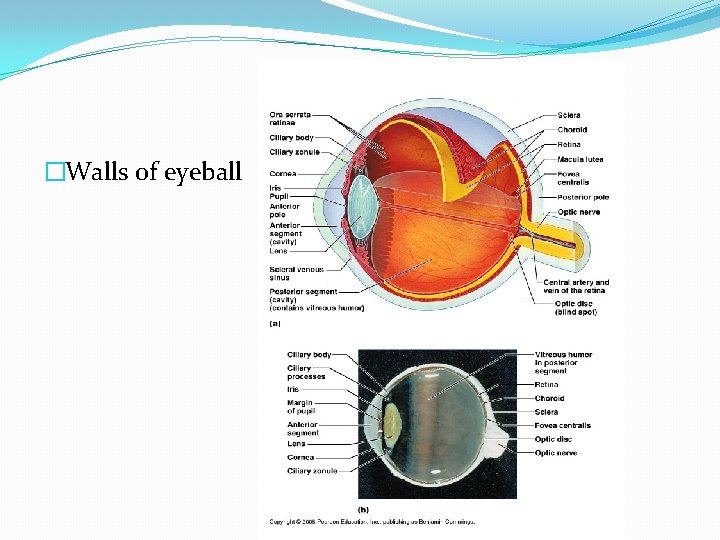
�Walls of eyeball
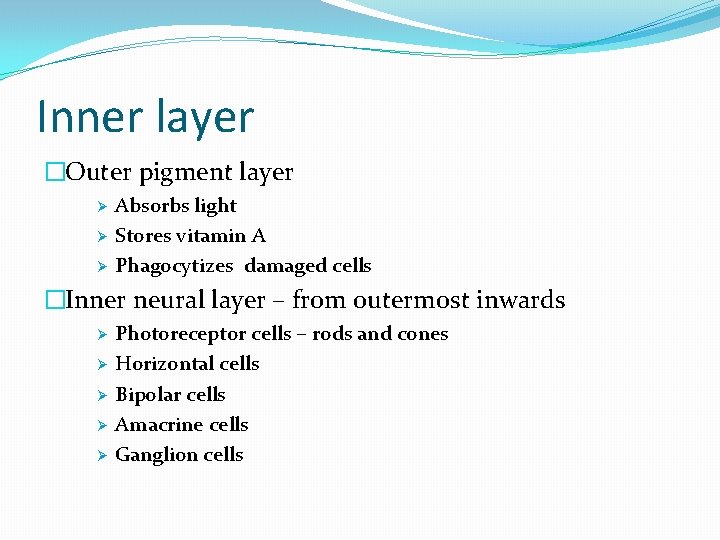
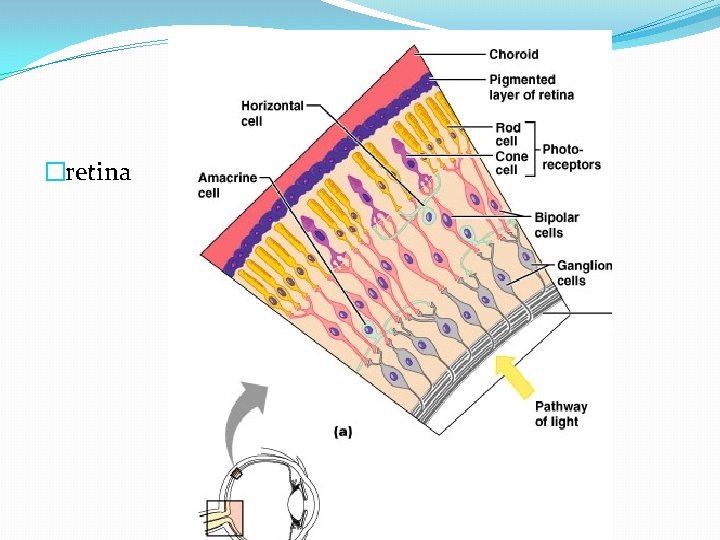
Inner layer �Outer pigment layer Ø Ø Ø Absorbs light Stores vitamin A Phagocytizes damaged cells �Inner neural layer – from outermost inwards Ø Ø Ø Photoreceptor cells – rods and cones Horizontal cells Bipolar cells Amacrine cells Ganglion cells
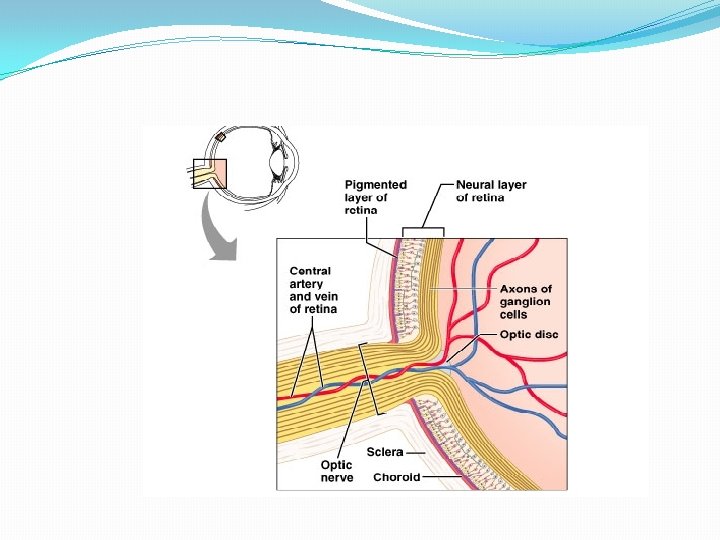
Outer plexiform layer v Inner plexiform layer v Glial cells (muller cells) form the internal and external limiting membranes v Optic disc – blind spot v Macula lutea – fovea centralis v Distribution of rods and cones v Convergence and divergence in retina and visual pathway v Blood supply to retina, diagnostic relevance v Retinal detachment v
�retina
Internal chambers and fluids �Lens and suspensory ligament anterior and posterior segments �The posterior segment – vitreous humor Ø Ø Gelatinous Maintains shape �Anterior segment - filled with aqeous humor Ø Ø Ø Iris anterior and posterior chambers Canal of Schlemm Intraocular pressure 12 – 20 mm. Hg (Av 15 mm. Hg) Glaucoma - open angle, angle closure glaucoma Treatment – beta adrenergic blockers, carbonic anhydrase inhibitors or cholinergic agonists
Lens �Biconvex, transparent, flexible in thin elastic capsule �Avascular �Cuboidal lens epithelium – anterior surface �Lens fibers – no nuclei, few organelles, proteins (crystallins) �Loss of elasticity with age – presbyopia �Cataract – congenital, age related, diabetes, smoking, intense sunlight �Long term vit C – reduces risk
PHYSIOLOGY OF VISION
OVERVIEW OF LIGHT AND OPTICS �Electromagnetic spectrum – all energy waves from long radio waves(m) to very short gamma and x – rays(≤ 1 nm) �Visible light – 400 – 700 nm �Light energy - photons �Prism – visible spectrum �Red – longest wavelength, lowest energy �Violet – shortest wavelength, greatest energy �Green object – absorbs other wavelengths, reflects green �Black absorbs all, white reflects all
�Speed of light – 300, 000 km/s increases in less dense medium, decreases denser medium �Refraction of oblique rays at media interface �Convex lens – converges �Concave lens – diverges
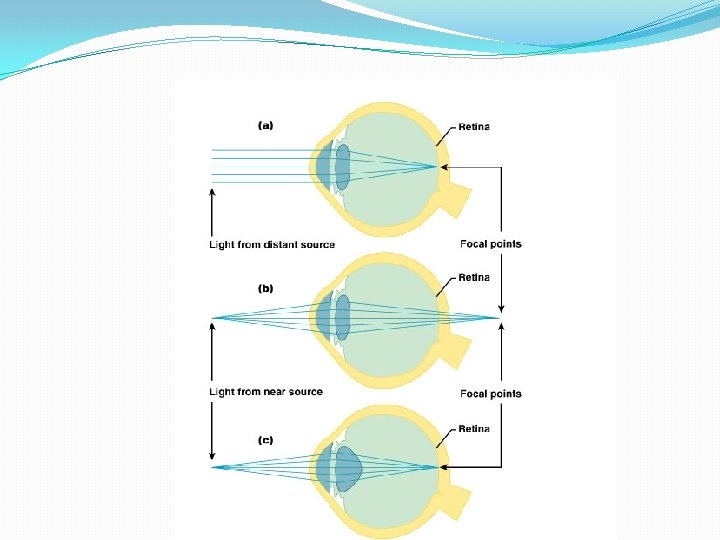
Focusing of light on the retina �Far point of vision(distance beyond which no change in lens shape is required for focusing – 6 m(20 ft), ciliary muscles relaxed, ciliary zonule tense, lens thin and at lowest refractory power �Close vision – light from close objects diverge, to focus on retina requires: Ø Ø Ø Accommodation of the lenses Constriction of the pupil Convergence of the eyeballs =Near Response �Pupillary light reflexes – direct and consensual �Argyll Robertson pupil
�Near point of vision – the nearest point from the eye at which an object can be brought clearly into focus. Can change from 10 cm at 10 yrs to 83 cm at 60 yrs �Pupillary aperture 1. 5 – 8 mm �Decrease in size – miosis(parasymp) �Increase in size – mydriasis(symp)
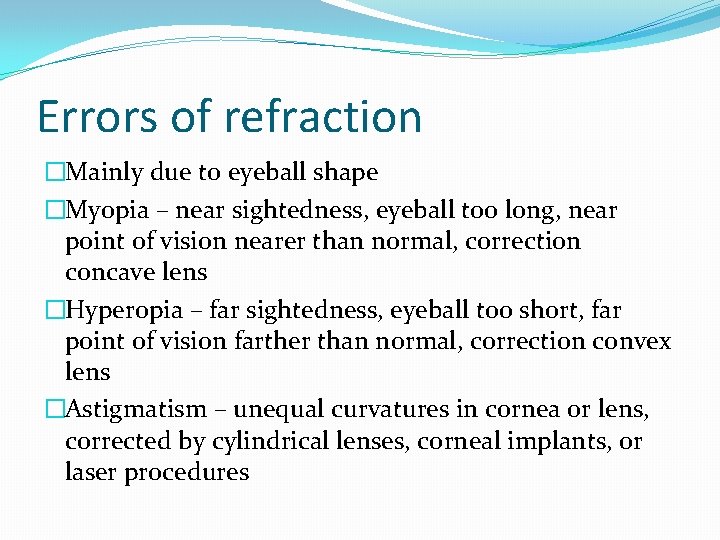
Errors of refraction �Mainly due to eyeball shape �Myopia – near sightedness, eyeball too long, near point of vision nearer than normal, correction concave lens �Hyperopia – far sightedness, eyeball too short, far point of vision farther than normal, correction convex lens �Astigmatism – unequal curvatures in cornea or lens, corrected by cylindrical lenses, corneal implants, or laser procedures
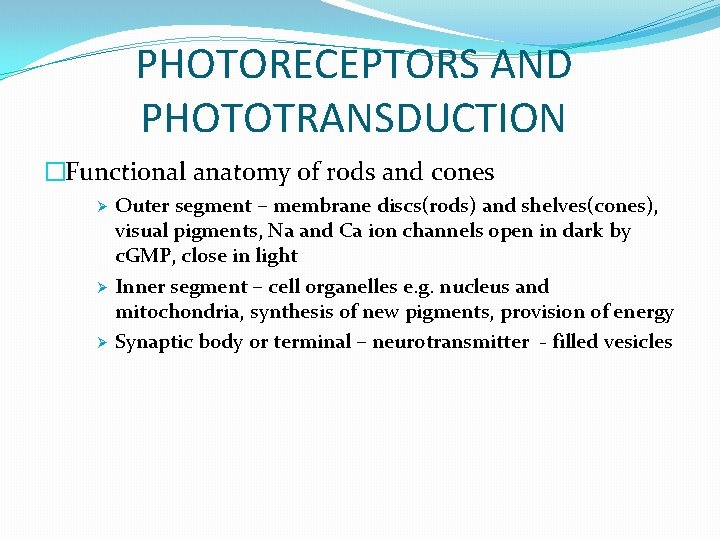
PHOTORECEPTORS AND PHOTOTRANSDUCTION �Functional anatomy of rods and cones Ø Ø Ø Outer segment – membrane discs(rods) and shelves(cones), visual pigments, Na and Ca ion channels open in dark by c. GMP, close in light Inner segment – cell organelles e. g. nucleus and mitochondria, synthesis of new pigments, provision of energy Synaptic body or terminal – neurotransmitter - filled vesicles
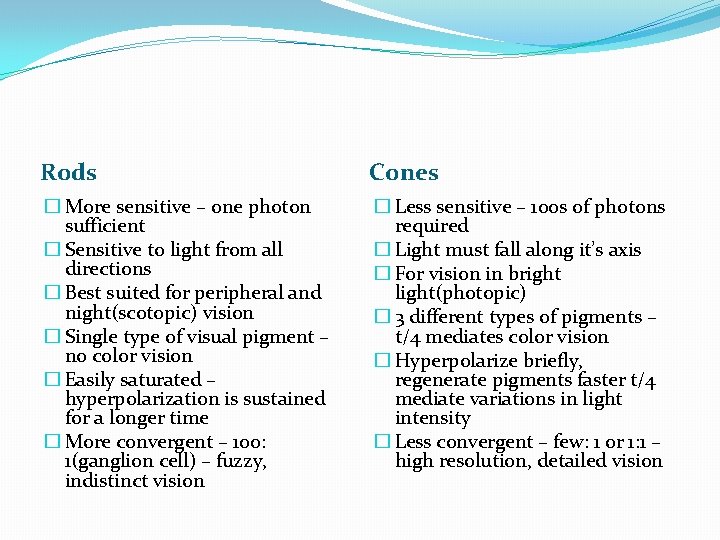
Rods Cones � More sensitive – one photon sufficient � Sensitive to light from all directions � Best suited for peripheral and night(scotopic) vision � Single type of visual pigment – no color vision � Easily saturated – hyperpolarization is sustained for a longer time � More convergent – 100: 1(ganglion cell) – fuzzy, indistinct vision � Less sensitive – 100 s of photons required � Light must fall along it’s axis � For vision in bright light(photopic) � 3 different types of pigments – t/4 mediates color vision � Hyperpolarize briefly, regenerate pigments faster t/4 mediate variations in light intensity � Less convergent – few: 1 or 1: 1 – high resolution, detailed vision
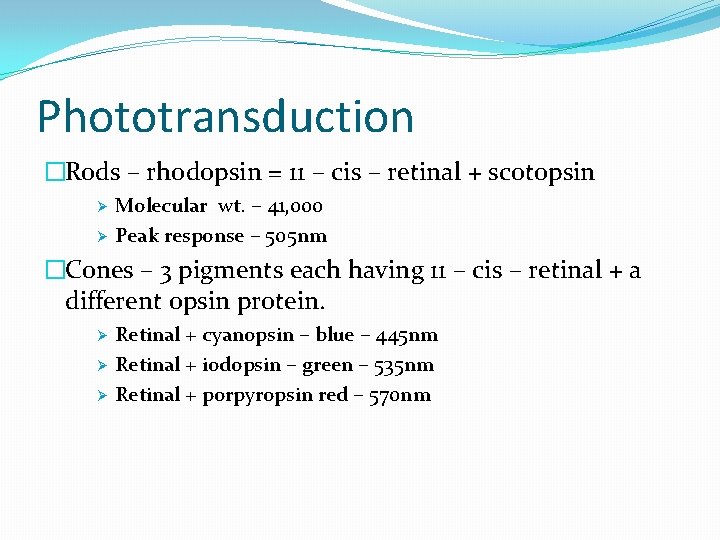
Phototransduction �Rods – rhodopsin = 11 – cis – retinal + scotopsin Ø Ø Molecular wt. – 41, 000 Peak response – 505 nm �Cones – 3 pigments each having 11 – cis – retinal + a different opsin protein. Ø Ø Ø Retinal + cyanopsin – blue – 445 nm Retinal + iodopsin – green – 535 nm Retinal + porpyropsin red – 570 nm
�Rhodopsin + light = all – trans – retinal + scotopsin which gives rise to metarhodopsin II (activated rhodopsin) �All – trans – retinal splits from scotopsin(bleaching), is reduced to vit A and converted by enzymes to 11 – cis – retinal which combines with scotopsin to regenerate rhodopsin.
�Rhodopsin absorbs light metarhodopsin II �Metarhodopsin II activates transducin �Transducin activates phosphodiesterase �Phosphodiesterase converts cyclic GMP to 5’GMP �Results in closure of cyclic GMP gated cation channels in outer segment �Leading to hyperpolarization of photoreceptor cell �And decreased release of synaptic neurotransmitters �Response in bipolar cells and other neural elements of the retina
Response in neural elements of retina In the dark In light � Cyclic GMP channels open – cation influx – photoreceptor depolarization � Voltage gated Ca ion channels open in synaptic terminal – continuous NT release � NT produces IPSP in bipolar cells which hyperpolarize � Voltage gated Ca channels close in bipolar cell terminals – no NT released � No EPSP in ganglion cells � No action potential in optic nerve � Cyclic GMP channels close, cation influx ceases, photoreceptor hyperpolarises � Voltage gated Ca channels close in terminal, no NT released � No IPSP in bipolar cells t/4 they depolarize � Depolarization opens voltage gated Ca ion channels and NT is released from bipolar cells � EPSP occurs in ganglion cells � Action potential propagated along optic nerve
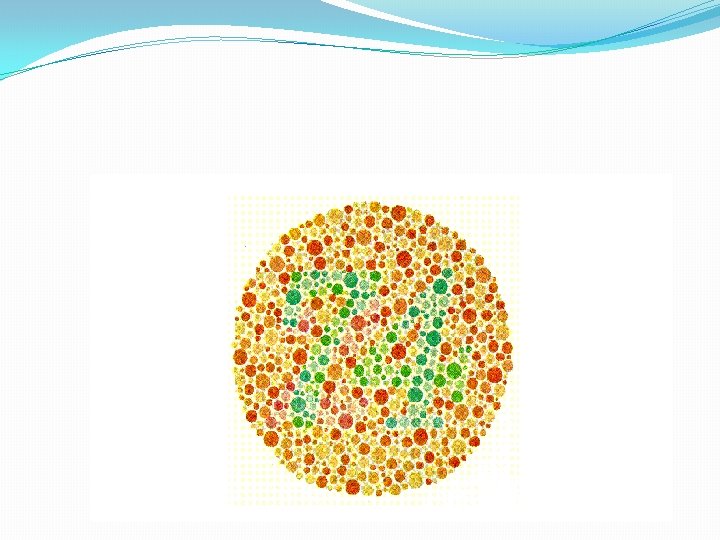
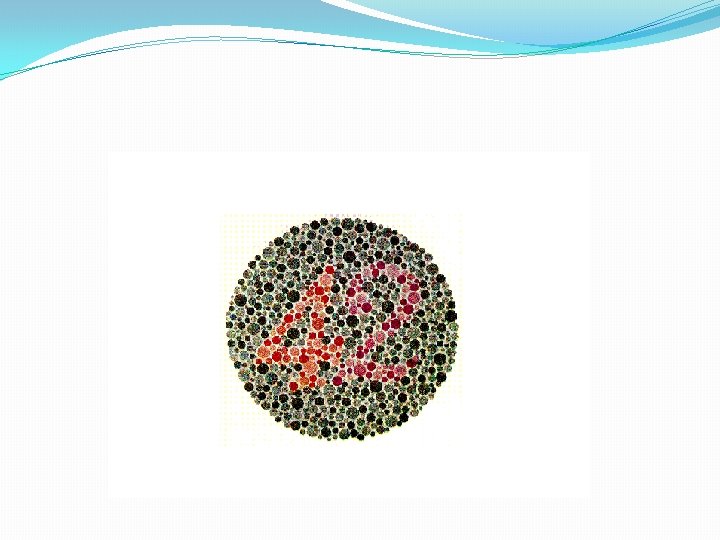
Color vision �Young – Helmholtz trichromatic theory – the perception of any color depends on the ratio of signals arising from each type of cone Ø Ø Orange – red(99%), green(42%), blue(0%) Yellow – red(83%), green(83%), blue(0%) �Color blindness Ø Ø Color vision is tested with Ishihara charts Inherited as an X – linked recessive trait More common in males, females mainly carriers Red/green color blindness is most common
Melanopsin �A small subset of ganglion cells contain the visual pigment melanopsin(circadian pigment) �These ganglion cells respond directly to light �Project directly to the pretectal nuclei which mediates pupillary reflexes �And to the suprachiasmatic nucleus of hypothalamus which mediates circadian rhythms in response to daytime and night
Dark and light adaptation �Dark adaptation Ø Ø Moving from bright place to dimly – lit place One is not able to see for some time but begins to see slowly Max. duration – 20 mins It occurs as a result of : time required for increased rod sensitivity b/c of rhodopsin regeneration and dilatation of the pupils �Light adaptation Ø Ø moving from dim to brightly lit room produces a dazzling effect and after sometime the eyes adapt and one can see without discomfort It is due to : decreased sensitivity of rods and constriction of the pupils
THE VISUAL PATHWAY �Visual field – the view seen by one eye without movement of the head �Binocular vision – the visual fields of both eyes overlap �Corresponding points on the retina �Diplopia results when light from an object in the binocular field of vision does not fall on corresponding points of the retinae. Possible causes include: Ø Ø Ø Paralysis of ocular muscles e. g. myaesthenia gravis Alcoholic intoxication Lesion in 3 rd 4 th and 6 th cranial nerves, oculomotor nucleus and cerebral peduncles
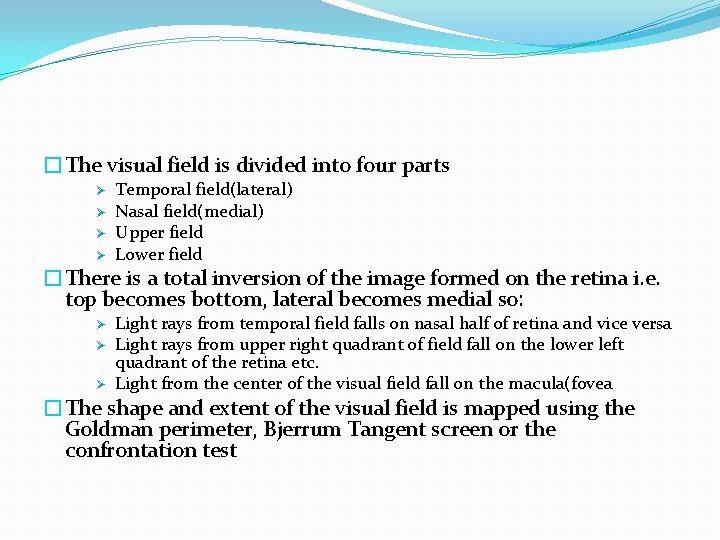
�The visual field is divided into four parts Ø Ø Temporal field(lateral) Nasal field(medial) Upper field Lower field �There is a total inversion of the image formed on the retina i. e. top becomes bottom, lateral becomes medial so: Ø Ø Ø Light rays from temporal field falls on nasal half of retina and vice versa Light rays from upper right quadrant of field fall on the lower left quadrant of the retina etc. Light from the center of the visual field fall on the macula(fovea �The shape and extent of the visual field is mapped using the Goldman perimeter, Bjerrum Tangent screen or the confrontation test
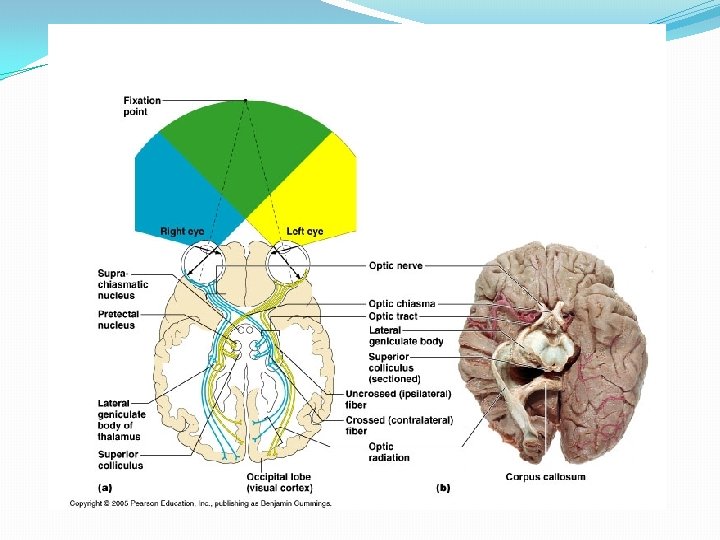
The visual pathway �The visual pathway consists of: Ø Ø Ø The optic nerve Optic chiasma Optic tract Lateral geniculate body Optic radiation Visual cortex
The optic nerve �Leaves retina at optic disc �Fibers from temporal part of retina is in lateral part of nerve and carry impulses from nasal half of visual field �Fibers from nasal part of retina is in the medial part of the nerve and carry impulses from the temporal half of the visual field
The optic chiasma �Medial fibers of each optic nerve cross the midline at the optic chiasma to join the uncrossed lateral fibers of the opposite optic nerve to form the optic tract
The optic tract �Contains fibers from lateral side of ipsilateral retina and fibers from medial side of contralateral retina �Conveys information from the part of the retina on the same(homonymous) side which receives light from the contralateral half of the visual field
The lateral geniculate body �Most fibers of the optic tract end in the LGB of the thalamus where they synapse with neurons of the lat. Geniculate nuclei whose axons form the geniculo – calcarine tract(optic radiation) �Laminated organization of the nuclei of the LGB �Somatotopic representation of the retina to the LGB such that: Ø Ø Crossed fibers from contralateral retina terminates on laminae 1, 4 and 6 Uncrossed fibers terminate in laminae 2, 3 and 5
�Some optic tract fibers do not terminate in the LGB but in one of the following areas: Ø Ø Ø In the superior colliculus – coordinates reflex ocular and head movements in response to visual stimulus Pretectal area of midbrain – mediates pupillary reflexes Suprachiasmatic nucleus and tuber cinereum of the hypothalamus – mediates hypothalamic functions related to circadian rhythms
The visual cortex �Primary visual cortex – forms walls and lips of the calcarine fissure in the medial surface of occipital lobes �It consists of primary, secondary and visual association areas �There is somatotopic representation of the retina in the primary visual cortex such that Ø Ø Ø Upper quadrant of homonymous retinas – above the calcarine fissure calcarine(cuneus gyrus) Lower quadrant of homonymous retinas – below calcarine fissure(lingular gyrus) Cortical area for the macula is disproportionately large – occupies posterior 3 rd of the of calcarine cortex
Ø Ø Ø The primary visual – area 17 – perception of visual impulses Area 18 – interpretation of visual impulses Area 19 – movement of the eye
Effect of lesions of the visual pathway �Optic nerve – blindness of affected eye �Optic chiasma – bitemporal hemianopia �Right Optic tract – left homonymous hemianopia and vice versa �Optic radiation and visual cortex – contralateral homonymous hemianopia Ø Damage to lingular gyrus of right cerebral hemisphere – damages fibers from the right lower quadrants of the two retinas
Macula sparing �Lesions that damage visual cortex often spare macula vision b/c fibers from the macula separate from those from peripheral retina and terminate in a large posterior area of the visual cortex.
Visual processing �Retinal processing �Thalamic processing �Cortical processing
Retinal processing • Ganglion cells generate action potential sat a fairly steady rate 20 – 30/sec even in the dark – basal rate �Basal rate does not change when retina is evenly illuminated �Activity of individual ganglion cells changes dramatically when a particular pattern of light falls on it’s receptive field. �The receptive field is that part of the retina that when stimulated influences the activity of the ganglion cell �Different ganglion cells detect different light patterns e. g. lines at a particular angle, or moving in particular direction at a particular speed. The simplest being a spot of light
Ganglion cells receiving input from rods �Have two types (circle within a circle) of receptive fields based on what happens to the ganglion cell when the center of it’s receptive field is illuminated with a spot of light Ø Ø On - center fields Off - center fields
�Ganglion cells with on – center Ø Ø Depolarize(stimulated) when light falls on photoreceptors in the center of their receptive field Inhibited when light falls on photoreceptors in the periphery �Ganglion cells with off – center Ø Ø Depolarize(stimulated) when light falls on photoreceptors in the periphery of their receptive field Inhibited when light falls on photoreceptors in the center of their receptive field � Activation of a neural unit associated with the inhibition of nearby units is an example of lateral or afferent inhibition. It serves to sharpen the edges of a stimulus and improve discrimination
Thalamic processing �The ganglion cells project a detailed spatial representation of the retina on the LGB. �The LGB has 6 layers receiving input from two types of ganglion cells Ø Ø Small ganglion cells – parvo or P cells relay signals to layers 3 – 6 of the LGB called the parvocellular layers and contains small cells. The P ganglion cells subtract input from one type of cone from input from other types and are concerned with color, texture and shape Large, magno or M ganglion cells project to layers 1 and 2 of LGB(magnocellular with large cells). These ganglion cells summate responses from different kinds of cones and are concerned with movement and stereopsis(depth perception) �Cells in the interlaminar regions of the LGB also receive input from P ganglion cells and project through a separate component of P pathway to the blobs in the visual cortex
Cortical processing �Like the retina to the LGB, the LGB transmits a similar point for point representation on the primary visual cortex. Many nerve cells in the visual cortex are associated with each incoming fiber and it has 6 layers �Axons from interlaminar regions of LGB end in layers 2 and 3 in cell clusters with high cytochrome oxidase concentration called blobs – concerned with color vision. �Left visual cortex receives input from right visual fields and vice versa �
�Two types of areas for processing retinal input are found in the visual cortex Ø Ø Primary visual cortex(striate cortex, area 17) – responds to dark and bright edges (contrast information) object orientation and provides form, color and motion inputs to visual association areas Visual association areas(prestriate cortices, areas 18 and 19) continues processing of visual information concerned with form, color and movement
�Complex visual processing extends beyond the occipital lobe to the temporal, parietal and frontal lobes along 2 parallel lines Ø Ø The ‘what' processing stream extends through the ventral part of the temporal lobe – identification of objects i. e. shape, recognition of forms and faces The ‘where’ takes a dorsal path through the parietal cortex to the post central gyrus, uses information from primary visual cortex to assess spatial location of objects and motion Output from these pathways pass to the frontal cortex which uses the information to direct activities Other parts of the cortex and subcortical structures activated by visual stimuli are the amygdala, pulvinar, caudate nuclei, putamen and claustrum