
Visible Spectropolarimeter Vi SP Conceptual Design David Elmore
Visible Spectro-polarimeter (Vi. SP) Conceptual Design David Elmore HAO/NCAR Elmore@ucar. edu
Outline • • Requirements Science Requirements Issues Spectrograph Review Spectrograph Mechanism Description and Modes • Camera Options • Resource Estimation Issues August 11 -13, 2004 Vi. SP DRAFT 2
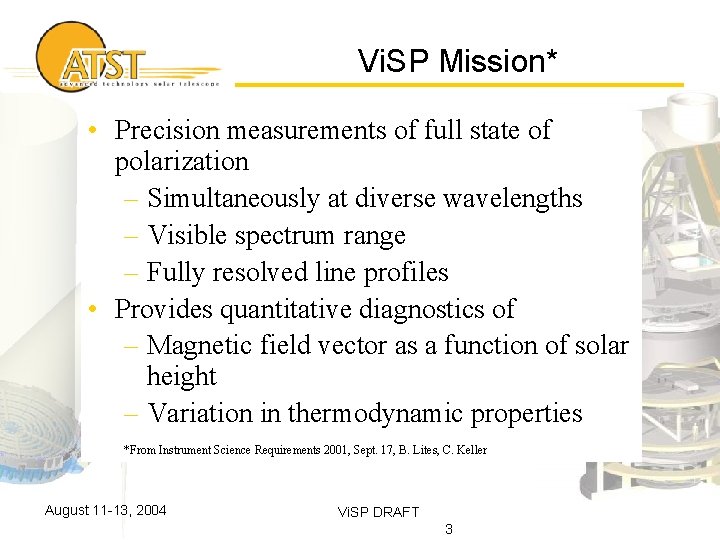
Vi. SP Mission* • Precision measurements of full state of polarization – Simultaneously at diverse wavelengths – Visible spectrum range – Fully resolved line profiles • Provides quantitative diagnostics of – Magnetic field vector as a function of solar height – Variation in thermodynamic properties *From Instrument Science Requirements 2001, Sept. 17, B. Lites, C. Keller August 11 -13, 2004 Vi. SP DRAFT 3
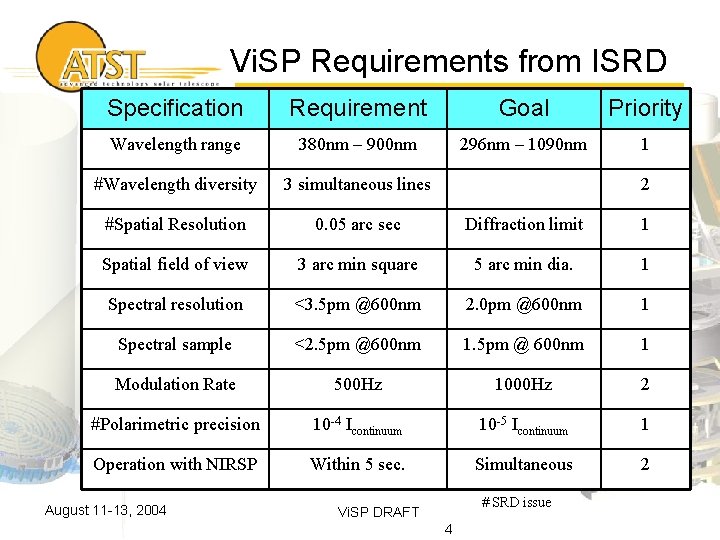
Vi. SP Requirements from ISRD Specification Requirement Goal Priority Wavelength range 380 nm – 900 nm 296 nm – 1090 nm 1 #Wavelength diversity 3 simultaneous lines #Spatial Resolution 0. 05 arc sec Diffraction limit 1 Spatial field of view 3 arc min square 5 arc min dia. 1 Spectral resolution <3. 5 pm @600 nm 2. 0 pm @600 nm 1 Spectral sample <2. 5 pm @600 nm 1. 5 pm @ 600 nm 1 Modulation Rate 500 Hz 1000 Hz 2 #Polarimetric precision 10 -4 Icontinuum 10 -5 Icontinuum 1 Operation with NIRSP Within 5 sec. Simultaneous 2 August 11 -13, 2004 2 # SRD issue Vi. SP DRAFT 4
SRD Issues: Polarimetric “accuracy” • Polarization accuracy, precision, and sensitivity – Vi. SP ISRD Sec. 5. 8: • Precision 10 -4 Ic, goal 10 -5 Ic – SRD Sec. 2. 8 Table 1: • Accuracy < 10 -4 Ic – SRD Sec. 2. 2: ( HAO recommendation) • Accuracy 5 x 10 -4 Ic • Sensitivity 10 -5 Ic (at reduced spatial resolution) August 11 -13, 2004 Vi. SP DRAFT 5
SRD Issues: Spatial Resolution • ISRD Sec. 5. 3 – Requriement: 0. 05 arc second resolution ( no specified wavelength ) – Goal: diffraction limit • Based upon existing visible spectro-polarimeters in order to complete a measurement at a single slit position before solar features change, a spatial sample size should equal to the telescope resolution spot size – At 630 nm this the sample size is 0. 033 arc seconds • Recommended Requirement: Polarimetric accuracy is achieved with a spatial sample size equal to telescope spot size. August 11 -13, 2004 Vi. SP DRAFT 6
SRD Issues: Wavelength Diversity • Mission ranks wavelength diversity at the top. • SRD ranks wavelength diversity as ‘ 2’ August 11 -13, 2004 Vi. SP DRAFT 7
SRD Issues: Time • There is no integration time specified in order to achieve requirements – 5 seconds to achieve a polarization accuracy of 5 X 10 -4 at required spatial and spectral resolution – At required spatial and spectral resolution 12, 500 seconds would be needed to achieve a sensitivity of 10 -5 – A complete specification would trade off solar evolution, spatial sample size, spectral sample size, and polarization sensitivity – Leave open and use time as a trade item August 11 -13, 2004 Vi. SP DRAFT 8
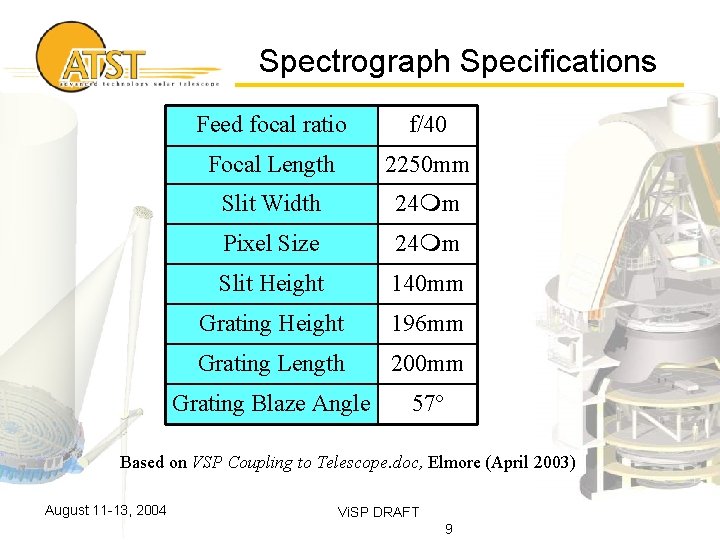
Spectrograph Specifications Feed focal ratio f/40 Focal Length 2250 mm Slit Width 24 mm Pixel Size 24 mm Slit Height 140 mm Grating Height 196 mm Grating Length 200 mm Grating Blaze Angle 57º Based on VSP Coupling to Telescope. doc, Elmore (April 2003) August 11 -13, 2004 Vi. SP DRAFT 9
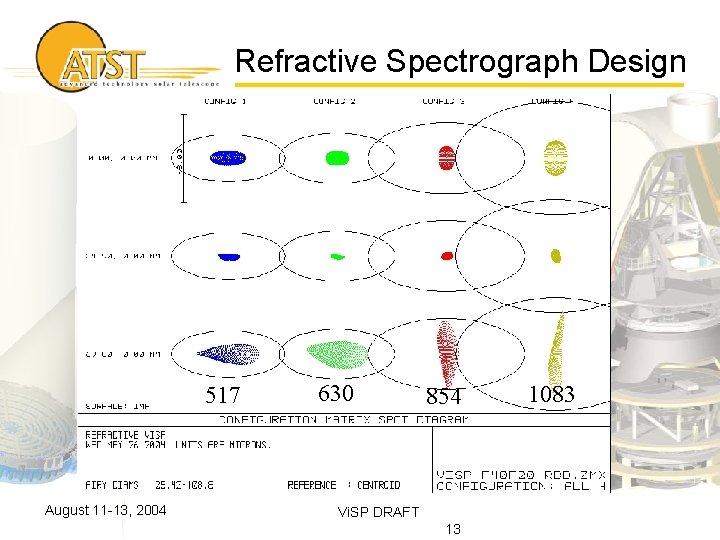
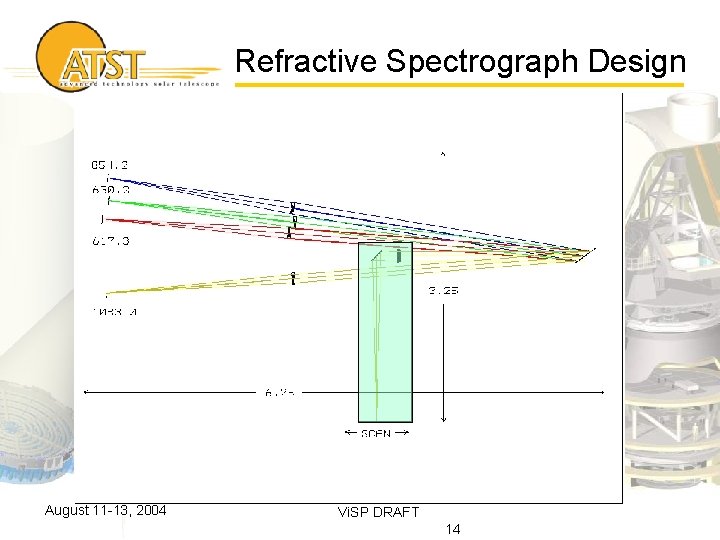
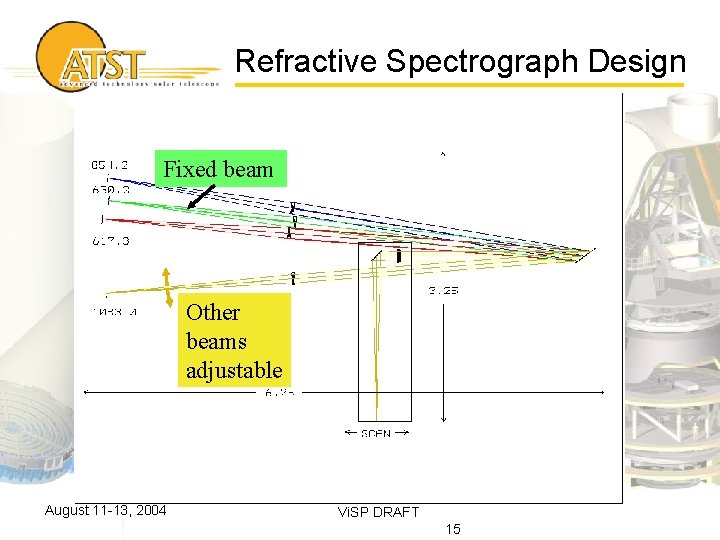
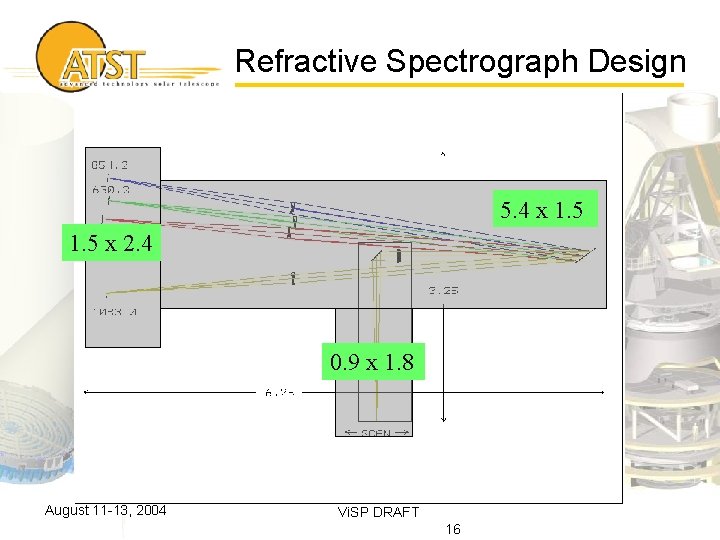
Refractive Spectrograph • Based upon Horizontal Spectrograph designed by Dick Dunn at DST • Single fixed beam plus adjustable beams • Ideal optical interface is f/40 telecentric. August 11 -13, 2004 Vi. SP DRAFT 10
Refractive Spectrograph • Relatively small moving mass • Large spacing between orders allows for easily selecting spectrum lines • Excellent optical performance for every wavelength • Camera lens focal length can be changed to accommodate cameras with various pixel sizes 24 mm, 18 mm, 27 mm, 12 mm … August 11 -13, 2004 Vi. SP DRAFT 11
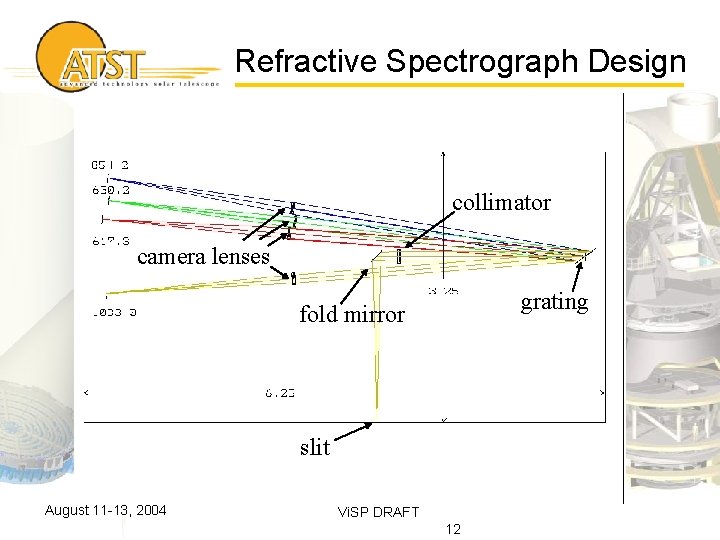
Refractive Spectrograph Design collimator camera lenses grating fold mirror slit August 11 -13, 2004 Vi. SP DRAFT 12
Refractive Spectrograph Design 517 August 11 -13, 2004 630 854 Vi. SP DRAFT 13 1083
Refractive Spectrograph Design August 11 -13, 2004 Vi. SP DRAFT 14
Refractive Spectrograph Design Fixed beam Other beams adjustable August 11 -13, 2004 Vi. SP DRAFT 15
Refractive Spectrograph Design 5. 4 x 1. 5 x 2. 4 0. 9 x 1. 8 August 11 -13, 2004 Vi. SP DRAFT 16
Spectrograph Motions • Slit scan stage – Range: Continuous motion over 5 arc minutes @ f/40 = 233 mm – Accuracy: Absolute encoding to ~. 001 arc seconds = 3. 5 mm (16 bits) – Mechanism: One or two linear stages or servo motors with ball screws • Slit width – Range: Continuous motion 0 to 1 mm – Accuracy: 1 mm – Mechanism: Motor micrometer • Slit rotation – Range: Continuous motion over ± 5° – Accuracy: ± 1 pixel over slit length = ± 18 arc seconds – Mechanism: Motor micrometer August 11 -13, 2004 Vi. SP DRAFT 17
Spectrograph Motions • Grating selector – Range: Discrete motion with N=3 positions – Accuracy: Position accuracy to 8 arc seconds (10 pm at 630. 2 nm) – Mechanism: Servo motor, geneva, … • Grating a (selects wavelength) – Range Continuous motion over -90° to 90° – Accuracy: 10 pm @ 630. 2 nm = 8 arc second (16 -bits) – Mechanism: Servo motor • Grating b (tip) – Range: Continuous motion 140 mm field at 2. 25 m = ± 1. 8° – Accuracy: Ten 10 mm pixels @2. 25 m = 9 arc seconds – Mechanism: Motor micrometer August 11 -13, 2004 Vi. SP DRAFT 18
Spectrograph Motions • Grating g (tilt end to end) – Range: Continuous to correct gross mechanical error of ± 1 mm – Accuracy: 10 pixels across 10° range of a angles = 12 arc seconds = 6 mm at the end of a 200 mm long grating – Mechanism: Motor micrometer • Camera lens X-Y-Z motion – None: Cameras are adjustable for commonality among instruments. • Filter wheels (one per camera) – Range: Discrete motion with N=8 positions – Accuracy: 1° – Mechanism: Servo motor or geneva August 11 -13, 2004 Vi. SP DRAFT 19
Spectrograph Motions • Camera X &Y – Range: Continuous motion ± 12 mm – Accuracy: < 1 pixel or < 10 mm – Mechanism: Motor micrometer or servo motor • Camera Z (focus) – Range: Continuous motion ± 12 mm – Accuracy : < 200 micron circle of confusion @ f/20 and 10 mm pixel or <20 mm – Mechanism: Motor micrometer or servo motor • Camera rotation – Range: Continuous motion ± 5° – Accuracy: 0. 1 pixel over length of array. If 1000 pixels this is. 0001 radian or 20 arc seconds – Mechanism: Motor micrometer or servo motor August 11 -13, 2004 Vi. SP DRAFT 20
Suggested Adjustment Modes • Qualification Mode (‘One time’ alignments) – Values are saved in system tables for ‘reset’ if needed • Setup Mode (Once per observing run) – Values are saved in system tables for ‘reset’ if needed • Observing Mode (Changed during observations) – Values changed during an observing sequence – The set of allowable motions depends upon the observing program. For example some observing programs will permit changing the grating a angle, others will not. August 11 -13, 2004 Vi. SP DRAFT 21
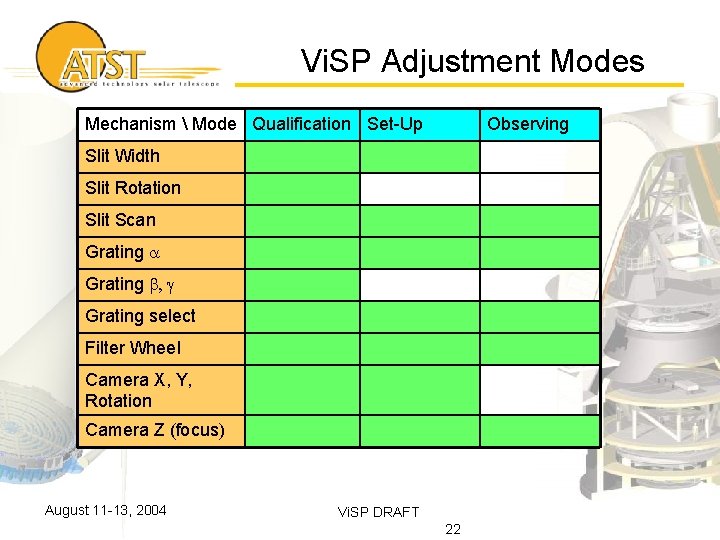
Vi. SP Adjustment Modes Mechanism Mode Qualification Set-Up Observing Slit Width Slit Rotation Slit Scan Grating a Grating b, g Grating select Filter Wheel Camera X, Y, Rotation Camera Z (focus) August 11 -13, 2004 Vi. SP DRAFT 22
Vi. SP Gratings • Normal spectro-polarimetry – 308. 57 l/mm – 57° blaze • Higher spectral resolution – 316 l/mm – 63. 46° blaze • TBD August 11 -13, 2004 Vi. SP DRAFT 23
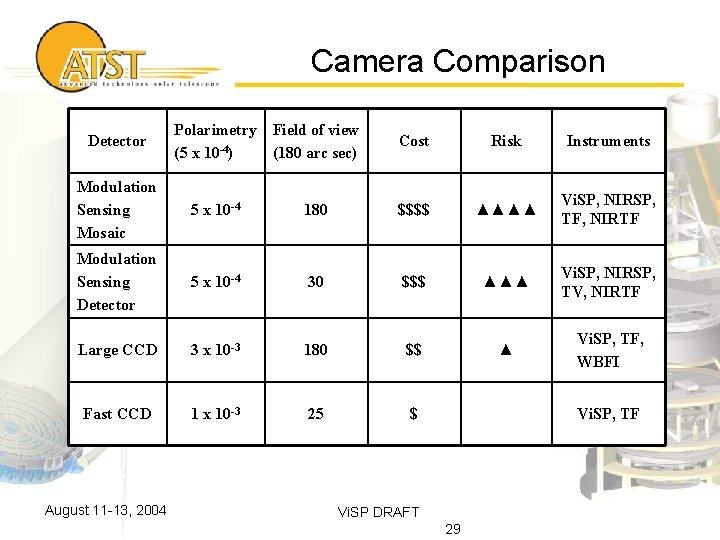
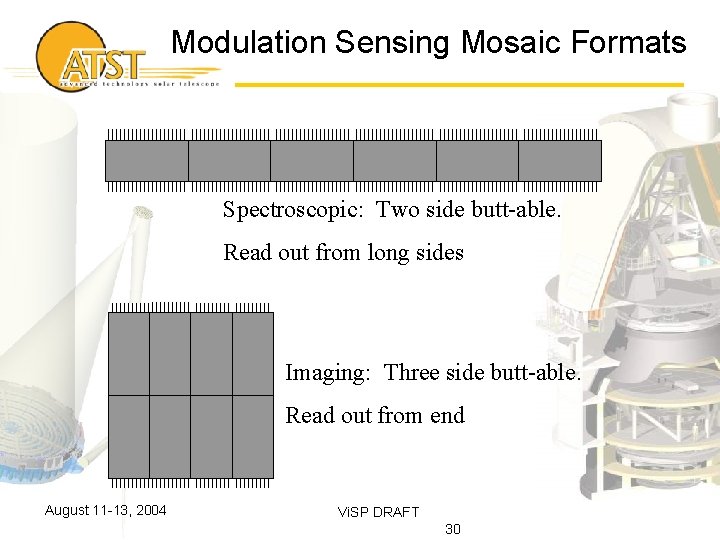
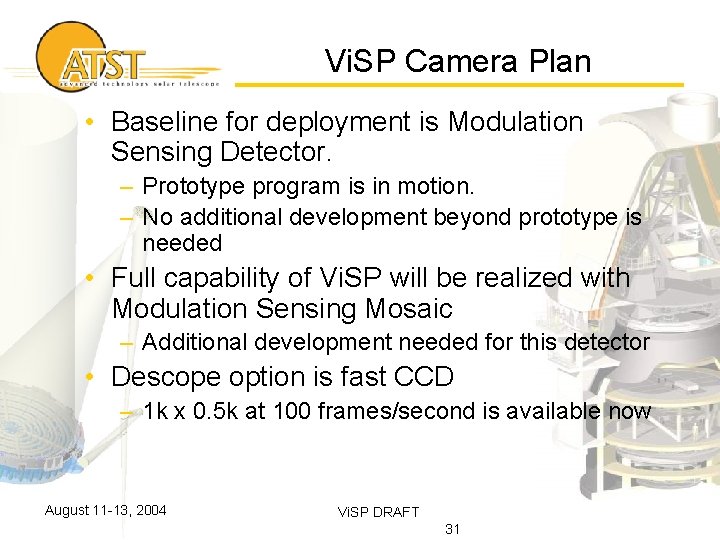
Vi. SP Cameras • To meet FOV/spatial/spectral/polarimetric accuracy requirements simultaneously: a Modulation Sensing Mosaic is required – 7200 pixels spatial x ~500 pixels spectral • Array of six 1152 x 576 detectors (short sides abut) for example (1024 x 512 @ 27 mm pixels) • Re-image 1: 1 onto 24 mm pixels – Up to 3 silicon modulation sensing mosaic cameras – One NIR modulation sensing mosaic camera August 11 -13, 2004 Vi. SP DRAFT 24
Vi. SP Cameras • To meet spatial/spectral/polarimetric but not FOV requirements a single Modulation Sensing Detector could be used – Single detector • 1152 x 576 spatial x spectral pixels for example • Re-image 1: 1 onto 24 mm pixels – Up to 3 silicon modulation sensing detector cameras – One NIR modulation sensing detector camera – FOV ~30 arc seconds. Requirement 180 arc seconds August 11 -13, 2004 Vi. SP DRAFT 25
Vi. SP Cameras • To meet FOV/spatial/spectral but not polarimetric accuracy requirements a single large format CCD could be used – Single detector • 8192 x 8192 spatial x spectral pixels (normally windowed spectrally to << 8192) • Re-image 2: 1 onto 12 mm pixels – Up to 3 silicon CCD cameras – Polarimetric accuracy: assume 10 Hz frame rate, scale from ASP by root 1/f • 3 x 10 -3 dual beam • 1. 5 x 10 -2 single beam August 11 -13, 2004 Vi. SP DRAFT 26
Vi. SP Cameras • To meet spatial/spectral but neither FOV nor polarimetric accuracy requirements a single fast CCD could be used – Single detector (SPINOR) • 1024 x 512, spatial x spectral pixels • Re-image 4: 3 onto 18 mm pixels – Up to 3 silicon CCD cameras – Polarimetric accuracy approximately equal to current ASP • 1 x 10 -3 dual beam • 5 x 10 -3 single beam – Field of view ~25 arc seconds August 11 -13, 2004 Vi. SP DRAFT 27
Camera Costs • Modulation Sensing Mosaic – NRE ___/___ – Each camera ___/___ • Modulation Sensing Detector – NRE ___/___ – Each camera ___/___ • Large format CCD – Each camera ___ • Fast CCD – $70 K August 11 -13, 2004 Vi. SP DRAFT 28
Camera Comparison Detector Polarimetry Field of view (5 x 10 -4) (180 arc sec) Cost Risk Instruments Modulation Sensing Mosaic 5 x 10 -4 180 $$$$ ▲▲▲▲ Vi. SP, NIRSP, TF, NIRTF Modulation Sensing Detector 5 x 10 -4 30 $$$ ▲▲▲ Vi. SP, NIRSP, TV, NIRTF Large CCD 3 x 10 -3 180 $$ ▲ Vi. SP, TF, WBFI Fast CCD 1 x 10 -3 25 $ August 11 -13, 2004 Vi. SP, TF Vi. SP DRAFT 29
Modulation Sensing Mosaic Formats Spectroscopic: Two side butt-able. Read out from long sides Imaging: Three side butt-able. Read out from end August 11 -13, 2004 Vi. SP DRAFT 30
Vi. SP Camera Plan • Baseline for deployment is Modulation Sensing Detector. – Prototype program is in motion. – No additional development beyond prototype is needed • Full capability of Vi. SP will be realized with Modulation Sensing Mosaic – Additional development needed for this detector • Descope option is fast CCD – 1 k x 0. 5 k at 100 frames/second is available now August 11 -13, 2004 Vi. SP DRAFT 31
Descope Discussion • Moving from Stokes II to the Advanced Stokes Polarimeter spatial resolution was improved by an order of magnitude. Polarimetric sensitivity decreased by about an order of magnitude yet our understanding of magnetic structures realized by better resolution of solar magnetic features more than offset the loss of polarimetric sensitivity. • With ATST we expect an additional order of magnitude improvement in spatial resolution, fully resolving magnetic structures and even though the full scientific requirements for polarimetric accuracy will not be met with a CCD, there will be a clear advancement in the science of understanding magnetic structures at the finest scales on the Sun. August 11 -13, 2004 Vi. SP DRAFT 32
Resource Issues - Facility • Cameras – what does facility provide? – – – Cameras themselves Camera control computers Software for camera control computers Camera mounts Computer to control mounts Software for computer to control mounts August 11 -13, 2004 Vi. SP DRAFT 33
Resource Issues - Facility • Mechanisms – Mechanism control computers • servo motors (grating mounts, spectrograph scanning) • motor micrometers (camera and slit adjustments) • multi-position selectors (filters & gratings) – Software for mechanism control computers August 11 -13, 2004 Vi. SP DRAFT 34
Resource Issues - Facility • Experiment control at the ATST – Experiment control computer – Software for scientific experiment – what is the boundary between facility and instrument? August 11 -13, 2004 Vi. SP DRAFT 35
Resource Issues - Shared • Items NIRSP and Vi. SP can share – – – Slit assembly design Grating selector design Grating mount design (a, b, g motions) Diffraction Gratings Filter wheel design Scan mechanism design (? ) August 11 -13, 2004 Vi. SP DRAFT 36
Resource Issues – Vi. SP • Items most likely associated with Vi. SP – Collimator and camera lenses – Collimator and camera lens mounts – Alignment mechanism for spectrally adjustable light paths – Optical tables August 11 -13, 2004 Vi. SP DRAFT 37
Other Issues • Silver mirrors following Gregorian? • SI Units – In discussions only – Do not allow SAE tools at the telescope August 11 -13, 2004 Vi. SP DRAFT 38
pau August 11 -13, 2004 Vi. SP DRAFT 39
- Slides: 39