
Visibility Service and Observation Locator Planning future observations
Visibility Service and Observation Locator: Planning future observations Jesús Salgado 1 on behalf of Aitor Ibarra 1 Richard Saxton 2, Jan-Uwe Ness 4, Erik Kuulkers 4, Carlos Gabriel 4, Bruno Merin 4, Peter Kretschmar 4, Matthias Ehle 4, Emilio Salazar 3, Celia Sánchez 3 1 2 3 4 Quasar for ESA TPZ-VEGA for ESA ATG for ESA
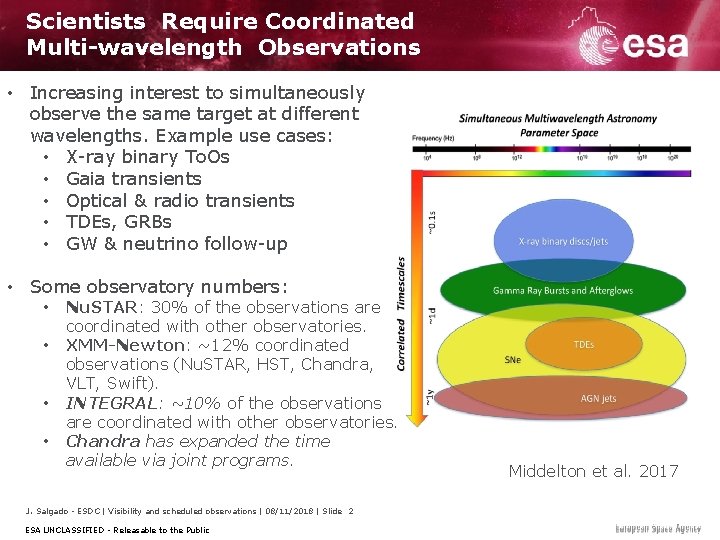
Scientists Require Coordinated Multi-wavelength Observations • Increasing interest to simultaneously observe the same target at different wavelengths. Example use cases: • X-ray binary To. Os • Gaia transients • Optical & radio transients • TDEs, GRBs • GW & neutrino follow-up • Some observatory numbers: • • Nu. STAR: 30% of the observations are coordinated with other observatories. XMM-Newton: ~12% coordinated observations (Nu. STAR, HST, Chandra, VLT, Swift). INTEGRAL: ~10% of the observations are coordinated with other observatories. Chandra has expanded the time available via joint programs. J. Salgado - ESDC | Visibility and scheduled observations | 08/11/2018 | Slide 2 ESA UNCLASSIFIED - Releasable to the Public Middelton et al. 2017

Visibility services J. Salgado - ESDC | Visibility and scheduled observations | 08/11/2018 | Slide 3 ESA UNCLASSIFIED - Releasable to the Public

Planned Observations Services J. Salgado - ESDC | Visibility and scheduled observations | 08/11/2018 | Slide 4 ESA UNCLASSIFIED - Releasable to the Public
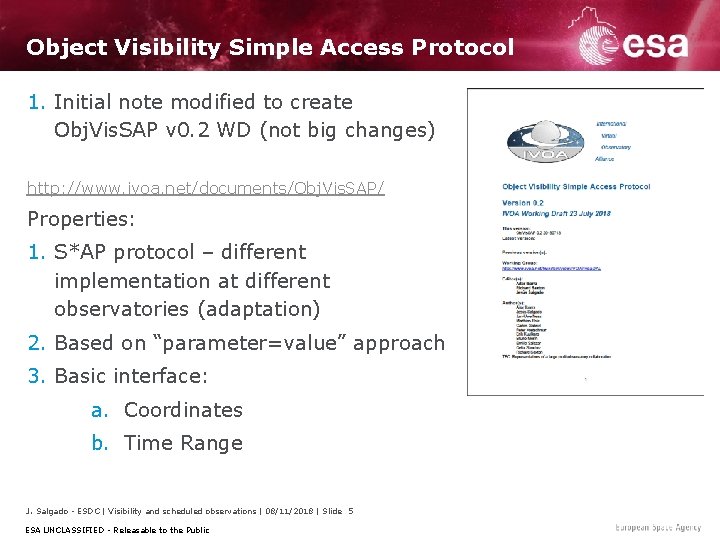
Object Visibility Simple Access Protocol 1. Initial note modified to create Obj. Vis. SAP v 0. 2 WD (not big changes) http: //www. ivoa. net/documents/Obj. Vis. SAP/ Properties: 1. S*AP protocol – different implementation at different observatories (adaptation) 2. Based on “parameter=value” approach 3. Basic interface: a. Coordinates b. Time Range J. Salgado - ESDC | Visibility and scheduled observations | 08/11/2018 | Slide 5 ESA UNCLASSIFIED - Releasable to the Public
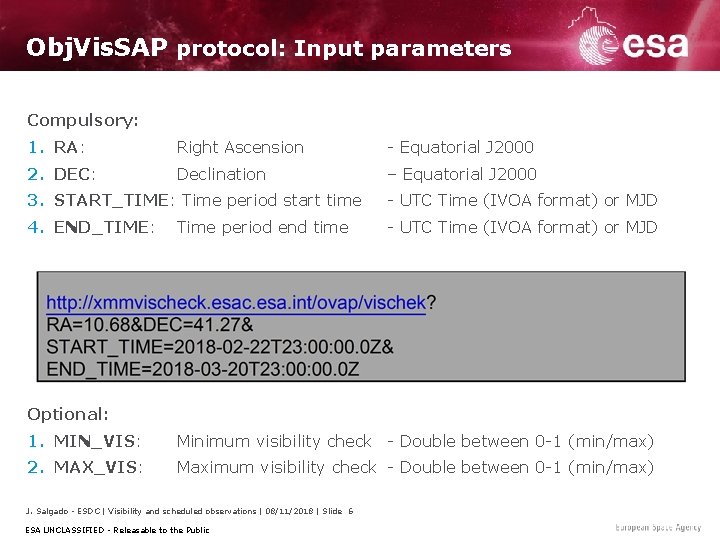
Obj. Vis. SAP protocol: Input parameters Compulsory: 1. RA: Right Ascension - Equatorial J 2000 2. DEC: Declination – Equatorial J 2000 3. START_TIME: Time period start time - UTC Time (IVOA format) or MJD 4. END_TIME: - UTC Time (IVOA format) or MJD Time period end time Optional: 1. MIN_VIS: Minimum visibility check - Double between 0 -1 (min/max) 2. MAX_VIS: Maximum visibility check - Double between 0 -1 (min/max) J. Salgado - ESDC | Visibility and scheduled observations | 08/11/2018 | Slide 6 ESA UNCLASSIFIED - Releasable to the Public

Obj. Vis. SAP protocol: Output 1. Visibility period start: UTC Time (IVOA format) or MJD (utype=”ovdm: Visibility. start. Visibility. value”) 1. Visibility period end: UTC Time (IVOA format) or MJD (utype=”ovdm: Visibility. end. Visibility. value”) 1. Visibility period duration: seconds (utype=”ovdm: Visibility. duration. value”) J. Salgado - ESDC | Visibility and scheduled observations | 08/11/2018 | Slide 7 ESA UNCLASSIFIED - Releasable to the Public

Obs. Loc. TAP: Observation Locator Table Access Protocol 1. Initial note modified to create Obs. Loc. TAP v 0. 2 WD http: //www. ivoa. net/documents/Obs. Loc. TAP/ Properties: 1. TAP protocol – Similar to Obs. TAP 2. Data Model contains: a. Observation Characterization b. Axes: – Spatial Coverage – Spectral Coverage – Polarization c. Observatory provenance J. Salgado - ESDC | Visibility and scheduled observations | 08/11/2018 | Slide 8 ESA UNCLASSIFIED - Releasable to the Public

Obs. Loc. TAP Use Case I Discovery of observations planned for a certain observatory 1. The observatory receives observatory proposals by the scientists 2. Proposals are ranked 3. Proposals are inserted into the observation planning system 4. Observation planners schedule short-medium plan trying to maximize the relevance of a certain observation period (e. g. per night or orbit revolution) and taking into account the constrains of the observatory (e. g. visibility of the object, geometrical constrains like the Sun or the Earth for space based observatories, etc) 5. In case of unexpected events like, e. g. targets of opportunity, scheduled plan could be replaced by another one modifying the short or medium plans. J. Salgado - ESDC | Visibility and scheduled observations | 08/11/2018 | Slide 9 ESA UNCLASSIFIED - Releasable to the Public
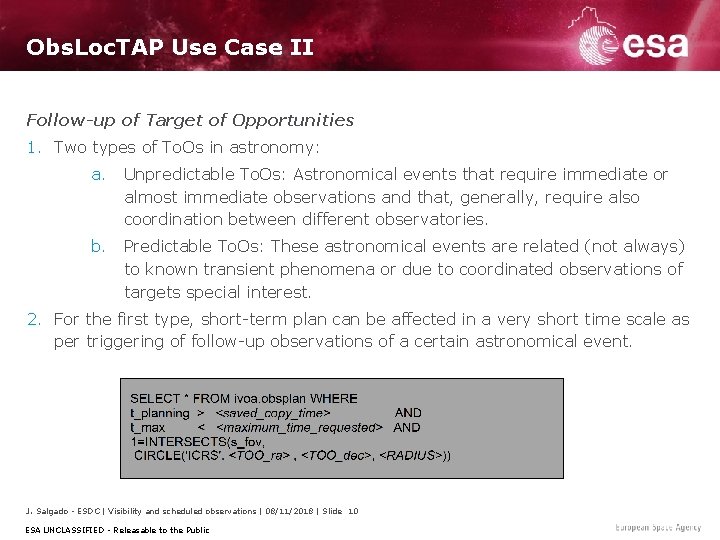
Obs. Loc. TAP Use Case II Follow-up of Target of Opportunities 1. Two types of To. Os in astronomy: a. Unpredictable To. Os: Astronomical events that require immediate or almost immediate observations and that, generally, require also coordination between different observatories. b. Predictable To. Os: These astronomical events are related (not always) to known transient phenomena or due to coordinated observations of targets special interest. 2. For the first type, short-term plan can be affected in a very short time scale as per triggering of follow-up observations of a certain astronomical event. J. Salgado - ESDC | Visibility and scheduled observations | 08/11/2018 | Slide 10 ESA UNCLASSIFIED - Releasable to the Public
Obs. Loc. TAP Main discussions 1. Main discussion is relation with Obs. TAP a. Why different protocol? – Different community – Different data model – Somehow different use cases b. Data model decoupled from Obs. TAP to prevent versioning coupling (ivoa. obsplan) 2. References to TAP (self-consistent protocol? External relay? ) 3. Pull vs Push approach 4. Mission dependent language (e. g. priority) J. Salgado - ESDC | Visibility and scheduled observations | 08/11/2018 | Slide 11 ESA UNCLASSIFIED - Releasable to the Public

VO protocols for visibility workshop 1. Workshop organized at ESAC (looking for partners) last September 21 st 2. Large number of collaborators attended 3. Workshop agenda: a. Introduction of the problem b. Introduction of the standards drafted c. Previous prototypes and operational services d. Understanding of requirements e. Possible collaboration J. Salgado - ESDC | Visibility and scheduled observations | 08/11/2018 | Slide 12 ESA UNCLASSIFIED - Releasable to the Public
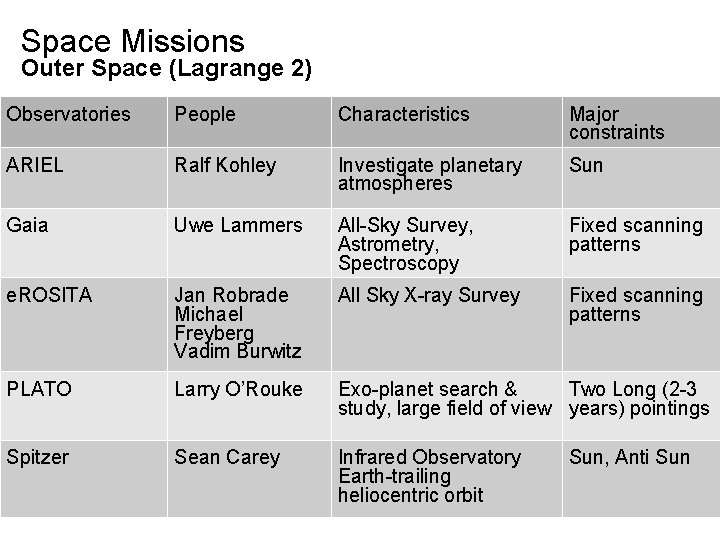
Space Missions Outer Space (Lagrange 2) Observatories People Characteristics Major constraints ARIEL Ralf Kohley Investigate planetary atmospheres Sun Gaia Uwe Lammers All-Sky Survey, Astrometry, Spectroscopy Fixed scanning patterns e. ROSITA Jan Robrade Michael Freyberg Vadim Burwitz All Sky X-ray Survey Fixed scanning patterns PLATO Larry O’Rouke Exo-planet search & Two Long (2 -3 study, large field of view years) pointings Spitzer Sean Carey Infrared Observatory Earth-trailing heliocentric orbit Sun, Anti Sun
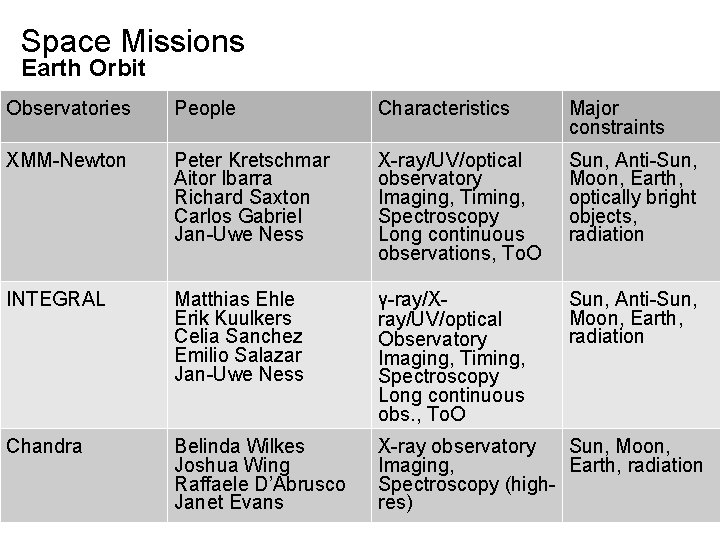
Space Missions Earth Orbit Observatories People Characteristics Major constraints XMM-Newton Peter Kretschmar Aitor Ibarra Richard Saxton Carlos Gabriel Jan-Uwe Ness X-ray/UV/optical observatory Imaging, Timing, Spectroscopy Long continuous observations, To. O Sun, Anti-Sun, Moon, Earth, optically bright objects, radiation INTEGRAL Matthias Ehle Erik Kuulkers Celia Sanchez Emilio Salazar Jan-Uwe Ness γ-ray/Xray/UV/optical Observatory Imaging, Timing, Spectroscopy Long continuous obs. , To. O Sun, Anti-Sun, Moon, Earth, radiation Chandra Belinda Wilkes Joshua Wing Raffaele D’Abrusco Janet Evans X-ray observatory Sun, Moon, Imaging, Earth, radiation Spectroscopy (highres)
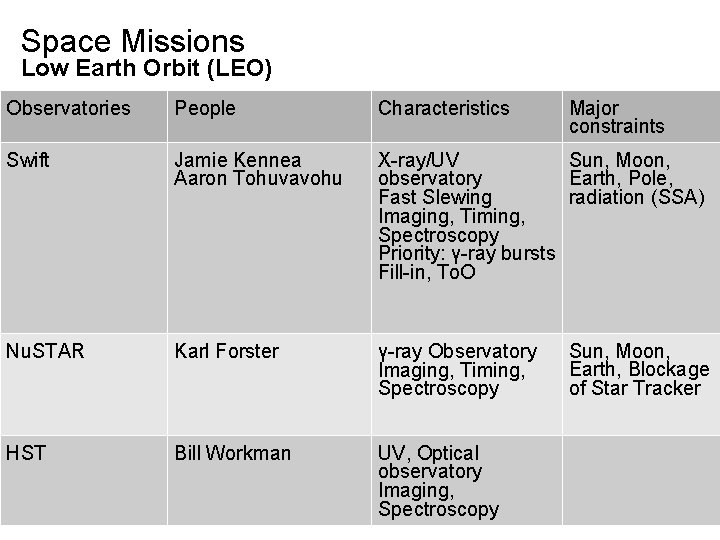
Space Missions Low Earth Orbit (LEO) Observatories People Characteristics Major constraints Swift Jamie Kennea Aaron Tohuvavohu X-ray/UV Sun, Moon, observatory Earth, Pole, Fast Slewing radiation (SSA) Imaging, Timing, Spectroscopy Priority: γ-ray bursts Fill-in, To. O Nu. STAR Karl Forster γ-ray Observatory Imaging, Timing, Spectroscopy HST Bill Workman UV, Optical observatory Imaging, Spectroscopy Sun, Moon, Earth, Blockage of Star Tracker
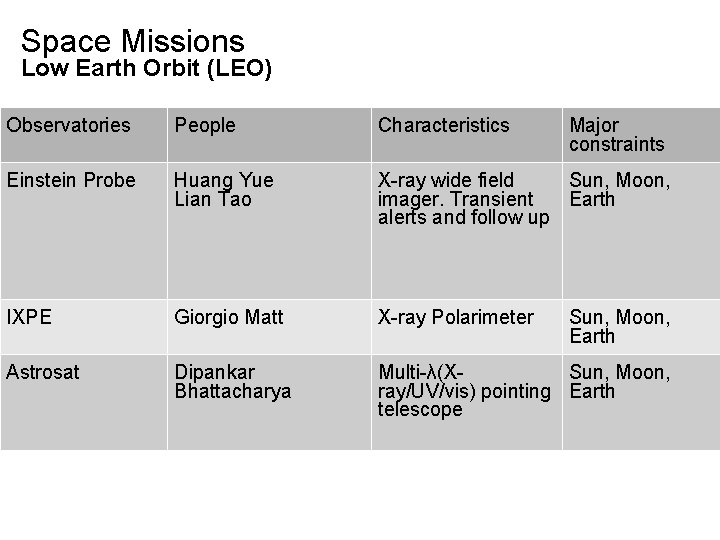
Space Missions Low Earth Orbit (LEO) Observatories People Characteristics Major constraints Einstein Probe Huang Yue Lian Tao X-ray wide field Sun, Moon, imager. Transient Earth alerts and follow up IXPE Giorgio Matt X-ray Polarimeter Astrosat Dipankar Bhattacharya Multi-λ(XSun, Moon, ray/UV/vis) pointing Earth telescope Sun, Moon, Earth
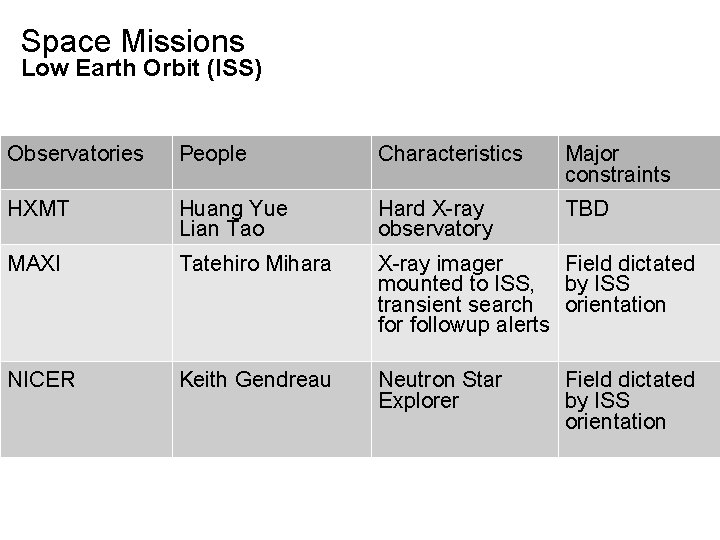
Space Missions Low Earth Orbit (ISS) Observatories People Characteristics Major constraints HXMT Huang Yue Lian Tao Hard X-ray observatory TBD MAXI Tatehiro Mihara X-ray imager Field dictated mounted to ISS, by ISS transient search orientation for followup alerts NICER Keith Gendreau Neutron Star Explorer Field dictated by ISS orientation

Space Missions Flights Observatories People Characteristics Major constraints Sofia Bernhard Schulz Observations from Air Plane Flight Schedules Balloon Flight Schedules

Ground-based Facilities Radio, IR Observatorie s People Characteristics ALMA Maria Diaz Trigo SKA Australia Square km Array Minh Huynh SKA Africa Square km Array Portuguese group ENGAGE: Domingos Barbosa Valerio Ribeiro LOFAR Jason Hessels Huge radio array, mapping in S/W; can look in several directions at once. REM Rapid Eye Emilio Molinari Eliana Palazzi Near-IR GRB counterparts Major constraints Weather (12 hrs) => Dynamic Schedule
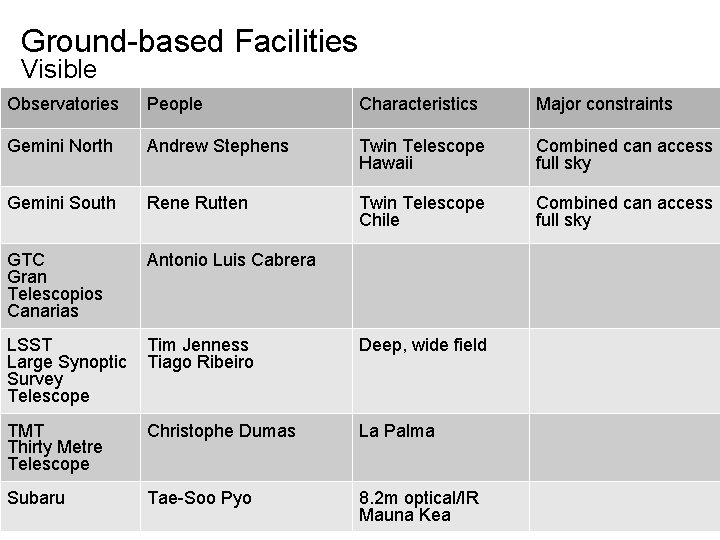
Ground-based Facilities Visible Observatories People Characteristics Major constraints Gemini North Andrew Stephens Twin Telescope Hawaii Combined can access full sky Gemini South Rene Rutten Twin Telescope Chile Combined can access full sky GTC Gran Telescopios Canarias Antonio Luis Cabrera LSST Large Synoptic Survey Telescope Tim Jenness Tiago Ribeiro Deep, wide field TMT Thirty Metre Telescope Christophe Dumas La Palma Subaru Tae-Soo Pyo 8. 2 m optical/IR Mauna Kea
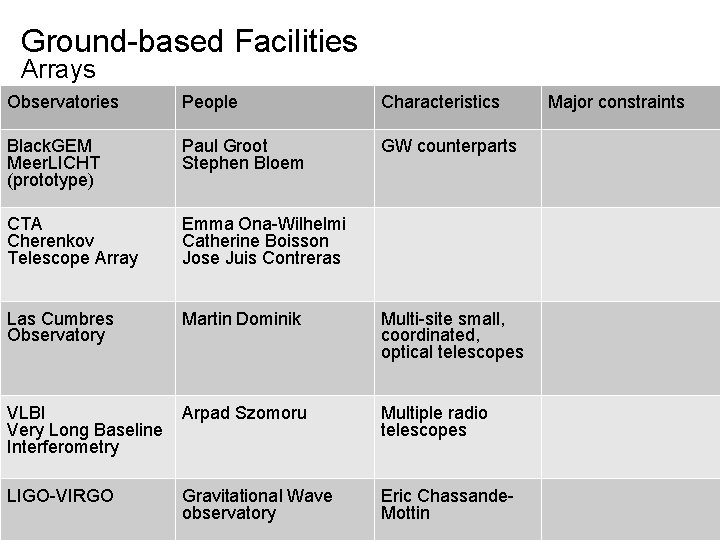
Ground-based Facilities Arrays Observatories People Characteristics Black. GEM Meer. LICHT (prototype) Paul Groot Stephen Bloem GW counterparts CTA Cherenkov Telescope Array Emma Ona-Wilhelmi Catherine Boisson Jose Juis Contreras Las Cumbres Observatory Martin Dominik Multi-site small, coordinated, optical telescopes VLBI Very Long Baseline Interferometry Arpad Szomoru Multiple radio telescopes LIGO-VIRGO Gravitational Wave observatory Eric Chassande. Mottin Major constraints
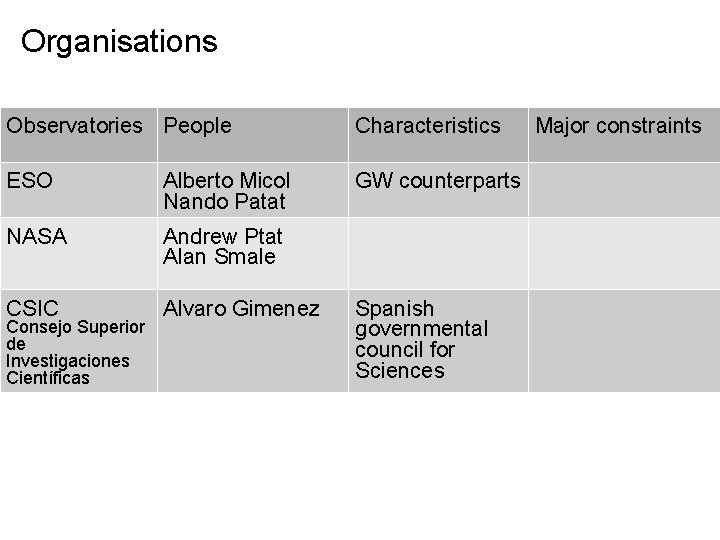
Organisations Observatories People Characteristics ESO Alberto Micol Nando Patat GW counterparts NASA Andrew Ptat Alan Smale CSIC Alvaro Gimenez Consejo Superior de Investigaciones Científicas Spanish governmental council for Sciences Major constraints

Networks, Activities, Programmes Initiatives People Characteristics Objectives for meeting ASTERICS Cleopatra Rob van der Meer Marjan Timmer Pep Colome Catherine Boisson EC funded project Astronomy+Astroparticle communities Facilitate multimessenger science Find common grounds for multimessenger observations Daryl Haggard GW followup distribution list Smart. Net Matt Middleton Phil Charles OPTICON Martin Dominik e. PESSTO Maria Teresa Botticella ESO Spectroscopy Survey Multi-observatory proposal platform
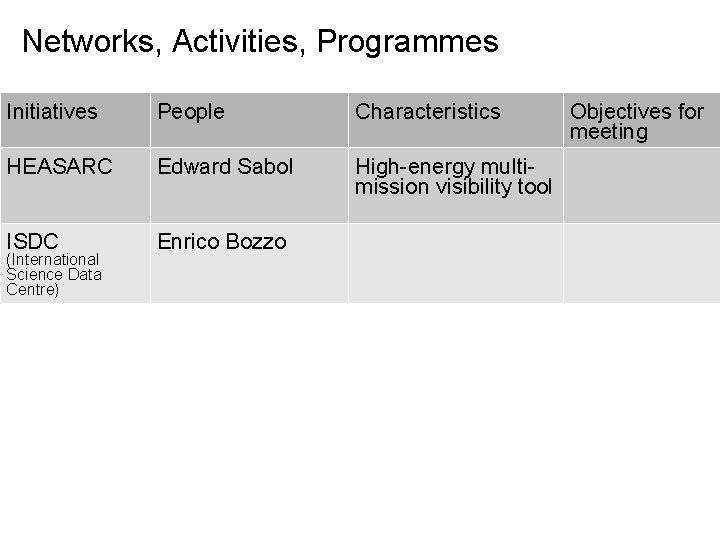
Networks, Activities, Programmes Initiatives People Characteristics HEASARC Edward Sabol High-energy multimission visibility tool ISDC Enrico Bozzo (International Science Data Centre) Objectives for meeting
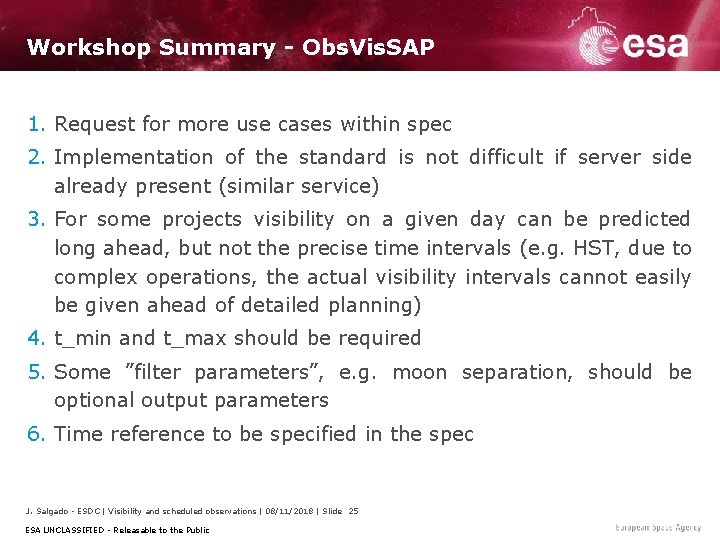
Workshop Summary - Obs. Vis. SAP 1. Request for more use cases within spec 2. Implementation of the standard is not difficult if server side already present (similar service) 3. For some projects visibility on a given day can be predicted long ahead, but not the precise time intervals (e. g. HST, due to complex operations, the actual visibility intervals cannot easily be given ahead of detailed planning) 4. t_min and t_max should be required 5. Some ”filter parameters”, e. g. moon separation, should be optional output parameters 6. Time reference to be specified in the spec J. Salgado - ESDC | Visibility and scheduled observations | 08/11/2018 | Slide 25 ESA UNCLASSIFIED - Releasable to the Public
Workshop Summary - Obs. Loc. TAP 1. Coordinated observations are quite usual for many observations 2. Exact t_min and t_max for planned observations could be not exact. Two proposals: a. Remove NOT_NULL for these fields b. Set a best guess time (option preferred) 3. Category and priority need to be specified more in detail as these fields have totally different definitions as per project 4. Link to Obs. Core data model and why not to use it was also discussed 5. Implementation of TAP is not trivial for newcomers. Toolkits required J. Salgado - ESDC | Visibility and scheduled observations | 08/11/2018 | Slide 26 ESA UNCLASSIFIED - Releasable to the Public
Conclusions and future steps 1. Comments received on the specs will be tackled 2. Quite relevant interest from this community (Science Operations Centres) 3. Many use cases are already in people minds. It is important to reflect them into the specs 4. IVOA could support offering technical assistance and frameworks (in particular for TAP implementations) 5. Difficulties to find resources for reference implementations 6. Next steps: a. New minor version of the specs including comments b. Some server prototypes proposed (Integral, XMM-Newton). Some other non-ESA missions also discussed c. For visibility SALT could implement a client (many TAP clients) d. ESASky already have support for future observations J. Salgado - ESDC | Visibility and scheduled observations | 08/11/2018 | Slide 27 ESA UNCLASSIFIED - Releasable to the Public
Thanks! J. Salgado - ESDC | Visibility and scheduled observations | 08/11/2018 | Slide 28 ESA UNCLASSIFIED - Releasable to the Public
- Slides: 28