
Viscous hydrodynamics with shear and bulk viscosity Huichao
Viscous hydrodynamics with shear and bulk viscosity Huichao Song The Ohio State University Supported by DOE in collaboration with Ulrich Heinz DPF 2009 July 27 -July 31, Detroit, MI 07/30/2009
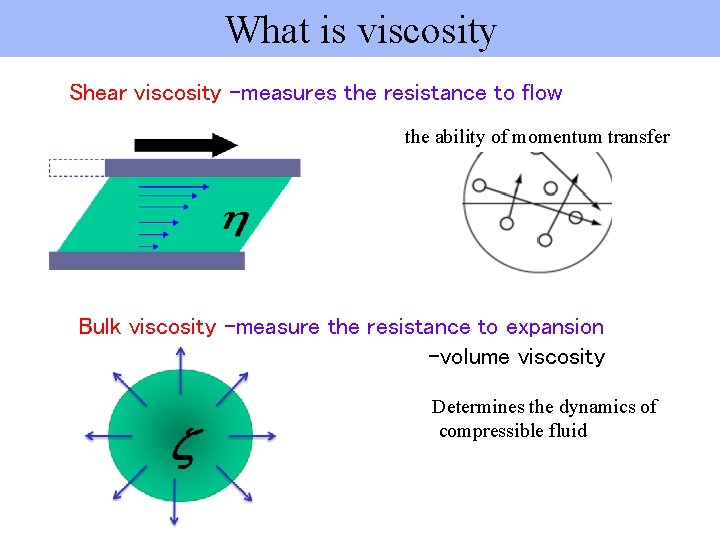
What is viscosity Shear viscosity –measures the resistance to flow the ability of momentum transfer Bulk viscosity –measure the resistance to expansion -volume viscosity Determines the dynamics of compressible fluid
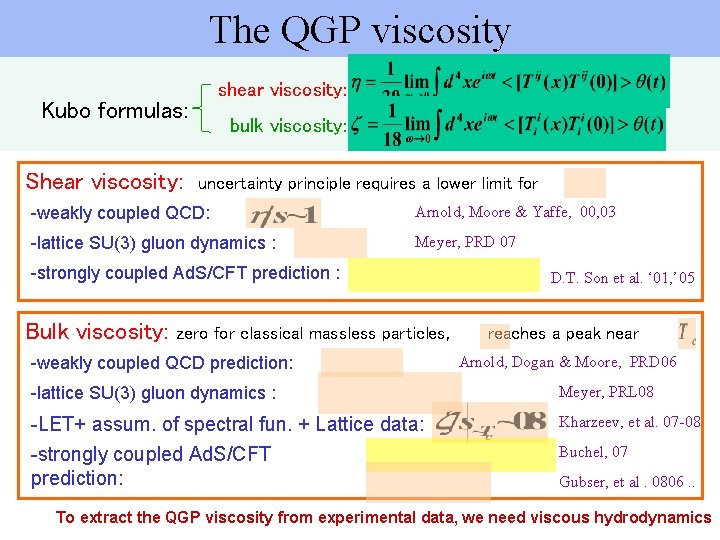
The QGP viscosity shear viscosity: Kubo formulas: Shear viscosity: bulk viscosity: uncertainty principle requires a lower limit for -weakly coupled QCD: Arnold, Moore & Yaffe, 00, 03 -lattice SU(3) gluon dynamics : Meyer, PRD 07 -strongly coupled Ad. S/CFT prediction : Bulk viscosity: zero for classical massless particles, -weakly coupled QCD prediction: D. T. Son et al. ‘ 01, ’ 05 reaches a peak near Arnold, Dogan & Moore, PRD 06 -lattice SU(3) gluon dynamics : Meyer, PRL 08 -LET+ assum. of spectral fun. + Lattice data: -strongly coupled Ad. S/CFT prediction: Kharzeev, et al. 07 -08 Buchel, 07 Gubser, et al. 0806. . To extract the QGP viscosity from experimental data, we need viscous hydrodynamics
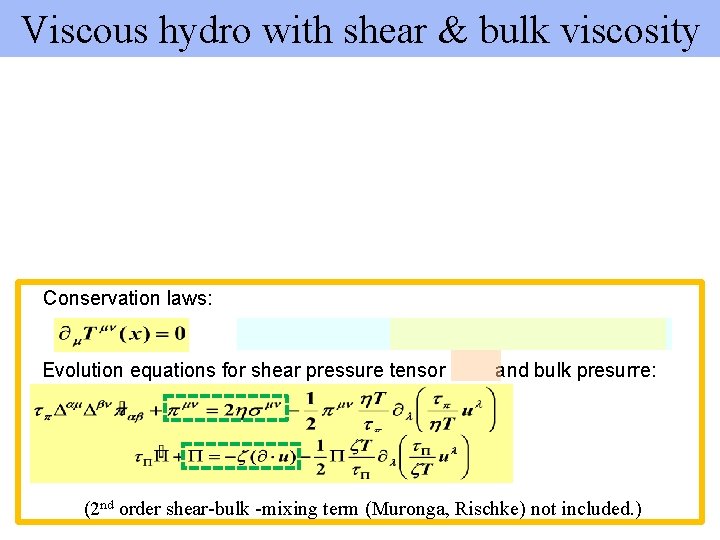
Viscous hydro with shear & bulk viscosity Conservation laws: Evolution equations for shear pressure tensor and bulk presurre: (2 nd order shear-bulk -mixing term (Muronga, Rischke) not included. )
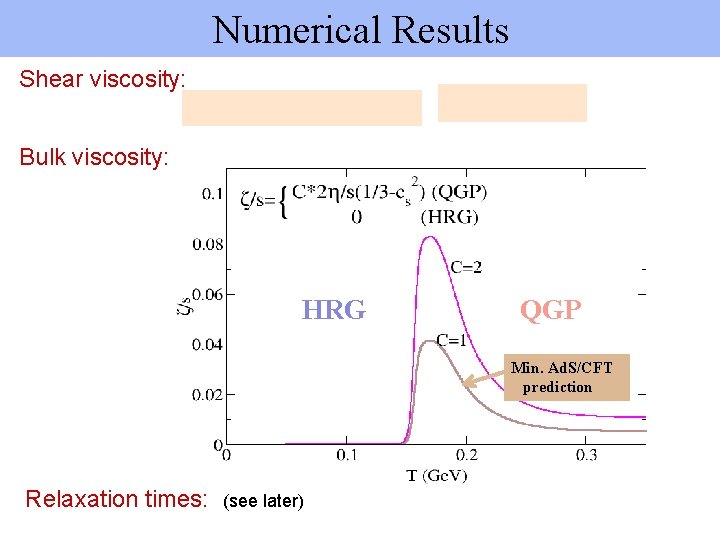
Numerical Results Shear viscosity: Bulk viscosity: HRG QGP Min. Ad. S/CFT prediction Relaxation times: (see later)
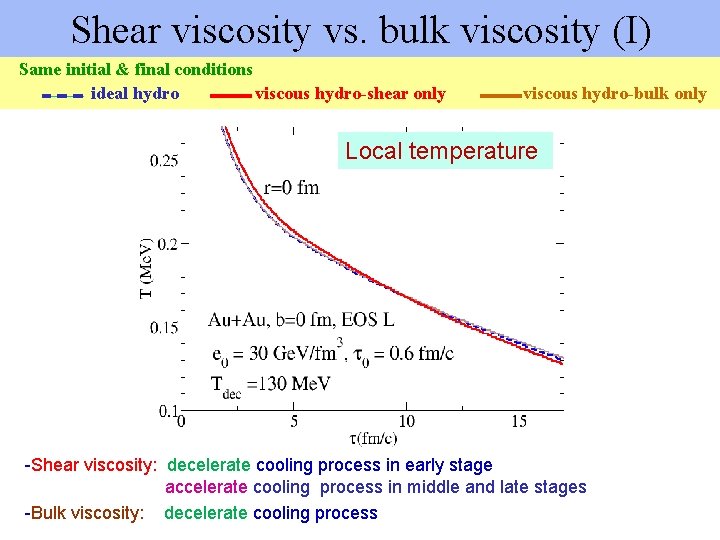
Shear viscosity vs. bulk viscosity (I) Same initial & final conditions ideal hydro viscous hydro-shear only viscous hydro-bulk only Local temperature -Shear viscosity: decelerate cooling process in early stage accelerate cooling process in middle and late stages -Bulk viscosity: decelerate cooling process
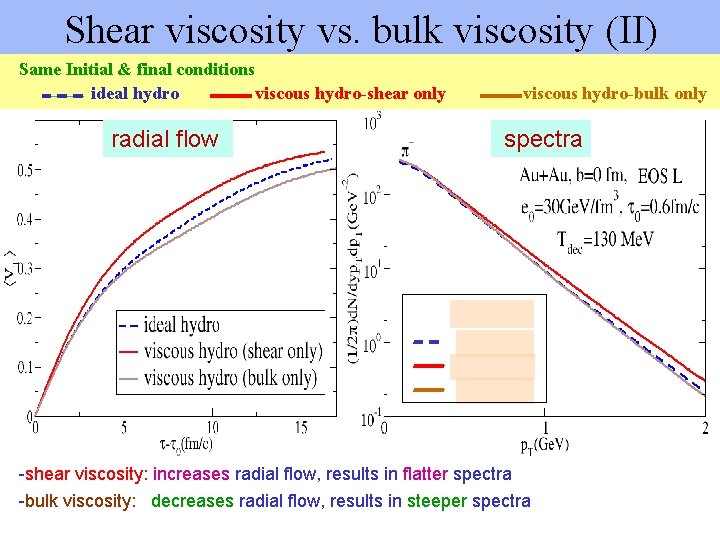
Shear viscosity vs. bulk viscosity (II) Same Initial & final conditions ideal hydro viscous hydro-shear only radial flow viscous hydro-bulk only spectra -shear viscosity: increases radial flow, results in flatter spectra -bulk viscosity: decreases radial flow, results in steeper spectra
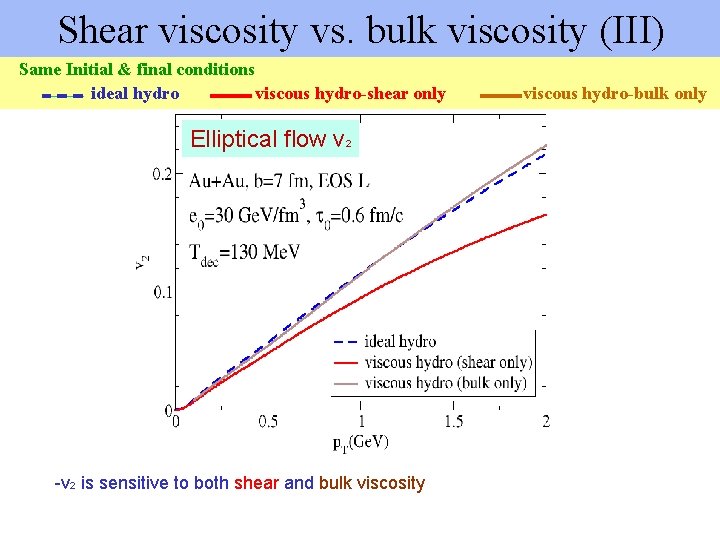
Shear viscosity vs. bulk viscosity (III) Same Initial & final conditions ideal hydro viscous hydro-shear only Elliptical flow v 2 -v 2 is sensitive to both shear and bulk viscosity viscous hydro-bulk only
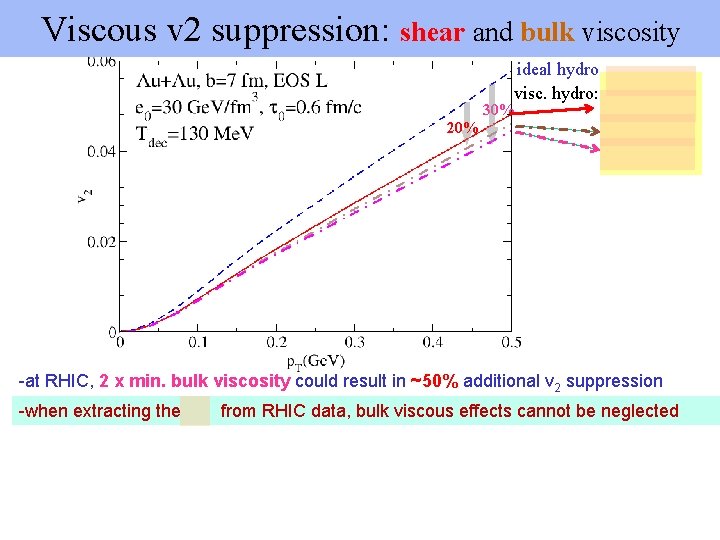
Viscous v 2 suppression: shear and bulk viscosity ideal hydro visc. hydro: 30% 20% -at RHIC, 2 x min. bulk viscosity could result in ~50% additional v 2 suppression -when extracting the from RHIC data, bulk viscous effects cannot be neglected
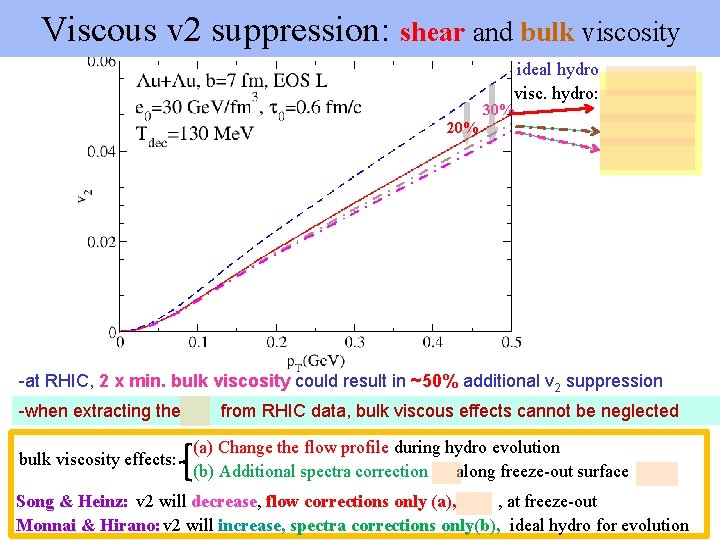
Viscous v 2 suppression: shear and bulk viscosity ideal hydro visc. hydro: 30% 20% -at RHIC, 2 x min. bulk viscosity could result in ~50% additional v 2 suppression -when extracting the bulk viscosity effects: from RHIC data, bulk viscous effects cannot be neglected (a) Change the flow profile during hydro evolution (b) Additional spectra correction along freeze-out surface Song & Heinz: v 2 will decrease, flow corrections only (a), , at freeze-out Monnai & Hirano: v 2 will increase, spectra corrections only(b), ideal hydro for evolution

Bulk Viscosity -relaxation time effects
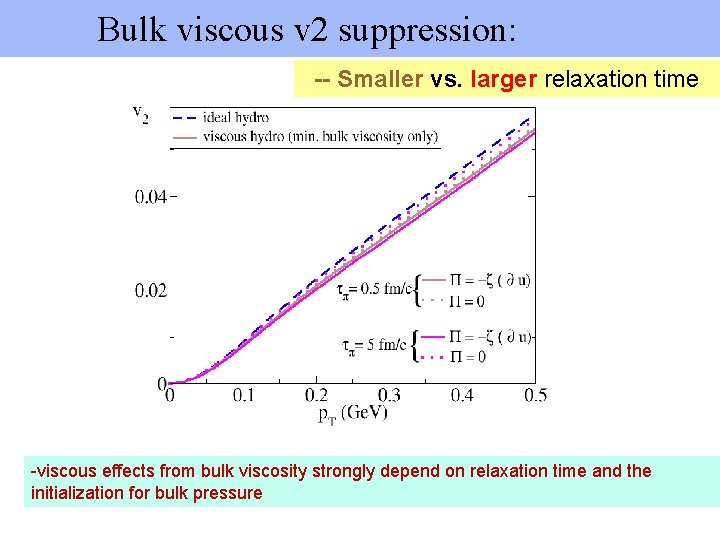
Bulk viscous v 2 suppression: -- Smaller vs. larger relaxation time -viscous effects from bulk viscosity strongly depend on relaxation time and the initialization for bulk pressure
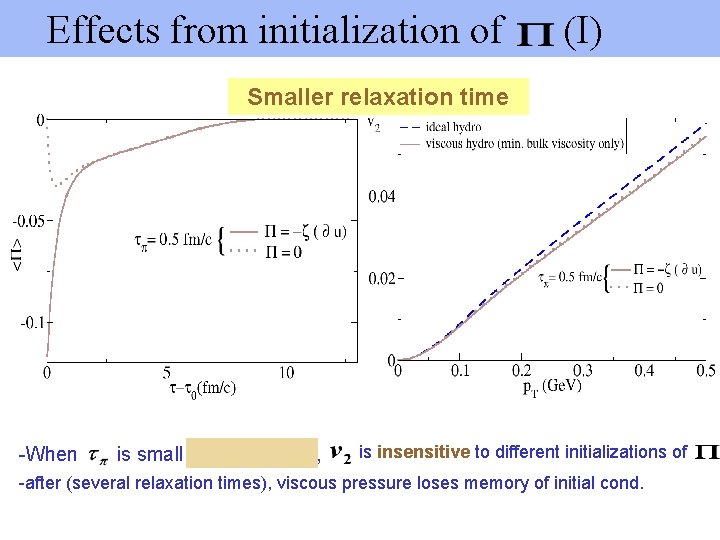
Effects from initialization of (I) Smaller relaxation time -When is small , is insensitive to different initializations of -after (several relaxation times), viscous pressure loses memory of initial cond.
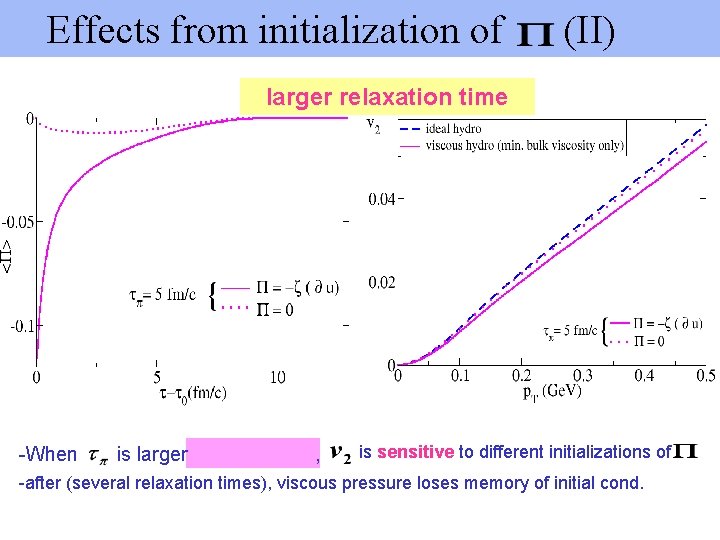
Effects from initialization of (II) larger relaxation time -When is larger , is sensitive to different initializations of -after (several relaxation times), viscous pressure loses memory of initial cond.
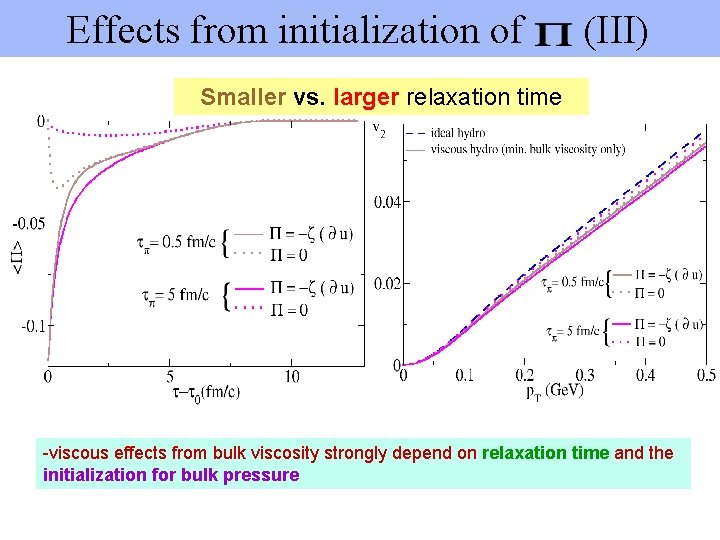
Effects from initialization of (III) Smaller vs. larger relaxation time -viscous effects from bulk viscosity strongly depend on relaxation time and the initialization for bulk pressure

Multiplicity scaling of --Effects from systemvsize 2/ε and collision energy
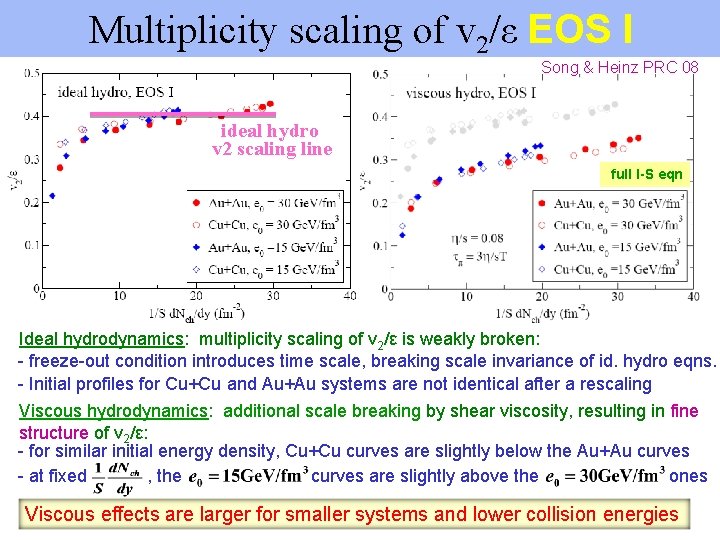
Multiplicity scaling of v 2/ε EOS I Song & Heinz PRC 08 ideal hydro v 2 scaling line full I-S eqn Ideal hydrodynamics: multiplicity scaling of v 2/ε is weakly broken: - freeze-out condition introduces time scale, breaking scale invariance of id. hydro eqns. - Initial profiles for Cu+Cu and Au+Au systems are not identical after a rescaling Viscous hydrodynamics: additional scale breaking by shear viscosity, resulting in fine structure of v 2/ε: - for similar initial energy density, Cu+Cu curves are slightly below the Au+Au curves - at fixed , the curves are slightly above the ones Viscous effects are larger for smaller systems and lower collision energies
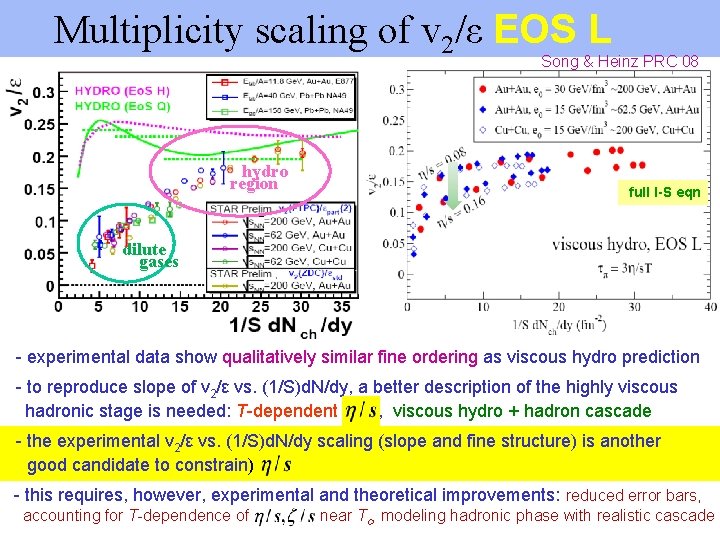
Multiplicity scaling of v 2/ε EOS L Song & Heinz PRC 08 hydro region full I-S eqn dilute gases - experimental data show qualitatively similar fine ordering as viscous hydro prediction - to reproduce slope of v 2/ε vs. (1/S)d. N/dy, a better description of the highly viscous hadronic stage is needed: T-dependent , viscous hydro + hadron cascade - the experimental v 2/ε vs. (1/S)d. N/dy scaling (slope and fine structure) is another good candidate to constrain) - this requires, however, experimental and theoretical improvements: reduced error bars, accounting for T-dependence of near Tc, modeling hadronic phase with realistic cascade
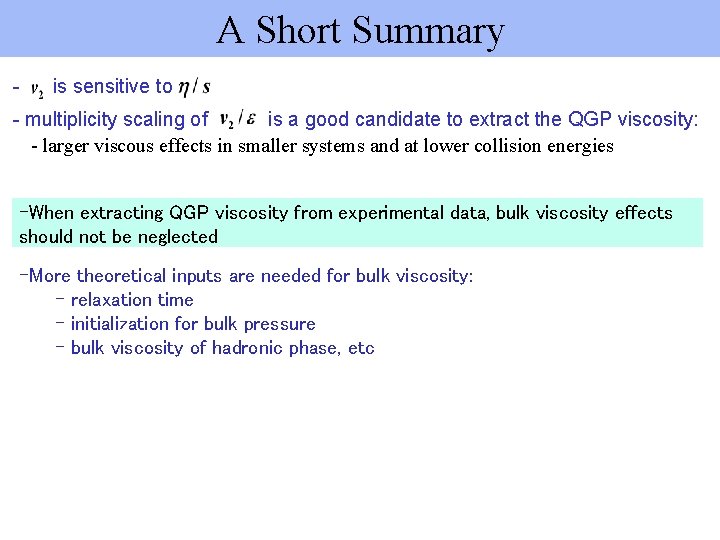
A Short Summary - is sensitive to - multiplicity scaling of is a good candidate to extract the QGP viscosity: - larger viscous effects in smaller systems and at lower collision energies -When extracting QGP viscosity from experimental data, bulk viscosity effects should not be neglected -More theoretical inputs are needed for bulk viscosity: - relaxation time - initialization for bulk pressure - bulk viscosity of hadronic phase, etc

Thank You 20
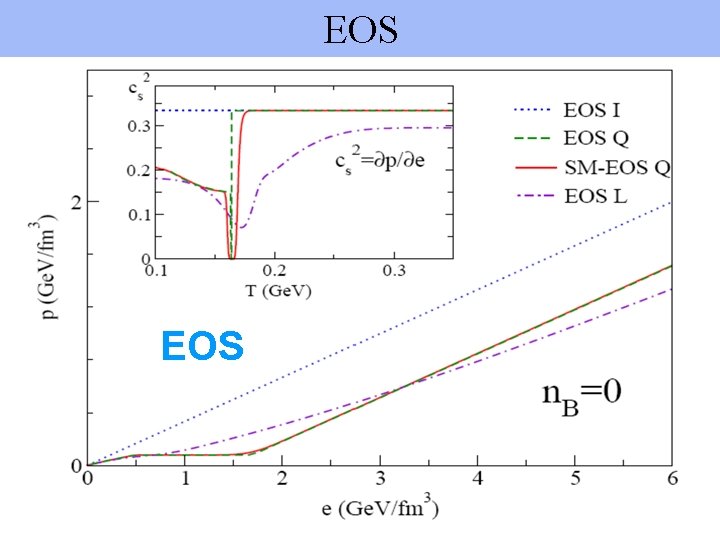
EOS
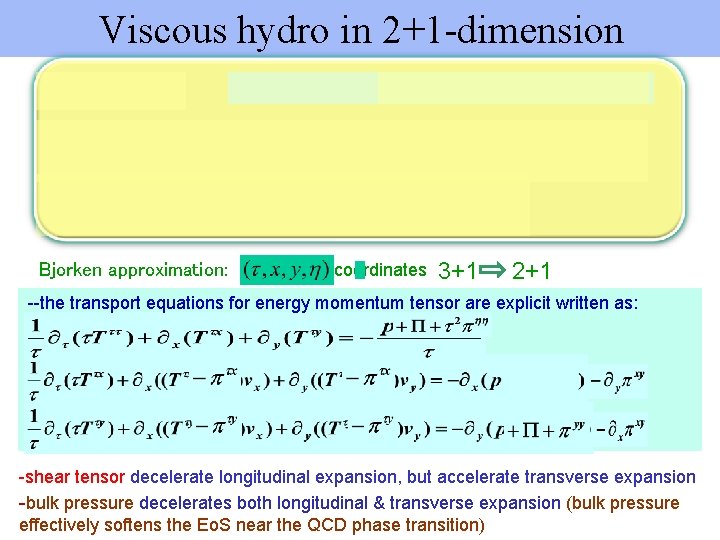
Viscous hydro in 2+1 -dimension Bjorken approximation: coordinates 3+1 2+1 --the transport equations for energy momentum tensor are explicit written as: -shear tensor decelerate longitudinal expansion, but accelerate transverse expansion -bulk pressure decelerates both longitudinal & transverse expansion (bulk pressure effectively softens the Eo. S near the QCD phase transition)
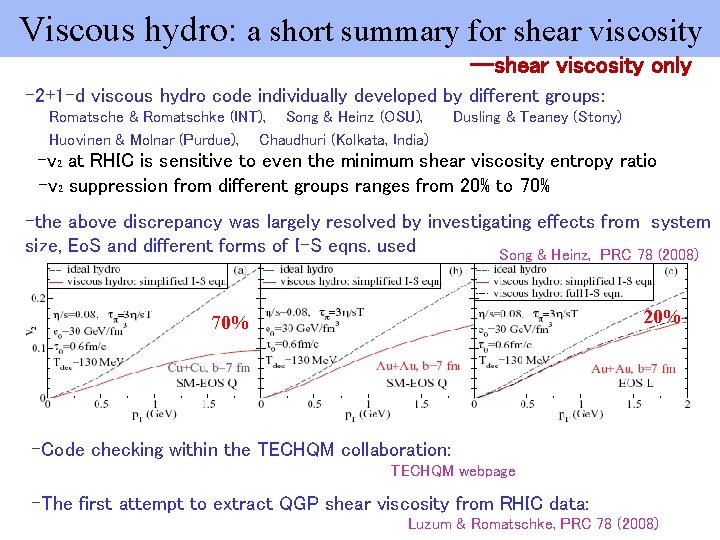
Viscous hydro: a short summary for shear viscosity --shear viscosity only -2+1 -d viscous hydro code individually developed by different groups: Romatsche & Romatschke (INT), Song & Heinz (OSU), Huovinen & Molnar (Purdue), Chaudhuri (Kolkata, India) Dusling & Teaney (Stony) -v 2 at RHIC is sensitive to even the minimum shear viscosity entropy ratio -v 2 suppression from different groups ranges from 20% to 70% -the above discrepancy was largely resolved by investigating effects from system size, Eo. S and different forms of I-S eqns. used Song & Heinz, PRC 78 (2008) 20% 70% -Code checking within the TECHQM collaboration: TECHQM webpage -The first attempt to extract QGP shear viscosity from RHIC data: Luzum & Romatschke, PRC 78 (2008)
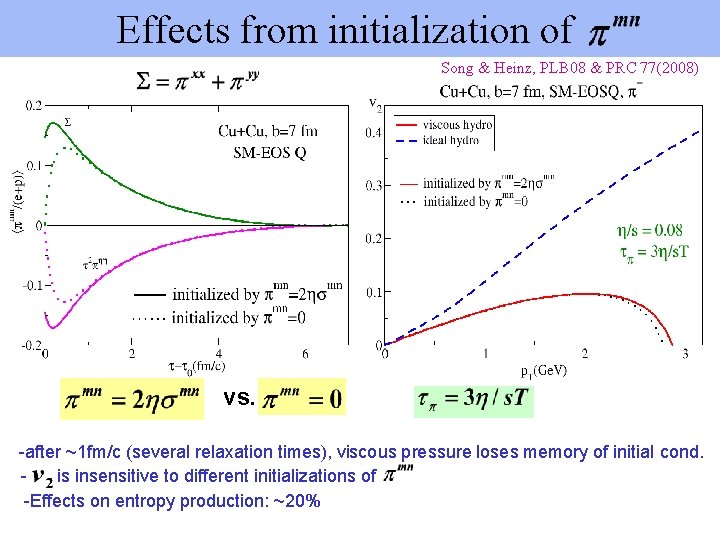
Effects from initialization of Song & Heinz, PLB 08 & PRC 77(2008) vs. -after ~1 fm/c (several relaxation times), viscous pressure loses memory of initial cond. is insensitive to different initializations of -Effects on entropy production: ~20%
- Slides: 24