
Viscosity Capillary and Cone Plate Viscometers Brydger Cauch

Viscosity Capillary and Cone & Plate Viscometers Brydger Cauch November 27, 2006
Importance • Classifies fluid flow – Newtonian or non-Newtonian • Motor Oil: 5 W 30 – Higher Number=Thicker
What is viscosity? • Rheology – Deformation and flow of matter under the influence of applied stress – Viscosity, elasticity, and plasticity • Viscosity – Measure of the resistance to deformation of a fluid under shear stress
Overview • Theory – Shear Stress – Molecular Origins – Newtonian and non-Newtonian fluids • Operation of capillary and cone & plate viscometers • Calibrations – Parameter for Capillary Viscometer – Calibration Curve for Cone and Plate Viscometer • Viscosity of an unknown fluid • Conclusions • Questions

Theory
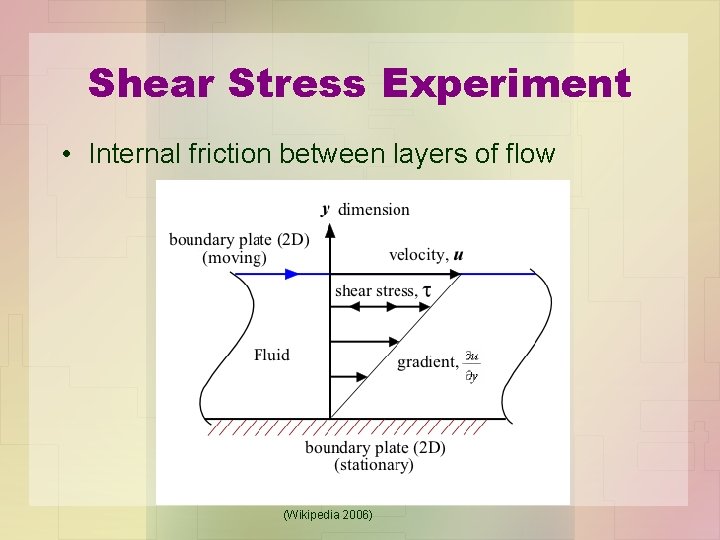
Shear Stress Experiment • Internal friction between layers of flow (Wikipedia 2006)
Molecular Origins • Gases – Molecular diffusion between layers of flow – Independent of pressure – Increases with increasing temperature – Newtonian • Liquids – Additional forces between molecules but exact mechanics unknown – Independent of pressure except at very high pressure – Decrease with increasing temperature – Newtonian and non. Newtonian
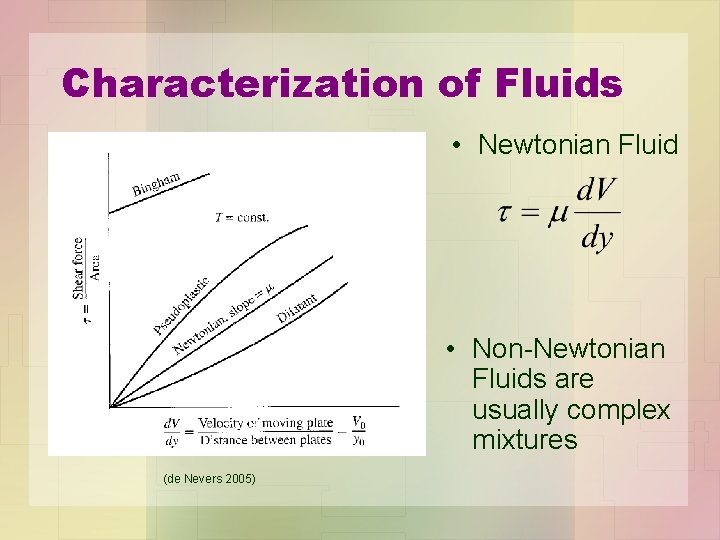
Characterization of Fluids • Newtonian Fluid • Non-Newtonian Fluids are usually complex mixtures (de Nevers 2005)
Operation of Capillary and Cone & Plate Viscometers
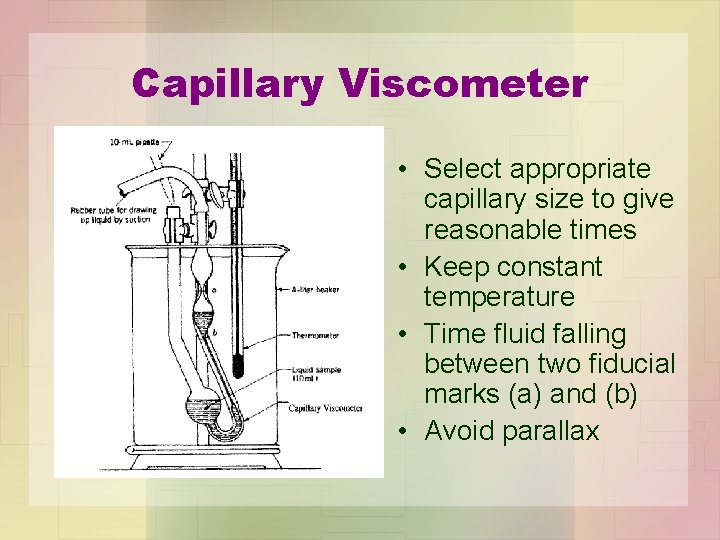
Capillary Viscometer • Select appropriate capillary size to give reasonable times • Keep constant temperature • Time fluid falling between two fiducial marks (a) and (b) • Avoid parallax
Brookfield Cone & Plate Viscometer • Shallow angled cone in very close proximity with a flat plate • Important features – – – Circulating bath to keep constant temperature Different cone sizes Level on the instrument Adjusting ring Motor speed in RPM • Operation – Adjust cup so pins barely not making contact – Measure torque needed to overcome viscous resistance
Calibrations

Calibration • Capillary Viscometer – Second term neglected for sufficiently long times (>60 sec) – Fluid of known viscosity used to determine parameter B
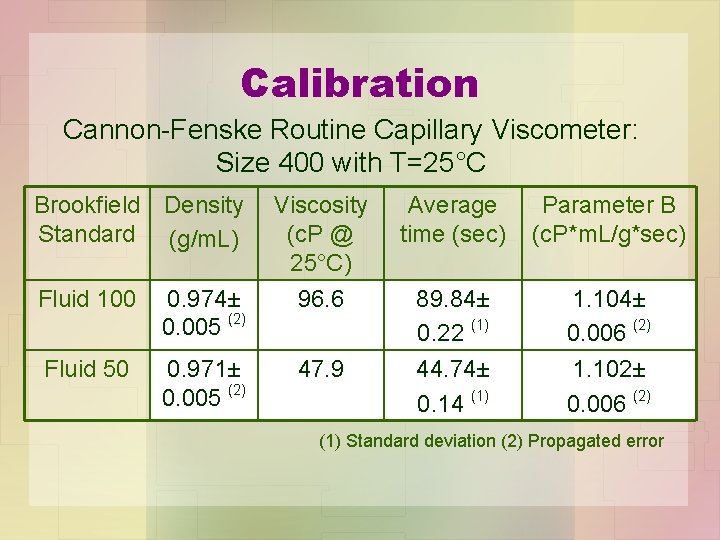
Calibration Cannon-Fenske Routine Capillary Viscometer: Size 400 with T=25°C Brookfield Density Standard (g/m. L) Fluid 100 0. 974± 0. 005 (2) Fluid 50 0. 971± 0. 005 (2) Viscosity (c. P @ 25°C) 96. 6 Average time (sec) Parameter B (c. P*m. L/g*sec) 89. 84± 0. 22 (1) 1. 104± 0. 006 (2) 47. 9 44. 74± 0. 14 (1) 1. 102± 0. 006 (2) (1) Standard deviation (2) Propagated error
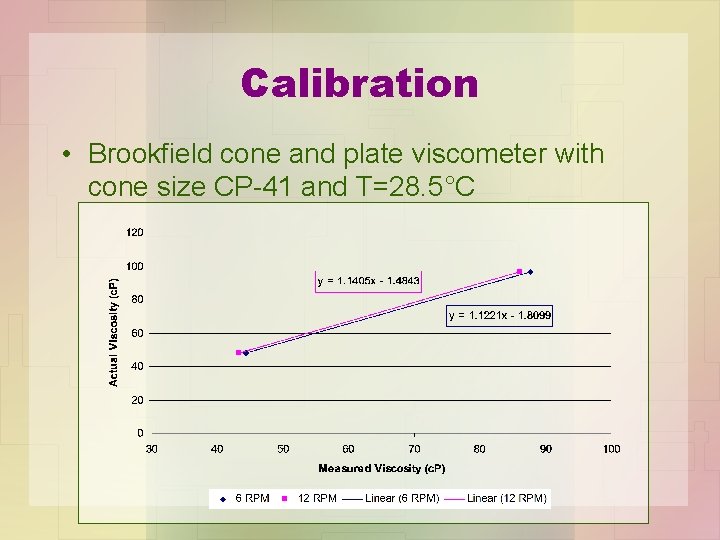
Calibration • Brookfield cone and plate viscometer with cone size CP-41 and T=28. 5°C

Viscosity of an Unknown Fluid
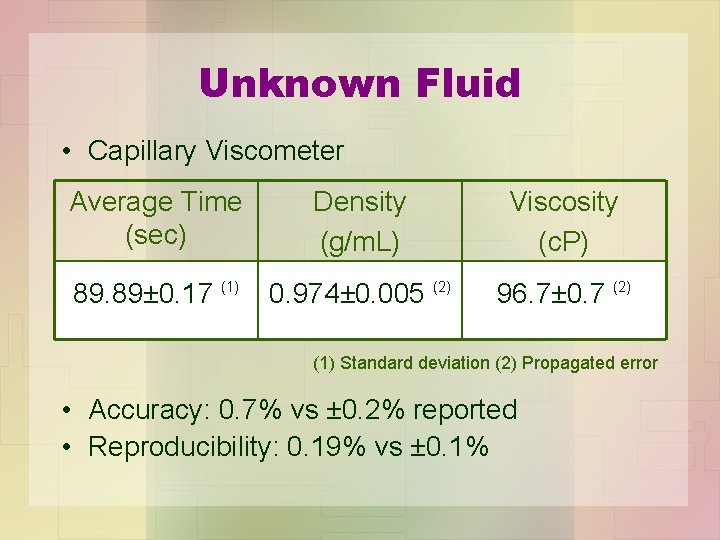
Unknown Fluid • Capillary Viscometer Average Time (sec) Density (g/m. L) Viscosity (c. P) 89. 89± 0. 17 (1) 0. 974± 0. 005 (2) 96. 7± 0. 7 (2) (1) Standard deviation (2) Propagated error • Accuracy: 0. 7% vs ± 0. 2% reported • Reproducibility: 0. 19% vs ± 0. 1%
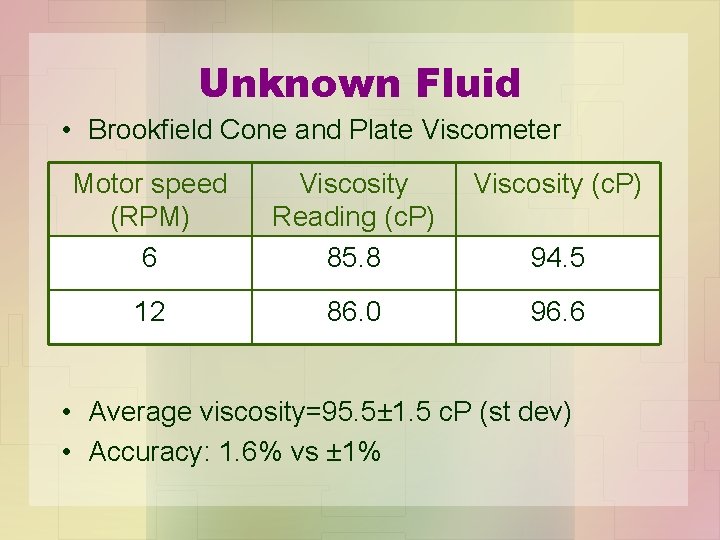
Unknown Fluid • Brookfield Cone and Plate Viscometer Motor speed (RPM) 6 Viscosity Reading (c. P) 85. 8 Viscosity (c. P) 12 86. 0 96. 6 94. 5 • Average viscosity=95. 5± 1. 5 c. P (st dev) • Accuracy: 1. 6% vs ± 1%
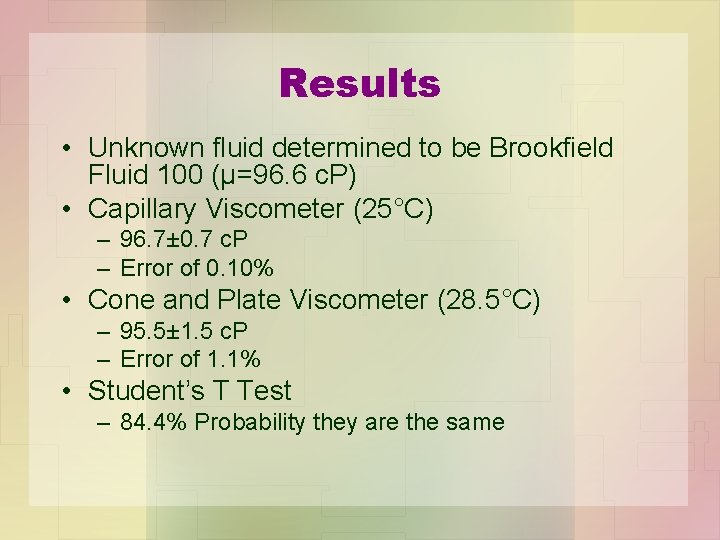
Results • Unknown fluid determined to be Brookfield Fluid 100 (μ=96. 6 c. P) • Capillary Viscometer (25°C) – 96. 7± 0. 7 c. P – Error of 0. 10% • Cone and Plate Viscometer (28. 5°C) – 95. 5± 1. 5 c. P – Error of 1. 1% • Student’s T Test – 84. 4% Probability they are the same
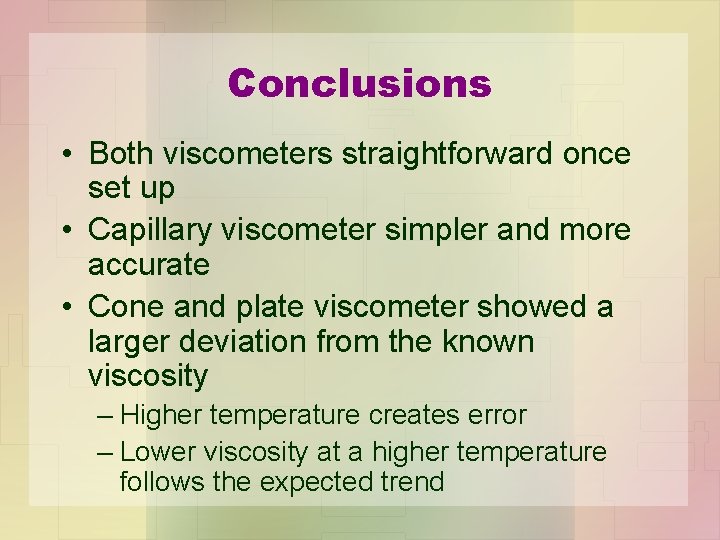
Conclusions • Both viscometers straightforward once set up • Capillary viscometer simpler and more accurate • Cone and plate viscometer showed a larger deviation from the known viscosity – Higher temperature creates error – Lower viscosity at a higher temperature follows the expected trend
Review • Theory • Operation of capillary and cone & plate viscometers • Calibrations • Determining the viscosity of an unknown fluid • Results • Conclusions
References • “Viscosity. ” Wikipedia. 2006. 24 August 2006. < http: //en. wikipedia. org/wiki/Viscosity> • de Nevers, Noel. Fluid Mechanics. Mc. Graw-Hill, New York, 2005. • Shoemaker, D. P. , C. W. Garland, and J. W. Nibler. Experiments in Physical Chemistry, 6 th ed. Mc-Graw-Hill, New York, 1996. • “Measuring Viscosity with a Digital Viscometer. ” 21 June 2005. University of Utah. 24 August 2006. <http: //www. che. utah. edu/~ring/Instrumental%20 Analysis %20 CHE 5503/SOP's/Digital. Viscosity%20 SOP%20 Ver%2 01. 22%20%20%206 -21 -05. PRC. doc>

Questions?
- Slides: 23