
Viruses MSS Biology 11Life Sciences Viruses Cells are
Viruses MSS Biology 11/Life Sciences
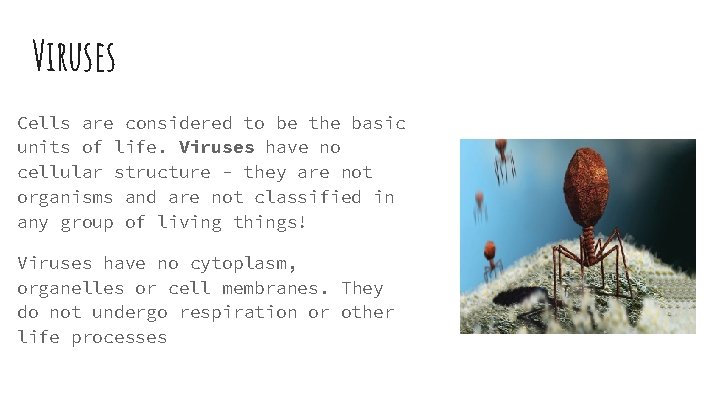
Viruses Cells are considered to be the basic units of life. Viruses have no cellular structure - they are not organisms and are not classified in any group of living things! Viruses have no cytoplasm, organelles or cell membranes. They do not undergo respiration or other life processes
Viruses consist of strands of DNA or RNA surrounded by a protective protein coat called a capsid. Viruses are essentially mobile genes that attack cells The capsid protects the virus from attack by the host cell and helps the virus attach to the host cell.

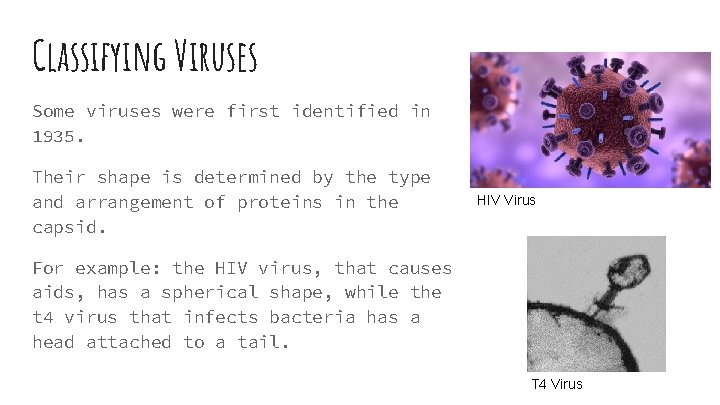
Classifying Viruses Some viruses were first identified in 1935. Their shape is determined by the type and arrangement of proteins in the capsid. HIV Virus For example: the HIV virus, that causes aids, has a spherical shape, while the t 4 virus that infects bacteria has a head attached to a tail. T 4 Virus
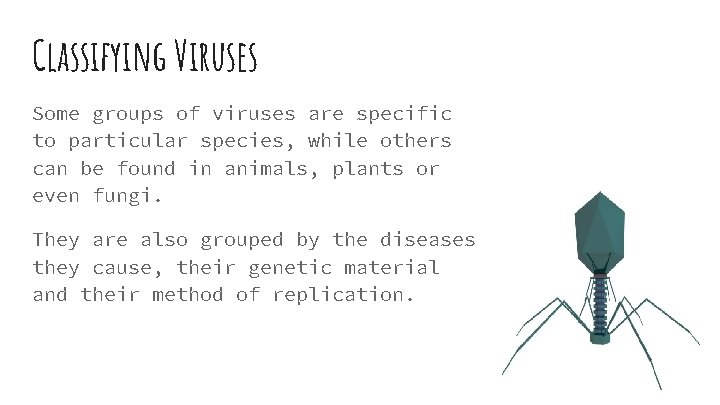
Classifying Viruses Some groups of viruses are specific to particular species, while others can be found in animals, plants or even fungi. They are also grouped by the diseases they cause, their genetic material and their method of replication.
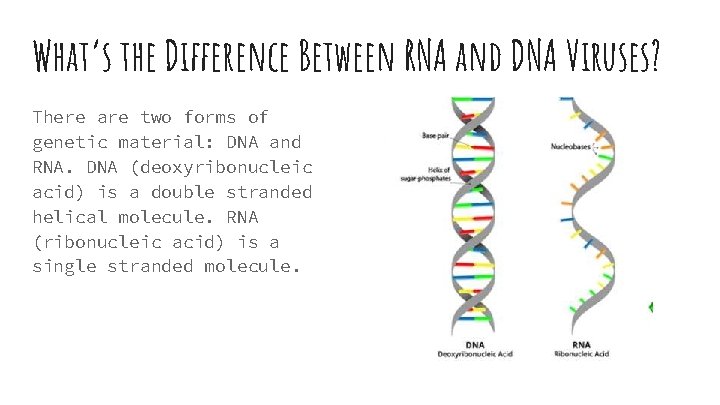
What’s the Difference Between RNA and DNA Viruses? There are two forms of genetic material: DNA and RNA. DNA (deoxyribonucleic acid) is a double stranded helical molecule. RNA (ribonucleic acid) is a single stranded molecule.
What’s the Difference Between DNA and RNA Viruses? ● Viruses that have RNA as their genetic material are less stable than DNA viruses. However, they are able to change their outer protein coat to fool the immune system. They also can mutate quickly and adapt. An example is the common cold virus and the influenza virus. ● Viruses that have DNA are stable and do not often mutate or change. An example is the chicken pox virus. ● This is why a flu shot is needed every year! The virus is constantly changing itself!
Viral Reproduction One characteristic that viruses share with living things is their ability to multiply. BUT a virus cannot do this on its own. It relies on other cells to replicate its genetic material (DNA or RNA) and to make protein coats for each newly formed virus particle.
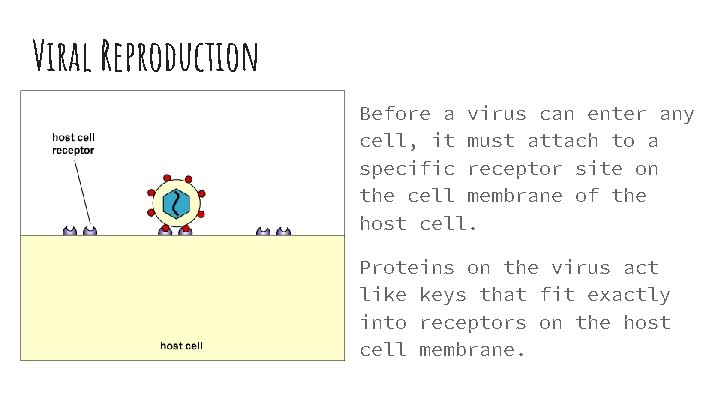
Viral Reproduction Before a virus can enter any cell, it must attach to a specific receptor site on the cell membrane of the host cell. Proteins on the virus act like keys that fit exactly into receptors on the host cell membrane.
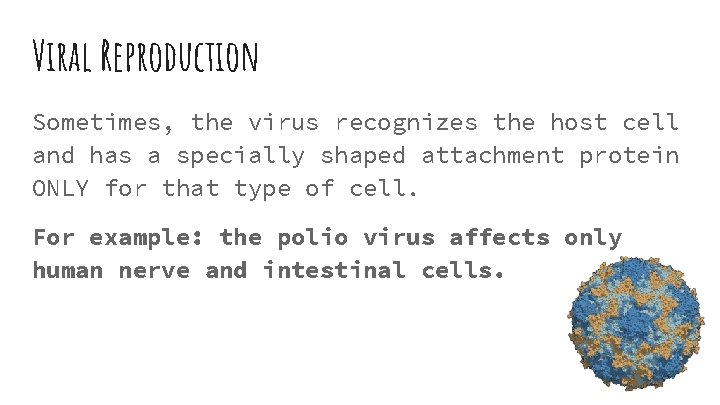
Viral Reproduction Sometimes, the virus recognizes the host cell and has a specially shaped attachment protein ONLY for that type of cell. For example: the polio virus affects only human nerve and intestinal cells.
Viral Reproduction This specificity is very important for controlling the spread of viral diseases. Each virus can only enter particular cells with specific receptor sites. Outside of their host cells, viruses are unable to function.
Viral Reproduction Viruses can enter cells in two different ways. 1. It attaches to the host cell, then the virus injects its nucleic acids (DNA/RNA) into the cell. 2. The host cell surrounds the virus (in an attempt to destroy it) and is held in a vacuole (sort of like a bubble). The virus breaks out of the vacuole and then releases its nucleic acids.
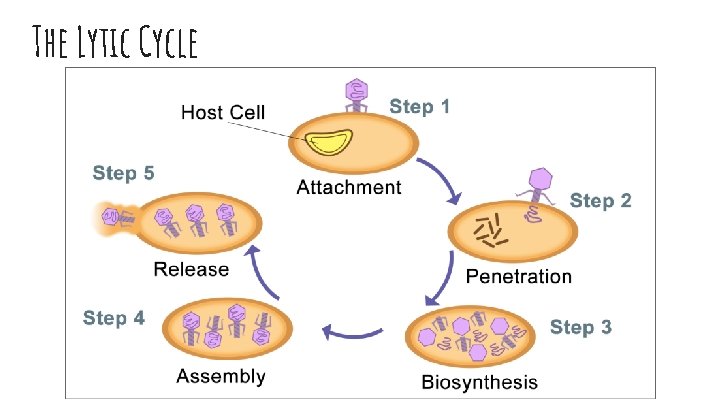
The Lytic Cycle is typical of bacteriophages - viruses that attack bacterial cells. A typical cycle takes about 30 minutes and may produce up to 200 new viruses. Let’s go through the steps!
The Lytic Cycle
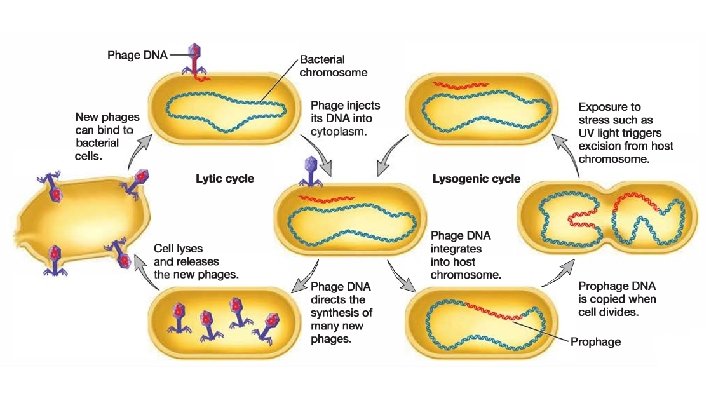
The Lytic Cycle 1. Attachment: The virus known as a bacteriophage (or phage for short) attaches itself to the host cell. 2. Penetration: The virus injects its genetic material (DNA or RNA) into the host cell. 3. Biosynthesis: The viruses genetic material destroys the hosts cells genetic material and begins to synthesize virus parts. 4. Assembly: New phages (viruses) are assembled inside the host cell. 5. Release: The host cell bursts and all the new viruses are released. The cycle begins again.
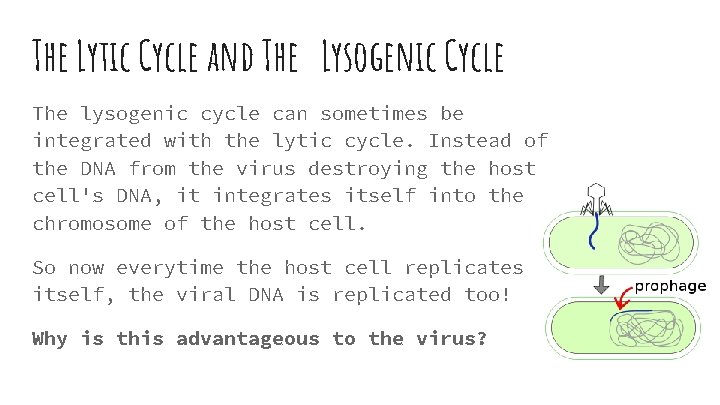
The Lytic Cycle and The Lysogenic Cycle The lysogenic cycle can sometimes be integrated with the lytic cycle. Instead of the DNA from the virus destroying the host cell's DNA, it integrates itself into the chromosome of the host cell. So now everytime the host cell replicates itself, the viral DNA is replicated too! Why is this advantageous to the virus?
The Lytic and The Lysogenic Cycle ● Every time the host cell replicates, the viral genetic material is being replicated too! ● When the virus is eventually activated (see next slide), there already many copies of the viral DNA or RNA ready to be assembled!
The Lysogenic Cycle If at some point the host cells become stressed or exposed to to UV rays or chemicals the DNA from the virus is activated and now the cell goes through the lytic cycle!
Viruses and Disease Polio, smallpox, measles, COVID-19 and AIDS (just to name a few) are all caused by viruses. In most viral infections, the virus attacks the cell and destroys them as it reproduces - causing symptoms of the disease. Despite this, most people manage to stay healthy most of the time! Mainly because of the bodies natural defenses and modern medical advancements.
Viruses and Disease Some diseases, like the common cold, are endemic, meaning they are with us all of the time. When a disease starts to spread rapidly, it is said to be epidemic. Just like COVID-19. Influenza often becomes epidemic in the winter months.
Viruses and Disease Unfortunately, most viral infections are difficult to treat and cannot be destroyed by drugs. Also, some viruses remain dormant in the body for years before disease symptoms appear. Some viral diseases can be prevented with vaccines. When people are vaccinated, the body reacts to the vaccine as if it were a real virus and produces antibodies. The body is then immune to that disease.
- Slides: 23