
VIRUSES Introduction to Viruses video VIRUSES The Beginnings
VIRUSES • Introduction to Viruses video
VIRUSES The Beginnings of Life?
VIRUSES • Viruses are nonliving particles that can only reproduce within a HOST CELL (living cell). • CANNOT carry out life-sustaining functions. • Most biologists do not consider them as living.
VIRUSES • Smaller than bacteria, most can only be seen with an electron microscope. • Incapable of reproducing independently. • Do not grow. • Do not have homeostasis. • Do not metabolize. • Can crystallize.
DISCOVERY OF VIRUSES • Viruses can cause disease in plants and animals. • Pathogens are disease-causing microorganisms. • Scientists were looking for the cause for the disease in tobacco plants. • 1892, Dmitri Iwanowski, squeezed fluid from a diseased plant, passed it through a filter, and gave it to a healthy plant. The fluid caused disease in a healthy plant. • 1898, Martinus Beijerinck, repeated Iwanowski’s experiment and concluded fluid contained “unknown factor, ” he called a virus, Latin for “poison. ” • 1935, Wendell Stanley isolated the Tobacco Mosaic Virus (TMV), crystallized it, placed it back in solution, rubbed fluid on a healthy plant which became diseased.
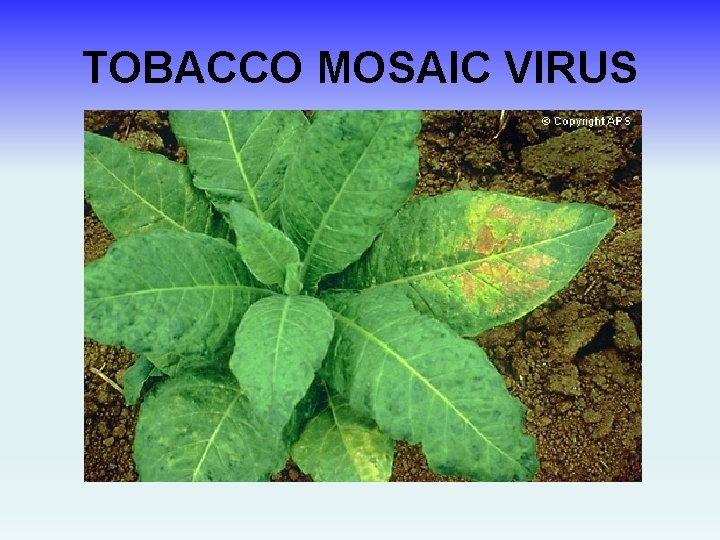
TOBACCO MOSAIC VIRUS
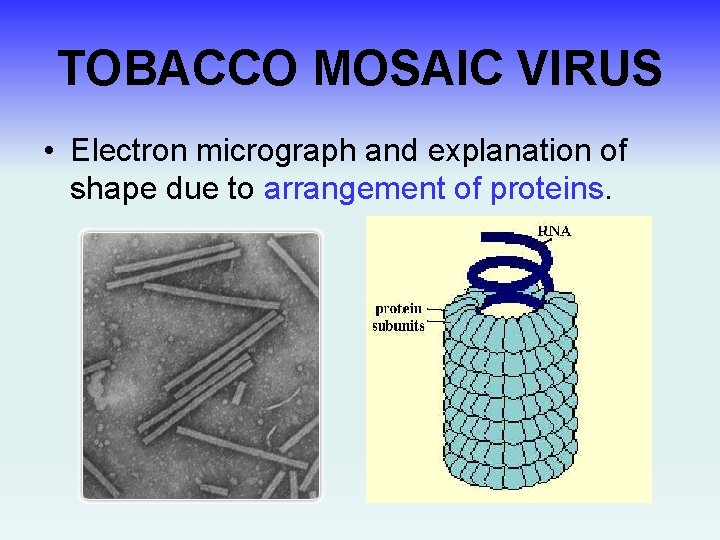
TOBACCO MOSAIC VIRUS • Electron micrograph and explanation of shape due to arrangement of proteins.
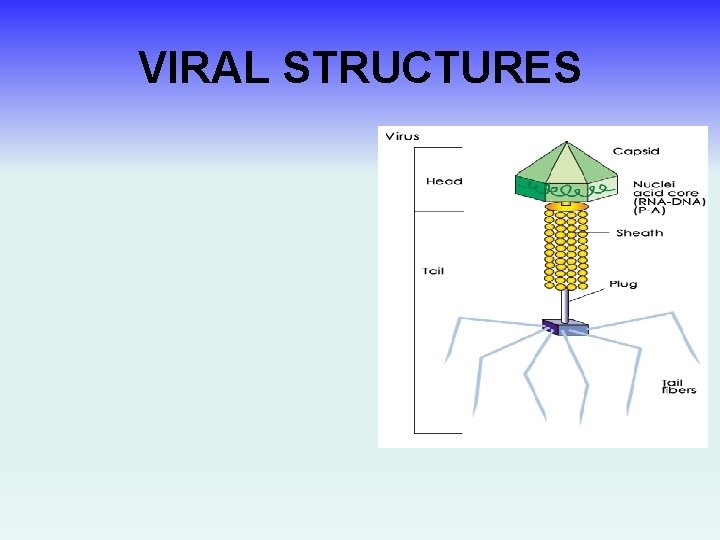
VIRAL STRUCTURES • Nucleic Acid – DNA or RNA – encodes for the synthesis of proteins and making new viruses • Capsid – protein coat surrounding nucleic acid; arrangement determines shape – protects the nucleic acid from digestive enzymes – contains special sites on its protein surface that allow the virus to attach and penetrate the host cell membrane
VIRAL STRUCTURES
VIRAL STRUCTURES DIFFERENT MORPHOLOGICAL TYPES • Envelope: membrane surrounding the capsid; not found in all viruses; helps the virus enter cells. Made up of proteins, lipids, and glycoproteins. Some also have enzymes. Example: influenza • Helical: rod-like with capsid proteins winding around the core in a spiral. Example – Tobacco Mosaic Virus
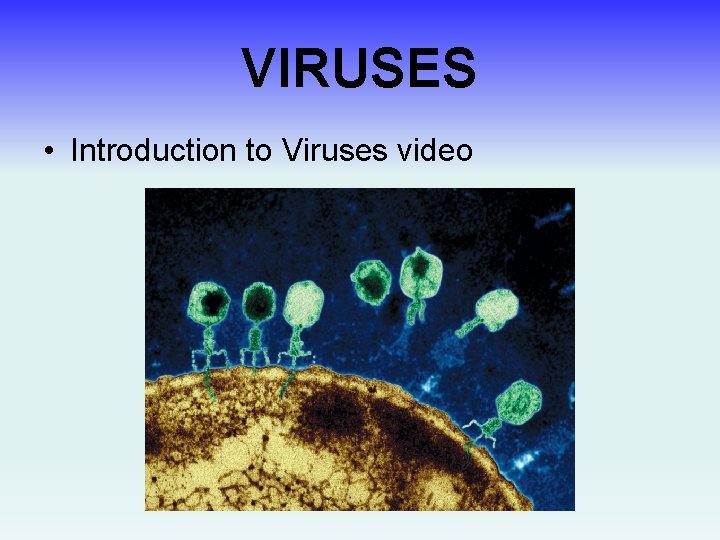
VIRAL STRUCTURES DIFFERENT MORPHOLOGICAL TYPES • Polyhedral: many sides (20 triangular faces & 12 corners) and roughly spherical. Example: Adenovirus, causes several human infections such as chest & stomach flu. • Bacteriophage: Viruses that infect bacteria. Polyhedron capsid attached to a helical tail.

BACTERIOPHAGE
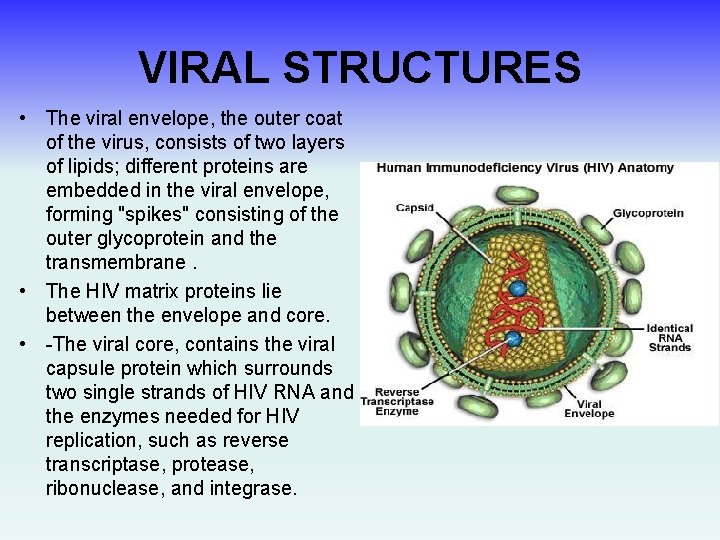
VIRAL STRUCTURES • The viral envelope, the outer coat of the virus, consists of two layers of lipids; different proteins are embedded in the viral envelope, forming "spikes" consisting of the outer glycoprotein and the transmembrane. • The HIV matrix proteins lie between the envelope and core. • -The viral core, contains the viral capsule protein which surrounds two single strands of HIV RNA and the enzymes needed for HIV replication, such as reverse transcriptase, protease, ribonuclease, and integrase.
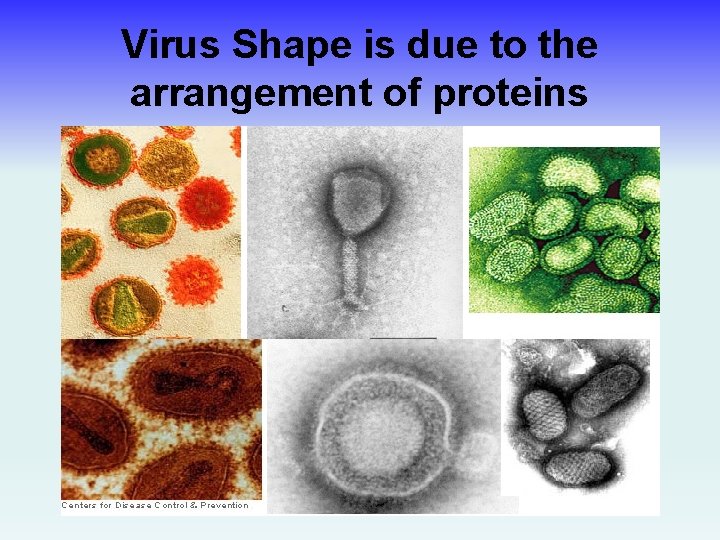
Virus Shape is due to the arrangement of proteins

VIRUS SHAPES

VIRUS SHAPES
CLASSIFICATION OF VIRUSES • • Group I: double-stranded DNA viruses Group II: single-stranded DNA viruses Group III: double-stranded RNA viruses Group IV: positive-sense single-stranded RNA viruses • Group V: negative-sense single-stranded RNA viruses • Group VI: reverse transcribing Diploid singlestranded RNA viruses • Group VII: reverse transcribing Circular doublestranded DNA viruses
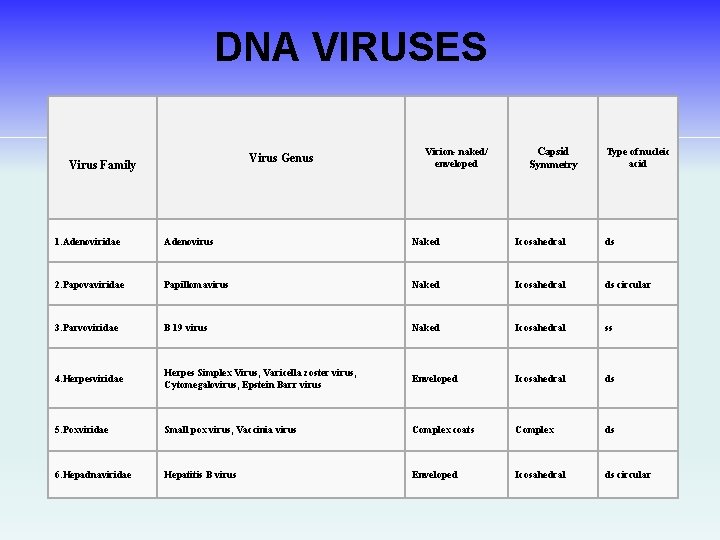
DNA VIRUSES Virus Genus Virus Family Virion- naked/ enveloped Capsid Symmetry Type of nucleic acid 1. Adenoviridae Adenovirus Naked Icosahedral ds 2. Papovaviridae Papillomavirus Naked Icosahedral ds circular 3. Parvoviridae B 19 virus Naked Icosahedral ss 4. Herpesviridae Herpes Simplex Virus, Varicella zoster virus, Cytomegalovirus, Epstein Barr virus Enveloped Icosahedral ds 5. Poxviridae Small pox virus, Vaccinia virus Complex coats Complex ds 6. Hepadnaviridae Hepatitis B virus Enveloped Icosahedral ds circular
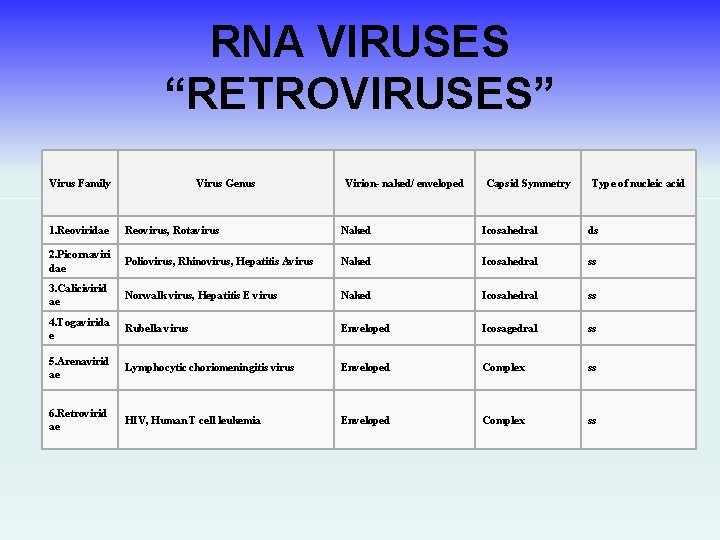
RNA VIRUSES “RETROVIRUSES” Virus Family Virus Genus Virion- naked/ enveloped Capsid Symmetry Type of nucleic acid 1. Reoviridae Reovirus, Rotavirus Naked Icosahedral ds 2. Picornaviri dae Poliovirus, Rhinovirus, Hepatitis Avirus Naked Icosahedral ss 3. Calicivirid ae Norwalk virus, Hepatitis E virus Naked Icosahedral ss 4. Togavirida e Rubella virus Enveloped Icosagedral ss 5. Arenavirid ae Lymphocytic choriomeningitis virus Enveloped Complex ss 6. Retrovirid ae HIV, Human T cell leukemia Enveloped Complex ss
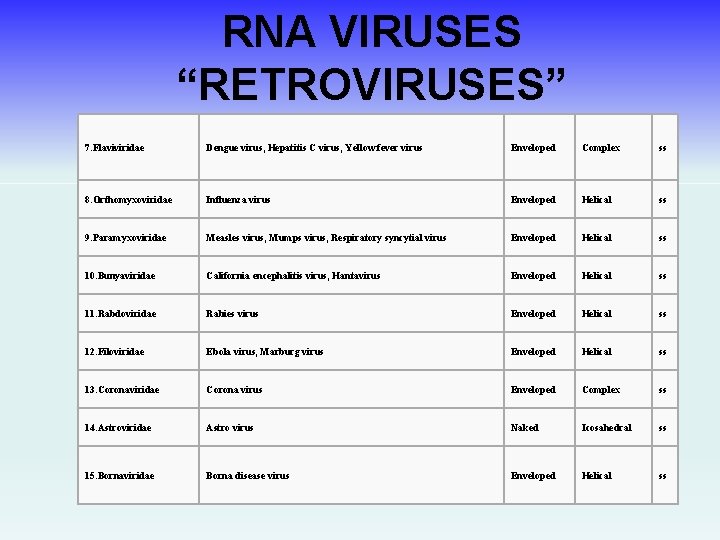
RNA VIRUSES “RETROVIRUSES” 7. Flaviviridae Dengue virus, Hepatitis C virus, Yellow fever virus Enveloped Complex ss 8. Orthomyxoviridae Influenza virus Enveloped Helical ss 9. Paramyxoviridae Measles virus, Mumps virus, Respiratory syncytial virus Enveloped Helical ss 10. Bunyaviridae California encephalitis virus, Hantavirus Enveloped Helical ss 11. Rabdoviridae Rabies virus Enveloped Helical ss 12. Filoviridae Ebola virus, Marburg virus Enveloped Helical ss 13. Coronaviridae Corona virus Enveloped Complex ss 14. Astroviridae Astro virus Naked Icosahedral ss 15. Bornaviridae Borna disease virus Enveloped Helical ss
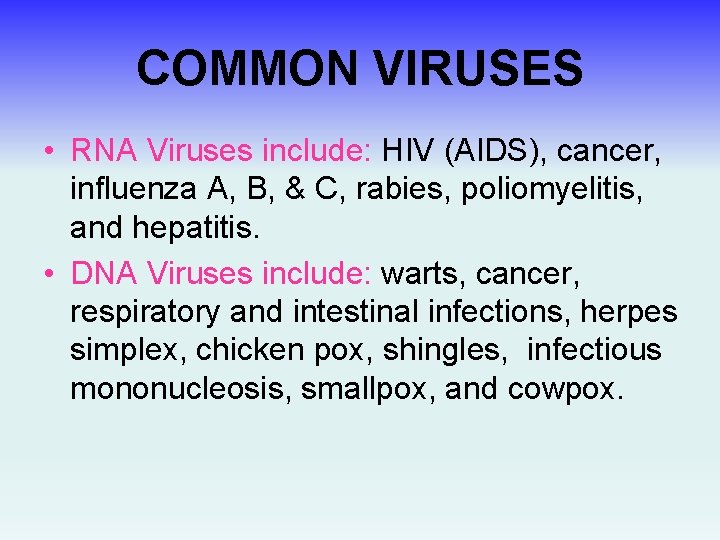
COMMON VIRUSES • RNA Viruses include: HIV (AIDS), cancer, influenza A, B, & C, rabies, poliomyelitis, and hepatitis. • DNA Viruses include: warts, cancer, respiratory and intestinal infections, herpes simplex, chicken pox, shingles, infectious mononucleosis, smallpox, and cowpox.
TO DO • Cell versus Virus • Do Section C #1 -5 using the “Viruses: The Ultimate Parasites” handout

DO NOW • Get out your notes, worksheet, and a new EOC sheet.
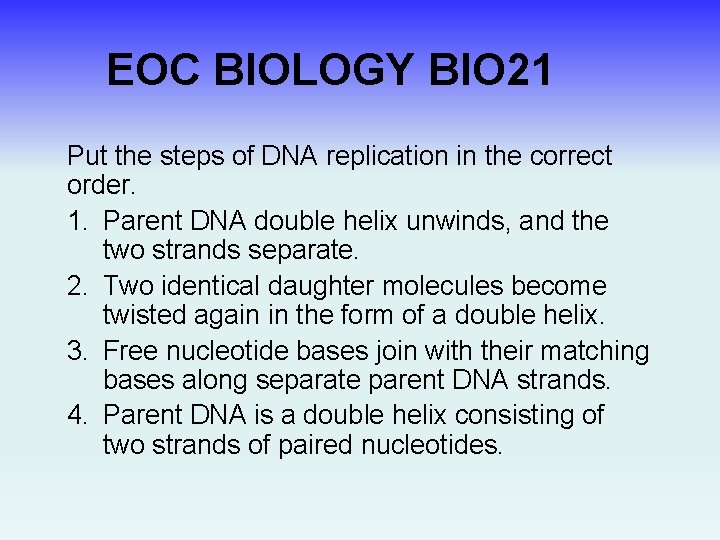
EOC BIOLOGY BIO 21 Put the steps of DNA replication in the correct order. 1. Parent DNA double helix unwinds, and the two strands separate. 2. Two identical daughter molecules become twisted again in the form of a double helix. 3. Free nucleotide bases join with their matching bases along separate parent DNA strands. 4. Parent DNA is a double helix consisting of two strands of paired nucleotides.
EOC BIOLOGY BIO 21 4. Parent DNA is a double helix consisting of two strands of paired nucleotides. 1. Parent DNA double helix unwinds, and the two strands separate. 3. Free nucleotide bases join with their matching bases along separate parent DNA strands. 2. Two identical daughter molecules become twisted again in the form of a double helix.
TO DO • Go over Section C #1 -5 • Watch “How Viruses Work”
THE LYTIC CYCLE Virulent Bacteriophages and the Lytic Cycle • Viruses that kill their infected host cell are called virulent. • The DNA in these type of viruses reproduces through the lytic cycle. • When these viruses reproduce, they break open, or lyse, their host cells, resulting in the destruction of the host. • The whole cycle can be complete in 20 - 30 minutes depending on a variety of factors such as temperature. • Phage reproduction is much faster than typical bacterial reproduction, so entire colonies can be destroyed very quickly.
THE LYTIC CYCLE 1. Virus attaches to host cell and injects viral DNA 2. Viral DNA uses host cell to create new viruses 3. New viruses assemble –destroying host
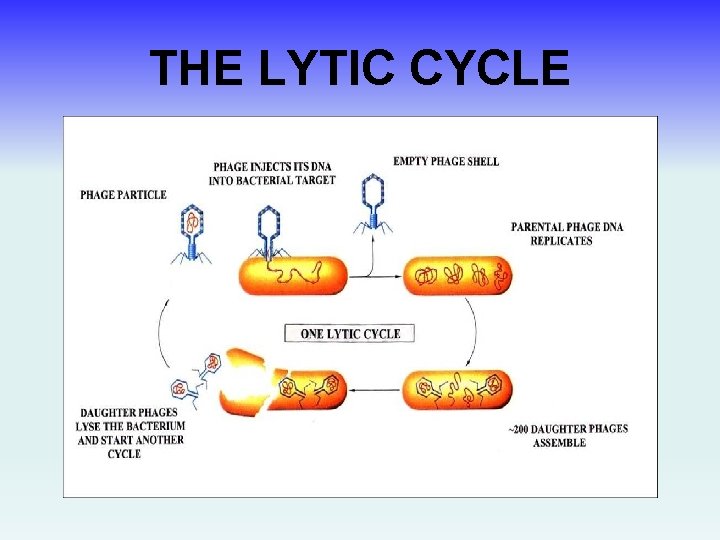
THE LYTIC CYCLE
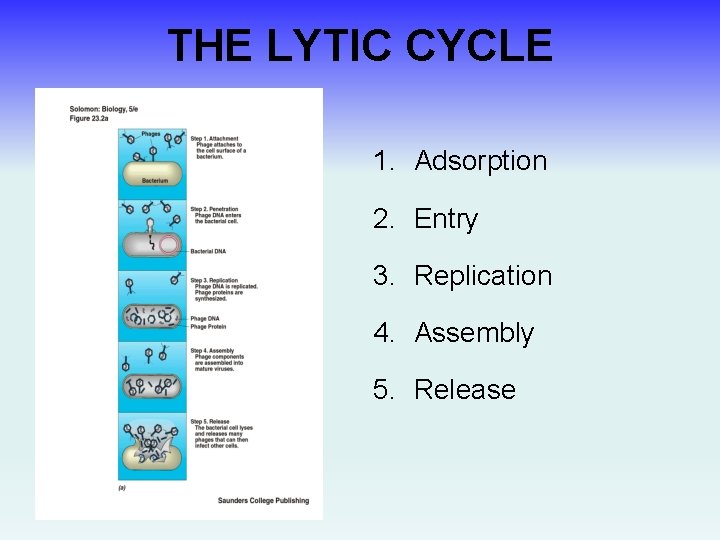
THE LYTIC CYCLE 1. Adsorption 2. Entry 3. Replication 4. Assembly 5. Release
WATCH • The Lytic Cycle
THE LYSOGENIC CYCLE Temperate Viruses and the Lysogenic Cycle • Temperate viruses are those that reproduce without killing their host cell. Typically they reproduce in two ways: through the lytic cycle and the lysogenic cycle. • In the lysogenic cycle, the phage's DNA recombines with the bacterial chromosome. • Once it has inserted itself, it is known as a provirus. • A host cell that carries a prophage has the potential to lyse, thus it is called a lysogenic cell. • Transduction: Viruses also have the ability to transfer genetic material from one host to another, altering the genetic code of a cell.
THE LYSOGENIC CYCLE 1. Virus attaches to host cell and injects viral DNA. 2. Viral DNA integrates with host DNA creates provirus. 3. Provirus is replicated along with host cell’s DNA. 4. Virus may become active, switching to the lytic cycle, destroying host.
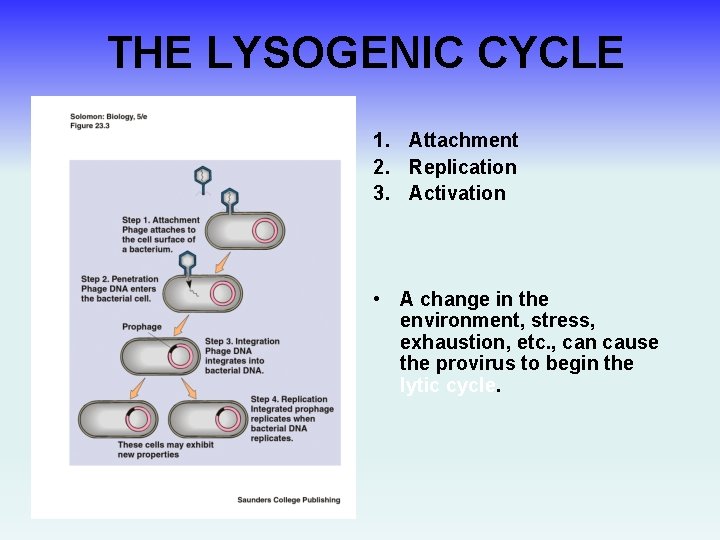
THE LYSOGENIC CYCLE 1. Attachment 2. Replication 3. Activation • A change in the environment, stress, exhaustion, etc. , can cause the provirus to begin the lytic cycle.
WATCH • The Lysogenic Cycle
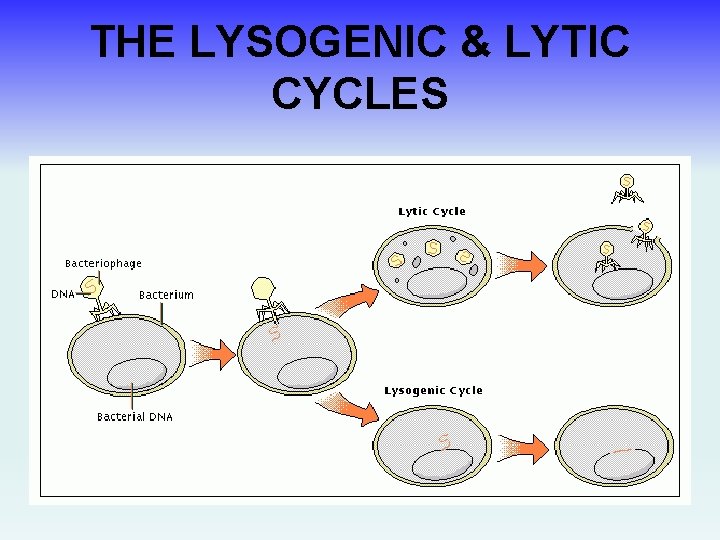
THE LYSOGENIC & LYTIC CYCLES
TO DO • Do Section C #6 -12 using the “Viruses: The Ultimate Parasites” handout and your notes.

DO NOW • Get out notes, worksheet and EOC Daily sheet.
EOC BIOLOGY BIO 22 A team of scientists at the University of California Irvine has recently placed foreign DNA in mosquitoes. The World Health Organization helped fund the project. What might the team be trying to accomplish?
EOC BIOLOGY BIO 22 • The team could be trying to eradicate diseases, such as malaria, caused by mosquitoes by causing permanent genetic mutations.
TO DO • Go over Section C #6 -12 • Watch Flu Attack
VIRUSES ARE HOST SPECIFIC • Viruses tend to attack particular species of animals and plants and specific cells in the organism. • Cold viruses attack cells from the respiratory system while polio attacks the nervous system. • Many viruses can attack more than one species, for example, rabies can be transmitted from dogs and raccoons to humans. • Cowpox can be transmitted from cows to humans. • Psittacosis can be transmitted from birds to humans.
VIRUSES CAUSE MANY DISEASES • The most lethal virus in history: The Spanish Flu (1918 -1919). • Approximately 25 million people died, more people than died in battle in WWI. • More than the number that died in a four year time period (1347 -1351) from the plague (bacterium). • Many viruses cause cancer: Hepatitis B (liver cancer), Epstein-Barr (Burkitt’s Lymphoma), & human papilloma virus (cervical cancer).
VIRAL DISEASES Mumps Rabies Influenza Herpes Smallpox Chickenpox Measles AIDS Polio Hepatitis
VIRULENCE • The ability of a virus to cause disease: 1. response of the host cell. 2. speed the virus multiplies. 3. presence or activity of receptor sites on the cell surface. • Emerging Viruses: Viruses that evolve in geographically isolated areas and are pathogenic to humans. Ex: Hantavirus (U. S) , Ebola (Africa), Lassa (Africa), Machupo (S. A. )
TREATMENTS • Antiviral drugs – treat symptoms or suppress the virus • Your immune system has to kill the virus • Vaccine – preparation of weakened or killed virus/viral particle. – stimulates immune system to prevent infection by “teaching” it to recognize virus – Edward Jenner created smallpox vaccine – Jonas Salk created polio vaccine
DEFENSE AGAINST VIRAL INFECTIONS • The body provides its own best natural defense against viral disease. • The first line of defense: skin, mucous membranes. Once the virus enters, the body attacks directly with white blood cells (phagocytes). • The second method of defense involves the production of protein molecules (antibodies). • The third method of defense is the production of interferon, a protein which interferes with viral replication. Successful with cancer treatments. Now readily produced through Recombinant DNA technology.
IMMUNITY: THE BODY’S NATURAL RESISTANCE TO DISEASE • Active Immunity: Body produces antibodies in response to a pathogen (natural) or a vaccine (artificial). – Example: exposure to measles (natural active immunity) – Example: chicken pox vaccine (artificial active immunity) • Passive immunity: Person receives antibodies already produced. – Example: shot of gamma globulin (artificial passive immunity) – Example: mother unborn child (natural passive immunity) – Passive immunity is temporary.
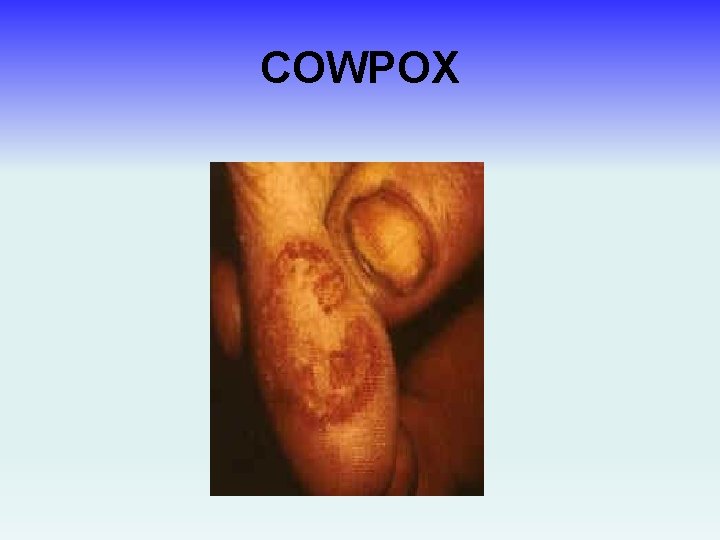
COWPOX
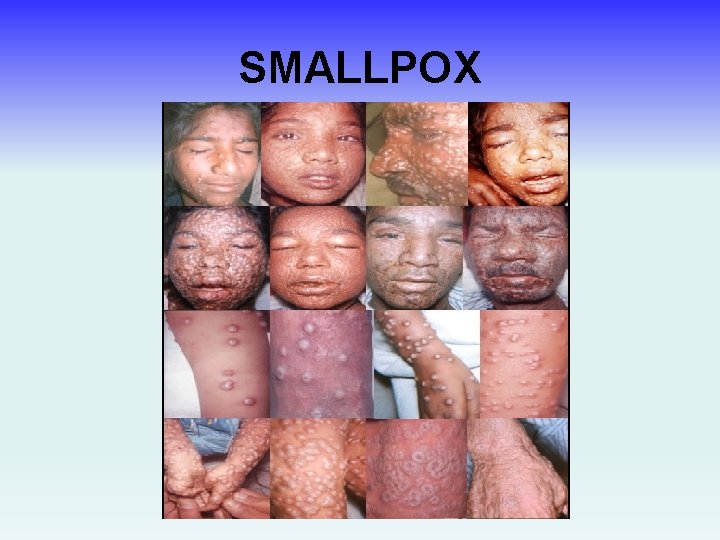
SMALLPOX
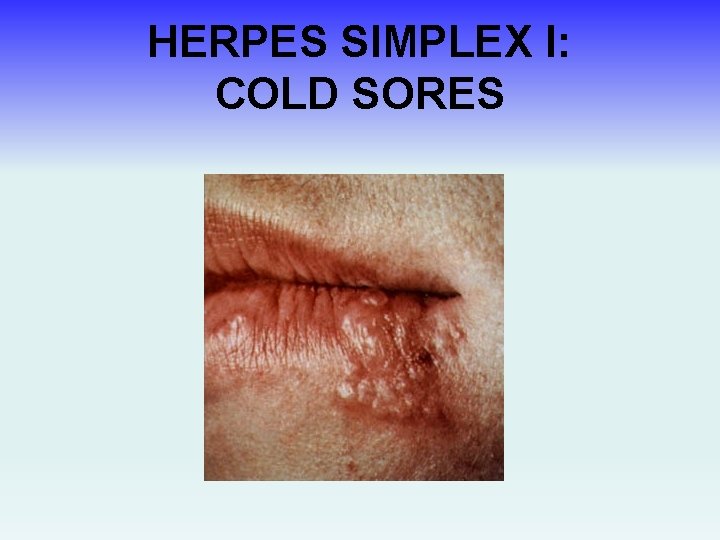
HERPES SIMPLEX I: COLD SORES
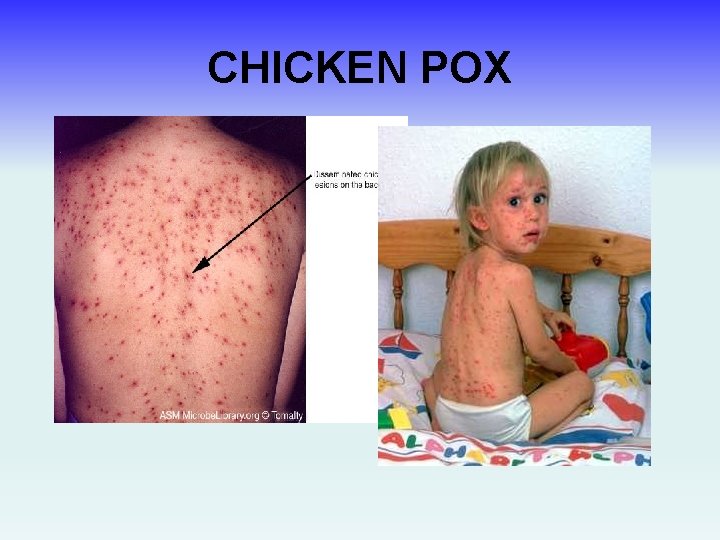
CHICKEN POX
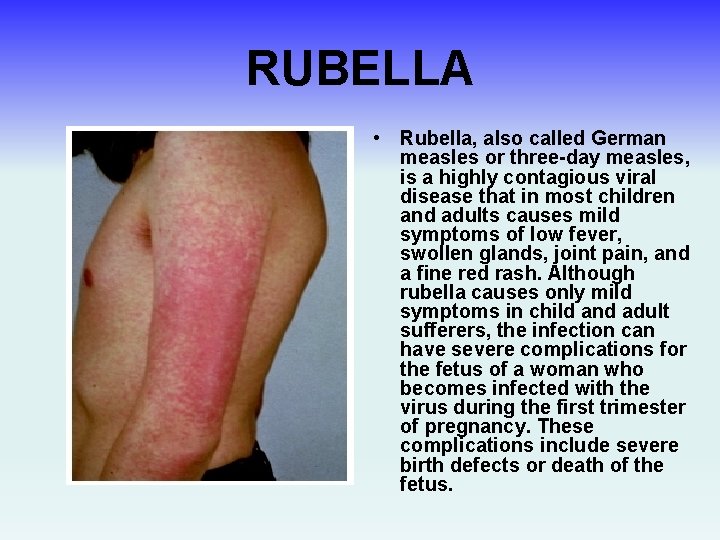
RUBELLA • Rubella, also called German measles or three-day measles, is a highly contagious viral disease that in most children and adults causes mild symptoms of low fever, swollen glands, joint pain, and a fine red rash. Although rubella causes only mild symptoms in child and adult sufferers, the infection can have severe complications for the fetus of a woman who becomes infected with the virus during the first trimester of pregnancy. These complications include severe birth defects or death of the fetus.
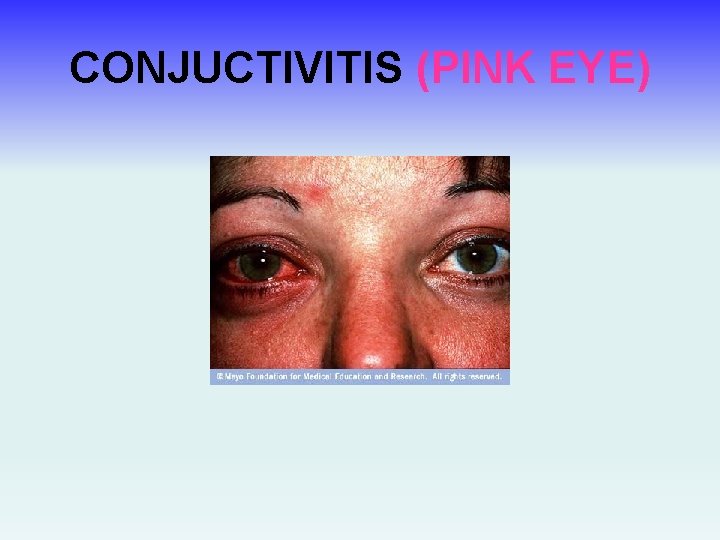
CONJUCTIVITIS (PINK EYE)
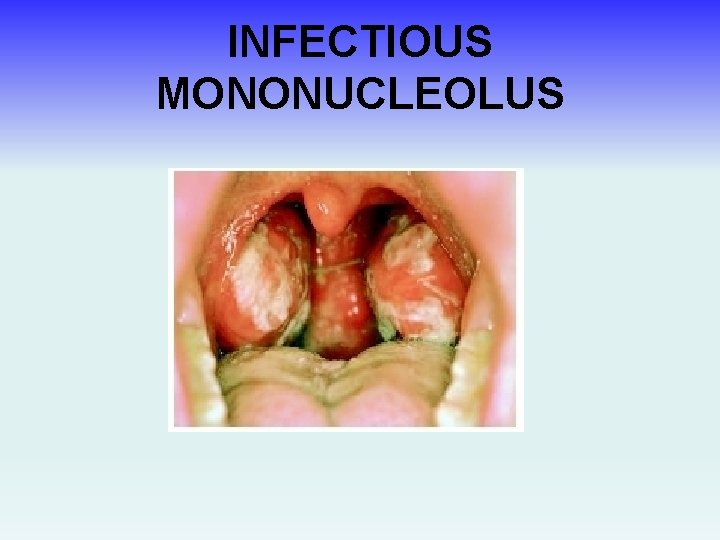
INFECTIOUS MONONUCLEOLUS
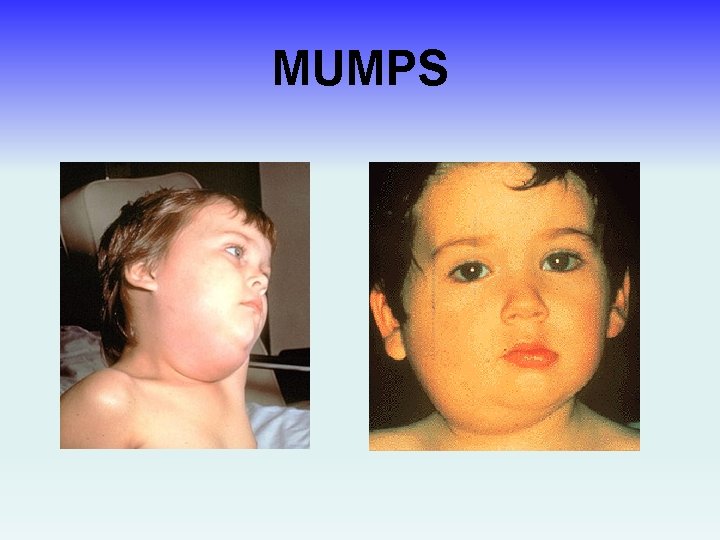
MUMPS
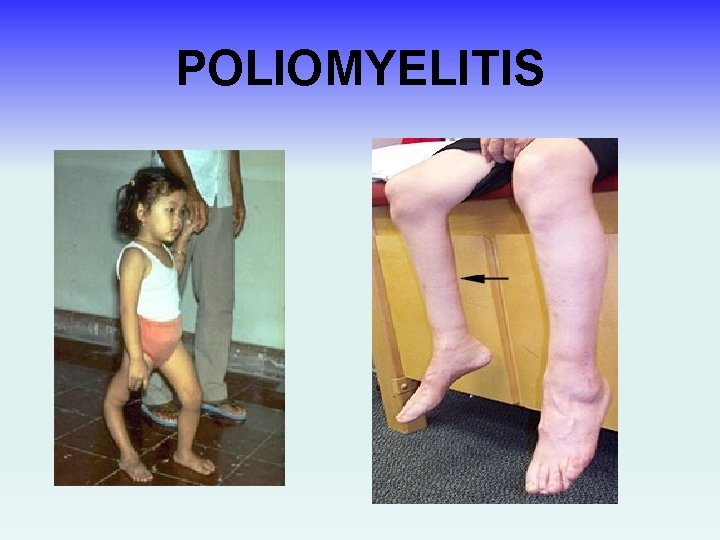
POLIOMYELITIS
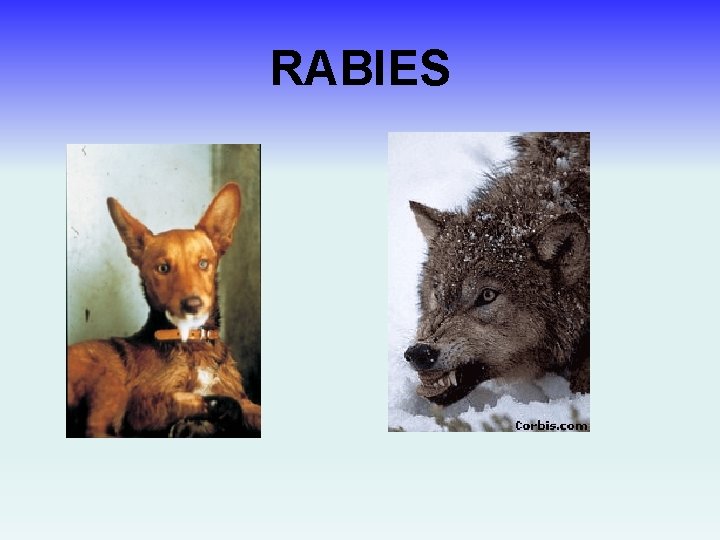
RABIES
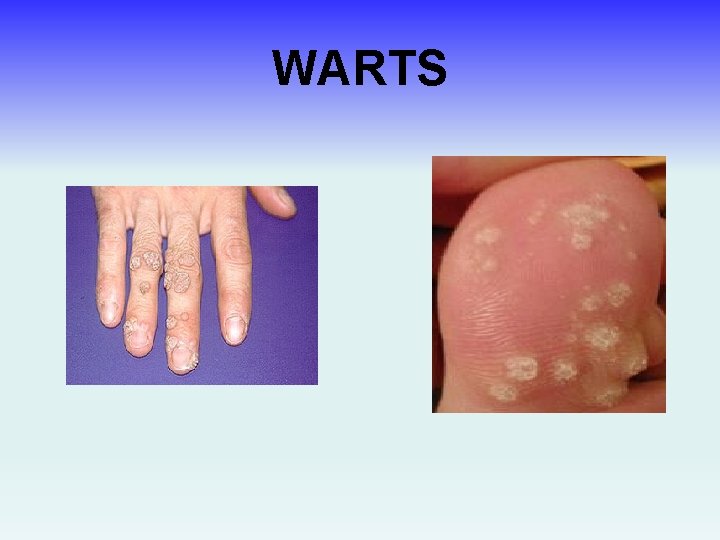
WARTS
EXTRAS • Oncogenic viruses – cause cancer; genes disrupt cell cycle. • Retrovirus – contains RNA; produces a DNA copy of the viral RNA and inserts viral DNA into host cell. • Prion – protein particle with no nucleic acid; accumulation of proteins in an area and kills cells. • Viroid - small naked single-stranded RNA molecules that cause plant diseases.
- Slides: 60