
Virus and Bacteria Genetics Chapter 18 Viruses NOT

Virus and Bacteria Genetics Chapter 18
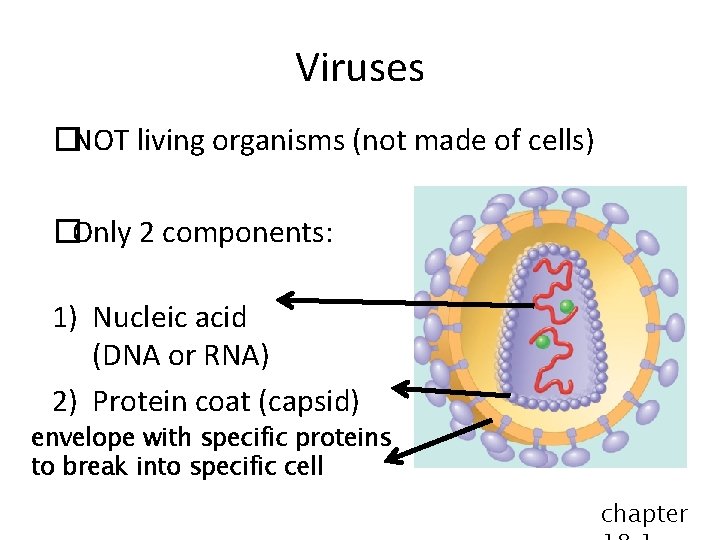
Viruses �NOT living organisms (not made of cells) �Only 2 components: 1) Nucleic acid (DNA or RNA) 2) Protein coat (capsid) envelope with specific proteins to break into specific cell chapter
Host range of viruses �Cannot break into any cell, must enter by “tricking” a particular receptor protein �Viruses often species-specific, even cell specific within larger hosts �Ex: tobacco mosaic virus, HIV (helper T cells), cold virus (respiratory cells) �Mutations might lead to “jumping” to a new species (bird flu human flu? )
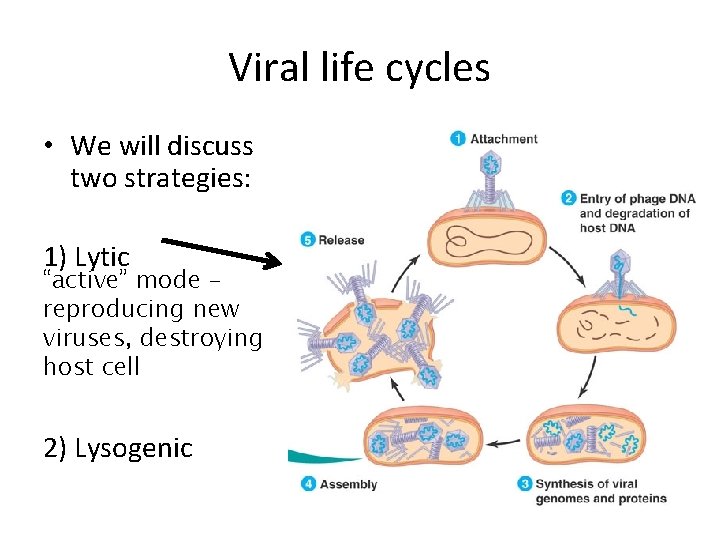
Viral life cycles • We will discuss two strategies: 1) Lytic “active” mode – reproducing new viruses, destroying host cell 2) Lysogenic
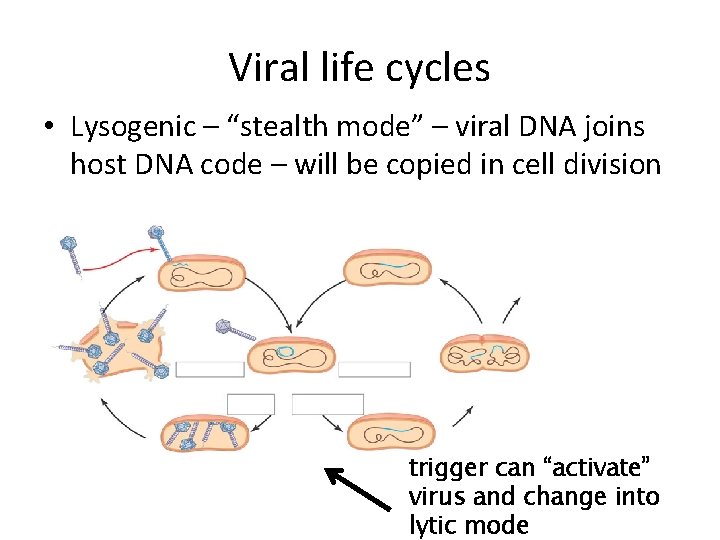
Viral life cycles • Lysogenic – “stealth mode” – viral DNA joins host DNA code – will be copied in cell division trigger can “activate” virus and change into lytic mode
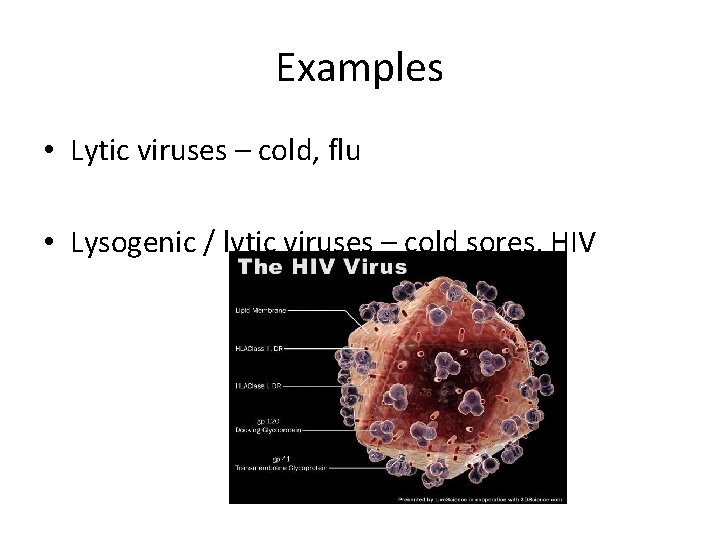
Examples • Lytic viruses – cold, flu • Lysogenic / lytic viruses – cold sores, HIV
Retroviruses • Infect with RNA code, not DNA • Carry enzyme called reverse transcriptase to use host nucleotides to make RNA DNA • Ex: influenza, HIV • These evolve very quickly (need for new flu vaccine every year)
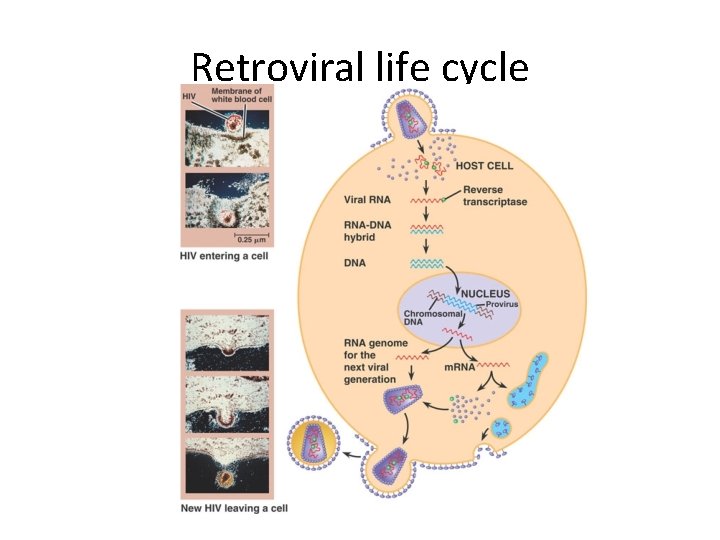
Retroviral life cycle
Evolution of viruses • Simple, but certainly could NOT have come first in history of life • Evidence suggests they came about long after complex, multicellular life? • Rogue transposon virus hypothesis?
Bacteria • Slide show by Kim Foglia (modified) Blue edged slides are Kim’s
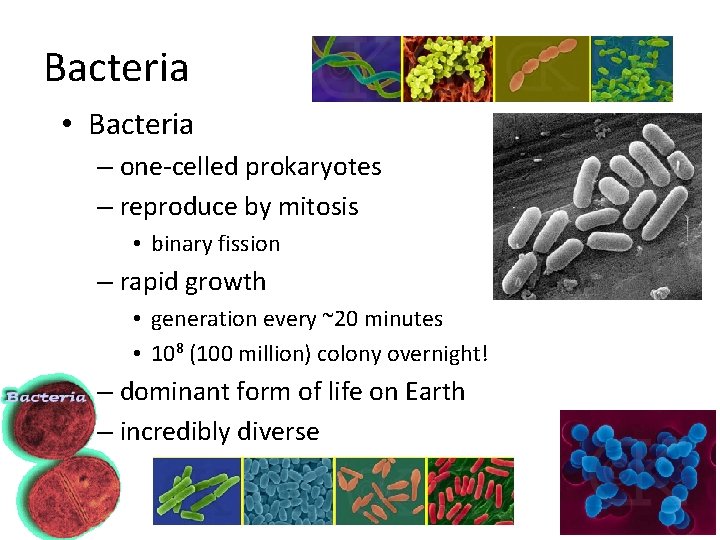
Bacteria • Bacteria – one-celled prokaryotes – reproduce by mitosis • binary fission – rapid growth • generation every ~20 minutes • 108 (100 million) colony overnight! – dominant form of life on Earth – incredibly diverse

Bacterial genome • Single circular chromosome – haploid – naked DNA • no histone proteins – ~4 million base pairs • ~4300 genes • 1/1000 DNA in eukaryote How have these little guys gotten to be so diverse? ?
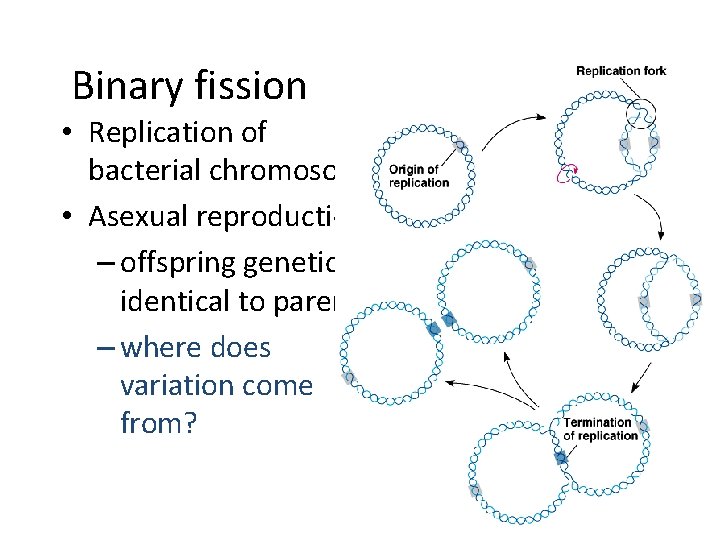
Binary fission • Replication of bacterial chromosome • Asexual reproduction – offspring genetically identical to parent – where does variation come from?
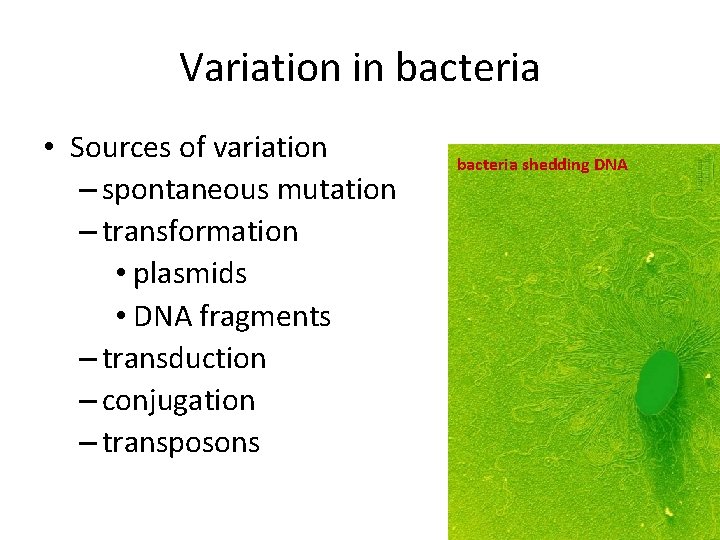
Variation in bacteria • Sources of variation – spontaneous mutation – transformation • plasmids • DNA fragments – transduction – conjugation – transposons bacteria shedding DNA
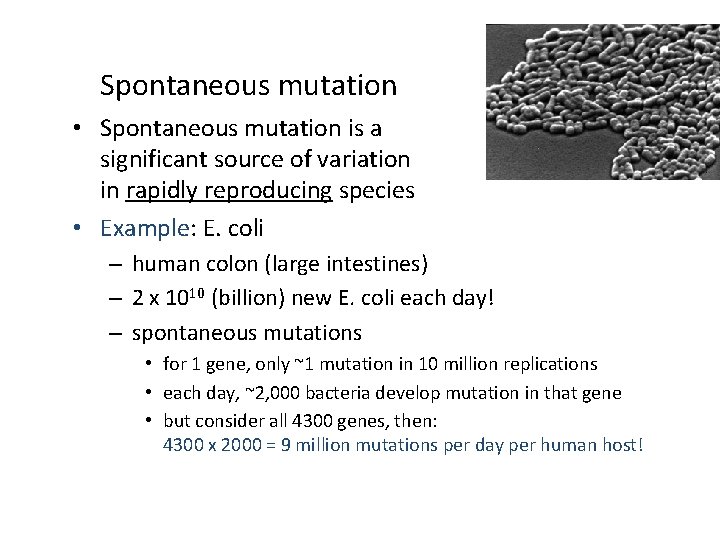
Spontaneous mutation • Spontaneous mutation is a significant source of variation in rapidly reproducing species • Example: E. coli – human colon (large intestines) – 2 x 10¹⁰ (billion) new E. coli each day! – spontaneous mutations • for 1 gene, only ~1 mutation in 10 million replications • each day, ~2, 000 bacteria develop mutation in that gene • but consider all 4300 genes, then: 4300 x 2000 = 9 million mutations per day per human host!
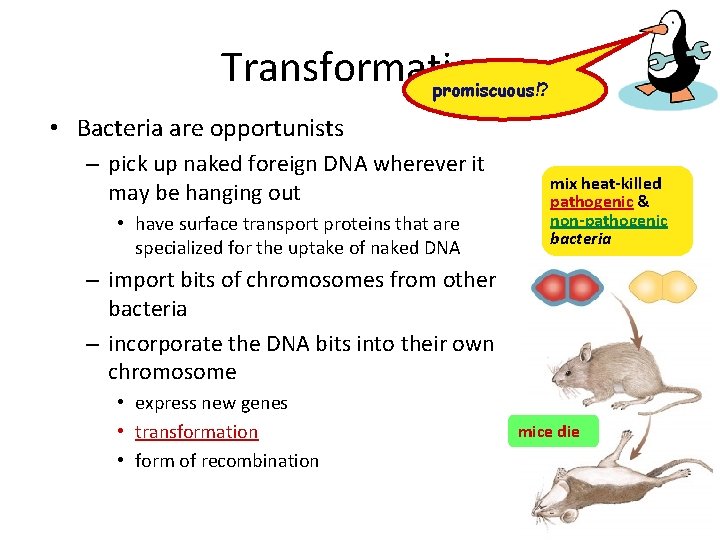
Transformation promiscuous!? • Bacteria are opportunists – pick up naked foreign DNA wherever it may be hanging out • have surface transport proteins that are specialized for the uptake of naked DNA mix heat-killed pathogenic & non-pathogenic bacteria – import bits of chromosomes from other bacteria – incorporate the DNA bits into their own chromosome • express new genes • transformation • form of recombination mice die
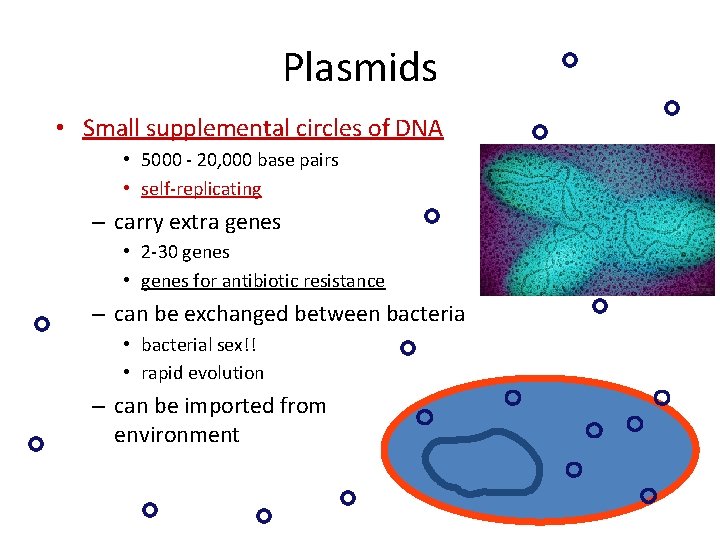
Plasmids • Small supplemental circles of DNA • 5000 - 20, 000 base pairs • self-replicating – carry extra genes • 2 -30 genes • genes for antibiotic resistance – can be exchanged between bacteria • bacterial sex!! • rapid evolution – can be imported from environment
GENE REGULATION slide shows by Kim Foglia modified Slides with blue edges are Kim’s 2007 -2008
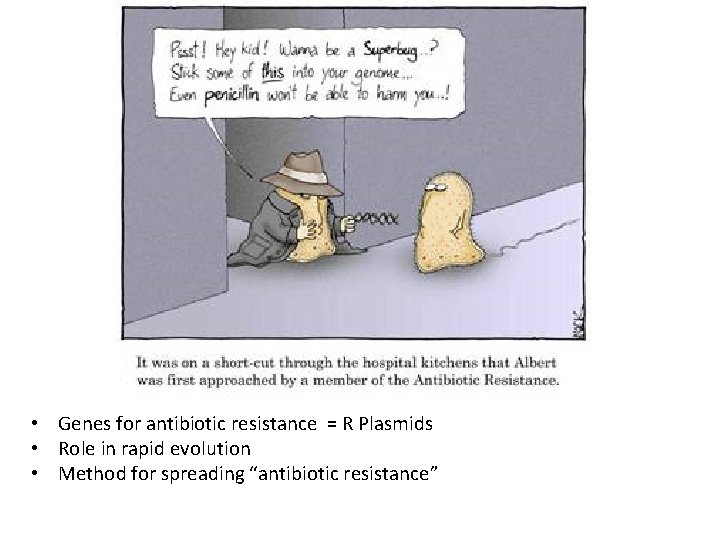
• Genes for antibiotic resistance = R Plasmids • Role in rapid evolution • Method for spreading “antibiotic resistance”

Plasmids & antibiotic resistance • Resistance is futile? – 1 st recognized in 1950 s in Japan – bacterial dysentery not responding to antibiotics – worldwide problem now • resistant genes are on plasmids that are swapped between bacteria
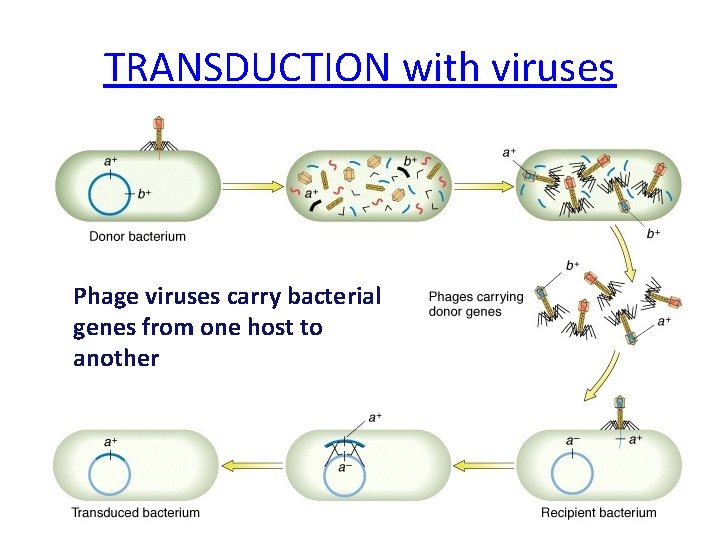
TRANSDUCTION with viruses Phage viruses carry bacterial genes from one host to another
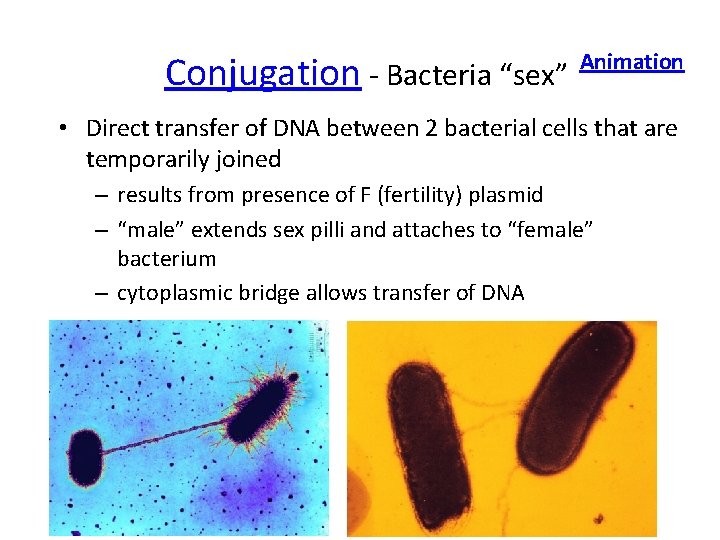
Conjugation - Bacteria “sex” Animation • Direct transfer of DNA between 2 bacterial cells that are temporarily joined – results from presence of F (fertility) plasmid – “male” extends sex pilli and attaches to “female” bacterium – cytoplasmic bridge allows transfer of DNA
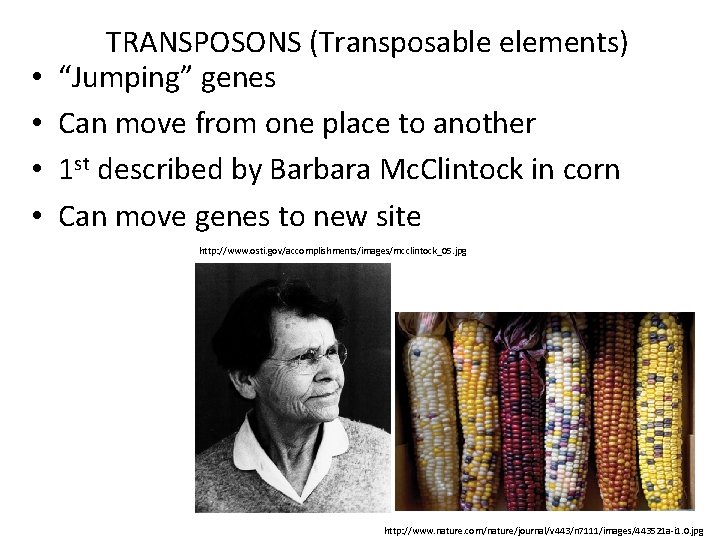
• • TRANSPOSONS (Transposable elements) “Jumping” genes Can move from one place to another 1 st described by Barbara Mc. Clintock in corn Can move genes to new site http: //www. osti. gov/accomplishments/images/mcclintock_05. jpg http: //www. nature. com/nature/journal/v 443/n 7111/images/443521 a-i 1. 0. jpg
Bacterial metabolism • Bacteria need to respond quickly to changes in their environment – if they have enough of a product, need to stop production STOP • why? waste of energy to produce more • how? stop production of enzymes for synthesis – if they find new food/energy source, need to utilize it quickly GO • why? metabolism, growth, reproduction • how? start production of enzymes for digestion
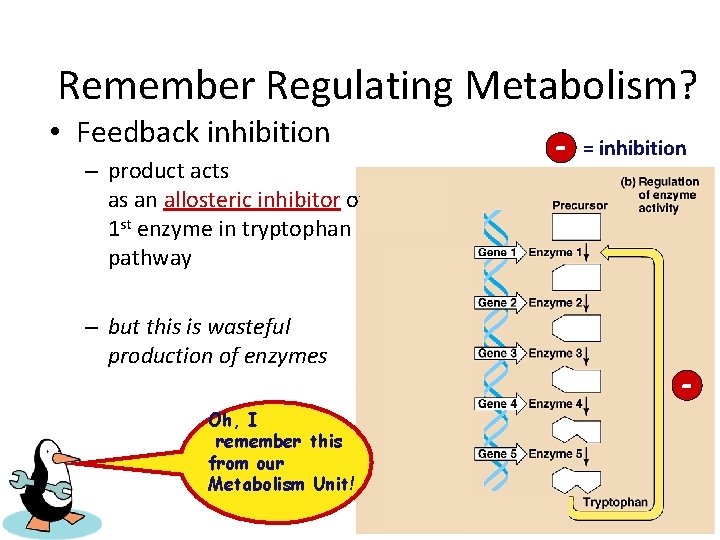
Remember Regulating Metabolism? • Feedback inhibition – product acts as an allosteric inhibitor of 1 st enzyme in tryptophan pathway – but this is wasteful production of enzymes Oh, I remember this from our Metabolism Unit! - = inhibition -
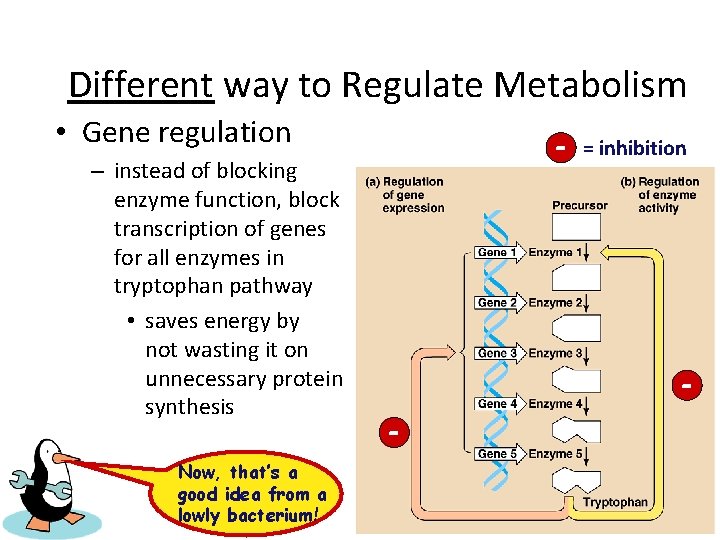
Different way to Regulate Metabolism • Gene regulation – instead of blocking enzyme function, block transcription of genes for all enzymes in tryptophan pathway • saves energy by not wasting it on unnecessary protein synthesis Now, that’s a good idea from a lowly bacterium! - = inhibition -
Gene regulation in bacteria • Cells vary amount of specific enzymes by regulating gene transcription – turn genes on or turn genes off STOP GO • turn genes OFF example if bacterium has enough tryptophan then it doesn’t need to make enzymes used to build tryptophan • turn genes ON example if bacterium encounters new sugar (energy source), like lactose, then it needs to start making enzymes used to digest lactose
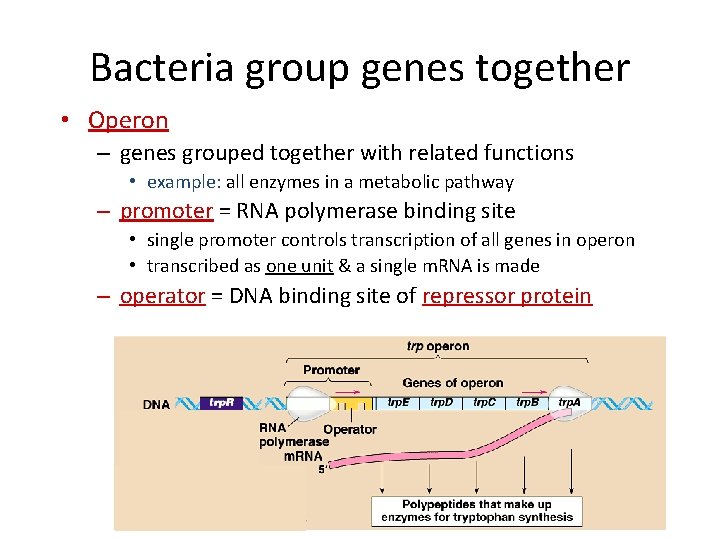
Bacteria group genes together • Operon – genes grouped together with related functions • example: all enzymes in a metabolic pathway – promoter = RNA polymerase binding site • single promoter controls transcription of all genes in operon • transcribed as one unit & a single m. RNA is made – operator = DNA binding site of repressor protein
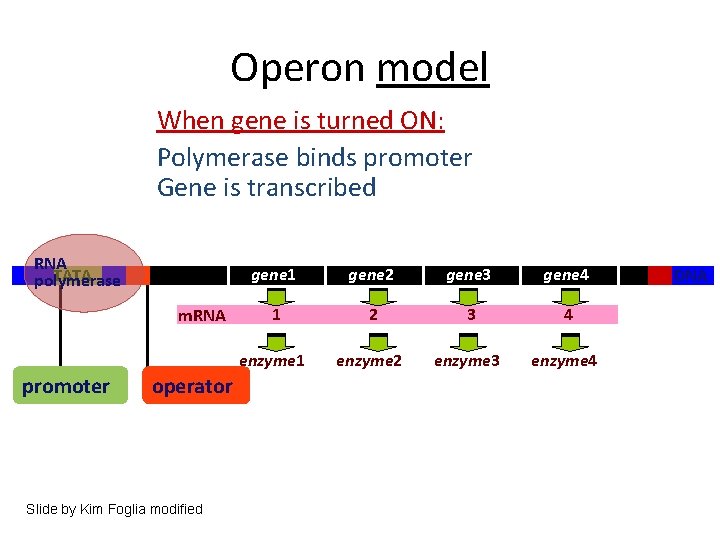
Operon model When gene is turned ON: Polymerase binds promoter Gene is transcribed RNA TATA polymerase m. RNA promoter operator Slide by Kim Foglia modified gene 1 gene 2 gene 3 gene 4 1 2 3 4 enzyme 1 enzyme 2 enzyme 3 enzyme 4 DNA
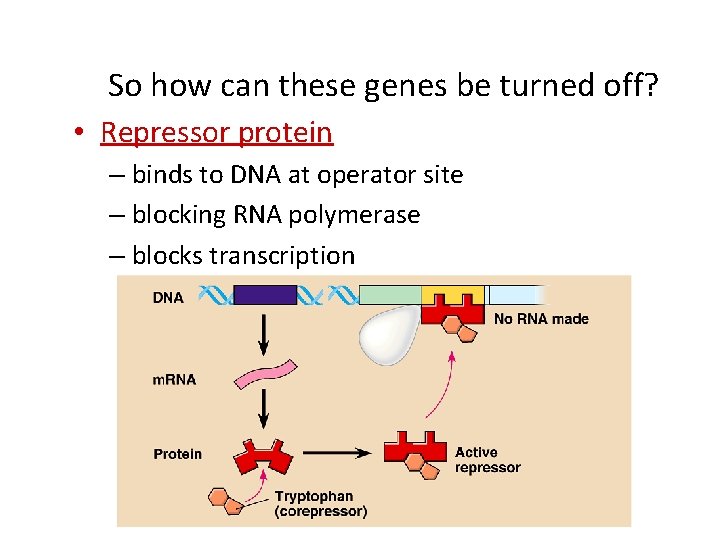
So how can these genes be turned off? • Repressor protein – binds to DNA at operator site – blocking RNA polymerase – blocks transcription
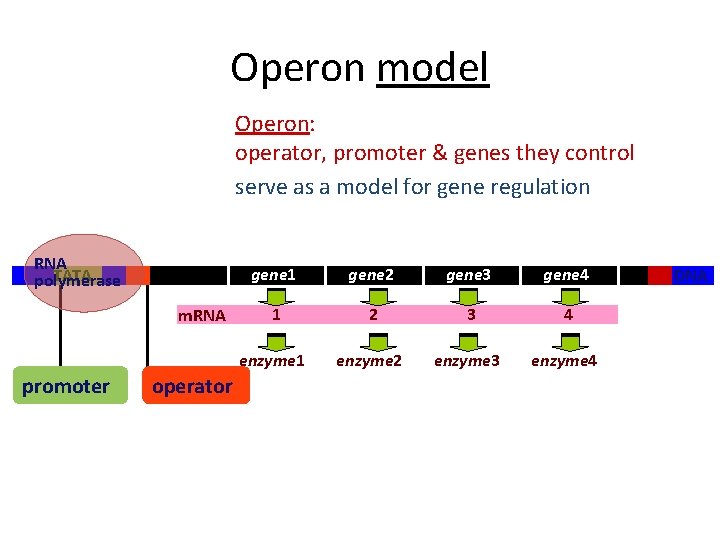
Operon model Operon: operator, promoter & genes they control serve as a model for gene regulation RNA TATA polymerase m. RNA promoter operator gene 1 gene 2 gene 3 gene 4 1 2 3 4 enzyme 1 enzyme 2 enzyme 3 enzyme 4 DNA
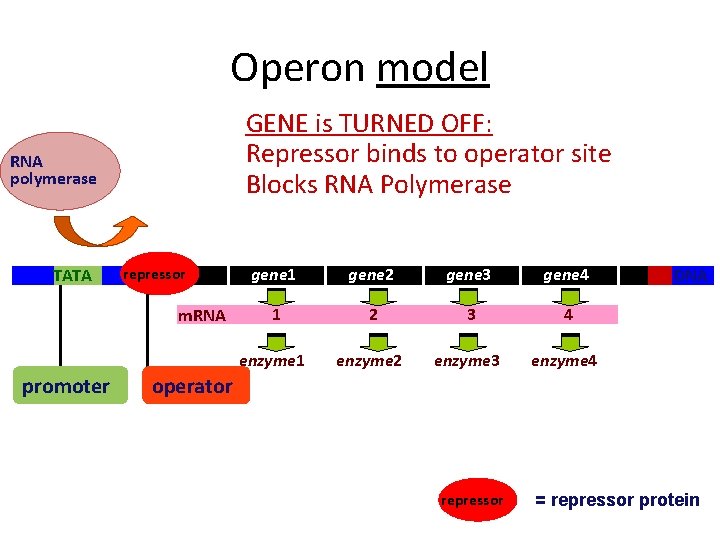
Operon model GENE is TURNED OFF: Repressor binds to operator site Blocks RNA Polymerase RNA polymerase TATA repressor m. RNA promoter gene 1 gene 2 gene 3 gene 4 1 2 3 4 enzyme 1 enzyme 2 enzyme 3 enzyme 4 DNA operator repressor = repressor protein
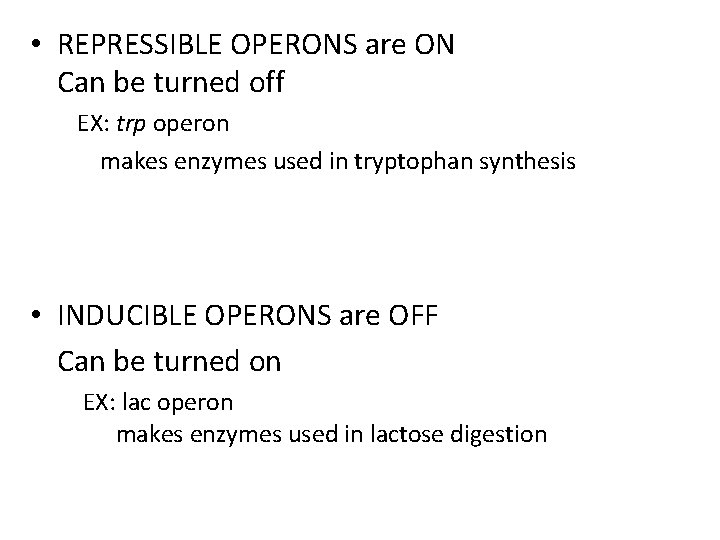
• REPRESSIBLE OPERONS are ON Can be turned off EX: trp operon makes enzymes used in tryptophan synthesis • INDUCIBLE OPERONS are OFF Can be turned on EX: lac operon makes enzymes used in lactose digestion
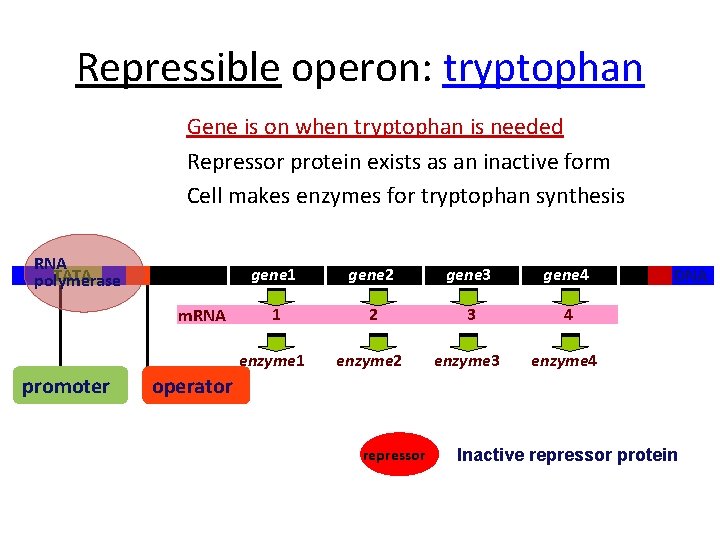
Repressible operon: tryptophan Gene is on when tryptophan is needed Repressor protein exists as an inactive form Cell makes enzymes for tryptophan synthesis RNA TATA polymerase m. RNA promoter gene 1 gene 2 gene 3 gene 4 1 2 3 4 enzyme 1 enzyme 2 enzyme 3 enzyme 4 DNA operator repressor Inactive repressor protein
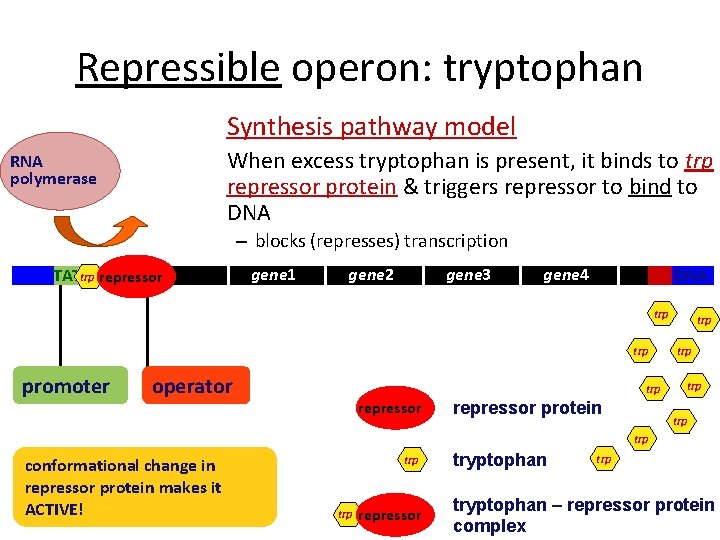
Repressible operon: tryptophan Synthesis pathway model When excess tryptophan is present, it binds to trp repressor protein & triggers repressor to bind to DNA RNA polymerase – blocks (represses) transcription trp repressor TATA gene 1 gene 2 gene 3 gene 4 DNA trp promoter operator trp repressor protein trp trp trp conformational change in repressor protein makes it ACTIVE! trp repressor tryptophan trp tryptophan – repressor protein complex
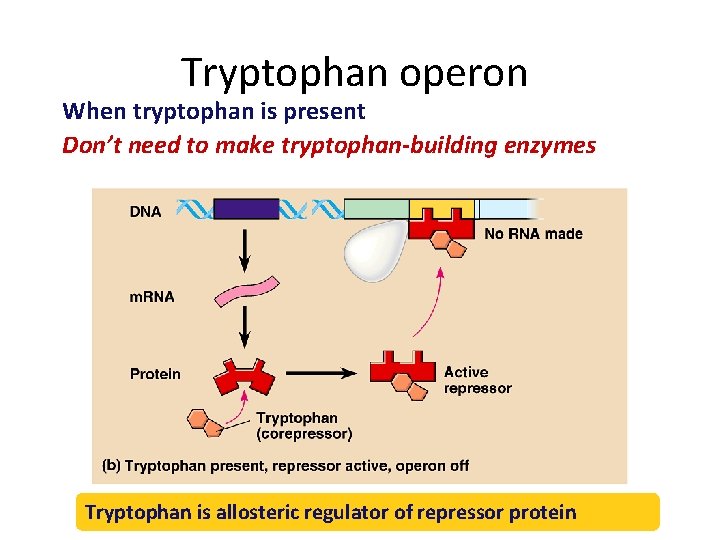
Tryptophan operon When tryptophan is present Don’t need to make tryptophan-building enzymes Tryptophan is allosteric regulator of repressor protein
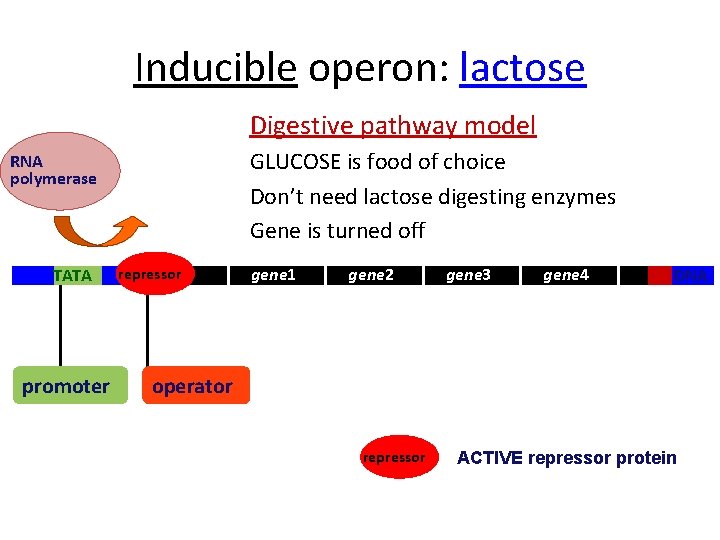
Inducible operon: lactose Digestive pathway model GLUCOSE is food of choice Don’t need lactose digesting enzymes Gene is turned off RNA polymerase TATA promoter repressor gene 1 gene 2 gene 3 gene 4 DNA operator repressor ACTIVE repressor protein
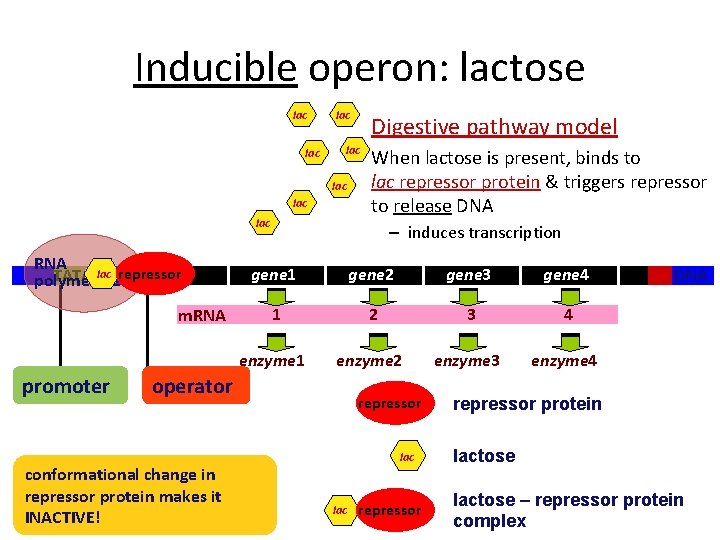
Inducible operon: lactose lac lac RNA TATA lac repressor polymerase m. RNA promoter When lactose is present, binds to lac repressor protein & triggers repressor to release DNA – induces transcription gene 1 gene 2 gene 3 gene 4 1 2 3 4 enzyme 1 enzyme 2 enzyme 3 enzyme 4 operator conformational change in repressor protein makes it INACTIVE! Digestive pathway model repressor lac repressor DNA repressor protein lactose – repressor protein complex
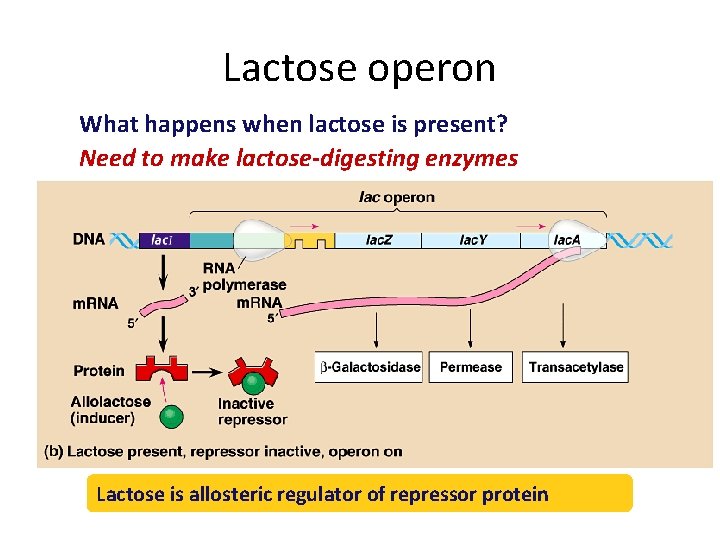
Lactose operon What happens when lactose is present? Need to make lactose-digesting enzymes Lactose is allosteric regulator of repressor protein
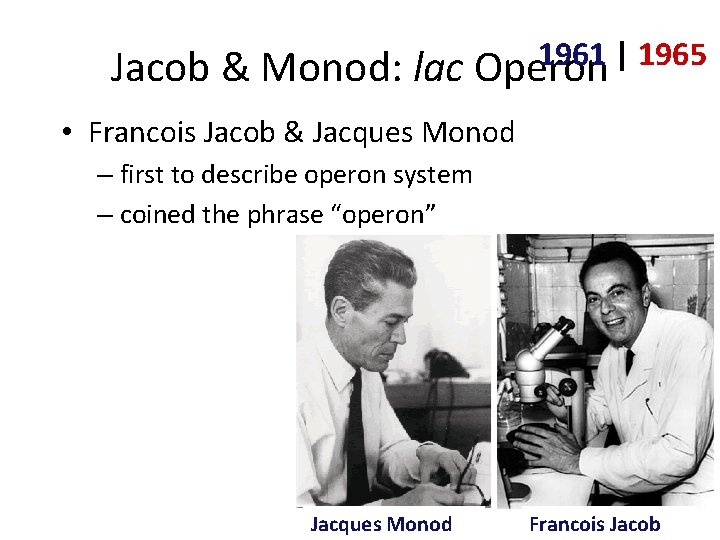
1961 | 1965 Jacob & Monod: lac Operon • Francois Jacob & Jacques Monod – first to describe operon system – coined the phrase “operon” Jacques Monod Francois Jacob
Operon summary • Repressible operon – usually functions in anabolic pathways • synthesizing end products – when end product is present in excess, cell allocates resources to other uses • Inducible operon – usually functions in catabolic pathways, • digesting nutrients to simpler molecules – produce enzymes only when nutrient is available • cell avoids making proteins that have nothing to do, cell allocates resources to other uses
- Slides: 41