
Virtualization Technique System Virtualization Memory Virtualization Agenda Basic
虛擬化技術 Virtualization Technique System Virtualization Memory Virtualization
Agenda • Basic concept of memory management • Brief introduction to ARM v 7 AMSA • Memory Virtualization § Shadow page table § Hardware assistance § Comparison
BASIC CONCEPT OF MEMORY MANAGEMENT
Memory Management Unit • A hardware component responsible for handling accesses to memory requested by the CPU § Address translation: virtual address to physical address (VA to PA) § Memory protection § Cache control § Bus arbitration • Page tables are maintained by operating system, and MMU only references them. • TLB updates are performed automatically by pagetable walking hardware
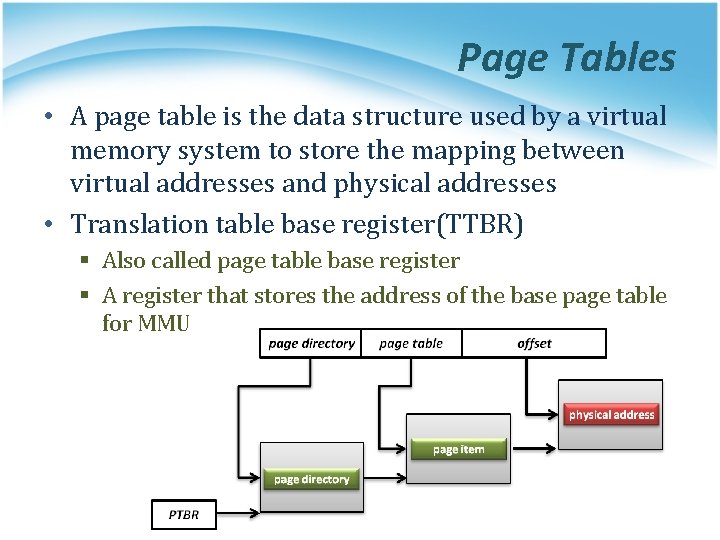
Page Tables • A page table is the data structure used by a virtual memory system to store the mapping between virtual addresses and physical addresses • Translation table base register(TTBR) § Also called page table base register § A register that stores the address of the base page table for MMU
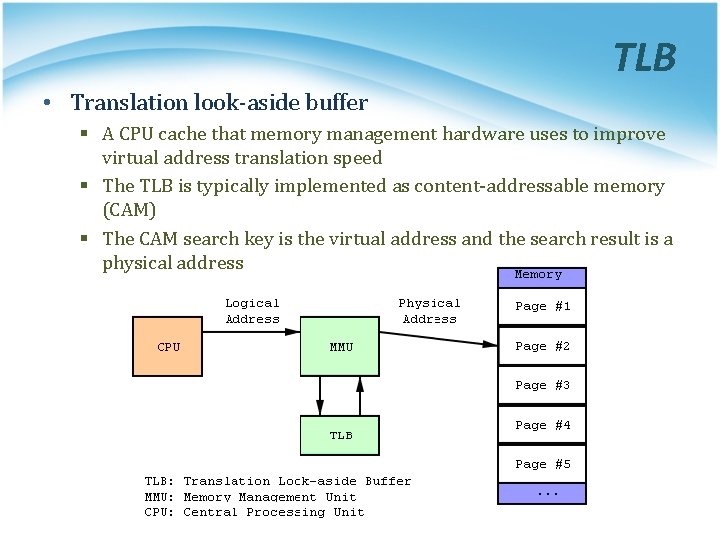
TLB • Translation look-aside buffer § A CPU cache that memory management hardware uses to improve virtual address translation speed § The TLB is typically implemented as content-addressable memory (CAM) § The CAM search key is the virtual address and the search result is a physical address
BRIEF INTRODUCTION TO ARMV 7 VMSA
ARMv 7 VMSA • VMSA: Virtual memory system architecture • Support four mapping types § § 16 MB Super section 1 MB Section 64 KB Large page 4 KB Small page • Basically a 32 -bit two-layer translation table • Other features (virtualization extension and 64 -bit large physical address extension) would be mentioned in the future class
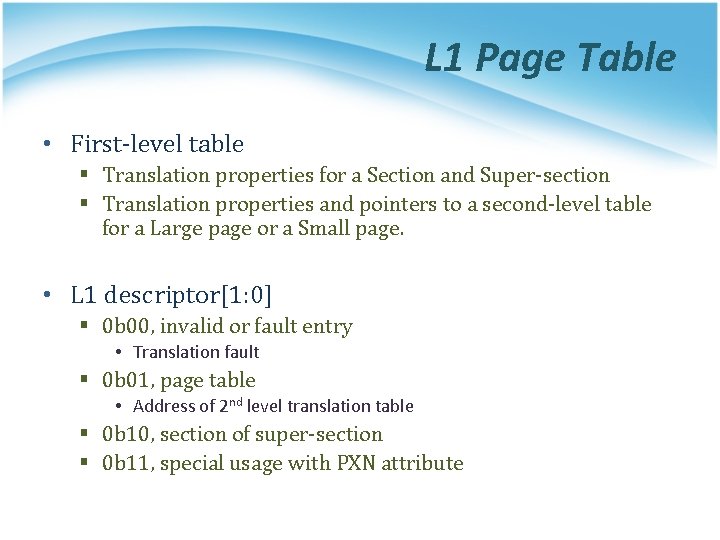
L 1 Page Table • First-level table § Translation properties for a Section and Super-section § Translation properties and pointers to a second-level table for a Large page or a Small page. • L 1 descriptor[1: 0] § 0 b 00, invalid or fault entry • Translation fault § 0 b 01, page table • Address of 2 nd level translation table § 0 b 10, section of super-section § 0 b 11, special usage with PXN attribute
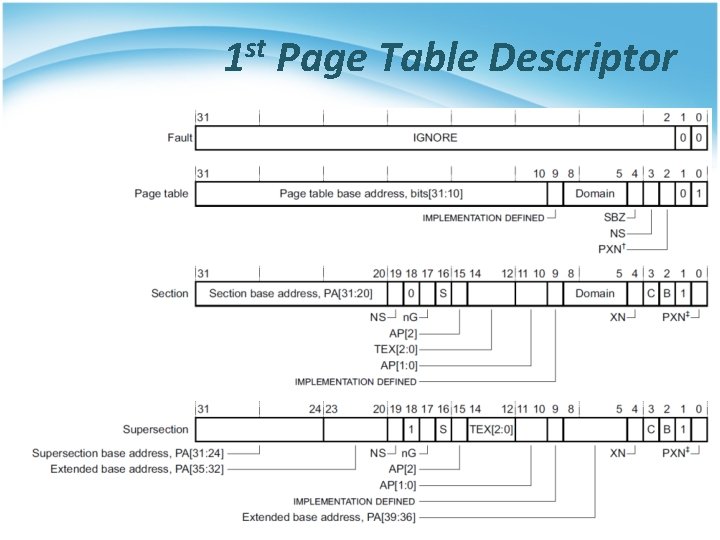
1 st Page Table Descriptor
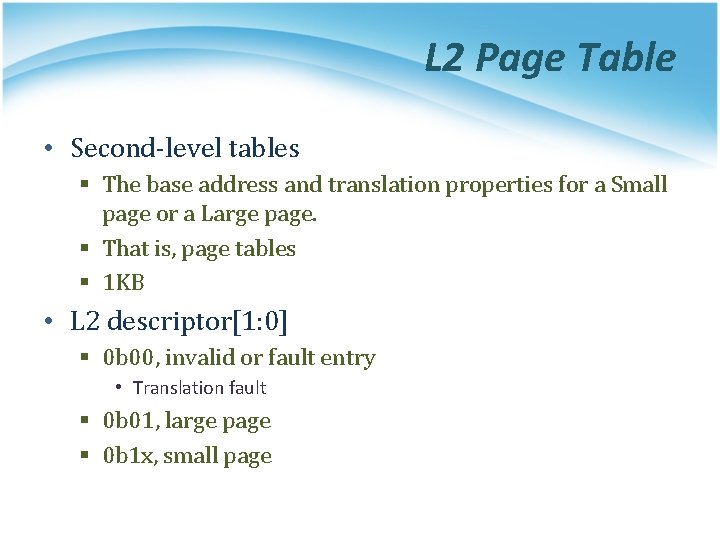
L 2 Page Table • Second-level tables § The base address and translation properties for a Small page or a Large page. § That is, page tables § 1 KB • L 2 descriptor[1: 0] § 0 b 00, invalid or fault entry • Translation fault § 0 b 01, large page § 0 b 1 x, small page
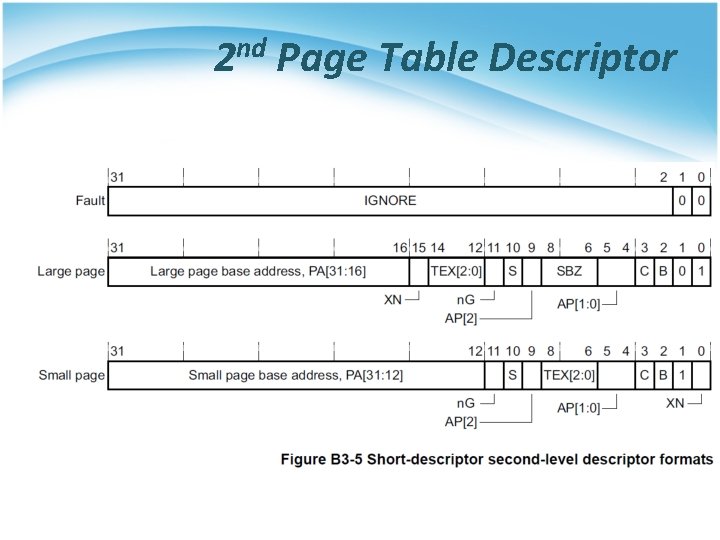
2 nd Page Table Descriptor
Concepts Shadow page table Hardware assistance Comparison MEMORY VIRTUALIZATION
Memory Management on a VM • Traditionally, OS fully controls all physical memory space and provides a continuous addressing space to each process • Guest OS is just one of user space processes of host OS • If guest OS is allowed to access the physical memory arbitrarily, then what happens? • In system virtualization, VMM should make all virtual machines share the physical memory space
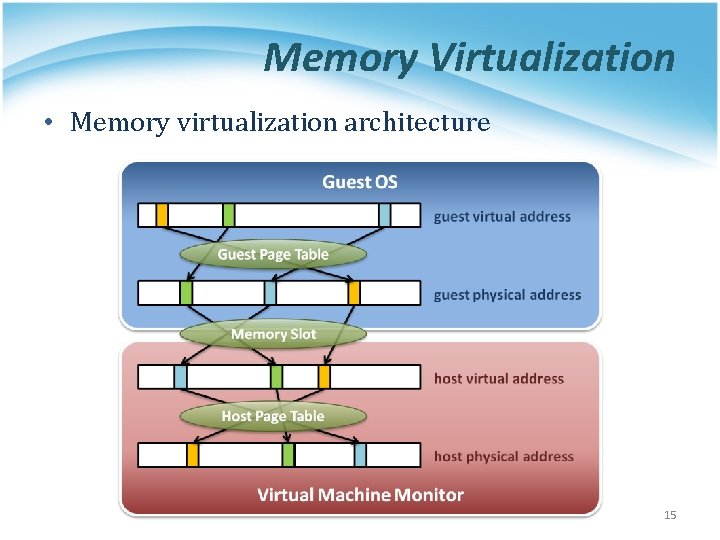
Memory Virtualization • Memory virtualization architecture 15
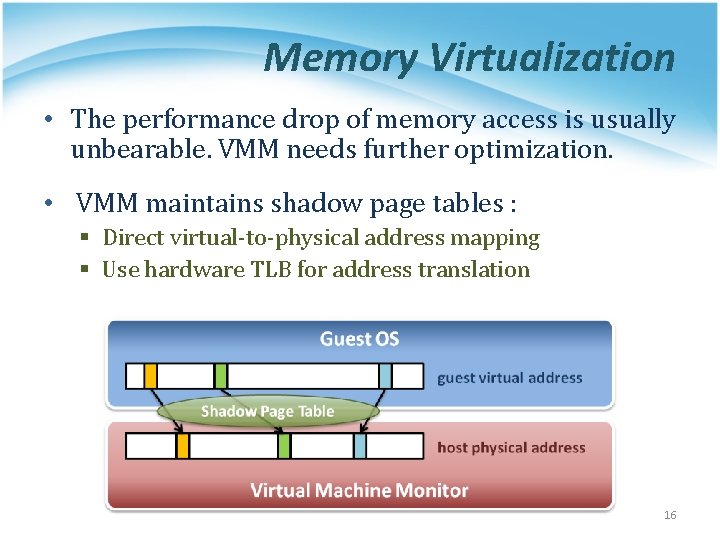
Memory Virtualization • The performance drop of memory access is usually unbearable. VMM needs further optimization. • VMM maintains shadow page tables : § Direct virtual-to-physical address mapping § Use hardware TLB for address translation 16
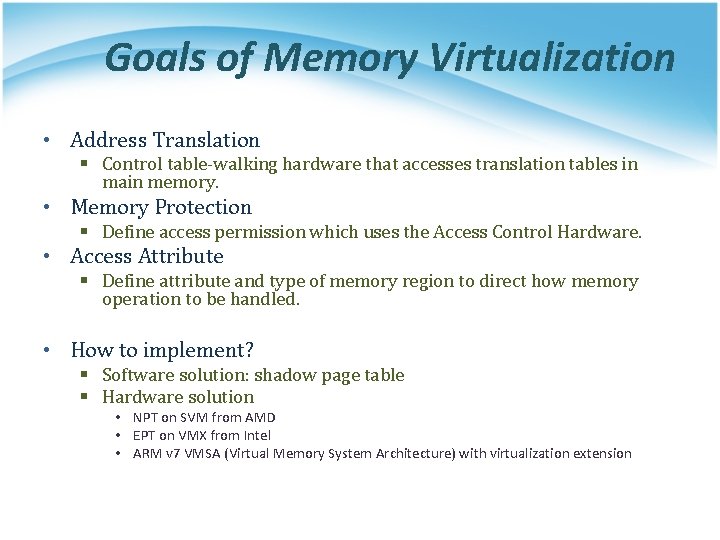
Goals of Memory Virtualization • Address Translation § Control table-walking hardware that accesses translation tables in main memory. • Memory Protection § Define access permission which uses the Access Control Hardware. • Access Attribute § Define attribute and type of memory region to direct how memory operation to be handled. • How to implement? § Software solution: shadow page table § Hardware solution • NPT on SVM from AMD • EPT on VMX from Intel • ARM v 7 VMSA (Virtual Memory System Architecture) with virtualization extension
Concepts Shadow page table Hardware assistance Comparison MEMORY VIRTUALIZATION
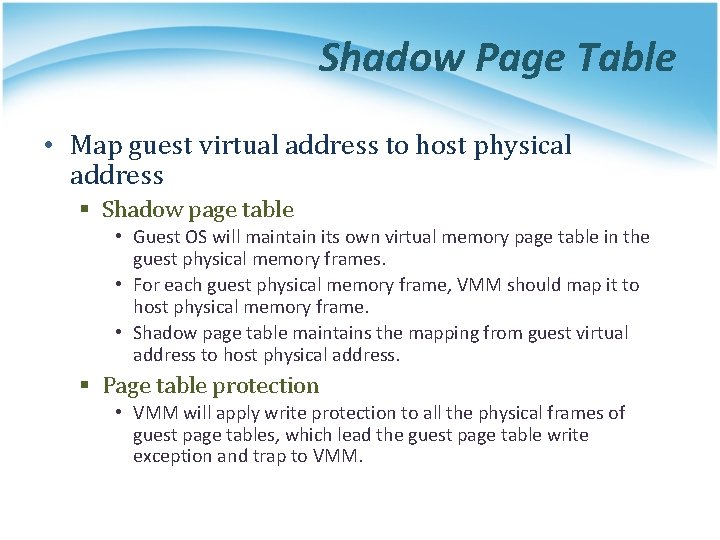
Shadow Page Table • Map guest virtual address to host physical address § Shadow page table • Guest OS will maintain its own virtual memory page table in the guest physical memory frames. • For each guest physical memory frame, VMM should map it to host physical memory frame. • Shadow page table maintains the mapping from guest virtual address to host physical address. § Page table protection • VMM will apply write protection to all the physical frames of guest page tables, which lead the guest page table write exception and trap to VMM.
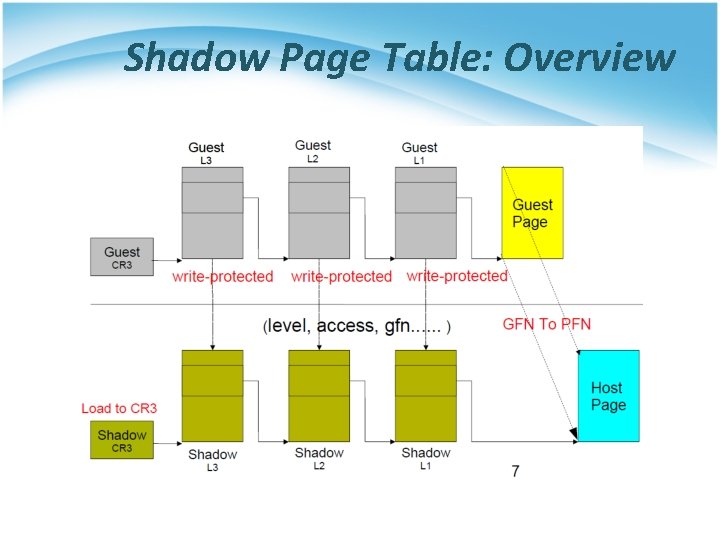
Shadow Page Table: Overview
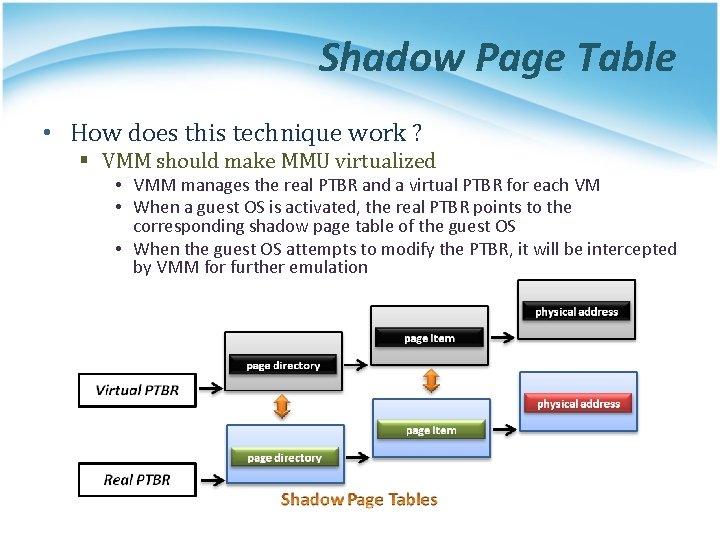
Shadow Page Table • How does this technique work ? § VMM should make MMU virtualized • VMM manages the real PTBR and a virtual PTBR for each VM • When a guest OS is activated, the real PTBR points to the corresponding shadow page table of the guest OS • When the guest OS attempts to modify the PTBR, it will be intercepted by VMM for further emulation
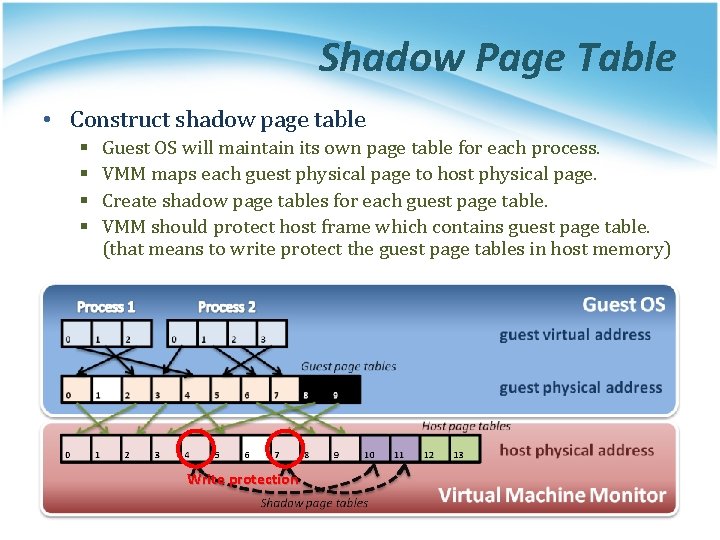
Shadow Page Table • Construct shadow page table § § Guest OS will maintain its own page table for each process. VMM maps each guest physical page to host physical page. Create shadow page tables for each guest page table. VMM should protect host frame which contains guest page table. (that means to write protect the guest page tables in host memory) Write protection
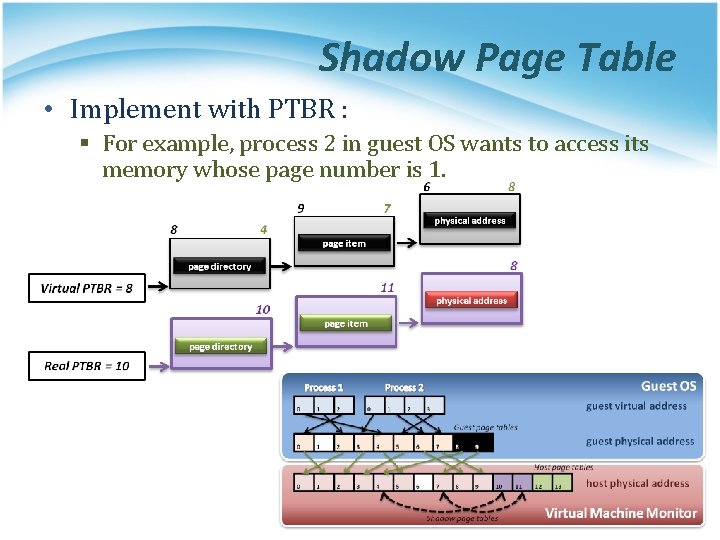
Shadow Page Table • Implement with PTBR : § For example, process 2 in guest OS wants to access its memory whose page number is 1.
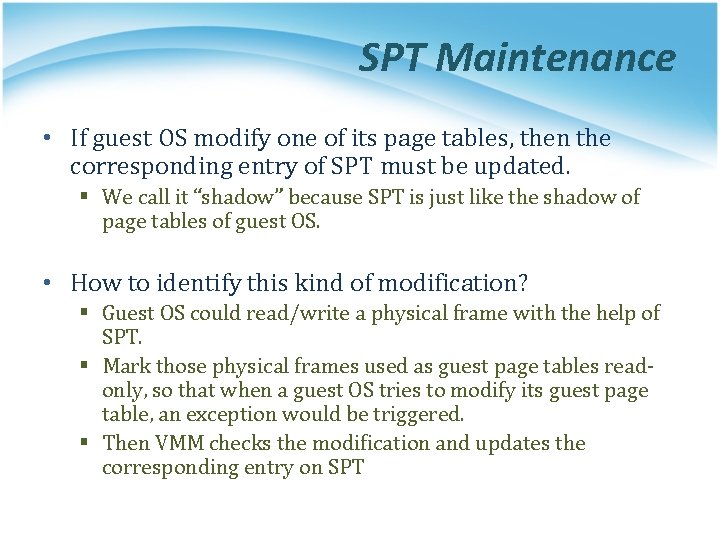
SPT Maintenance • If guest OS modify one of its page tables, then the corresponding entry of SPT must be updated. § We call it “shadow” because SPT is just like the shadow of page tables of guest OS. • How to identify this kind of modification? § Guest OS could read/write a physical frame with the help of SPT. § Mark those physical frames used as guest page tables readonly, so that when a guest OS tries to modify its guest page table, an exception would be triggered. § Then VMM checks the modification and updates the corresponding entry on SPT
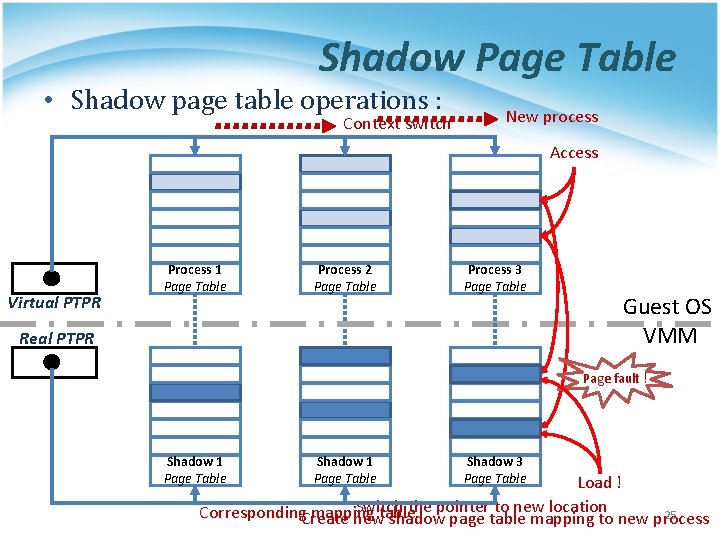
Shadow Page Table • Shadow page table operations : Context switch New process Access Virtual PTPR Process 1 Page Table Process 2 Page Table Process 3 Page Table Real PTPR Guest OS VMM Page fault ! Shadow 1 Page Table Shadow 3 Page Table Load ! Switch the pointer to new location Corresponding. Create mapping 25 newtable shadow page table mapping to new process
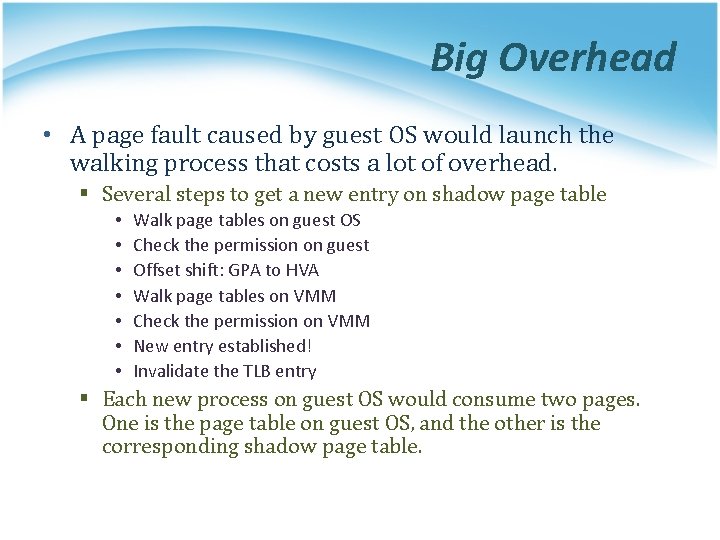
Big Overhead • A page fault caused by guest OS would launch the walking process that costs a lot of overhead. § Several steps to get a new entry on shadow page table • • Walk page tables on guest OS Check the permission on guest Offset shift: GPA to HVA Walk page tables on VMM Check the permission on VMM New entry established! Invalidate the TLB entry § Each new process on guest OS would consume two pages. One is the page table on guest OS, and the other is the corresponding shadow page table.
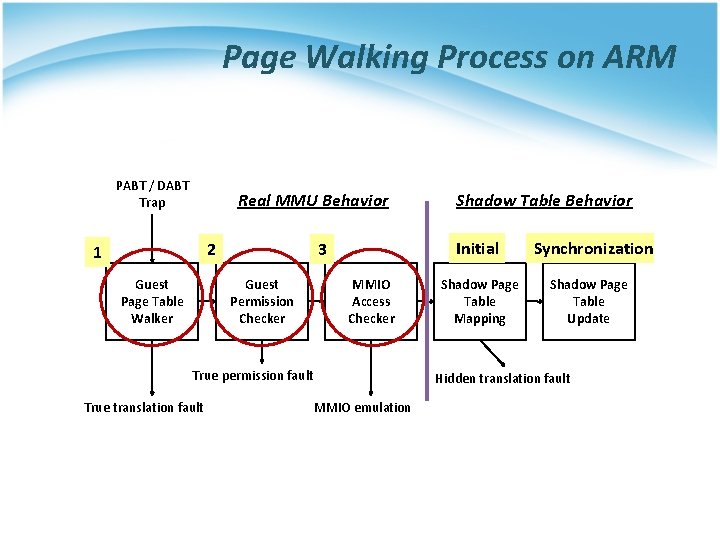
Page Walking Process on ARM PABT / DABT Trap Real MMU Behavior 2 1 Guest Page Table Walker Initial 3 Guest Permission Checker MMIO Access Checker True permission fault True translation fault Shadow Table Behavior Shadow Page Table Mapping Synchronization Shadow Page Table Update Hidden translation fault MMIO emulation
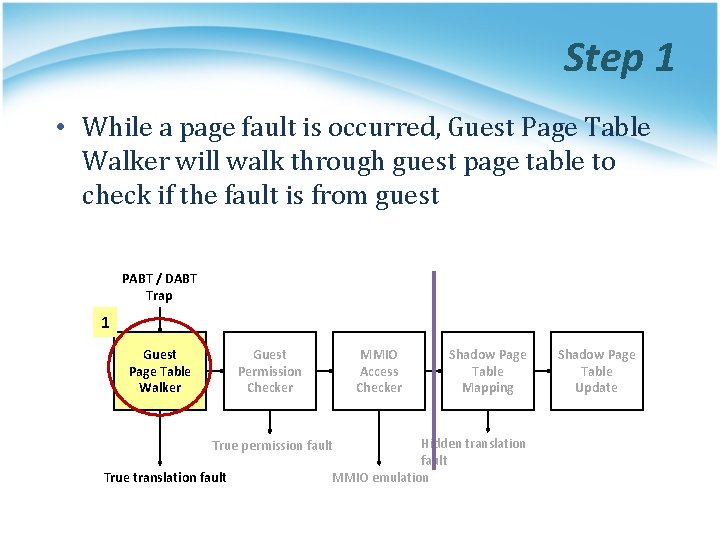
Step 1 • While a page fault is occurred, Guest Page Table Walker will walk through guest page table to check if the fault is from guest PABT / DABT Trap 1 Guest Page Table Walker Guest Permission Checker MMIO Access Checker Hidden translation fault MMIO emulation True permission fault True translation fault Shadow Page Table Mapping Shadow Page Table Update
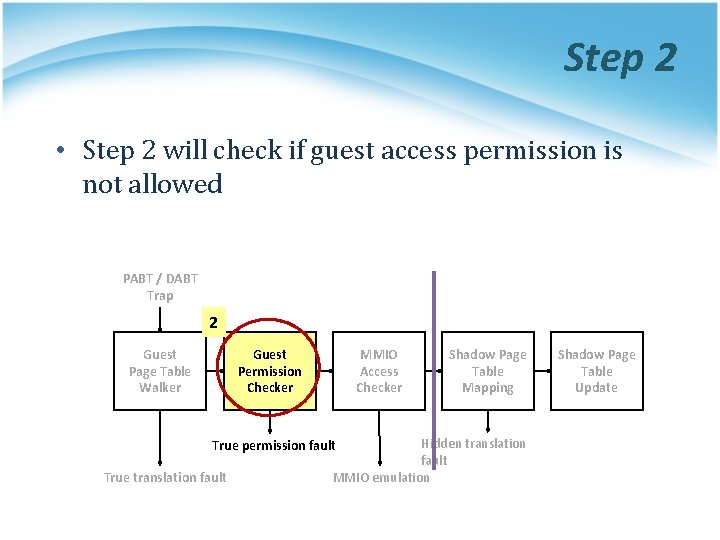
Step 2 • Step 2 will check if guest access permission is not allowed PABT / DABT Trap 2 Guest Page Table Walker Guest Permission Checker MMIO Access Checker Hidden translation fault MMIO emulation True permission fault True translation fault Shadow Page Table Mapping Shadow Page Table Update
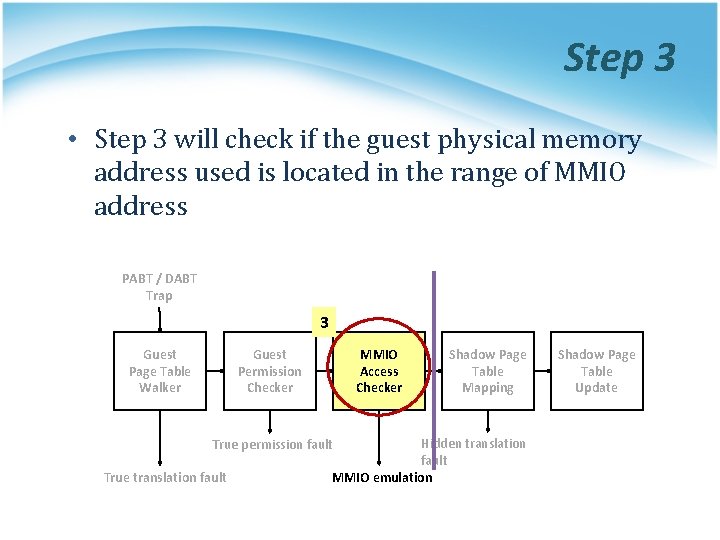
Step 3 • Step 3 will check if the guest physical memory address used is located in the range of MMIO address PABT / DABT Trap 3 Guest Page Table Walker Guest Permission Checker MMIO Access Checker Hidden translation fault MMIO emulation True permission fault True translation fault Shadow Page Table Mapping Shadow Page Table Update
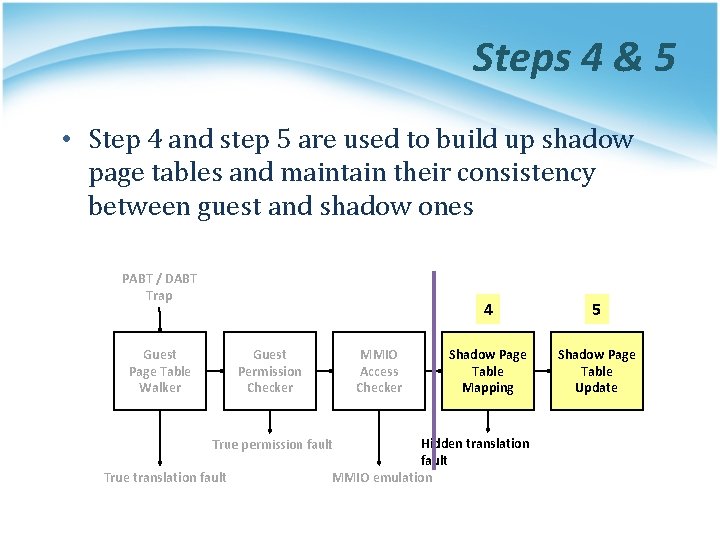
Steps 4 & 5 • Step 4 and step 5 are used to build up shadow page tables and maintain their consistency between guest and shadow ones PABT / DABT Trap Guest Page Table Walker Guest Permission Checker MMIO Access Checker 5 Shadow Page Table Mapping Shadow Page Table Update Hidden translation fault MMIO emulation True permission fault True translation fault 4
Optimization For SPT • Para-virtualization § Reduce VM exits § Guest OS would send a hyper call to VMM when guest OS sets the page table entries. § This method will eliminate from using write-protection for synchronization • No trap for non-present PTEs § Reduce VM exits § If the page-fault is caused by PTE not present, it is not intercepted by the host § Only works on VMX
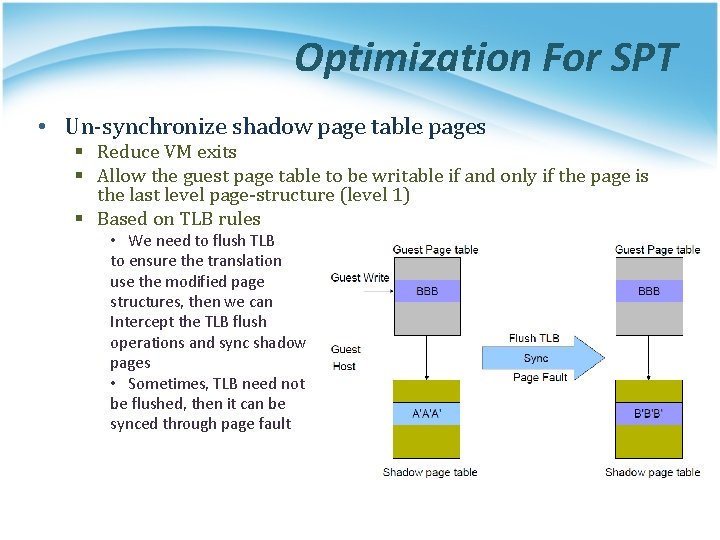
Optimization For SPT • Un-synchronize shadow page table pages § Reduce VM exits § Allow the guest page table to be writable if and only if the page is the last level page-structure (level 1) § Based on TLB rules • We need to flush TLB to ensure the translation use the modified page structures, then we can Intercept the TLB flush operations and sync shadow pages • Sometimes, TLB need not be flushed, then it can be synced through page fault
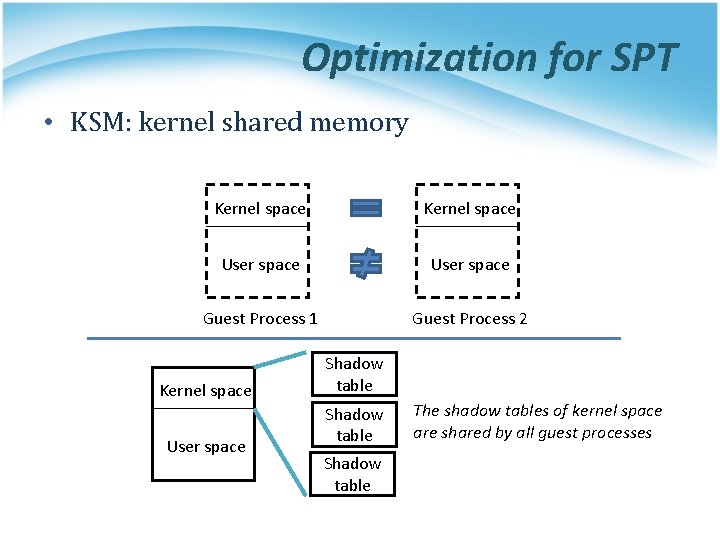
Optimization for SPT • KSM: kernel shared memory Kernel space User space Guest Process 1 Guest Process 2 Kernel space User space Shadow table The shadow tables of kernel space are shared by all guest processes
Other Issues • Page fault and page protection issue § When a physical page fault occurs, VMM needs to decide whether this exception should be injected to guest OS or not • If the page entry in a guest page table is still valid, VMM prepares for the corresponding page and does not inject any exception to guest OS. • If the page entry in a guest page table is invalid, then VMM directly injects the virtual page fault to guest OS.
Concepts Shadow page table Hardware assistance Comparison MEMORY VIRTUALIZATION
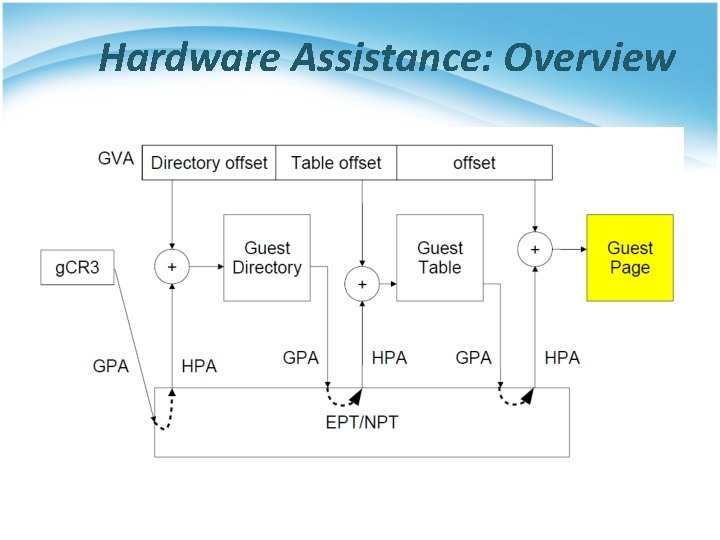
Hardware Assistance: Overview
Hardware Solution • Difficulties of shadow page table technique : § Shadow page table implementation is extremely complex. § Page fault mechanism and synchronization issues are critical. § Host memory space overhead is considerable. • But why we need this technique to virtualize MMU ? § MMU do not first implemented for virtualization. § MMU is knowing nothing about two level page address translation. • Now, let us consider hardware solution.
Extended Page Table • Concept of Extended Page Table (EPT) : § Instead of walking along with only one page table hierarchy, EPT technique implement one more page table hierarchy. • One page table is maintained by guest OS, which is used to generate guest physical address. • The other page table is maintained by VMM, which is used to map guest physical address to host physical address. § For each memory access operation, EPT MMU directly gets the guest physical address from guest page table, and then gets the host physical address by the VMM mapping table automatically.
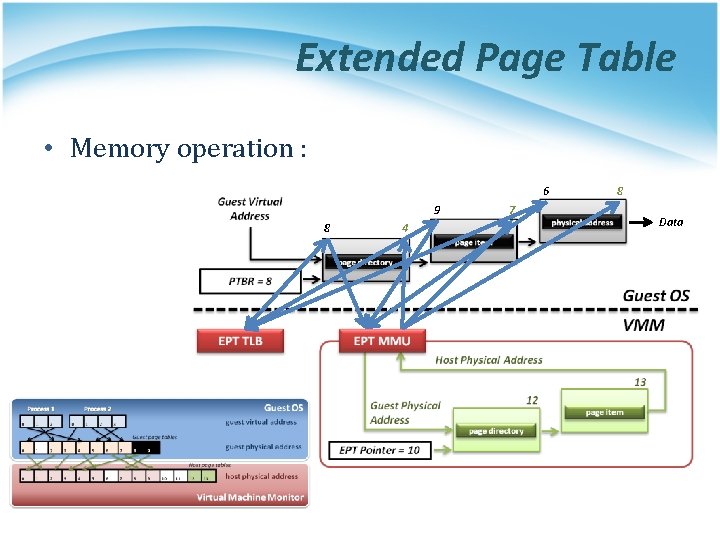
Extended Page Table • Memory operation : 6 9 8 4 7 8 Data
Concepts Shadow page table Hardware assistance Comparison MEMORY VIRTUALIZATION
Question • Computer architecture with virtualization extension is a trend. • Hardware-assisted techniques replace many software methods of virtualization. • However, is hardware-assisted implementation a definite winner?
Comparisons Hardware-assisted Software solution • Walk any requested address • Only walk when SPT entry miss § Appropriate to programs that have a large amount of page table miss when executing § Less chance to exit VM (less context switch) • Two-layer EPT § Means each access needs to walk two tables • Easier to develop § Many particular registers § Hardware helps guest OS to notify the VMM § Appropriate to programs that would access only some addresses frequently § Every access might be intercepted by VMM (many traps) • One reference § Fast and convenient when page hit • Hard to develop § Two-layer structure § Complicated reverse map § Permission emulation
Combination? • Is hardware-assisted implementation a definite winner? § No § How about combining these two methods? • Selective memory virtualization § The VMM can dynamically choose the memory management mechanism depending on the executing status. § Challenge • Hard to figure out the standard that we judge a program performs too many page table misses • An accurate algorithm to sample behaviors of a program is necessary § Group from Peking University completed a selective solution on VEE 2011 • Gain just a little bit performance improvement • For now, it’s not worth to do so.
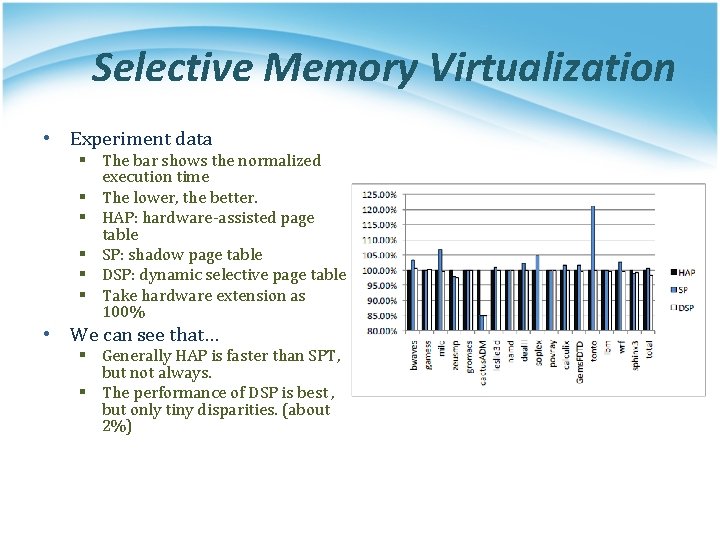
Selective Memory Virtualization • Experiment data § The bar shows the normalized execution time § The lower, the better. § HAP: hardware-assisted page table § SP: shadow page table § DSP: dynamic selective page table § Take hardware extension as 100% • We can see that… § Generally HAP is faster than SPT, but not always. § The performance of DSP is best , but only tiny disparities. (about 2%)
Memory Virtualization Summary • Software implementation § Memory architecture • MMU (memory management unit) • TLB (translation look-aside buffer) § Shadow page table • MMU virtualization by virtual PTBR • Shadow page table construction • Page fault and page table protection • Hardware assistance § Extended page table • Hardware walk guest and host page table simultaneously
Reference • Selective hardware/software memory virtualization § http: //www. cs. mtu. edu/~zlwang/papers/vee 11. pdf • ARM® Architecture Reference Manual: ARMv 7 -A and ARMv 7 -R edition
- Slides: 47