
Virtual Textures Texture Management in Silicon Chris Hall

- Slides: 13
Virtual Textures Texture Management in Silicon Chris Hall Director, Product Marketing 3 Dlabs Inc. © Copyright 3 Dlabs, 1999 - Page 1 - PROPRIETARY & CONF
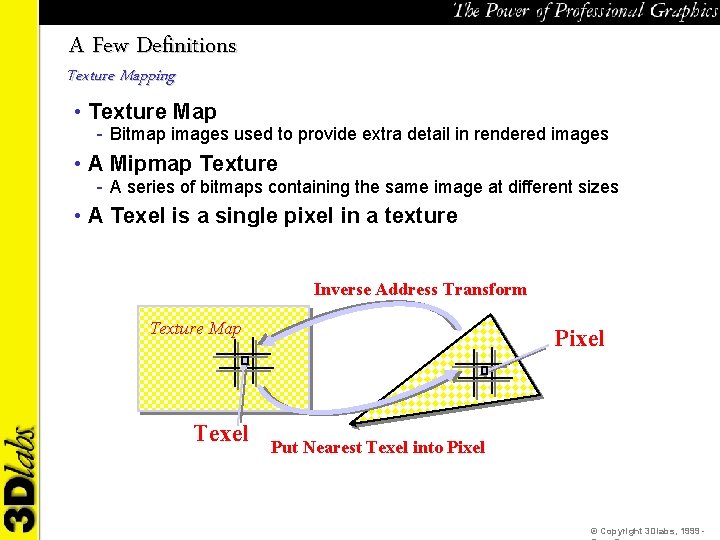
A Few Definitions Texture Mapping • Texture Map - Bitmap images used to provide extra detail in rendered images • A Mipmap Texture - A series of bitmaps containing the same image at different sizes • A Texel is a single pixel in a texture Inverse Address Transform Texture Map Texel Pixel Put Nearest Texel into Pixel © Copyright 3 Dlabs, 1999 -
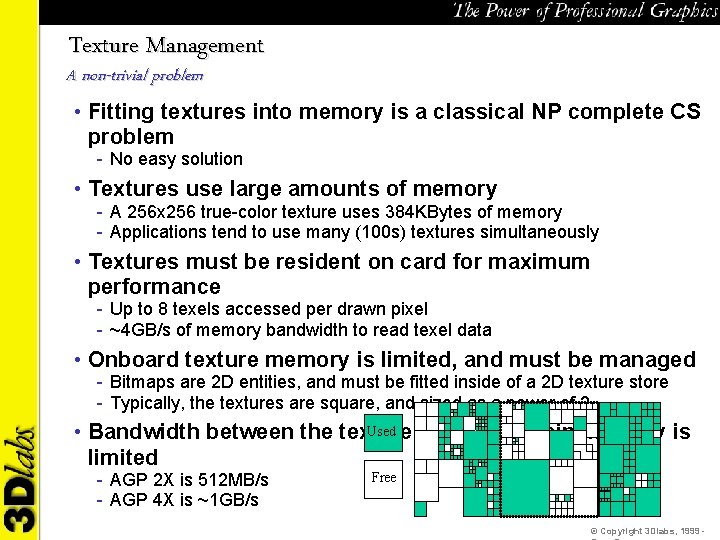
Texture Management A non-trivial problem • Fitting textures into memory is a classical NP complete CS problem - No easy solution • Textures use large amounts of memory - A 256 x 256 true-color texture uses 384 KBytes of memory - Applications tend to use many (100 s) textures simultaneously • Textures must be resident on card for maximum performance - Up to 8 texels accessed per drawn pixel - ~4 GB/s of memory bandwidth to read texel data • Onboard texture memory is limited, and must be managed - Bitmaps are 2 D entities, and must be fitted inside of a 2 D texture store - Typically, the textures are square, and sized as a power of 2 Used • Bandwidth between the texture store and main memory is limited - AGP 2 X is 512 MB/s - AGP 4 X is ~1 GB/s Free © Copyright 3 Dlabs, 1999 -
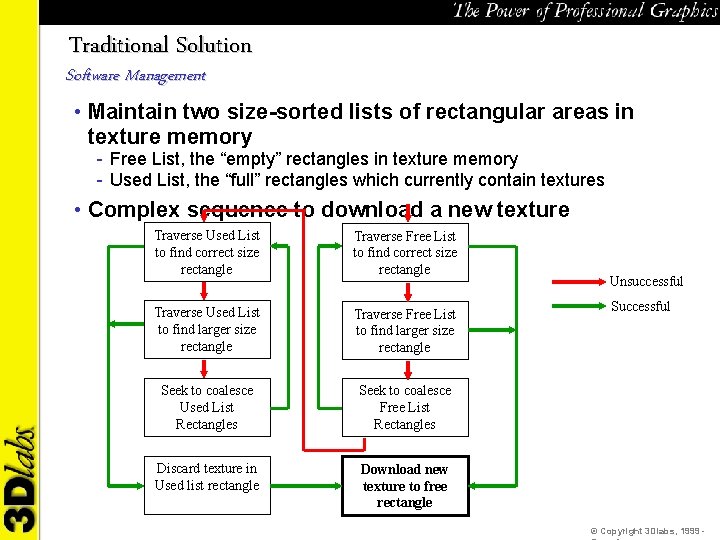
Traditional Solution Software Management • Maintain two size-sorted lists of rectangular areas in texture memory - Free List, the “empty” rectangles in texture memory - Used List, the “full” rectangles which currently contain textures • Complex sequence to download a new texture Traverse Used List to find correct size rectangle Traverse Free List to find correct size rectangle Traverse Used List to find larger size rectangle Traverse Free List to find larger size rectangle Seek to coalesce Used List Rectangles Seek to coalesce Free List Rectangles Discard texture in Used list rectangle Download new texture to free rectangle Unsuccessful Successful © Copyright 3 Dlabs, 1999 -
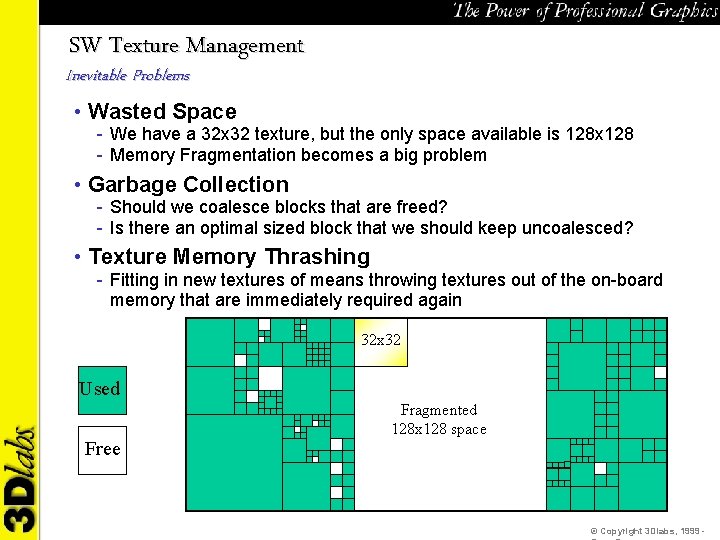
SW Texture Management Inevitable Problems • Wasted Space - We have a 32 x 32 texture, but the only space available is 128 x 128 - Memory Fragmentation becomes a big problem • Garbage Collection - Should we coalesce blocks that are freed? - Is there an optimal sized block that we should keep uncoalesced? • Texture Memory Thrashing - Fitting in new textures of means throwing textures out of the on-board memory that are immediately required again 32 x 32 Used Free Fragmented 128 x 128 space © Copyright 3 Dlabs, 1999 -
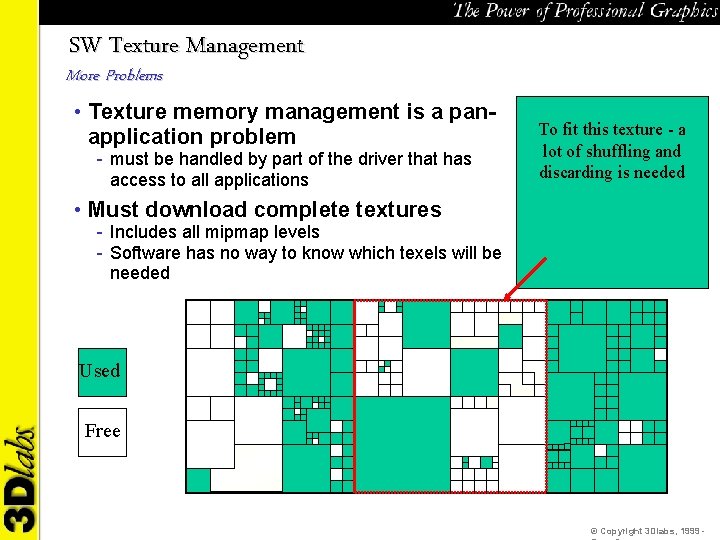
SW Texture Management More Problems • Texture memory management is a panapplication problem - must be handled by part of the driver that has access to all applications To fit this texture - a lot of shuffling and discarding is needed • Must download complete textures - Includes all mipmap levels - Software has no way to know which texels will be needed Used Free © Copyright 3 Dlabs, 1999 -
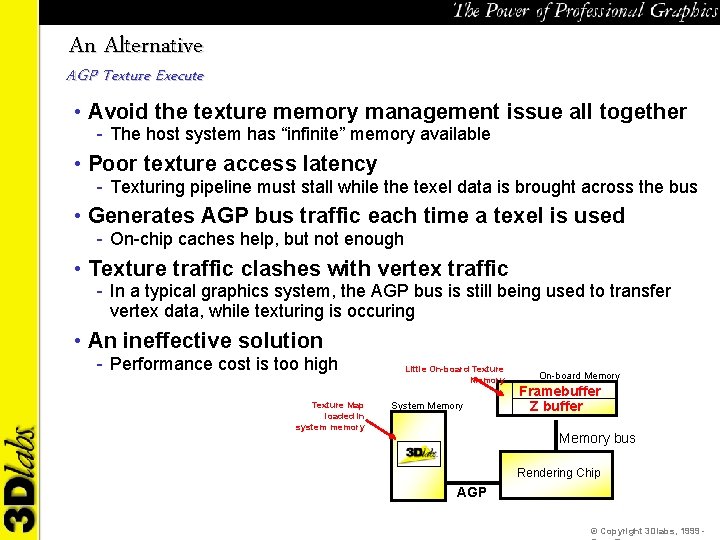
An Alternative AGP Texture Execute • Avoid the texture memory management issue all together - The host system has “infinite” memory available • Poor texture access latency - Texturing pipeline must stall while the texel data is brought across the bus • Generates AGP bus traffic each time a texel is used - On-chip caches help, but not enough • Texture traffic clashes with vertex traffic - In a typical graphics system, the AGP bus is still being used to transfer vertex data, while texturing is occuring • An ineffective solution - Performance cost is too high Texture Map loaded in system memory Little On-board Texture Memory System Memory On-board Memory Framebuffer Z buffer Memory bus Rendering Chip AGP © Copyright 3 Dlabs, 1999 -
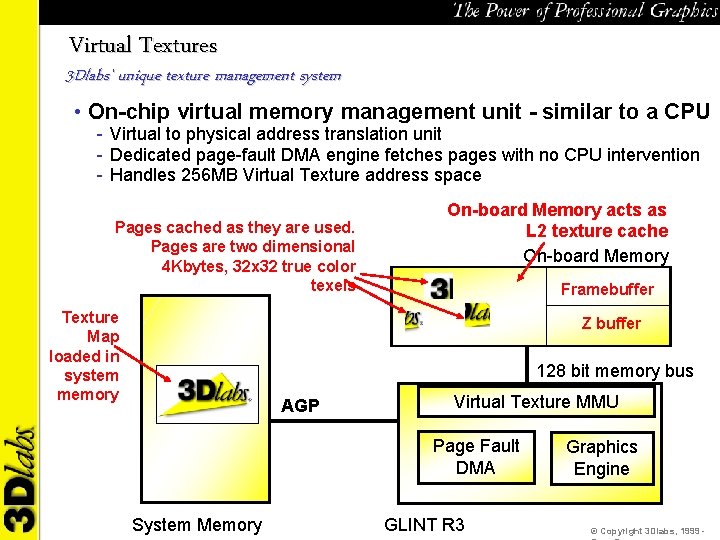
Virtual Textures 3 Dlabs’ unique texture management system • On-chip virtual memory management unit - similar to a CPU - Virtual to physical address translation unit - Dedicated page-fault DMA engine fetches pages with no CPU intervention - Handles 256 MB Virtual Texture address space Pages cached as they are used. Pages are two dimensional 4 Kbytes, 32 x 32 true color texels Texture Map loaded in system memory On-board Memory acts as L 2 texture cache On-board Memory Framebuffer Z buffer 128 bit memory bus AGP Virtual Texture MMU Page Fault DMA System Memory GLINT R 3 Graphics Engine © Copyright 3 Dlabs, 1999 -
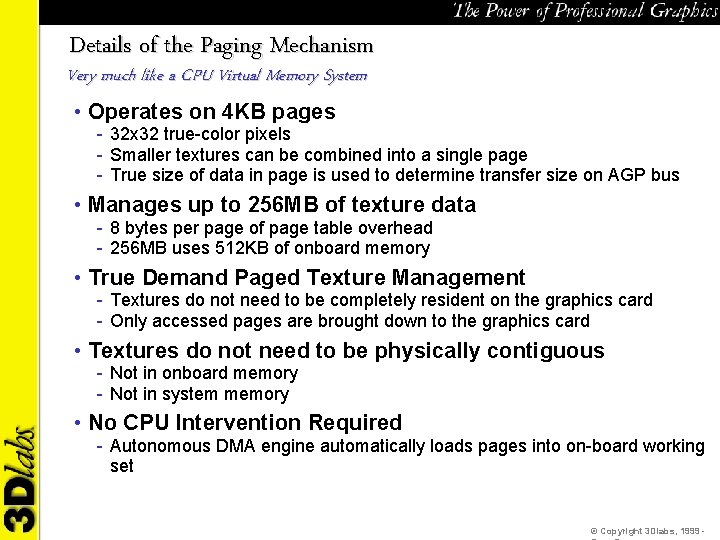
Details of the Paging Mechanism Very much like a CPU Virtual Memory System • Operates on 4 KB pages - 32 x 32 true-color pixels - Smaller textures can be combined into a single page - True size of data in page is used to determine transfer size on AGP bus • Manages up to 256 MB of texture data - 8 bytes per page of page table overhead - 256 MB uses 512 KB of onboard memory • True Demand Paged Texture Management - Textures do not need to be completely resident on the graphics card - Only accessed pages are brought down to the graphics card • Textures do not need to be physically contiguous - Not in onboard memory - Not in system memory • No CPU Intervention Required - Autonomous DMA engine automatically loads pages into on-board working set © Copyright 3 Dlabs, 1999 -
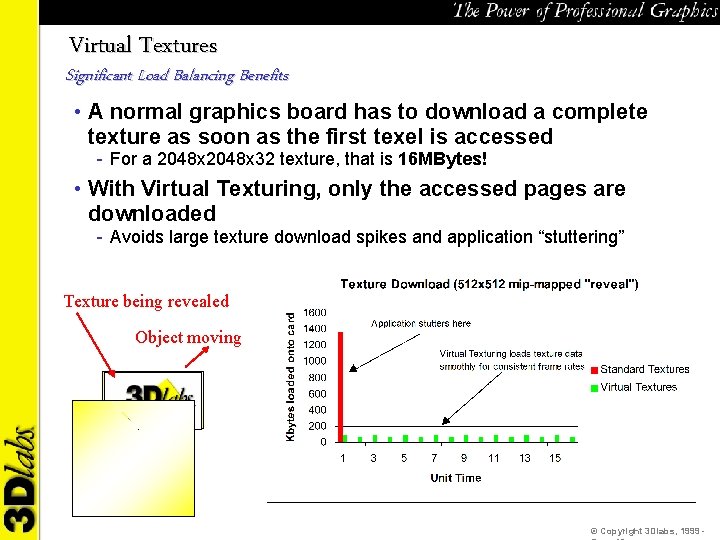
Virtual Textures Significant Load Balancing Benefits • A normal graphics board has to download a complete texture as soon as the first texel is accessed - For a 2048 x 32 texture, that is 16 MBytes! • With Virtual Texturing, only the accessed pages are downloaded - Avoids large texture download spikes and application “stuttering” Texture being revealed Object moving © Copyright 3 Dlabs, 1999 -
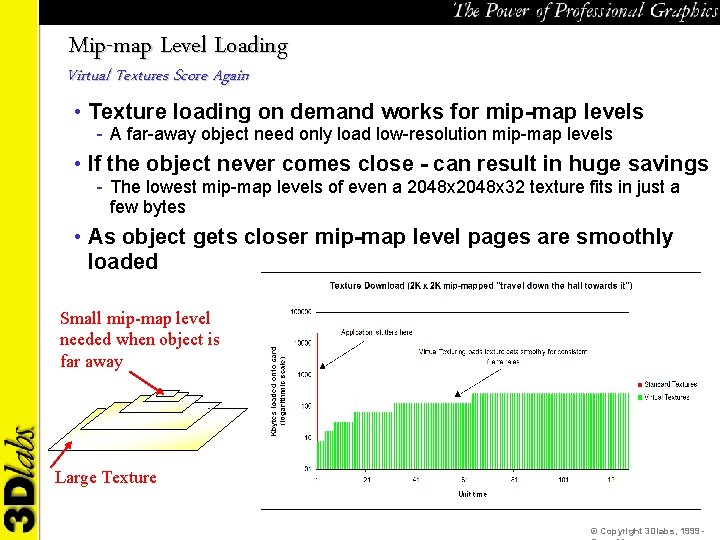
Mip-map Level Loading Virtual Textures Score Again • Texture loading on demand works for mip-map levels - A far-away object need only load low-resolution mip-map levels • If the object never comes close - can result in huge savings - The lowest mip-map levels of even a 2048 x 32 texture fits in just a few bytes • As object gets closer mip-map level pages are smoothly loaded Small mip-map level needed when object is far away Large Texture © Copyright 3 Dlabs, 1999 -
Other Virtual Textures Benefits Texture management software becomes trivial • Software simply identifies location of texture in host memory to the graphics sub-system • No CPU Intervention needed on a page miss - Geometry pipeline doesn’t need to understand whether or not to load a new texture down to the graphics sub-system • Ability to (effectively) use textures that are larger than available memory • Easily handles thousands of small textures • Can be extended to access System Virtual Memory - Interrupt generated upon page fault - ISR causes operating system to page in required data - ISR causes graphics sub-system to load required data © Copyright 3 Dlabs, 1999 -
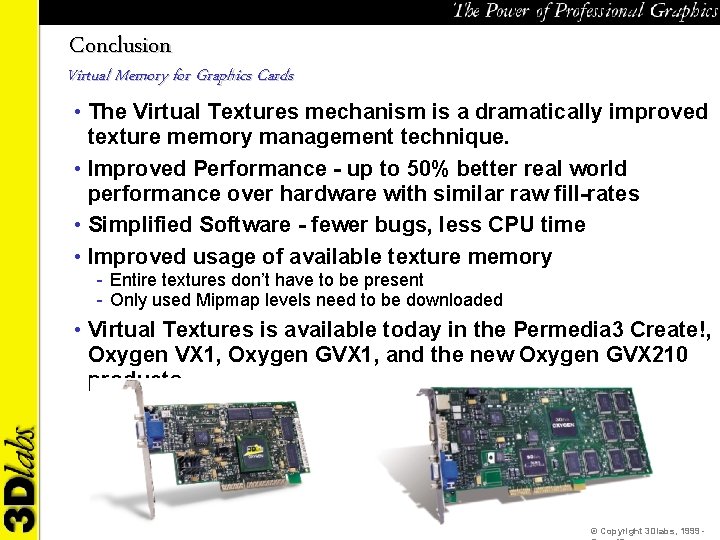
Conclusion Virtual Memory for Graphics Cards • The Virtual Textures mechanism is a dramatically improved texture memory management technique. • Improved Performance - up to 50% better real world performance over hardware with similar raw fill-rates • Simplified Software - fewer bugs, less CPU time • Improved usage of available texture memory - Entire textures don’t have to be present - Only used Mipmap levels need to be downloaded • Virtual Textures is available today in the Permedia 3 Create!, Oxygen VX 1, Oxygen GVX 1, and the new Oxygen GVX 210 products © Copyright 3 Dlabs, 1999 -