
Virtual Research Presentation Conference Autonomous Deep Space Navigation
![Publications and References [1] Simone D’Amico et al. , “Noncooperative rendezvous using angles-only optical](https://slidetodoc.com/presentation_image_h2/b12f928ea03eac11fba4d72fd83342fd/image-6.jpg "Publications and References [1] Simone D’Amico et al. , “Noncooperative rendezvous using angles-only optical")
- Slides: 6
Virtual Research Presentation Conference Autonomous Deep Space Navigation using Intersatellite Optical Measurements Principal Investigator: Stefano Campagnola (*392 M) Co-Is: Shyam Bhaskaran (*392 J), Eric Gustafson (*392 A), Tim Mc. Elrath (*3920), Simone D’Amico (o), Justin Kruger(o), Katie Wallace(o), (o) Adam Koening * Jet Propulsion Laboratory, California Institute of Technology, o Stanford University Program: SURP Assigned Presentation # RPC-187
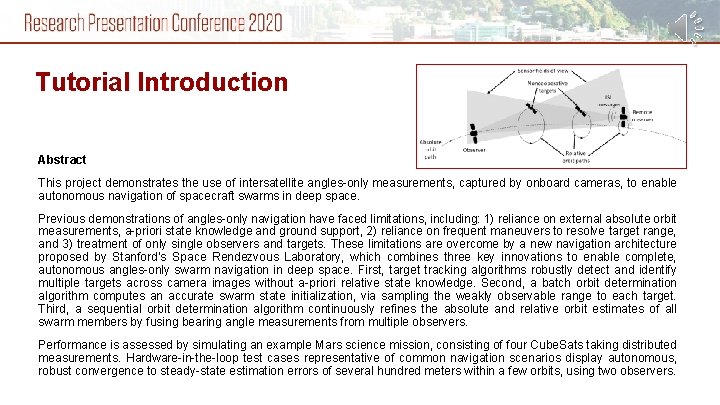
Tutorial Introduction Abstract This project demonstrates the use of intersatellite angles-only measurements, captured by onboard cameras, to enable autonomous navigation of spacecraft swarms in deep space. Previous demonstrations of angles-only navigation have faced limitations, including: 1) reliance on external absolute orbit measurements, a-priori state knowledge and ground support, 2) reliance on frequent maneuvers to resolve target range, and 3) treatment of only single observers and targets. These limitations are overcome by a new navigation architecture proposed by Stanford’s Space Rendezvous Laboratory, which combines three key innovations to enable complete, autonomous angles-only swarm navigation in deep space. First, target tracking algorithms robustly detect and identify multiple targets across camera images without a-priori relative state knowledge. Second, a batch orbit determination algorithm computes an accurate swarm state initialization, via sampling the weakly observable range to each target. Third, a sequential orbit determination algorithm continuously refines the absolute and relative orbit estimates of all swarm members by fusing bearing angle measurements from multiple observers. Performance is assessed by simulating an example Mars science mission, consisting of four Cube. Sats taking distributed measurements. Hardware-in-the-loop test cases representative of common navigation scenarios display autonomous, robust convergence to steady-state estimation errors of several hundred meters within a few orbits, using two observers.
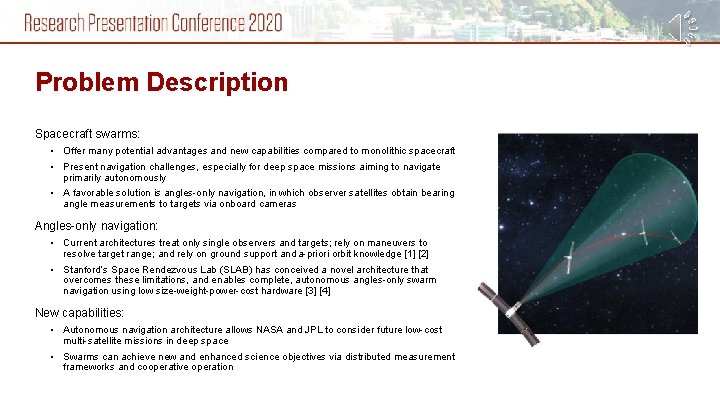
Problem Description Spacecraft swarms: • Offer many potential advantages and new capabilities compared to monolithic spacecraft • Present navigation challenges, especially for deep space missions aiming to navigate primarily autonomously • A favorable solution is angles-only navigation, in which observer satellites obtain bearing angle measurements to targets via onboard cameras Angles-only navigation: • Current architectures treat only single observers and targets; rely on maneuvers to resolve target range; and rely on ground support and a-priori orbit knowledge [1] [2] • Stanford’s Space Rendezvous Lab (SLAB) has conceived a novel architecture that overcomes these limitations, and enables complete, autonomous angles-only swarm navigation using low size-weight-power-cost hardware [3] [4] New capabilities: • Autonomous navigation architecture allows NASA and JPL to consider future low-cost multi-satellite missions in deep space • Swarms can achieve new and enhanced science objectives via distributed measurement frameworks and cooperative operation
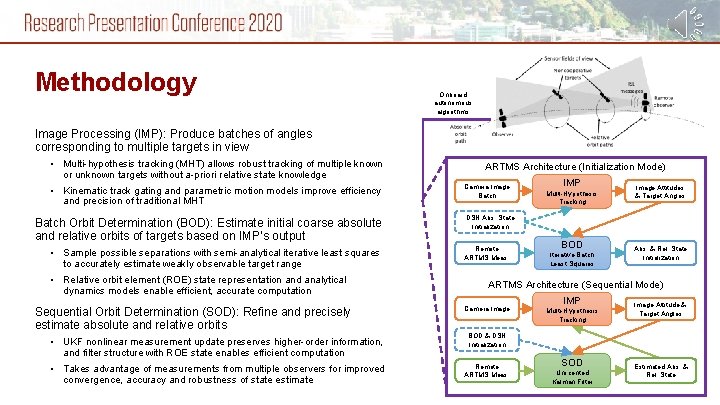
Methodology Onboard autonomous algorithms Image Processing (IMP): Produce batches of angles corresponding to multiple targets in view • Multi-hypothesis tracking (MHT) allows robust tracking of multiple known or unknown targets without a-priori relative state knowledge • Kinematic track gating and parametric motion models improve efficiency and precision of traditional MHT Batch Orbit Determination (BOD): Estimate initial coarse absolute and relative orbits of targets based on IMP’s output • Sample possible separations with semi-analytical iterative least squares to accurately estimate weakly observable target range • Relative orbit element (ROE) state representation and analytical dynamics models enable efficient, accurate computation Sequential Orbit Determination (SOD): Refine and precisely estimate absolute and relative orbits • UKF nonlinear measurement update preserves higher-order information, and filter structure with ROE state enables efficient computation • Takes advantage of measurements from multiple observers for improved convergence, accuracy and robustness of state estimate ARTMS Architecture (Initialization Mode) Camera Image Batch IMP Multi-Hypothesis Tracking Image Attitudes & Target Angles DSN Abs. State Initialization Remote ARTMS Meas. BOD Iterative Batch Least Squares Abs. & Rel. State Initialization ARTMS Architecture (Sequential Mode) Camera Image IMP Multi-Hypothesis Tracking Image Attitude & Target Angles BOD & DSN Initialization Remote ARTMS Meas. SOD Unscented Kalman Filter Estimated Abs. & Rel. State
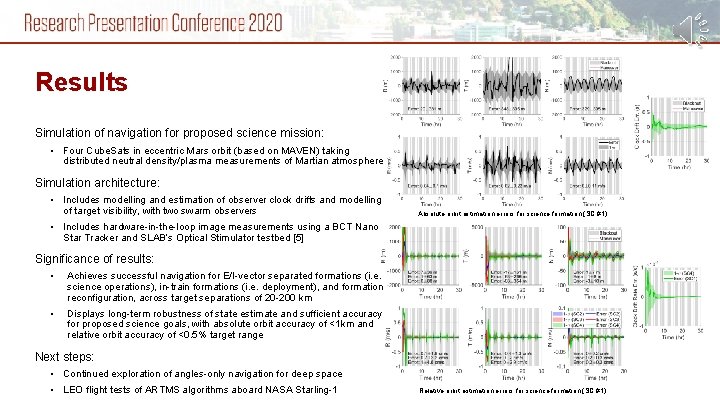
Results Simulation of navigation for proposed science mission: • Four Cube. Sats in eccentric Mars orbit (based on MAVEN) taking distributed neutral density/plasma measurements of Martian atmosphere Simulation architecture: • Includes modelling and estimation of observer clock drifts and modelling of target visibility, with two swarm observers Absolute orbit estimation errors for science formation (SC #1) • Includes hardware-in-the-loop image measurements using a BCT Nano Star Tracker and SLAB’s Optical Stimulator testbed [5] Significance of results: • Achieves successful navigation for E/I-vector separated formations (i. e. science operations), in-train formations (i. e. deployment), and formation reconfiguration, across target separations of 20 -200 km • Displays long-term robustness of state estimate and sufficient accuracy for proposed science goals, with absolute orbit accuracy of <1 km and relative orbit accuracy of <0. 5% target range Next steps: • Continued exploration of angles-only navigation for deep space • LEO flight tests of ARTMS algorithms aboard NASA Starling-1 Relative orbit estimation errors for science formation (SC #1)
Publications and References [1] Simone D’Amico et al. , “Noncooperative rendezvous using angles-only optical navigation: System design and flight results”, Journal of Guidance, Control and Dynamics 36 (2013): pp. 1476 -1595. [2] Gabriella Gaias and Jean-Sebastien Ardaens, “Flight Demonstration of Autonomous Noncooperative Rendezvous in Low Earth Orbit”, Journal of Guidance, Control and Dynamics 41 (2017): pp. 1337 -1354. [3] Adam W. Koenig, Justin Kruger, and Simone D’Amico. “ARTMS: Enabling Autonomous Distributed Angles-Only Orbit Estimation for Spacecraft Swarms”, American Control Conference, New Orleans, Louisiana (2020). [4] Justin Kruger, Kathryn Wallace, Adam W. Koenig and Simone D’Amico. “Autonomous Multi-Observer Angles-Only Navigation for Spacecraft Swarms around Planetary Bodies”, IEEE Aerospace Conference, Big Sky, Montana (2021). [5] Connor Beierle and Simone D’Amico, “High fidelity validation of vision-based sensors and algorithms for spaceborne navigation”, Journal of Spacecraft and Rockets 56 (2019): pp. 1060 -1072.