
Virtual Reality Plan 1 2 3 4 5
- Slides: 23
Virtual Reality Plan 1. 2. 3. 4. 5. What is VR What is required for VR A brief history of VR Understanding of principles, methods and applications of VR Advantages and limitations of VR 1
What is VR? Virtual (Merriam-Webster): • • …in essense, in effect, hypothetical, existence inferred from indirect evidence …being on or simulated on a computer or computer network Reality (Merriam-Webster): • • the quality or state of being real (circular) something that is neither derivative nor dependent but exists necessarily Virtual Reality: • a (computer-generated) environment simulating reality (? ) 2
What is VR? Visons le plus haut possible… "The ultimate display would, of course, be a room within which the computer can control the existence of matter. A chair displayed in such a room would be good enough to sit in. Handcuffs displayed in such a room would be confining, and a bullet displayed in such a room would be fatal. " (Sutherland, 1965) 3
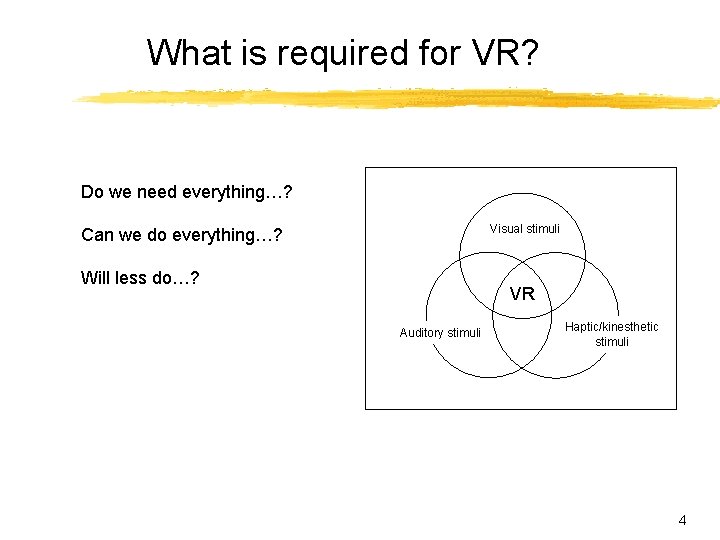
What is required for VR? Do we need everything…? Visual stimuli Can we do everything…? Will less do…? VR Auditory stimuli Haptic/kinesthetic stimuli 4
What is required for VR? Do we need everything…? Can we do everything…? Will less do…? We need measures to be able to answer these questions… 5
What is required for VR? Do we need everything…? Can we do everything…? Immersion and Presence Will less do…? 6
What is required for VR? Immersion: the sense of losing the real world (in a simulated environment): • • • Sensory-motoric immersion skillful actions - players feel "in the zone" while perfecting actions that result in success Cognitive immersion associated with mental challenge - chess players choosing a correct solution among a broad array of possibilities Emotional immersion Investment in the story - similar to what is experienced while reading a book or watching a movie (Wikipedia) 7
What is required for VR? Presence: the sense of being bodily present (in a simulated environment) Two types: • • Subjective presence the likelihood/extent to which the person judges himself to be physically present in the virtual environment (subjective reality) Objective presence the likelihood/extent to which the person completes a task Schuemi et al (2001) “VR goes one step further than immersion to deliver ‘presence’. This is something that can only be realised by VR. ” Shuhei Yoshida, president of Sony Computer Entertainment Worldwide Studios at the 2014 Game Developers Conference in San Francisco. 8
What is required for VR? Do we need everything/will less do…? Immersion • • • Sensory-motoric immersion: we experience this while playing video games (V+A) Cognitive immersion: chess players, maths problems… (V) Emotional immersion: books, films… (V+A) So we can argue that we don’t need everything and less will do to achieve immersion in virtual environments… 9
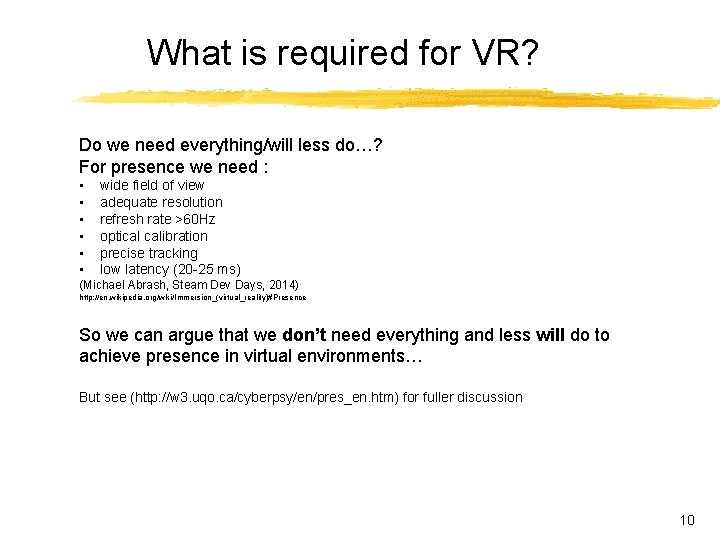
What is required for VR? Do we need everything/will less do…? For presence we need : • • • wide field of view adequate resolution refresh rate >60 Hz optical calibration precise tracking low latency (20 -25 ms) (Michael Abrash, Steam Dev Days, 2014) http: //en. wikipedia. org/wiki/Immersion_(virtual_reality)#Presence So we can argue that we don’t need everything and less will do to achieve presence in virtual environments… But see (http: //w 3. uqo. ca/cyberpsy/en/pres_en. htm) for fuller discussion 10
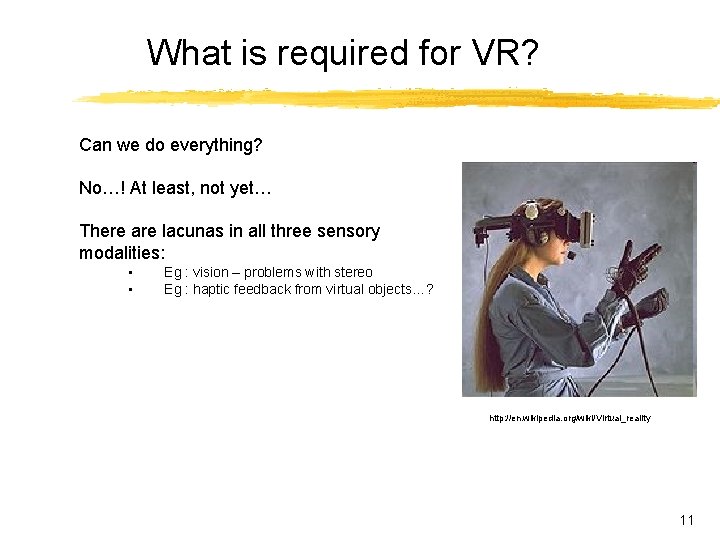
What is required for VR? Can we do everything? No…! At least, not yet… There are lacunas in all three sensory modalities: • • Eg : vision – problems with stereo Eg : haptic feedback from virtual objects…? http: //en. wikipedia. org/wiki/Virtual_reality 11
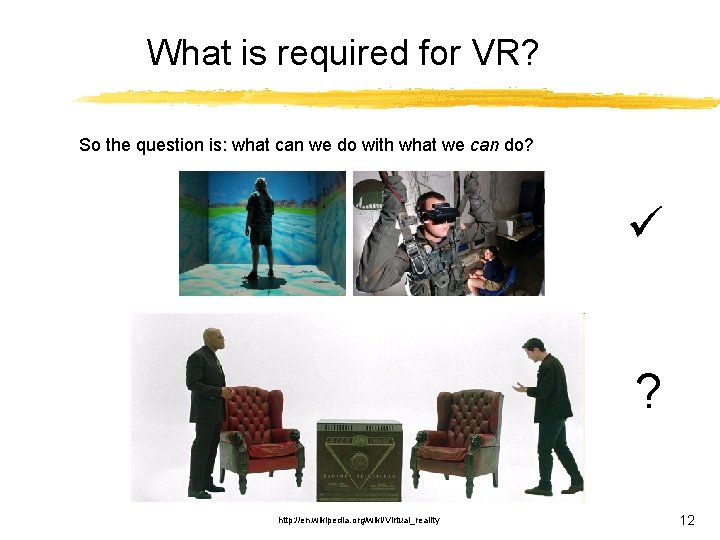
What is required for VR? So the question is: what can we do with what we can do? ? http: //en. wikipedia. org/wiki/Virtual_reality 12
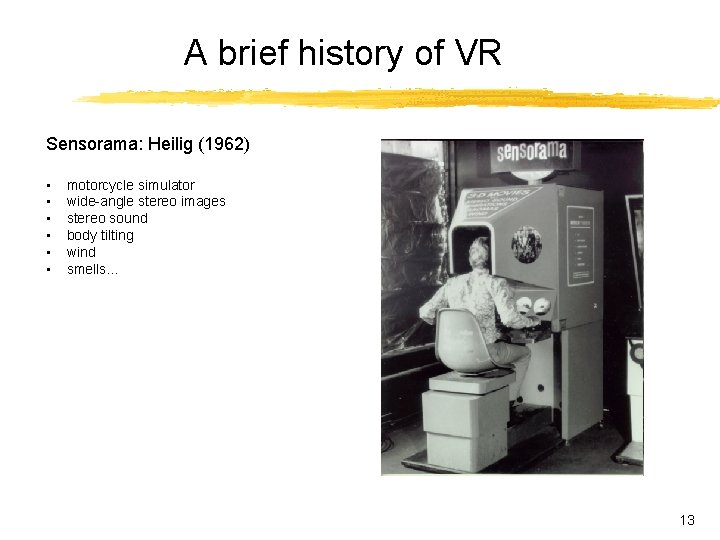
A brief history of VR Sensorama: Heilig (1962) • • • motorcycle simulator wide-angle stereo images stereo sound body tilting wind smells… 13
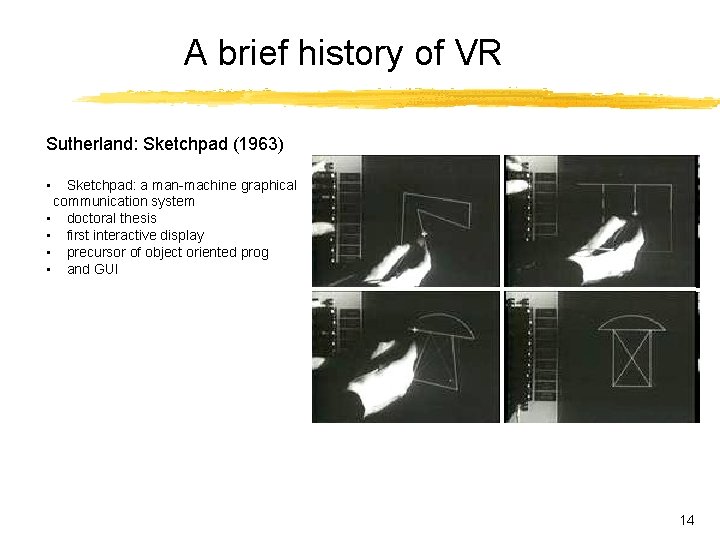
A brief history of VR Sutherland: Sketchpad (1963) • Sketchpad: a man-machine graphical communication system • doctoral thesis • first interactive display • precursor of object oriented prog • and GUI 14
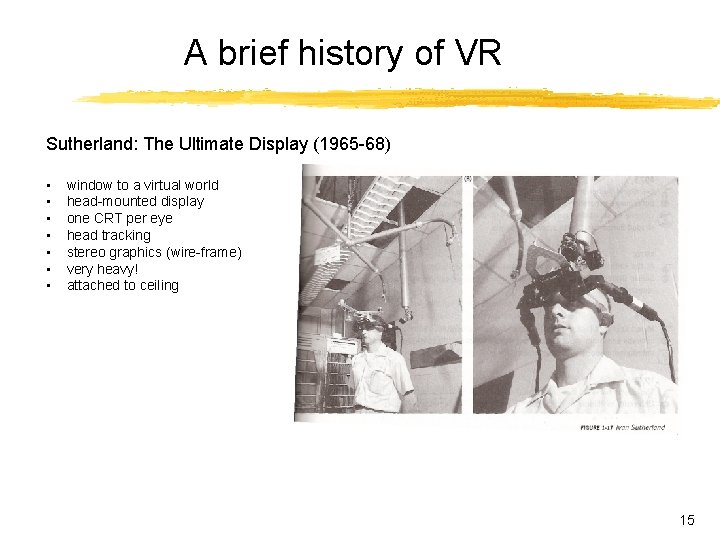
A brief history of VR Sutherland: The Ultimate Display (1965 -68) • • window to a virtual world head-mounted display one CRT per eye head tracking stereo graphics (wire-frame) very heavy! attached to ceiling 15
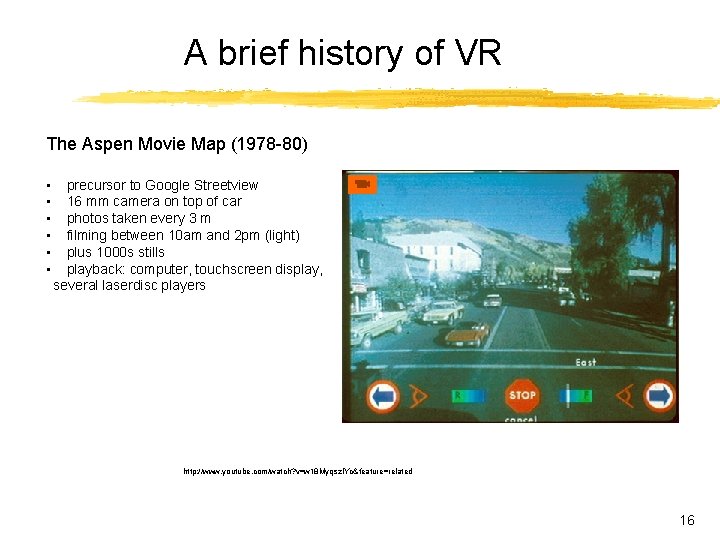
A brief history of VR The Aspen Movie Map (1978 -80) • • • precursor to Google Streetview 16 mm camera on top of car photos taken every 3 m filming between 10 am and 2 pm (light) plus 1000 s stills playback: computer, touchscreen display, several laserdisc players http: //www. youtube. com/watch? v=w 18 Myqsz. IYc&feature=related 16
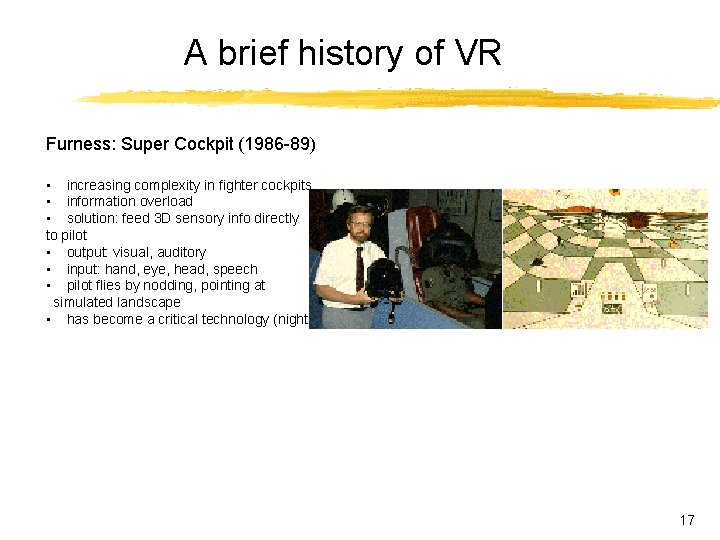
A brief history of VR Furness: Super Cockpit (1986 -89) • increasing complexity in fighter cockpits • information overload • solution: feed 3 D sensory info directly to pilot • output: visual, auditory • input: hand, eye, head, speech • pilot flies by nodding, pointing at simulated landscape • has become a critical technology (night fighting) 17
A brief history of VR British Aerospace (1987 -1990 s) • • Virtual Cockpit pilot training, concept testing (eg. stereo radar displays, symbology, etc. ) revealed problems such as not seeing hands, etc. Virtual Environment Configurable Training Aids (VECTA) wargaming 18
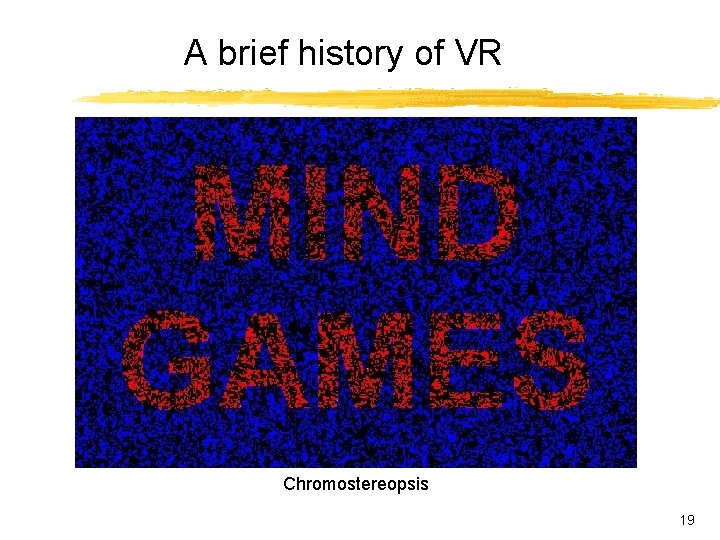
A brief history of VR Chromostereopsis 19
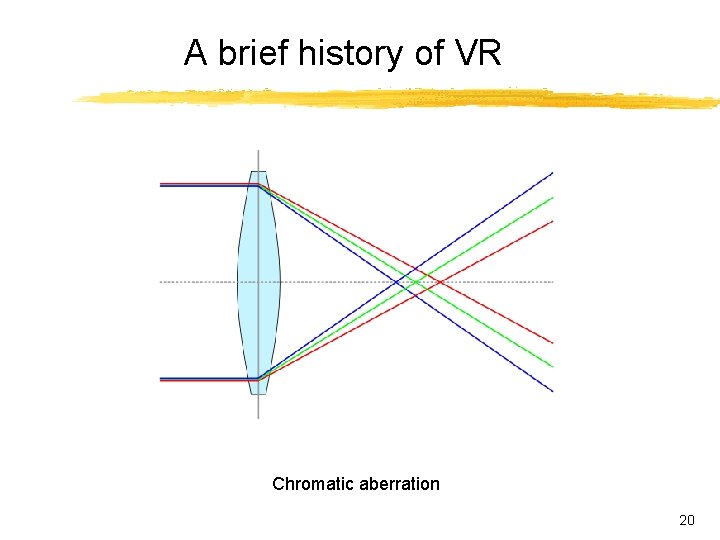
A brief history of VR Chromatic aberration 20
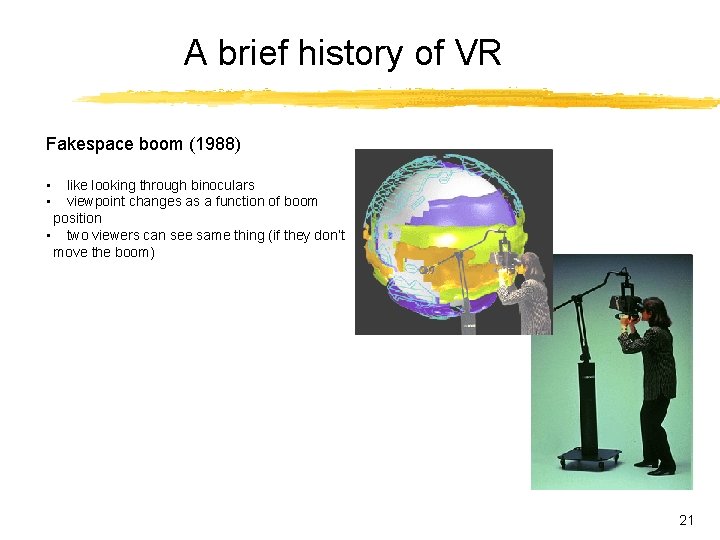
A brief history of VR Fakespace boom (1988) • • like looking through binoculars viewpoint changes as a function of boom position • two viewers can see same thing (if they don’t move the boom) 21
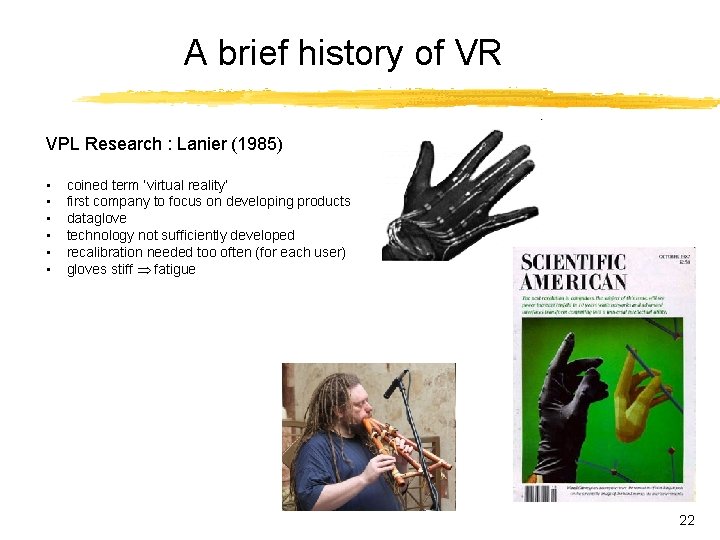
A brief history of VR VPL Research : Lanier (1985) • • • coined term ‘virtual reality’ first company to focus on developing products dataglove technology not sufficiently developed recalibration needed too often (for each user) gloves stiff fatigue 22
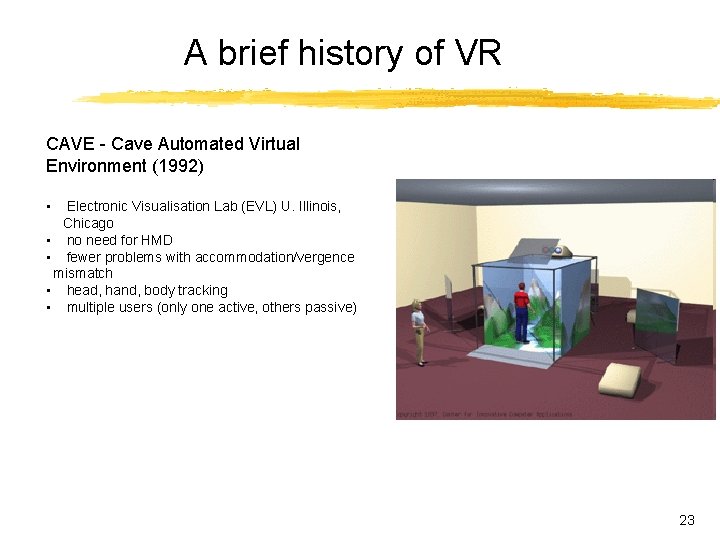
A brief history of VR CAVE - Cave Automated Virtual Environment (1992) • Electronic Visualisation Lab (EVL) U. Illinois, Chicago • no need for HMD • fewer problems with accommodation/vergence mismatch • head, hand, body tracking • multiple users (only one active, others passive) 23