
Virtual Reality Interface in MATLABSimulink for mechatronic interface
Virtual Reality Interface in MATLAB/Simulink for mechatronic interface D. Todorović, M. Božić, V. Zerbe, and G. S. Đorđević
Overview �Introduction �Telepresence � 2 d. o. f. joystick design �Force feedback and tactile sensation �Virtual reality toolbox �Forces and information flow �Conclusion
Motivation �Modern video and audio processing is rapidly developing. �Unable to understand meaning of interaction �Telepresence is necessary to use maximum from present technology
Telepresence �Teleconferencing �The most important use in robotic telemedicine �On the same site (few meters away) �On remote site �Two way information flow (position, speed, force, image, voice…) �To improve robotic surgery haptic enabled interface is necessary.

2 d. o. f. joystick �Paralelogram mechanism � 2 perpendicular axis ◦ Humusoft MF 624 interface PC card ◦ 2 DC motor drivers � 2 axis force sensors �Low cost development �Modeling and integration in Matlab/Simulink ◦ Virtual reality toolbox ◦ Testing and iterative design
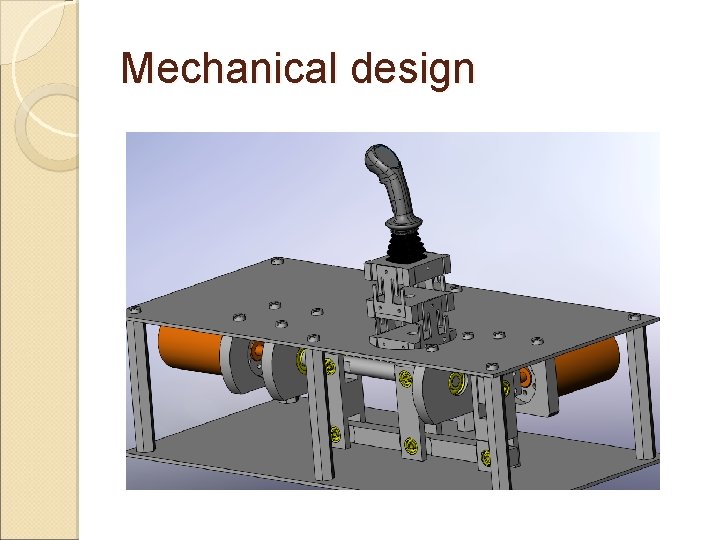
Mechanical design
Force feedback and tactile sensation �Crucial for improvements in robotic surgery �Two main components of such system ◦ Sensorized surgical instrument (endoscope with force sensors on its tip) ◦ Force-reflective human machine interface that mediates between surgeon and the robot. �Problems in communication, mechanical design and control algorithms ◦ Can be solved in simulated environment, and then implemented and tested.
Virtual reality world in VR toolbox �Physical models of objects being controlled. �Virtual world simulation (gravity, friction, viscosity…) �Simulink 3 D animation product ◦ ◦ ◦ Virtual worlds Animation Manipulation Interaction
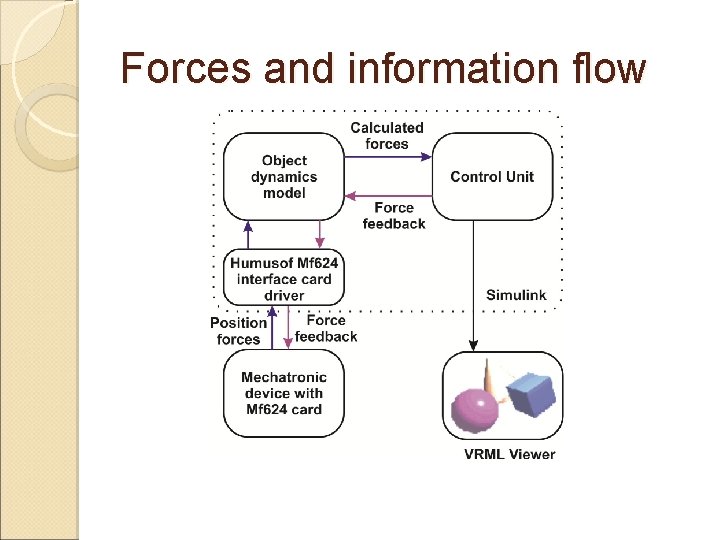
Forces and information flow
Taxonomy of VR interface �Robotized application require training �Evaluation against taxonomy of tasks ◦ Moving an object in VR with only visual feedback ◦ Moving an object in VR with haptics turned on ◦ Examination of trial-by-trial performance.
Conclusion �Virtual reality enabled mechatronic system for haptic research. �Future research includes: ◦ Evaluation of different haptics (force reflection) algorithms ◦ Does the haptics algorithm improve the process of motor learning? ◦ Can this help during the training period?

Thank you. �Any questions?
- Slides: 12