
Virtual Proving Ground Terrain Validation by Dr David
Virtual Proving Ground Terrain Validation by Dr. David Lamb, Dr. Alex Reid, Nancy Truong, John Weller (IVSS-2003 -MAS-1) 3 rd Annual Intelligent Vehicle Systems Symposium National Defense Industrial Association 10 June 2003 Presented by: Nancy Truong US Army TACOM-TARDEC National Automotive Center (NAC) Ground Vehicle Simulation Laboratory (GVSL)
Outline • • Background Information about Lab Visual Churchville Virtual Profilometer Validation Process/Methodology NURBS Conclusions
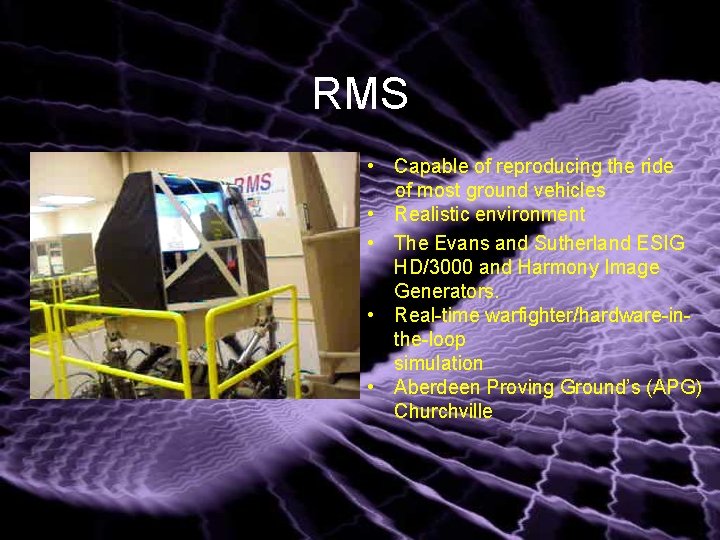
RMS • Capable of reproducing the ride of most ground vehicles • Realistic environment • The Evans and Sutherland ESIG HD/3000 and Harmony Image Generators. • Real-time warfighter/hardware-inthe-loop simulation • Aberdeen Proving Ground’s (APG) Churchville
Why Do We Need More Resolution? • To aid in the application of high-fidelity modeling and simulation techniques to the development/testing of new vehicle systems and emerging technologies. • To include: – motion-based, human- and hardware-in-theloop simulations. – high-resolution virtual testing of systems.
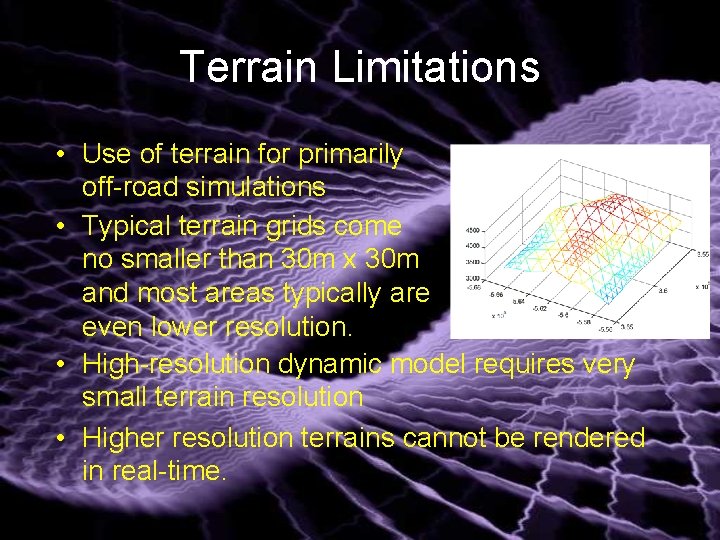
Terrain Limitations • Use of terrain for primarily off-road simulations • Typical terrain grids come no smaller than 30 m x 30 m and most areas typically are even lower resolution. • High-resolution dynamic model requires very small terrain resolution • Higher resolution terrains cannot be rendered in real-time.

Visual Correlation Questions • How does the low-resolution IG database correlate to the highresolution dynamic database? • Does it need to? • Why?
Visual Correlation • Needed to mitigate simulator sickness • Creates a more realistic virtual environment • Use Bump-Map Texturing
GVSL • • Human Factors Vehicle performance Motion Sickness Comparison of head-mounted display (HMD) vs flat panel
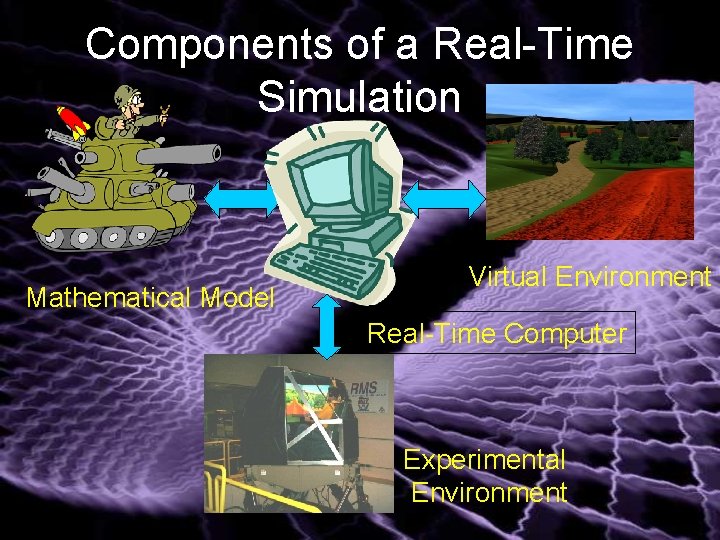
Components of a Real-Time Simulation Mathematical Model Virtual Environment Real-Time Computer Experimental Environment
Churchville • Visual- what we see • Terrain- what we feel
Validate the Terrain • Acquired the data for the virtual terrain, • Obtained the x & y coordinates • Input data into the virtual profilometer
Virtual Profilometer • Acts the same way a profilometer acts over a read proving ground • Simulates a trailer • Reports other terrain properties stored in the database
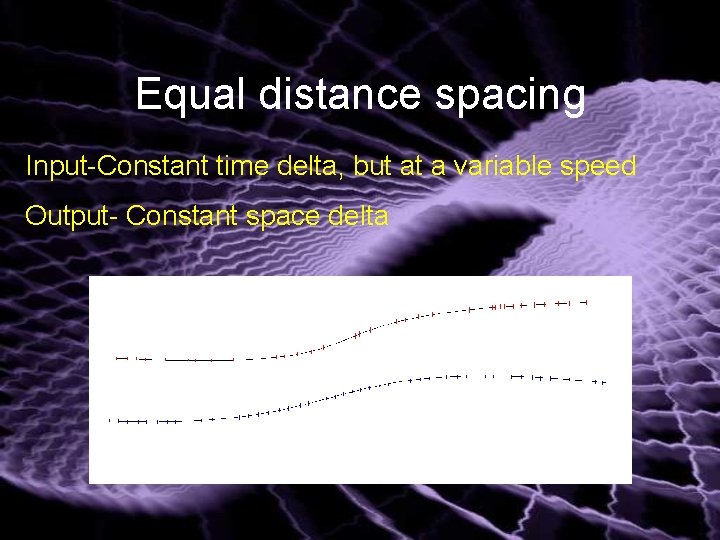
Equal distance spacing Input-Constant time delta, but at a variable speed Output- Constant space delta

Arc Length Formula
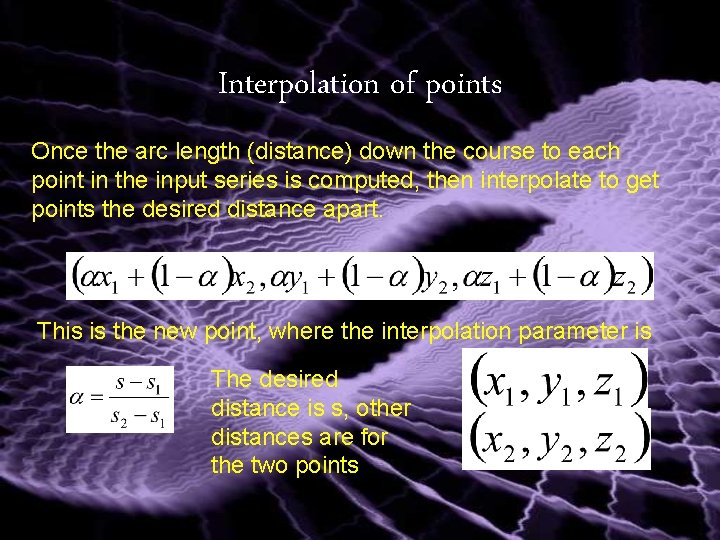
Interpolation of points Once the arc length (distance) down the course to each point in the input series is computed, then interpolate to get points the desired distance apart. This is the new point, where the interpolation parameter is The desired distance is s, other distances are for the two points
Other Features • A rough Power Spectral Density (PSD) of the course • Various input and output formats are supported • Options for track offset (left and right) or single track (centerline) available
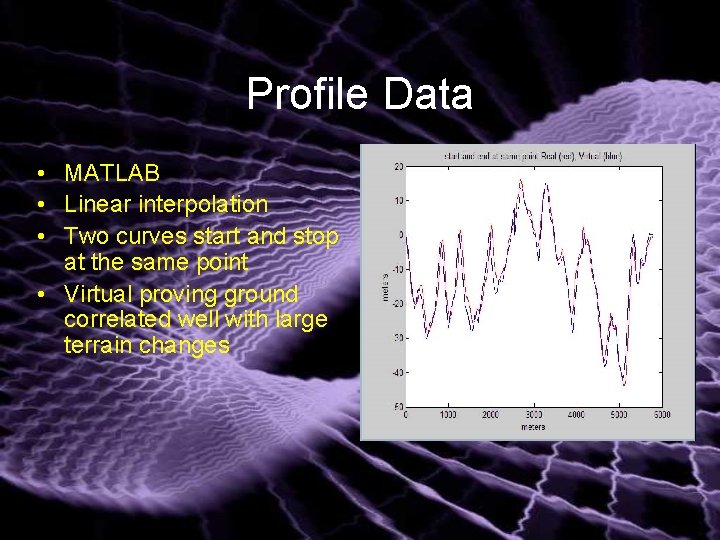
Profile Data • MATLAB • Linear interpolation • Two curves start and stop at the same point • Virtual proving ground correlated well with large terrain changes
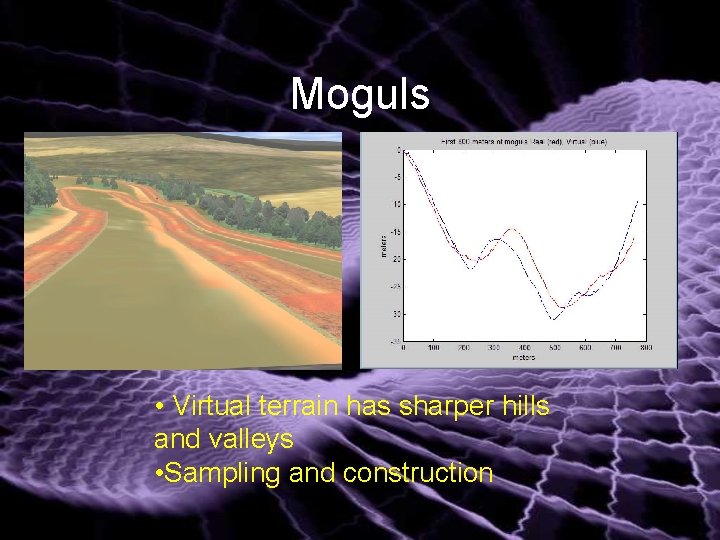
Moguls • Virtual terrain has sharper hills and valleys • Sampling and construction
RMS Values • Removed wavelengths greater than 18 m • Real-terrain is 4. 95 cm. • Virtual terrain is 4. 57 cm. • A difference of 8%.
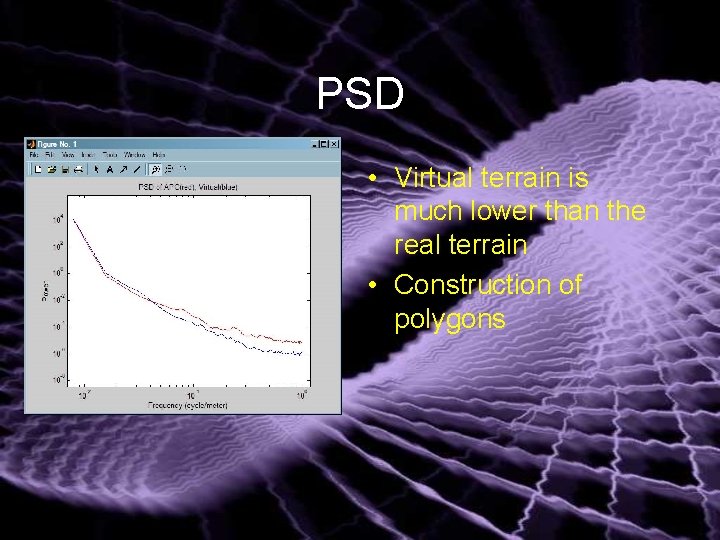
PSD • Virtual terrain is much lower than the real terrain • Construction of polygons
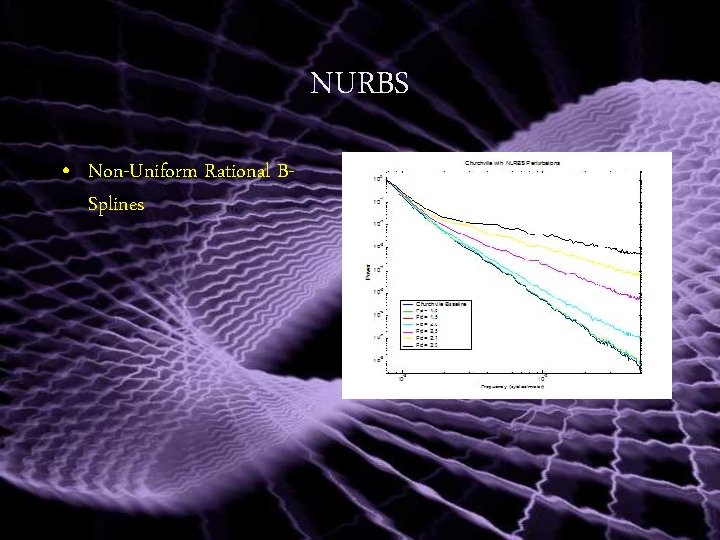
NURBS • Non-Uniform Rational BSplines
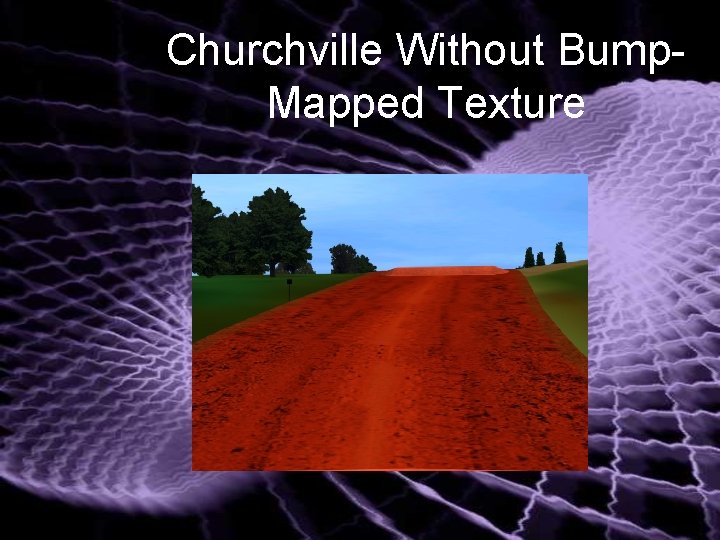
Churchville Without Bump. Mapped Texture
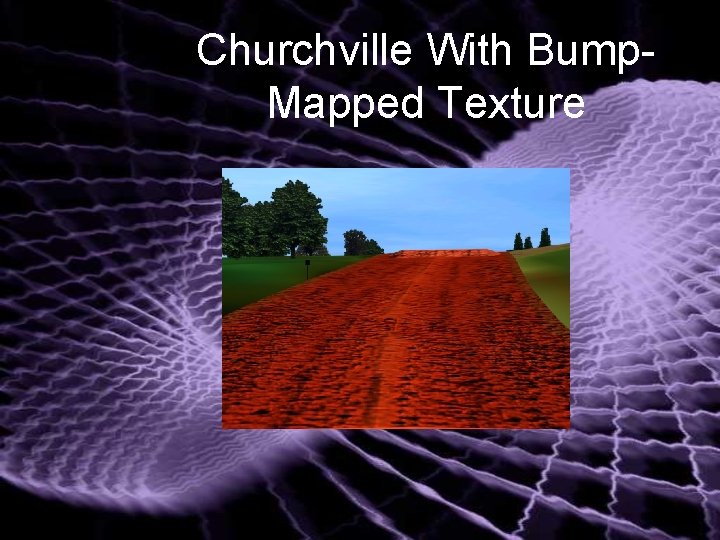
Churchville With Bump. Mapped Texture
Conclusion • • Need to validate models Real and virtual terrain comparisons NURBS Work on other APG databases
Questions For further information on this presentation, contact: Dr. David Lamb. D@tacom. army. mil (586)-574 -5209 Dr. Alex Reid, Reid. A@tacom. army. mil (586)-753 -2212 Nancy Truong, Truong. N@tacom. army. mil (586)-574 -8633 John Weller, Weller. J@tacom. army. mil (586)-574 -8633 Motion Base Technologies Team TACOM-TARDEC 6501 E. Eleven Mile Road Warren, MI 48397 AMSTA-TR-N MS: 157, Bldg 215
- Slides: 25