
Virtual Monotonic Counters and CountLimited Objects Using a
Virtual Monotonic Counters and Count-Limited Objects Using a TPM without a Trusted OS Luis F. G. Sarmenta (lfgs@mit. edu), Marten van Dijk (marten@mit. edu), Charles W. O’Donnell, Jonathan Rhodes, Srini Devadas MIT Computer Science and Artificial Intelligence Laboratory November 3, 2006 (these slides edited on November 4, 2006) 1 st ACM Workshop on Scalable Trusted Computing * This work was funded by Quanta Corporation as part of the MIT-Quanta T-Party project.
Our Paper • • Monotonic Counter: A counter whose value cannot be reversed to an old value – even if an adversary has complete control of the host machine containing the counter mechanism Enables several offline (and thus highly scalable) applications: – Replay-evident Trusted Storage using Untrusted Servers * * where clients can be offline relative to each other monotonic counters can be used for time-stamping – Count-Limited Objects (“clobs”) and operations (“clops”): * * * • • Objects/operations which can only be used once e. g. , one-time or n-time use signing/encryption keys, etc. Potential: DRM, offline payment (e-cash), e-voting, etc. Our paper: Virtual monotonic counters using TPM without a Trusted OS Two solutions – Log-based scheme (works with TPM 1. 2, but has drawbacks) – Hash-tree based scheme (small new proposed TPM functionality) * More efficient, and allows count-limited objects and operations MIT Computer Science and Artificial Intelligence Laboratory 9/25/2020
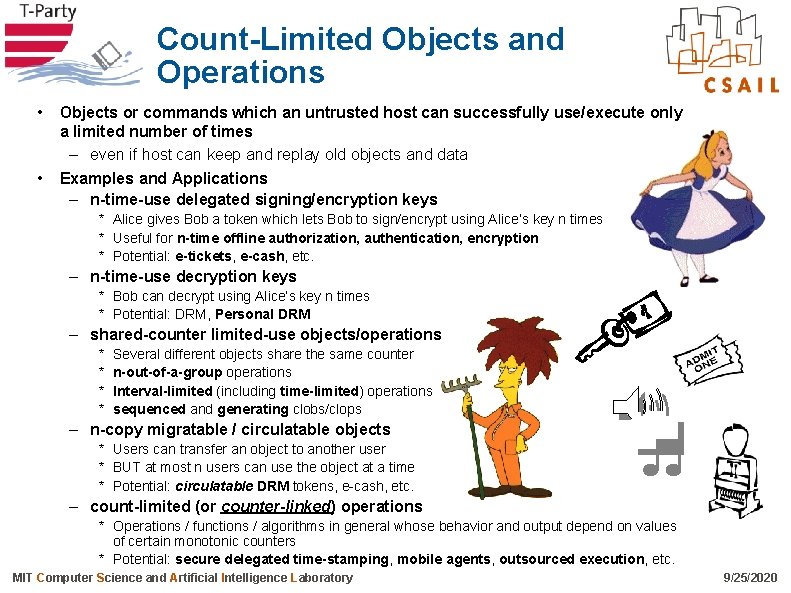
Count-Limited Objects and Operations • Objects or commands which an untrusted host can successfully use/execute only a limited number of times – even if host can keep and replay old objects and data • Examples and Applications – n-time-use delegated signing/encryption keys * Alice gives Bob a token which lets Bob to sign/encrypt using Alice’s key n times * Useful for n-time offline authorization, authentication, encryption * Potential: e-tickets, e-cash, etc. – n-time-use decryption keys * Bob can decrypt using Alice’s key n times * Potential: DRM, Personal DRM – shared-counter limited-use objects/operations * * Several different objects share the same counter n-out-of-a-group operations Interval-limited (including time-limited) operations sequenced and generating clobs/clops – n-copy migratable / circulatable objects * Users can transfer an object to another user * BUT at most n users can use the object at a time * Potential: circulatable DRM tokens, e-cash, etc. – count-limited (or counter-linked) operations * Operations / functions / algorithms in general whose behavior and output depend on values of certain monotonic counters * Potential: secure delegated time-stamping, mobile agents, outsourced execution, etc. MIT Computer Science and Artificial Intelligence Laboratory 9/25/2020
How Can We Implement Count-Limited Objects? • Three general approaches – Online Trusted Third Party * * Used in software/media licensing, online payments, etc. Not always possible. Not scalable. Not topic of this paper. – Cryptography * * Detect and trace double-spending (> n-times use) Works for certain applications (e. g. , e-cash, n-time anonymous authentication, etc. ) But, cannot prevent double-spending at time of offline transaction * – Using Trusted Component * Require trusted component to produce results • * * * • can be hardware, software or combination Trusted component securely counts usage of object Actually prevents double-spending at time of offline transaction But, assumes trusted component is not compromised We follow the third approach, but using only a TPM – Minimize trusted computing base MIT Computer Science and Artificial Intelligence Laboratory 9/25/2020
Count-Limited Objects using Monotonic Counters • Note: We need to keep trusted independent state for each object • such as … a dedicated monotonic counter per object – – • Irreversible, non-volatile register Needs to be implemented using secure internal non-volatile memory Problem: – It is hard to have a lot of secure NVRAM in a small secure chip * * – • small space inside trusted chip wear-out problem So, existing secure chips only support a few monotonic counters Example: Built-in (aka Physical) Monotonic Counters in TPM 1. 2 – – – TPM 1. 2 chips can create and keep track of at least 4 independent monotonic counters BUT … can only increment 1 per boot cycle (!) Allowed to throttle increments to once every 5 seconds, good for 7 years MIT Computer Science and Artificial Intelligence Laboratory 9/25/2020
Virtual Monotonic Counters with Trusted OS • If we have a trusted OS or trusted software, then keeping a large number of monotonic counters is straightforward • Example: TCG/Microsoft scheme for “virtual monotonic counters” – Trusted OS keeps track of an arbitrary number of virtual counters – To increment a virtual counter: * OS increments global physical counter * OS “seals” the new virtual counters’ collective state together with counter’s value as timestamp (can only be decrypted by TPM when Trusted OS is running) * OS stores sealed data on untrusted disk * OS can detect replay attacks by comparing time-stamp with current value of global counter • Trusted OS can also enforce Count-Limited Objects/Operations – Trusted OS checks the virtual counters before executing clobs/clops • Current DRM-enabled devices do something similar (but not using TPM) – either using trusted firmware, or obfuscated software as trusted component MIT Computer Science and Artificial Intelligence Laboratory 9/25/2020
Problems with depending on Trusted OS • Problem: Trusted OS is a BIG requirement – – – requires TPM requires trusted BIOS (CRTM) requires trusted CPU (with special features) requires other hardware support requires new OS, which must be fully tested • Can we implement trusted virtual monotonic counters using just a TPM, but without a trusted OS? • Note: Most real-world TPM apps that ordinary people actually use today do not use trusted boot – E. g. , mostly use ability of TPM to protect and use encrypted keyblobs • VMCs and Clobs are fundamental primitives that should also be supported without requiring Trusted OS – can even help in implementing Trusted OS’s MIT Computer Science and Artificial Intelligence Laboratory 9/25/2020
Our Solutions • Using TPM 1. 2 : Log-Based Scheme – Use one built-in monotonic counter – Use log of increment operations as a freshness proof – Good enough for implementing trusted storage on untrusted servers – Advantage: works with existing hardware – But has drawbacks • Better: Hash-tree based scheme – Use Merkle Hash Tree – Simple Proposed additional TPM functionality * 1 new TPM command * 1 word (160 -bits) of secure NVRAM space for root hash – Advantages * More efficient * Enables count-limited objects and operations • (with simple additional changes to other operations) MIT Computer Science and Artificial Intelligence Laboratory 9/25/2020
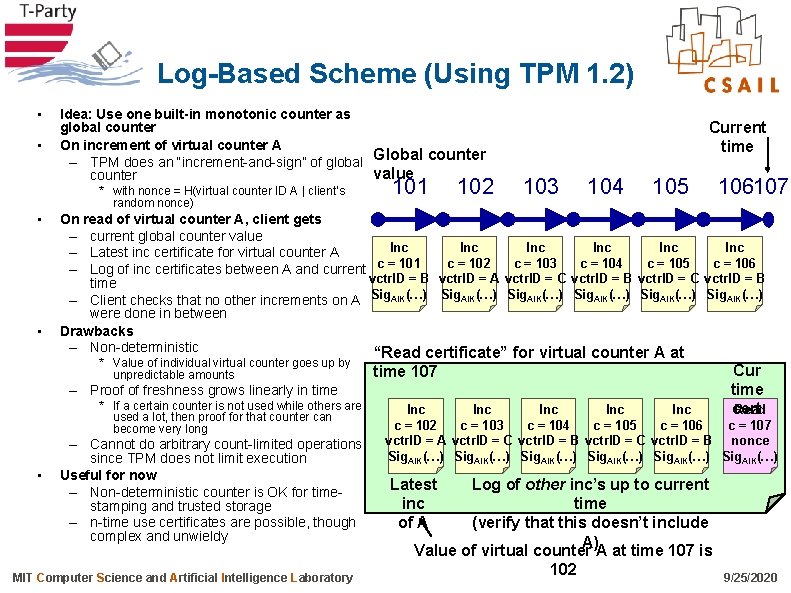
Log-Based Scheme (Using TPM 1. 2) • • Idea: Use one built-in monotonic counter as global counter On increment of virtual counter A – TPM does an “increment-and-sign” of global Global counter value counter * with nonce = H(virtual counter ID A | client’s random nonce) • • 101 102 Current time 103 104 105 On read of virtual counter A, client gets – current global counter value Inc Inc Inc – Latest inc certificate for virtual counter A c = 106 c = 101 c = 102 c = 103 c = 104 c = 105 – Log of inc certificates between A and current vctr. ID = B vctr. ID = A vctr. ID = C vctr. ID = B time – Client checks that no other increments on A Sig. AIK(…) were done in between Drawbacks – Non-deterministic “Read certificate” for virtual counter A at * Value of individual virtual counter goes up by unpredictable amounts time 107 – Proof of freshness grows linearly in time * If a certain counter is not used while others are used a lot, then proof for that counter can become very long • 106107 – Cannot do arbitrary count-limited operations since TPM does not limit execution Useful for now – Non-deterministic counter is OK for timestamping and trusted storage – n-time use certificates are possible, though complex and unwieldy MIT Computer Science and Artificial Intelligence Laboratory Cur time Read cert Inc Inc Inc c = 106 c = 107 c = 102 c = 103 c = 104 c = 105 vctr. ID = A vctr. ID = C vctr. ID = B nonce Sig. AIK(…) Latest inc of A Log of other inc’s up to current time (verify that this doesn’t include A) Value of virtual counter A at time 107 is 102 9/25/2020
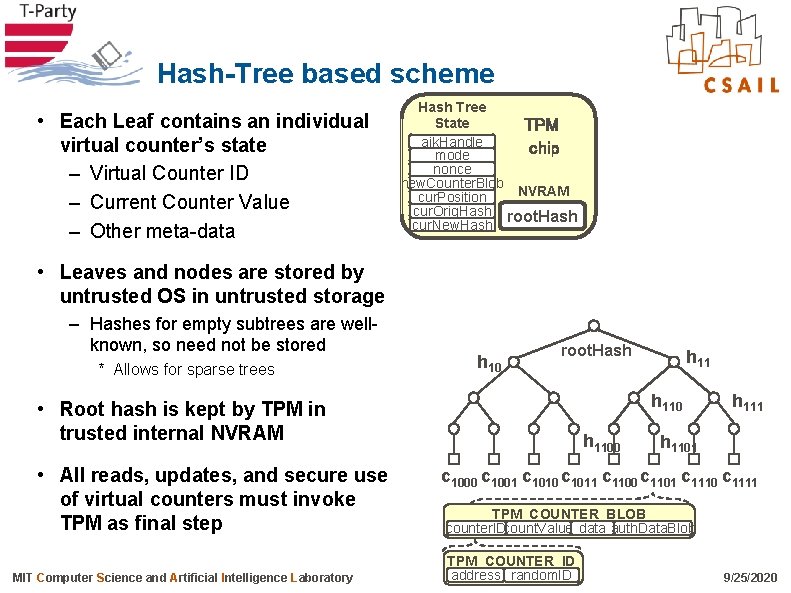
Hash-Tree based scheme • Each Leaf contains an individual virtual counter’s state – Virtual Counter ID – Current Counter Value – Other meta-data Hash Tree State TPM (volatile) aik. Handle chip mode nonce new. Counter. Blob NVRAM cur. Position cur. Orig. Hash root. Hash cur. New. Hash • Leaves and nodes are stored by untrusted OS in untrusted storage – Hashes for empty subtrees are wellknown, so need not be stored * Allows for sparse trees h 10 root. Hash h 110 • Root hash is kept by TPM in trusted internal NVRAM • All reads, updates, and secure use of virtual counters must invoke TPM as final step MIT Computer Science and Artificial Intelligence Laboratory h 1100 h 111 h 1101 c 1000 c 1001 c 1010 c 1011 c 1100 c 1101 c 1110 c 1111 TPM_COUNTER_BLOB counter. IDcount. Value data auth. Data. Blob TPM_COUNTER_ID address random. ID 9/25/2020
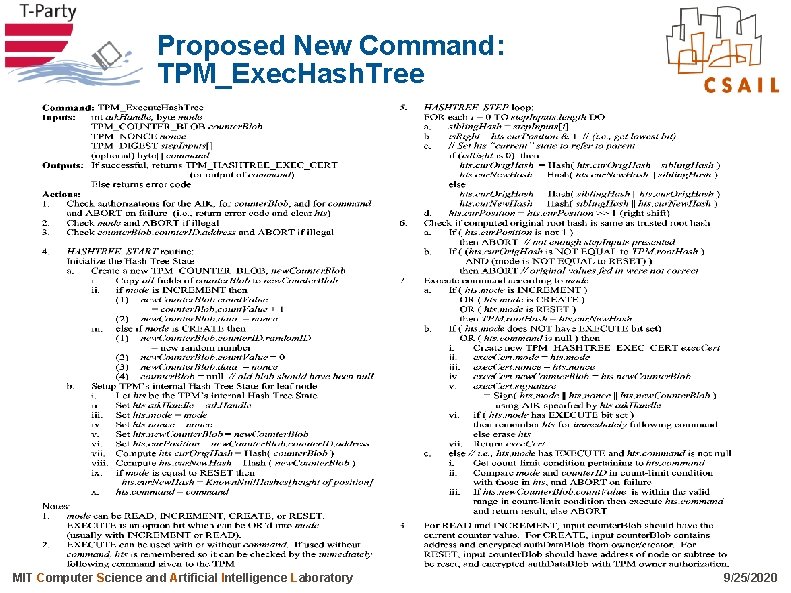
Proposed New Command: TPM_Exec. Hash. Tree MIT Computer Science and Artificial Intelligence Laboratory 9/25/2020
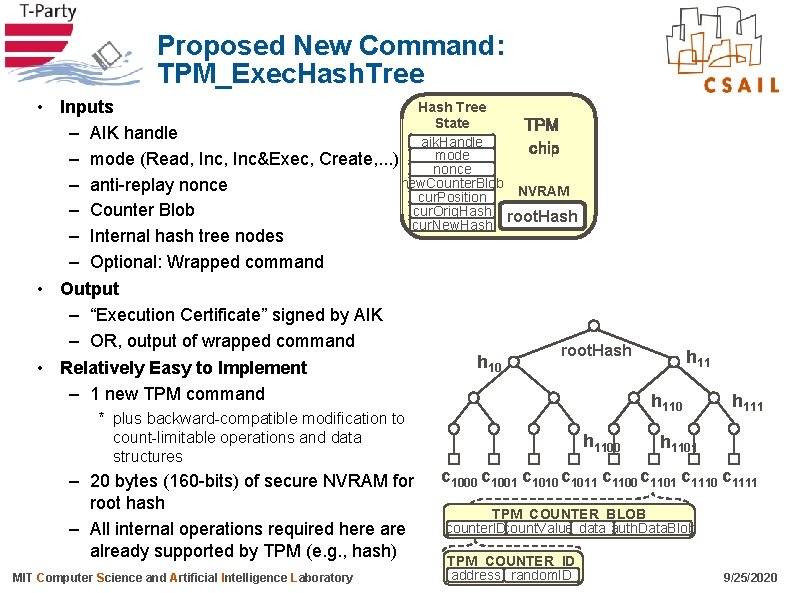
Proposed New Command: TPM_Exec. Hash. Tree Hash Tree • Inputs State TPM – AIK handle (volatile) aik. Handle chip mode – mode (Read, Inc&Exec, Create, . . . ) nonce new. Counter. Blob – anti-replay nonce NVRAM cur. Position cur. Orig. Hash root. Hash – Counter Blob cur. New. Hash – Internal hash tree nodes – Optional: Wrapped command • Output – “Execution Certificate” signed by AIK – OR, output of wrapped command root. Hash h 10 • Relatively Easy to Implement – 1 new TPM command * plus backward-compatible modification to count-limitable operations and data structures – 20 bytes (160 -bits) of secure NVRAM for root hash – All internal operations required here already supported by TPM (e. g. , hash) MIT Computer Science and Artificial Intelligence Laboratory h 1100 h 110 h 111 h 1101 c 1000 c 1001 c 1010 c 1011 c 1100 c 1101 c 1110 c 1111 TPM_COUNTER_BLOB counter. IDcount. Value data auth. Data. Blob TPM_COUNTER_ID address random. ID 9/25/2020
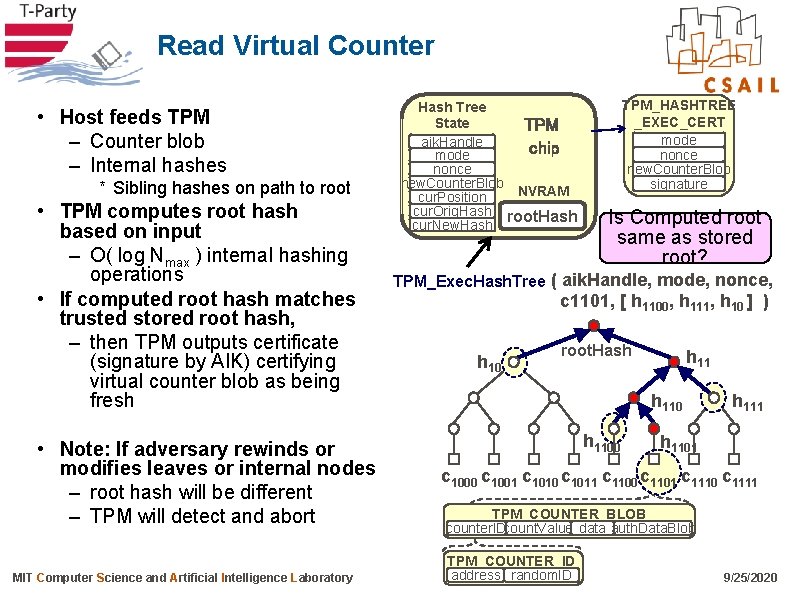
Read Virtual Counter • Host feeds TPM – Counter blob – Internal hashes * Sibling hashes on path to root • TPM computes root hash based on input – O( log Nmax ) internal hashing operations • If computed root hash matches trusted stored root hash, – then TPM outputs certificate (signature by AIK) certifying virtual counter blob as being fresh • Note: If adversary rewinds or modifies leaves or internal nodes – root hash will be different – TPM will detect and abort MIT Computer Science and Artificial Intelligence Laboratory Hash Tree State TPM (volatile) aik. Handle chip mode nonce new. Counter. Blob NVRAM cur. Position cur. Orig. Hash root. Hash cur. New. Hash TPM_HASHTREE _EXEC_CERT mode nonce new. Counter. Blob signature Is Computed root same as stored root? TPM_Exec. Hash. Tree ( aik. Handle, mode, nonce, c 1101, [ h 1100, h 111, h 10 ] ) h 10 root. Hash h 1100 h 111 h 1101 c 1000 c 1001 c 1010 c 1011 c 1100 c 1101 c 1110 c 1111 TPM_COUNTER_BLOB counter. IDcount. Value data auth. Data. Blob TPM_COUNTER_ID address random. ID 9/25/2020
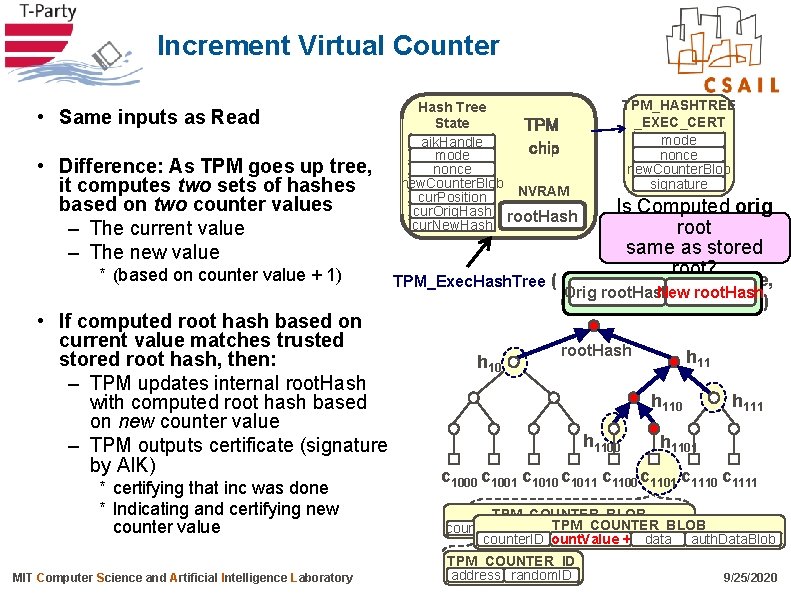
Increment Virtual Counter • Same inputs as Read • Difference: As TPM goes up tree, it computes two sets of hashes based on two counter values – The current value – The new value * (based on counter value + 1) • If computed root hash based on current value matches trusted stored root hash, then: – TPM updates internal root. Hash with computed root hash based on new counter value – TPM outputs certificate (signature by AIK) * certifying that inc was done * Indicating and certifying new counter value MIT Computer Science and Artificial Intelligence Laboratory Hash Tree State TPM (volatile) aik. Handle chip mode nonce new. Counter. Blob NVRAM cur. Position cur. Orig. Hash root. Hash cur. New. Hash TPM_HASHTREE _EXEC_CERT mode nonce new. Counter. Blob signature Is Computed orig root same as stored root? TPM_Exec. Hash. Tree ( aik. Handle, mode, nonce, Orig root. Hash New root. Hash c 1101, [ h 1100, h 111, h 10 ] ) h 10 root. Hash h 1100 h 111 h 1101 c 1000 c 1001 c 1010 c 1011 c 1100 c 1101 c 1110 c 1111 TPM_COUNTER_BLOB counter. IDcount. Value data auth. Data. Blob counter. IDcount. Value +1 data auth. Data. Blob TPM_COUNTER_ID address random. ID 9/25/2020
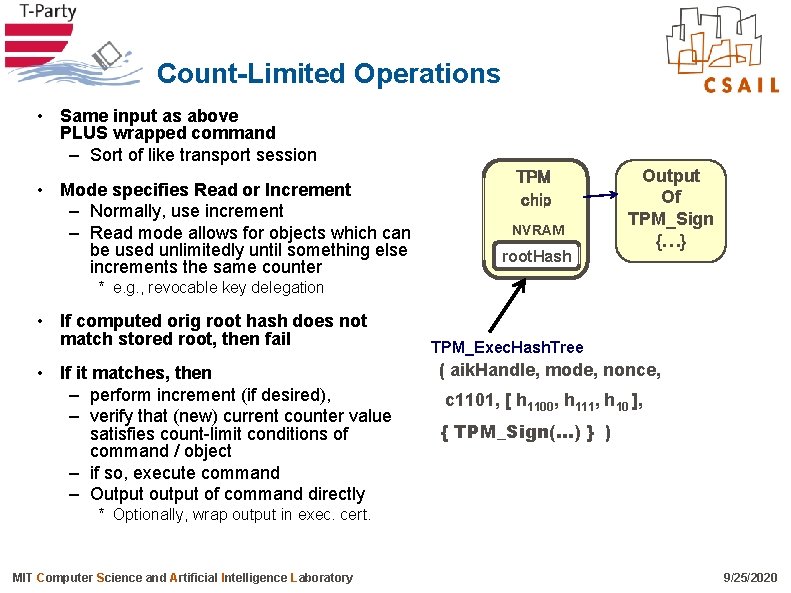
Count-Limited Operations • Same input as above PLUS wrapped command – Sort of like transport session • Mode specifies Read or Increment – Normally, use increment – Read mode allows for objects which can be used unlimitedly until something else increments the same counter TPM chip NVRAM root. Hash Output Of TPM_Sign {…} * e. g. , revocable key delegation • If computed orig root hash does not match stored root, then fail • If it matches, then – perform increment (if desired), – verify that (new) current counter value satisfies count-limit conditions of command / object – if so, execute command – Output of command directly TPM_Exec. Hash. Tree ( aik. Handle, mode, nonce, c 1101, [ h 1100, h 111, h 10 ], { TPM_Sign(…) } ) * Optionally, wrap output in exec. cert. MIT Computer Science and Artificial Intelligence Laboratory 9/25/2020
Count-Limited Keys • Existing TPM feature: wrapped keys – Alice can give Bob encrypted blob containing her PK-SK keypair – Alice encrypts blob using Bob’s TPM’s storage key’s PK * SK of storage keypair is never revealed outside the TPM * So, only TPM can decrypt and use Alice’s SK in the blob – To use: * Use TPM_Load. Key to load blob into TPM returns key handle * Use TPM_Sign, etc. with key handle – Note: currently, wrapped keys are NOT count-limited • Modifications to TPM – Add count-limit condition field to wrapped key * Includes virtual counter ID, valid range, and allowed/required modes * Put in a variable-length field where PCR configuration is now – When key is loaded, condition is remembered – Upon doing a TPM_Sign using that key, check condition MIT Computer Science and Artificial Intelligence Laboratory 9/25/2020
Using Count-Limited Keys • Scenario: Alice wants to give Bob a 1 -time key • Issuing (Alice and Bob) – Step 1: Alice certifies Bob’s TPM and gets Bob’s storage key * e. g. , check Bob’s AIK’s PK vs. known/certified value or via DAA – Step 2: Alice creates a new virtual counter on Bob’s host * Bob executes TPM_Exec. Hash. Tree * gives new counter ID and exec certificate to Alice who verifies it – Step 3: Alice encrypts a key blob using Bob’s storage key containing her keypair and gives to Bob * include count-limit condition • Virtual counter ID, required mode=Increment, and valid range (in this case “ 1”) • Use (Bob alone, offline from Alice) – Step 1: Bob uses TPM_Load. Key on encrypted key blob – Step 2: Bob calls TPM_Exec. Hash. Tree with wrapped TPM_Sign/TPM_Unbind/etc * gets relevant hash tree nodes from his storage * Calls TPM_Exec. Hash. Tree * Computes and stores new counter value and new hash tree nodes MIT Computer Science and Artificial Intelligence Laboratory 9/25/2020
Applications of Count-Limited Keys • n-time authentication / authorization / certification – Authority gives Bob a wrapped count-limited signing keypair PK-SK * where SK is unknown to Bob, * and PK is certified and verifiable as coming from the Authority * count-limited to n – When Bob needs to prove certification to Charlie * Charlie gives Bob a random nonce * Bob uses count-limited signing key to sign nonce * Charlie verifies Authority’s signature on nonce – Bob can only do this at most n times • This leads to many potential applications* – Offline payment: Authority is Bank, signature has cash value – E-tickets (probably more feasible) – etc. * Caveat on privacy and resiliency MIT Computer Science and Artificial Intelligence Laboratory 9/25/2020
Caveats • • Note: Anonymity can be preserved because the final output contains nothing from Bob – Only Charlie’s nonce, and Authority’s signature – (Note: Charlie does not need to verify/identify Bob, because Authority’s signature is enough proof) Caveats – #1: If Authority uses single global key, then TPMs must never broken * If a single TPM is broken, Authority’s private key is revealed. Very bad! – #2: If Authority uses multiple keys, then anonymity may be broken * At time of issuing, Authority may give Bob a unique key, and be able to link the key to Bob’s AIK (used by Authority to verify Bob’s TPM) * Solution (? ): Use DAA at time of issuing so Authority can’t link AIK to Bob • • In the end, probably, the best solution for critical apps (e. g. , real e-cash) is to use cryptobased n-time-use techniques, but use virtual monotonic counters to count-limit these in hardware – e. g. , implement a TPM command implementing Brand’s e-cash scheme [Brands 93], but store the e-coin as a count-limited object stored outside the TPM – Provides hardware support for immediate prevention of double-spending * assuming TPM is not broken – AND also provides eventual traceability in case TPM is broken However, simple schemes based on straightforward count-limited RSA signing operations may still be useful in non-critical applications (i. e. , where the cost of breaking a TPM would be much more than the potential gain one can get by doing so) – Advantage is that minimal change is needed in the TPM, and no need to define for specialpurpose commands/algorithms for each application MIT Computer Science and Artificial Intelligence Laboratory 9/25/2020
Other Variations on Clobs • shared-counter limited-use objects/operations – e. g. , Alice generates several different wrapped objects depending on the same virtual counter ID – Possibilities * N-times-within-a-group operations * Interval-limited operations • Can translate to time-limited if trusted clock increments counter • n-copy migratable objects – TPM already has a migrate key feature – Idea: count-limit the migration * Assume that usage of key reads but does not increment counter * But migration of key increments counter * If Alice migrates a key to Bob, then Alice’s counter gets incremented, so Alice can’t use her copy anymore * On Bob’s side, Bob gets a new key tied to a virtual counter on his TPM * Bob can use it until he migrates it to someone else (possibly Alice!) – “Lendable” objects circulatable DRM, e-cash, etc. – Possible to make n-copy (not just 1 -copy) circulatable objects * Circulatable but at most only n copies at any given time are usable – Challenge: Verification must be done by TPM (not host) * Verification key must be included in blob • Others – See our MIT CSAIL Technical Report, Sept. 2006 MIT Computer Science and Artificial Intelligence Laboratory 9/25/2020
Other Variations on Hash-Tree based scheme • Split TPM_Exec. Hash. Tree into 2 commands – Start() command, followed by Step() command for each level of tree – Advantage: no need to feed all internal tree node hashes (sibling hashes) to the TPM at once – – – * works even if TPM only has small input buffer space Note: internal volatile memory requirement of TPM does NOT grow * computation of hashes and updating of state is done at each step * no need to remember all the node hashes * Hash tree state is constant-sized Note: Failure before the end is not a security problem * TPM state is only changed at the very last step if everything succeeds However, not clear whether splitting is even necessary * we can handle 32 levels (232 virtual counters) with only 20 * 32 = 640 bytes for the sibling hashes • Even with other input data, total input size would still be much less than 4 K typical input buffer space of TPM 1. 2 chips * maybe it can be useful for 160 -bit (unique) virtual counter ID’s • Other Variants – Multiple root hashes (allows independent hash trees, possibly of different depths) – Dynamically growing hash trees – Caching – Have TPM_Exec. Hash. Tree support operations other than increment * * “mode” field can indicate different kinds of operations e. g. , Extend (i. e. , one-way hash) can lead to unlimited PCR-like “hash clocks” e. g. , Read, Update Virtual Trusted Memory This is why we recommend keeping the command name TPM_Exec. Hash. Tree generic • – – • it’s not limited to just monotonic counters Multiple counter operations per TPM_Exec. Hash. Tree invocation * e. g. , increment several counters with one TPM_Exec. Hash. Tree invocation * saves on time for signature operation in the end, and also saves on wear out of root hash NVRAM VMCs and count-limited objects/operations using physical monotonic counters Count-limited wrapped commands * Encrypted TPM commands with a count-limit condition field Count-limited general-purpose commands See MIT CSAIL TR 2006 -064 (Sept. 2006) for details MIT Computer Science and Artificial Intelligence Laboratory 9/25/2020
Related Work • • Of course, general idea of n-time-use operations is an old idea Some interesting/relevant related work – “Consumable Credentials” (Bauer et al. 2006) * * – Logic for analyzing/modeling systems whose security depend on limited-use credentials Currently, they assume an online trusted third party, though Cryptographic Techniques * * Classic e-cash, etc. : Chaum 82, Brands, etc. Lots of other recent work: • – Using Trusted Component * – Practically all DRM systems fall under this category today Using combination of Crypto and Trusted Hardware * * – E. g. , n-time anonymous authentication, etc. (e. g. , CHKLM, ACM CCS 06) e. g. , Brands 93 talks about “observer” that stores a special value per e-coin in trusted memory and forgets it after using the e-coin once Our approach can be used with this algorithm, and would allow a much larger number of values to be remembered using very little trusted NVRAM One-time or n-time arbitrary programs using very simple hardware * Slightly prior to us, Goldwasser et al. have proposed a theoretical scheme using very simple hardware (not a secure processor like TPM). (Not yet published. ) MIT Computer Science and Artificial Intelligence Laboratory 9/25/2020
Ongoing / Future Work • Applications – Virtual Storage, Offline Payments, etc. – (We’re starting with what we can do with. TPM 1. 2) • CLAMs – counter-linkage modules – implement VMCs and clobs/clops mechanisms and ideas using other secure components in general, not just TPM – using other trusted hardware (e. g. , smart cards, IBM 4758, AEGIS, Secure. Blue, etc. ) – or, potentially even CLAMs using obfuscated software and/or trusted OS * less secure but more immediately implementable and useful • How can having VMCs and clobs/clops as a primitive help improve the design of future trusted modules, platforms, and software? MIT Computer Science and Artificial Intelligence Laboratory 9/25/2020
Conclusions • Virtual Monotonic Counters and Count. Limited/Linked Objects are small but potentially extremely useful primitives • We have presented 2 solutions – Using TPM 1. 2 log-based – Hash-tree based scheme (better) • It would be great if TCG incorporates this functionality into the next TPM – Very simple to implement – Potentially very powerful MIT Computer Science and Artificial Intelligence Laboratory 9/25/2020
For more info • Email: – Luis Sarmenta (lfgs@mit. edu) * http: //people. csail. mit. edu/lfgs – Marten van Dijk (marten@mit. edu) • MIT CSAIL TR 2006 -064 (Sept. 2006) has some more details – http: //hdl. handle. net/1721. 1/33966 MIT Computer Science and Artificial Intelligence Laboratory 9/25/2020
- Slides: 25