
Virtual Memory II Chapter 8 1 Fetch Policy
- Slides: 35
Virtual Memory II Chapter 8 1
Fetch Policy • Fetch Policy – Determines when a page should be brought into memory – Demand paging only brings pages into main memory when a reference is made to a location on the page • Many page faults when process first started – Prepaging brings in more pages than needed • More efficient to bring in pages that reside contiguously on the disk 2
Placement Policy • Determines where in real memory a process piece is to reside • Important in a segmentation system • Paging or combined paging with segmentation hardware performs address translation 3
Replacement Policy • Placement Policy – Which page is replaced? – Page removed should be the page least likely to be referenced in the near future – Most policies predict the future behavior on the basis of past behavior 4
Replacement Policy • Frame Locking – If frame is locked, it may not be replaced – Kernel of the operating system – Control structures – I/O buffers – Associate a lock bit with each frame 5
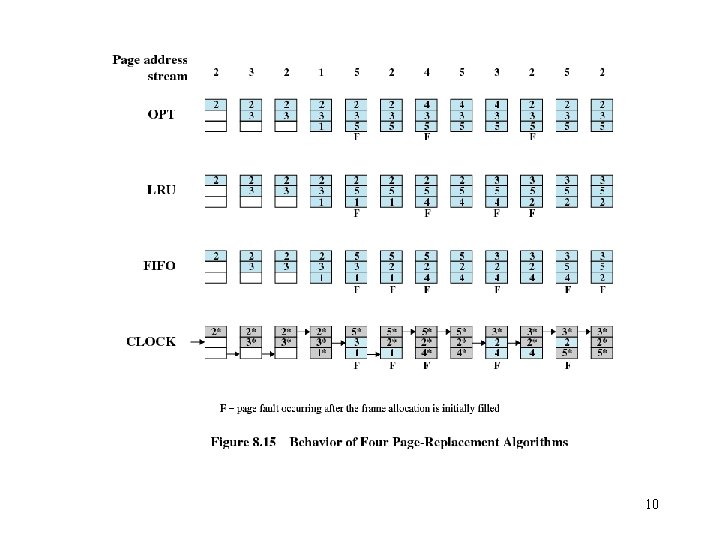
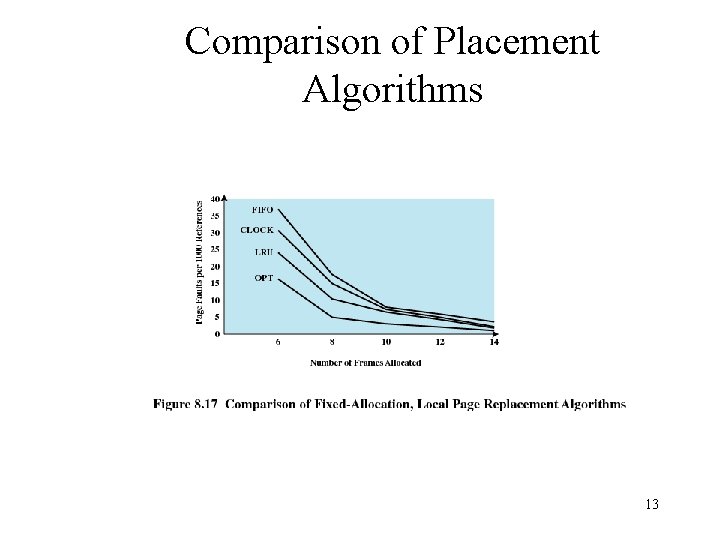
Basic Replacement Algorithms • Optimal policy – Selects for replacement that page for which the time to the next reference is the longest – Impossible to have perfect knowledge of future events 6
Basic Replacement Algorithms • Least Recently Used (LRU) – Replaces the page that has not been referenced for the longest time – By the principle of locality, this should be the page least likely to be referenced in the near future – Each page could be tagged with the time of last reference. This would require a great deal of overhead. 7
Basic Replacement Algorithms • First-in, first-out (FIFO) – Treats page frames allocated to a process as a circular buffer – Pages are removed in round-robin style – Simplest replacement policy to implement – Page that has been in memory the longest is replaced – These pages may be needed again very soon 8
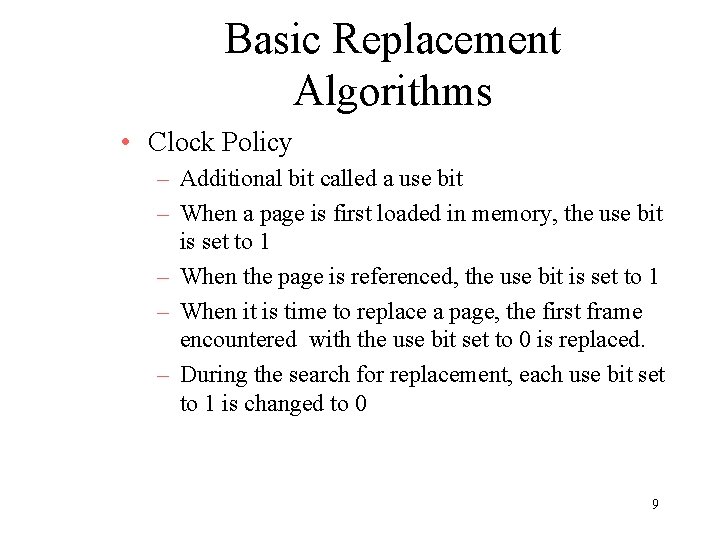
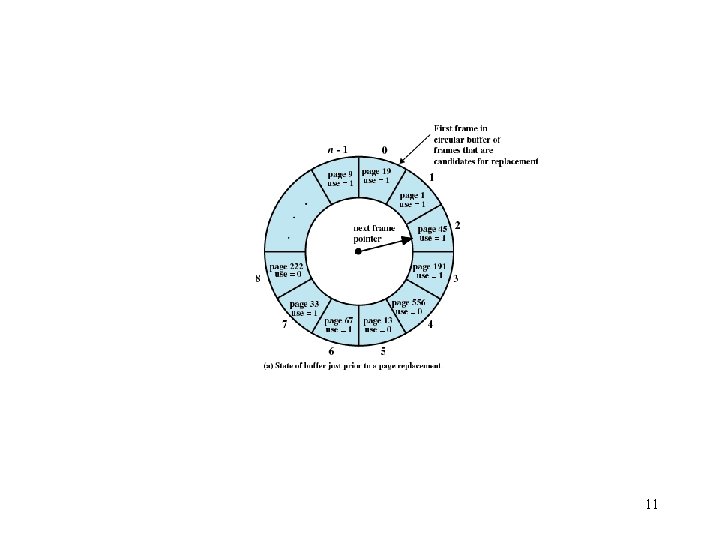
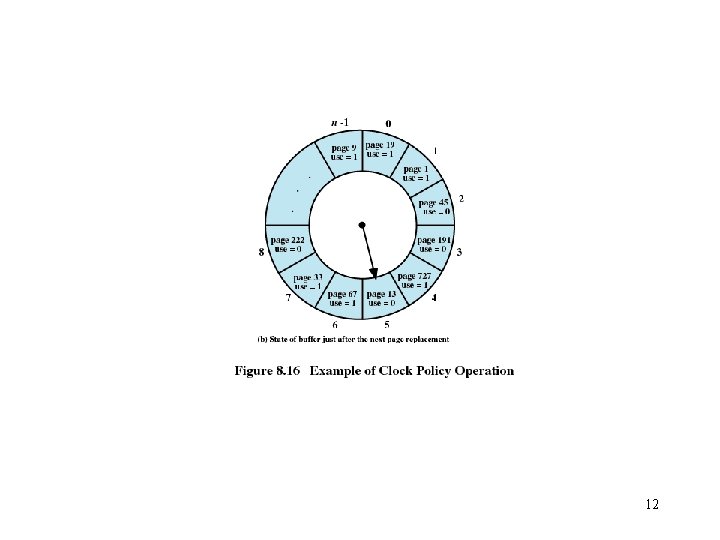
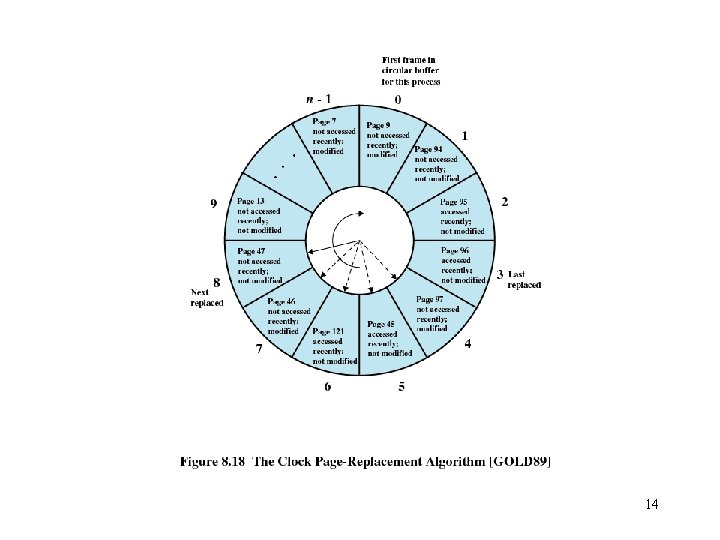
Basic Replacement Algorithms • Clock Policy – Additional bit called a use bit – When a page is first loaded in memory, the use bit is set to 1 – When the page is referenced, the use bit is set to 1 – When it is time to replace a page, the first frame encountered with the use bit set to 0 is replaced. – During the search for replacement, each use bit set to 1 is changed to 0 9
10
11
12
Comparison of Placement Algorithms 13
14
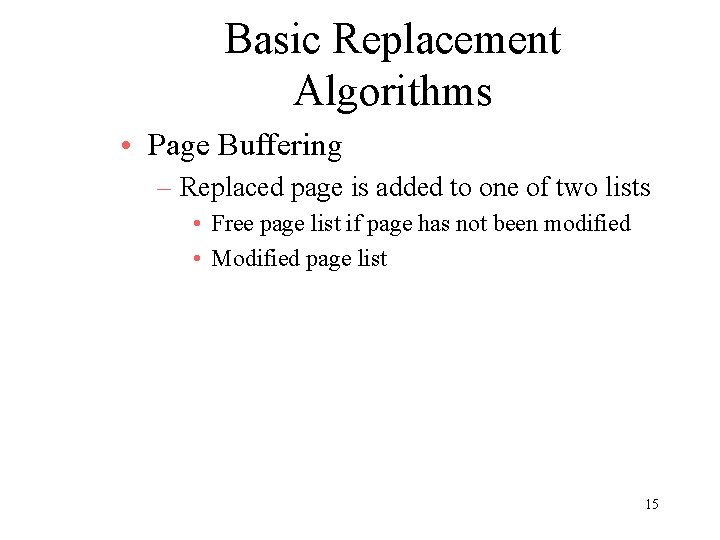
Basic Replacement Algorithms • Page Buffering – Replaced page is added to one of two lists • Free page list if page has not been modified • Modified page list 15
Resident Set Size • Fixed-allocation – Gives a process a fixed number of pages within which to execute – When a page fault occurs, one of the pages of that process must be replaced • Variable-allocation – Number of pages allocated to a process varies over the lifetime of the process 16
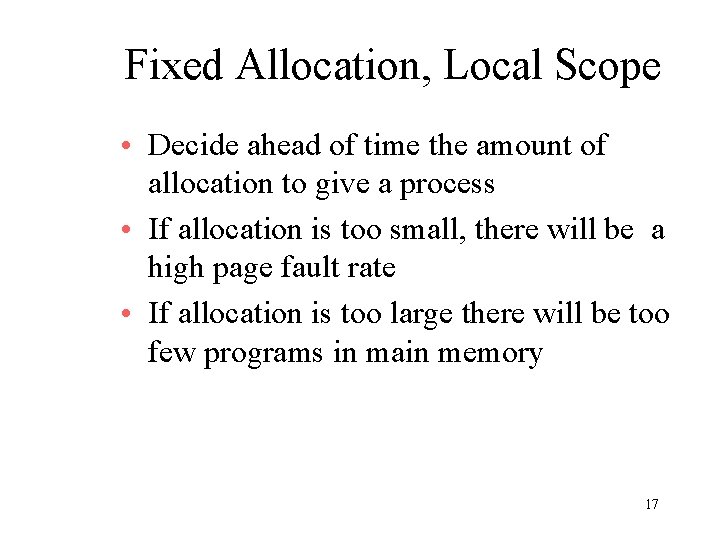
Fixed Allocation, Local Scope • Decide ahead of time the amount of allocation to give a process • If allocation is too small, there will be a high page fault rate • If allocation is too large there will be too few programs in main memory 17
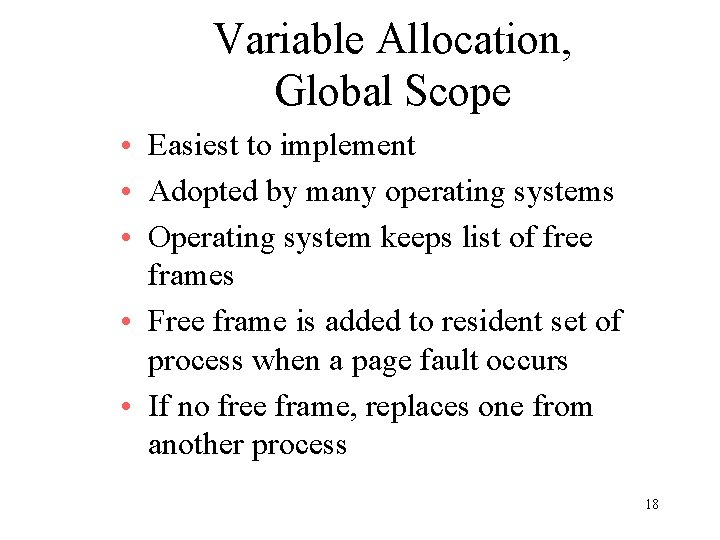
Variable Allocation, Global Scope • Easiest to implement • Adopted by many operating systems • Operating system keeps list of free frames • Free frame is added to resident set of process when a page fault occurs • If no free frame, replaces one from another process 18
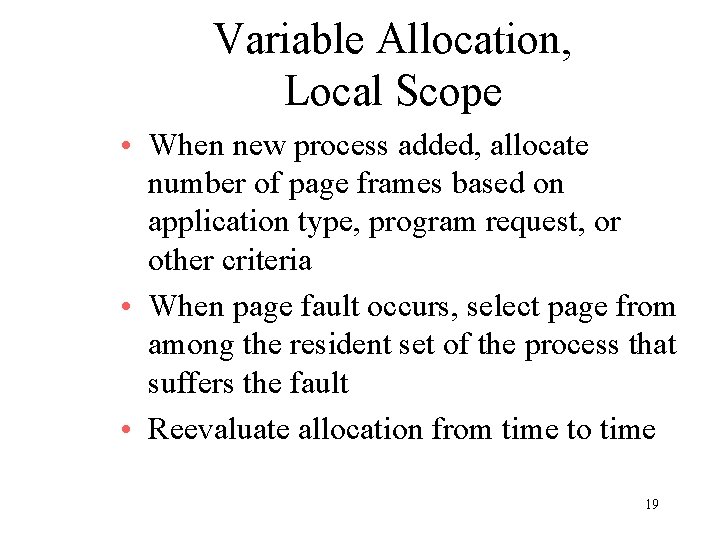
Variable Allocation, Local Scope • When new process added, allocate number of page frames based on application type, program request, or other criteria • When page fault occurs, select page from among the resident set of the process that suffers the fault • Reevaluate allocation from time to time 19
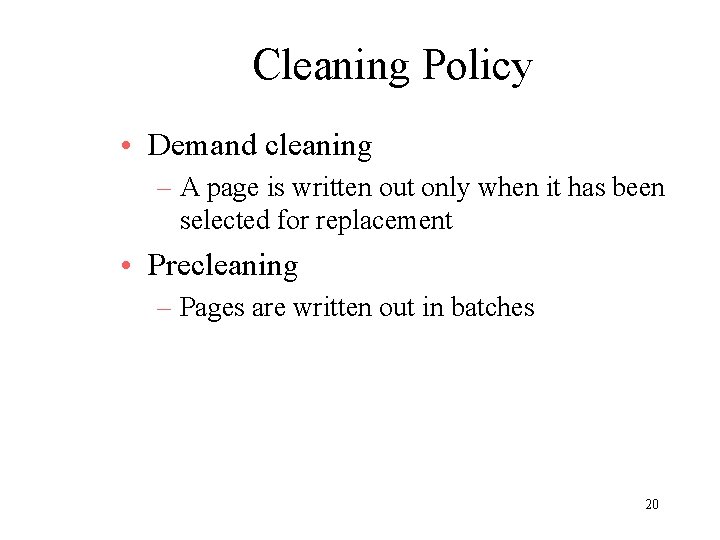
Cleaning Policy • Demand cleaning – A page is written out only when it has been selected for replacement • Precleaning – Pages are written out in batches 20
Cleaning Policy • Best approach uses page buffering – Replaced pages are placed in two lists • Modified and unmodified – Pages in the modified list are periodically written out in batches – Pages in the unmodified list are either reclaimed if referenced again or lost when its frame is assigned to another page 21
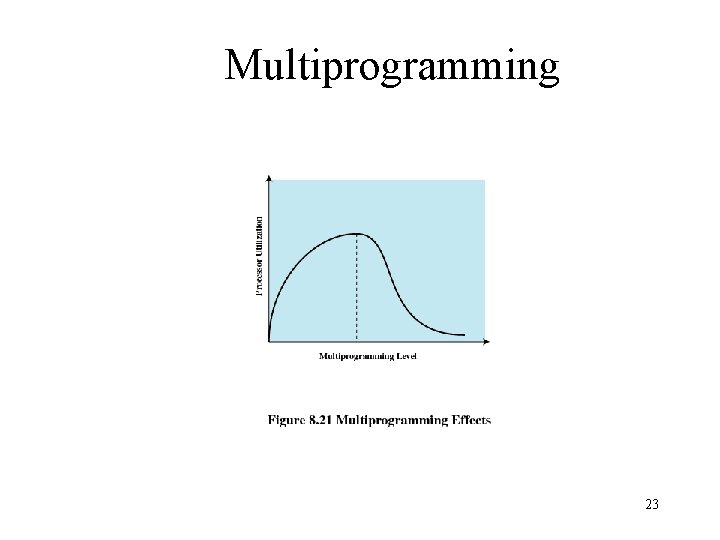
Load Control • Determines the number of processes that will be resident in main memory • Too few processes, many occasions when all processes will be blocked and much time will be spent in swapping • Too many processes will lead to thrashing 22
Multiprogramming 23
Process Suspension • Lowest priority process • Faulting process – This process does not have its working set in main memory so it will be blocked anyway • Last process activated – This process is least likely to have its working set resident 24
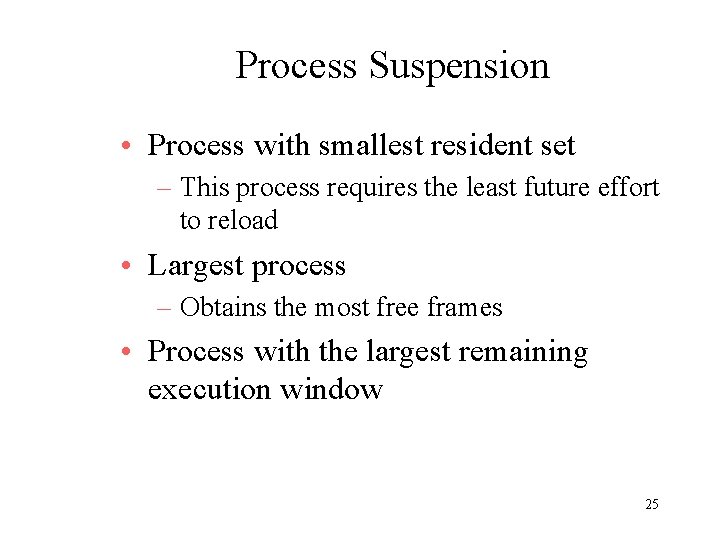
Process Suspension • Process with smallest resident set – This process requires the least future effort to reload • Largest process – Obtains the most free frames • Process with the largest remaining execution window 25
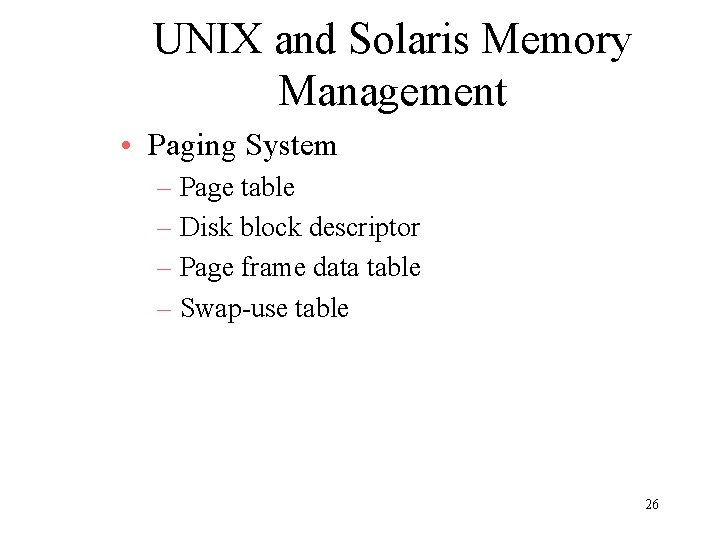
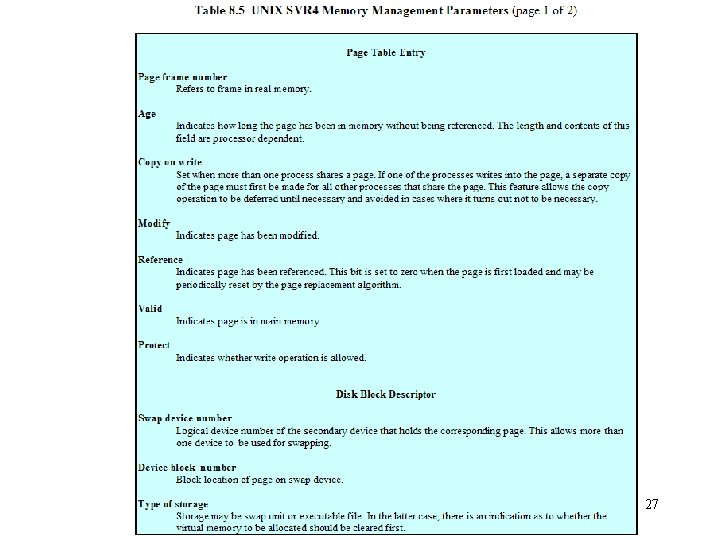
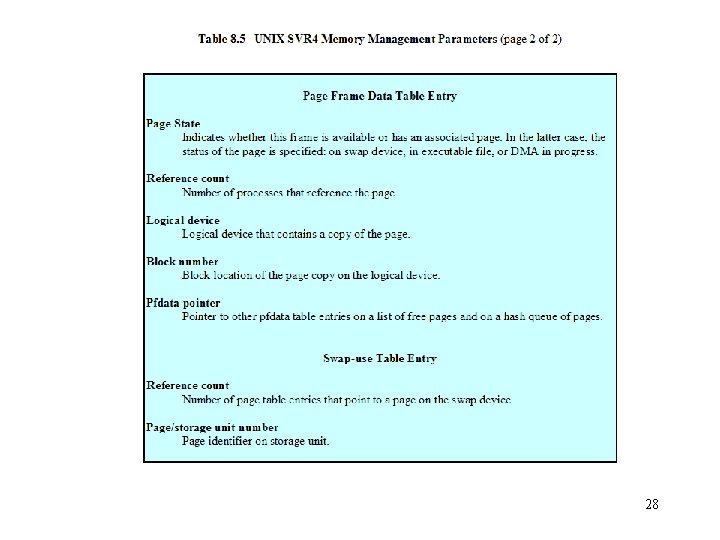
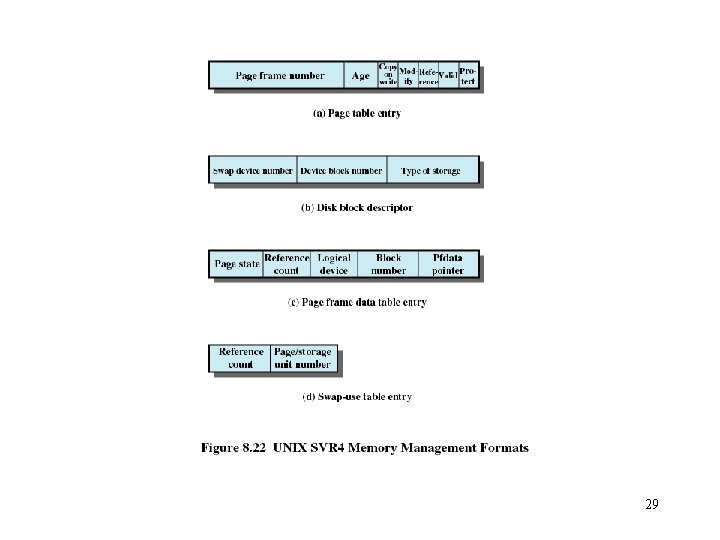
UNIX and Solaris Memory Management • Paging System – Page table – Disk block descriptor – Page frame data table – Swap-use table 26
27
28
29
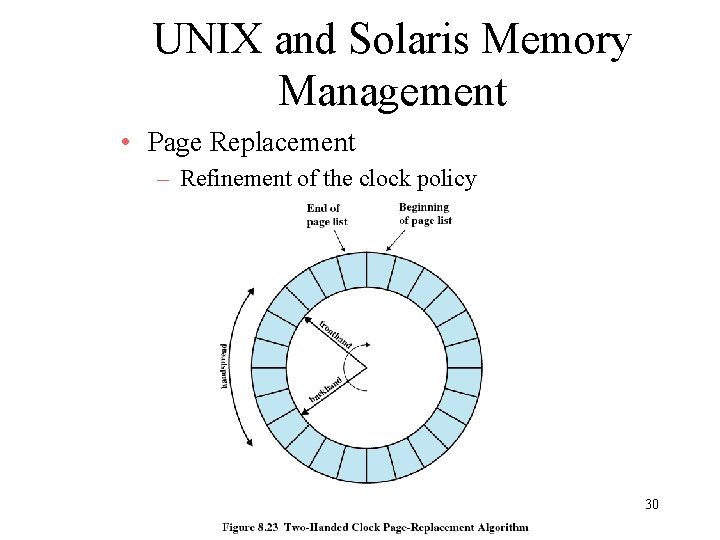
UNIX and Solaris Memory Management • Page Replacement – Refinement of the clock policy 30
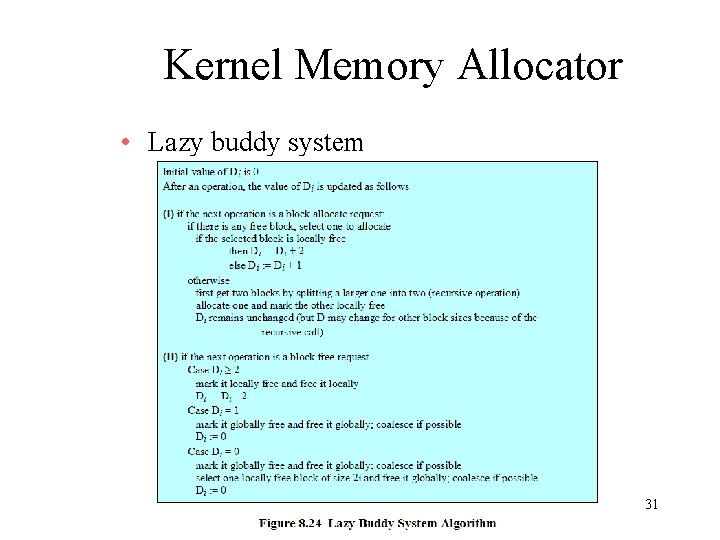
Kernel Memory Allocator • Lazy buddy system 31
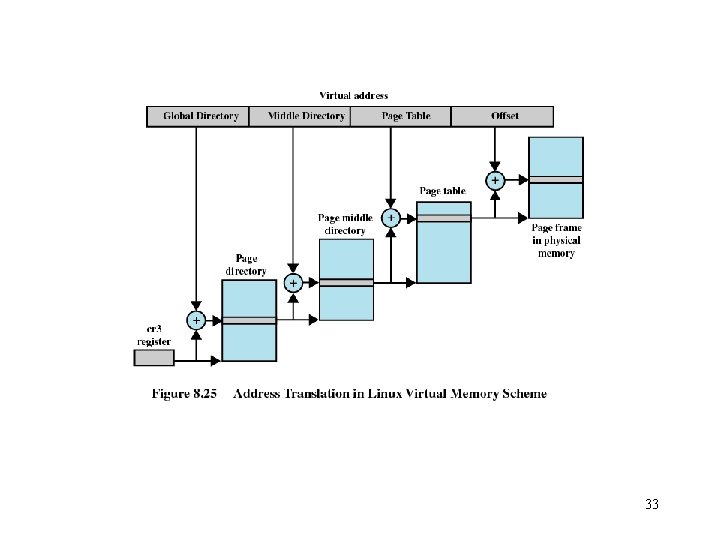
Linux Memory Management • Page directory • Page middle directory • Page table 32
33
34
Windows Memory Management • Paging – Available – Reserved – Committed 35