
Virtual Machines Matthew Dwyer 324 E Nichols Hall
![Memory/Register Instructions st Ri, [Rj] st Ri, [Rj+C] [Rj] : = Ri [Rj+C] :](https://slidetodoc.com/presentation_image/24effb04718338f05a2f85511a7819d6/image-11.jpg "Memory/Register Instructions st Ri, [Rj] st Ri, [Rj+C] [Rj] : = Ri [Rj+C] :")

![Example Virtual. RISC Code _fact: save sp, -112, sp st R 0, [fp+68] mov](https://slidetodoc.com/presentation_image/24effb04718338f05a2f85511a7819d6/image-18.jpg "Example Virtual. RISC Code _fact: save sp, -112, sp st R 0, [fp+68] mov")
![Example Virtual. RISC Code L 5: ld [fp-16], R 0 ld [fp-12], R 1](https://slidetodoc.com/presentation_image/24effb04718338f05a2f85511a7819d6/image-19.jpg "Example Virtual. RISC Code L 5: ld [fp-16], R 0 ld [fp-12], R 1")
![Bytecode Interpreter pc = code. start; while(true) { npc = pc + inst_length(code[pc]); switch](https://slidetodoc.com/presentation_image/24effb04718338f05a2f85511a7819d6/image-29.jpg "Bytecode Interpreter pc = code. start; while(true) { npc = pc + inst_length(code[pc]); switch")
![Bytecode Interpreter pc = code. start; while(true){ … ISTORE: t = pop(); local[code[pc+1]] =](https://slidetodoc.com/presentation_image/24effb04718338f05a2f85511a7819d6/image-30.jpg "Bytecode Interpreter pc = code. start; while(true){ … ISTORE: t = pop(); local[code[pc+1]] =")
![More Branches if_icmpeq L [. . . : i 1: i 2] branch if](https://slidetodoc.com/presentation_image/24effb04718338f05a2f85511a7819d6/image-33.jpg "More Branches if_icmpeq L [. . . : i 1: i 2] branch if")
![More Branches if_icmple L [. . . : i 1: i 2] branch if](https://slidetodoc.com/presentation_image/24effb04718338f05a2f85511a7819d6/image-34.jpg "More Branches if_icmple L [. . . : i 1: i 2] branch if")
![Memory Access iload k istore k [. . . ] -> [. . .](https://slidetodoc.com/presentation_image/24effb04718338f05a2f85511a7819d6/image-36.jpg "Memory Access iload k istore k [. . . ] -> [. . .")
![Class Operations new C [. . . ] -> [. . . : o]](https://slidetodoc.com/presentation_image/24effb04718338f05a2f85511a7819d6/image-38.jpg "Class Operations new C [. . . ] -> [. . . : o]")
![Method Operations ireturn [. . . : i] -> [. . . ] return](https://slidetodoc.com/presentation_image/24effb04718338f05a2f85511a7819d6/image-41.jpg "Method Operations ireturn [. . . : i] -> [. . . ] return")
![Corresponding Bytecode. method public member(Ljava/lang/Object; )Z. limit locals 2 // local[0] = o //](https://slidetodoc.com/presentation_image/24effb04718338f05a2f85511a7819d6/image-43.jpg "Corresponding Bytecode. method public member(Ljava/lang/Object; )Z. limit locals 2 // local[0] = o //")
![Corresponding Bytecode else_2: aload_0 // [ o * ] getfield Cons/rest LCons; // [](https://slidetodoc.com/presentation_image/24effb04718338f05a2f85511a7819d6/image-45.jpg "Corresponding Bytecode else_2: aload_0 // [ o * ] getfield Cons/rest LCons; // [")
- Slides: 49
Virtual Machines Matthew Dwyer 324 E Nichols Hall dwyer@cis. ksu. edu http: //www. cis. ksu. edu/~dwyer
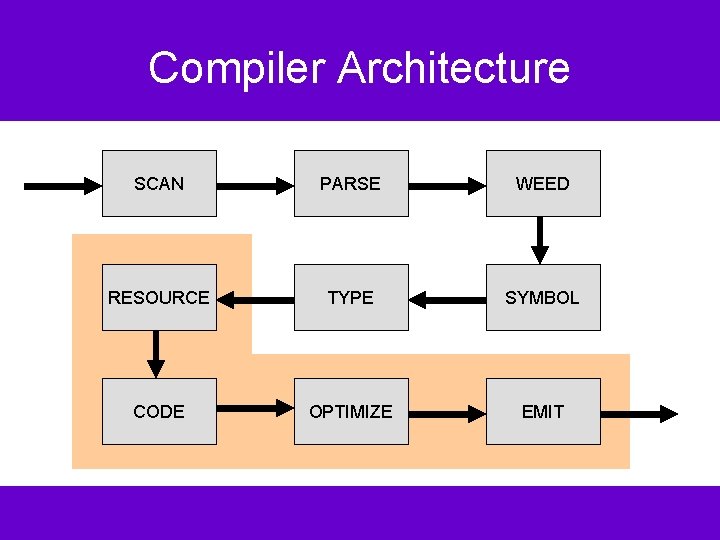
Compiler Architecture SCAN PARSE WEED RESOURCE TYPE SYMBOL CODE OPTIMIZE EMIT
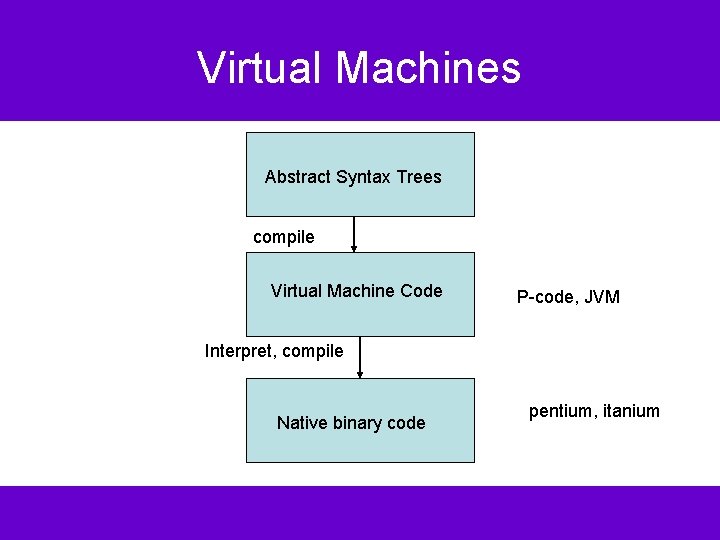
Virtual Machines Abstract Syntax Trees compile Virtual Machine Code P-code, JVM Interpret, compile Native binary code pentium, itanium
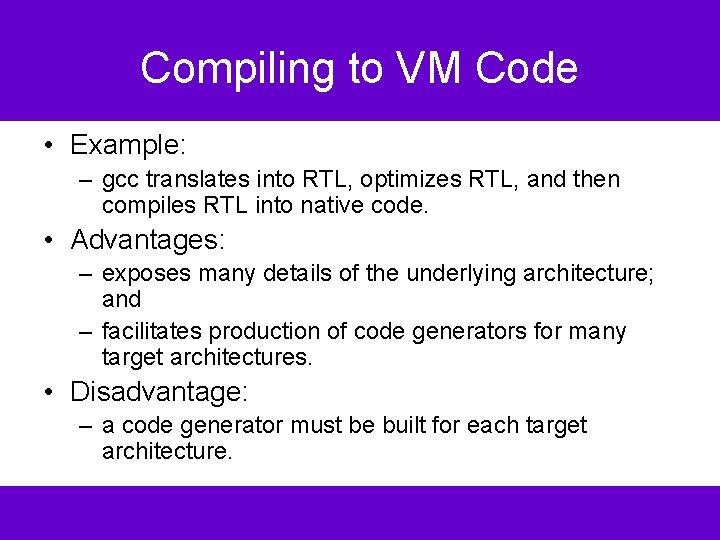
Compiling to VM Code • Example: – gcc translates into RTL, optimizes RTL, and then compiles RTL into native code. • Advantages: – exposes many details of the underlying architecture; and – facilitates production of code generators for many target architectures. • Disadvantage: – a code generator must be built for each target architecture.
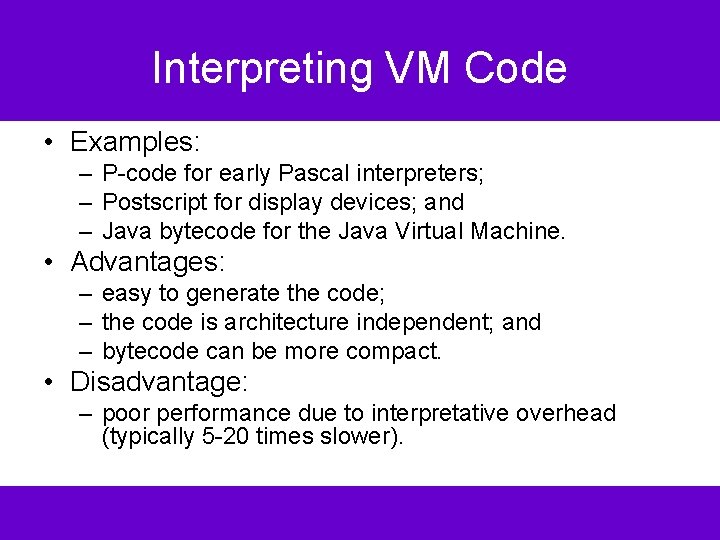
Interpreting VM Code • Examples: – P-code for early Pascal interpreters; – Postscript for display devices; and – Java bytecode for the Java Virtual Machine. • Advantages: – easy to generate the code; – the code is architecture independent; and – bytecode can be more compact. • Disadvantage: – poor performance due to interpretative overhead (typically 5 -20 times slower).
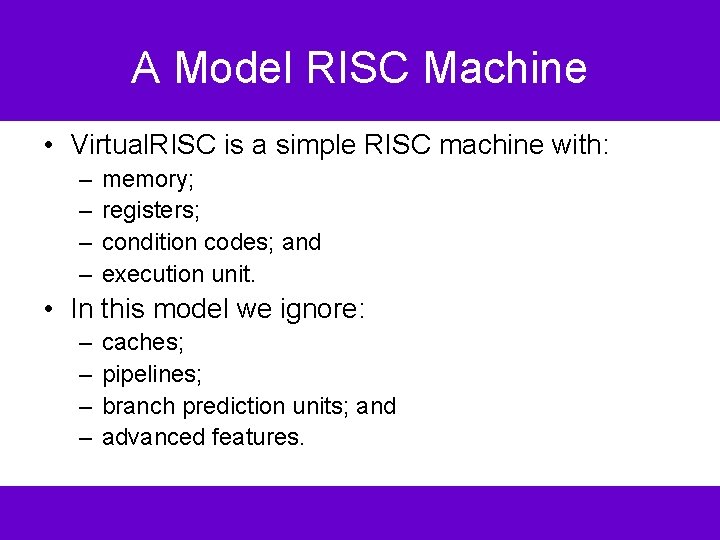
A Model RISC Machine • Virtual. RISC is a simple RISC machine with: – – memory; registers; condition codes; and execution unit. • In this model we ignore: – – caches; pipelines; branch prediction units; and advanced features.
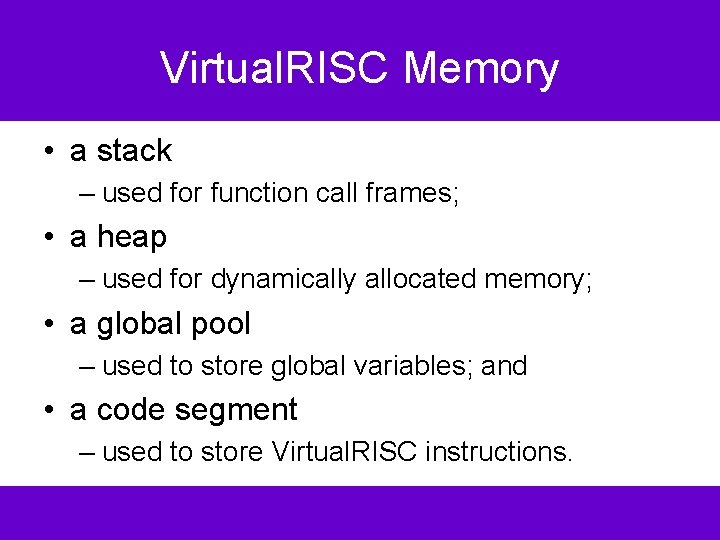
Virtual. RISC Memory • a stack – used for function call frames; • a heap – used for dynamically allocated memory; • a global pool – used to store global variables; and • a code segment – used to store Virtual. RISC instructions.
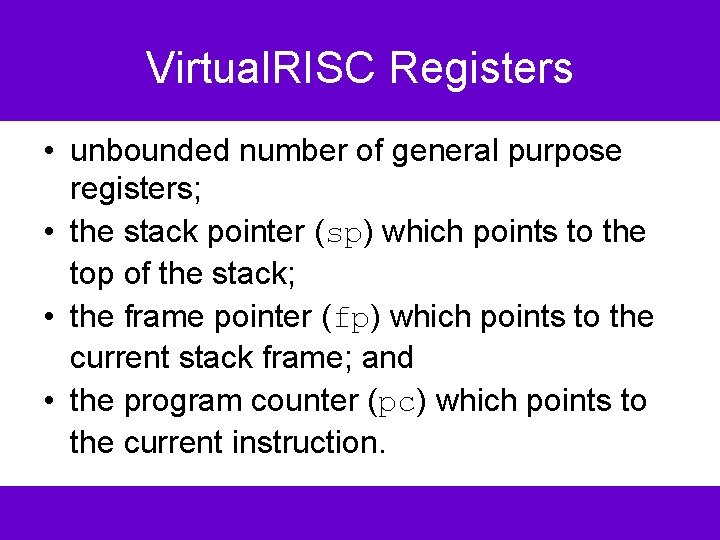
Virtual. RISC Registers • unbounded number of general purpose registers; • the stack pointer (sp) which points to the top of the stack; • the frame pointer (fp) which points to the current stack frame; and • the program counter (pc) which points to the current instruction.
Virtual. RISC Condition Codes • stores the result of last instruction that can set condition codes (used for branching).
Virtual. RISC Execution Unit • reads the Virtual. RISC instruction at the current pc, decodes the instruction and executes it; • this may change the state of the machine (memory, registers, condition codes); • the pc is automatically incremented after executing an instruction; but • function calls and branches explicitly change the pc.
Memory/Register Instructions st Ri, [Rj] st Ri, [Rj+C] [Rj] : = Ri [Rj+C] : = Ri ld [Ri], Rj ld [Ri+C], Rj Rj : = [Ri] Rj : = [Ri+C]
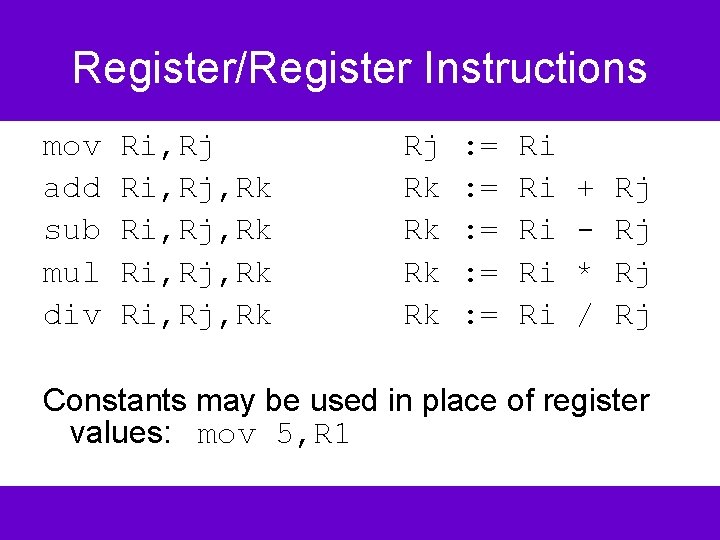
Register/Register Instructions mov add sub mul div Ri, Rj, Rk Ri, Rj, Rk Rj Rk Rk : = : = : = Ri Ri Ri + * / Rj Rj Constants may be used in place of register values: mov 5, R 1
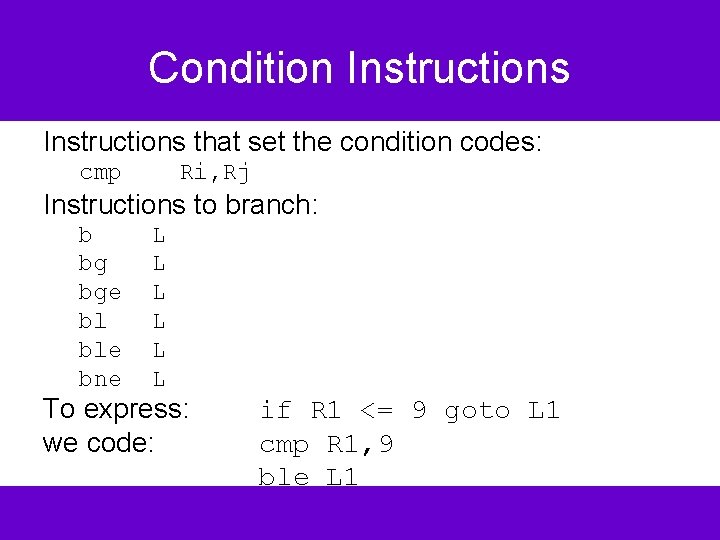
Condition Instructions that set the condition codes: cmp Ri, Rj Instructions to branch: b bg bge bl ble bne L L L To express: we code: if R 1 <= 9 goto L 1 cmp R 1, 9 ble L 1
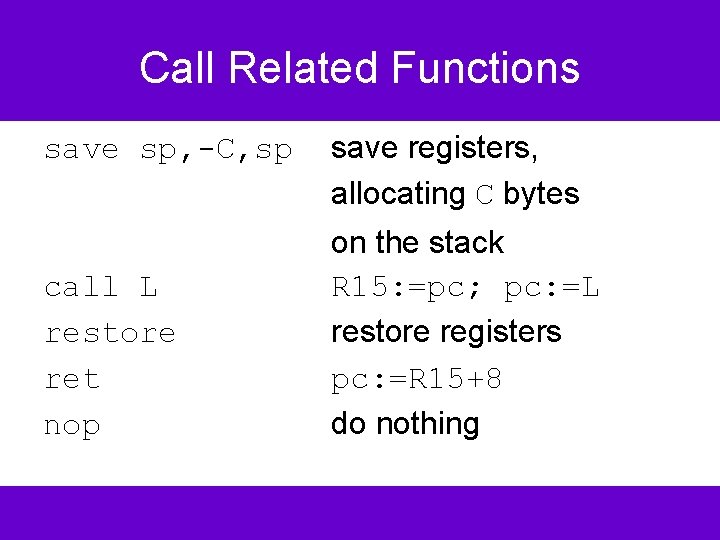
Call Related Functions save sp, -C, sp call L restore ret nop save registers, allocating C bytes on the stack R 15: =pc; pc: =L restore registers pc: =R 15+8 do nothing
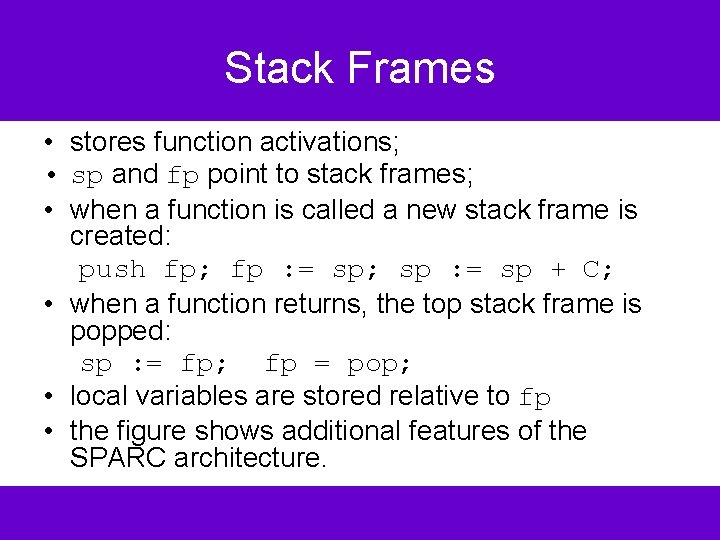
Stack Frames • stores function activations; • sp and fp point to stack frames; • when a function is called a new stack frame is created: push fp; fp : = sp; sp : = sp + C; • when a function returns, the top stack frame is popped: sp : = fp; fp = pop; • local variables are stored relative to fp • the figure shows additional features of the SPARC architecture.
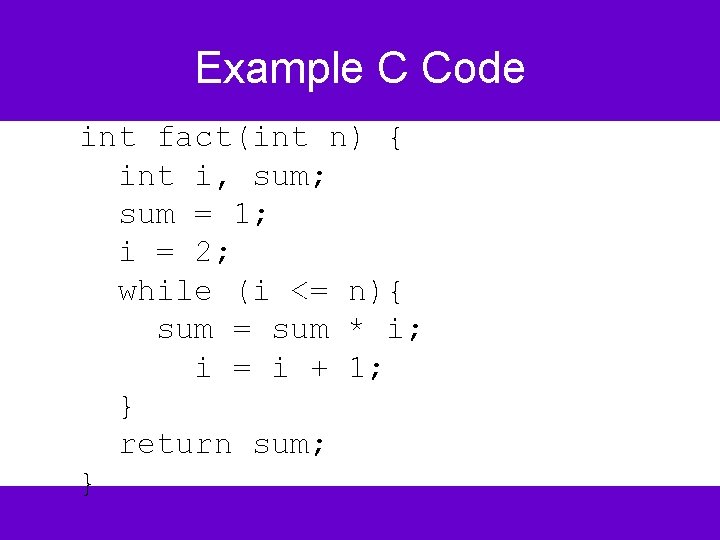
Example C Code int fact(int n) { int i, sum; sum = 1; i = 2; while (i <= n){ sum = sum * i; i = i + 1; } return sum; }
Example Virtual. RISC Code _fact: save sp, -112, sp st R 0, [fp+68] mov 1, R 0 st R 0, [fp-16] mov 2, R 0 st RO, [%fp-12] L 3: ld [fp-12], R 0 ld [fp+68], R 1 cmp R 0, R 1 ble L 5 b L 4 // // // save stack frame save arg n in caller frame R 0 : = 1 sum is in [fp-16] RO : = 2 i is in [fp-12] // // // load i into R 0 load n into R 1 compare R 0 to R 1 if R 0 <= R 1 goto L 5 goto L 4
Example Virtual. RISC Code L 5: ld [fp-16], R 0 ld [fp-12], R 1 mul R 0, R 1, R 0 st R 0, [fp-16] ld [fp-12], R 0 add R 0, 1, R 1 st R 1, [fp-12] b L 3 L 4: ld [fp-16], R 0 restore ret // // load sum into R 0 load i into R 1 R 0 : = R 0 * R 1 store R 0 into sum load i into R 0 R 1 : = R 0 + 1 store R 1 into i goto L 3 // put return value into R 0 // restore register window // return from function
Java Virtual Machine • • memory; registers; condition codes; and execution unit.
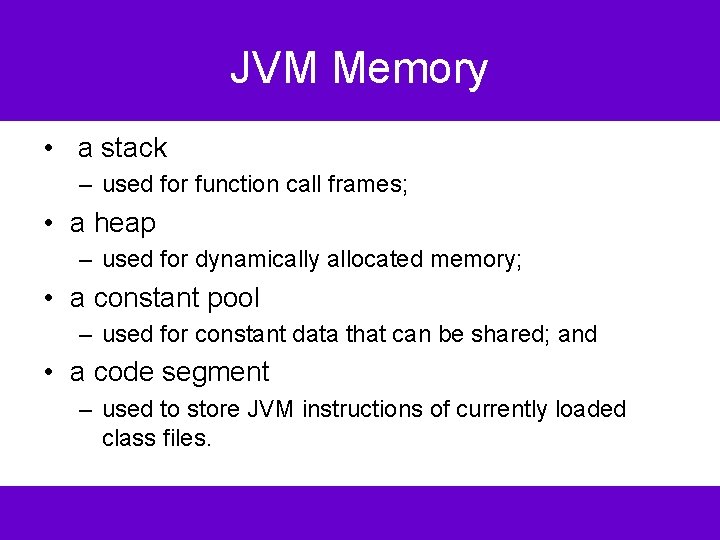
JVM Memory • a stack – used for function call frames; • a heap – used for dynamically allocated memory; • a constant pool – used for constant data that can be shared; and • a code segment – used to store JVM instructions of currently loaded class files.
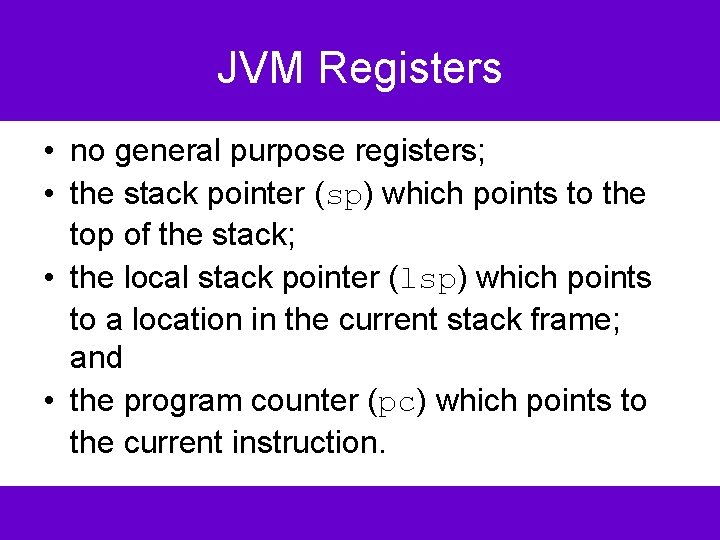
JVM Registers • no general purpose registers; • the stack pointer (sp) which points to the top of the stack; • the local stack pointer (lsp) which points to a location in the current stack frame; and • the program counter (pc) which points to the current instruction.
JVM Condition Codes • stores the result of last instruction that can set condition codes (used for branching).
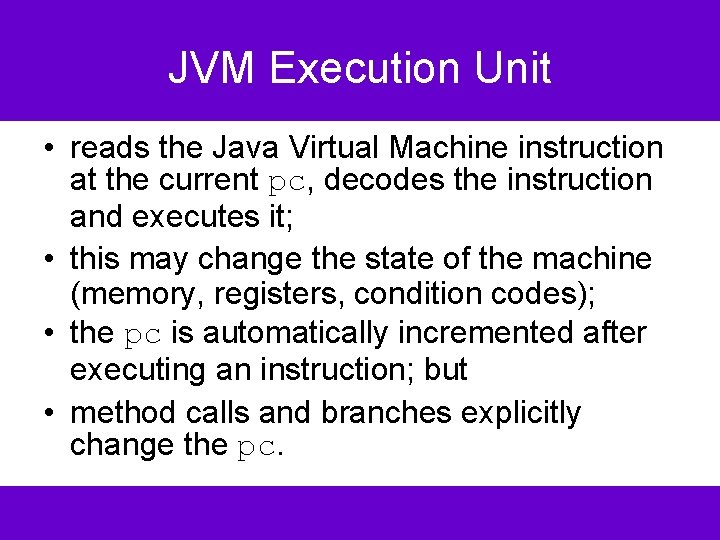
JVM Execution Unit • reads the Java Virtual Machine instruction at the current pc, decodes the instruction and executes it; • this may change the state of the machine (memory, registers, condition codes); • the pc is automatically incremented after executing an instruction; but • method calls and branches explicitly change the pc.
JVM Stack Frames • Have space for: – a reference to the current object (this); – the method arguments; – the local variables; and – a local stack used for intermediate results. • The number of local slots and the maximum size of the local stack are fixed at compile-time.
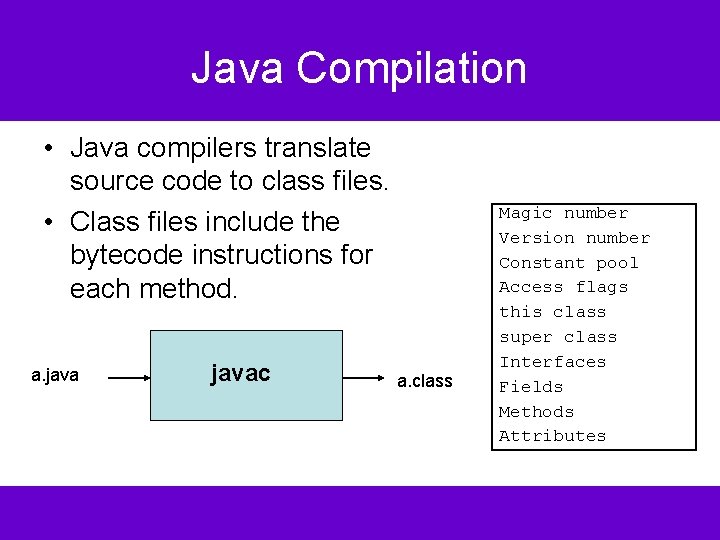
Java Compilation • Java compilers translate source code to class files. • Class files include the bytecode instructions for each method. a. javac a. class Magic number Version number Constant pool Access flags this class super class Interfaces Fields Methods Attributes
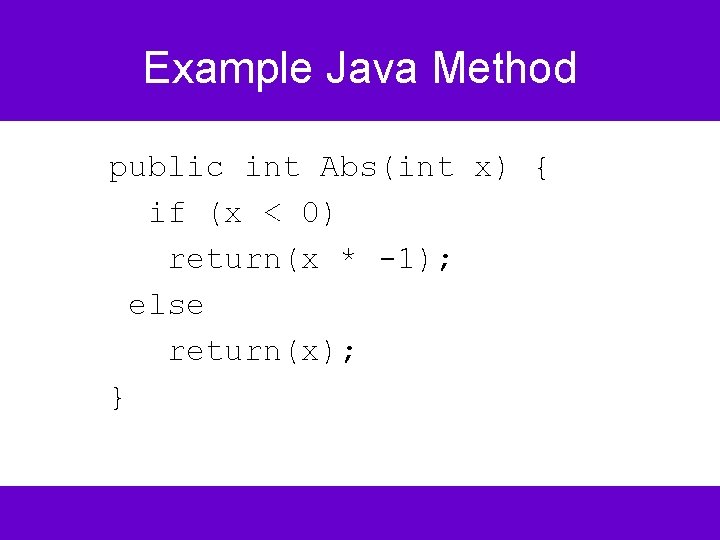
Example Java Method public int Abs(int x) { if (x < 0) return(x * -1); else return(x); }
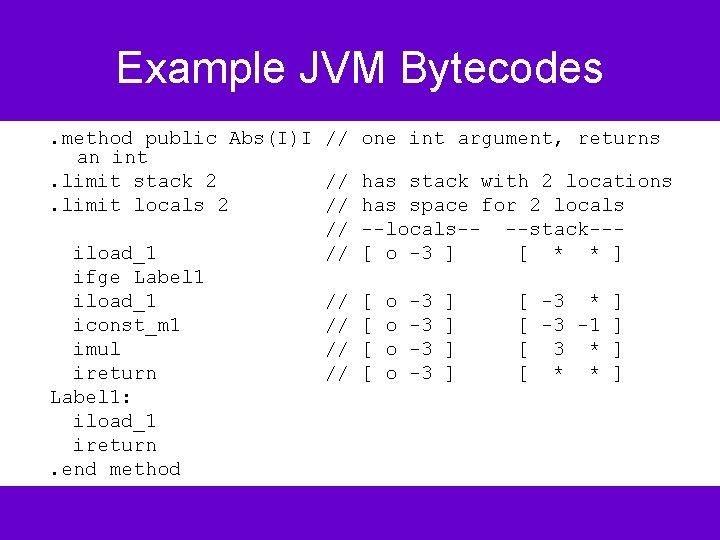
Example JVM Bytecodes. method public Abs(I)I // one int argument, returns an int. limit stack 2 // has stack with 2 locations. limit locals 2 // has space for 2 locals // --locals-- --stack--iload_1 // [ o -3 ] [ * * ] ifge Label 1 iload_1 // [ o -3 ] [ -3 * ] iconst_m 1 // [ o -3 ] [ -3 -1 ] imul // [ o -3 ] [ 3 * ] ireturn // [ o -3 ] [ * * ] Label 1: iload_1 ireturn. end method
Bytecode Interpreter pc = code. start; while(true) { npc = pc + inst_length(code[pc]); switch (opcode(code[pc])) { ILOAD_1: push(local[1]); break; ILOAD: push(local[code[pc+1]]); break; . . . } pc = npc; }
Bytecode Interpreter pc = code. start; while(true){ … ISTORE: t = pop(); local[code[pc+1]] = t; break; IADD: t 1 = pop(); t 2 = pop(); push(t 1 + t 2); break; IFEQ: t = pop(); if (t == 0) npc = code[pc+1]; break; }
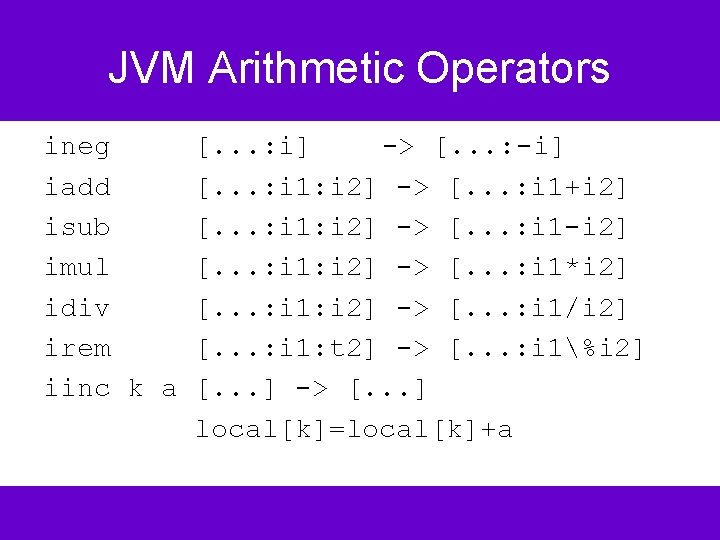
JVM Arithmetic Operators ineg iadd isub imul idiv irem iinc k a [. . . : i] -> [. . . : -i] [. . . : i 1: i 2] -> [. . . : i 1+i 2] [. . . : i 1: i 2] -> [. . . : i 1 -i 2] [. . . : i 1: i 2] -> [. . . : i 1*i 2] [. . . : i 1: i 2] -> [. . . : i 1/i 2] [. . . : i 1: t 2] -> [. . . : i 1%i 2] [. . . ] -> [. . . ] local[k]=local[k]+a
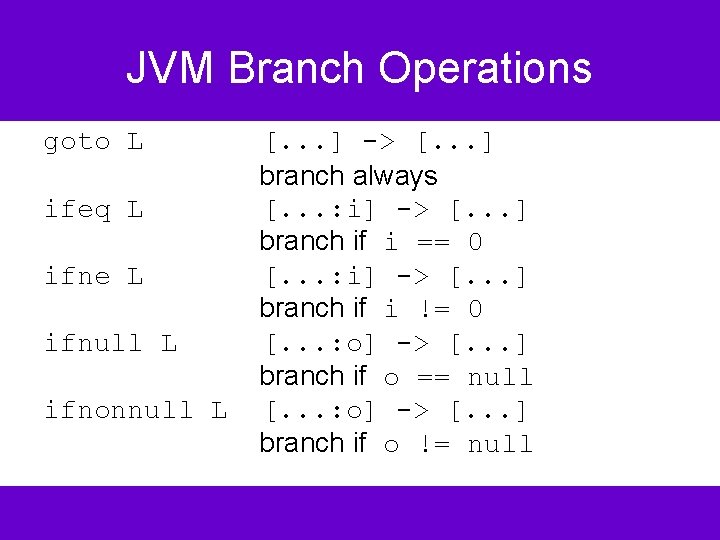
JVM Branch Operations goto L ifeq L ifne L ifnull L ifnonnull L [. . . ] -> [. . . ] branch always [. . . : i] -> [. . . ] branch if i == 0 [. . . : i] -> [. . . ] branch if i != 0 [. . . : o] -> [. . . ] branch if o == null [. . . : o] -> [. . . ] branch if o != null
More Branches if_icmpeq L [. . . : i 1: i 2] branch if i 1 == i 2 if_icmpne L [. . . : i 1: i 2] branch if i 1 != i 2 if_icmpgt L [. . . : i 1: i 2] branch if i 1 > i 2 if_icmplt L [. . . : i 1: i 2] branch if i 1 < i 2 -> [. . . ]
More Branches if_icmple L [. . . : i 1: i 2] branch if i 1 <= i 2 if_icmpge L [. . . : i 1: i 2] branch if i 1 >= i 2 if_acmpeq L [. . . : o 1: o 2] branch if o 1 == o 2 if_acmpne L [. . . : o 1: o 2] branch if o 1 != o 2 -> [. . . ]
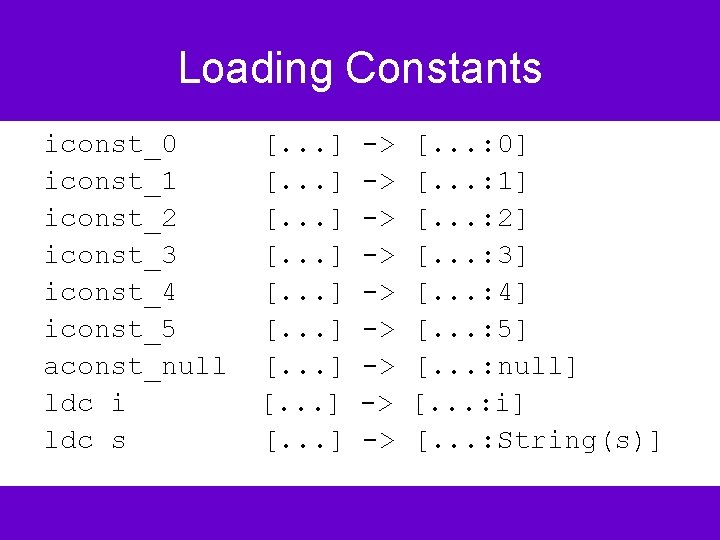
Loading Constants iconst_0 iconst_1 iconst_2 iconst_3 iconst_4 iconst_5 aconst_null ldc i ldc s [. . . ] [. . . ] -> -> -> [. . . : 0] [. . . : 1] [. . . : 2] [. . . : 3] [. . . : 4] [. . . : 5] [. . . : null] [. . . : i] [. . . : String(s)]
Memory Access iload k istore k [. . . ] -> [. . . : local[k]] [. . . : i] -> [. . . ] local[k]=i aload k [. . . ] -> [. . . : local[k]] astore k [. . . : o] -> [. . . ] local[k]=o getfield f sig [. . . : o] -> [. . . : o. f] putfield f sig [. . . : o: v] -> [. . . ] o. f=v
Class Operations new C [. . . ] -> [. . . : o] instance_of C [. . . : o] -> [. . . : i] if (o==null) i=0 else i=(C<=type(o)) checkcast C [. . . : o] -> [. . . : o] if (o!=null && !C<=type(o)) throw Class. Cast. Exception
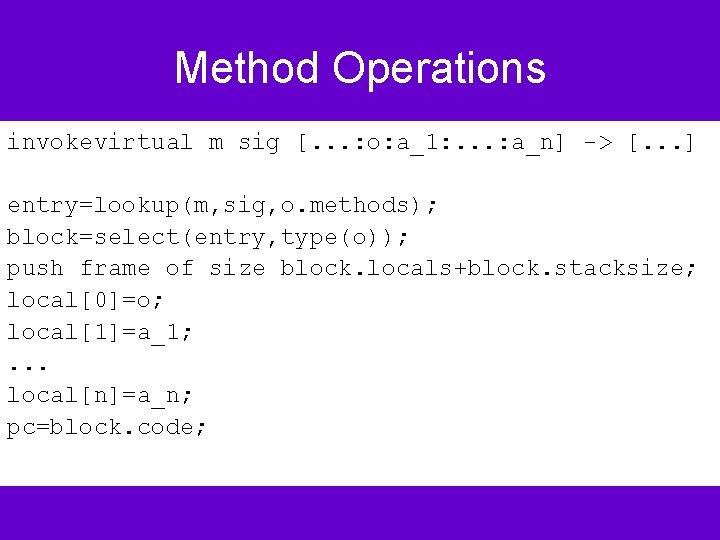
Method Operations invokevirtual m sig [. . . : o: a_1: . . . : a_n] -> [. . . ] entry=lookup(m, sig, o. methods); block=select(entry, type(o)); push frame of size block. locals+block. stacksize; local[0]=o; local[1]=a_1; . . . local[n]=a_n; pc=block. code;
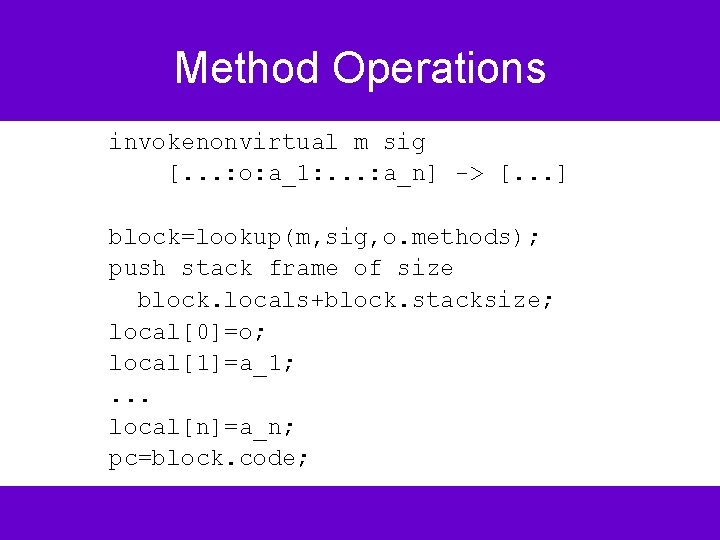
Method Operations invokenonvirtual m sig [. . . : o: a_1: . . . : a_n] -> [. . . ] block=lookup(m, sig, o. methods); push stack frame of size block. locals+block. stacksize; local[0]=o; local[1]=a_1; . . . local[n]=a_n; pc=block. code;
Method Operations ireturn [. . . : i] -> [. . . ] return i and pop stack frame areturn [. . . : o] -> [. . . ] return o and pop stack frame return [. . . ] -> [. . . ] pop stack frame
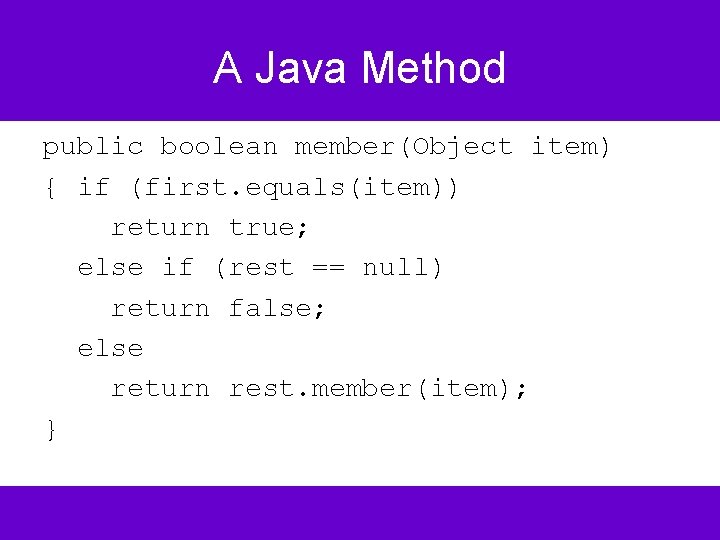
A Java Method public boolean member(Object item) { if (first. equals(item)) return true; else if (rest == null) return false; else return rest. member(item); }
Corresponding Bytecode. method public member(Ljava/lang/Object; )Z. limit locals 2 // local[0] = o // local[1] = item. limit stack 2 // initial stack [ * * ] aload_0 // [ o * ] getfield Cons/first Ljava/lang/Object; // [ o. first *] aload_1 // [ o. first item] invokevirtual java/lang/Object/equals(Ljava/lang/Object; )Z // [bool *]
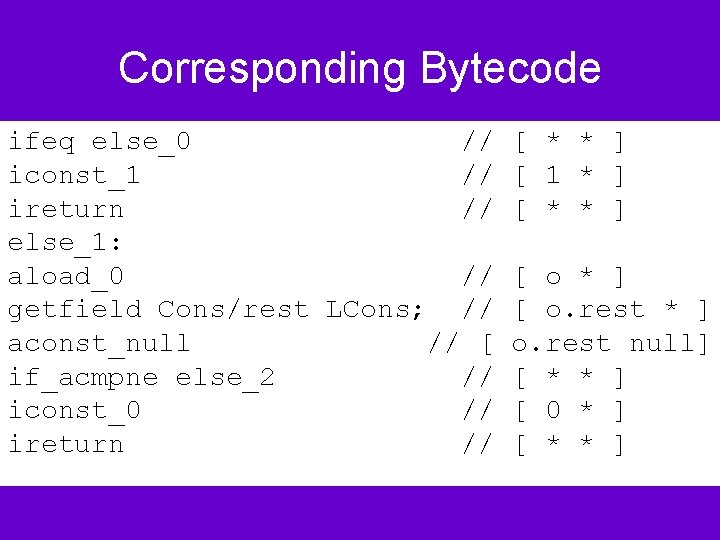
Corresponding Bytecode ifeq else_0 // iconst_1 // ireturn // else_1: aload_0 // getfield Cons/rest LCons; // aconst_null // [ if_acmpne else_2 // iconst_0 // ireturn // [ * * ] [ 1 * ] [ * * ] [ o. rest * ] o. rest null] [ * * ] [ 0 * ] [ * * ]
Corresponding Bytecode else_2: aload_0 // [ o * ] getfield Cons/rest LCons; // [ o. rest * ] aload_1 // [ o. rest item ] Invokevirtual Cons/member(Ljava/lang/Object; )Z // [ bool * ] ireturn // [ * * ]. end method
Bytecode Verification • bytecode cannot be trusted to be well-formed and well-behaved; • before executing any bytecode that is received over the network, it should be verified; • verification is performed partly at class loading time, and partly at run-time; and • at load time, dataflow analysis is used to approximate the number and type of values in locals and on the stack.
Properties of Verified Bytecode • each instruction must be executed with the correct number and types of arguments on the stack, and in locals (on all execution paths); • at any program point, the stack is the same size along all execution paths; and • no local variable can be accessed before it has been assigned a value.
Interpreting Java • when a method is invoked, a classloader finds the correct class and checks that it contains an appropriate method; • if the method has not yet been loaded, then it may be verified (remote classes); • after loading and verification, the method body is interpreted; or • the bytecode for the method is translated to native code (only for the first invocation).
How we will use JVM and Virtual. RISC • Future use of Java bytecode: – the JOOS compiler will produce Java bytecode in Jasmin format; and – the JOOS peephole optimizer transforms bytecode into more efficient bytecode. • Future use of Virtual. RISC: – Java bytecode can be converted into machine code at run-time using a JIT (Just-In-Time) compiler; – we will study some examples of converting Java bytecode into a language similar to Virtual. RISC; – we will study some simple, standard optimizations on Virtual. RISC.