
Virtual Laboratory Overview A collaborative analysis environment for
Virtual Laboratory Overview A collaborative analysis environment for applied experimental science • • Distributed instrumentation & resource access Remote resources transparently available Focus on content and information Guide the user through the experiment David Groep / 2001. 05. 08 Virtual Lab overview 1
Distributed Metacomputing: the Grid • Dependable, consistent and pervasive access to (high-end) resources • • Guaranteed end-to-end performance Varying resource availability Various administrative domains Security, policy and payment David Groep / 2001. 05. 08 Virtual Lab overview 2
The Grid, a layman’s view • In ye olde days (till approx 1992): – Hardly any network security – All machines in a LAN are created equal – All local users happy with remote shell, rlogin, rcp • Now: – Want to communicate globally over Gigabit WAN, but – Internet is a dangerous place full of crackers and government agencies, firewalls and barriers • The Grid: – Bring back single sign on and trust – use the WAN as the 80’s LANs: all global users happy David Groep / 2001. 05. 08 Virtual Lab overview 3

The fabric (machines and network) • Surfnet 5/Gigaport networking – Now: 20 Gbit/s IP backbone (POS framing) – In 2003: 80 Gbit/s – Connects universities, institutes and acad. home users • Client connections now: – NIKHEF: 1 Gbit/s Surfnet, 2 x 1 Gbit/s WTCWnet (SARA) – VU: 155 Mbit/s (soon 1 Gbit/s) • Compute Resources – Farms, supercomputer, tape robot, visualization, … David Groep / 2001. 05. 08 Virtual Lab overview 4
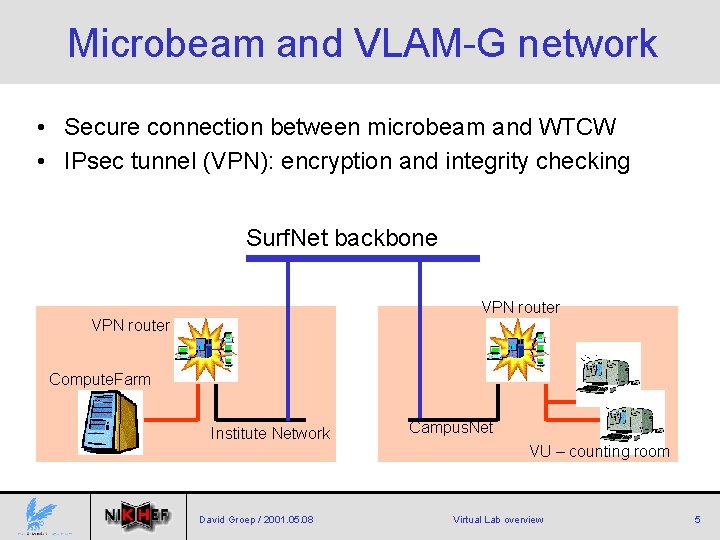
Microbeam and VLAM-G network • Secure connection between microbeam and WTCW • IPsec tunnel (VPN): encryption and integrity checking Surf. Net backbone VPN router Compute. Farm Institute Network Campus. Net VU – counting room David Groep / 2001. 05. 08 Virtual Lab overview 5
The VLAM-G Applications • Three prototype applications for the VLAM-G – Materials Analysis of Complex Surfaces (Macs. Lab) • Microbeam, FT-IR, TOF-SIMS mass spectroscopy – Biomedical simulation and visualization (VRE) • Link patient MRI scans with blood-flow simulations in vessels – Genome expression studies using a DNA Micro Array (Expressive) • Mass-test reaction of antibodies on DNA and proteins • Applications share concept of Process Flow • Many use unique (in NL) resources or need compute power David Groep / 2001. 05. 08 Virtual Lab overview 6

A layered architecture Bio Medicine MRI Scanner Material Ana Micro beam FTIR, . . . DNA Array genome expression Others Application Domains VLAM Science Portal + Workbench VLAM RTS Grid Middleware (Globus) Grid Fabric (Farms, microscope, etc. ) David Groep / 2001. 05. 08 Virtual Lab overview 7

Objectives • Designing middleware: bridge gap between Grid- and application-layer • Enable VL users to define, execute, and monitor their experiments • Provide to VL users: location independent experimentation, familiar experimentation environment assistance during his experiment David Groep / 2001. 05. 08 Virtual Lab overview 8
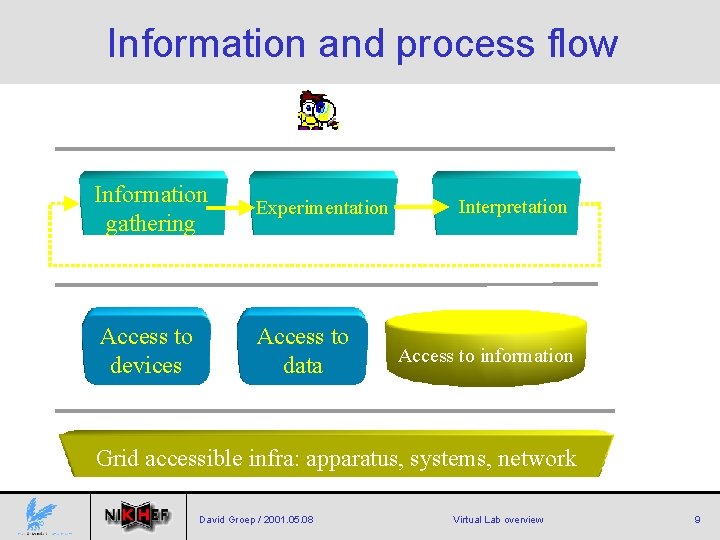
Information and process flow Information gathering Access to devices Experimentation Access to data Interpretation Access to information Grid accessible infra: apparatus, systems, network David Groep / 2001. 05. 08 Virtual Lab overview 9
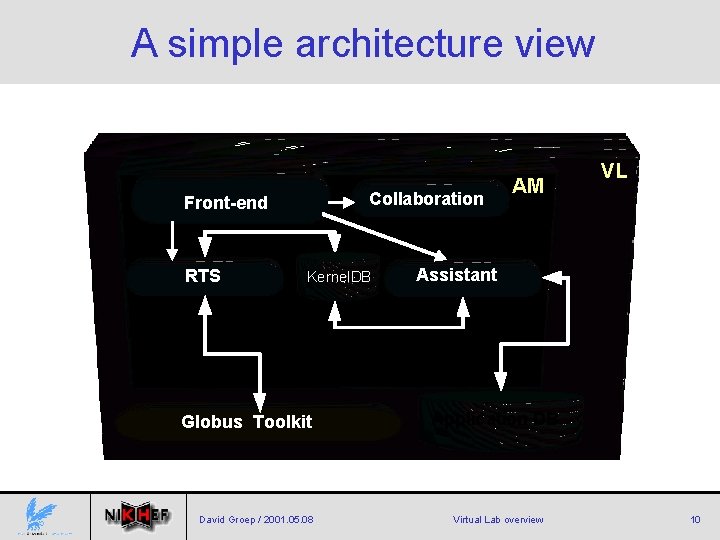
A simple architecture view Collaboration Front-end RTS Kernel. DB Globus Toolkit David Groep / 2001. 05. 08 AM VL Assistant Application DB Virtual Lab overview 10
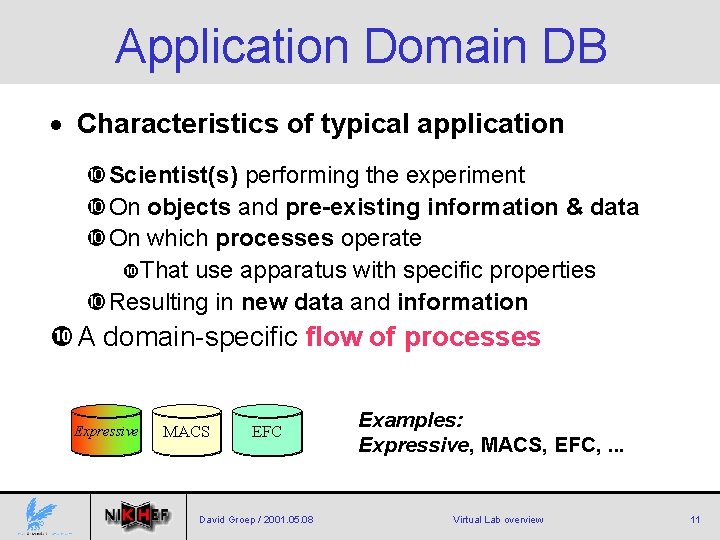
Application Domain DB · Characteristics of typical application Scientist(s) performing the experiment On objects and pre-existing information & data On which processes operate That use apparatus with specific properties Resulting in new data and information A domain-specific flow of processes Expressive MACS EFC David Groep / 2001. 05. 08 Examples: Expressive, MACS, EFC, . . . Virtual Lab overview 11
VL-AM Kernel DB " Stores user support information: experiment topology definitions module descriptions user information " Provides cross-links to application annotations knows the context in which data was generated| " Extends resource directories now used in Grid David Groep / 2001. 05. 08 Virtual Lab overview 12
Device control • Needs a very stable and secure environment • Concurrent access: – Full control for (many) local operators – Limited control for remote end-users (laymen) • Control very device dependent (unique properties) • Use dedicated control software as user interface • DACQ output needs to be integrated in the VLAM David Groep / 2001. 05. 08 Virtual Lab overview 13
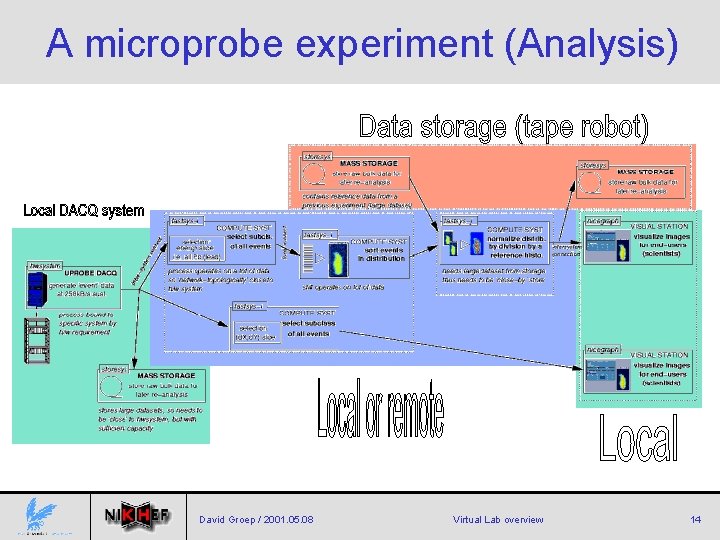
A microprobe experiment (Analysis) David Groep / 2001. 05. 08 Virtual Lab overview 14
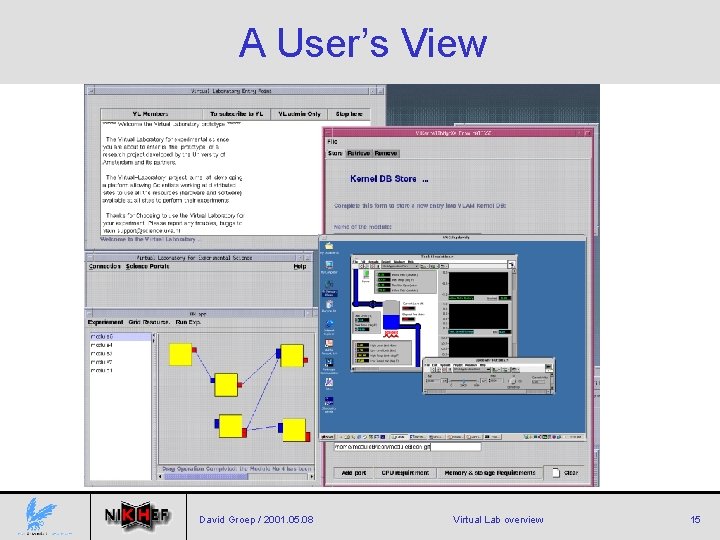
A User’s View David Groep / 2001. 05. 08 Virtual Lab overview 15
VLAM-G current status • Prototypes of the analysis environment exist • Distributed compute environment ready @WCW (VU soon) • • Integrating the various parts of VLAM-G AM Currently building the analysis GUI Expect working demo in June (HPCN conference) Analysis modules: Stefan Piet and Gert Eijkel • Secure Network to VU: now selecting equipment • Building of device interface (Lab. View): Q 3/Q 4 2001 David Groep / 2001. 05. 08 Virtual Lab overview 16
- Slides: 16