
Virtual Environments Teaching children about the spatial layout
Virtual Environments: Teaching children about the spatial layout of their school
Colleagues include Paul Wilson, Danae Stanton. Fraser, Bernd Leplow, George Sandamas, Maria Lehnung, Michael Tlauka
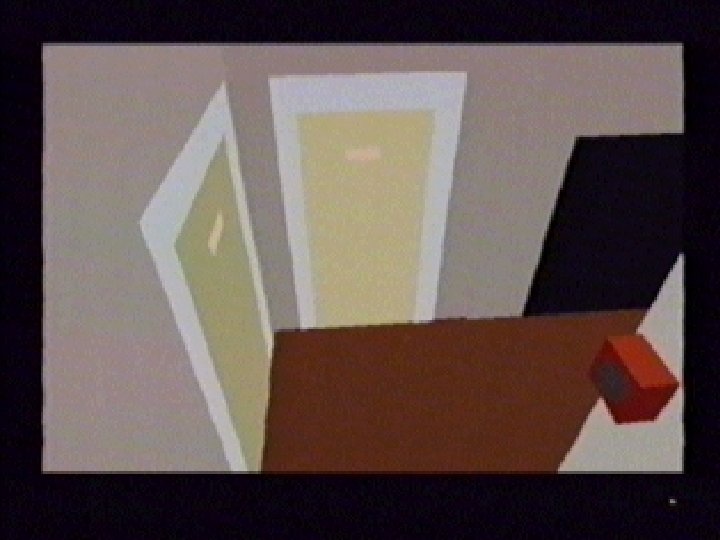
Definition of VE • Graphical display having x, y and z co- ordinates, so depth incorporated, creating 3 -D objects in 3 -D space • Movement in pseudo-real time via an input device such as joystick, mouse or keyboard keys • Doesn’t need to be immersive; desk-top is adequate for many training purposes
What does 3 -D “add” to spatial cognitive experience? • Not certain: what brain systems recruited as a • • • result? Spatial cognition invoked by 3 -D changes (cf. Gibsonian optic flow) that result from selfinitiated displacements Arguably spatial up-dating of own position and cognitive “maps” Explains why real and (all) virtual media improve on 2 -D representations
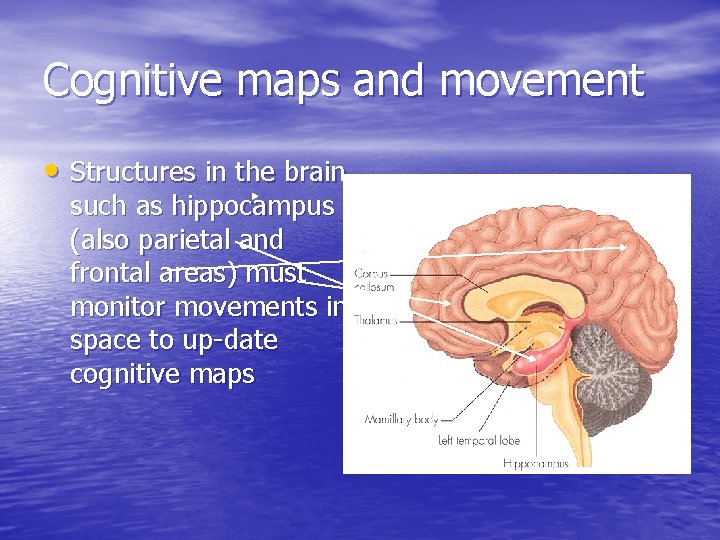
Cognitive maps and movement • Structures in the brain such as hippocampus (also parietal and frontal areas) must monitor movements in space to up-date cognitive maps
Potential for “Virtual Reality” • Always assumed that authentic information would be acquired from VEs, because they provide “spatial” experience similar to real world experience -- VE “soft-where” -- despite environments appearing a bit ugly (unreal)
David Rose et al (UEL) • Stroke patient: spatially disoriented • Select several routes between ward and occupational therapy • Train some only using a VE: only these are used effectively • Not reinstating lost function per se • Patient uses residual procedural skills to compensate for absence of mapping skills
Ways of navigating • Use of landmarks • Routes connecting landmarks • Cognitive spatial maps • Piloting – can be landmark-based • Ded-reckoning (deduced reckoning) • Others… • Depends on age, experience, environment
AN APPLICATION: CHILDREN NEED EXPLORATION TO ESTABLISH COGNITIVE REPRESENTATIONS OF A NEW SCHOOL Children find changing schools a particularly traumatic and emotional experience, in many cases because they fear getting lost when having to locate class rooms, the gym, the head’s office, dinner room, music room and toilets. The school campus is a bewildering complex of important locations that must be accessed on time, and in which route-taking is an important feature of life. Peer accompaniment cannot be relied upon. Moreover, many school campuses are poorly marked and sign-posted. This is particularly daunting for a child with special needs, whose environmental experience is restricted.
Schools often daunting • Architects tend to be economical and reproduce • • “units” often looking the same (also in hospitals) Signposting poor Need for orientation sessions on arrival Kids will say that changing schools is especially daunting because they will get lost, get to lessons late and so on Especially so for children with special needs
Navigational disorders -causes • Primary brain damage (not reversible) – also sometimes “invisible” eg. long-term effects of CHI or anoxia resulting from preterm birth • Secondary effects of brain damage or peripheral disorders caused indirectly via – Lack of independence in choice of movements in space – Rarely challenged to self-navigate; passive mode, poor motivation (see Foreman, N. [2006], Spatial Cognition in Special Populations. In Allen, G (Ed. ), Applied Spatial Cognition, New Jersey: Erlbaum).

Children with disabilities that affect their mobility • Poor cognitive spatial maps/navigation • Skills may be developed and improved via training -- plasticity in the system suggested by taxi driver studies; MRI shows the hippocampus to increase in size in proportion to years spent using “the knowledge” of London streets • Can a VE provide training experience? • Does VE experience transfer to reality?
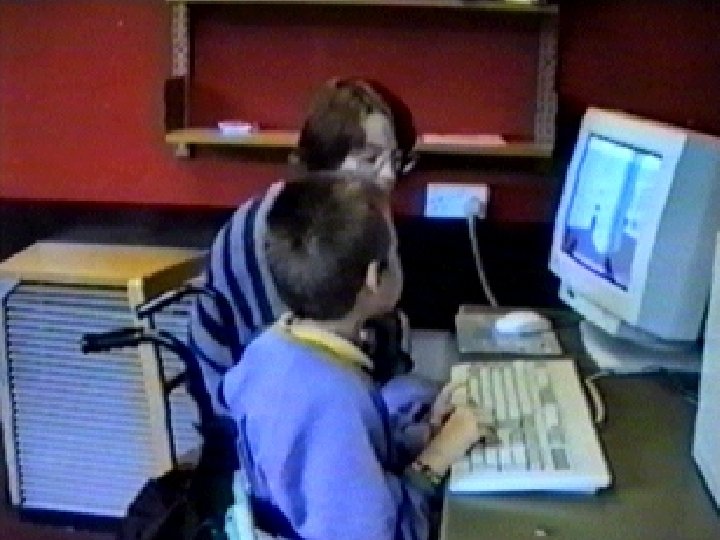
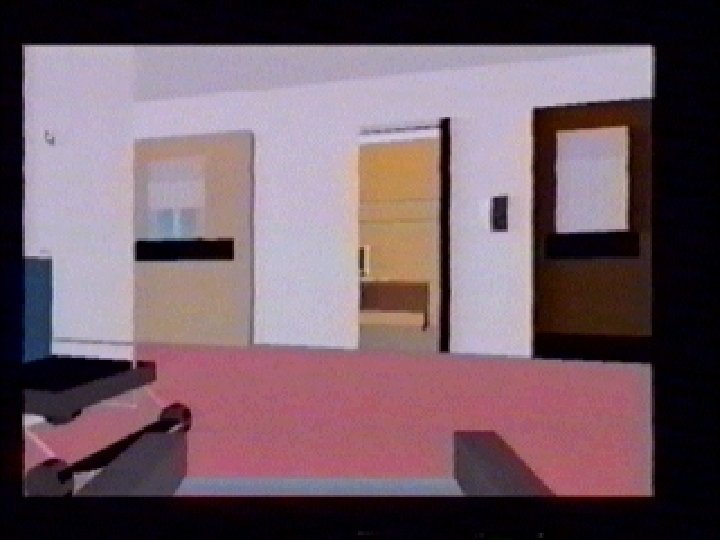
Studies in schools • Children with disabilities at Westbrook School, Derbyshire given virtual exposure to a building in Leicester university (experiment 1) and Ash Field School (special school) in Leicester (experiment 2)
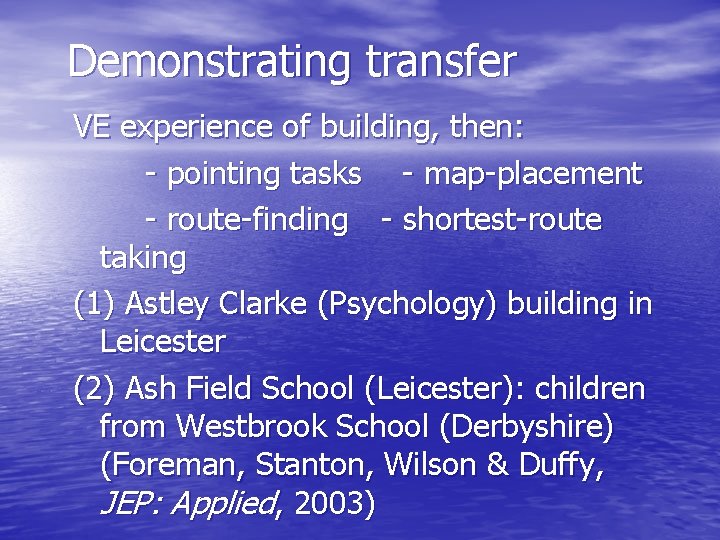
Demonstrating transfer VE experience of building, then: - pointing tasks - map-placement - route-finding - shortest-route taking (1) Astley Clarke (Psychology) building in Leicester (2) Ash Field School (Leicester): children from Westbrook School (Derbyshire) (Foreman, Stanton, Wilson & Duffy, JEP: Applied, 2003)
Mean horizontal pointing errors
Why does a VE help? • VE improves spatial functions in children with impaired mobility by 1. maybe, giving them free choice 2. motivating them to think about space 3. providing experience of self-initiated movement and contingent visual changes
Learning or rehabilitation? • May only learn about the one environment explored in the VE • But could educate brain structures/strategies generally, in which case performance on NEW spatial tasks should benefit from prior training • So far examined only in a VE: three 3 room environments of similar complexity
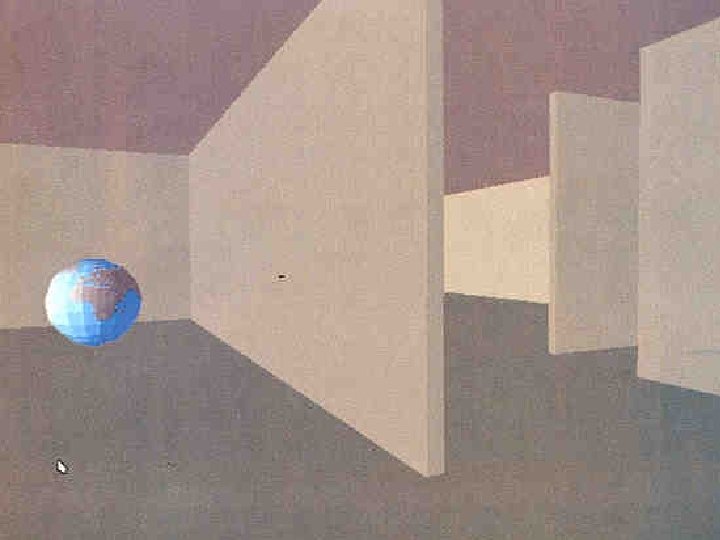
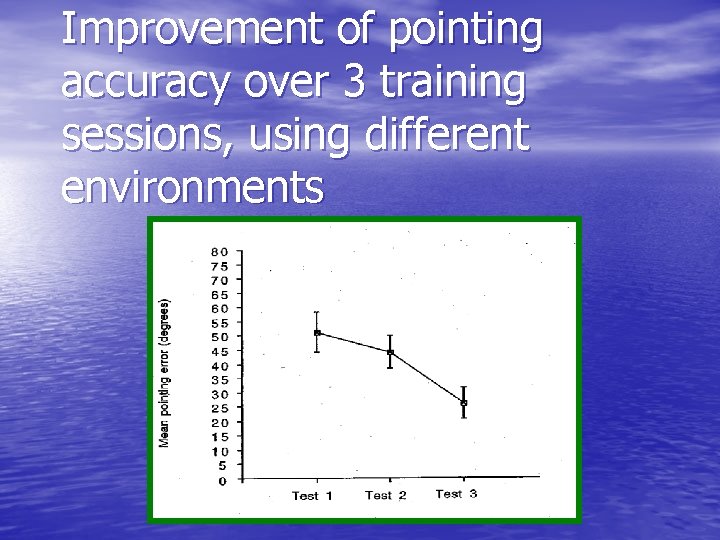
Improvement of pointing accuracy over 3 training sessions, using different environments
A caveat: Navigation training in augmented VEs and mixed reality environments: Overcompensation? • Augmentation, eg. highlight wheelchair-accessible routes • Always need to challenge the individual -- cf. ZPD (L. S. • Vygotsky) Too much intelligent technology can remove the need for active brain processing (smart houses, smart vehicles and wheelchairs, web shopping, GPS); needs further research
A problem in VE research? Underestimation of distances • Doesn’t seem to have a great influence on navigational training, but. . .
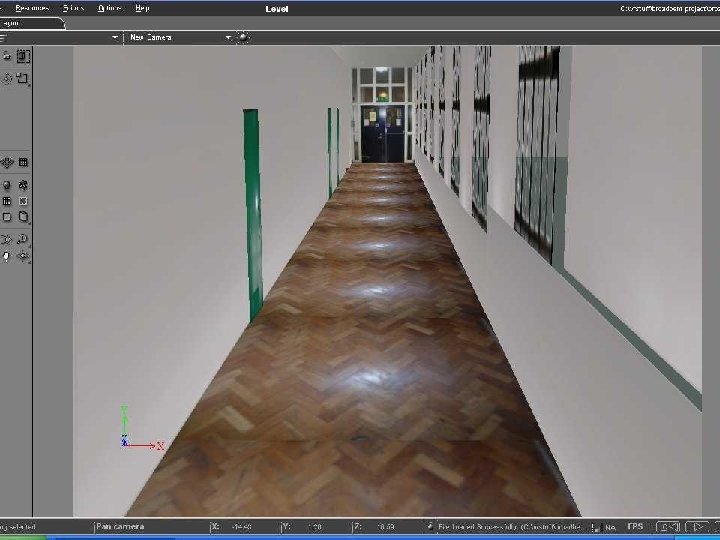
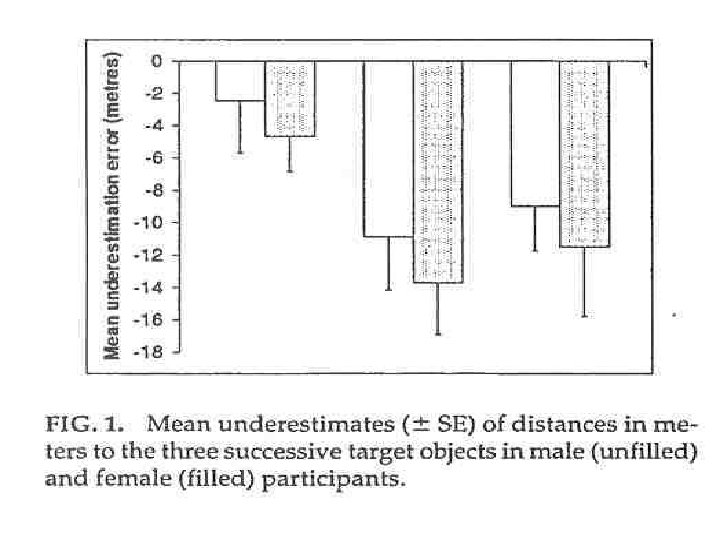
1. Horizontal distance underestimation • Studies have shown that distances are invariably underestimated in VEs, and especially by women (eg. Foreman Sandamas & Newson, Cyberpsychology & Behaviour, 2004). • Participants walked or flew through a virtual corridor and then estimated the distance travelled by pacing out in an equivalent real corridor
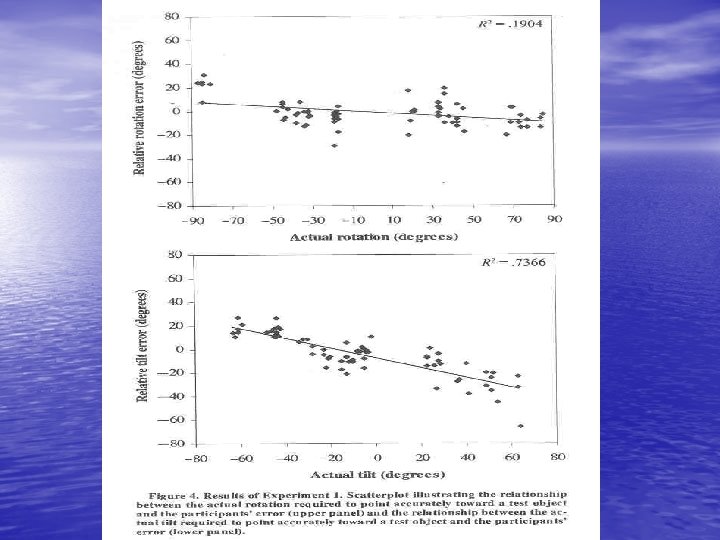
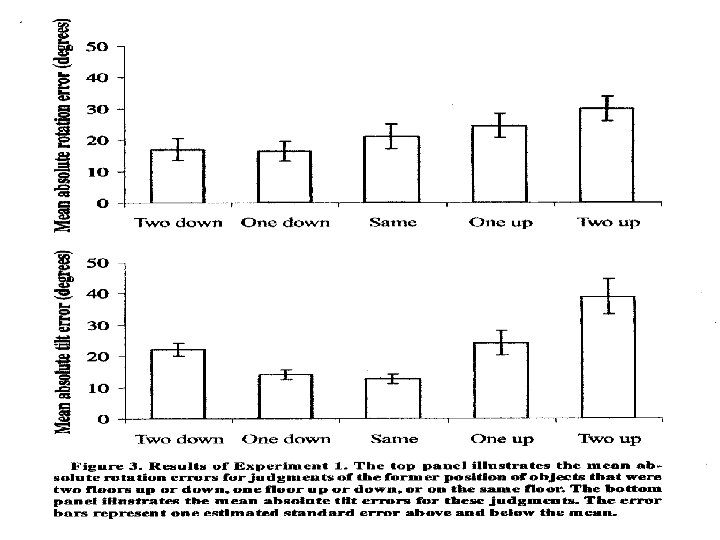
2. Vertical distance underestimation? • Vertical angles/distances underestimated: 3 • • • level virtual lift (Wilson, Foreman, Stanton and Duffy, Memory & Cognition, 2005) 1. Tilt angle up & down invariably underestimated 2. Downward estimates were better than upward estimates (consistent with many previous studies of up versus down decisions) 3. Effect 2 larger in young disabled participants (Stanton, Foreman & Wilson, BJP, 2005).
Conclusions and recommendations • Architects should made 3 -D CAD files available • • • for import into 3 -D software environments to create training tools Better differentiation of areas and focal landmarks in schools generally Training of staff to encourage spatial thinking Use of VEs to familiarise in advance of joining a new school
- Slides: 31