
Virtual Center of Excellence Workshop NASA Langley Research
- Slides: 17
Virtual Center of Excellence Workshop NASA Langley Research Center April 30 – May 1, 2009 Education Charge Greg Selby, Old Dominion University
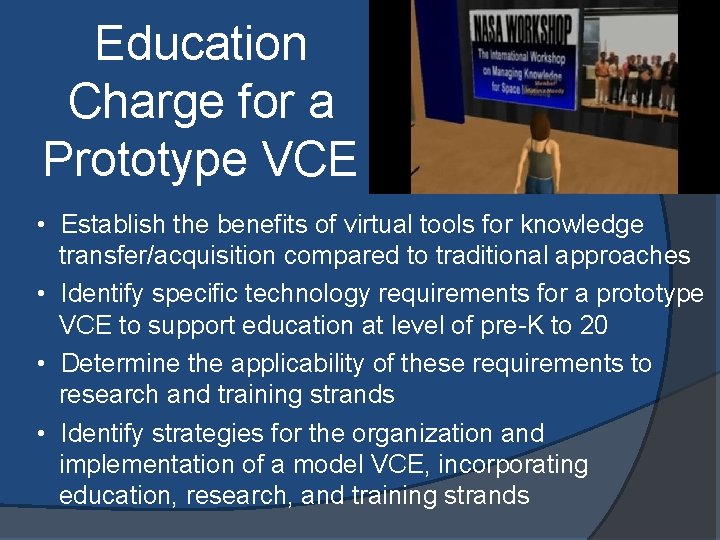
Education Charge • Establish the benefits of virtual tools for knowledge transfer/acquisition compared to traditional approaches • Identify specific technology requirements for a prototype VCE to support education at level of pre-K to 20 • Determine the applicability of these requirements to research and training strands • Identify strategies for the organization and implementation of a model VCE, incorporating education, research, and training strands
Environmental Issues Affecting 22 nd Century Education Approximately $800 billion spent annually in U. S. on precollege education Nation’s report card suggests that the “No Child Left Behind” act is not succeeding in closing the achievement gap between minority and non-minority students Our students live in a world where futuristic gaming systems/software capture their attention and imagination
Environmental Issues - Conclusion We must: Use our resources more effectively by creating linkages and public-private partnerships and avoiding duplication of effort Engage students’ interest more successfully using virtual gaming strategies and modsim technologies Convert increased interest into achievement gains and educational goal attainment Continue to champion process-based, rather than content-based, instruction Discourage the concept of “teaching to the test”
Video Gaming Culture Ambitious, progressive, futuristic, profit-driven approach to capturing children’s attention, motivate gaming behaviors and acquisition of specific gaming skills (that usually do not correlate with skills required for success in traditional educational settings) Nevertheless - successful
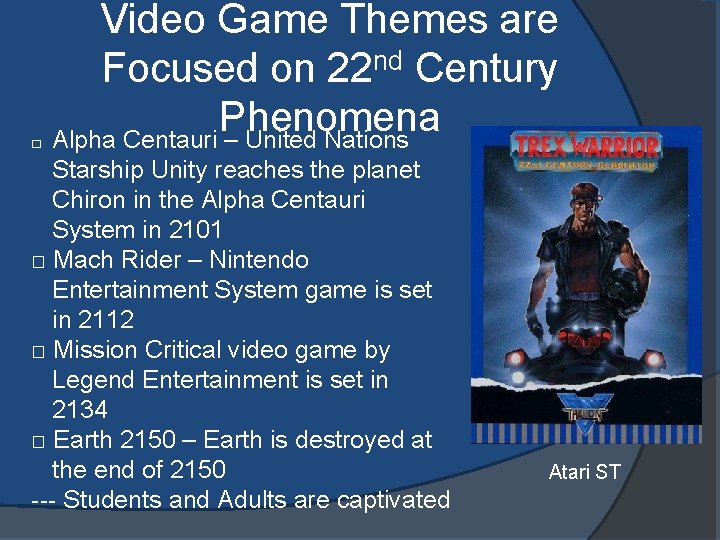
Video Game Themes are Focused on 22 nd Century Phenomena □ Alpha Centauri – United Nations Starship Unity reaches the planet Chiron in the Alpha Centauri System in 2101 □ Mach Rider – Nintendo Entertainment System game is set in 2112 □ Mission Critical video game by Legend Entertainment is set in 2134 □ Earth 2150 – Earth is destroyed at the end of 2150 --- Students and Adults are captivated Atari ST
Other General Considerations Learning modalities of the student populace – aural, visual, tactile, and kinestatic - all exercised in a virtual environment Must provide holistic education to student populace – intellectually, socially, physically, emotionally, and morally Gender-neutral non-biased STEM instruction and support system to increase females in STEM careers
Other General Considerations Global economy considerations become interplanetary economy considerations Life expectancy by the end of the 22 nd century will approach 100 years
Technological Issues Affecting 22 nd Century Education In the foreseeable future: Computer graphics will be indistinguishable from reality Virtual worlds will be created faster than real time – simulations to be run faster and in more detail than presently ○ Can investigate consequences of future behavior at decision points
More Technological Considerations In the foreseeable future: Internet will continue to grow Specific technologies will continue to develop: nanotechnology, interplanetary travel, robotics, smart materials, etc. Holography will enable transporting of instructor’s image into classroom – Re: Will-I-Am on Election Night
Energy Considerations Affecting 22 nd Century Education Our ability to manage and control our resources affects our manner and life and the modes for the delivery of education Kardashev Scale is relevant since energy availability affects the delivery of education
Kardashev Scale Classifies our ability to harness available energy Type 1 – able to harness all power available on earth Type 2 – able to harness all power available from a single star Type 3 – able to harness all power available from a single galaxy
Education Charge Consider Development of Existing Virtual Worlds Stanford University’s Sci. Centr. org ○ Sci. Centr. org provides resources and opportunities for both formal and informal learning ○ Utilized in the Virtual Exploration Sustainability Challenge (VESC) supported by NASA Second Life (SL) developed by Linden Lab ○ Users (Residents) interact through avatars
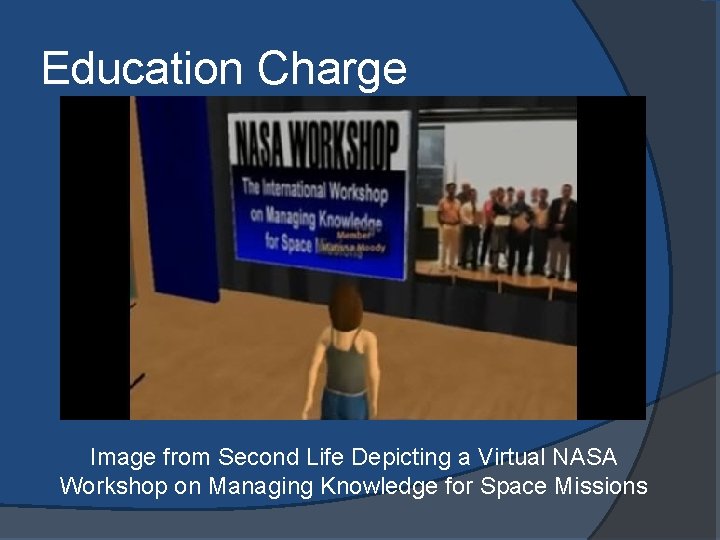
Education Charge Image from Second Life Depicting a Virtual NASA Workshop on Managing Knowledge for Space Missions
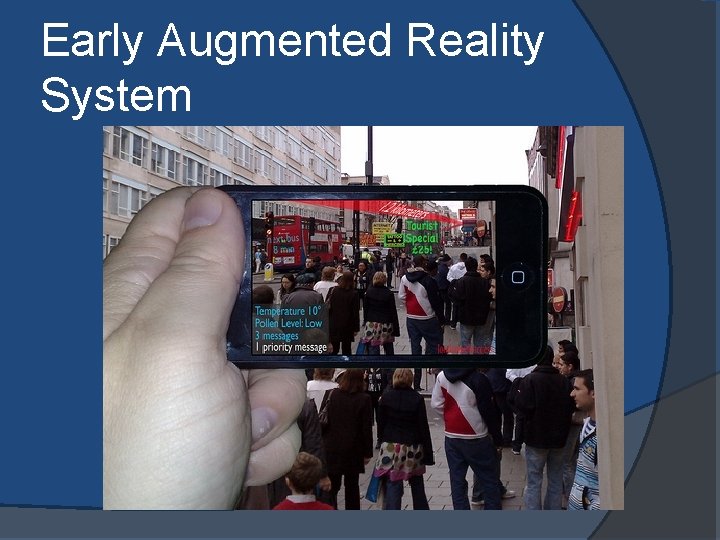
Education Charge Must Also Consider Augmented Reality Combination of widely-accessible sensors (including cameras), lightweight computing technologies, and high-speed wireless networks Users hold up an i. Phone-like device, scan what's around them, and see various pop-up items and data links on their screens
Early Augmented Reality System
Education Charge for a Prototype VCE • Establish the benefits of virtual tools for knowledge transfer/acquisition compared to traditional approaches • Identify specific technology requirements for a prototype VCE to support education at level of pre-K to 20 • Determine the applicability of these requirements to research and training strands • Identify strategies for the organization and implementation of a model VCE, incorporating education, research, and training strands