
Virginia Uniform Performance Standards for Teachers Updated November
Virginia Uniform Performance Standards for Teachers (Updated November 2011) May 2011 0
Question: What should be the basis of teacher evaluation? May 2011 1
Answer: Job-relevant Performance Standards May 2011 (Updated November 2011) 2
What are Performance Standards? The criteria expected when teachers perform their major duties. May 2011 3
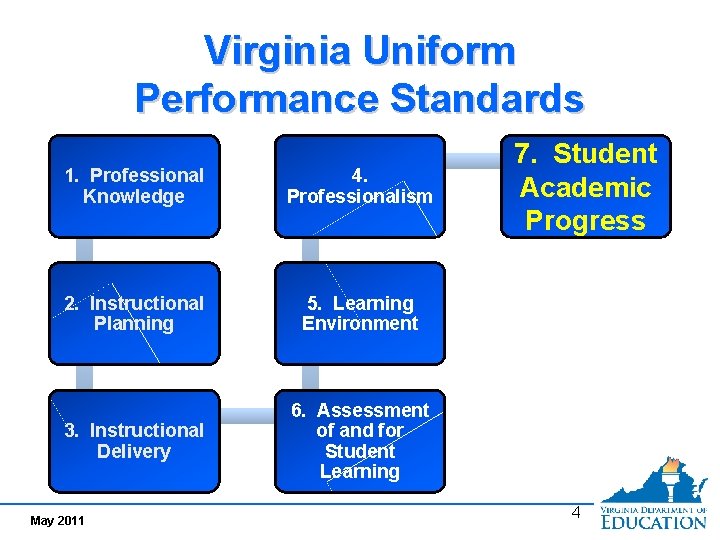
Virginia Uniform Performance Standards 1. Professional Knowledge 4. Professionalism 2. Instructional Planning 5. Learning Environment 3. Instructional Delivery 6. Assessment of and for Student Learning May 2011 7. Student Academic Progress 4
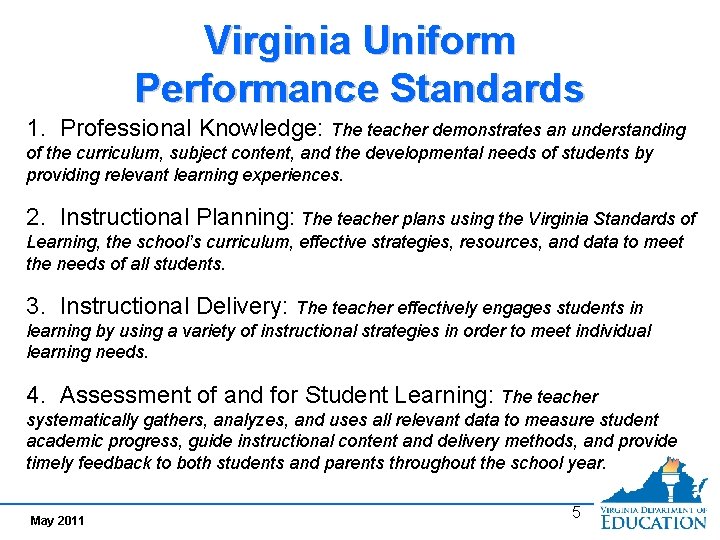
Virginia Uniform Performance Standards 1. Professional Knowledge: The teacher demonstrates an understanding of the curriculum, subject content, and the developmental needs of students by providing relevant learning experiences. 2. Instructional Planning: The teacher plans using the Virginia Standards of Learning, the school’s curriculum, effective strategies, resources, and data to meet the needs of all students. 3. Instructional Delivery: The teacher effectively engages students in learning by using a variety of instructional strategies in order to meet individual learning needs. 4. Assessment of and for Student Learning: The teacher systematically gathers, analyzes, and uses all relevant data to measure student academic progress, guide instructional content and delivery methods, and provide timely feedback to both students and parents throughout the school year. May 2011 5
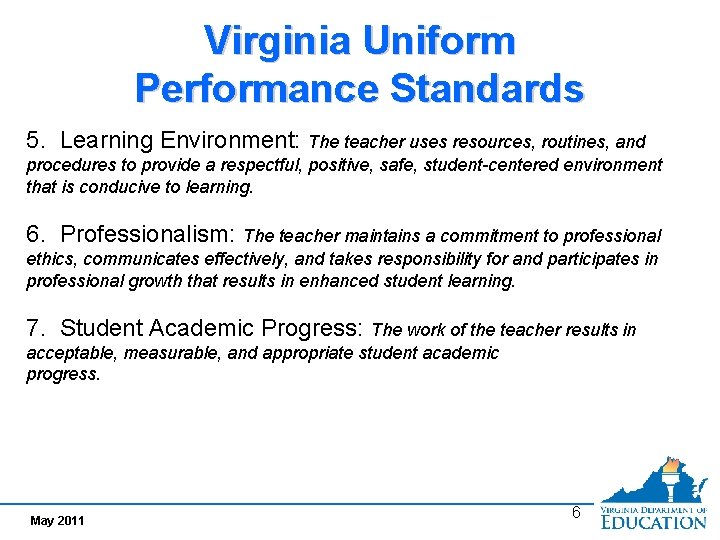
Virginia Uniform Performance Standards 5. Learning Environment: The teacher uses resources, routines, and procedures to provide a respectful, positive, safe, student-centered environment that is conducive to learning. 6. Professionalism: The teacher maintains a commitment to professional ethics, communicates effectively, and takes responsibility for and participates in professional growth that results in enhanced student learning. 7. Student Academic Progress: The work of the teacher results in acceptable, measurable, and appropriate student academic progress. May 2011 6
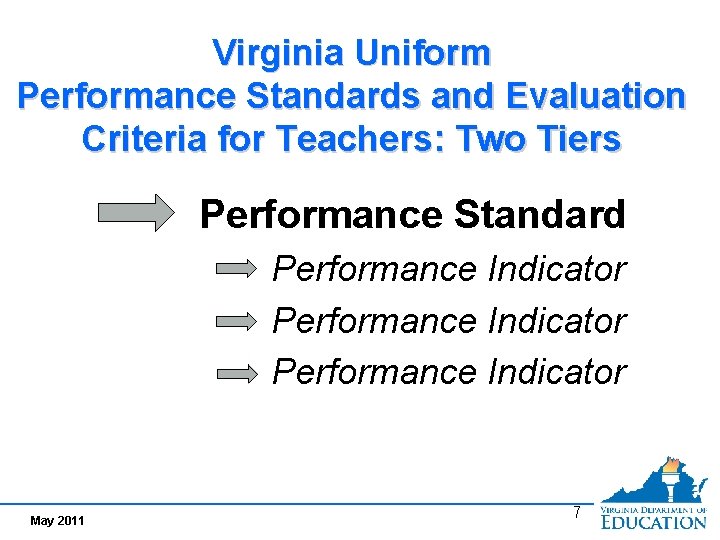
Virginia Uniform Performance Standards and Evaluation Criteria for Teachers: Two Tiers Performance Standard Performance Indicator May 2011 7
What are Performance Indicators? Examples of observable, tangible behavior that indicate the degree to which teachers are meeting each teaching standard Note: The list of performance indicators is not exhaustive, and they are not intended to be prescriptive. May 2011 8
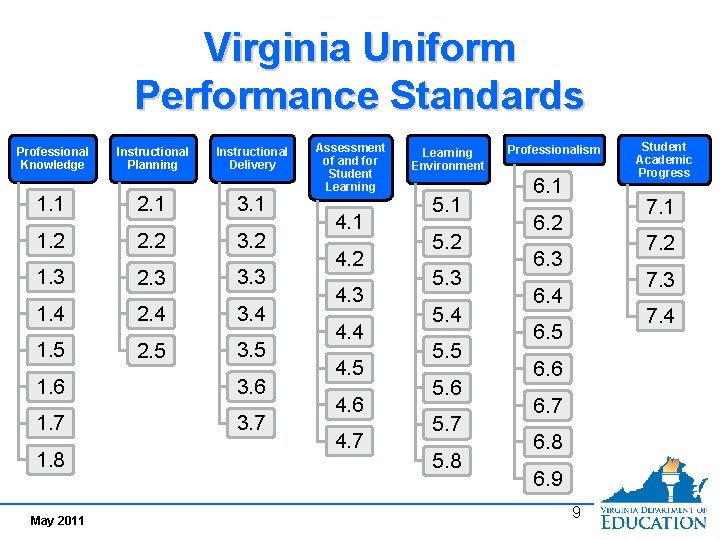
Virginia Uniform Performance Standards Professional Knowledge Instructional Planning Instructional Delivery 1. 1 2. 1 3. 1 1. 2 2. 2 3. 2 1. 3 2. 3 3. 3 1. 4 2. 4 3. 4 1. 5 2. 5 3. 5 1. 6 3. 6 1. 7 3. 7 1. 8 May 2011 Assessment of and for Student Learning 4. 1 4. 2 4. 3 4. 4 4. 5 4. 6 4. 7 Learning Environment 5. 1 5. 2 5. 3 5. 4 5. 5 5. 6 5. 7 5. 8 Professionalism 6. 1 Student Academic Progress 7. 1 6. 2 7. 2 6. 3 7. 3 6. 4 7. 4 6. 5 6. 6 6. 7 6. 8 6. 9 9
Teacher Performance Standard 1: Professional Knowledge The teacher demonstrates an understanding of the curriculum, subject content, and the developmental needs of students by providing relevant learning experiences. May 2011 10
Performance Indicators Examples for Standard 1: Professional Knowledge § Effectively addresses appropriate curriculum standards. § Integrates key content elements and facilitates students’ use of higher level thinking skills in instruction. § Demonstrates ability to link present content with past and future learning experiences, other subject areas, and real world experiences and applications. § Demonstrates an accurate knowledge of the subject matter. § Demonstrates skills relevant to the subject area(s) taught. § Bases instruction on goals that reflect high expectations and an understanding of the subject. § Demonstrates an understanding of the intellectual, social, emotional, and physical development of the age group. § Communicates clearly and checks for understanding. May 2011 Note: Only Samples! 11
Teacher Performance Standard 2: Instructional Planning The teacher plans using the Virginia Standards of Learning, the school’s curriculum, effective strategies, resources, and data to meet the needs of all students. May 2011 12
Performance Indicators Examples for Standard 2: Instructional Planning § § Uses student learning data to guide planning. Plans time realistically for pacing, content mastery, and transitions. Plans for differentiated instruction. Aligns lesson objectives to the school’s curriculum and student learning needs. § Develops appropriate long- and short-range plans and adapts plans when needed. May 2011 Note: Only Samples! 13
Teacher Performance Standard 3: Instructional Delivery The teacher effectively engages students in learning by using a variety of instructional strategies in order to meet individual learning needs. May 2011 14
Performance Indicators Examples for Standard 3: Instructional Delivery § § § § Engages and maintains students in active learning. Builds upon students’ existing knowledge and skills. Differentiates instruction to meet the students’ needs. Reinforces learning goals consistently throughout lessons. Uses a variety of effective instructional strategies and resources. Uses instructional technology to enhance student learning. Communicates clearly and checks for understanding. May 2011 Note: Only Samples! 15
Teacher Performance Standard 4: Assessment of and for Student Learning The teacher systematically gathers, analyzes, and uses all relevant data to measure student academic progress, guide instructional content and delivery methods, and provide timely feedback to both students and parents throughout the school year. May 2011 16
Performance Indicators Examples for Standard 4: Assessment of and for Student Learning § Uses pre-assessment data to develop expectations for students, to differentiate instruction, and to document learning. § Involves students in setting learning goals and monitoring their own progress. § Uses a variety of assessment strategies and instruments that are valid and appropriate for the content and for the student population. § Aligns student assessment with established curriculum standards and benchmarks. § Uses assessment tools for both formative and summative purposes and uses grading practices that report final mastery in relationship to content goals and objectives. § Uses assessment tools for both formative and summative purposes to inform, guide, and adjust students’ learning. § Gives constructive and frequent feedback to students on their learning. May 2011 Note: Only Samples! 17
Teacher Performance Standard 5: Learning Environment The teacher uses resources, routines, and procedures to provide a respectful, positive, safe, student-centered environment that is conducive to learning. May 2011 18
Performance Indicators Examples for Standard 5: Learning Environment § Arranges the classroom to maximize learning while providing a safe environment. § Establishes clear expectations, with student input, for classroom rules and procedures early in the school year, and enforces them consistently and fairly. § Maximizes instructional time and minimizes disruptions. § Establishes a climate of trust and teamwork by being fair, caring, respectful, and enthusiastic. § Promotes cultural sensitivity. § Respects students’ diversity, including language, culture, race, gender, and special needs. § Actively listens and pays attention to students’ needs and responses. § Maximizes instructional learning time by working with students individually as well as in small groups or whole groups. May 2011 Note: Only Samples! 19
Teacher Performance Standard 6: Professionalism The teacher maintains a commitment to professional ethics, communicates effectively, and takes responsibility for and participates in professional growth that results in enhanced student learning. May 2011 20
Performance Indicators Examples for Standard 6: Professionalism § Collaborates and communicates effectively within the school community to promote students’ well-being and success. § Adheres to federal and state laws, school and division policies, and ethical guidelines. § Incorporates learning from professional growth opportunities into instructional practice. § Sets goals for improvement of knowledge and skills. § Engages in activities outside the classroom intended for school and student enhancement. May 2011 Note: Only Samples! 21
Teacher Performance Standard 7: Student Academic Progress The work of the teacher results in acceptable, measurable, and appropriate student academic progress. May 2011 22
Performance Indicators Examples for Standard 7: Student Academic Progress § Sets acceptable, measurable, and appropriate achievement goals for student learning progress based on baseline data. § Documents the progress of each student throughout the year. § Provides evidence that achievement goals have been met, including the state-provided growth measure when available as well as other multiple measures of student growth. § Uses available performance outcome data to continually document and communicate student academic progress and develop interim learning targets. May 2011 Note: Only Samples! 23
- Slides: 24