
Virginia STEP Project Chickahominy Eastern Division Tribal Center
Virginia STEP Project Chickahominy – Eastern Division Tribal Center Providence Forge, VA November 18 -19, 2019 SAM REDDING AND STEPHANIE BISSON ACADEMIC DEVELOPMENT INSTITUTE
Virginia STEP Project Chickahominy Indian Tribe - Eastern Division Monacan Indian Nation Pamunkey Indian Tribe State-Tribal Education Partnership Virginia Tribal Consortium (5 Tribes) VDOE and Identified LEAs Resource Partners TEDNA Upper Mattaponi Indian Tribe NARF ADI

Virginia STEP Project. . . will establish the Virginia Tribal Consortium of participating federally recognized Tribes in the Commonwealth of Virginia and will build the capacity of that Consortium to: v serve as the Tribal Education Agency for the member Tribes v promote Tribal self-determination in education among Tribes in Virginia, v improve the academic achievement of Indian children and youth, and v promote the coordination and collaboration of participating Tribes with the Virginia Department of Education and Local Educational Agencies (LEAs) to meet the unique educational and culturally related academic needs of Indian students.
Chickahominy Indian Tribe In the early 1900 s, the Tribe: § established the Samaria Baptist Church, § bought land for Tribal use, § built the Samaria School serving their children up to 8 th grade, and § funded construction, supplies, and teacher salaries out of donated funds and a tax on Chickahominy men. The Tribe's school was integrated in 1968 as a primary school for the county. The vision of life in harmony with creation offers hope for a better future. http: //www. chickahominytribe. org/

Chickahominy Indian Tribe. Eastern Division In 1910, the Tribe started a one-room schoolhouse called the Boulevard Indian School. In 1950, the tribal school was closed, and the children bused to the Samaria Indian School In 1967 students integrated in public school system with rest of Virginia Late 1970’s, with grants, the Tribe: § bought two mobile homes to be used as office and classroom space, § purchase of office equipment and supplies. Chickahominy Indian Tribe-Eastern Division has been steadfast in addressing the education needs of its membership. http: //www. cied. org/
In 1868, a parcel of land was donated for a meeting place for the Indian people. Monacan Indian Nation v Originally, a wooden arbor served as the meeting place; itinerant ministers began to hold Baptist and Methodist services Shortly thereafter, a log building was built, to be used for the meeting place. v The new church served about 350 Indian people v Church later became the Indian mission school, which still stands as a national historic landmark In the early 1900 s, most of the Indian people were tenant farmers and working seasonally at the local fruit farms. The Monacan Nation is strongly dedicated to the survival of Indian people in Virginia and throughout the hemisphere. https: //www. monacannatio n. com/ v In 1946 the owner of two fruit farms agreed to transport the children to school and church v the Presbyterian Church formed a separate mission and school at Pedlar Mills. In 1963, 23 students applied for transfer to public schools v the old mission schoolhouse closed as its students entered public schooling for the first time.

Pamunkey Indian Tribe The Tribe: Federally recognized by U. S. Department of Interior on July 2, 2015 Established Tribal Resource Center (TRC) to research, write, facilitate, and manage grants. v facilitates and funds training opportunities v provides information to tribal members on federal program opportunities v non-tribal spouses/parents are invited to participate when they have children under the age of 18 v provides resources for Education (i. e. , Administration, Economic Development, Cultural & Natural Resources, and Public Health & Safety) The Pamunkey Indian Tribe is resolute in its commitment to education. http: //pamunkey. org/
Upper Mattaponi Indian Tribe The Upper Mattaponi Tribe has a profound commitment to meet the education needs of its children https: //umitribe. org/). The Tribe has strong ties to Christianity Community is centered around The Indian View Baptist Church, built in 1942 Next door to the church is the Sharon Indian School. v Originally built in the early 1900’s v replaced with a more modern structure in the 1950’s As the only public Indian school building in the state of Virginia v serves as the Tribal Center Tribe owns 32 acres of land are a proud and humble people of strong character and values, with much optimism and hope for the future.
Ken Adams, Start-Up Consultant Ken, Upper Mattaponi Indian Tribe, will serve as the onsite Start-Up Consultant. Ken holds a Bachelor of Science degree in Industrial Technology and is a 25 -year veteran of the U. S. Air Force. He has an extensive background promoting Native American education, including Chairman of the United Indians of Virginia (UIV) and Chairman of the Board of Trustees for Bacone College in Muskogee, Oklahoma. In 2007 400 th anniversary of the 1607 settlement at Jamestown, served as the Native American Events Coordinator.
Tribal Education Departments National Assembly (TEDNA) TEDNA is a national non-profit membership organization. Since 2003 TEDNA has been providing ongoing resources for professional development and technical assistance to Tribal Education Agencies in crafting more comprehensive educational systems. TEDNA has managed federal grants to support the college and career readiness of Indian youth and advancing tribal school sovereignty. TEDNA will serve as the lead applicant organization to manage the Virginia STEP Project and provide expertise on the formation and operation of the Virginia Tribal Consortium.
Native American Rights Fund Melody Mc. Coy Founded in 1970, the Native American Rights Fund (NARF) is one of the oldest and largest nonprofit law firms dedicated to asserting and defending the rights of Indian tribes, organizations and individuals nationwide. NARF’s extensive experience in tribal rights in education is advanced through its direct representation of tribes and Indian organizations, its published comprehensive Tribalizing Indian Education Series, and professional training and development pertaining to conceptualizing, developing, and implementing tribally-sanctioned education codes. NARF will contribute to the Virginia STEP Project by sharing its insights with and advising the Virginia Tribal Consortium on Tribally sanctioned education codes.
Academic Development Institute Sam Redding and Stephanie Bisson ADI is a non-profit organization founded in 1984 with a national reputation as the preeminent developer and provider of transformational services to improve individual and organizational performance to enhance children's academic and personal development. ADI has served as a partner in the Idaho-Nez Perce STEP Project for seven years and the Oklahoma-Muscogee Creek STEP Project for three years. Through federally funded national content centers, ADI has provided technical assistance to 35 state education agencies (SEAs), including the VDOE, over the past 14 years. ADI will develop and provide training opportunities for the Virginia STEP Project to create and sustain a Virginia Tribal Consortium relative to effective education practices, community engagement, and cultural responsiveness, and to provide and manage a strategic performance management (SPM) online system to plan, track, and report progress.

Virginia Department of Education The Virginia Department of Education (VDOE) through its commitment to the Virginia STEP Project and its ongoing support for the Virginia Tribal Consortium, will benefit from the offerings of TEDNA, NARF, and ADI to advance its own ability to support the success of Native American students and assist the member Tribes in connecting with Commonwealth resources.
Dr. Michael Pavel, an enrolled member of the Skokomish Indian Tribe and owner of Tuwaduq Cultural & Research Institute (TCRI), will serve as the Project Narrator. He has published widely on factors influencing the social and academic success of Indian students, integrating Native language and culture into school curricula and supports, assisting teachers to teach Indian students, and professional development to school personnel on cultivating meaningful relationships with Tribal communities. A nationally renowned scholar, Dr. Pavel has an extensive list of publications and received numerous awards and honors for his scholarship recognizing his commitment to advancing public understanding about the necessity of an education system that responds to the needs of Indian students, families, and Tribal communities. He will oversee the process of bringing to life a narrative “story” that describes and recounts the experience of member Tribes and partners in conceptualizing, forming and operating the Virginia STEP Consortium. Tentatively titled, STEPs Taken: The Compelling Story of Small Tribes Establishing a Tribal Education Agency, the Project narrative will include descriptions of Project participants, voices from the Tribal community (Tribal leaders, elders, parents, and youth), visuals (i. e. , photos, artwork, maps, etc. ), and other elements to bring the story to life.
Dr. Todd Johnson, Project Evaluator, is Director of the Center for Research and Data Analysis for the Educational Service District (ESD) 113. Dr. Johnson brings to the Project extensive experience conducting research, evaluation, and measurement experience in rural and high poverty schools across the United States. His most recent research and evaluation projects have included evaluation of afterschool programing, rural student marijuana use and perceptions, early warning educational systems, teacher professional development, and school-university partnerships with an emphasis on improving math. He has widespread experience working with TEDNA and other organizations to address the education needs of Tribes at the local, state, regional, and national levels. Dr. Johnson has been involved in the development of this proposal to design the initial evaluation plan in partnership with TEDNA and ADI.
Trainings and Products TEA Governance Training—three-day training for the Consortium Board and Start-Up Consultant, conducted by TEDNA with resource partners, covering the functions of a Tribal Education Agency including: v stakeholder engagement; v fiscal responsibilities; v oversight of personnel; v relationships with the VDOE, LEAs, and other relevant entities; and v potential Consortium-supported activities.
TEA Management Training---five-day training for the Start Up Consultant and again for the Consortium Coordinator, conducted by TEDNA and the resource partners, covering the management of a Tribal Education Agency, including: v financial management; v stakeholder communication; v hiring, onboarding, and mentoring new Tribal education staff; and v effective practices for scheduling, coordinating, and communicating with the Consortium’s Board and the member Tribes.
Virginia Tribal Consortium Outreach Seminar—a one-day initial meeting and six virtual modules enable the Consortium to educate VDOE, LEA, and related entities on Native American culture and education challenges and aspirations. SPM Management Training—two days of initial training followed by weekly virtual training for three months for the Consortium Coordinator to administer the SPM (strategic performance management) system to create a Strategic Plan and track and report progress for the Project and, at the conclusion of the Project, for the Consortium. Virginia Education Resources Training—two-day training for the Consortium Board and Coordinator, conducted by VDOE, covering education resources provided by VDOE and other education entities, available funding, and grants management. Educating Native Youth for Success —a day of initial training for the Board and Coordinator and invited VDOE and LEA representatives, followed by a virtual module each month conducted on the day of the monthly Board meeting to build an understanding of the capabilities that contribute to students’ success in school and beyond school and the roles of schools, families, and communities in supporting the development of these capabilities.
Tribal Sovereignty and Education Code Training—two two-day trainings with follow-up video conference meetings for the Consortium Coordinator, Consortium Board, and invited VDOE and LEA representatives that orients them to: Tribal Education Codes, U. S. Department of Education’s Tribal Consultation Policy, the contribution of the Code and Policy to the sovereignty of Tribal Education Agencies (TEAs), and Tribal K-12 Education Governance in comparison to state and federal laws. Virginia Tribal Consortium Guidebook—a key resource developed by the resource partners, accompanied by PPTs, including examples of practice to assist member Tribes in: ◦ Affiliating with and benefiting from relationships with the Virginia Department of Education and key education organizations; ◦ Establishing channels of communication with Local Education Agencies (LEAs) serving Native American students and providing the LEAs with information and education on culturally responsive teaching; ◦ Providing information and education to families to promote the school success of their children and to plan for post-secondary education; and Organizing and facilitating community groups to support the school success of Native youth
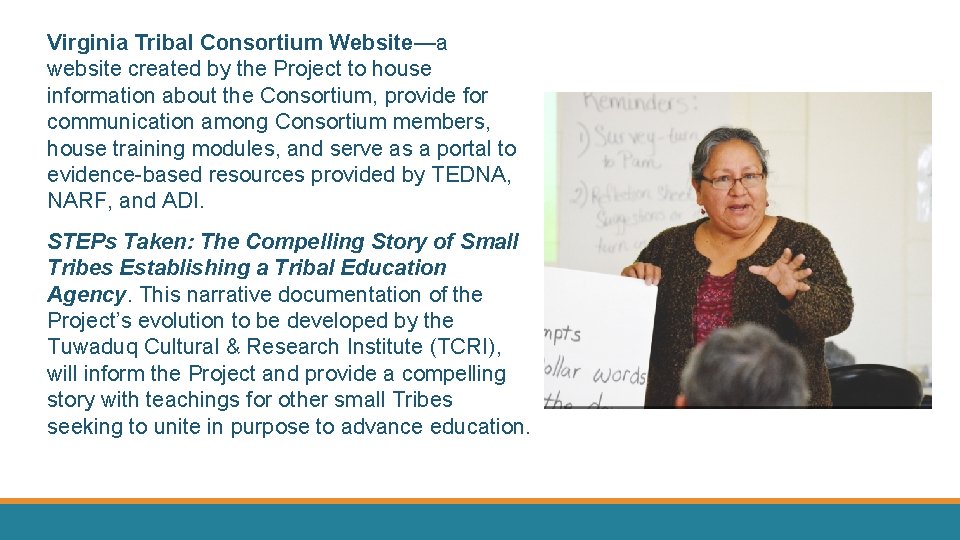
Virginia Tribal Consortium Website—a website created by the Project to house information about the Consortium, provide for communication among Consortium members, house training modules, and serve as a portal to evidence-based resources provided by TEDNA, NARF, and ADI. STEPs Taken: The Compelling Story of Small Tribes Establishing a Tribal Education Agency. This narrative documentation of the Project’s evolution to be developed by the Tuwaduq Cultural & Research Institute (TCRI), will inform the Project and provide a compelling story with teachings for other small Tribes seeking to unite in purpose to advance education.
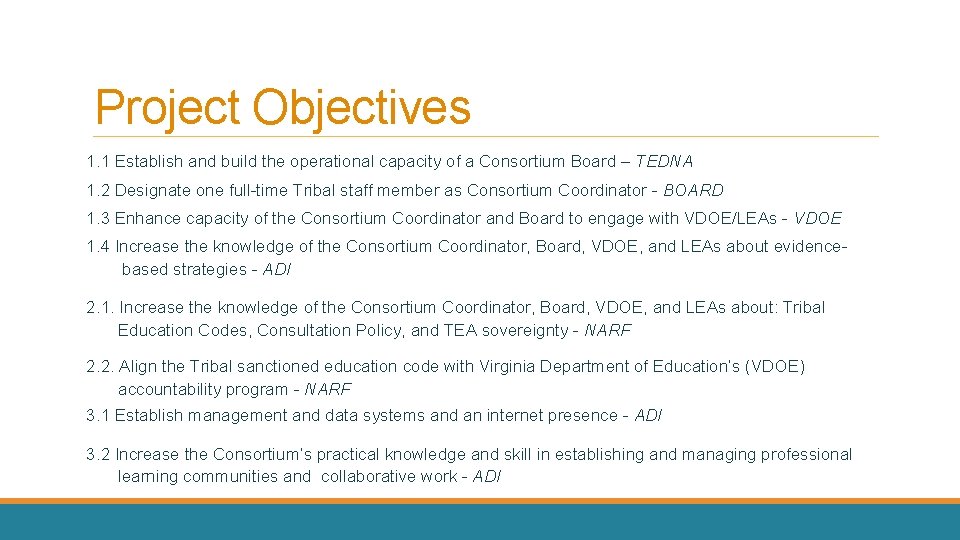
Project Objectives 1. 1 Establish and build the operational capacity of a Consortium Board – TEDNA 1. 2 Designate one full-time Tribal staff member as Consortium Coordinator - BOARD 1. 3 Enhance capacity of the Consortium Coordinator and Board to engage with VDOE/LEAs - VDOE 1. 4 Increase the knowledge of the Consortium Coordinator, Board, VDOE, and LEAs about evidencebased strategies - ADI 2. 1. Increase the knowledge of the Consortium Coordinator, Board, VDOE, and LEAs about: Tribal Education Codes, Consultation Policy, and TEA sovereignty - NARF 2. 2. Align the Tribal sanctioned education code with Virginia Department of Education’s (VDOE) accountability program - NARF 3. 1 Establish management and data systems and an internet presence - ADI 3. 2 Increase the Consortium’s practical knowledge and skill in establishing and managing professional learning communities and collaborative work - ADI
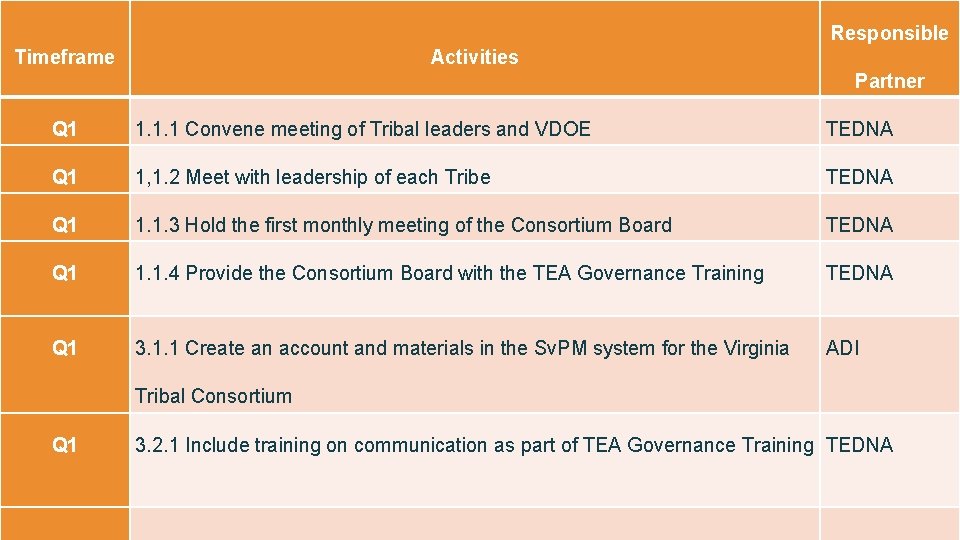
Responsible Timeframe Activities Partner Q 1 1. 1. 1 Convene meeting of Tribal leaders and VDOE TEDNA Q 1 1, 1. 2 Meet with leadership of each Tribe TEDNA Q 1 1. 1. 3 Hold the first monthly meeting of the Consortium Board TEDNA Q 1 1. 1. 4 Provide the Consortium Board with the TEA Governance Training TEDNA Q 1 3. 1. 1 Create an account and materials in the Sv. PM system for the Virginia ADI Tribal Consortium Q 1 3. 2. 1 Include training on communication as part of TEA Governance Training TEDNA
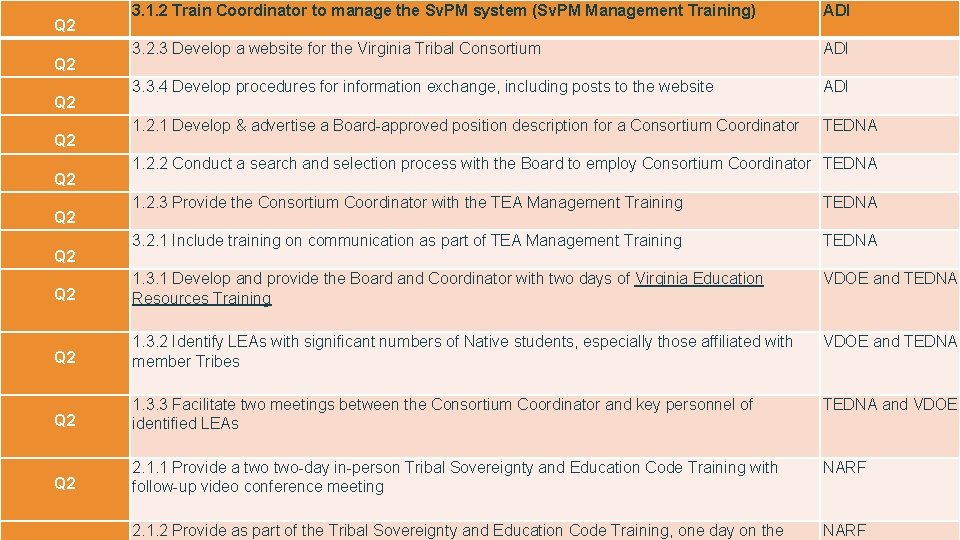
Q 2 Q 2 Q 2 3. 1. 2 Train Coordinator to manage the Sv. PM system (Sv. PM Management Training) ADI 3. 2. 3 Develop a website for the Virginia Tribal Consortium ADI 3. 3. 4 Develop procedures for information exchange, including posts to the website ADI 1. 2. 1 Develop & advertise a Board-approved position description for a Consortium Coordinator TEDNA 1. 2. 2 Conduct a search and selection process with the Board to employ Consortium Coordinator TEDNA 1. 2. 3 Provide the Consortium Coordinator with the TEA Management Training TEDNA 3. 2. 1 Include training on communication as part of TEA Management Training TEDNA Q 2 1. 3. 1 Develop and provide the Board and Coordinator with two days of Virginia Education Resources Training VDOE and TEDNA Q 2 1. 3. 2 Identify LEAs with significant numbers of Native students, especially those affiliated with member Tribes VDOE and TEDNA Q 2 1. 3. 3 Facilitate two meetings between the Consortium Coordinator and key personnel of identified LEAs TEDNA and VDOE Q 2 2. 1. 1 Provide a two-day in-person Tribal Sovereignty and Education Code Training with follow-up video conference meeting NARF 2. 1. 2 Provide as part of the Tribal Sovereignty and Education Code Training, one day on the NARF Q 2
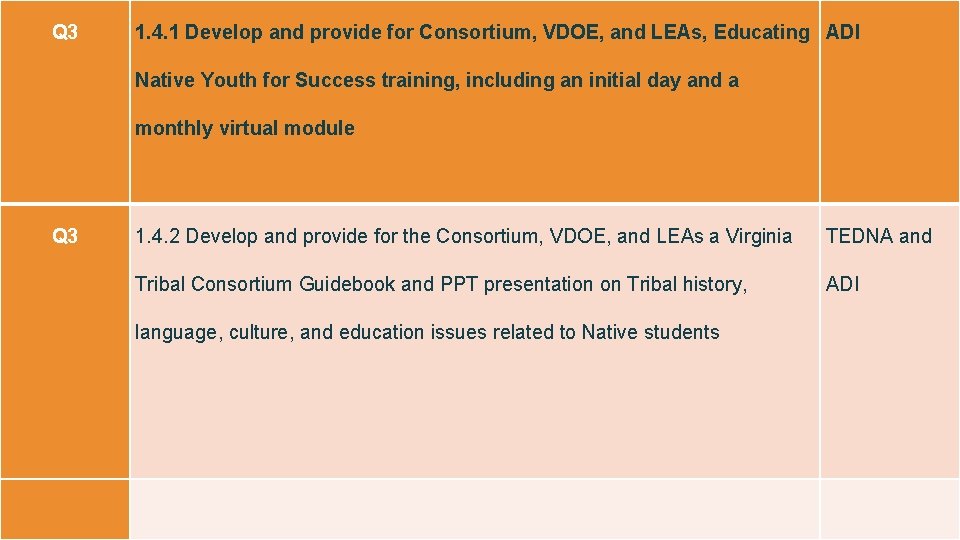
Q 3 1. 4. 1 Develop and provide for Consortium, VDOE, and LEAs, Educating ADI Native Youth for Success training, including an initial day and a monthly virtual module Q 3 1. 4. 2 Develop and provide for the Consortium, VDOE, and LEAs a Virginia TEDNA and Tribal Consortium Guidebook and PPT presentation on Tribal history, ADI language, culture, and education issues related to Native students
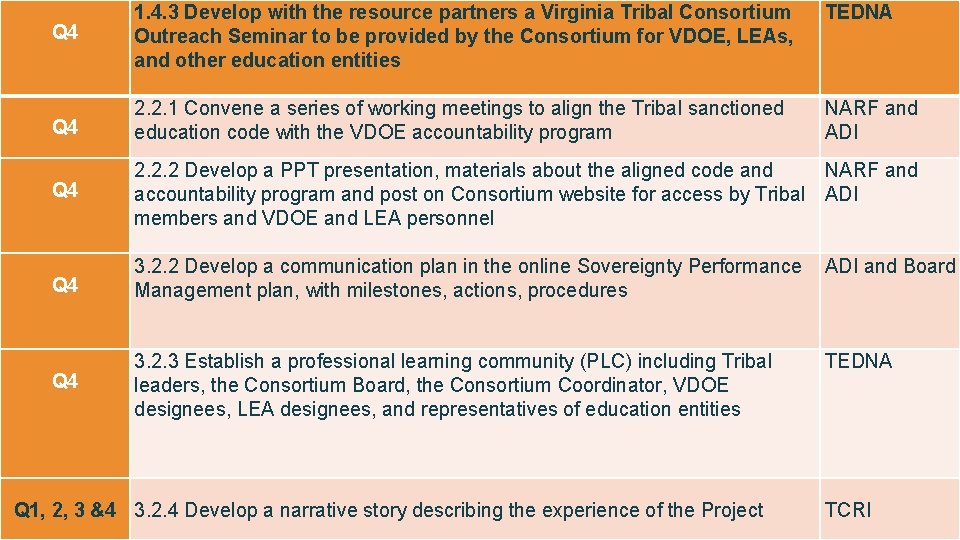
Q 4 1. 4. 3 Develop with the resource partners a Virginia Tribal Consortium Outreach Seminar to be provided by the Consortium for VDOE, LEAs, and other education entities TEDNA Q 4 2. 2. 1 Convene a series of working meetings to align the Tribal sanctioned education code with the VDOE accountability program NARF and ADI Q 4 2. 2. 2 Develop a PPT presentation, materials about the aligned code and NARF and accountability program and post on Consortium website for access by Tribal ADI members and VDOE and LEA personnel Q 4 3. 2. 2 Develop a communication plan in the online Sovereignty Performance Management plan, with milestones, actions, procedures ADI and Board Q 4 3. 2. 3 Establish a professional learning community (PLC) including Tribal leaders, the Consortium Board, the Consortium Coordinator, VDOE designees, LEA designees, and representatives of education entities TEDNA Q 1, 2, 3 &4 3. 2. 4 Develop a narrative story describing the experience of the Project TCRI
- Slides: 25