
Virginia Preschool Initiative VPI Guidelines Webinar May 23
Virginia Preschool Initiative (VPI) Guidelines Webinar May 23, 2019
Objective and Agenda Objective: • Participants will gain a deeper understanding of the revised 20192020 VPI Guidelines. Agenda: 1. Vision and Background 2. VPI Guidelines Purpose, Overview and Summary of Revisions 3. On the Horizon 4. Questions

Classroom photo 1
Vision and Background
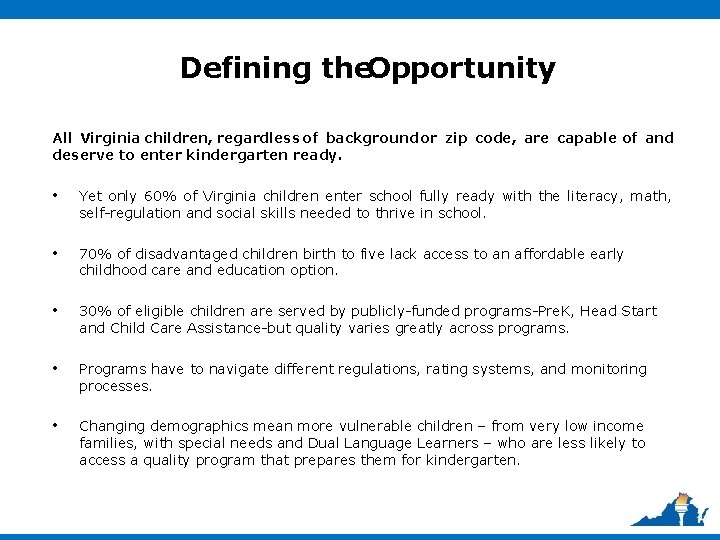
Defining the. Opportunity All Virginia children, regardless of background or zip code, are capable of and deserve to enter kindergarten ready. • Yet only 60% of Virginia children enter school fully ready with the literacy, math, self-regulation and social skills needed to thrive in school. • 70% of disadvantaged children birth to five lack access to an affordable early childhood care and education option. • 30% of eligible children are served by publicly-funded programs-Pre. K, Head Start and Child Care Assistance-but quality varies greatly across programs. • Programs have to navigate different regulations, rating systems, and monitoring processes. • Changing demographics mean more vulnerable children – from very low income families, with special needs and Dual Language Learners – who are less likely to access a quality program that prepares them for kindergarten.
Vision: All Virginia Children Enter Kindergarten Ready We envisiona Virginiawhere all children, includingall those who participatedin VPI or any other school-based preschool program, enter school ready to fulfill their potential. This means: • More Virginia families have affordableaccess to early childhood care and education that supports learning across the birth through 3 rd grade continuum and meets their unique needs. • With a shared definition of school readiness, Virginia families and early childhood programs work together to ensurechildrenthrive, developingthe skills needed for kindergarten and beyond. • Virginia has unified quality standards for all publicly-funded early childhood programs that are indicative of child outcomes. Virginia measures and rewards programs for performance, ensuring leaders and teachers are well compensatedfor their achievement. • Overall, Virginia’s early childhood system will be more unified, transparent, datadriven and resource-effective, with no funding “left on the table. ”
VPI Guidelines and the VPI Plan The Planto Ensure High-Quality Instruction in All Virginia Preschool Initiative (VPI) Classroomsoutlines how we can work together to ensure every child in VPI receives a high quality instructional experience that prepares him or her for kindergarten. • • The VPI Plan was required by the Virginia legislature in response to JLARC study. • Related to teacher observations, The Plan describes increased supports for teachers that include: The Plan focuses on increased feedback for teachers through CLASS® observations, effective use of comprehensive curriculum and high-quality professional development. • ü Encouraging local observations at least two times a year with the Classroom Assessment Scoring System (CLASS®)and providing targeted feedback and professional development to teachers. ü External observations will take at least every two years with the CLASS® to provide a statewide baseline and ensure accuracy. The 2019 -2020 VPI Guidelines establish current the expectations for VPI Programs as they work towards meeting the goals within the Plan.

Classroom photo 2
VPI Guidelines: Purpose, Overview and Summary of Revisions
Purpose of the Revised VPI Guidelines The VPI Guidelines seek to accomplish the following: ü Provide context within the framework of Virginia’s Plan to Ensure High. Quality Instruction in All VPI Classrooms ü Establish clear expectations for providing a quality preschool education as it relates to evidenced-based curriculum, teacher-child interactions, and professional development ü Provide guidance on family engagement ü Provide guidance on serving special populations with equity for all learners ü Summarize budget, program operations, and transportation requirements
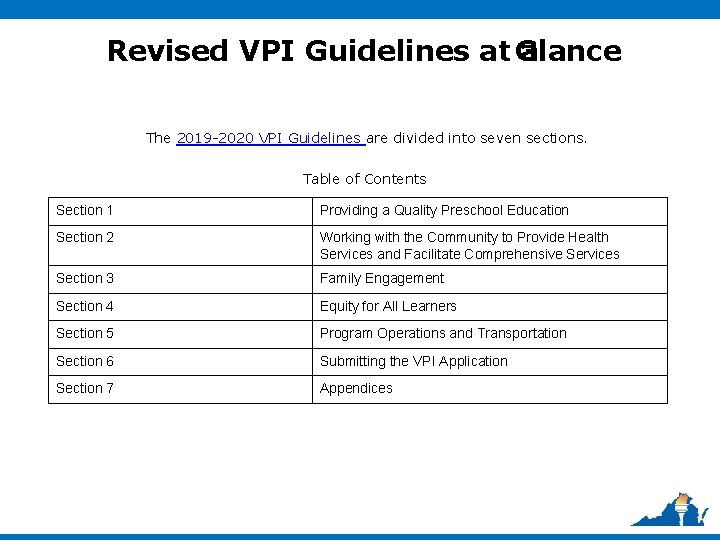
Revised VPI Guidelines at Glance a The 2019 -2020 VPI Guidelines are divided into seven sections. Table of Contents Section 1 Providing a Quality Preschool Education Section 2 Working with the Community to Provide Health Services and Facilitate Comprehensive Services Section 3 Family Engagement Section 4 Equity for All Learners Section 5 Program Operations and Transportation Section 6 Submitting the VPI Application Section 7 Appendices
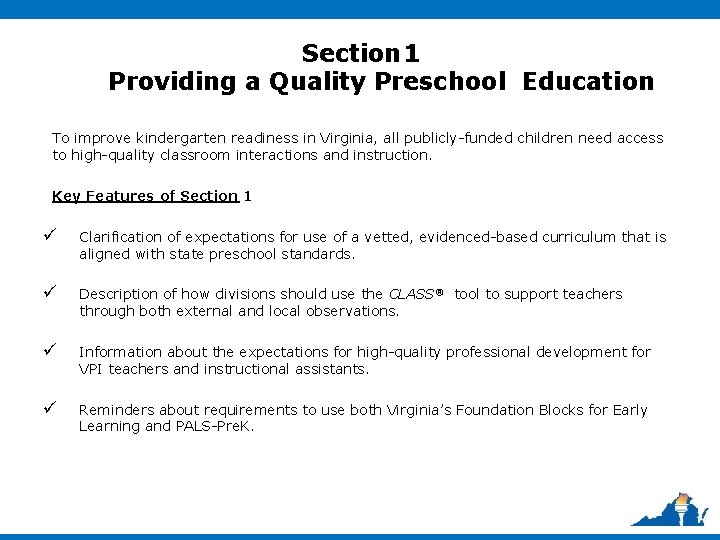
Section 1 Providing a Quality Preschool Education To improve kindergarten readiness in Virginia, all publicly-funded children need access to high-quality classroom interactions and instruction. Key Features of Section 1 ü Clarification of expectations for use of a vetted, evidenced-based curriculum that is aligned with state preschool standards. ü Description of how divisions should use the CLASS® tool to support teachers through both external and local observations. ü Information about the expectations for high-quality professional development for VPI teachers and instructional assistants. ü Reminders about requirements to use both Virginia’s Foundation Blocks for Early Learning and PALS-Pre. K.
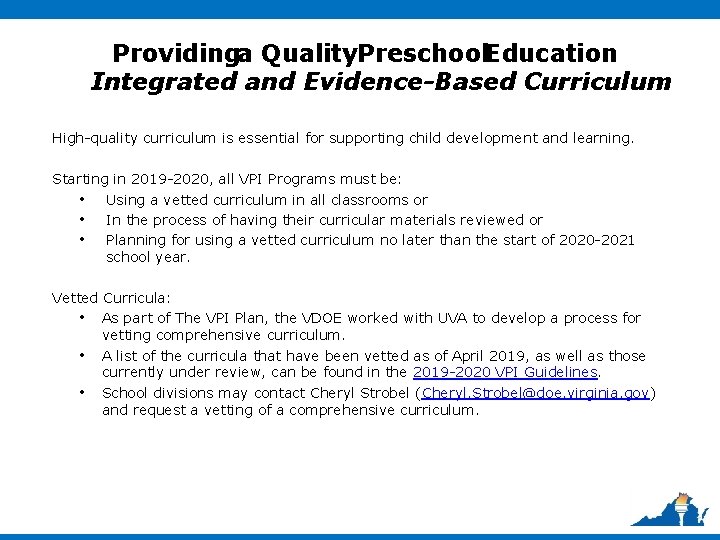
Providinga Quality. Preschool. Education Integrated and Evidence-Based Curriculum High-quality curriculum is essential for supporting child development and learning. Starting in 2019 -2020, all VPI Programs must be: • Using a vetted curriculum in all classrooms or • In the process of having their curricular materials reviewed or • Planning for using a vetted curriculum no later than the start of 2020 -2021 school year. Vetted Curricula: • As part of The VPI Plan, the VDOE worked with UVA to develop a process for vetting comprehensive curriculum. • A list of the curricula that have been vetted as of April 2019, as well as those currently under review, can be found in the 2019 -2020 VPI Guidelines. • School divisions may contact Cheryl Strobel (Cheryl. Strobel@doe. virginia. gov) and request a vetting of a comprehensive curriculum.
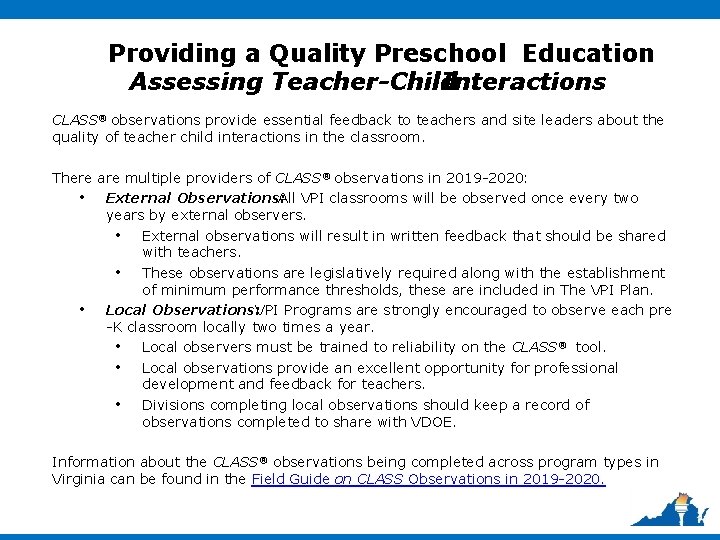
Providing a Quality Preschool Education Assessing Teacher-Child Interactions CLASS® observations provide essential feedback to teachers and site leaders about the quality of teacher child interactions in the classroom. There are multiple providers of CLASS® observations in 2019 -2020: • External Observations: All VPI classrooms will be observed once every two years by external observers. • External observations will result in written feedback that should be shared with teachers. • These observations are legislatively required along with the establishment of minimum performance thresholds, these are included in The VPI Plan. • Local Observations: VPI Programs are strongly encouraged to observe each pre -K classroom locally two times a year. • Local observers must be trained to reliability on the CLASS® tool. • Local observations provide an excellent opportunity for professional development and feedback for teachers. • Divisions completing local observations should keep a record of observations completed to share with VDOE. Information about the CLASS® observations being completed across program types in Virginia can be found in the Field Guide on CLASS Observations in 2019 -2020.
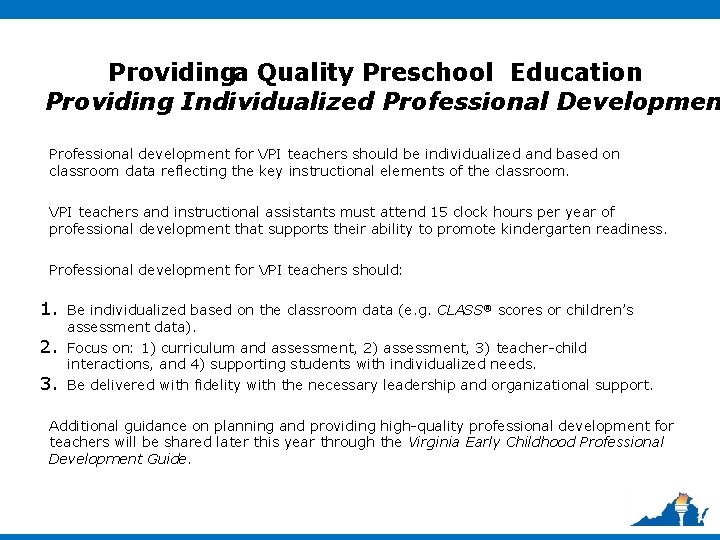
Providinga Quality Preschool Education Providing Individualized Professional Developmen Professional development for VPI teachers should be individualized and based on classroom data reflecting the key instructional elements of the classroom. VPI teachers and instructional assistants must attend 15 clock hours per year of professional development that supports their ability to promote kindergarten readiness. Professional development for VPI teachers should: 1. 2. 3. Be individualized based on the classroom data (e. g. CLASS® scores or children’s assessment data). Focus on: 1) curriculum and assessment, 2) assessment, 3) teacher-child interactions, and 4) supporting students with individualized needs. Be delivered with fidelity with the necessary leadership and organizational support. Additional guidance on planning and providing high-quality professional development for teachers will be shared later this year through the Virginia Early Childhood Professional Development Guide.
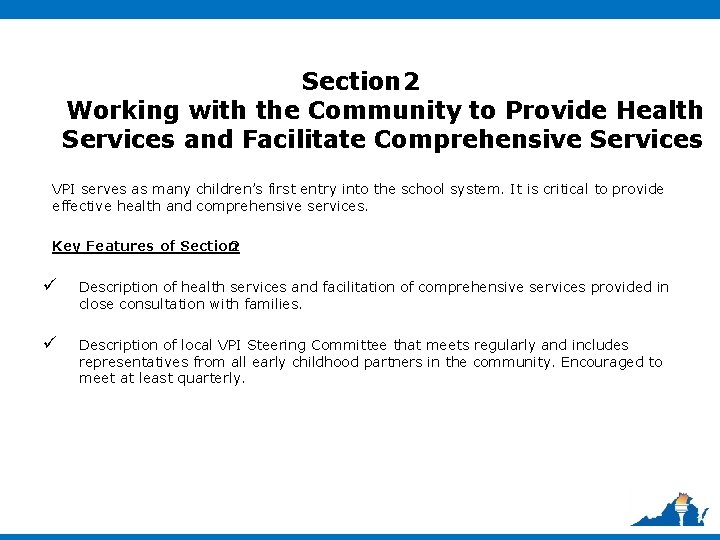
Section 2 Working with the Community to Provide Health Services and Facilitate Comprehensive Services VPI serves as many children’s first entry into the school system. It is critical to provide effective health and comprehensive services. Key Features of Section 2 ü Description of health services and facilitation of comprehensive services provided in close consultation with families. ü Description of local VPI Steering Committee that meets regularly and includes representatives from all early childhood partners in the community. Encouraged to meet at least quarterly.
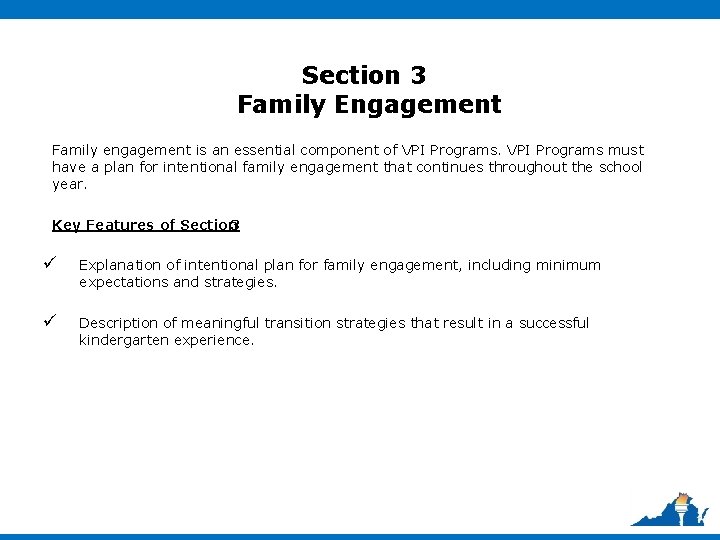
Section 3 Family Engagement Family engagement is an essential component of VPI Programs must have a plan for intentional family engagement that continues throughout the school year. Key Features of Section 3 ü Explanation of intentional plan for family engagement, including minimum expectations and strategies. ü Description of meaningful transition strategies that result in a successful kindergarten experience.
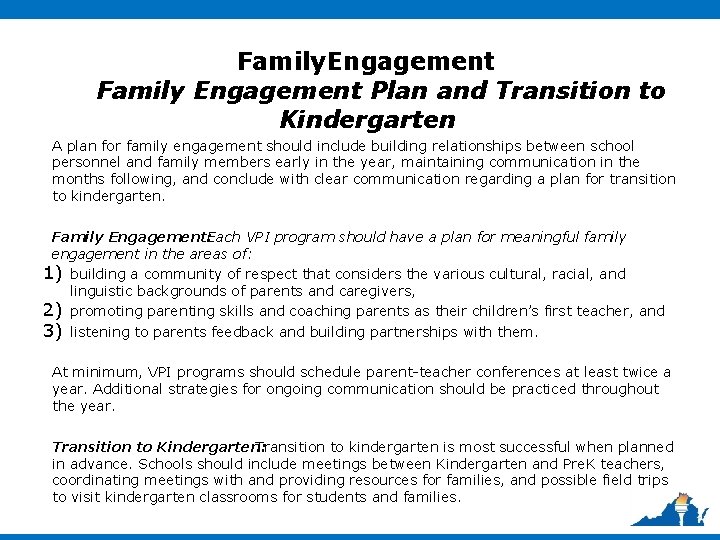
Family Engagement Plan and Transition to Kindergarten A plan for family engagement should include building relationships between school personnel and family members early in the year, maintaining communication in the months following, and conclude with clear communication regarding a plan for transition to kindergarten. Family Engagement: Each VPI program should have a plan for meaningful family engagement in the areas of: 1) building a community of respect that considers the various cultural, racial, and linguistic backgrounds of parents and caregivers, 2) promoting parenting skills and coaching parents as their children’s first teacher, and 3) listening to parents feedback and building partnerships with them. At minimum, VPI programs should schedule parent-teacher conferences at least twice a year. Additional strategies for ongoing communication should be practiced throughout the year. Transition to Kindergarten: Transition to kindergarten is most successful when planned in advance. Schools should include meetings between Kindergarten and Pre. K teachers, coordinating meetings with and providing resources for families, and possible field trips to visit kindergarten classrooms for students and families.
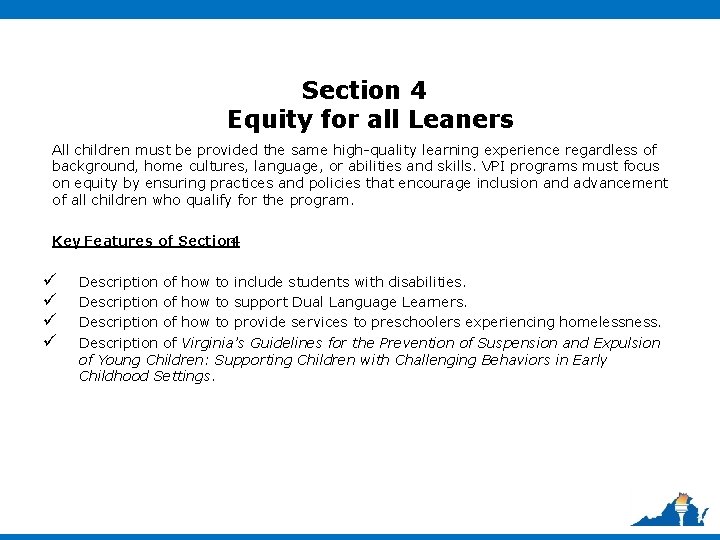
Section 4 Equity for all Leaners All children must be provided the same high-quality learning experience regardless of background, home cultures, language, or abilities and skills. VPI programs must focus on equity by ensuring practices and policies that encourage inclusion and advancement of all children who qualify for the program. Key Features of Section 4 ü ü Description of how to include students with disabilities. Description of how to support Dual Language Learners. Description of how to provide services to preschoolers experiencing homelessness. Description of Virginia’s Guidelines for the Prevention of Suspension and Expulsion of Young Children: Supporting Children with Challenging Behaviors in Early Childhood Settings.
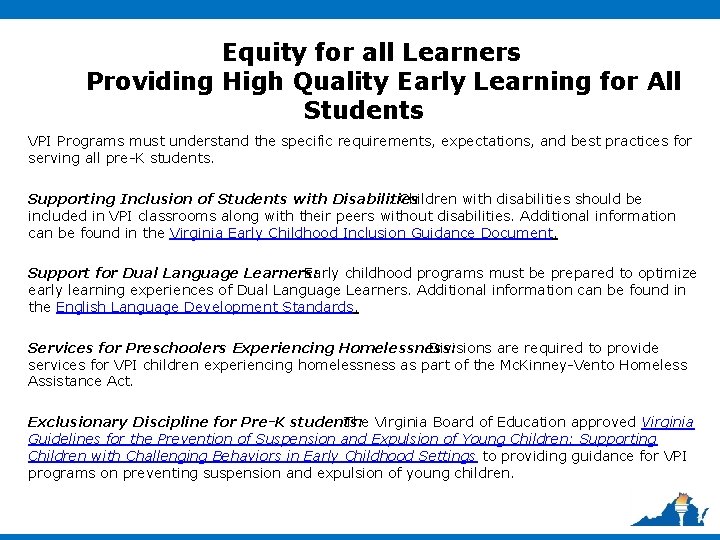
Equity for all Learners Providing High Quality Early Learning for All Students VPI Programs must understand the specific requirements, expectations, and best practices for serving all pre-K students. Supporting Inclusion of Students with Disabilities : Children with disabilities should be included in VPI classrooms along with their peers without disabilities. Additional information can be found in the Virginia Early Childhood Inclusion Guidance Document. Support for Dual Language Learners: Early childhood programs must be prepared to optimize early learning experiences of Dual Language Learners. Additional information can be found in the English Language Development Standards. Services for Preschoolers Experiencing Homelessness: Divisions are required to provide services for VPI children experiencing homelessness as part of the Mc. Kinney-Vento Homeless Assistance Act. Exclusionary Discipline for Pre-K students: The Virginia Board of Education approved Virginia Guidelines for the Prevention of Suspension and Expulsion of Young Children: Supporting Children with Challenging Behaviors in Early Childhood Settings to providing guidance for VPI programs on preventing suspension and expulsion of young children.
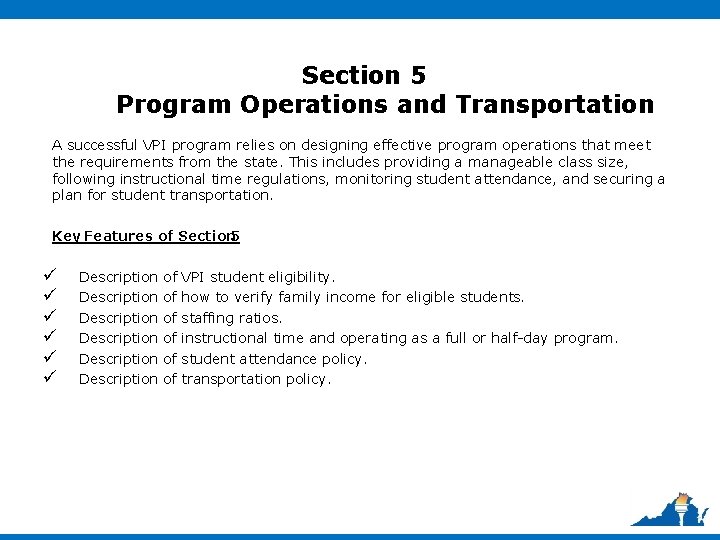
Section 5 Program Operations and Transportation A successful VPI program relies on designing effective program operations that meet the requirements from the state. This includes providing a manageable class size, following instructional time regulations, monitoring student attendance, and securing a plan for student transportation. Key Features of Section 5 ü ü ü Description Description of of of VPI student eligibility. how to verify family income for eligible students. staffing ratios. instructional time and operating as a full or half-day program. student attendance policy. transportation policy.
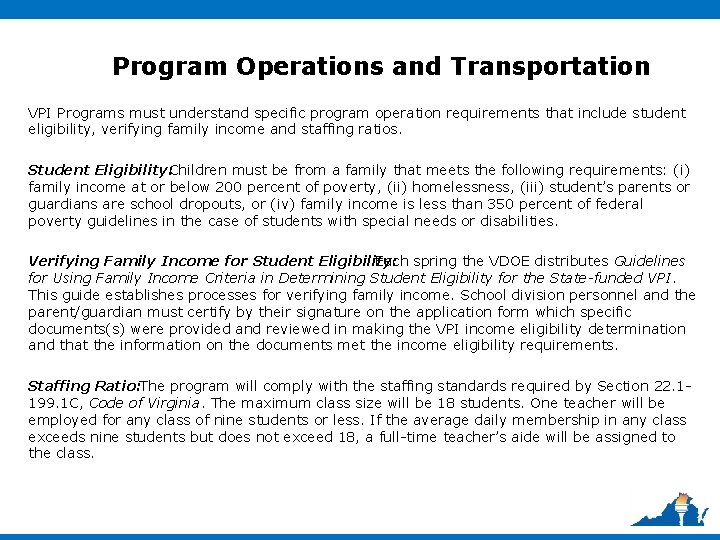
Program Operations and Transportation VPI Programs must understand specific program operation requirements that include student eligibility, verifying family income and staffing ratios. Student Eligibility: Children must be from a family that meets the following requirements: (i) family income at or below 200 percent of poverty, (ii) homelessness, (iii) student’s parents or guardians are school dropouts, or (iv) family income is less than 350 percent of federal poverty guidelines in the case of students with special needs or disabilities. Verifying Family Income for Student Eligibility: Each spring the VDOE distributes Guidelines for Using Family Income Criteria in Determining Student Eligibility for the State-funded VPI. This guide establishes processes for verifying family income. School division personnel and the parent/guardian must certify by their signature on the application form which specific documents(s) were provided and reviewed in making the VPI income eligibility determination and that the information on the documents met the income eligibility requirements. Staffing Ratio: The program will comply with the staffing standards required by Section 22. 1199. 1 C, Code of Virginia. The maximum class size will be 18 students. One teacher will be employed for any class of nine students or less. If the average daily membership in any class exceeds nine students but does not exceed 18, a full-time teacher’s aide will be assigned to the class.
Program Operations and Transportation(continued) VPI Programs must understand specific program operation requirements that include instructional time and unstructured recreational time, operating full or half-day and student attendance. Instructional Time and Unstructured Recreational Time: VPI programs may include unstructured recreational time that is intended to develop teamwork, social skills, and overall physical fitness in any calculation of total instructional time, provided that such unstructured recreational time does not exceed 15 percent of total instructional time or teaching hours. Operating as a Full or Half-Day Program: Programs must provide full-day and at least school -year services (180 days or 990 hours). Programs must operate on a full-day or half-day basis for the entire school year to receive state funds. Student Attendance: Clear attendance and communication policies along with collaboration with families, are crucial to improving VPI student attendance and increasing outcomes for students. Every eligible four-year-old enrolled and funded by the VPI program in a public or private setting must have a State Testing Identification (STI) number and be reported in three VDOE Student Record Collection (SRC) reporting cycles: fall, spring and end of year.
Program Operations and Transportation(continued) VPI Programs must understand specific program operation requirements as it relates to transportation. Transportation: VPI programs must have a plan for ensuring that VPI eligible students have access to a safe method of transportation to and from the home setting and the VPI program site. Transportation must never be a barrier for recruiting eligible children for the VPI and for providing full VPI services to eligible children and their families.
Section 6 Submitting the VPI Application Divisions must submit an application and develop a plan for funding to offer the VPI program each year. Key Features of Section 6 ü Description of the process for submitting the application and a list of the local plan questions. ü Description of the application requirements. ü Definitions for cash and in-kind contributions. ü Description of coordination of funds. ü Description of mixed delivery services.
Section 7 Using Appendices to Complete the Application The Appendices refers to information regarding the requirements of a quality preschool program and the Virginia Preschool Initiative. Key Features of Section 7 ü Appendix A: Student Eligibility Criteria ü Appendix B: PALS-Pre. K ü Appendix C: Historical Information Regarding VPI ü Appendix D: Comparing Key Expectations for 2019 -2020 and 2020 -2021
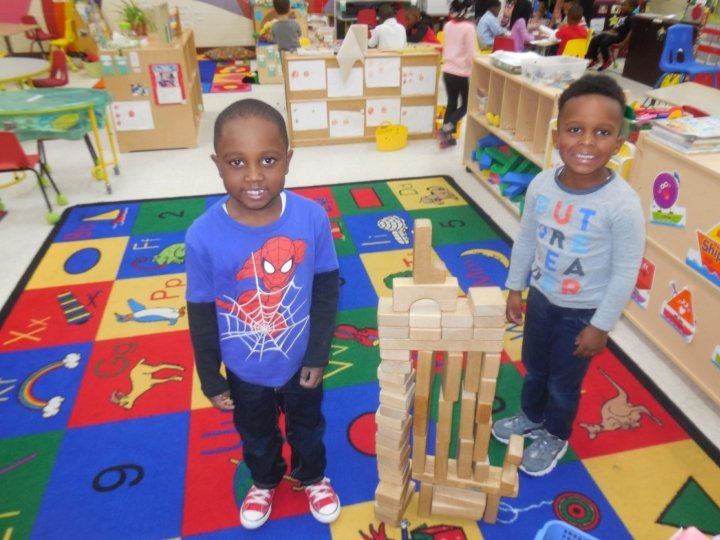
Clasrrom photo
On the Horizon
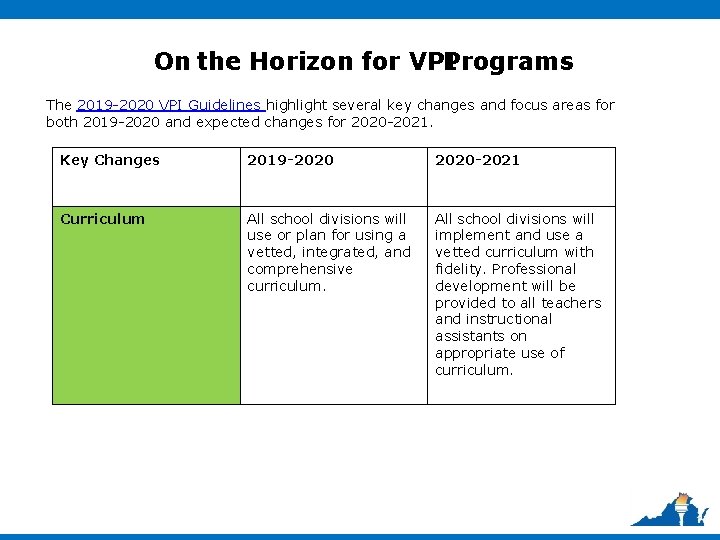
On the Horizon for VPI Programs The 2019 -2020 VPI Guidelines highlight several key changes and focus areas for both 2019 -2020 and expected changes for 2020 -2021. Key Changes 2019 -2020 -2021 Curriculum All school divisions will use or plan for using a vetted, integrated, and comprehensive curriculum. All school divisions will implement and use a vetted curriculum with fidelity. Professional development will be provided to all teachers and instructional assistants on appropriate use of curriculum.
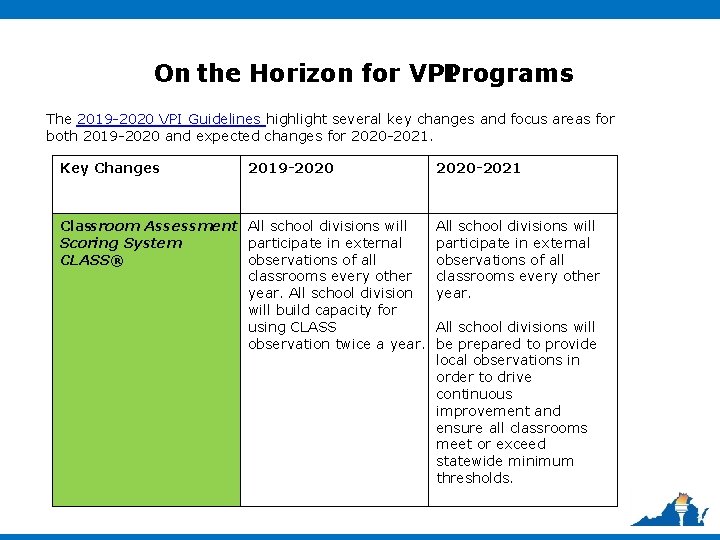
On the Horizon for VPI Programs The 2019 -2020 VPI Guidelines highlight several key changes and focus areas for both 2019 -2020 and expected changes for 2020 -2021. Key Changes 2019 -2020 Classroom Assessment All school divisions will Scoring System participate in external CLASS® observations of all classrooms every other year. All school division will build capacity for using CLASS observation twice a year. 2020 -2021 All school divisions will participate in external observations of all classrooms every other year. All school divisions will be prepared to provide local observations in order to drive continuous improvement and ensure all classrooms meet or exceed statewide minimum thresholds.
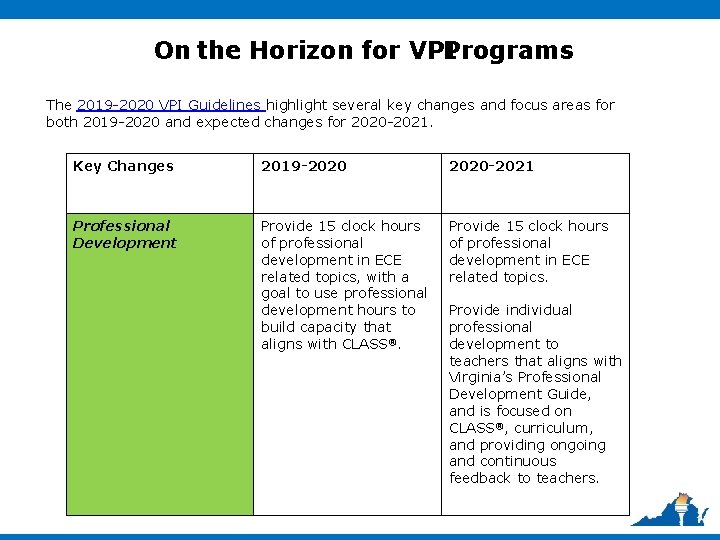
On the Horizon for VPI Programs The 2019 -2020 VPI Guidelines highlight several key changes and focus areas for both 2019 -2020 and expected changes for 2020 -2021. Key Changes 2019 -2020 -2021 Professional Development Provide 15 clock hours of professional development in ECE related topics, with a goal to use professional development hours to build capacity that aligns with CLASS®. Provide 15 clock hours of professional development in ECE related topics. Provide individual professional development to teachers that aligns with Virginia’s Professional Development Guide, and is focused on CLASS®, curriculum, and providing ongoing and continuous feedback to teachers.
Classroom photo 3
Questions
Questions Virginia Preschool Initiative Cheryl Strobel, Associate Director of Childhood Education Cheryl. Strobel@doe. virginia. gov 804 -371 -7578 Dr. Mark Allan, Early Childhood Project Manager Mark. Allan@doe. virginia. gov 804 -225 -3665 Early Childhood Special Dr. Dawn Hendricks Education Early Childhood Special Education Specialist Dawn. Henricks@doe. virginia. gov 804 -225 -2675
- Slides: 34