
VIRGINIA DEFENSE FORCE COMM 101 Basic Communications COM
VIRGINIA DEFENSE FORCE COMM 101: Basic Communications
COM 101 Purpose Action: Discuss VDF radio operations and components Conditions. Interactive classroom and demonstration/application Standards. Be able to understand the basic radio operations encountered through service in the VDF • • • *SILENCE CELLPHONES *50/10 TIMEKEEPER *SIGN IN FOR CREDIT *TESTABLE *SAFETY BRIEF
Course Objectives At the completion of this period of instruction, you should be familiar with the following: Ø Ø Ø Recognize basic principles of radio communications and electricity Understand radio and signal fundamentals Identify radio components and circuits
Introduction • What is an HF radio system? • What are the characteristics, frequencies, and capabilities of an HF system? • When to utilize HF communications. • How to assemble an HF system.
What is HF Radio? • HF is an abbreviation for High Frequency. • High Frequency is a term used to describe the 1. 6 MHz. To 30 MHz. Portion of the radio spectrum. • This range of frequencies can provide both short-range and long-haul communications. • In the VDF HF will typically be used for beyond line of site communications with a range of apox. 250 miles.
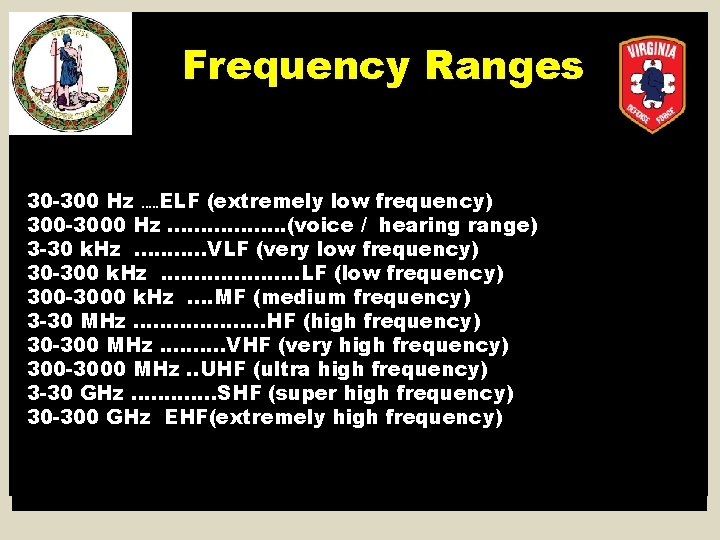
Radio Frequency Band Designations 30 -300 Hz. . . ELF (extremely low frequency) 300 -3000 Hz. . . . …(voice / hearing range) 3 -30 k. Hz. . . VLF (very low frequency) 30 -300 k. Hz. . . . . LF (low frequency) 300 -3000 k. Hz. . MF (medium frequency) 3 -30 MHz. . . . . HF (high frequency) 30 -300 MHz. . VHF (very high frequency) 300 -3000 MHz. . UHF (ultra high frequency) 3 -30 GHz. . . SHF (super high frequency) 30 -300 GHz EHF(extremely high frequency)
Modes of Operation • Radios use various modes of operation to convey information in a signal. • There are three basic modes used in HF operation. • SSB voice: USB (upper side band), LSB (lower side band). • CW: (continuous wave) more commonly known as Morse code. • Data: there are many different data modes in use today.
Modes of Operation • With data communications signals are received and processed by a computer to display text, pictures, files, E-mail, etc. • One type of data mode that has been used by the VDF is PSK 31. • PSK 31 is similar to instant messaging.
Modes of Operation • In the VDF, the primary mode of operation on HF will be USB (upper side band) voice on all frequencies. • LSB operation under certain conditions will be used, only when authorized by the NCS (Net Control Station).
Putting the HF Station Together There are four basic things needed to assemble an HF station: 1. HF transceiver 2. Power source 3. Cabling 4. Antenna
Power Sources • Most modern day HF transceivers can operate from 12 VDC. • This is very convenient when operating in an emergency operation where commercial power or fuel for a generator might be in short supply. • When commercial power or generator is available, a 12 VDC power supply can be used. • The HF radios that the VDF will use require an external power source.
VDF HF Radios • The Micom 3 t is the HF radio That is installed in the mobile communication trailers. • The Micom 3 t is an advanced HF transceiver, can provide Voice, data, Fax, and E-mail over HF with appropriate accessories. • The 3 t is ALE capable. • High Frequency Radio Teams use the Icom M 700/710 Pro Marine radios.

ICOM – IC-M 700
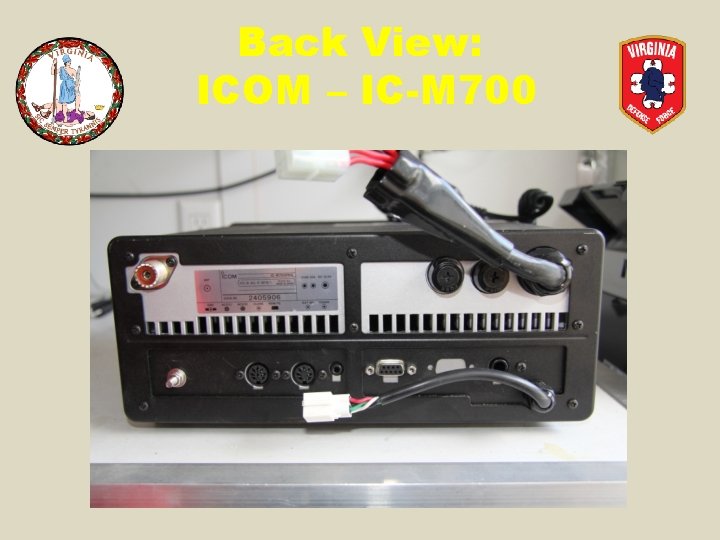
Back View: ICOM – IC-M 700
Antennas • An antenna is a devices that picks up or sends out radio waves. • The transmitter generates radio frequency energy. This energy is converted into radio waves with an antenna. • An antenna works the other way also. When a radio wave crosses an antenna, it generates a voltage in the antenna. • This voltage travels through the coax to the radio. • The same antenna will be used for transmitting and receiving.
Antennas • There are many types of HF antennas. In order to establish reliable communications in the AO (Area of Operation), the correct type of antenna must be chosen. • For HF communications that the VDF will be tasked with, a standard half wavelength dipole configured to utilize NVIS (near vertical incidence skywave) techniques will be the best choice. (More on NVIS later). • Vertical antennas because of their characteristics are not suitable for other than LOS (Line of Site) HF communications.
Antennas / Important Properties • Antennas are classified as either resonant or nonresonant. • An antenna should be tuned to the frequency you are using, much like tuning the strings on a guitar are tuned to certain notes. • If an antenna is fed with a frequency other than the one it was tuned for, much of the signal will be lost. • A resonant antenna will effectively radiate a signal for frequencies close to the one it was tuned for. • The fundamental antenna is the dipole.
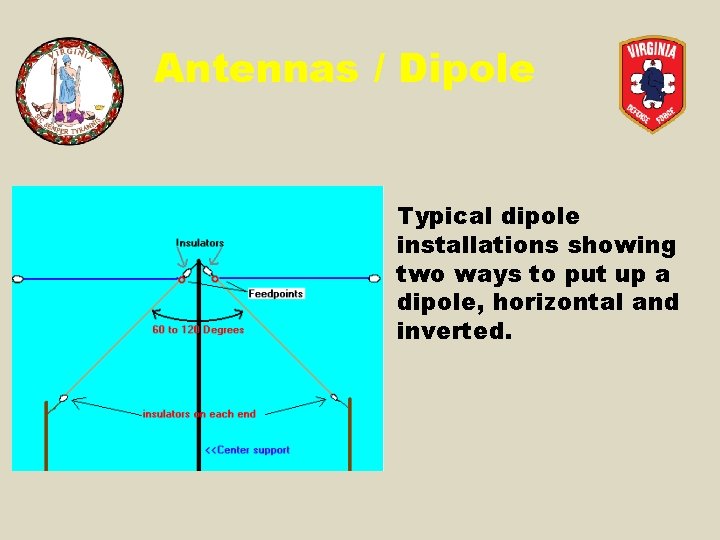
Antennas / Dipole Typical dipole installations showing two ways to put up a dipole, horizontal and inverted.
Antennas • Tuning the antenna for the frequency of operation can be done in two ways: • Physically matching (or tuning) the length of the antenna to the frequency being used. • Electrically matching the antenna to the frequency with an antenna tuner. • The length of a half-wave dipole antenna can be calculated by dividing 468 by the frequency in megahertz you want to operate on. This will give you the full length of the antenna in feet.
Antennas • The Barker and Williamson broad band folded dipole is one the type antenna the VDF will be utilizing for use with the mobile command posts. • Due to its design, an antenna tuner is not required. • Works well for NVIS techniques and ALE applications where frequencies are changed at an extremely rapid rate.
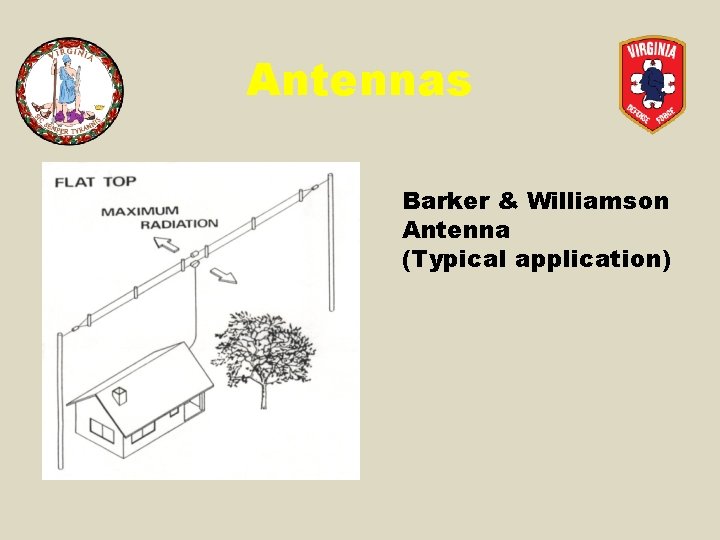
Antennas Barker & Williamson Antenna (Typical application)
Putting It All Together • As stated earlier, there are four basic components needed to assemble an HF station. 1. Transceiver 2. Power Source 3. Cabling 4. Antenna
Precautions • As with any transceiver, never key the microphone until the antenna is in place and connected. Damage to the equipment can result. • Make sure there are no personnel working on the antenna before the microphone is keyed. Serious RF burns to personnel can result. • If not sure, do not key the microphone. Go and look.
Theory & Propagation • The radio equipment for communication between two stations and the path the signal follows through the air is called a radio link. A radio link consists of seven components: the transmitter, power supply, transmission lines, transmitting antenna, propagation path, receiving antenna, and receiver • The transmitter generates a radio signal. The power supply (i. e. , battery or generator) supplies power for the operating voltage of the radio. The transmission line delivers the signal from the transmitter to the antenna.
Theory & Propagation • The transmitting antenna sends the radio signal into space toward the receiving antenna. The path in space that the radio signal follows as it goes to the receiving antenna is the propagation path. The receiving antenna intercepts or receives the signal and sends it through a transmission line to the receiver. The receiver processes the radio signal so the human ear can hear it. • When transmitting, the radio operator aims to provide the strongest possible signal at the site of the receiving station. The best possible signal is that signal which will provide the greatest signal-tonoise ratio at the receiving antenna.
Theory & Propagation • To transmit the best possible signal, select or determine the • Optimum frequency. • Best antenna for that frequency based on the available space of the transmitting site. • Proper propagation path.
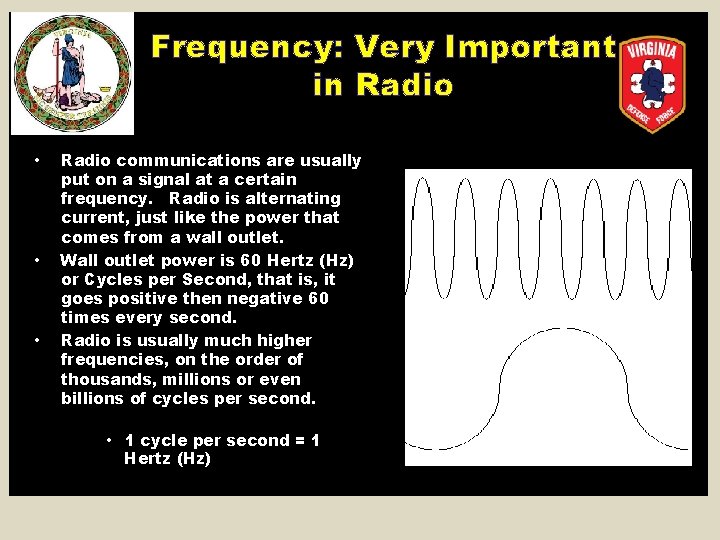
Frequency: Very Important in Radio • • • Radio communications are usually put on a signal at a certain frequency. Radio is alternating current, just like the power that comes from a wall outlet. Wall outlet power is 60 Hertz (Hz) or Cycles per Second, that is, it goes positive then negative 60 times every second. Radio is usually much higher frequencies, on the order of thousands, millions or even billions of cycles per second. • 1 cycle per second = 1 Hertz (Hz)
Frequency Ranges 30 -300 Hz. . . ELF (extremely low frequency) 300 -3000 Hz. . . . …(voice / hearing range) 3 -30 k. Hz. . . VLF (very low frequency) 30 -300 k. Hz. . . . . LF (low frequency) 300 -3000 k. Hz. . MF (medium frequency) 3 -30 MHz. . . . . HF (high frequency) 30 -300 MHz. . VHF (very high frequency) 300 -3000 MHz. . UHF (ultra high frequency) 3 -30 GHz. . . SHF (super high frequency) 30 -300 GHz EHF(extremely high frequency)
Characteristics of VHF/UHF Radio • 1. Portability • -- hand held radios • -- mobile antennas easy to build • -- limited to Line Of Sight (LOS) • -- terrain limited • 2. Repeaters and/or Trunked Networks • -- Repeaters extend coverage area • -- Trunked Networks can cover large areas (STARS is a good example)
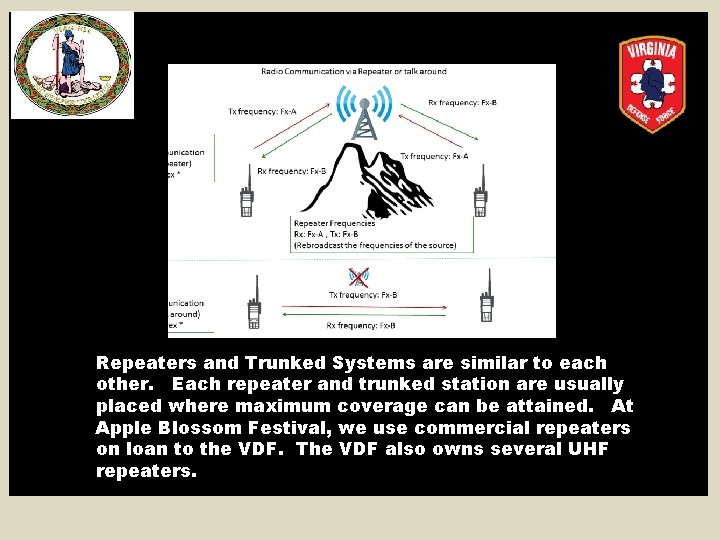
Repeaters and Trunked Systems are similar to each other. Each repeater and trunked station are usually placed where maximum coverage can be attained. At Apple Blossom Festival, we use commercial repeaters on loan to the VDF. The VDF also owns several UHF repeaters.
HF radio • Can go Over The Horizon (OTH) – A. Near Vertical Incidence Skywave (NVIS) – B. Long skip, going long distances (DX) • Frequency Selection • A. NOT a Basic Soldier Skill (responsibility of RGT S-6, G 6 and/or RTO) • B. Setting up radios and antennas IS a required soldier skill
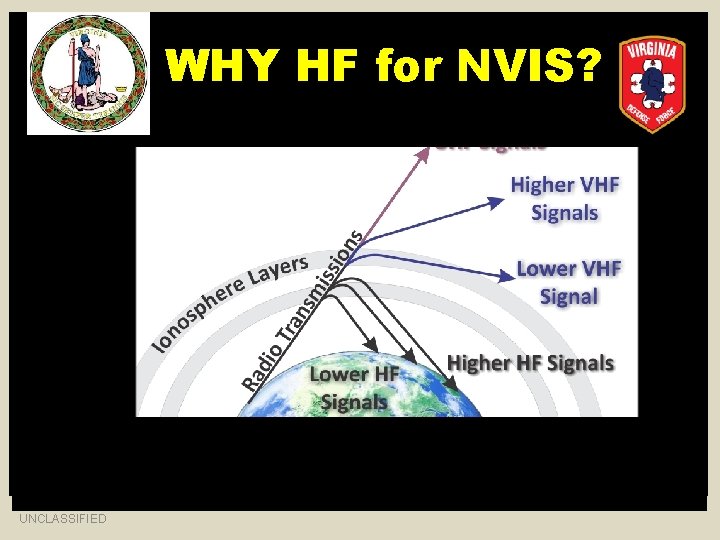
WHY HF for NVIS? • The VHF/UHF frequencies under most conditions are not refracted back to Earth, however, HF usually does get refracted enough to come back to Earth. UNCLASSIFIED
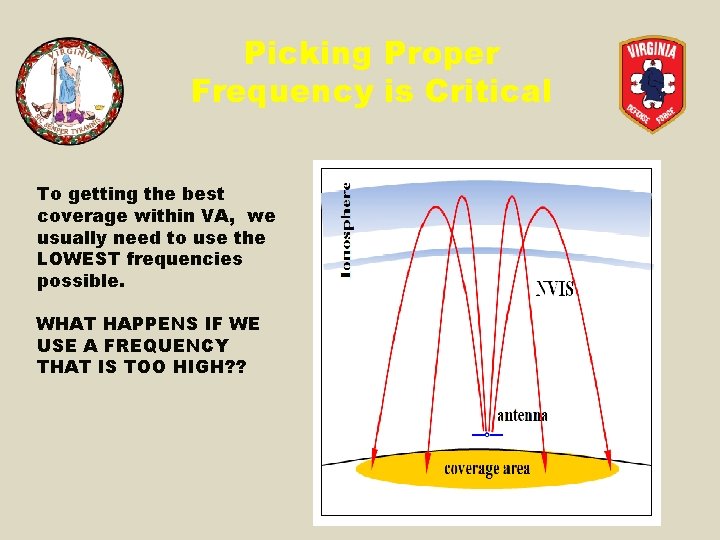
Picking Proper Frequency is Critical To getting the best coverage within VA, we usually need to use the LOWEST frequencies possible. WHAT HAPPENS IF WE USE A FREQUENCY THAT IS TOO HIGH? ?
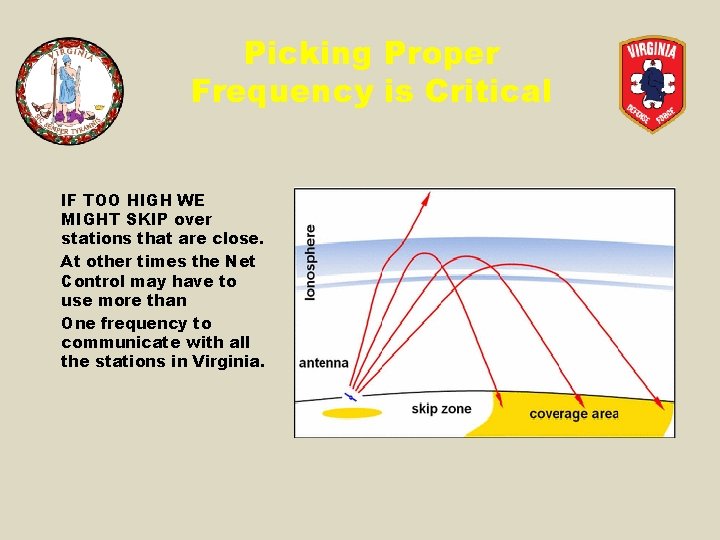
Picking Proper Frequency is Critical IF TOO HIGH WE MIGHT SKIP over stations that are close. At other times the Net Control may have to use more than One frequency to communicate with all the stations in Virginia.
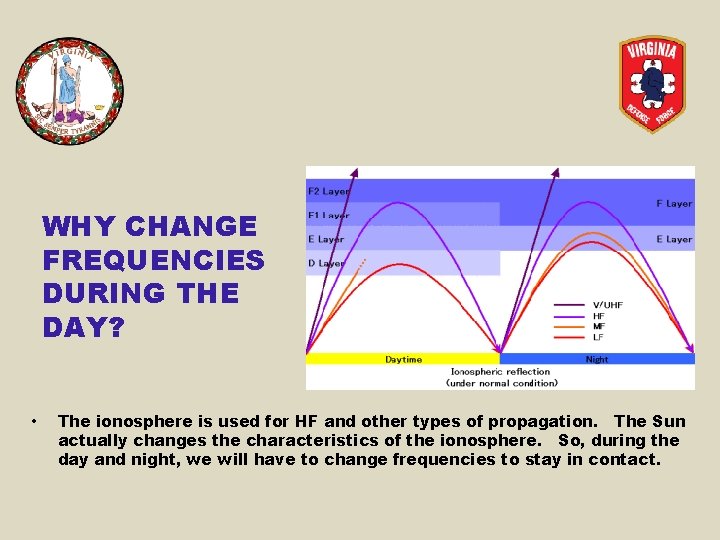
WHY CHANGE FREQUENCIES DURING THE DAY? • The ionosphere is used for HF and other types of propagation. The Sun actually changes the characteristics of the ionosphere. So, during the day and night, we will have to change frequencies to stay in contact.
THREE MAIN HF SYSTEM COMPONENTS 1. Transceiver (short for “Transmitter-Receiver”) normally called “The Radio. ” • -- Generates transmit signal at a particular frequency and receives similar signals sent from other stations • -- Displays frequency and/or channel in use • -- Provides interface for microphone and/or modem (modulatordemodulator). Ø 2. Antenna Tuner Ø -- Provides a “matchable” interface between The Radio and certain antennas. Ø -- Not necessary with a matched antenna (RTO, RGT S-6 or G 6 will determine if it is NOT necessary). Always use Antenna Tuner if uncertain. Ø 3. Antenna Ø -- There are many different kinds. The ones we commonly use are “long wires, ” AS-2259 and Barker & Williamson broadband antennas. Ø -- Allows transmitted signals to be radiated into space Ø -- Allows received signals to be sent to The Radio •
ALTERNATIVE POWER SOURCES • A. Batteries – 1. Deep Cycle Batteries • a. best for radios • b. acid hazard • 2. Alternatives – a. Lithium ion – b. Nickel-Cadmium – c. Nickel-Metal Hydride – 3. Automobile batteries will do in a pinch
ALTERNATIVE POWER (CONT’D) • B. Generators – 1. Plenty of power (can run several radios, computers, whole MCP) – 2. Noisy – 3. Fire and carbon monoxide hazard – 4. Heavy and not very portable.

Questions?
- Slides: 39