
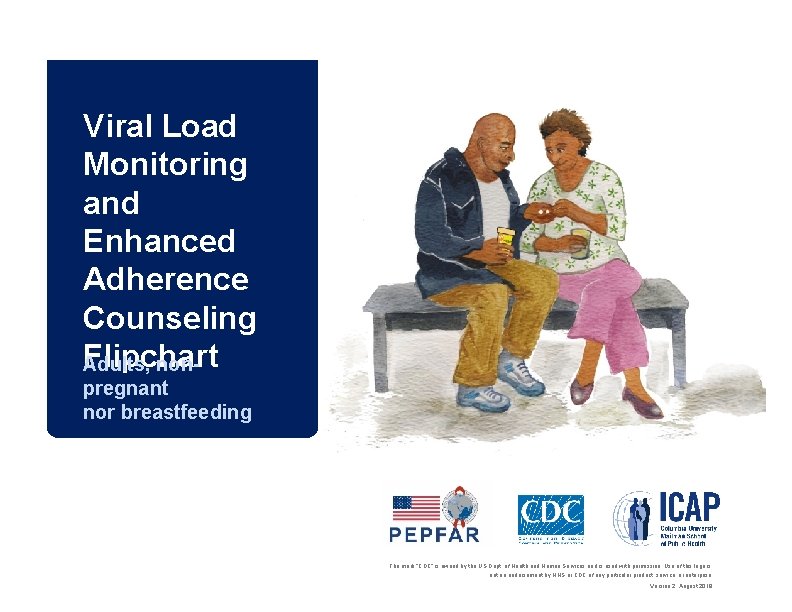
Viral Load Monitoring and Enhanced Adherence Counseling Flipchart







- Slides: 52
Viral Load Monitoring and Enhanced Adherence Counseling Flipchart Adults, nonpregnant nor breastfeeding The mark “CDC” is owned by the US Dept. of Health and Human Services and is used with permission. Use of this logo is not an endorsement by HHS or CDC of any particular product, service, or enterprise. Version 2: August 2019
This job tool was created by ICAP at Columbia University with funding from the U. S. President’s Emergency Plan for AIDS Relief (PEPFAR) through the Centers for Disease Control and Prevention (CDC) under the terms of cooperative agreement #U 2 GGH 000994. Its contents are solely the responsibility of the authors and do not necessarily represent the views of the U. S. Government. This flipchart is intended for use by health care workers in order to provide information to patients living with HIV and their families. For questions about the contents or use, please contact ICAP at icap-communications@columbia. edu.
HOW TO USE THE VIRAL LOAD MONITORING AND ENHANCED ADHERENCE COUNSELING FLIPCHART The purpose of this flipchart is to provide information about viral load monitoring to patients who are receiving antiretrovirals (ARVs) in order to explain the meaning of viral load results and to help with adherence assessment and counselling. This is especially important for those with elevated viral loads who warrant enhanced adherence counseling. It was developed for a range of health care workers (e. g. adherence counsellors, doctors, nurses, pharmacists, community health workers) who work with patients living with HIV and their families in setting where viral load testing is being performed. Each card, or set of cards, focuses on a specific topic important to the care and support of patients on ARVs who will have a viral load test done or who already have a viral load result. Topics are color-coded for ease of use. Directions on how to use the flip chart: • Place flip chart on table so that the patient has a good view of the pictures while you use the side with notes. • Key messages to convey to the patient and instructions to provider are in bold. • There are notes to prompt and guide discussion with the patient, including specific questions to review covered material and assess the patient’s understanding. • There are certain cards for specific visits, including when starting ARVs, when a viral load test is being sent, and when results are available. If the viral load result is low, there are corresponding cards to use. If the viral load result is high, there a series of cards to be used to explain the result and to conduct enhanced adherence counseling sessions. There also cards for undetectable viral loads that address issues of sexual transmission. Note that these cards may be used, when appropriate, in addition to the low viral load cards. • A separate document, the Enhanced Adherence Plan tool, is used to document findings and plan for cards 6 -16, and should be included in the patient’s file. • After the first enhanced adherence counseling session (second and beyond), begin the session with card 16 and repeat cards 616 as needed.
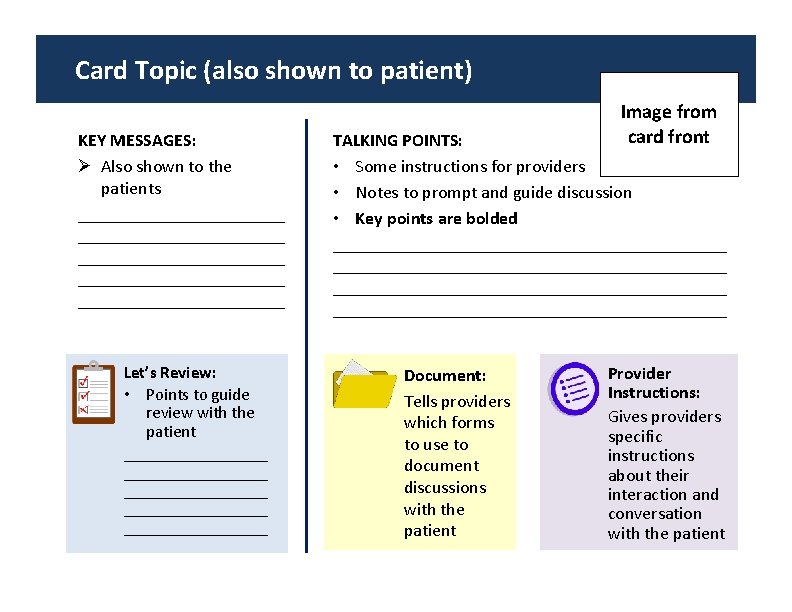
Card Topic (also shown to patient) KEY MESSAGES: Ø Also shown to the patients _______________________ ____________ Let’s Review: • Points to guide review with the patient _________________ _________ Image from card front TALKING POINTS: • Some instructions for providers • Notes to prompt and guide discussion • Key points are bolded ____________________________________________ Document: Tells providers which forms to use to document discussions with the patient Provider Instructions: Gives providers specific instructions about their interaction and conversation with the patient
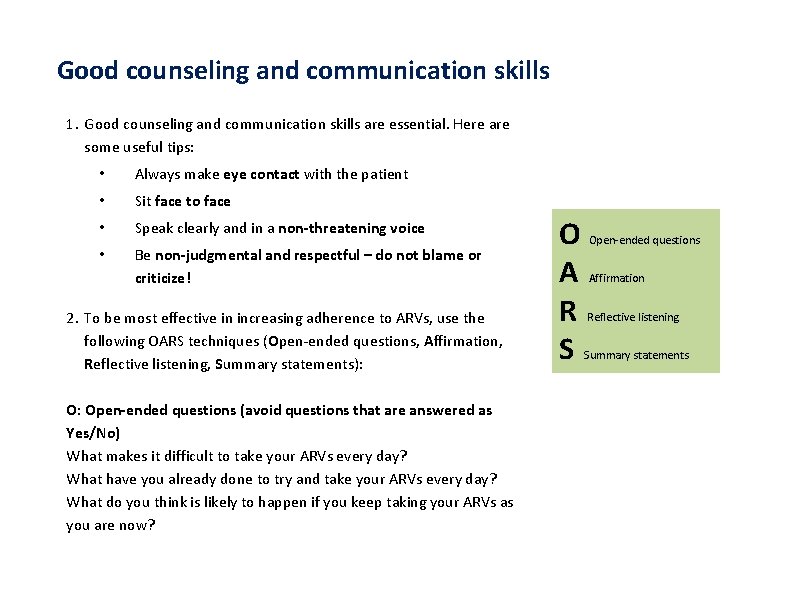
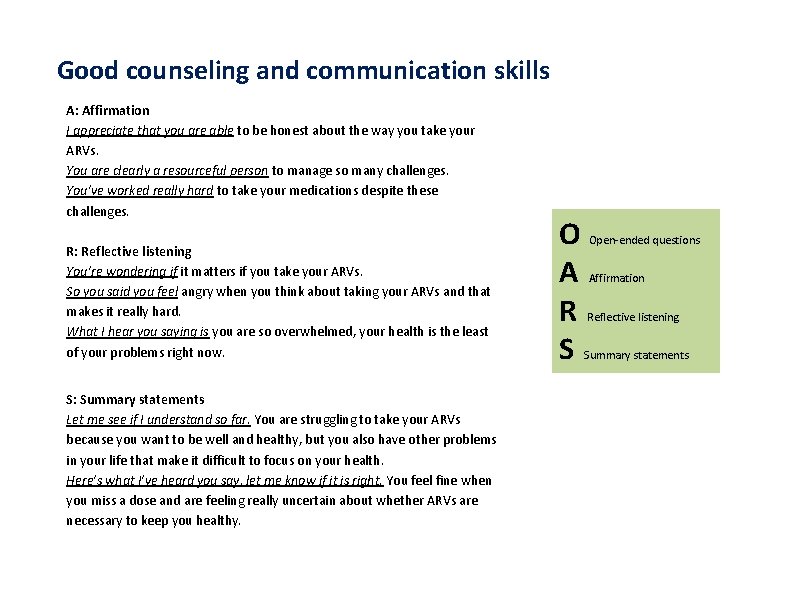
Good counseling and communication skills 1. Good counseling and communication skills are essential. Here are some useful tips: • Always make eye contact with the patient • Sit face to face • Speak clearly and in a non-threatening voice • Be non-judgmental and respectful – do not blame or criticize! 2. To be most effective in increasing adherence to ARVs, use the following OARS techniques (Open-ended questions, Affirmation, Reflective listening, Summary statements): O: Open-ended questions (avoid questions that are answered as Yes/No) What makes it difficult to take your ARVs every day? What have you already done to try and take your ARVs every day? What do you think is likely to happen if you keep taking your ARVs as you are now? O A R S Open-ended questions Affirmation Reflective listening Summary statements
Good counseling and communication skills A: Affirmation I appreciate that you are able to be honest about the way you take your ARVs. You are clearly a resourceful person to manage so many challenges. You’ve worked really hard to take your medications despite these challenges. R: Reflective listening You’re wondering if it matters if you take your ARVs. So you said you feel angry when you think about taking your ARVs and that makes it really hard. What I hear you saying is you are so overwhelmed, your health is the least of your problems right now. S: Summary statements Let me see if I understand so far. You are struggling to take your ARVs because you want to be well and healthy, but you also have other problems in your life that make it difficult to focus on your health. Here’s what I’ve heard you say, let me know if it is right. You feel fine when you miss a dose and are feeling really uncertain about whether ARVs are necessary to keep you healthy. O A R S Open-ended questions Affirmation Reflective listening Summary statements
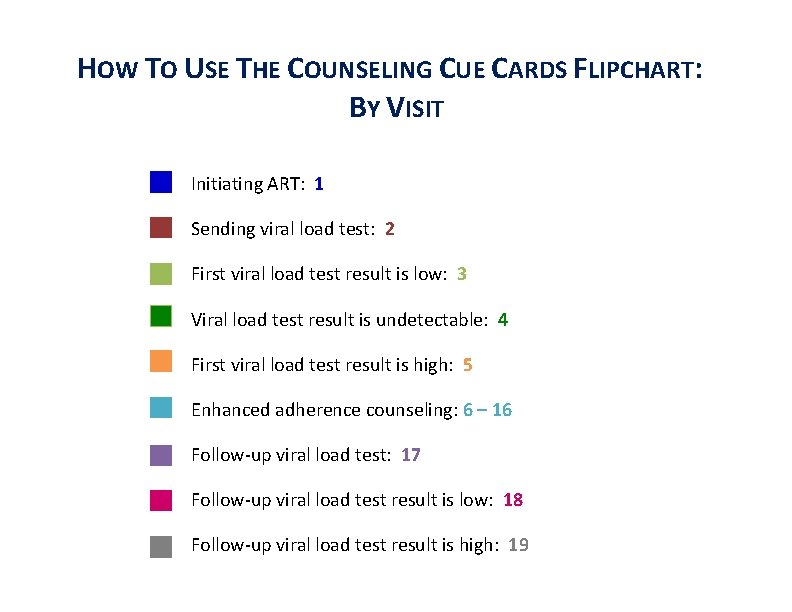
HOW TO USE THE COUNSELING CUE CARDS FLIPCHART: BY VISIT Initiating ART: 1 Sending viral load test: 2 First viral load test result is low: 3 Viral load test result is undetectable: 4 First viral load test result is high: 5 Enhanced adherence counseling: 6 – 16 Follow-up viral load test: 17 Follow-up viral load test result is low: 18 Follow-up viral load test result is high: 19
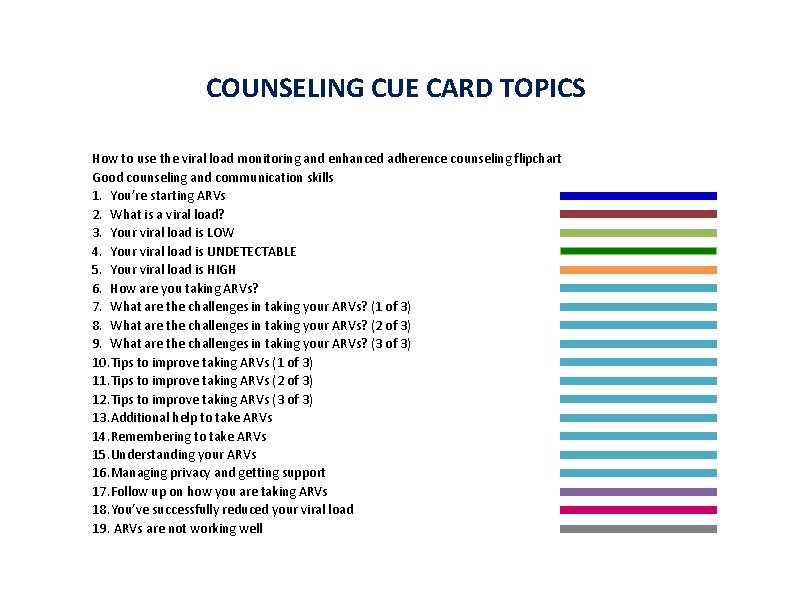
COUNSELING CUE CARD TOPICS How to use the viral load monitoring and enhanced adherence counseling flipchart Good counseling and communication skills 1. You’re starting ARVs 2. What is a viral load? 3. Your viral load is LOW 4. Your viral load is UNDETECTABLE 5. Your viral load is HIGH 6. How are you taking ARVs? 7. What are the challenges in taking your ARVs? (1 of 3) 8. What are the challenges in taking your ARVs? (2 of 3) 9. What are the challenges in taking your ARVs? (3 of 3) 10. Tips to improve taking ARVs (1 of 3) 11. Tips to improve taking ARVs (2 of 3) 12. Tips to improve taking ARVs (3 of 3) 13. Additional help to take ARVs 14. Remembering to take ARVs 15. Understanding your ARVs 16. Managing privacy and getting support 17. Follow up on how you are taking ARVs 18. You’ve successfully reduced your viral load 19. ARVs are not working well
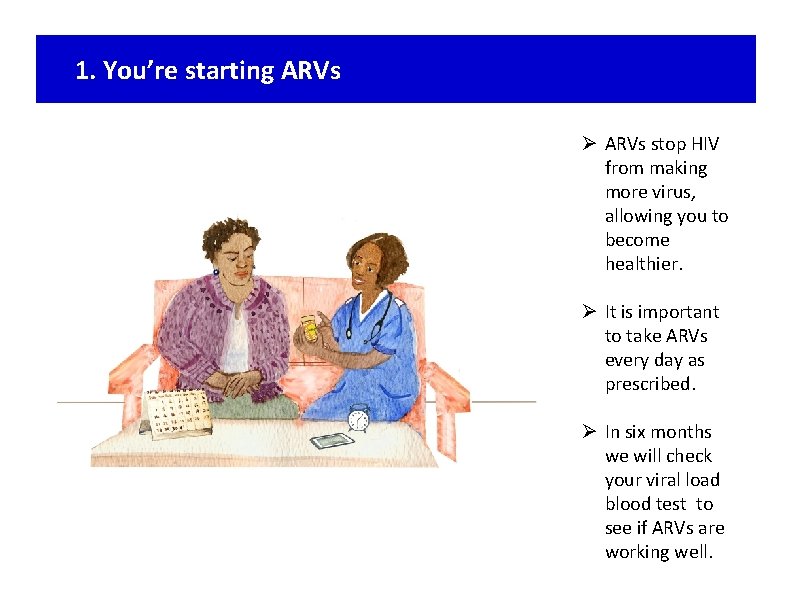
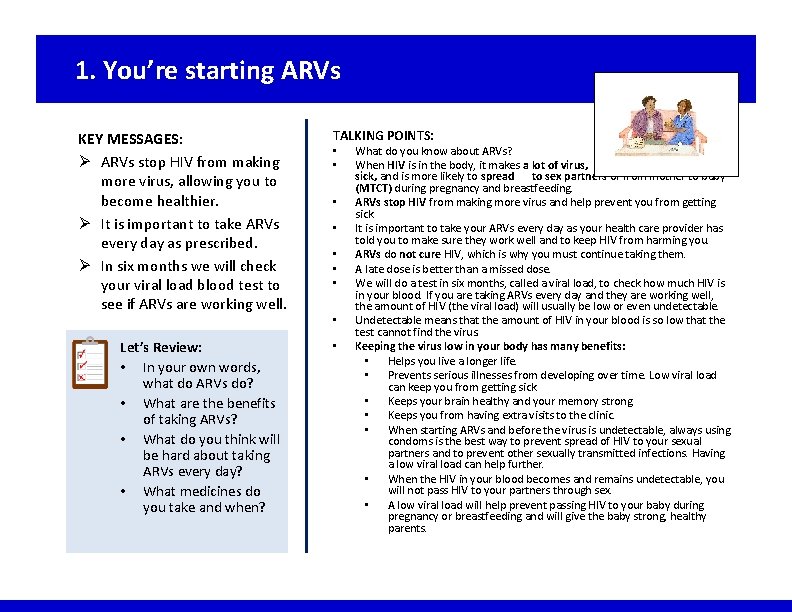
1. You’re starting ARVs Ø ARVs stop HIV from making more virus, allowing you to become healthier. Ø It is important to take ARVs every day as prescribed. Ø In six months we will check your viral load blood test to see if ARVs are working well.
1. You’re starting ARVs KEY MESSAGES: Ø ARVs stop HIV from making more virus, allowing you to become healthier. Ø It is important to take ARVs every day as prescribed. Ø In six months we will check your viral load blood test to see if ARVs are working well. Let’s Review: • In your own words, what do ARVs do? • What are the benefits of taking ARVs? • What do you think will be hard about taking ARVs every day? • What medicines do you take and when? TALKING POINTS: • • • Image from card front What do you know about ARVs? When HIV is in the body, it makes a lot of virus, can make you sick, and is more likely to spread to sex partners or from mother to baby (MTCT) during pregnancy and breastfeeding. ARVs stop HIV from making more virus and help prevent you from getting sick. It is important to take your ARVs every day as your health care provider has told you to make sure they work well and to keep HIV from harming you. ARVs do not cure HIV, which is why you must continue taking them. A late dose is better than a missed dose. We will do a test in six months, called a viral load, to check how much HIV is in your blood. If you are taking ARVs every day and they are working well, the amount of HIV (the viral load) will usually be low or even undetectable. Undetectable means that the amount of HIV in your blood is so low that the test cannot find the virus. Keeping the virus low in your body has many benefits: • Helps you live a longer life. • Prevents serious illnesses from developing over time. Low viral load can keep you from getting sick. • Keeps your brain healthy and your memory strong. • Keeps you from having extra visits to the clinic. • When starting ARVs and before the virus is undetectable, always using condoms is the best way to prevent spread of HIV to your sexual partners and to prevent other sexually transmitted infections. Having a low viral load can help further. • When the HIV in your blood becomes and remains undetectable, you will not pass HIV to your partners through sex. • A low viral load will help prevent passing HIV to your baby during pregnancy or breastfeeding and will give the baby strong, healthy parents.
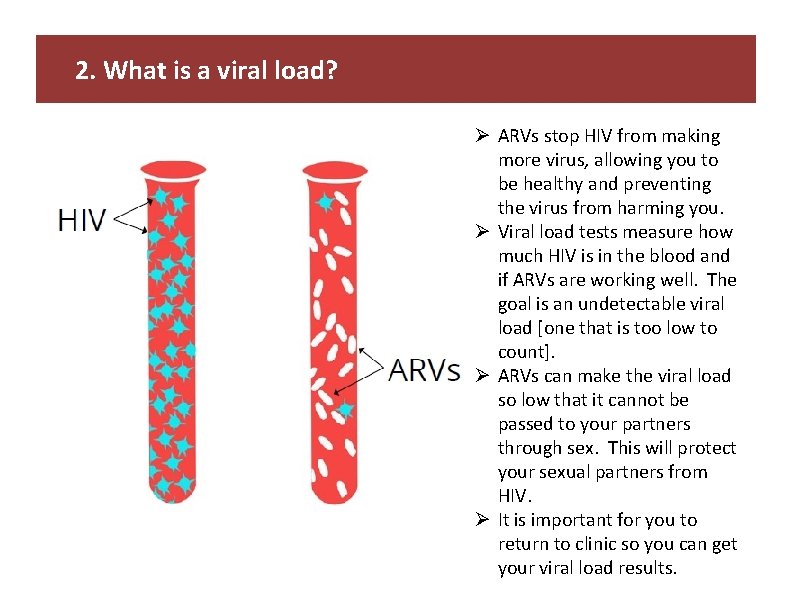
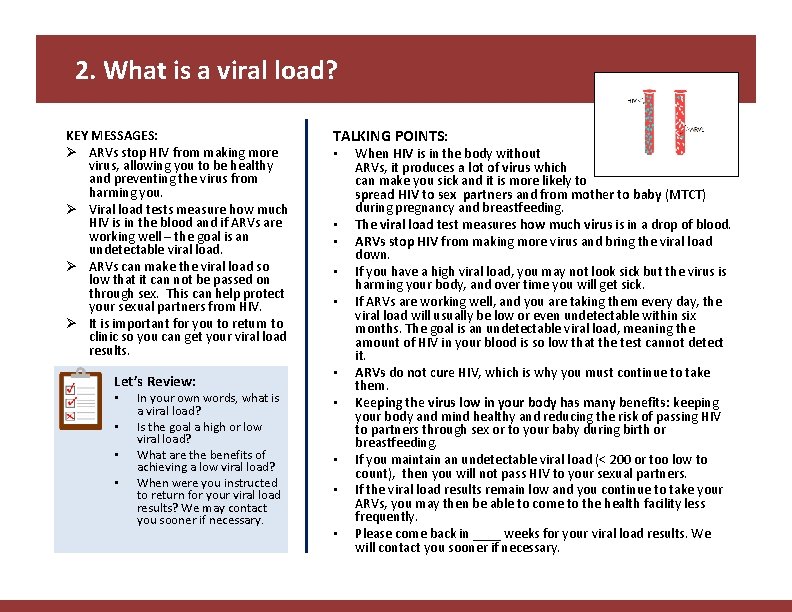
2. What is a viral load? Ø ARVs stop HIV from making more virus, allowing you to be healthy and preventing the virus from harming you. Ø Viral load tests measure how much HIV is in the blood and if ARVs are working well. The goal is an undetectable viral load [one that is too low to count]. Ø ARVs can make the viral load so low that it cannot be passed to your partners through sex. This will protect your sexual partners from HIV. Ø It is important for you to return to clinic so you can get your viral load results.
2. What is a viral load? KEY MESSAGES: Ø ARVs stop HIV from making more virus, allowing you to be healthy and preventing the virus from harming you. Ø Viral load tests measure how much HIV is in the blood and if ARVs are working well – the goal is an undetectable viral load. Ø ARVs can make the viral load so low that it can not be passed on through sex. This can help protect your sexual partners from HIV. Ø It is important for you to return to clinic so you can get your viral load results. Let’s Review: • • In your own words, what is a viral load? Is the goal a high or low viral load? What are the benefits of achieving a low viral load? When were you instructed to return for your viral load results? We may contact you sooner if necessary. TALKING POINTS: • • • Image from card front When HIV is in the body without ARVs, it produces a lot of virus which can make you sick and it is more likely to spread HIV to sex partners and from mother to baby (MTCT) during pregnancy and breastfeeding. The viral load test measures how much virus is in a drop of blood. ARVs stop HIV from making more virus and bring the viral load down. If you have a high viral load, you may not look sick but the virus is harming your body, and over time you will get sick. If ARVs are working well, and you are taking them every day, the viral load will usually be low or even undetectable within six months. The goal is an undetectable viral load, meaning the amount of HIV in your blood is so low that the test cannot detect it. ARVs do not cure HIV, which is why you must continue to take them. Keeping the virus low in your body has many benefits: keeping your body and mind healthy and reducing the risk of passing HIV to partners through sex or to your baby during birth or breastfeeding. If you maintain an undetectable viral load (< 200 or too low to count), then you will not pass HIV to your sexual partners. If the viral load results remain low and you continue to take your ARVs, you may then be able to come to the health facility less frequently. Please come back in ____ weeks for your viral load results. We will contact you sooner if necessary.
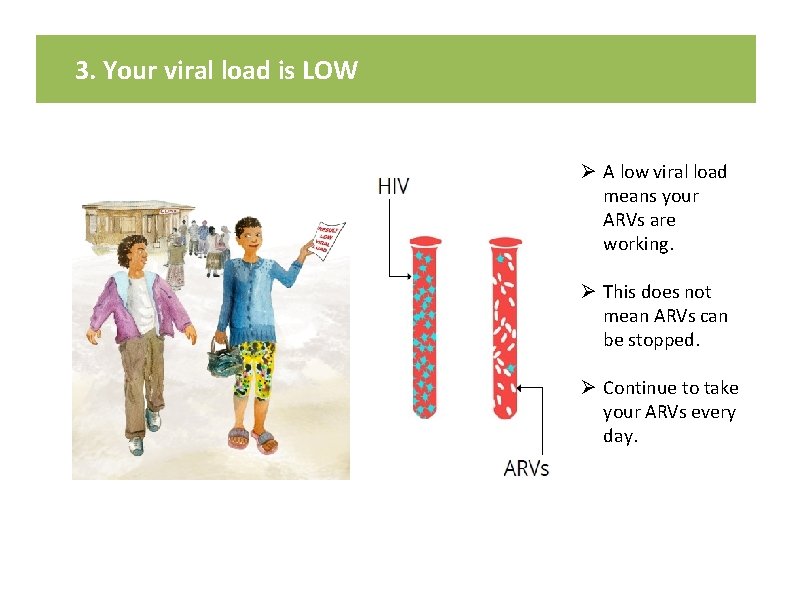
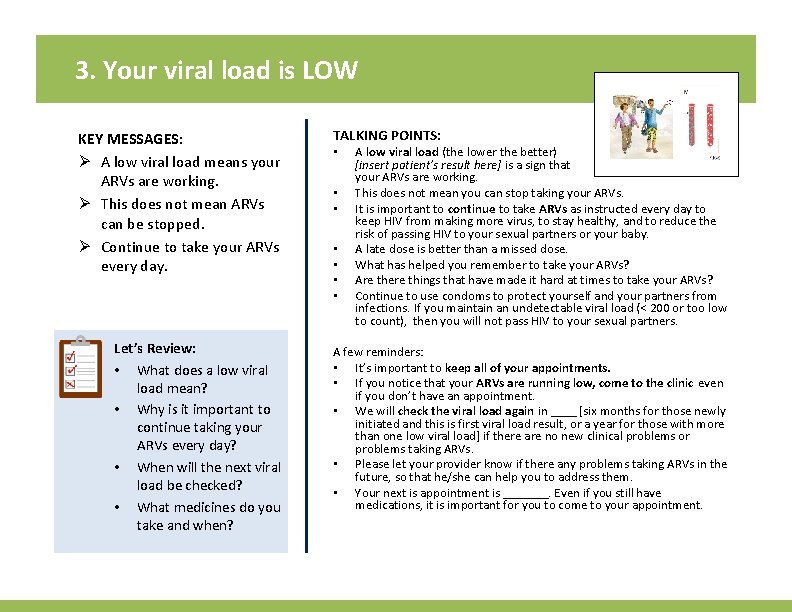
3. Your viral load is LOW Ø A low viral load means your ARVs are working. Ø This does not mean ARVs can be stopped. Ø Continue to take your ARVs every day.
3. Your viral load is LOW KEY MESSAGES: Ø A low viral load means your ARVs are working. Ø This does not mean ARVs can be stopped. Ø Continue to take your ARVs every day. Let’s Review: • What does a low viral load mean? • Why is it important to continue taking your ARVs every day? • When will the next viral load be checked? • What medicines do you take and when? TALKING POINTS: • • Image from card front A low viral load (the lower the better) [insert patient’s result here] is a sign that your ARVs are working. This does not mean you can stop taking your ARVs. It is important to continue to take ARVs as instructed every day to keep HIV from making more virus, to stay healthy, and to reduce the risk of passing HIV to your sexual partners or your baby. A late dose is better than a missed dose. What has helped you remember to take your ARVs? Are there things that have made it hard at times to take your ARVs? Continue to use condoms to protect yourself and your partners from infections. If you maintain an undetectable viral load (< 200 or too low to count), then you will not pass HIV to your sexual partners. A few reminders: • It’s important to keep all of your appointments. • If you notice that your ARVs are running low, come to the clinic even if you don’t have an appointment. • We will check the viral load again in ____ [six months for those newly initiated and this is first viral load result, or a year for those with more than one low viral load] if there are no new clinical problems or problems taking ARVs. • Please let your provider know if there any problems taking ARVs in the future, so that he/she can help you to address them. • Your next is appointment is _______. Even if you still have medications, it is important for you to come to your appointment.
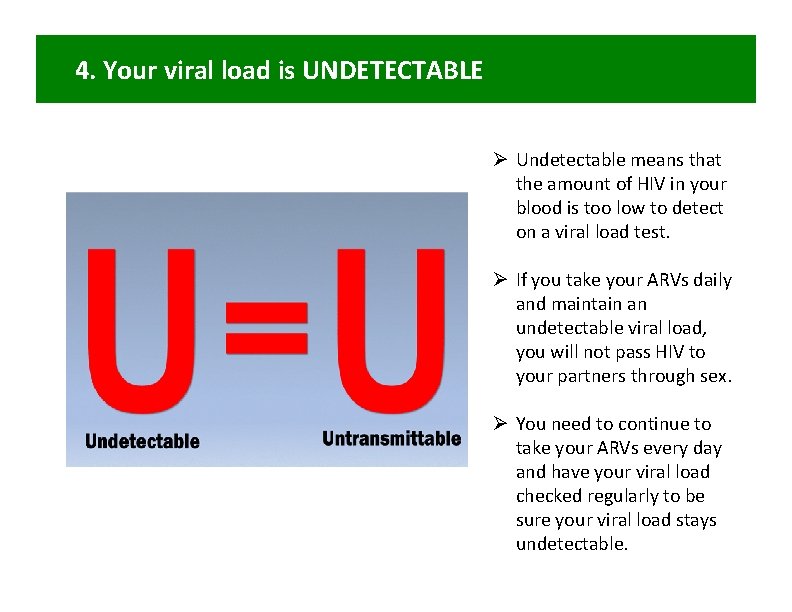
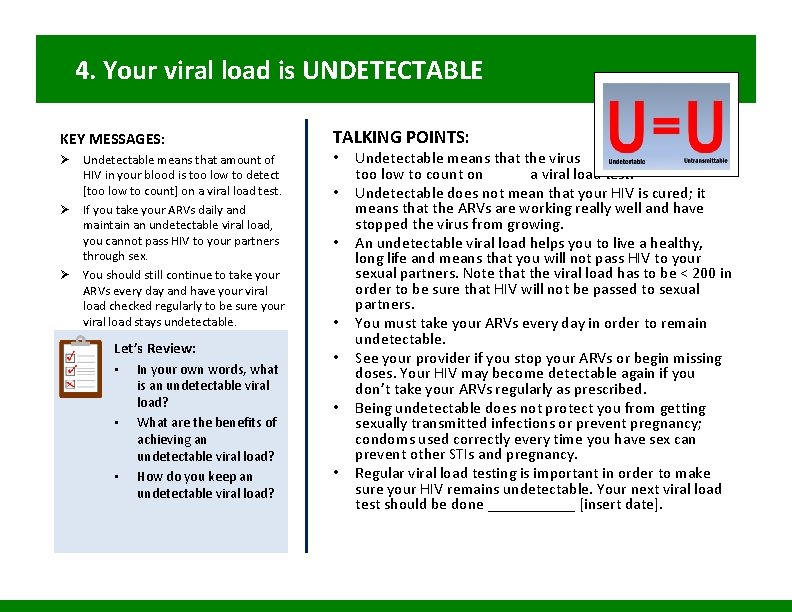
4. Your viral load is UNDETECTABLE Ø Undetectable means that the amount of HIV in your blood is too low to detect on a viral load test. Ø If you take your ARVs daily and maintain an undetectable viral load, you will not pass HIV to your partners through sex. Ø You need to continue to take your ARVs every day and have your viral load checked regularly to be sure your viral load stays undetectable.
4. Your viral load is UNDETECTABLE KEY MESSAGES: Ø Undetectable means that amount of HIV in your blood is too low to detect [too low to count] on a viral load test. Ø If you take your ARVs daily and maintain an undetectable viral load, you cannot pass HIV to your partners through sex. Ø You should still continue to take your ARVs every day and have your viral load checked regularly to be sure your viral load stays undetectable. Let’s Review: • In your own words, what • • is an undetectable viral load? What are the benefits of achieving an undetectable viral load? How do you keep an undetectable viral load? TALKING POINTS: • • Image from card front Undetectable means that the virus in your blood is too low to count on a viral load test. Undetectable does not mean that your HIV is cured; it means that the ARVs are working really well and have stopped the virus from growing. An undetectable viral load helps you to live a healthy, long life and means that you will not pass HIV to your sexual partners. Note that the viral load has to be < 200 in order to be sure that HIV will not be passed to sexual partners. You must take your ARVs every day in order to remain undetectable. See your provider if you stop your ARVs or begin missing doses. Your HIV may become detectable again if you don’t take your ARVs regularly as prescribed. Being undetectable does not protect you from getting sexually transmitted infections or prevent pregnancy; condoms used correctly every time you have sex can prevent other STIs and pregnancy. Regular viral load testing is important in order to make sure your HIV remains undetectable. Your next viral load test should be done ______ [insert date].
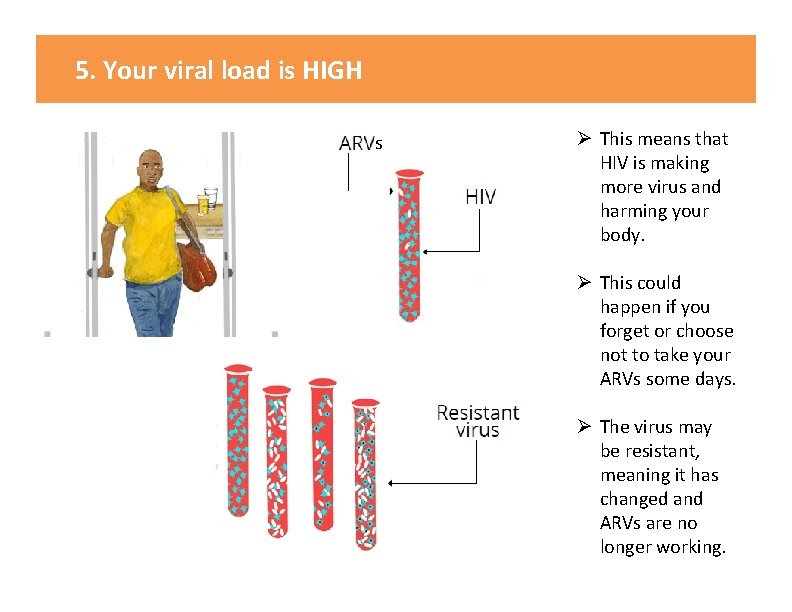
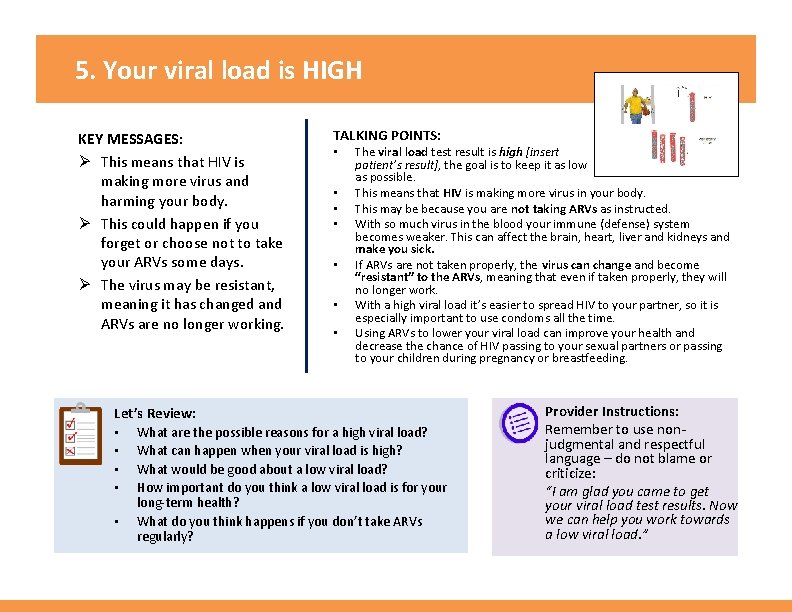
5. Your viral load is HIGH s Ø This means that HIV is making more virus and harming your body. Ø This could happen if you forget or choose not to take your ARVs some days. Ø The virus may be resistant, meaning it has changed and ARVs are no longer working.
5. Your viral load is HIGH KEY MESSAGES: Ø This means that HIV is making more virus and harming your body. Ø This could happen if you forget or choose not to take your ARVs some days. Ø The virus may be resistant, meaning it has changed and ARVs are no longer working. TALKING POINTS: • • The viral load test result is high [insert patient’s result], the goal is to keep it as low as possible. This means that HIV is making more virus in your body. This may be because you are not taking ARVs as instructed. With so much virus in the blood your immune (defense) system becomes weaker. This can affect the brain, heart, liver and kidneys and make you sick. If ARVs are not taken properly, the virus can change and become “resistant” to the ARVs, meaning that even if taken properly, they will no longer work. With a high viral load it’s easier to spread HIV to your partner, so it is especially important to use condoms all the time. Using ARVs to lower your viral load can improve your health and decrease the chance of HIV passing to your sexual partners or passing to your children during pregnancy or breastfeeding. Let’s Review: • What are the possible reasons for a high viral load? • What can happen when your viral load is high? • What would be good about a low viral load? • How important do you think a low viral load is for your • Image from card front long-term health? What do you think happens if you don’t take ARVs regularly? Provider Instructions: Remember to use nonjudgmental and respectful language – do not blame or criticize: “I am glad you came to get your viral load test results. Now we can help you work towards a low viral load. ”
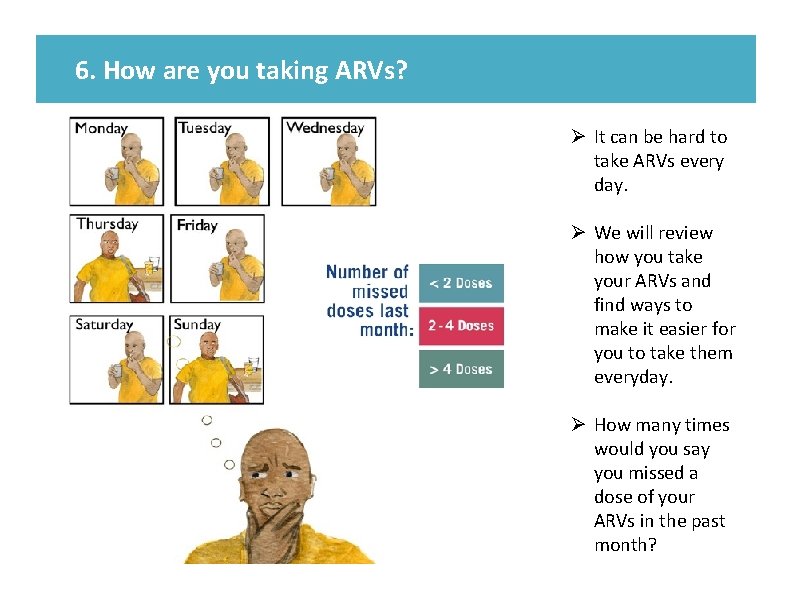
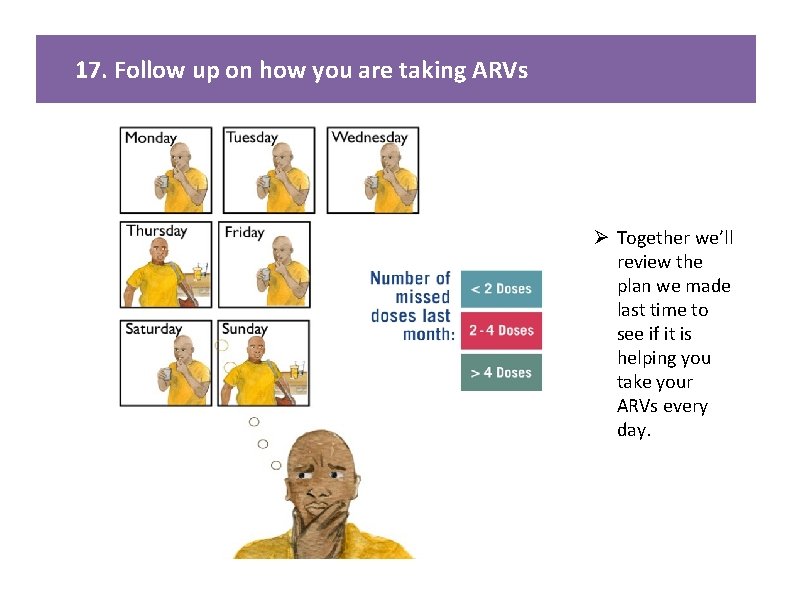
6. How are you taking ARVs? Ø It can be hard to take ARVs every day. Ø We will review how you take your ARVs and find ways to make it easier for you to take them everyday. Ø How many times would you say you missed a dose of your ARVs in the past month?
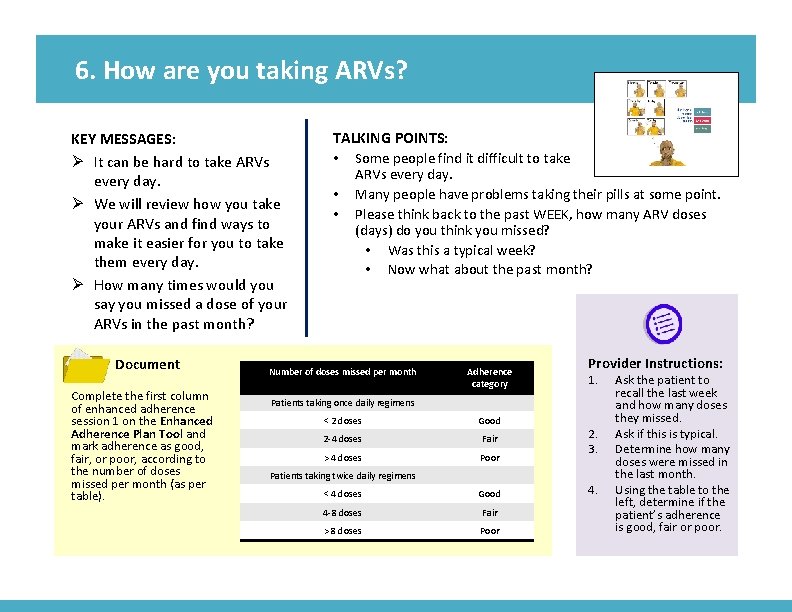
6. How are you taking ARVs? KEY MESSAGES: Ø It can be hard to take ARVs every day. Ø We will review how you take your ARVs and find ways to make it easier for you to take them every day. Ø How many times would you say you missed a dose of your ARVs in the past month? Document Complete the first column of enhanced adherence session 1 on the Enhanced Adherence Plan Tool and mark adherence as good, fair, or poor, according to the number of doses missed per month (as per table). Image from card front TALKING POINTS: • Some people find it difficult to take • • ARVs every day. Many people have problems taking their pills at some point. Please think back to the past WEEK, how many ARV doses (days) do you think you missed? • Was this a typical week? • Now what about the past month? Number of doses missed per month Adherence category Provider Instructions: 1. Patients taking once daily regimens < 2 doses Good 2 -4 doses Fair > 4 doses Poor Patients taking twice daily regimens < 4 doses Good 4 -8 doses Fair > 8 doses Poor 2. 3. 4. Ask the patient to recall the last week and how many doses they missed. Ask if this is typical. Determine how many doses were missed in the last month. Using the table to the left, determine if the patient’s adherence is good, fair or poor.
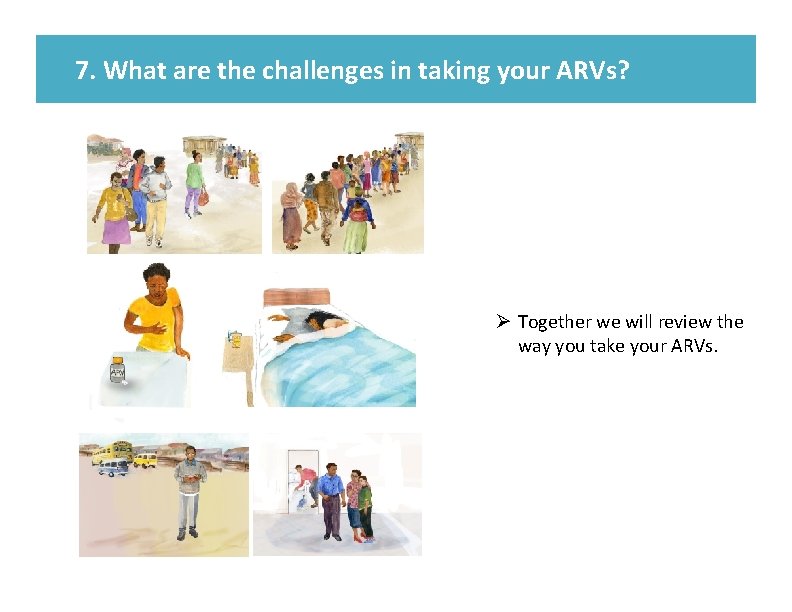
7. What are the challenges in taking your ARVs? Ø Together we will review the way you take your ARVs.
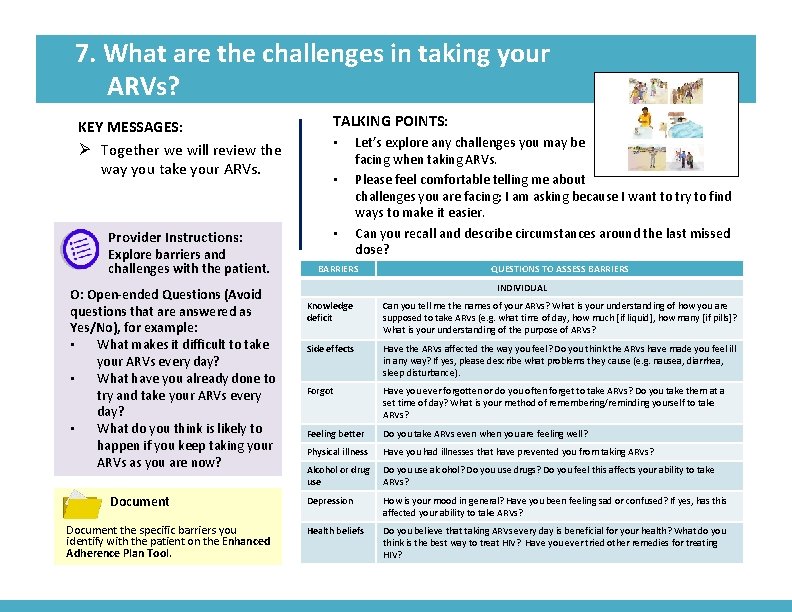
7. What are the challenges in taking your ARVs? KEY MESSAGES: Ø Together we will review the way you take your ARVs. Provider Instructions: Explore barriers and challenges with the patient. O: Open-ended Questions (Avoid questions that are answered as Yes/No), for example: • What makes it difficult to take your ARVs every day? • What have you already done to try and take your ARVs every day? • What do you think is likely to happen if you keep taking your ARVs as you are now? Document the specific barriers you identify with the patient on the Enhanced Adherence Plan Tool. TALKING POINTS: • • • Image from card front Let’s explore any challenges you may be facing when taking ARVs. Please feel comfortable telling me about challenges you are facing; I am asking because I want to try to find ways to make it easier. Can you recall and describe circumstances around the last missed dose? BARRIERS QUESTIONS TO ASSESS BARRIERS INDIVIDUAL Knowledge deficit Can you tell me the names of your ARVs? What is your understanding of how you are supposed to take ARVs (e. g. what time of day, how much [if liquid], how many [if pills]? What is your understanding of the purpose of ARVs? Side effects Have the ARVs affected the way you feel? Do you think the ARVs have made you feel ill in any way? If yes, please describe what problems they cause (e. g. nausea, diarrhea, sleep disturbance). Forgot Have you ever forgotten or do you often forget to take ARVs? Do you take them at a set time of day? What is your method of remembering/reminding yourself to take ARVs? Feeling better Do you take ARVs even when you are feeling well? Physical illness Have you had illnesses that have prevented you from taking ARVs? Alcohol or drug use Do you use alcohol? Do you use drugs? Do you feel this affects your ability to take ARVs? Depression How is your mood in general? Have you been feeling sad or confused? If yes, has this affected your ability to take ARVs? Health beliefs Do you believe that taking ARVs every day is beneficial for your health? What do you think is the best way to treat HIV? Have you ever tried other remedies for treating HIV?
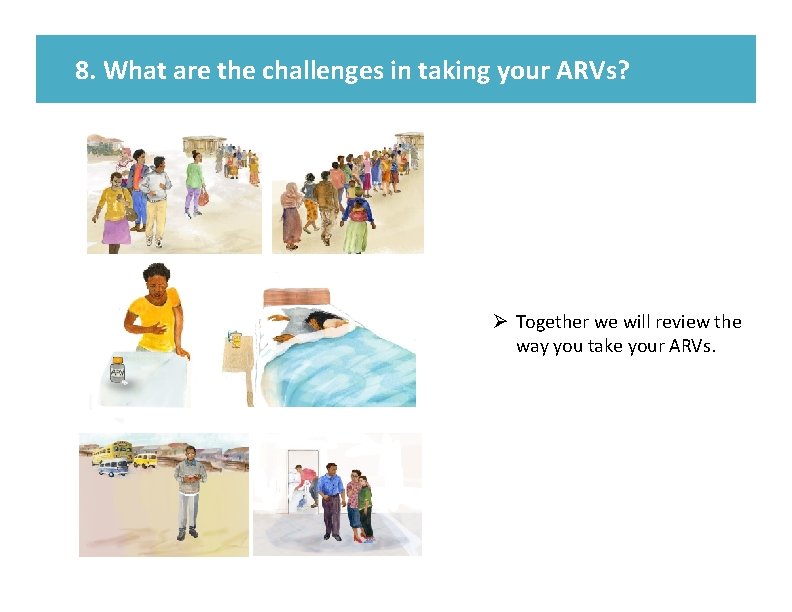
8. What are the challenges in taking your ARVs? Ø Together we will review the way you take your ARVs.
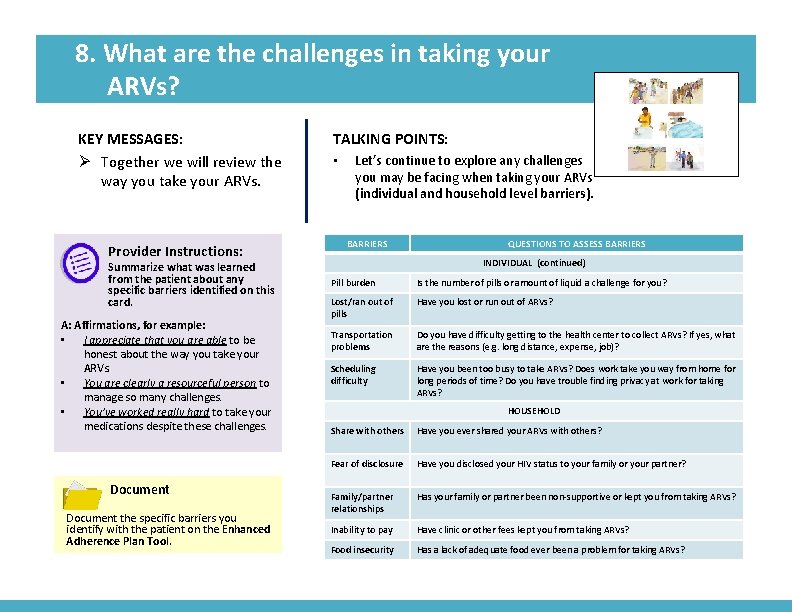
8. What are the challenges in taking your ARVs? KEY MESSAGES: Ø Together we will review the way you take your ARVs. Provider Instructions: Summarize what was learned from the patient about any specific barriers identified on this card. A: Affirmations, for example: • I appreciate that you are able to be honest about the way you take your ARVs. • You are clearly a resourceful person to manage so many challenges. • You’ve worked really hard to take your medications despite these challenges. Document the specific barriers you identify with the patient on the Enhanced Adherence Plan Tool. TALKING POINTS: • Image from card front Let’s continue to explore any challenges you may be facing when taking your ARVs (individual and household level barriers). BARRIERS QUESTIONS TO ASSESS BARRIERS INDIVIDUAL (continued) Pill burden Is the number of pills or amount of liquid a challenge for you? Lost/ran out of pills Have you lost or run out of ARVs? Transportation problems Do you have difficulty getting to the health center to collect ARVs? If yes, what are the reasons (e. g. long distance, expense, job)? Scheduling difficulty Have you been too busy to take ARVs? Does work take you way from home for long periods of time? Do you have trouble finding privacy at work for taking ARVs? HOUSEHOLD Share with others Have you ever shared your ARVs with others? Fear of disclosure Have you disclosed your HIV status to your family or your partner? Family/partner relationships Has your family or partner been non-supportive or kept you from taking ARVs? Inability to pay Have clinic or other fees kept you from taking ARVs? Food insecurity Has a lack of adequate food ever been a problem for taking ARVs?
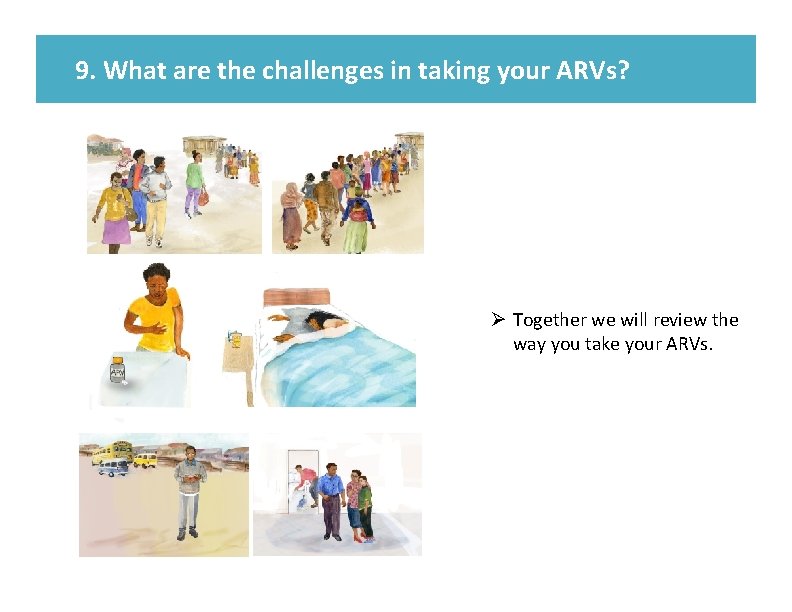
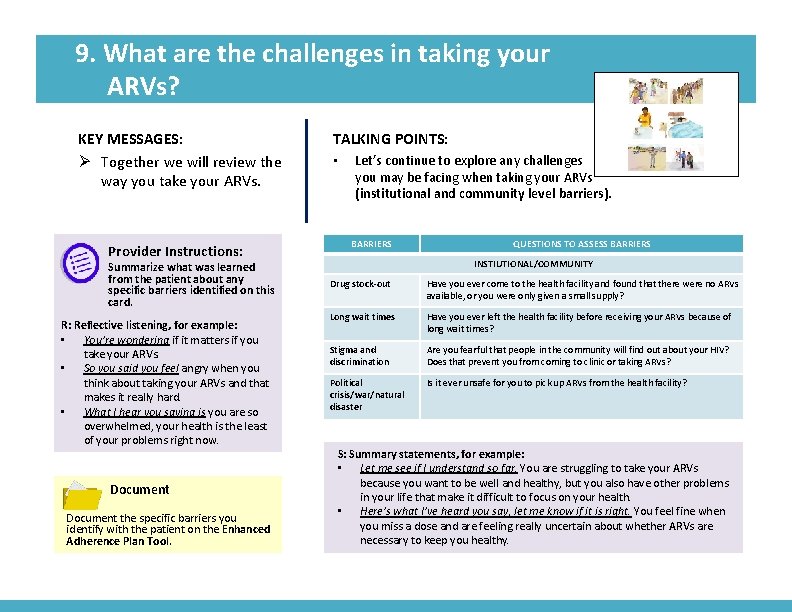
9. What are the challenges in taking your ARVs? Ø Together we will review the way you take your ARVs.
9. What are the challenges in taking your ARVs? KEY MESSAGES: Ø Together we will review the way you take your ARVs. Provider Instructions: Summarize what was learned from the patient about any specific barriers identified on this card. R: Reflective listening, for example: • You’re wondering if it matters if you take your ARVs. • So you said you feel angry when you think about taking your ARVs and that makes it really hard. • What I hear you saying is you are so overwhelmed, your health is the least of your problems right now. Document the specific barriers you identify with the patient on the Enhanced Adherence Plan Tool. TALKING POINTS: • Image from card front Let’s continue to explore any challenges you may be facing when taking your ARVs (institutional and community level barriers). BARRIERS QUESTIONS TO ASSESS BARRIERS INSTIUTIONAL/COMMUNITY Drug stock-out Have you ever come to the health facility and found that there were no ARVs available, or you were only given a small supply? Long wait times Have you ever left the health facility before receiving your ARVs because of long wait times? Stigma and discrimination Are you fearful that people in the community will find out about your HIV? Does that prevent you from coming to clinic or taking ARVs? Political crisis/war/natural disaster Is it ever unsafe for you to pick up ARVs from the health facility? S: Summary statements, for example: • Let me see if I understand so far. You are struggling to take your ARVs because you want to be well and healthy, but you also have other problems in your life that make it difficult to focus on your health. • Here’s what I’ve heard you say, let me know if it is right. You feel fine when you miss a dose and are feeling really uncertain about whether ARVs are necessary to keep you healthy.
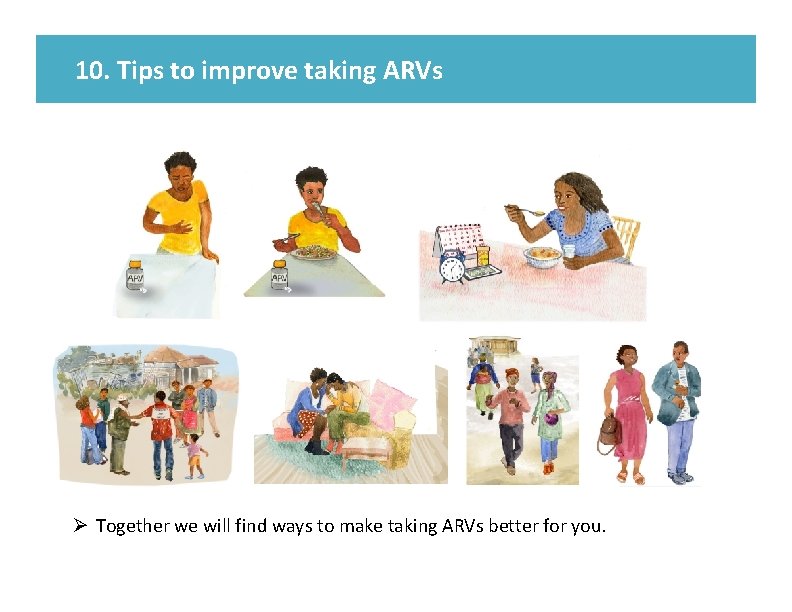
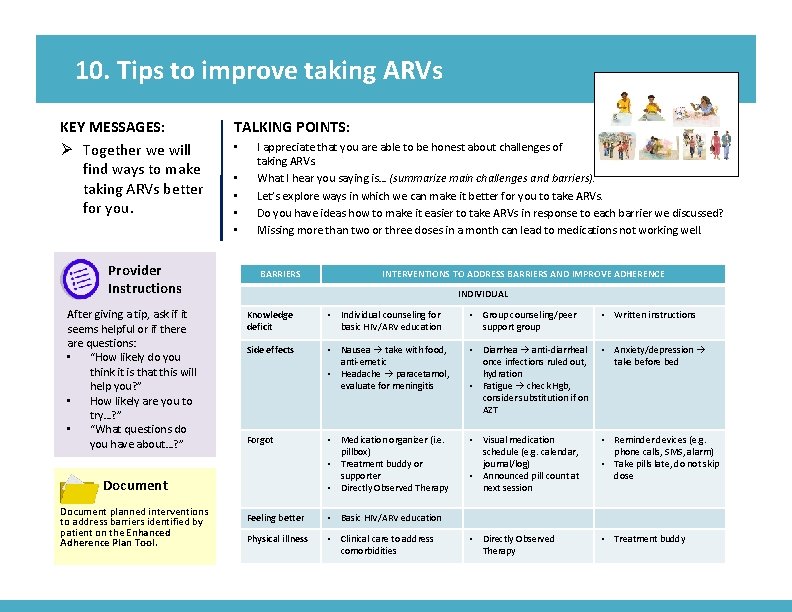
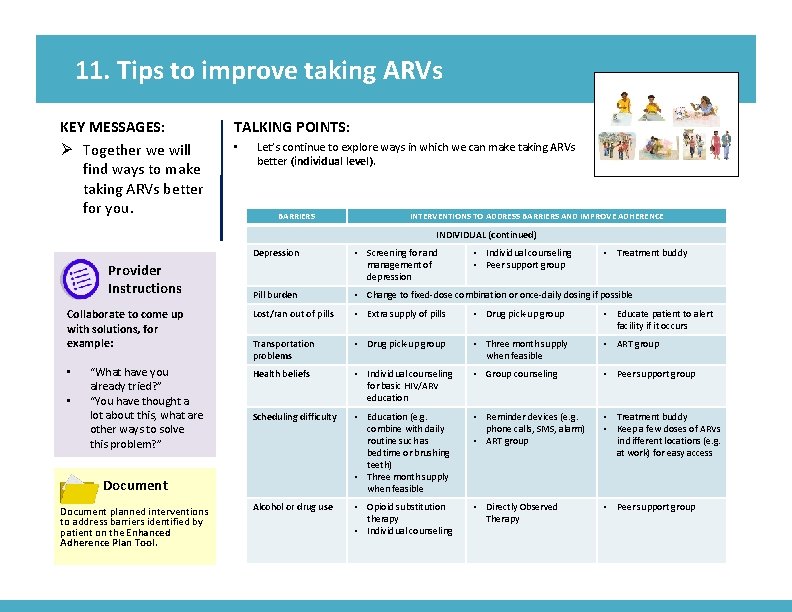
10. Tips to improve taking ARVs Ø Together we will find ways to make taking ARVs better for you.
10. Tips to improve taking ARVs KEY MESSAGES: Ø Together we will find ways to make taking ARVs better for you. Provider Instructions After giving a tip, ask if it seems helpful or if there are questions: • “How likely do you think it is that this will help you? ” • How likely are you to try…? ” • “What questions do you have about…? ” TALKING POINTS: • • • I appreciate that you are able to be honest about challenges of taking ARVs. What I hear you saying is… (summarize main challenges and barriers). Let’s explore ways in which we can make it better for you to take ARVs. Do you have ideas how to make it easier to take ARVs in response to each barrier we discussed? Missing more than two or three doses in a month can lead to medications not working well. BARRIERS INTERVENTIONS TO ADDRESS BARRIERS AND IMPROVE ADHERENCE INDIVIDUAL Knowledge deficit • Individual counseling for basic HIV/ARV education • Group counseling/peer support group • Written instructions Side effects • Nausea take with food, anti-emetic • Headache paracetamol, evaluate for meningitis • Diarrhea anti-diarrheal once infections ruled out, hydration • Fatigue check Hgb, consider substitution if on AZT • Anxiety/depression take before bed Forgot • Medication organizer (i. e. pillbox) • Treatment buddy or supporter • Directly Observed Therapy • Visual medication schedule (e. g. calendar, journal/log) • Announced pill count at next session • Reminder devices (e. g. phone calls, SMS, alarm) • Take pills late, do not skip dose Feeling better • Basic HIV/ARV education Physical illness • Clinical care to address comorbidities • Directly Observed Therapy • Treatment buddy Document planned interventions to address barriers identified by patient on the Enhanced Adherence Plan Tool. Image from card front
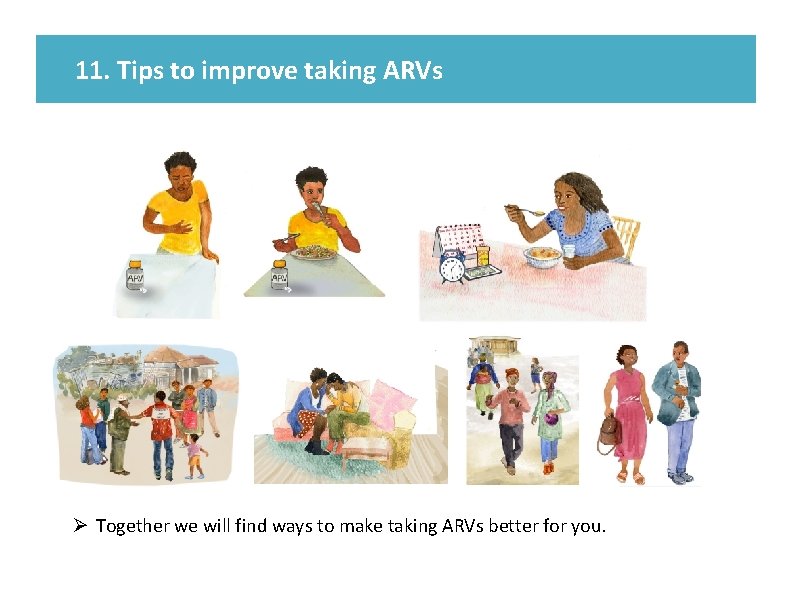
11. Tips to improve taking ARVs Ø Together we will find ways to make taking ARVs better for you.
11. Tips to improve taking ARVs KEY MESSAGES: Ø Together we will find ways to make taking ARVs better for you. TALKING POINTS: • Let’s continue to explore ways in which we can make taking ARVs better (individual level). BARRIERS Image from card front INTERVENTIONS TO ADDRESS BARRIERS AND IMPROVE ADHERENCE INDIVIDUAL (continued) Provider Instructions Collaborate to come up with solutions, for example: • • “What have you already tried? ” “You have thought a lot about this, what are other ways to solve this problem? ” Depression • Screening for and management of depression Pill burden • Change to fixed-dose combination or once-daily dosing if possible Lost/ran out of pills • Extra supply of pills • Drug pick-up group • Educate patient to alert facility if it occurs Transportation problems • Drug pick-up group • Three month supply when feasible • ART group Health beliefs • Individual counseling for basic HIV/ARV education • Group counseling • Peer support group Scheduling difficulty • Education (e. g. combine with daily routine such as bedtime or brushing teeth) • Three month supply when feasible • Reminder devices (e. g. phone calls, SMS, alarm) • ART group • Treatment buddy • Keep a few doses of ARVs in different locations (e. g. at work) for easy access Alcohol or drug use • Opioid substitution therapy • Individual counseling • Directly Observed Therapy • Peer support group Document planned interventions to address barriers identified by patient on the Enhanced Adherence Plan Tool. • Individual counseling • Peer support group • Treatment buddy
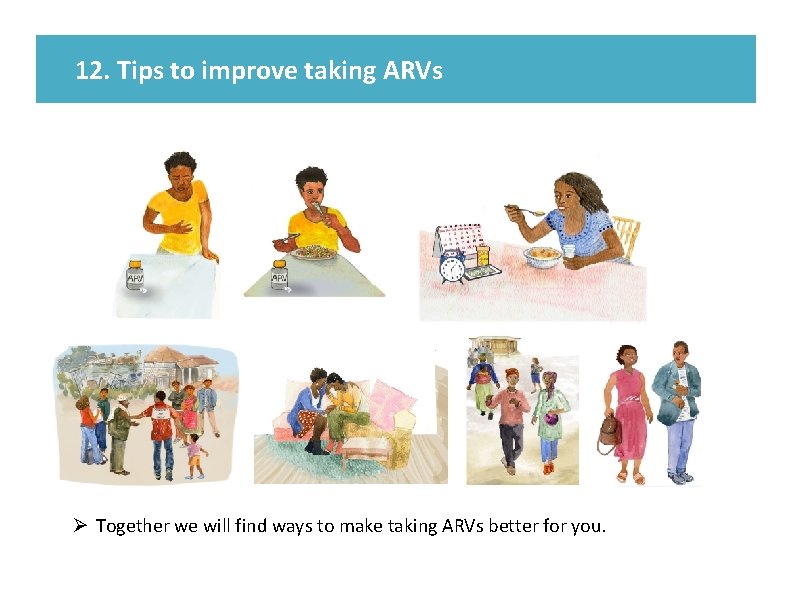
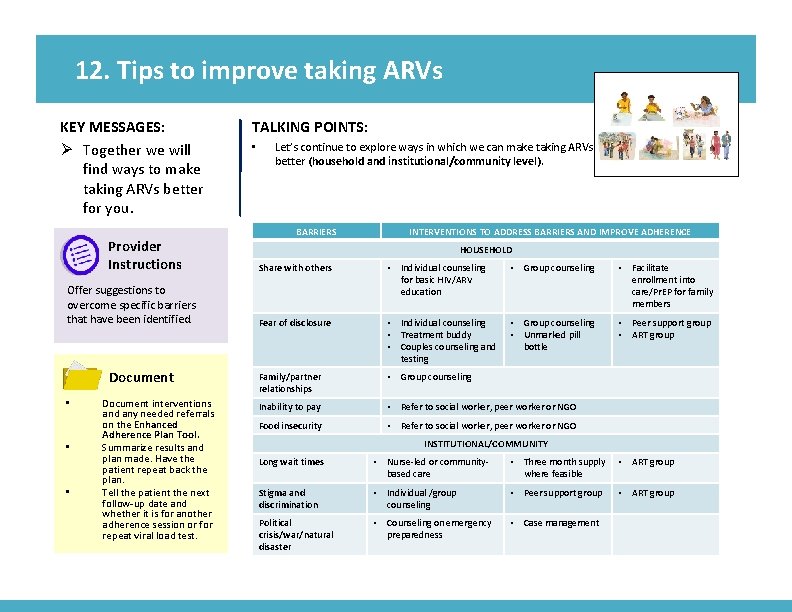
12. Tips to improve taking ARVs Ø Together we will find ways to make taking ARVs better for you.
12. Tips to improve taking ARVs KEY MESSAGES: Ø Together we will find ways to make taking ARVs better for you. Provider Instructions Offer suggestions to overcome specific barriers that have been identified. Document • • • Document interventions and any needed referrals on the Enhanced Adherence Plan Tool. Summarize results and plan made. Have the patient repeat back the plan. Tell the patient the next follow-up date and whether it is for another adherence session or for repeat viral load test. TALKING POINTS: • Let’s continue to explore ways in which we can make taking ARVs better (household and institutional/community level). BARRIERS Image from card front INTERVENTIONS TO ADDRESS BARRIERS AND IMPROVE ADHERENCE HOUSEHOLD Share with others • Individual counseling for basic HIV/ARV education • Group counseling • Facilitate enrollment into care/Pr. EP for family members Fear of disclosure • Individual counseling • Treatment buddy • Couples counseling and testing • Group counseling • Unmarked pill bottle • Peer support group • ART group Family/partner relationships • Group counseling Inability to pay • Refer to social worker, peer worker or NGO Food insecurity • Refer to social worker, peer worker or NGO INSTITUTIONAL/COMMUNITY Long wait times • Nurse-led or communitybased care • Three month supply where feasible • ART group Stigma and discrimination • Individual /group counseling • Peer support group • ART group Political crisis/war/natural disaster • Counseling on emergency preparedness • Case management
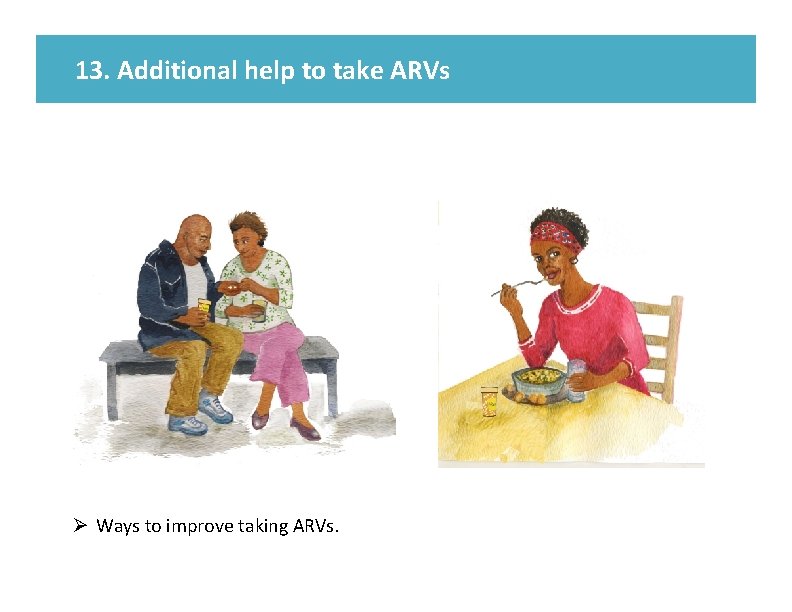
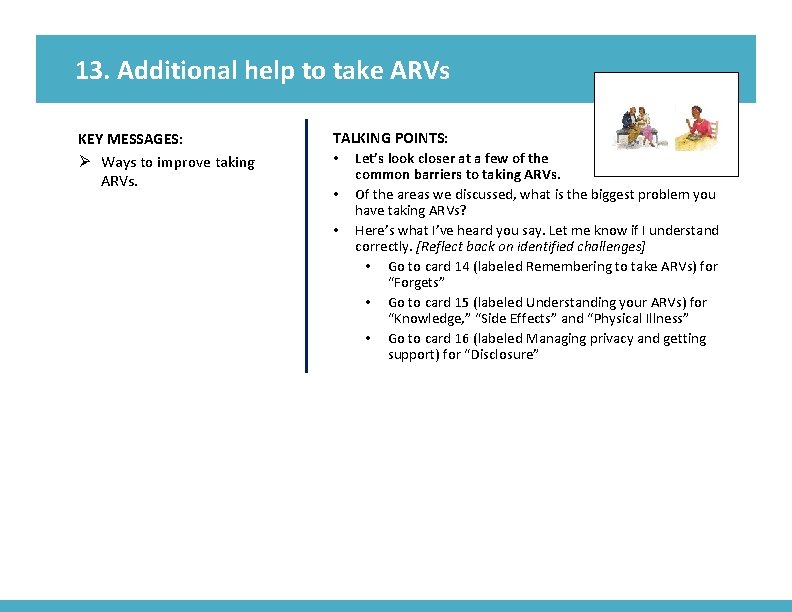
13. Additional help to take ARVs Ø Ways to improve taking ARVs.
13. Additional help to take ARVs KEY MESSAGES: Ø Ways to improve taking ARVs. TALKING POINTS: • Let’s look closer at a few of the • • Image from card front common barriers to taking ARVs. Of the areas we discussed, what is the biggest problem you have taking ARVs? Here’s what I’ve heard you say. Let me know if I understand correctly. [Reflect back on identified challenges] • Go to card 14 (labeled Remembering to take ARVs) for “Forgets” • Go to card 15 (labeled Understanding your ARVs) for “Knowledge, ” “Side Effects” and “Physical Illness” • Go to card 16 (labeled Managing privacy and getting support) for “Disclosure”
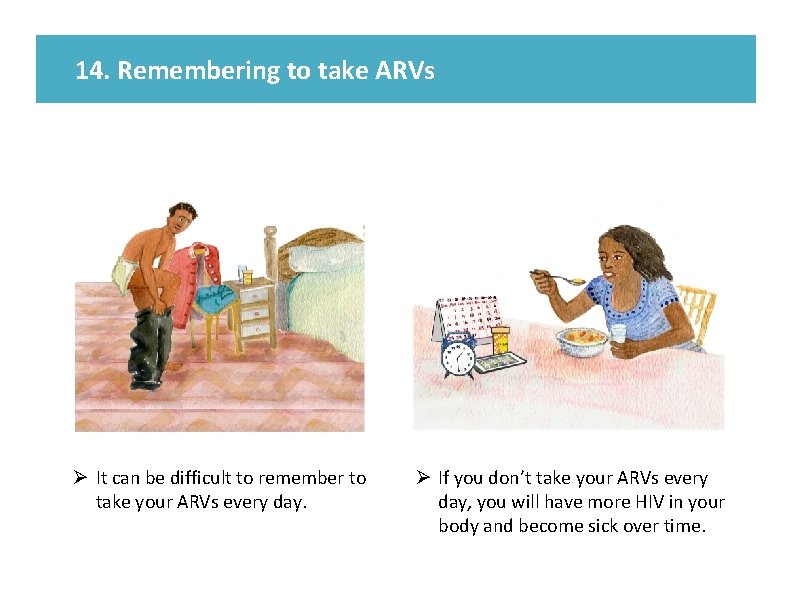
14. Remembering to take ARVs Ø It can be difficult to remember to take your ARVs every day. Ø If you don’t take your ARVs every day, you will have more HIV in your body and become sick over time.
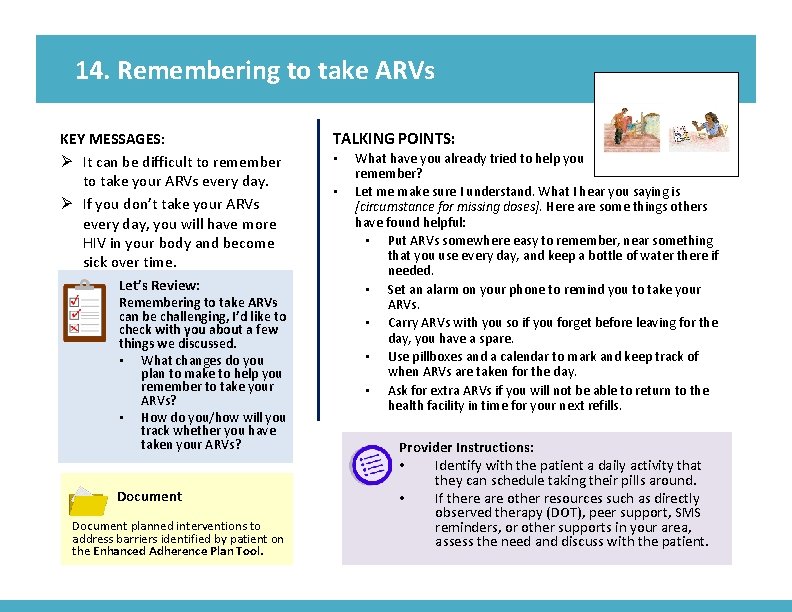
14. Remembering to take ARVs KEY MESSAGES: Ø It can be difficult to remember to take your ARVs every day. Ø If you don’t take your ARVs every day, you will have more HIV in your body and become sick over time. Let’s Review: Remembering to take ARVs can be challenging, I’d like to check with you about a few things we discussed. • What changes do you plan to make to help you remember to take your ARVs? • How do you/how will you track whether you have taken your ARVs? Document planned interventions to address barriers identified by patient on the Enhanced Adherence Plan Tool. TALKING POINTS: • • Image from card front What have you already tried to help you remember? Let me make sure I understand. What I hear you saying is [circumstance for missing doses]. Here are some things others have found helpful: • Put ARVs somewhere easy to remember, near something that you use every day, and keep a bottle of water there if needed. • Set an alarm on your phone to remind you to take your ARVs. • Carry ARVs with you so if you forget before leaving for the day, you have a spare. • Use pillboxes and a calendar to mark and keep track of when ARVs are taken for the day. • Ask for extra ARVs if you will not be able to return to the health facility in time for your next refills. Provider Instructions: • Identify with the patient a daily activity that they can schedule taking their pills around. • If there are other resources such as directly observed therapy (DOT), peer support, SMS reminders, or other supports in your area, assess the need and discuss with the patient.
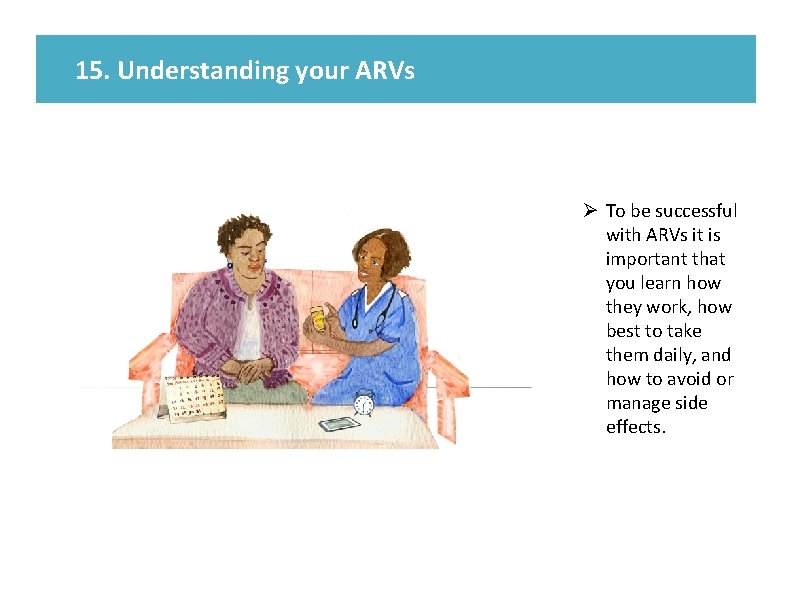
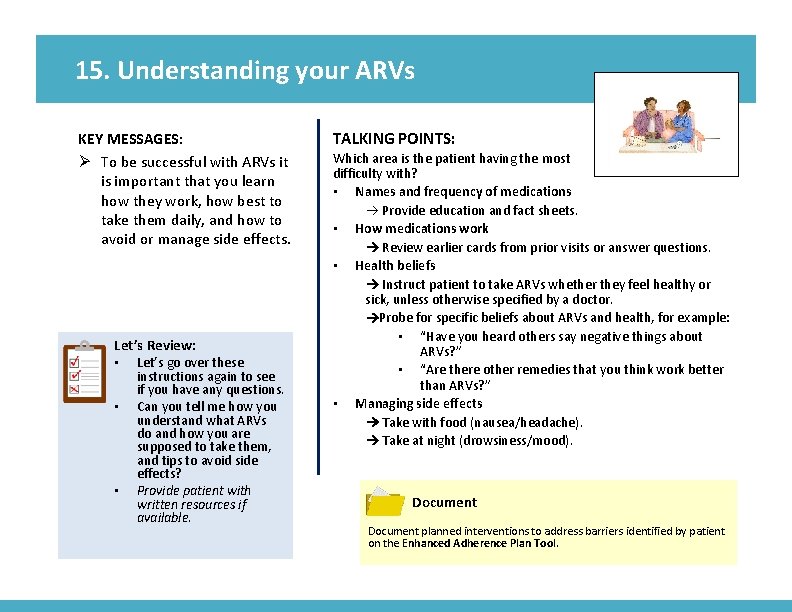
15. Understanding your ARVs Ø To be successful with ARVs it is important that you learn how they work, how best to take them daily, and how to avoid or manage side effects.
15. Understanding your ARVs KEY MESSAGES: Ø To be successful with ARVs it is important that you learn how they work, how best to take them daily, and how to avoid or manage side effects. Let’s Review: • Let’s go over these • • instructions again to see if you have any questions. Can you tell me how you understand what ARVs do and how you are supposed to take them, and tips to avoid side effects? Provide patient with written resources if available. TALKING POINTS: Image from card front Which area is the patient having the most difficulty with? • Names and frequency of medications Provide education and fact sheets. • How medications work Review earlier cards from prior visits or answer questions. • Health beliefs Instruct patient to take ARVs whether they feel healthy or sick, unless otherwise specified by a doctor. Probe for specific beliefs about ARVs and health, for example: • “Have you heard others say negative things about ARVs? ” • “Are there other remedies that you think work better than ARVs? ” • Managing side effects Take with food (nausea/headache). Take at night (drowsiness/mood). Document planned interventions to address barriers identified by patient on the Enhanced Adherence Plan Tool.
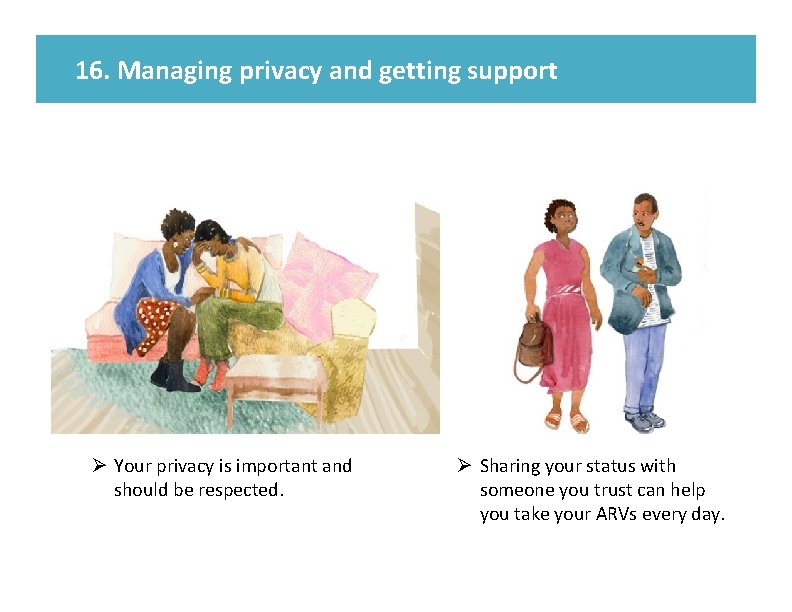
16. Managing privacy and getting support Ø Your privacy is important and should be respected. Ø Sharing your status with someone you trust can help you take your ARVs every day.
16. Managing privacy and getting support KEY MESSAGES: Ø Your privacy is important and should be respected. Ø Sharing your status with someone you trust can help you take your ARVs every day. Document planned interventions to address barriers identified by patient on the Enhanced Adherence Plan Tool. TALKING POINTS: Image from card front Ways to protect privacy: • Use an unmarked pill bottle. • Use pill boxes rather than bottles. • Brainstorm places where the patient can keep ARVs out of the sight of others, but that are easily visible/accessible to the patient. Discuss ways to decide who to share their diagnosis with and how to share. Provide the patient with fact sheets and information to assist as needed. • What characteristics do you think make a good choice for someone to share your status with? • What are benefits of someone knowing your status? • How do you decide whether you can trust someone? • How do you tell someone your status? • Are you concerned that harm might come to you if you disclose your HIV status? If the person is in a relationship: • What might be beneficial for your partner if you were taking your ARVs every day? • How do you think your partner might support you to take your ARVs?
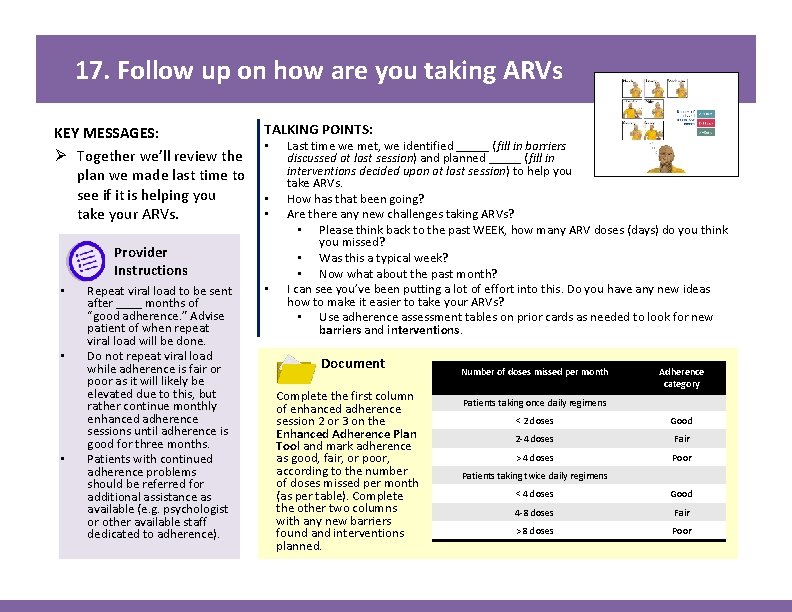
17. Follow up on how you are taking ARVs Ø Together we’ll review the plan we made last time to see if it is helping you take your ARVs every day.
17. Follow up on how are you taking ARVs KEY MESSAGES: Ø Together we’ll review the plan we made last time to see if it is helping you take your ARVs. TALKING POINTS: • • • Provider Instructions • • • Repeat viral load to be sent after ____ months of “good adherence. ” Advise patient of when repeat viral load will be done. Do not repeat viral load while adherence is fair or poor as it will likely be elevated due to this, but rather continue monthly enhanced adherence sessions until adherence is good for three months. Patients with continued adherence problems should be referred for additional assistance as available (e. g. psychologist or other available staff dedicated to adherence). Image from card front • Last time we met, we identified _____ ( fill in barriers discussed at last session) and planned _____ (fill in interventions decided upon at last session) to help you take ARVs. How has that been going? Are there any new challenges taking ARVs? • Please think back to the past WEEK, how many ARV doses (days) do you think you missed? • Was this a typical week? • Now what about the past month? I can see you’ve been putting a lot of effort into this. Do you have any new ideas how to make it easier to take your ARVs? • Use adherence assessment tables on prior cards as needed to look for new barriers and interventions. Document Complete the first column of enhanced adherence session 2 or 3 on the Enhanced Adherence Plan Tool and mark adherence as good, fair, or poor, according to the number of doses missed per month (as per table). Complete the other two columns with any new barriers found and interventions planned. Number of doses missed per month Adherence category Patients taking once daily regimens < 2 doses Good 2 -4 doses Fair > 4 doses Poor Patients taking twice daily regimens < 4 doses Good 4 -8 doses Fair > 8 doses Poor
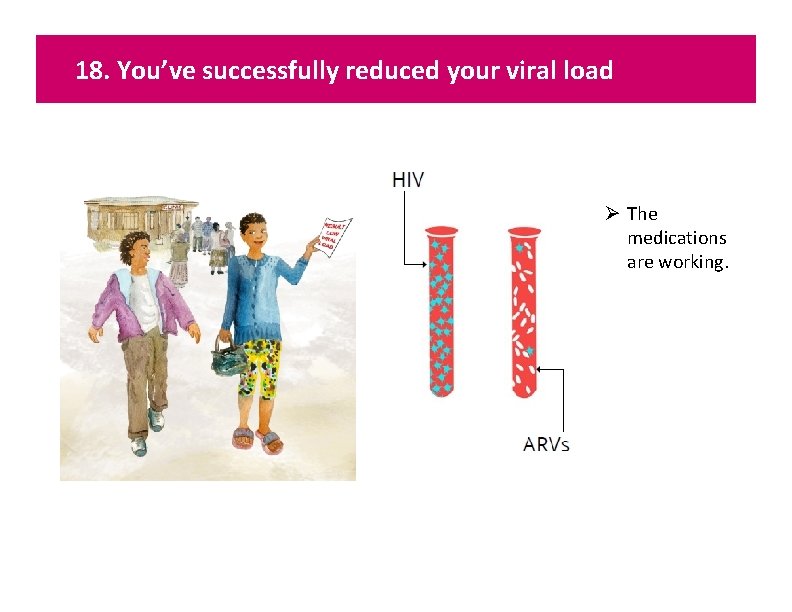
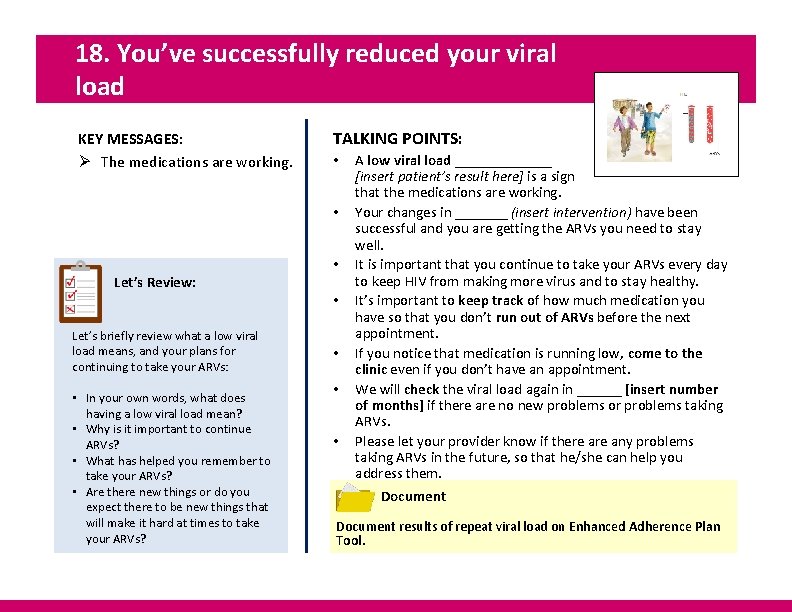
18. You’ve successfully reduced your viral load Ø The medications are working.
18. You’ve successfully reduced your viral load KEY MESSAGES: Ø The medications are working. TALKING POINTS: • • • Let’s Review: Let’s briefly review what a low viral load means, and your plans for continuing to take your ARVs: • In your own words, what does having a low viral load mean? • Why is it important to continue ARVs? • What has helped you remember to take your ARVs? • Are there new things or do you expect there to be new things that will make it hard at times to take your ARVs? • • Image from card front A low viral load _______ [insert patient’s result here] is a sign that the medications are working. Your changes in _______ (insert intervention) have been successful and you are getting the ARVs you need to stay well. It is important that you continue to take your ARVs every day to keep HIV from making more virus and to stay healthy. It’s important to keep track of how much medication you have so that you don’t run out of ARVs before the next appointment. If you notice that medication is running low, come to the clinic even if you don’t have an appointment. We will check the viral load again in ______ [insert number of months] if there are no new problems or problems taking ARVs. Please let your provider know if there any problems taking ARVs in the future, so that he/she can help you address them. Document results of repeat viral load on Enhanced Adherence Plan Tool.
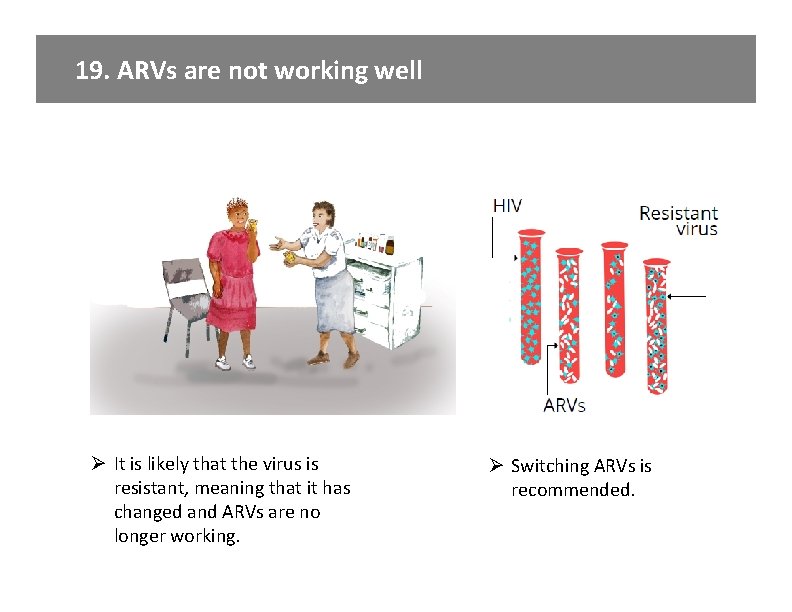
19. ARVs are not working well Ø It is likely that the virus is resistant, meaning that it has changed and ARVs are no longer working. Ø Switching ARVs is recommended.
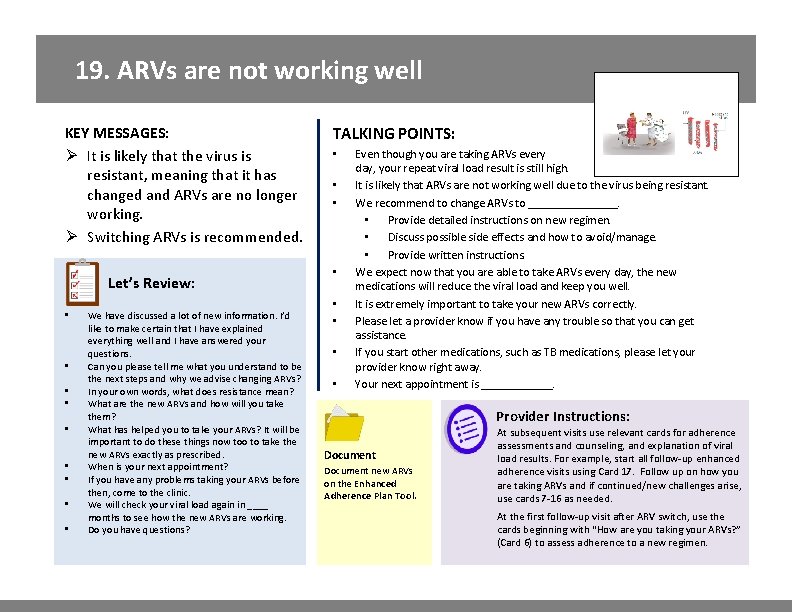
19. ARVs are not working well KEY MESSAGES: Ø It is likely that the virus is resistant, meaning that it has changed and ARVs are no longer working. Ø Switching ARVs is recommended. Let’s Review: • • • We have discussed a lot of new information. I’d like to make certain that I have explained everything well and I have answered your questions. Can you please tell me what you understand to be the next steps and why we advise changing ARVs? In your own words, what does resistance mean? What are the new ARVs and how will you take them? What has helped you to take your ARVs? It will be important to do these things now too to take the new ARVs exactly as prescribed. When is your next appointment? If you have any problems taking your ARVs before then, come to the clinic. We will check your viral load again in ____ months to see how the new ARVs are working. Do you have questions? TALKING POINTS: • • Image from card front Even though you are taking ARVs every day, your repeat viral load result is still high. It is likely that ARVs are not working well due to the virus being resistant. We recommend to change ARVs to ________. • Provide detailed instructions on new regimen. • Discuss possible side effects and how to avoid/manage. • Provide written instructions. We expect now that you are able to take ARVs every day, the new medications will reduce the viral load and keep you well. It is extremely important to take your new ARVs correctly. Please let a provider know if you have any trouble so that you can get assistance. If you start other medications, such as TB medications, please let your provider know right away. Your next appointment is ______. Provider Instructions: Document new ARVs on the Enhanced Adherence Plan Tool. At subsequent visits use relevant cards for adherence assessments and counseling, and explanation of viral load results. For example, start all follow-up enhanced adherence visits using Card 17. Follow up on how you are taking ARVs and if continued/new challenges arise, use cards 7 -16 as needed. At the first follow-up visit after ARV switch, use the cards beginning with “How are you taking your ARVs? ” (Card 6) to assess adherence to a new regimen.
A global health leader since 2003, ICAP was founded at Columbia University with one overarching goal: to improve the health of families and communities. Together with its partners—ministries of health, large multilaterals, health care providers, and patients—ICAP strives for a world where health is available to all. To date, ICAP has addressed major public health challenges and the needs of local health systems through 6, 000 sites across 30 countries. For more information about ICAP, visit: icap. columbia. edu