
Viral hepatitis A and E others Lecture objectives
Viral hepatitis A and E & others Lecture objectives: ● ● ● Distinguish the etiology of enteric viral hepatitis (HAV, HEV) from other viruses causing hepatitis such as EBV, CMV, Yellow fever virus. Describe the main characteristics of HAV , HEV, EBV, CMV, and Yellow fever virus Describe the epidemiology and the mode of transmission of these viruses. Describe the clinical manifestations of enteric viral hepatitis. Describe the laboratory methods used to diagnose enteric hepatitis. Describe the treatments and the prevention measures available for these viral infection Color index: Important Doctors’ note Extra Found in Girls’ slides Found in Boys’ slides EDITING FILE

Hepatitis ● Definition: Is inflammation of the liver. ● Etiology: ● Primary infections: ○ Hepatitis A virus (HAV). ○ Hepatitis B virus (HBV). ○ Hepatitis C virus (HCV), was known as non-A non-B hepatitis. ○ Hepatitis D virus (HDV) or delta virus. ○ Hepatitis E virus (HEV). ○ Hepatitis F virus (HFV). ○ Hepatitis G virus (HGV). ● As part of generalized infection : ○ CMV. ○ EBV. ○ Yellow fever virus. ● Hepatitis F has been reported in the literature but not confirmed. ● Viral hepatitis is divided into two large groups, based on the mode of transmission: 1. Enterically transmitted hepatitis or water borne hepatitis. This group includes hepatitis A and E viruses. 1. Parenterally transmitted hepatitis or blood borne hepatitis. This group includes hepatitis B, C, D & G viruses. Hepatitis A ● Characteristics: ● Family: Picornaviridae. ● Genus: Hepatovirus. ● Non-enveloped 1 virion consisting of: • Icosahedral capsid. • Positive sense ss-RNA. ● Presentation: - Short incubation hepatitis 2 - Infectious hepatitis 3 - Epidemic hepatitis 4 1. 2. 3. 4. Nonenveloped → more resistance to the harsh environment Due to its short incubation period Transmitted easily Causes outbreaks 1
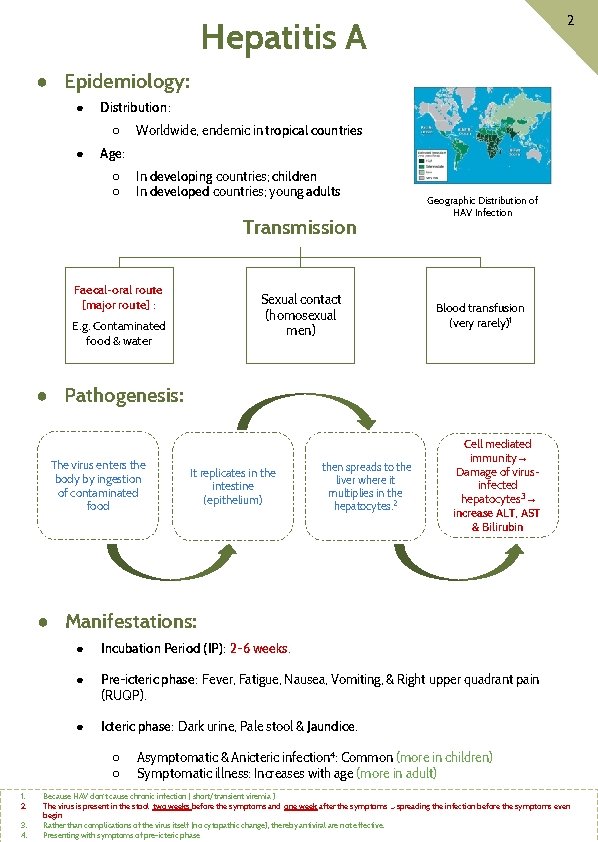
Hepatitis A 2 ● Epidemiology: ● Distribution: ○ ● Worldwide, endemic in tropical countries Age: ○ ○ In developing countries; children In developed countries; young adults Transmission Faecal-oral route [major route] : Sexual contact (homosexual men) E. g. Contaminated food & water Geographic Distribution of HAV Infection Blood transfusion (very rarely)1 ● Pathogenesis: The virus enters the body by ingestion of contaminated food It replicates in the intestine (epithelium) then spreads to the liver where it multiplies in the hepatocytes. 2 Cell mediated immunity → Damage of virusinfected hepatocytes 3 → increase ALT, AST & Bilirubin ● Manifestations: ● Incubation Period (IP): 2 -6 weeks. ● Pre-icteric phase: Fever, Fatigue, Nausea, Vomiting, & Right upper quadrant pain (RUQP). ● Icteric phase: Dark urine, Pale stool & Jaundice. ○ ○ 1. 2. 3. 4. Asymptomatic & Anicteric infection 4: Common (more in children) Symptomatic illness: Increases with age (more in adult) Because HAV don’t cause chronic infection ( short/ transient viremia ) The virus is present in the stool two weeks before the symptoms and one week after the symptoms → spreading the infection before the symptoms even begin Rather than complications of the virus itself (no cytopathic change), thereby antiviral are not effective. Presenting with symptoms of pre-icteric phase
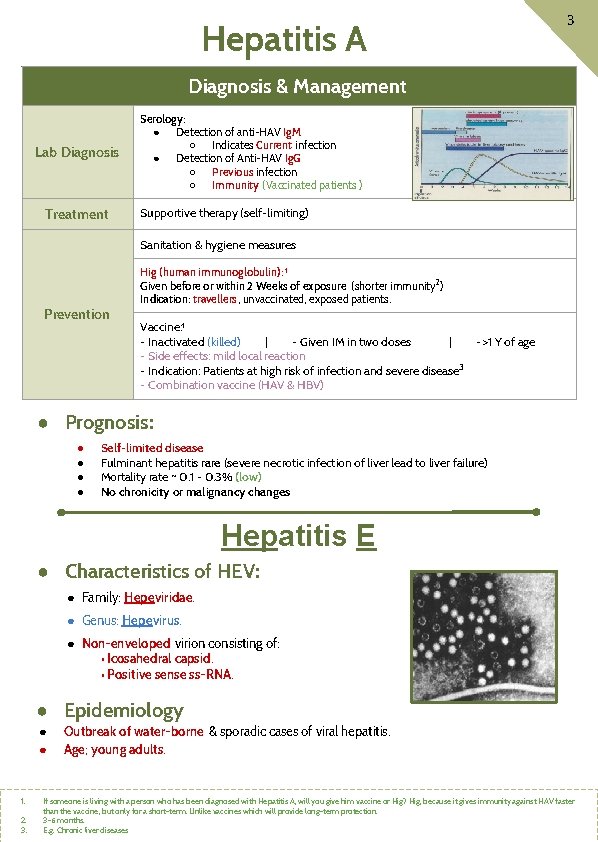
Hepatitis A 3 Diagnosis & Management Lab Diagnosis Treatment Serology: ● Detection of anti-HAV Ig. M ○ Indicates Current infection ● Detection of Anti-HAV Ig. G ○ Previous infection ○ Immunity (Vaccinated patients ) Supportive therapy (self-limiting) Sanitation & hygiene measures Prevention Hig (human immunoglobulin): 1 Given before or within 2 Weeks of exposure (shorter immunity 2) Indication: travellers, unvaccinated, exposed patients. Vaccine: 1 - Inactivated (killed) | - Given IM in two doses | - >1 Y of age - Side effects: mild local reaction - Indication: Patients at high risk of infection and severe disease 3 - Combination vaccine (HAV & HBV) ● Prognosis: ● ● Self-limited disease Fulminant hepatitis rare (severe necrotic infection of liver lead to liver failure) Mortality rate ~ 0. 1 - 0. 3% (low) No chronicity or malignancy changes Hepatitis E ● Characteristics of HEV: ● Family: Hepeviridae. ● Genus: Hepevirus. ● Non-enveloped virion consisting of: • Icosahedral capsid. • Positive sense ss-RNA. ● Epidemiology ● ● 1. 2. 3. Outbreak of water-borne & sporadic cases of viral hepatitis. Age; young adults. If someone is living with a person who has been diagnosed with Hepatitis A, will you give him vaccine or Hig? Hig, because it gives immunity against HAV faster than the vaccine, but only for a short-term. Unlike vaccines which will provide long-term protection. 3 -6 months. E. g. Chronic liver diseases
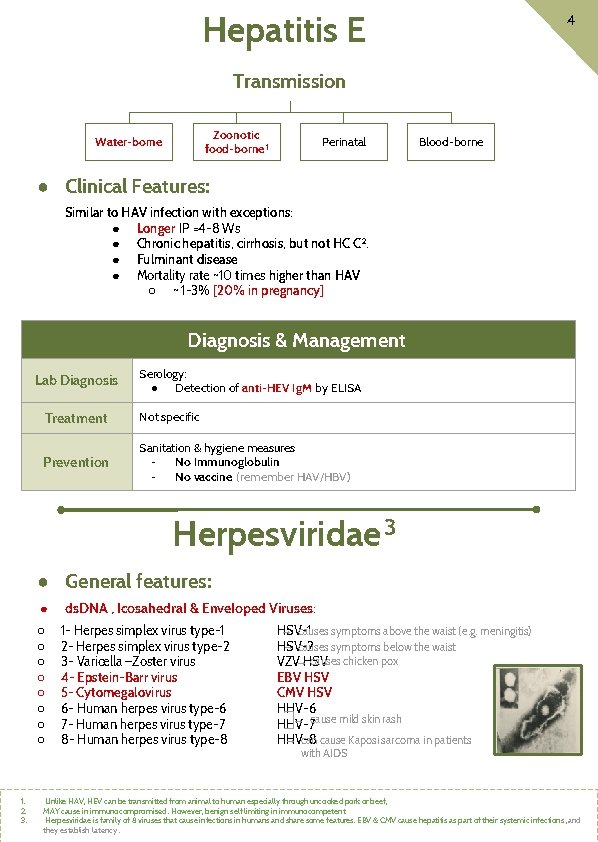
Hepatitis E 4 Transmission Zoonotic food-borne 1 Water-borne Perinatal Blood-borne ● Clinical Features: Similar to HAV infection with exceptions: ● Longer IP =4 -8 Ws ● Chronic hepatitis, cirrhosis, but not HC C 2. ● Fulminant disease ● Mortality rate ~10 times higher than HAV ○ ~ 1 -3% [20% in pregnancy] Diagnosis & Management Lab Diagnosis Serology: ● Detection of anti-HEV Ig. M by ELISA Treatment Not specific Prevention Sanitation & hygiene measures No Immunoglobulin No vaccine (remember HAV/HBV) Herpesviridae 3 ● General features: ● ○ ○ ○ ○ 1. 2. 3. ds. DNA , Icosahedral & Enveloped Viruses: 1 - Herpes simplex virus type-1 2 - Herpes simplex virus type-2 3 - Varicella –Zoster virus 4 - Epstein-Barr virus 5 - Cytomegalovirus 6 - Human herpes virus type-6 7 - Human herpes virus type-7 8 - Human herpes virus type-8 → causes symptoms above the waist (e. g. meningitis) HSV-1 → causes symptoms below the waist HSV-2 causes chicken pox VZV→HSV EBV HSV CMV HSV HHV-6 → cause mild skin rash HHV-7 HHV-8 → can cause Kaposi sarcoma in patients with AIDS Unlike HAV, HEV can be transmitted from animal to human especially through uncooked pork or beef, MAY cause in immunocompromised. However, benign self limiting in immunocompetent. Herpesviridae is family of 8 viruses that cause infections in humans and share some features. EBV & CMV cause hepatitis as part of their systemic infections , and they establish latency.
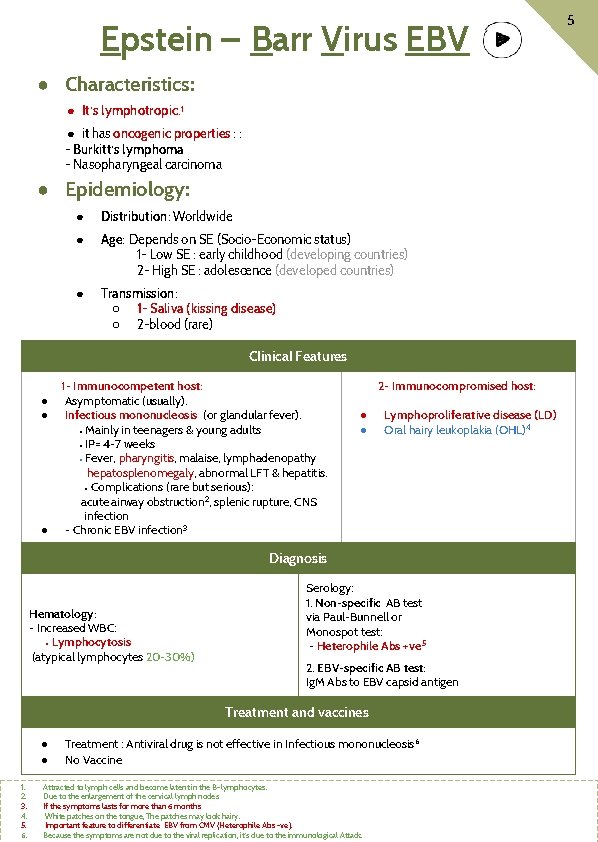
Epstein – Barr Virus EBV ● Characteristics: ● It’s lymphotropic. 1 ● it has oncogenic properties : : - Burkitt’s lymphoma - Nasopharyngeal carcinoma ● Epidemiology: ● Distribution: Worldwide ● Age: Depends on SE (Socio-Economic status) 1 - Low SE : early childhood (developing countries) 2 - High SE : adolescence (developed countries) ● Transmission: ○ 1 - Saliva (kissing disease) ○ 2 -blood (rare) Clinical Features ● ● ● 1 - Immunocompetent host: Asymptomatic (usually). Infectious mononucleosis (or glandular fever). ○ Mainly in teenagers & young adults ○ IP= 4 -7 weeks ○ Fever, pharyngitis, malaise, lymphadenopathy hepatosplenomegaly, abnormal LFT & hepatitis. ○ Complications (rare but serious): acute airway obstruction 2, splenic rupture, CNS eddinfection - Chronic EBV infection 3 2 - Immunocompromised host: ● ● Lymphoproliferative disease (LD) Oral hairy leukoplakia (OHL)4 Diagnosis Hematology: - Increased WBC: ○ Lymphocytosis (atypical lymphocytes 20 -30%) Serology: 1. Non-specific AB test via Paul-Bunnell or Monospot test: - Heterophile Abs +ve 5 2. EBV-specific AB test: Ig. M Abs to EBV capsid antigen Treatment and vaccines ● ● 1. 2. 3. 4. 5. 6. Treatment : Antiviral drug is not effective in Infectious mononucleosis 6 No Vaccine Attracted to lymph cells and become latent in the B-lymphocytes. Due to the enlargement of the cervical lymph nodes If the symptoms lasts for more than 6 months White patches on the tongue, The patches may look hairy. Important feature to differentiate EBV from CMV (Heterophile Abs -ve). Because the symptoms are not due to the viral replication, it’s due to the immunological Attack. 5
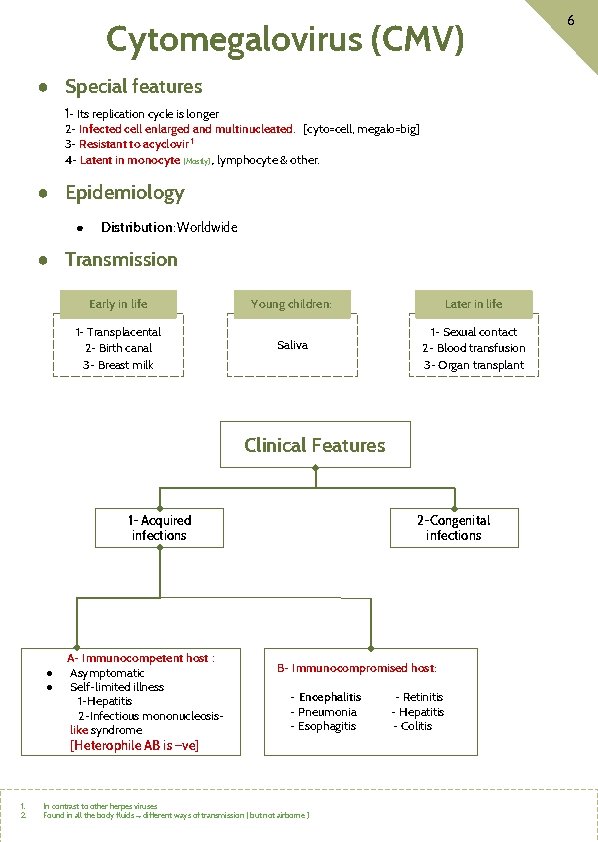
Cytomegalovirus (CMV) ● Special features 1 - Its replication cycle is longer 2 - Infected cell enlarged and multinucleated. [cyto=cell, megalo=big] 3 - Resistant to acyclovir 1 4 - Latent in monocyte (Mostly), lymphocyte & other. ● Epidemiology ● Distribution : Worldwide ● Transmission Early in life Young children: Later in life 1 - Transplacental 2 - Birth canal 3 - Breast milk Saliva 1 - Sexual contact 2 - Blood transfusion 3 - Organ transplant Clinical Features 2 -Congenital infections 1 - Acquired infections ● ● A- Immunocompetent host : Asymptomatic Self-limited illness 1 -Hepatitis 2 -Infectious mononucleosislike syndrome B- Immunocompromised host: - Encephalitis - Pneumonia - Esophagitis [Heterophile AB is –ve] 1. 2. In contrast to other herpes viruses Found in all the body fluids → different ways of transmission ( but not airborne ) - Retinitis - Hepatitis - Colitis 6
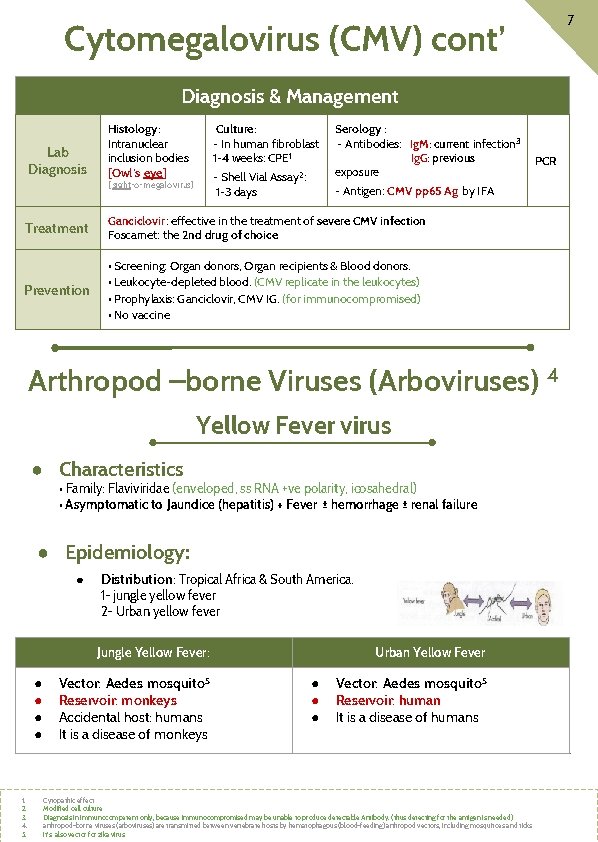
7 Cytomegalovirus (CMV) cont’ Diagnosis & Management Lab Diagnosis Histology: Intranuclear inclusion bodies [Owl’s eye] Culture: - In human fibroblast 1 -4 weeks: CPE 1 - Shell Vial 1 -3 days ( sight-o-megalo virus) Assay 2: Serology : - Antibodies: Ig. M: current infection 3 Ig. G: previous exposure PCR - Antigen: CMV pp 65 Ag by IFA Treatment Ganciclovir : effective in the treatment of severe CMV infection Foscarnet: the 2 nd drug of choice Prevention • Screening: Organ donors, Organ recipients & Blood donors. • Leukocyte-depleted blood. (CMV replicate in the leukocytes) • Prophylaxis: Ganciclovir, CMV IG. (for immunocompromised) • No vaccine Arthropod –borne Viruses (Arboviruses) 4 Yellow Fever virus ● Characteristics • Family: Flaviviridae (enveloped, ss RNA +ve polarity, icosahedral) • Asymptomatic to Jaundice (hepatitis) + Fever ± hemorrhage ± renal failure ● Epidemiology: ● Distribution : Tropical Africa & South America. 1 - jungle yellow fever 2 - Urban yellow fever Jungle Yellow Fever: ● ● 1. 2. 3. 4. 5. Vector: Aedes mosquito 5 Reservoir: monkeys Accidental host: humans It is a disease of monkeys Urban Yellow Fever ● ● ● Vector: Aedes mosquito 5 Reservoir: human It is a disease of humans Cytopathic effect Modified cell culture Diagnosis in immunocompetent only, because immunocompromised may be unable to produce detectable Antibody. (thus detecting for the antigen is needed) arthropod-borne viruses (arboviruses) are transmitted between vertebrate hosts by hematophagous (blood-feeding) arthropod vectors, including mosquitoes and ticks It’s also vector for zika virus
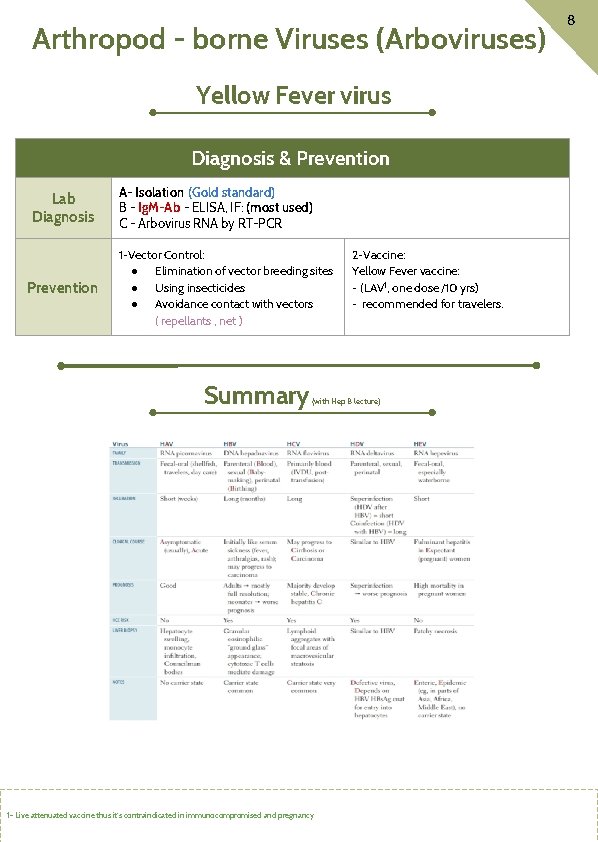
Arthropod - borne Viruses (Arboviruses) Yellow Fever virus Diagnosis & Prevention Lab Diagnosis Prevention A- Isolation (Gold standard) B - Ig. M-Ab - ELISA, IF: (most used) C - Arbovirus RNA by RT-PCR 1 -Vector Control: ● Elimination of vector breeding sites ● Using insecticides ● Avoidance contact with vectors ( repellants , net ) Summary 2 -Vaccine: Yellow Fever vaccine: - (LAV 1, one dose /10 yrs) - recommended for travelers. (with Hep B lecture) 1 - Live attenuated vaccine thus it’s contraindicated in immunocompromised and pregnancy 8
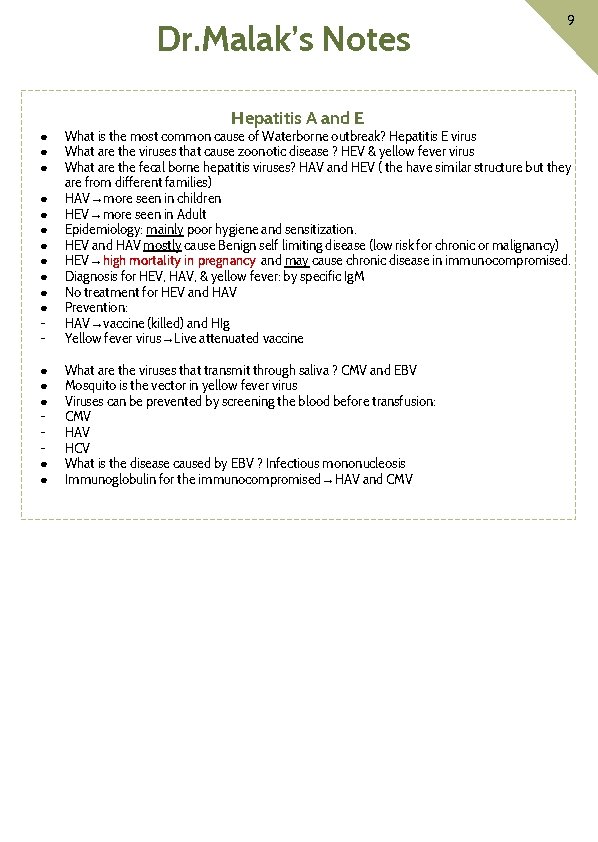
Dr. Malak’s Notes Hepatitis A and E 9 ● ● ● ● - What is the most common cause of Waterborne outbreak? Hepatitis E virus What are the viruses that cause zoonotic disease ? HEV & yellow fever virus What are the fecal borne hepatitis viruses? HAV and HEV ( the have similar structure but they are from different families) HAV → more seen in children HEV → more seen in Adult Epidemiology: mainly poor hygiene and sensitization. HEV and HAV mostly cause Benign self limiting disease (low risk for chronic or malignancy) HEV → high mortality in pregnancy and may cause chronic disease in immunocompromised. Diagnosis for HEV, HAV, & yellow fever: by specific Ig. M No treatment for HEV and HAV Prevention: HAV → vaccine (killed) and HIg Yellow fever virus → Live attenuated vaccine ● ● ● What are the viruses that transmit through saliva ? CMV and EBV Mosquito is the vector in yellow fever virus Viruses can be prevented by screening the blood before transfusion: CMV HAV HCV What is the disease caused by EBV ? Infectious mononucleosis Immunoglobulin for the immunocompromised → HAV and CMV ● ● ●
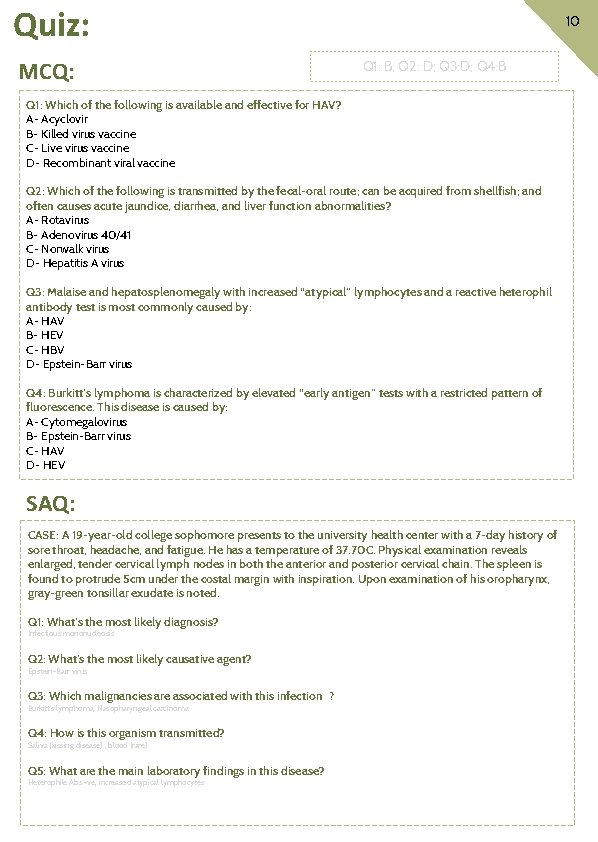
Quiz: MCQ: 10 Q 1: B; Q 2: D; Q 3: D; Q 4: B Q 1: Which of the following is available and effective for HAV? A- Acyclovir B- Killed virus vaccine C- Live virus vaccine D- Recombinant viral vaccine Q 2: Which of the following is transmitted by the fecal-oral route; can be acquired from shellfish; and often causes acute jaundice, diarrhea, and liver function abnormalities? A- Rotavirus B- Adenovirus 40/41 C- Norwalk virus D- Hepatitis A virus Q 3: Malaise and hepatosplenomegaly with increased “atypical” lymphocytes and a reactive heterophil antibody test is most commonly caused by: A- HAV B- HEV C- HBV D- Epstein-Barr virus Q 4: Burkitt’s lymphoma is characterized by elevated “early antigen” tests with a restricted pattern of fluorescence. This disease is caused by: A- Cytomegalovirus B- Epstein-Barr virus C- HAV D- HEV SAQ: CASE: A 19 -year-old college sophomore presents to the university health center with a 7 -day history of sore throat, headache, and fatigue. He has a temperature of 37. 70 C. Physical examination reveals enlarged, tender cervical lymph nodes in both the anterior and posterior cervical chain. The spleen is found to protrude 5 cm under the costal margin with inspiration. Upon examination of his oropharynx, gray-green tonsillar exudate is noted. Q 1: What’s the most likely diagnosis? Infectious mononucleosis Q 2: What’s the most likely causative agent? Epstein-Barr virus Q 3: Which malignancies are associated with this infection ? Burkitt’s lymphoma, Nasopharyngeal carcinoma Q 4: How is this organism transmitted? Saliva (kissing disease) , blood (rare) Q 5: What are the main laboratory findings in this disease? Heterophile Abs +ve, increased atypical lymphocytes
Members board: ● Team Leaders: Abdulaziz Alshomar ● Team sub-leader: Mohammed Alhumud ● This lecture was done by: khyal alderaan Saud Alaqeel Note takers: - Mashal Abaalkhail - Razan Alrabah Ghada Alsadhan
- Slides: 12