
Violence Risk Assessment Presented By David Kan MD
Violence Risk Assessment Presented By: David Kan, MD
Violence Risk Assessment Why are Psychiatrists & Psychologists involved in predicting violence?
Practical Risk Assessment Prior to 1966 little attention was paid to clinical risk assessment 1966 Johnnie K. BAXSTROM v. HEROLD 383 US 107 US SUPREME COURT NY Baxstrom prisoner in prison psychiatric hospital Civilly committed at end of sentence Left in prison hospital because state hospital didn’t want him Writs were dismissed, transfer requests denied USSC Holdings: n n Other civilly committed pts had right to hearing Commitment beyond term without judicial determination that he is dangerously mentally ill violates equal protection
Violence Risk Assessment Tarasoff v. The regents of the University of California, 1976 Facts: n n n Prosenjit Poddar and Tatiana Tarasoff Started dating Mr. Poddar unfamiliar with mores of America became depressed and saw psychologist, Dr. Moore.
Violence Risk Assessment Facts: n n n Mr. Poddar revealed intent to get gun and kill Tatiana. Psychologist asked UCPD to hospitalize Poddar was discharged Moved into house Tatiana returned from vacation Then stalked and killed
Violence Risk Assessment Facts: n n n Lawsuit was filed for failure to warn Case dismissed by trial and appellate court citing lack of duty to 3 rd party California Supreme Court overturned
Violence Risk Assessment "When a therapist determines…that his patient presents a serious danger of violence to another, he incurs an obligation to use reasonable care to protect the intended victim against such danger. The discharge of this duty may require therapist to take one or more of various steps. Thus, it may call for him to warn the intended victim, to notify the police, or to take whatever steps are reasonably necessary under the circumstances. ” – Tarasoff v. UC Regents

Violence Risk Assessment What is the best predictor of violence? Criminal Record b. Presence of Intoxication c. Past History of Violence d. Perception of Self as a “Victim” e. All of the Above f. None of the Above Correct Answer: F. None of the Above Violence is impossible to predict. However, RISK can be assessed. a.
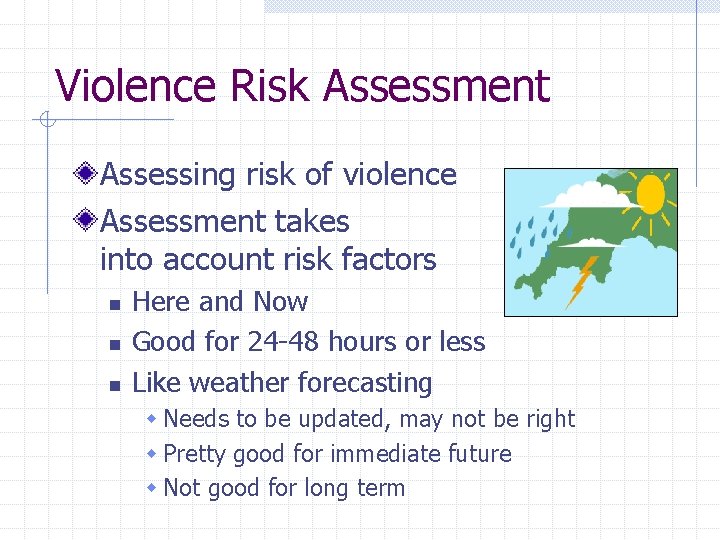
Violence Risk Assessment Assessing risk of violence Assessment takes into account risk factors n n n Here and Now Good for 24 -48 hours or less Like weather forecasting w Needs to be updated, may not be right w Pretty good for immediate future w Not good for long term
Violence Risk Assessment In assessment, psychiatrists look for mental disorders Connection is debatable Most violence is committed by people WITHOUT psychiatric diagnosis
Violence Risk Assessment Violence = Specific Individual + Specific Situation
Violence Risk Assessment Past History is the best predictor n n n What is the most violent thing they’ve ever done? Type of behavior, why it occurred, who was involved, intoxication, degree of injury Criminal and Court records w Age at 1 st arrest highly correlated with criminality w Each prior episode increases risk w Four previous arrests the probability of fifth is 80% (Borum et al. , 1996)

Violence Risk Assessment Specific threat towards an individual is another serious risk factor Specific threat + Past History exponentially increases risk.

Violence Risk Assessment People at high risk do not always commit violent acts People who commit violent acts may not be considered high risk
Violence Risk Assessment Psychiatrists accurately predict longterm future violence 33% of the time in institutionalized patients who have previously committed a violent act. (Borum et al. – Assessing and managing violence risk in clinical practice. Journal of practical psychiatry and Behavioral Health 4: 205 -215 ) More accurate in assessing future violence when prediction is limited to briefer amount of time. (Lidz et al. The accuracy of predictions of violence to others. JAMA 269 (8): 1007 -1011)
Violence Risk Assessment Psychiatrists tend to over predict violence out of concern for patients, 3 rd party and ourselves Assessing dangerousness n n Vaguely defined USSC Logic: if juries can do then psychiatrists must be better
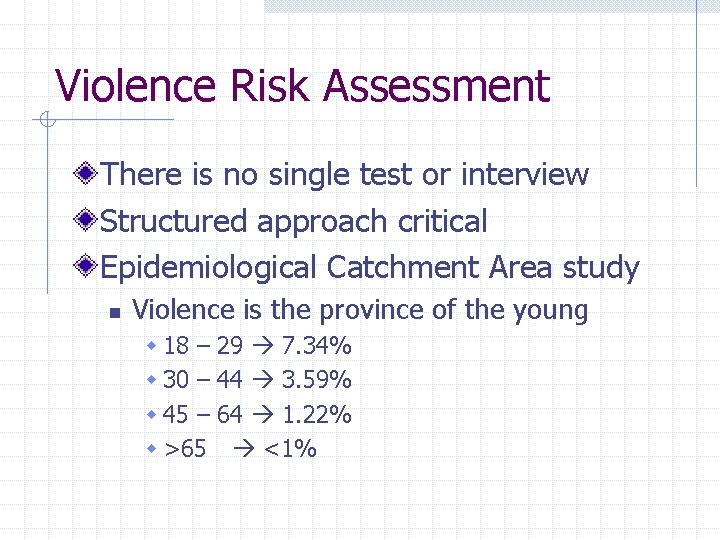
Violence Risk Assessment There is no single test or interview Structured approach critical Epidemiological Catchment Area study n Violence is the province of the young w 18 – 29 7. 34% w 30 – 44 3. 59% w 45 – 64 1. 22% w >65 <1%
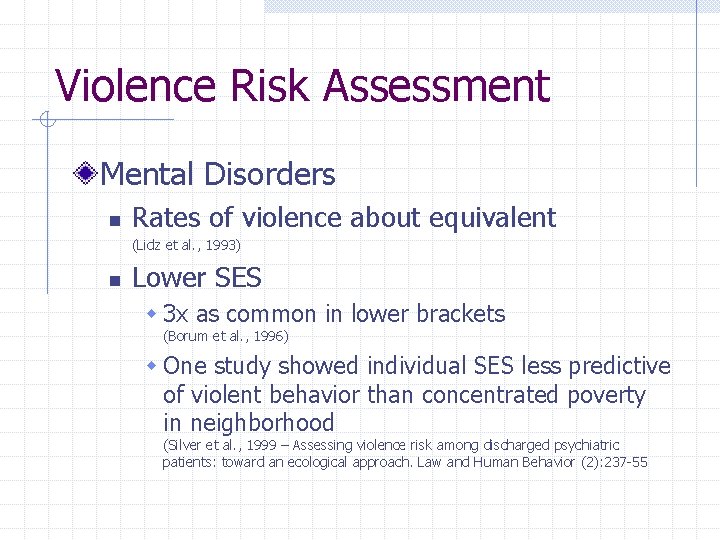
Violence Risk Assessment Mental Disorders n Rates of violence about equivalent (Lidz et al. , 1993) n Lower SES w 3 x as common in lower brackets (Borum et al. , 1996) w One study showed individual SES less predictive of violent behavior than concentrated poverty in neighborhood (Silver et al. , 1999 – Assessing violence risk among discharged psychiatric patients: toward an ecological approach. Law and Human Behavior (2): 237 -55
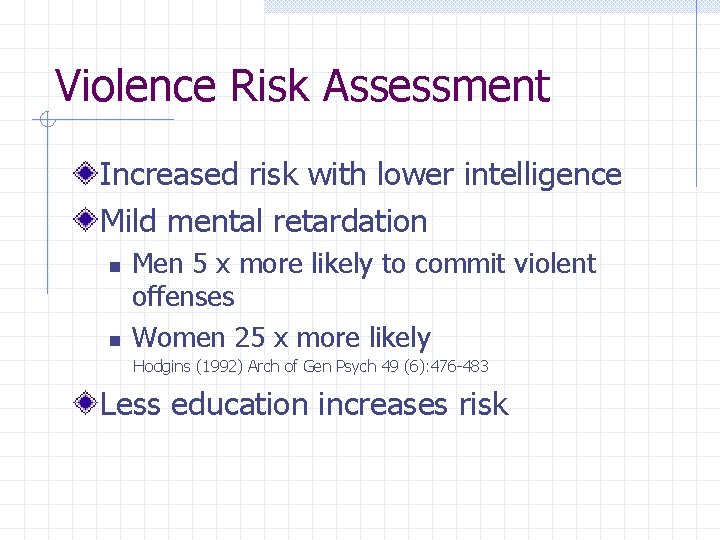
Violence Risk Assessment Increased risk with lower intelligence Mild mental retardation n n Men 5 x more likely to commit violent offenses Women 25 x more likely Hodgins (1992) Arch of Gen Psych 49 (6): 476 -483 Less education increases risk
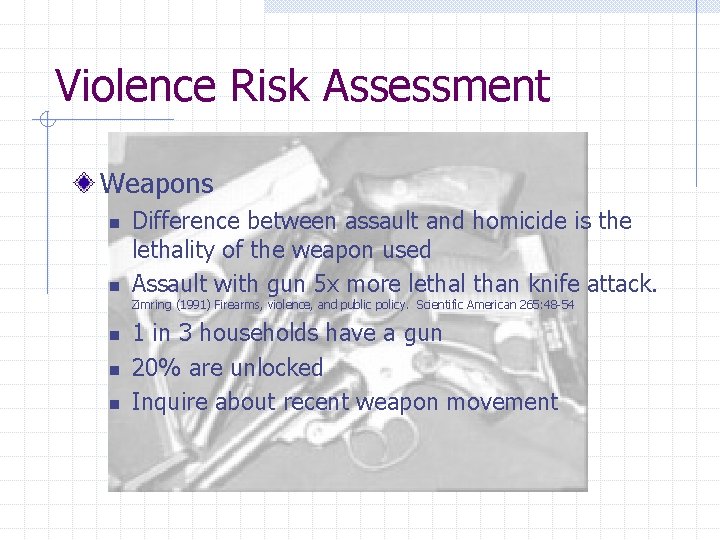
Violence Risk Assessment Weapons n n Difference between assault and homicide is the lethality of the weapon used Assault with gun 5 x more lethal than knife attack. Zimring (1991) Firearms, violence, and public policy. Scientific American 265: 48 -54 n n n 1 in 3 households have a gun 20% are unlocked Inquire about recent weapon movement
Violence Risk Assessment 50 -80% involved in violent crimes are under the influence of alcohol at the time of the offense Stimulant Drugs n n n Cocaine, amphetamines, and PCP Disinhibition and paranoia Cocaine – men commit crime, women victimized
Violence Risk Assessment Drugs and Alcohol n n Psychiatric patients 5 x increased rate Non-patients, 3 x increased rate Steadman et al. , 1998 – Violence by peopl d/c’d from AIP and by others in the same neighborhoods. Arch Gen Psych 55(5): 393 -401 Military and Work history n n n AWOL Frequent terminations Laid off 6 x more likely to be violent then employed
Violence Risk Assessment Violence and Mental Illness n n n Violence was greater only with acute symptoms Schizophrenia lower rates of violence than depression or Bipolar Disorder Substance Abuse > than Mental Illness Monahan, 1997 Actuarial support for the clinical assessment of violence risk. International Review of psychiatry 176: 312 -319.
Violence Risk Assessment Vietnam Combat Vets and PTSD n VN combat vets with PTSD > prevalence of violent behavior than VN vets without PTSD Lasko et al. Compr Psychiatry 1994 Sep-Oct; 35(5): 373 -81 n Hospitalized combat vets with PTSD > than nonhospitalized and VN general inpatient psychiatric population w PTSD symptoms severity w Substance abuse to a lesser degree Mc. Fall et al, J Trauma Stress 1999 Jul; 12(3): 501 -17 n n Vets with PTSD avg. 22 violent acts vs 0. 2 for non. PTSD Lower SES, increased aggressive responding and increased PTSD severity correlated Beckham et al. J Clin Psychol 1997 Dec; 53(8): 859 -69
Violence Risk Assessment 1 st break schizophrenia n n n 52/253 violent in 1992 study 36 violent in preceding year 16 > 1 year after admission Humphreys, et al (1992) Dangerous behavior preceding first admissions for schizophrenia Br J Schiz 161: 501 -505
Violence Risk Assessment Paranoid psychotic patients n n n Violence well-planned and in-line with beliefs Relatives or friends are usual targets Paranoid in community more dangerous than institutionalized given weapons access Krakowski et al. , (1986) Psychopathology and Violence: a review of the literature. Compr Psych 27 (2): 131 -148
Violence Risk Assessment Delusions – conflicting data n Factors to consider w Threat/control override symptoms w Non-delusional suspiciousness w If delusions make people unhappy, frightened or angry. w Whether they have acted on previous delusion Borum et al. , 1996
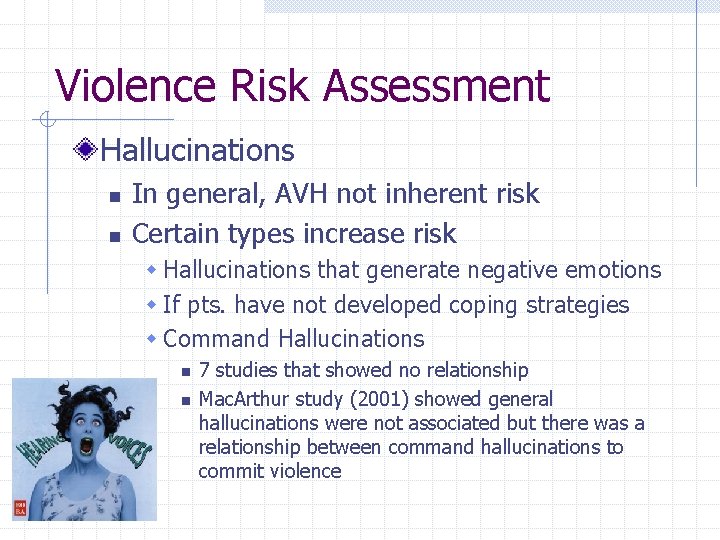
Violence Risk Assessment Hallucinations n n In general, AVH not inherent risk Certain types increase risk w Hallucinations that generate negative emotions w If pts. have not developed coping strategies w Command Hallucinations n n 7 studies that showed no relationship Mac. Arthur study (2001) showed general hallucinations were not associated but there was a relationship between command hallucinations to commit violence
Violence Risk Assessment Depression n May strike out in despair Depressed mothers who kill their children Most common diagnosis in murder-suicide w Extension of suicide w In couples, associated with feelings of jealousness and possessiveness Resnick (1969) Child murder by parents: a psychiatric review of filicide. Am J Psych 126 (3): 325 -334 Rosenbaum (1990) The role of depression in couples involved in murder-suicide and homicide. Am J Psych 147 (8): 1036 -1039
Violence Risk Assessment Mania n n High percentage of assaultive or threatening behavior Serious violence is rare Violence with restraints Violence with limit setting Tardiff (1980) Assault, suicide, and mental illness. Arch Gen Psych 37 (2): 164 -169
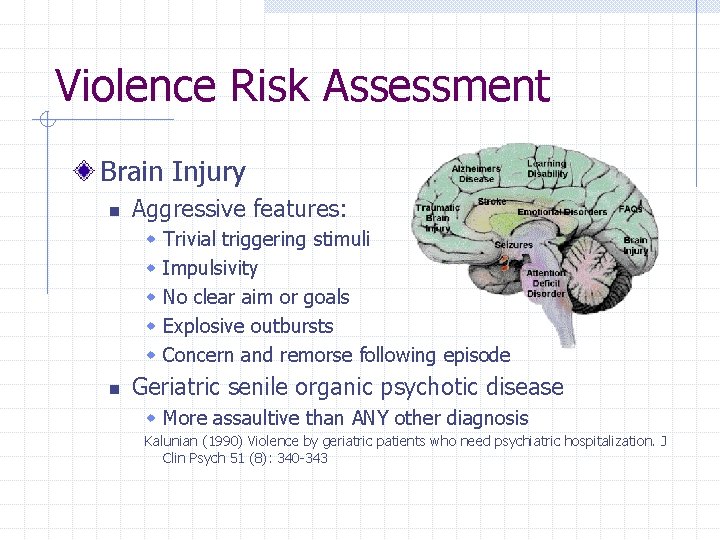
Violence Risk Assessment Brain Injury n Aggressive features: w w w n Trivial triggering stimuli Impulsivity No clear aim or goals Explosive outbursts Concern and remorse following episode Geriatric senile organic psychotic disease w More assaultive than ANY other diagnosis Kalunian (1990) Violence by geriatric patients who need psychiatric hospitalization. J Clin Psych 51 (8): 340 -343

Violence Risk Assessment Personality Disorders n n Borderline somewhat associated Antisocial personal disorder most common w Violence is cold and calculated w Motivated by revenge w Occurs during periods of heavy drinking w Combined with low IQ very ominous combination
Violence Risk Assessment Personality Traits n n n Impulsivity Inability to tolerate criticism Repetitive antisocial behavior Reckless driving A sense of entitlement and superficiality Typical Violence – paroxysmal, episodic Borum (1996)
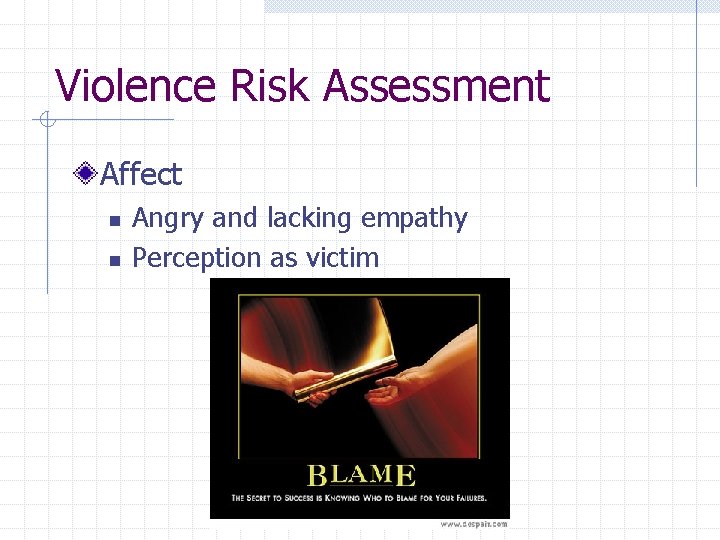
Violence Risk Assessment Affect n n Angry and lacking empathy Perception as victim
Violence Risk Assessment Approach n n Distinguish static from dynamic risk factors. Static w Demographic and past history w Unchangeable n Dynamic w Access to weapons, psychotic symptoms w Active substance abuse, living conditions
Violence Risk Assessment Interventions n n n Pharmacotherapy Substance Abuse treatment Psychosocial intervention Removal of available weapons Increased supervision
Violence Risk Assessment Approach n n n Take all threats seriously Details – how act will be carried out and anticipated consequences Potential grudge lists Investigation of fantasies of violence Also assess suicide risk Standardized instruments
Violence Risk Assessment Actuarial Instruments n Psychopathy Checklist (PCL-R) w 20 items on a three point scale w In North America cutoff is 30 or greater w Problems if used as sole assessment n n n Does not capture protective or mediating factors Overprediction of violence Several hours to administer
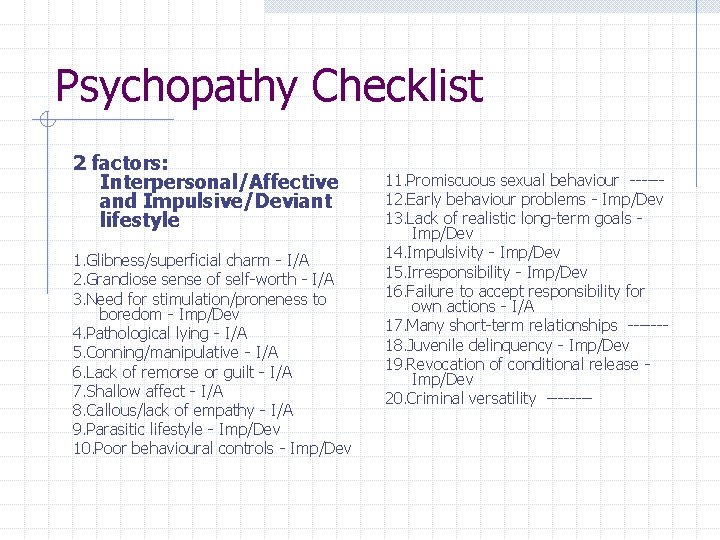
Psychopathy Checklist 2 factors: Interpersonal/Affective and Impulsive/Deviant lifestyle 1. Glibness/superficial charm - I/A 2. Grandiose sense of self-worth - I/A 3. Need for stimulation/proneness to boredom - Imp/Dev 4. Pathological lying - I/A 5. Conning/manipulative - I/A 6. Lack of remorse or guilt - I/A 7. Shallow affect - I/A 8. Callous/lack of empathy - I/A 9. Parasitic lifestyle - Imp/Dev 10. Poor behavioural controls - Imp/Dev 11. Promiscuous sexual behaviour -----12. Early behaviour problems - Imp/Dev 13. Lack of realistic long-term goals - Imp/Dev 14. Impulsivity - Imp/Dev 15. Irresponsibility - Imp/Dev 16. Failure to accept responsibility for own actions - I/A 17. Many short-term relationships ------18. Juvenile delinquency - Imp/Dev 19. Revocation of conditional release - Imp/Dev 20. Criminal versatility ----
Risk Assessment Summary Assessment does not = prediction Consider Risk Factors Risk assessment is like predicting weather n n Better for proximal events Needs to be updated frequently

Practical Risk Assessment Questions and Comments
- Slides: 41