
Violence against Women Do the Governments Care Mapping
- Slides: 12
Violence against Women: Do the Governments Care? Mapping the state response in CEE and CIS countries A project by the Open Society Institute Network Women’s Program/VAW Monitoring Program 2005 -2007 Presented by Eniko Pap
Background Stop Violence against Women Website (www. stopvaw. org) managed by Minnesota Advocates for Human Rights (MAHR) l Establishment and coordination of the National Violence against Women Monitor Program and Network by OSI Network Women’s Program/VAW Monitoring Program and MAHR l National VAW Monitors: NGOs working in the field of violence against women from CEE and CIS countries; management of the Country Pages of the STOPVAW website l
I. Monitoring methodology Basis: Recommendation Rec(2002)5 of the Committee of Ministers of the Council of Europe on the protection of women against violence – international norm, comprehensive, detailed; Monitoring Framework based on indicators prepared by the Co. E Group of Specialists l Building on the work of National VAW Monitors in 25 countries, with a request to involve other state and non-state actors in data collection l Questions to map the response to VAW, focusing on the state performance l
II. Examined fields – main proposed indicators in the light of the Co. E Monitoring Framework 1. State mechanisms: coordinating bodies, budget, action plans l l l l Special tasks allocated to the national machinery Governmental coordinating bodies to implement measures in the field of VAW (budget, number of staff, role of NGOs) NAPs – tasks, responsible actors, budget, timeframe, monitoring mechanism; evaluation/progress report Special budget lines in the State budget to combat VAW, amount Special budget lines, schemes to support NGOs in the field, amount State review mechanism on laws and policies Financing systems to compensate VAW victims
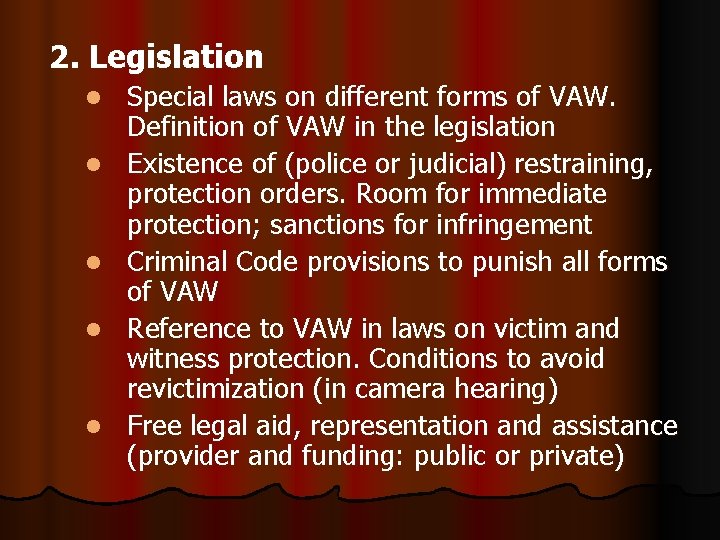
2. Legislation l l l Special laws on different forms of VAW. Definition of VAW in the legislation Existence of (police or judicial) restraining, protection orders. Room for immediate protection; sanctions for infringement Criminal Code provisions to punish all forms of VAW Reference to VAW in laws on victim and witness protection. Conditions to avoid revictimization (in camera hearing) Free legal aid, representation and assistance (provider and funding: public or private)
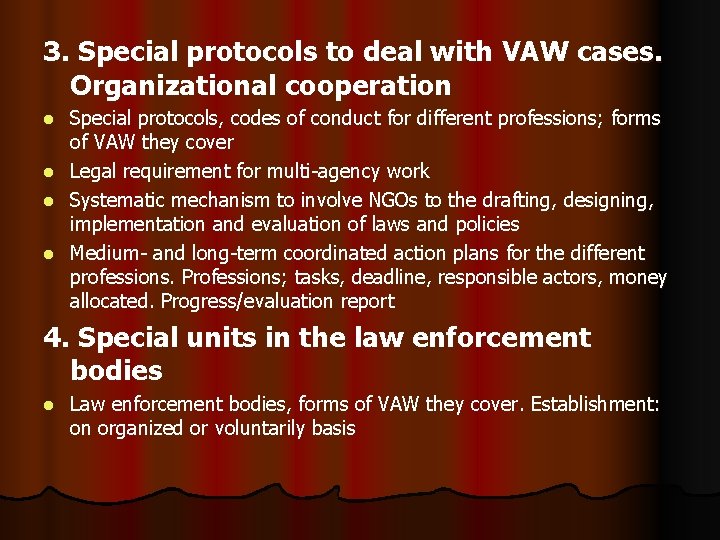
3. Special protocols to deal with VAW cases. Organizational cooperation l l Special protocols, codes of conduct for different professions; forms of VAW they cover Legal requirement for multi-agency work Systematic mechanism to involve NGOs to the drafting, designing, implementation and evaluation of laws and policies Medium- and long-term coordinated action plans for the different professions. Professions; tasks, deadline, responsible actors, money allocated. Progress/evaluation report 4. Special units in the law enforcement bodies l Law enforcement bodies, forms of VAW they cover. Establishment: on organized or voluntarily basis
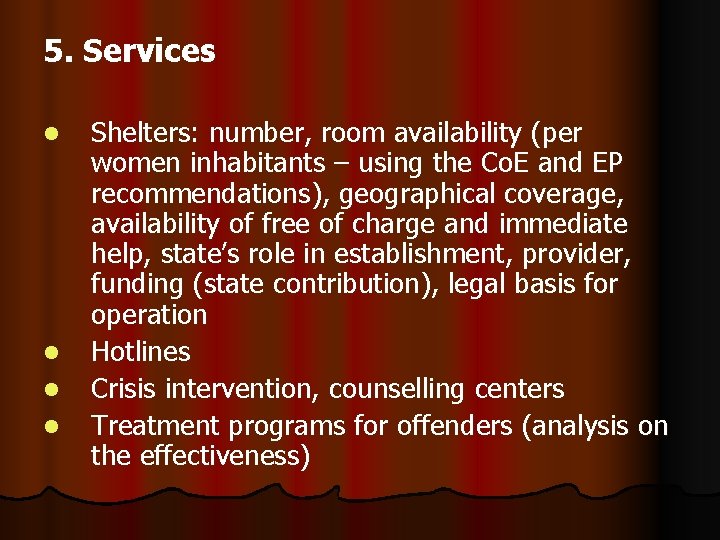
5. Services l l Shelters: number, room availability (per women inhabitants – using the Co. E and EP recommendations), geographical coverage, availability of free of charge and immediate help, state’s role in establishment, provider, funding (state contribution), legal basis for operation Hotlines Crisis intervention, counselling centers Treatment programs for offenders (analysis on the effectiveness)
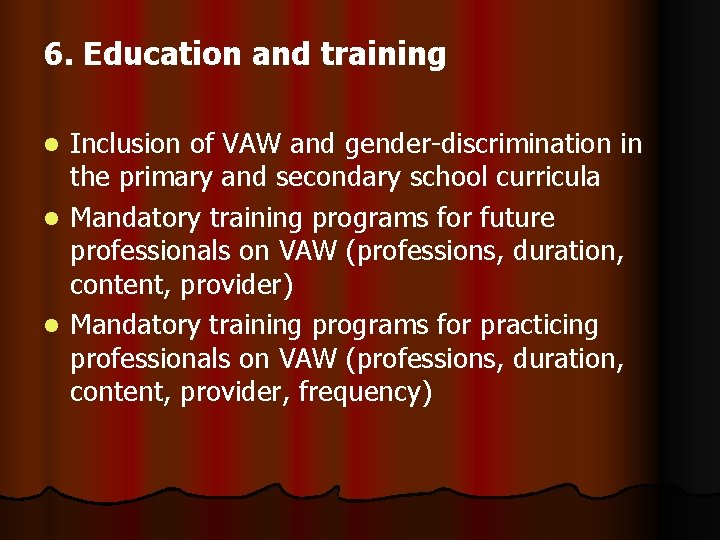
6. Education and training Inclusion of VAW and gender-discrimination in the primary and secondary school curricula l Mandatory training programs for future professionals on VAW (professions, duration, content, provider) l Mandatory training programs for practicing professionals on VAW (professions, duration, content, provider, frequency) l
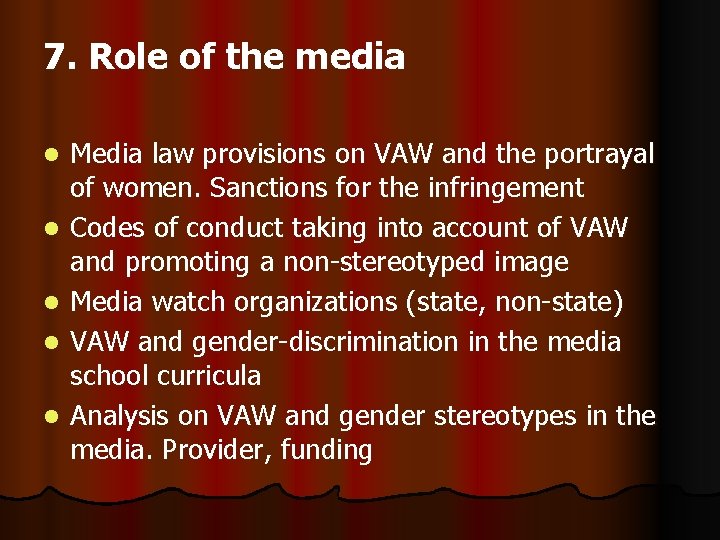
7. Role of the media l l l Media law provisions on VAW and the portrayal of women. Sanctions for the infringement Codes of conduct taking into account of VAW and promoting a non-stereotyped image Media watch organizations (state, non-state) VAW and gender-discrimination in the media school curricula Analysis on VAW and gender stereotypes in the media. Provider, funding
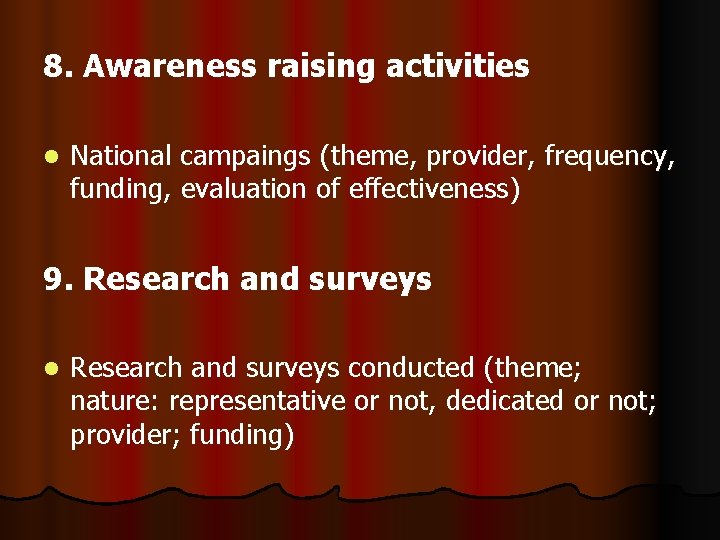
8. Awareness raising activities l National campaings (theme, provider, frequency, funding, evaluation of effectiveness) 9. Research and surveys l Research and surveys conducted (theme; nature: representative or not, dedicated or not; provider; funding)
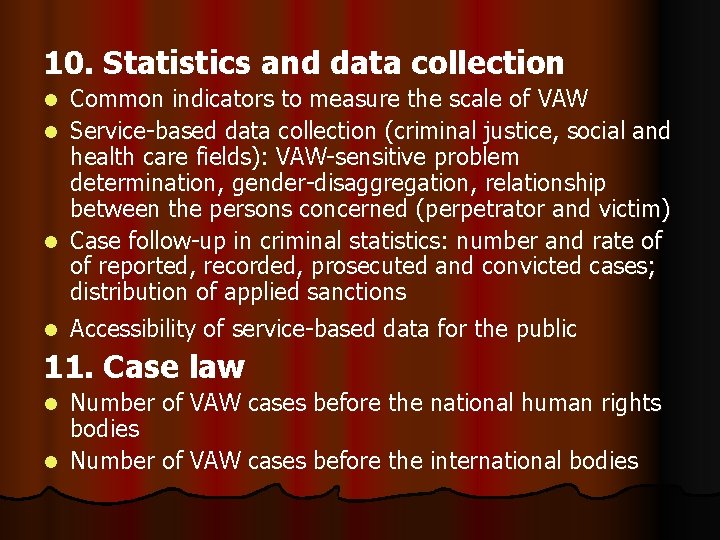
10. Statistics and data collection Common indicators to measure the scale of VAW l Service-based data collection (criminal justice, social and health care fields): VAW-sensitive problem determination, gender-disaggregation, relationship between the persons concerned (perpetrator and victim) l Case follow-up in criminal statistics: number and rate of of reported, recorded, prosecuted and convicted cases; distribution of applied sanctions l Accessibility of service-based data for the public l 11. Case law Number of VAW cases before the national human rights bodies l Number of VAW cases before the international bodies l
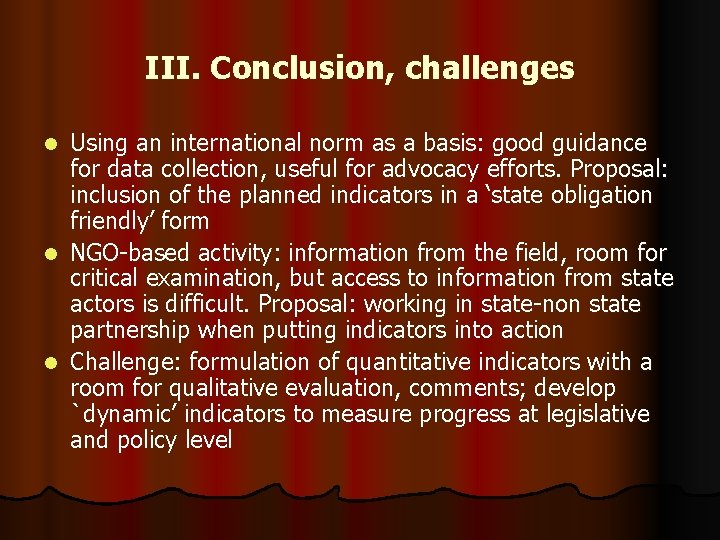
III. Conclusion, challenges Using an international norm as a basis: good guidance for data collection, useful for advocacy efforts. Proposal: inclusion of the planned indicators in a ‘state obligation friendly’ form l NGO-based activity: information from the field, room for critical examination, but access to information from state actors is difficult. Proposal: working in state-non state partnership when putting indicators into action l Challenge: formulation of quantitative indicators with a room for qualitative evaluation, comments; develop `dynamic’ indicators to measure progress at legislative and policy level l