
Violence against persons in institutional living arrangements Human


- Slides: 7
Violence against persons in institutional living arrangements Human Rights: a Reality of All conference March, 27 -28, 2017 Nicosia, Cyprus Dr Ágnes Kozma Hungary / Tizard Centre, University of Kent, UK
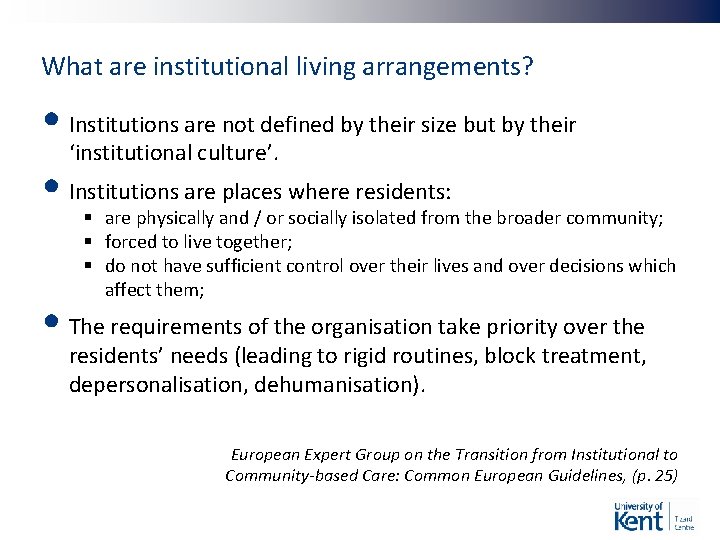
What are institutional living arrangements? • Institutions are not defined by their size but by their ‘institutional culture’. • Institutions are places where residents: § are physically and / or socially isolated from the broader community; § forced to live together; § do not have sufficient control over their lives and over decisions which affect them; • The requirements of the organisation take priority over the residents’ needs (leading to rigid routines, block treatment, depersonalisation, dehumanisation). European Expert Group on the Transition from Institutional to Community-based Care: Common European Guidelines, (p. 25)
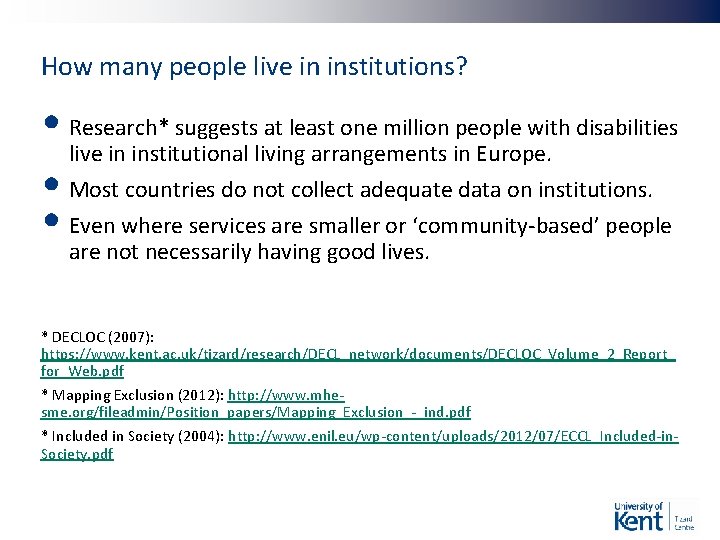
How many people live in institutions? • Research* suggests at least one million people with disabilities live in institutional living arrangements in Europe. • Most countries do not collect adequate data on institutions. • Even where services are smaller or ‘community-based’ people are not necessarily having good lives. * DECLOC (2007): https: //www. kent. ac. uk/tizard/research/DECL_network/documents/DECLOC_Volume_2_Report_ for_Web. pdf * Mapping Exclusion (2012): http: //www. mhesme. org/fileadmin/Position_papers/Mapping_Exclusion_-_ind. pdf * Included in Society (2004): http: //www. enil. eu/wp-content/uploads/2012/07/ECCL_Included-in. Society. pdf
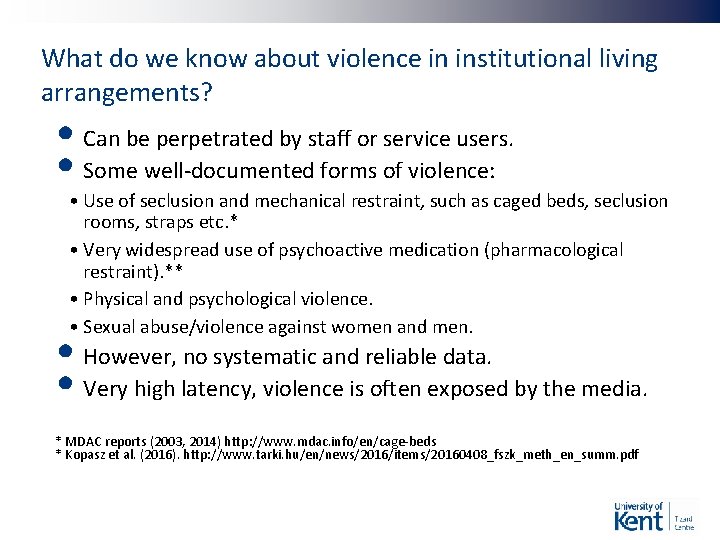
What do we know about violence in institutional living arrangements? • Can be perpetrated by staff or service users. • Some well-documented forms of violence: • Use of seclusion and mechanical restraint, such as caged beds, seclusion rooms, straps etc. * • Very widespread use of psychoactive medication (pharmacological restraint). ** • Physical and psychological violence. • Sexual abuse/violence against women and men. • However, no systematic and reliable data. • Very high latency, violence is often exposed by the media. * MDAC reports (2003, 2014) http: //www. mdac. info/en/cage-beds * Kopasz et al. (2016). http: //www. tarki. hu/en/news/2016/items/20160408_fszk_meth_en_summ. pdf
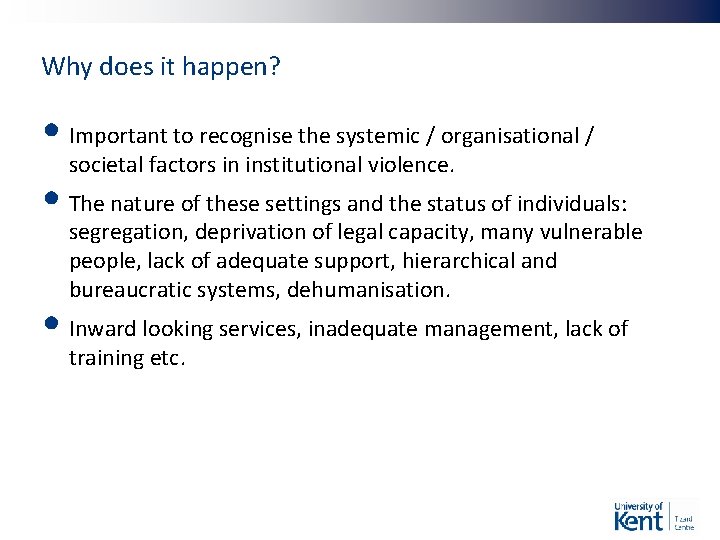
Why does it happen? • Important to recognise the systemic / organisational / societal factors in institutional violence. • The nature of these settings and the status of individuals: segregation, deprivation of legal capacity, many vulnerable people, lack of adequate support, hierarchical and bureaucratic systems, dehumanisation. • Inward looking services, inadequate management, lack of training etc.
What can be done? • Institutions must be replaced with support and services that enable people to live in the community. • Substituted decision-making systems must be replaced with supported decision-making. • Systems to prevent and detect violence must be created or strengthened.
Thank you for your attention! Contact: A. V. Turnpenny@kent. ac. uk