
Violence against children Concepts definitions and data needs
- Slides: 14
Violence against children: Concepts, definitions and data needs Claudia Cappa, Senior Adviser, Data and Analytics Section, UNICEF
1. Building a comprehensive data collection and monitoring system on VAC 2. Defining Violence against Children 3. Overview of the guidelines
Defining a national data collection and monitoring system A data collection and monitoring system is a set of coordinated processes and activities for the systematic collection, analysis, interpretation and dissemination of data A functioning system requires a centralised coordination body to oversee the system and ensure effective coordination between the different actors Key components of a child protection system to protect children from all forms of violence, exploitation, abuse and neglect
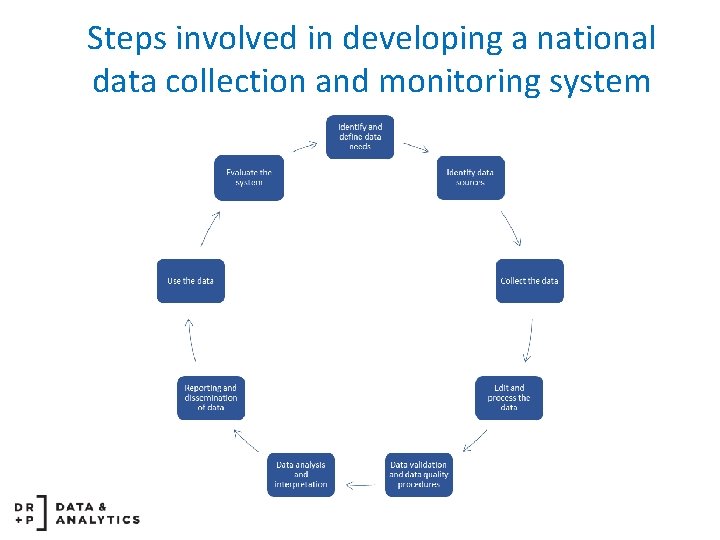
Steps involved in developing a national data collection and monitoring system
Data needs • Nature and magnitude of violence against children (all forms) • Risk and protective factors • What works and what does not work for prevention and response • Data on availability and outreach of services to prevent and respond to violence • Data and information for the monitoring and evaluation of interventions
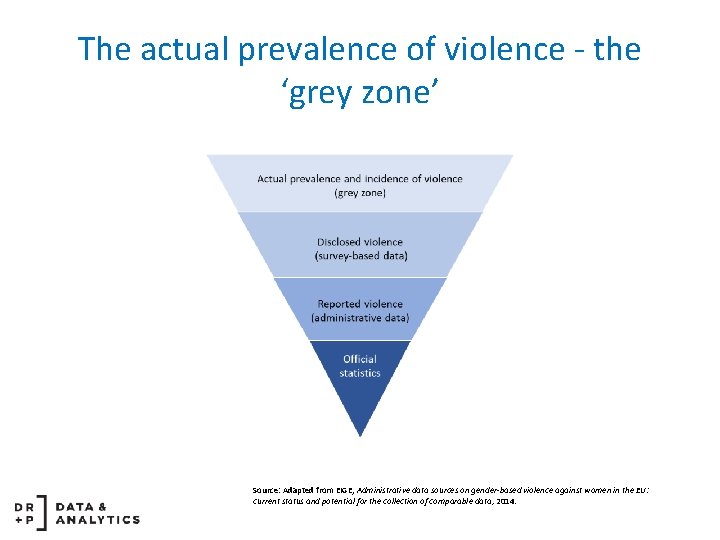
The actual prevalence of violence - the ‘grey zone’ Source: Adapted from EIGE, Administrative data sources on gender-based violence against women in the EU: current status and potential for the collection of comparable data, 2014.
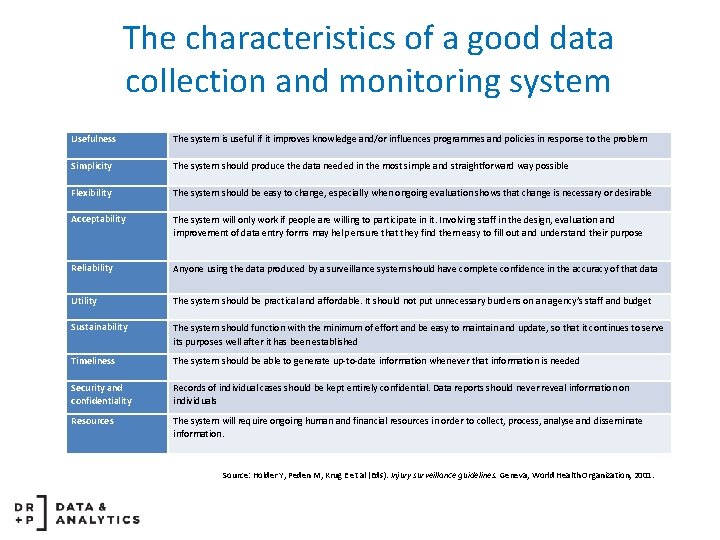
The characteristics of a good data collection and monitoring system Usefulness The system is useful if it improves knowledge and/or influences programmes and policies in response to the problem Simplicity The system should produce the data needed in the most simple and straightforward way possible Flexibility The system should be easy to change, especially when ongoing evaluation shows that change is necessary or desirable Acceptability The system will only work if people are willing to participate in it. Involving staff in the design, evaluation and improvement of data entry forms may help ensure that they find them easy to fill out and understand their purpose Reliability Anyone using the data produced by a surveillance system should have complete confidence in the accuracy of that data Utility The system should be practical and affordable. It should not put unnecessary burdens on an agency’s staff and budget Sustainability The system should function with the minimum of effort and be easy to maintain and update, so that it continues to serve its purposes well after it has been established Timeliness The system should be able to generate up-to-date information whenever that information is needed Security and confidentiality Records of individual cases should be kept entirely confidential. Data reports should never reveal information on individuals Resources The system will require ongoing human and financial resources in order to collect, process, analyse and disseminate information. Source: Holder Y, Peden M, Krug E et al (Eds). Injury surveillance guidelines. Geneva, World Health Organization, 2001.
Roles and responsibilities of national and international actors • At the national level: Enhanced coordination and cooperation among entities with responsibilities in VAC (data and responses) • At the international level: Enhanced coordination and cooperation between countries and international partners • Support to countries in terms of tools for data collection and technical assistance
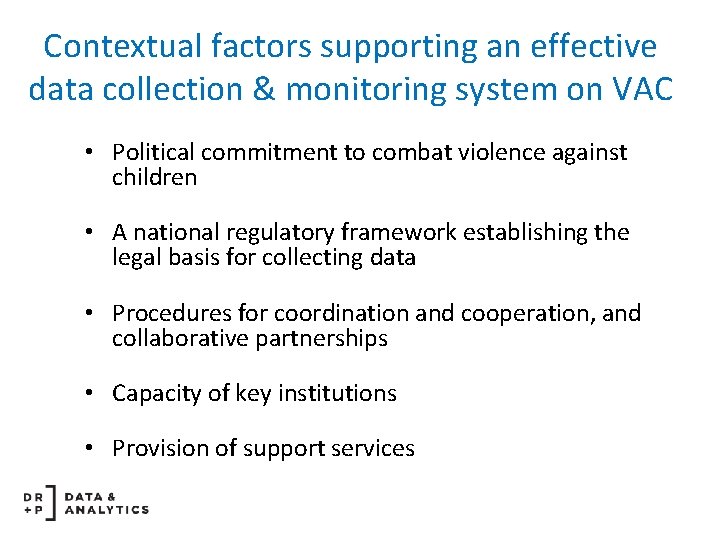
Contextual factors supporting an effective data collection & monitoring system on VAC • Political commitment to combat violence against children • A national regulatory framework establishing the legal basis for collecting data • Procedures for coordination and cooperation, and collaborative partnerships • Capacity of key institutions • Provision of support services
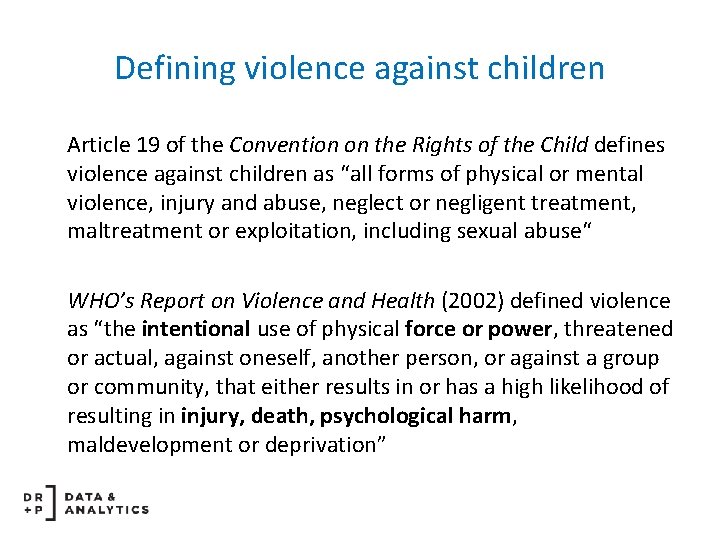
Defining violence against children Article 19 of the Convention on the Rights of the Child defines violence against children as “all forms of physical or mental violence, injury and abuse, neglect or negligent treatment, maltreatment or exploitation, including sexual abuse“ WHO’s Report on Violence and Health (2002) defined violence as “the intentional use of physical force or power, threatened or actual, against oneself, another person, or against a group or community, that either results in or has a high likelihood of resulting in injury, death, psychological harm, maldevelopment or deprivation”
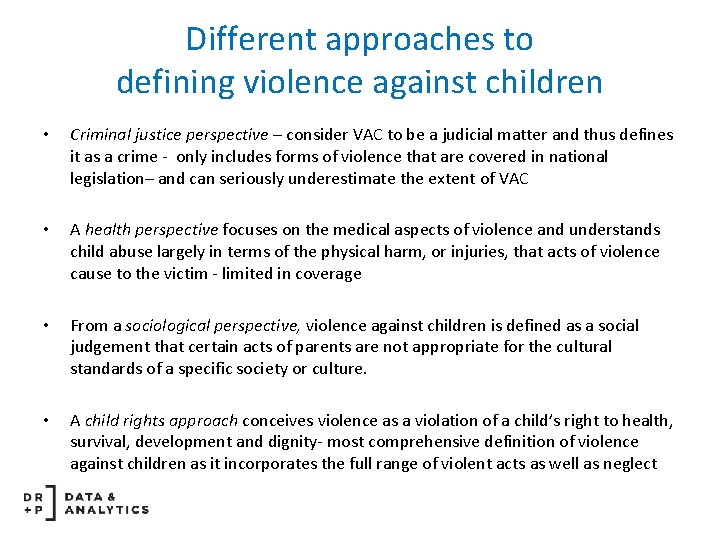
Different approaches to defining violence against children • Criminal justice perspective – consider VAC to be a judicial matter and thus defines it as a crime - only includes forms of violence that are covered in national legislation– and can seriously underestimate the extent of VAC • A health perspective focuses on the medical aspects of violence and understands child abuse largely in terms of the physical harm, or injuries, that acts of violence cause to the victim - limited in coverage • From a sociological perspective, violence against children is defined as a social judgement that certain acts of parents are not appropriate for the cultural standards of a specific society or culture. • A child rights approach conceives violence as a violation of a child’s right to health, survival, development and dignity- most comprehensive definition of violence against children as it incorporates the full range of violent acts as well as neglect
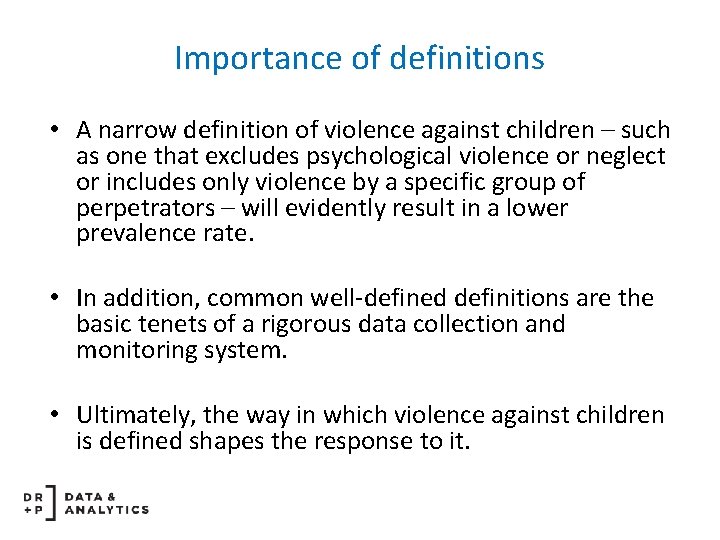
Importance of definitions • A narrow definition of violence against children – such as one that excludes psychological violence or neglect or includes only violence by a specific group of perpetrators – will evidently result in a lower prevalence rate. • In addition, common well-defined definitions are the basic tenets of a rigorous data collection and monitoring system. • Ultimately, the way in which violence against children is defined shapes the response to it.
Purpose of the guidelines • Provide technical guidance on the necessary steps for designing, planning and implementing national data collection and research efforts on VAC • Focus on quantitative data, specifically surveys and administrative data • Discuss the conceptual and theoretical issues related to measuring violence against children, outline the steps to take before, during and after the collection of different types of data • Contain guidance on how to transform violence data into practical action at the national level, from influencing the legal and policy environment to designing service delivery programmes
THANK YOU ccappa@unicef. org