
Vinyl Chloride Health hazards v Acute immediate health







- Slides: 26
Vinyl Chloride
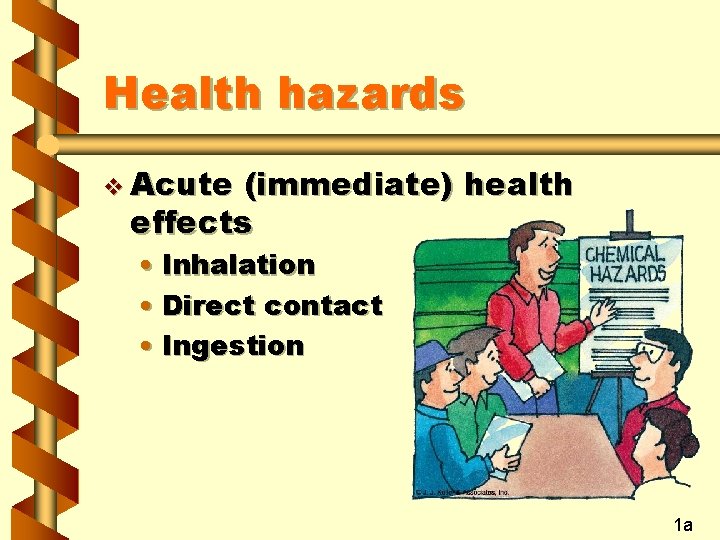
Health hazards v Acute (immediate) health effects • Inhalation • Direct contact • Ingestion 1 a
Health hazards v Chronic (long-term) effects • Raynaud’s syndrome • Liver damage • Nervous system damage • Cancer, especially liver cancer v Make effective use of warning labels 1 b
Permissible exposure limits v No employee may be exposed to vinyl chloride at concentrations greater than 1 ppm TWA v No employee may be exposed to vinyl chloride at concentrations greater than 5 ppm over any 15 minute period 2 a
Permissible exposure limits v No employee may be exposed to VC by direct contact with liquid VC 2 b
Vinyl chloride operations v Areas, processes that use vinyl chloride v Handling equipment 3 a
Vinyl chloride operations v Jobs that involve vinyl chloride activities v Operations where exposure to vinyl chloride exceeds PEL 3 b
Protective measures to prevent exposure v Use exhaust ventilation systems v Minimize chloride the release of vinyl v Follow properating procedures 4 a
Protective measures to prevent exposure v Wear required personal protective equipment v Keep containers closed, protected from damage, properly stored 4 b
Protective measures to prevent exposure v Establish regulated areas where concentrations are in excess of PEL 4 c
Respiratory protection v Required whenever engineering and work practice controls do not reduce exposure levels below the PEL v Use engineering and work practice controls to reduce exposure levels to the lowest practical level 5 a
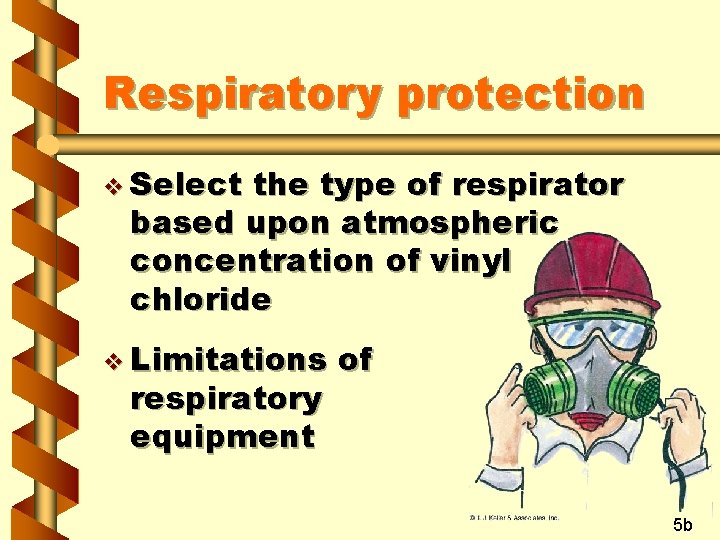
Respiratory protection v Select the type of respirator based upon atmospheric concentration of vinyl chloride v Limitations respiratory equipment of 5 b
Exposure monitoring v Initial monitoring to determine if exposures are above action level (0. 5 ppm TWA) v Test after changes in production, processes, or controls 6 a
Exposure monitoring v Test if any employee may be exposed above the action level v Repeat the monitoring if any exposures are above the action level 6 b
Exposure monitoring v Repeat monitoring at least monthly if exposures are above the PEL v Repeat monitoring at least every three months if exposures are above the action level 6 c
Exposure monitoring v Monitoring can only be discontinued after two consecutive tests, made five days apart, show exposure is at or below the action level 6 d
Exposure monitoring v Monitoring methods must meet accuracy standards v Employers must notify employees in writing within 10 working days if exposure is in excess of PEL 6 e
Exposure monitoring v Maintain monitoring records according to 29 CFR 1910. 1020 6 f
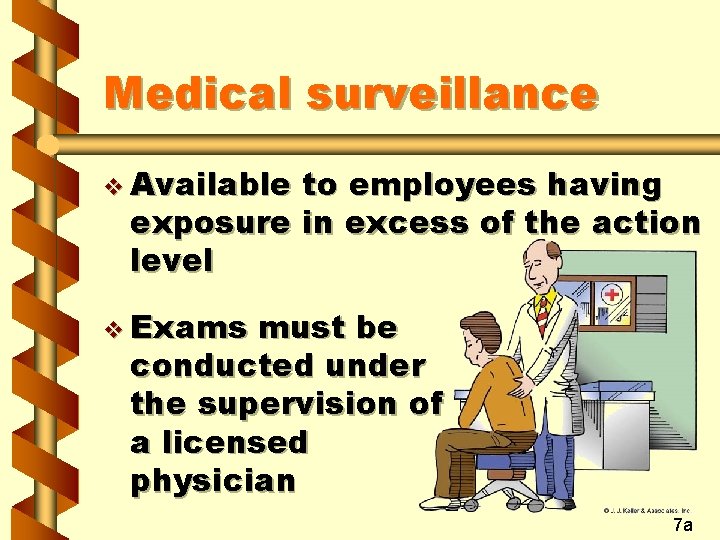
Medical surveillance v Available to employees having exposure in excess of the action level v Exams must be conducted under the supervision of a licensed physician 7 a
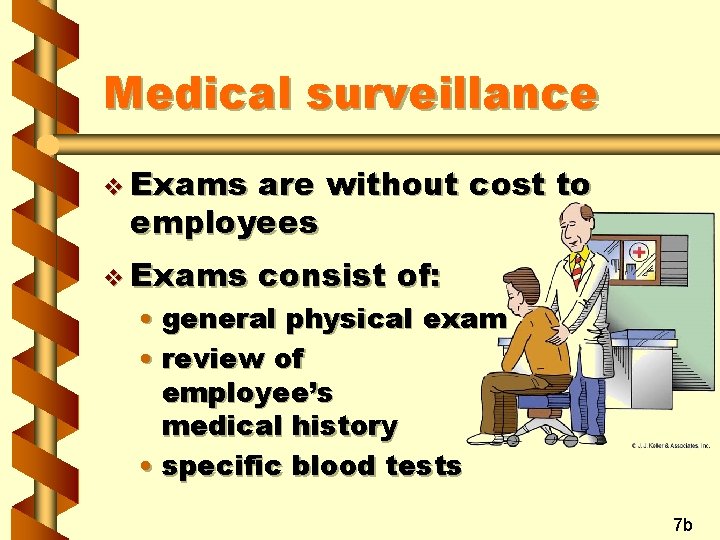
Medical surveillance v Exams are without cost to employees v Exams consist of: • general physical exam • review of employee’s medical history • specific blood tests 7 b
Medical surveillance v Medical surveillance must be started when: • an employee is initially assigned to work where exposure exceeds the action level • operations change so that exposure levels increase to above the action level 7 c
Medical surveillance v Medical surveillance must be started when: • an employee is exposed to vinyl chloride as a result of an emergency v Exams are repeated annually for most employees exposed above the action level 7 d
Medical surveillance v Physician issues a statement of the employee’s suitability for continued exposure to vinyl chloride v Employee statement receives a copy of the 7 e
Emergency situations v Employees engaged in hazardous operations are required to use respiratory protection and protective clothing v Emergencies must be reported to OSHA within 24 hours 8 a
Emergency situations v. A written operation plan must be developed for each facility storing, handling, using vinyl chloride v Remember that vinyl chloride is flammable; consult MSDSs 8 b
Training v Review paragraphs (a) through (o) of 29 CFR 1910. 1017 9 a