
Vinnitsa National Medical University n M I Pirogov







- Slides: 52
Vinnitsa National Medical University n. M. I. Pirogov Department of pathophysiology Lecture: “Pathology of the endocrine system” ектор:
PITUITARY GLAND There are hormones of the anterior, intermediate and posterior part of the pituitary gland. Most important - front fate (tropic produces hormones) Tropic - so stimulating function peripheral endocrine glands releasing-hormones: LIBERYNS -stimulate the secretion of hormones STATINS -Inhibits the secretion of hormones
Anterior part pituitary gland (adenohypophysis) ACTH TSH STH (GH) Gonadotropic (GTH): § FSH § LH prolactin
The intermediate lobe pituitary Melanocyte-stimulating hormone (MSH ) Hypothalamus and The posterior pituitary (neurohypophysis): Vasopressin (ADH) Oxytocin
Adrenocorticotropic hormone (ACTH) The secretion is stimulated corticoliberin Speed is regulated by secretion of feedback cortisol levels 1. On cortex adrenals → synthesis and secretion of glucocorticoids 2. increased pigmentation of the skin (force plays melanocyte-stimulating hormone) 3. mobilization of fat from fat depots;
Thyroid-stimulating hormone (TSH) is a pituitary hormone that stimulates the thyroid gland to produce thyroxine (T 4), and then triiodothyronine (T 3) which stimulates the metabolism of almost every tissue in the body.
Growth hormone (GHRH) (Somatotropin) Growth function: tissue growth factors somatomedin (insulin-like growth factors): • increased growth of cartilage • stimulation of cell division • hypertrophy bodies. -
Metabolic activity GHRH : carbohydrate metabolism: • stimulates the α-cells of pancreas → ↑ glucagon • insulin resistance fat metabolism: • activate lipolysis of adipose tissue • ↑ free fatty acids in the blood, • ↑ ketone bodies, • fatty liver protein metabolism - anabolic action – • activates the biosynthesis of proteins
Gonadotropic hormones Follicle stimulating hormone (FSH): In women: stimulates the growth of follicles in the ovaries of estrogen formation, In men : regulates spermatogenesis
Luteinizing hormone (LH): In women: stimulates the formation of the corpus luteum in the ovaries progestins androgens synthesis In men: regulates spermatogenesis the formation of testosterone.
Prolactin - stimulates breast growth and secretion of milk. Melanocyte-stimulating hormone (γ-MSH ) stimulates melanin synthesis and release from skin/hair melanocytes
• Hyperfunction disorders of endocrine functions: • Hypofunction • Disfunction
PATHOLOGY adenohypophysis : Hypopituitarism- hypofunction of adenohypophysis • Types : • 1. total • 2. partial
Panhypopituitarism • Reasons: • Damages glandular cells of adenohypophysis (operations, tumors) Postpartum pituitary necrosis (syndrome of Schegan) • Pituitary infarction, especially in the peripartum period; • Chromophobe hypophysis adenomas • Hypothalamic disorders – tumors and mass lesions (e. g. , hypothalamic radiation, tumor, trauma, infections).
Clinical forms : • Pituitary cachexia (Simmond’s disease) that is characterized by a severe cachexia and atrophy of the thyroid, adrenal, and sexual glands; • Pituitary necrosis (Sheehan’s syndrome) that result from infarction of the pituitary gland after substantial blood loss during childbirth.
Partial hypopituitarism: In children : Pituitary dwarfism (nanism), which results from a decreased secretion of GH.
Hyperpituitarism hyperfunction of adenohypophysis Reasons: Eosinophilic adenoma, develops from acidophilic cells of adenohypophysis forming STH – hypersecretion STH.
In chidren: Gigantism occurs in the prepubertal child when the epiphyses are not yet fused to the long bones, and high levels of GH stimulate excessive skeletal growth. In adult: Acromegaly - appears by increased growth of hands, legs, chin, nose, tongue, liver, kyphoscoliosis, increasing internal organs: liver, heart, thyroid.
Hyperproduction of STH у period before puberty and complete ossification causes gigantism. Hyperfunction of the pituitary gland in adults causes acromegaly - a disproportionately intensive growth of certain body parts (fingers and toes, nose, jaw, tongue and internal organs). The reason - the tumor adenohypophysis
Increased metabolic activity of STH Ø hyperglycemia Ø insulin resistanse (metahypophysar diabetes) Ø fatty infiltration of liver develop Ø enhanced lipolysis Ø hyperketonemiya (ketoacidosis)
Hypothalamic-neurohypophysis system Posterior pituitary fate: ADH (Vasopressin): increases water reabsorption in the distal part of nephron Oxytocin: 1. stimulates lactation 2. stimulates contraction of the pregnant uterus; 3. amnestic hormone (memory loss)
Hypersecretion ADH - Parhona syndrome. Reasons: • Ectopic ADH production of some tumors • Violation of the regulation of endocrine function of the hypothalamus. Manifestations: • Hypervolemiya • Brain edema • Hypertension. • Reflex anuria (pain shock)
Deficiency of oxytocin secretion. Manifestations: • violations of lactation, • weakness of labor.
Alteration in Adrenal function DISORDERS OF ADRENAL function can be divided into: CORTICAL • Hypofunction of adrenal cortex (adrenocortical insufficiency); • Hyperfunction of the: • zona fasticulata (hypercortisolism); • zona glomeruloza (hyperaldosteronism); • Dysfunction of the adrenal cortex (adrenogenital syndrome).
Primary adrenal insufficiency Addison’s disease results from destruction of the adrenal cortex by microorganisms or autoimmune disease. Reasons: 1. tuberkulosis adrenal cortex 2. autoimmune damage secretory cells of the adrenal glands (allergic reaction type II and IV) 3. AIDS 4. metastases of the tumors 5. adrenal hemorrhage.
Manifestations: Mineralocorticoid deficiency: • Low blood concentrations Na+ and Cl, higher – K+ • Dehydration • Arterial hypotension • Blood clotting (dehydration) • ↓ renal circulation → ↓ glomerular filtration → nitrogenemia (intoxication); • distal tubular acidosis
Glucocorticoid deficiency results in : • Hypoglycemia (diminished liver glycogen). • Hyperpigmentation (elevated level of ACTH ) The skin looks bronzed; the gums and oral mucous membranes may become bluish-black. • Decreased tolerance to cold (hypometabolism) • Gastrointestinal symptoms: anorexia, nausea, vomiting, diarrhea. • Weight loss. • Weakness
Addison’s disease is characterized by a deficiency of adrenal cortical hormones and an elevated ACTH levels resulted from a lack of feedback inhibition. Elevated level of ACTH causes hyperpigmentation. The skin looks bronzed; the gums and oral mucous membranes may become bluish-black.
Hyperfunction of the zona glomeruloza: Hyperaldosteronism may be divided into: ØPrimary - (Conn’s syndrome) ØSecondary - (Renin hypersecretion)
Primary hyperaldosteronism Conn’s syndrome Reason: adrenal adenoma Manifestations: The aldosterone excess produces sodium retention: • increased total plasma volume, • increased renal artery pressure, • inhibition of renin secretion. increased urinary losses of potassium: • Hypertension • Hypokalemic alkalosis
Pituitary hypercorticism is due to an overproduction of ACTH resulting in adrenocortical hyperfunction. Adrenocortical hyperfunction that results from an excessive glucocorticoid production by the adrenal cortex (primary hypercorticism) is called Cushing’s syndrome. By convention, when this symptom complex is due to ACTH hypersecretion by the pituitary glang, it is called Cushing’s disease. Pituitary hypersecretion of ACTH may be caused by hypothalamic overproduction of CRH (tertiary hypercorticism) or by a tumor of the pituitary gland (secondary hypersecretion).
Hyperfunction adrenal medulla Pheochromocytoma Reason: by chromaffin cell tumor Manifestations: • hypertension • tachycardia • hyperglycemia • hiperlipatsydemiya • hyperthermia
Thyroid gland: The thyroid follicle produces and secretes two thyroid hormones: thyroxin (T 4) and triiodthyronine (T 3). (Iodine-containing hormones). Calcitonin (The hormone participates in calcium (Ca 2+) and phosphorus metabolism) - hyporcalcemia.
Hypothyroidism Primary hypothyroidism : • autoimmune thyroiditis (Hashimoto's thyroiditis) • surgical or radiation “overkill” in removing thyroid tissue; • removal of the thyroid gland • previous treatment with radioactive iodine, • dietary lack of iodine (endemic goiter) • congenital lack of thyroid tissue (hypo- or aplasia of the thyroid gland, or enzymopathies); Secondary and tertiary hypothyroidism : • injury to the hypothalamus or the anterior pituitary gland • deficit of thyroid-stimulating hormone (TSH) • deficit tyreoliberyn.
Manifestations of Cretinsm : They are dwarfed and mentally retarded, and have enlarged, protruding tongues and potbellied • characteristic facial : retraction nose, coarse and thick facial features, widely set eyes, hair loss, poor facial expressions • myxedema
Acquired hypothyroidism – myxedema Manifestations: Myxedema hypometabolic state: • decrease in the basal metabolic rate (BMR), • a tendency to gain weight, • cold intolerance. CVS: bradycardia, decreased cardiac output, and hypotension. Nervous system: mental dullness, lethargy, and impaired memory. The major cause of acquired hypothyroidism is an autoimmune disorder in which the thyroid gland may be totally destroyed by an immunologic process (Hashimoto’s thyroiditis).
Hyperthyroidism or thyrotoxicosis -excessive delivery of thyroid hormone to the peripheral tissues Toxic diffuse goiter (Graves' disease) V types (stimulant) by Coombs and Jell, Саuses : • functional thyroid adenomas or carcinomas; • pituitary tumors that secret thyrotropin (secondary hyperthyroidism); • ingestion of excessive thyroid hormone(rarely). Pathogenesis : The antibodies (LATS and TSI), which mimic the action of TSH the interaction with cell surface antigens thyroid gland stimulating synthesis of T 3 and T 4.
Manifestations: • Goiter • Exophthalmos - ophthalmopathy - bilateral • ↑ basal metabolism (lipolysis) • hyperthermia, ↑ sweating • Heart Rate ↑, Arterial hypertension • weight loss • amenorrhea • ↑ irritability, tremor, fibrillar twitching • Diabetes militus • metabolic ketoacidosis
Goiter – Is apparent increase in the amount of thyroid gland. Type of goiter: 1. Toxic diffuse goiter, - hyperthyroidism (Graves' disease). Symptoms of thyroid hyperfunction. 2 Sporadic goiter - euthyroidism. Increased thyroid gland - functional activity normal. 3. Endemic goiter - hypothyroidism. Clinical hypofunction of thyroid gland.
Parathyroid glands – parathyroid hormone (PTH) or parathyrin. Secretion regulated PTH content of Ca 2+ in the blood. Normally Са 2+ 2, 25 -2, 55 мколь/л, Ionized Са 2+ 1, 03 -1, 27 Increased PTH –↓ Са 2+ ions in the plasma Decrease PTH - ↑ Са 2+ ions
Hypoparathyroidism. Reasons: 1) remove parathyroid glands 2) radioactive iodine therapy of the hyperthyroidism 3) autoimmune processes; 4) birth defects; 5)the sensitivity of target cells to the action parathyrin - pseudohypoparathyroidism. Manifestations : Hypocalcemia.
HYPERPARATHYROIDISM Reasons: 1. adenoma parathyroid glands (Recklinghausen's disease); 2. hyperfunction parathyroid glands
Manifestations : 1. Violation of bone structure : - pain in bones and joints, - osteoporosis, osteodystrofya, - osteomalacia 2) Hypercalcemia: - the formation of calcium kidney stones; - infringement excitability of the nervous system and muscles (muscle weakness, depression, memory impairment); - hypertension; - gastric hypersecretion; - calcification of soft tissues (kidney, blood vessels, lungs).
Hypogonadism is a condition in which the body produces little or no sex hormones. Normally the sex glands known as gonads in the body produce sex hormones, testosterone and estrogen. In men the testes in women the ovaries are the gonads.
The sex hormones produced by these glands are responsible for the sexual characteristics in men and women. q They control testicular development, sperm production, growth of pubic hair and masculine features in men; q. They control pubic hair, breast development, menstruation and feminine features in women. Hypogonadism or gonad deficiency in males results in low production of testosterone. It is also called as andropause.
The gonads are controlled by the hypothalamus and the pituitary gland in the brain, which send messages to the glands to produce sex hormones. Types Of Hypogonadism q. Primary Hypogonadism – improper functioning of the gonad itself, i. e. testes or ovaries and hence the sex hormones are not produced sufficiently. q. Central Hypogonadism – gonads are normal in their structure and function but do not receive proper signals from the brain.
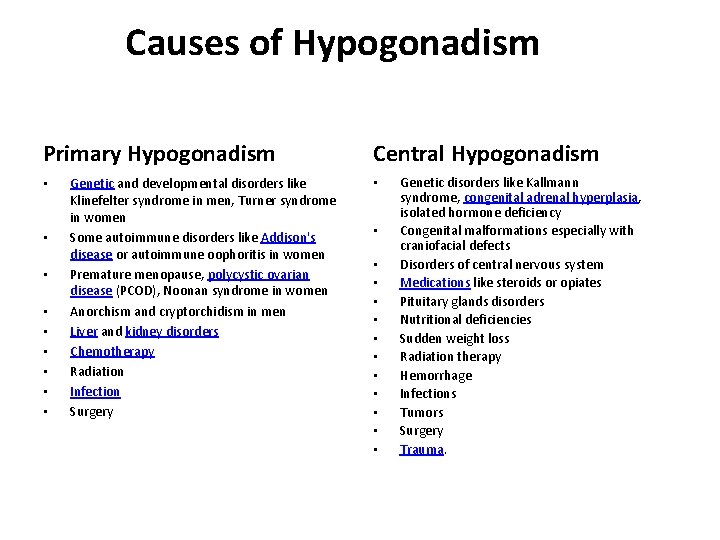
Causes of Hypogonadism Primary Hypogonadism • • • Genetic and developmental disorders like Klinefelter syndrome in men, Turner syndrome in women Some autoimmune disorders like Addison's disease or autoimmune oophoritis in women Premature menopause, polycystic ovarian disease (PCOD), Noonan syndrome in women Anorchism and cryptorchidism in men Liver and kidney disorders Chemotherapy Radiation Infection Surgery Central Hypogonadism • • • • Genetic disorders like Kallmann syndrome, congenital adrenal hyperplasia, isolated hormone deficiency Congenital malformations especially with craniofacial defects Disorders of central nervous system Medications like steroids or opiates Pituitary glands disorders Nutritional deficiencies Sudden weight loss Radiation therapy Hemorrhage Infections Tumors Surgery Trauma.
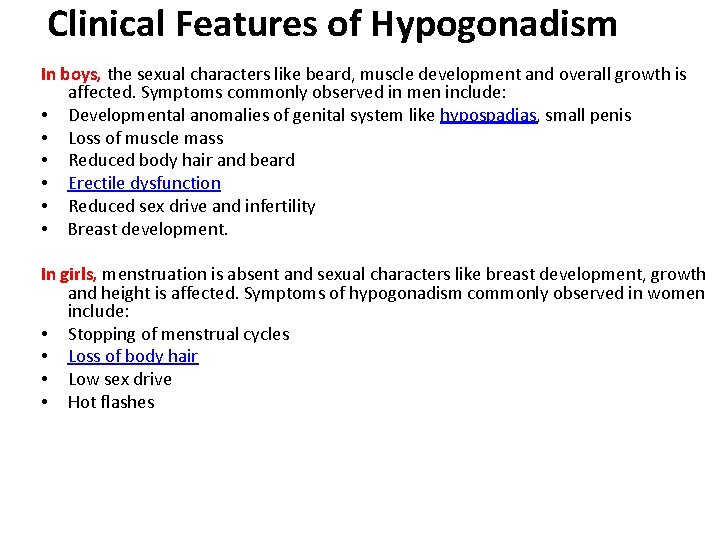
Clinical Features of Hypogonadism In boys, the sexual characters like beard, muscle development and overall growth is affected. Symptoms commonly observed in men include: • Developmental anomalies of genital system like hypospadias, small penis • Loss of muscle mass • Reduced body hair and beard • Erectile dysfunction • Reduced sex drive and infertility • Breast development. In girls, menstruation is absent and sexual characters like breast development, growth and height is affected. Symptoms of hypogonadism commonly observed in women include: • Stopping of menstrual cycles • Loss of body hair • Low sex drive • Hot flashes
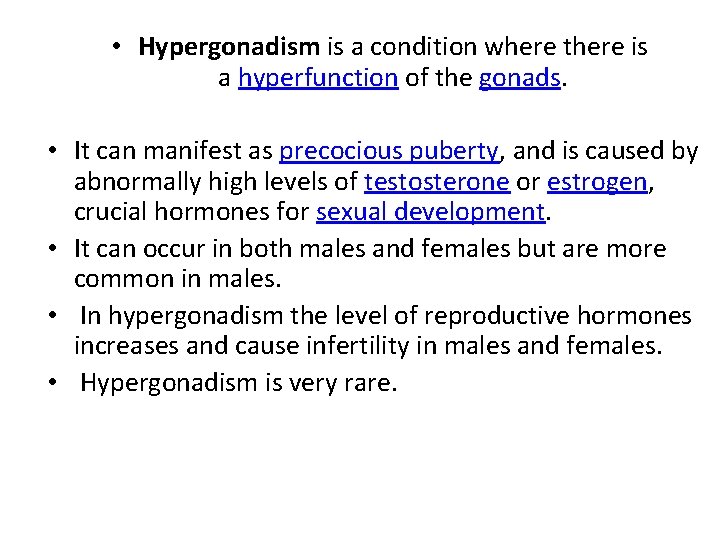
• Hypergonadism is a condition where there is a hyperfunction of the gonads. • It can manifest as precocious puberty, and is caused by abnormally high levels of testosterone or estrogen, crucial hormones for sexual development. • It can occur in both males and females but are more common in males. • In hypergonadism the level of reproductive hormones increases and cause infertility in males and females. • Hypergonadism is very rare.
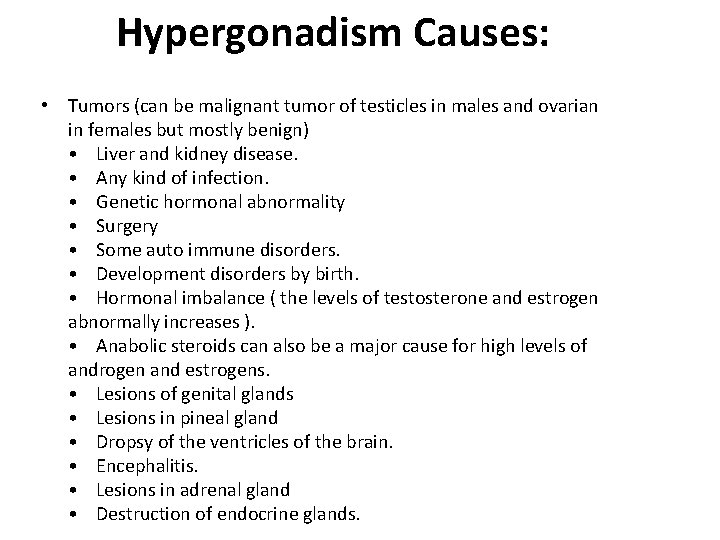
Hypergonadism Causes: • Tumors (can be malignant tumor of testicles in males and ovarian in females but mostly benign) • Liver and kidney disease. • Any kind of infection. • Genetic hormonal abnormality • Surgery • Some auto immune disorders. • Development disorders by birth. • Hormonal imbalance ( the levels of testosterone and estrogen abnormally increases ). • Anabolic steroids can also be a major cause for high levels of androgen and estrogens. • Lesions of genital glands • Lesions in pineal gland • Dropsy of the ventricles of the brain. • Encephalitis. • Lesions in adrenal gland • Destruction of endocrine glands.
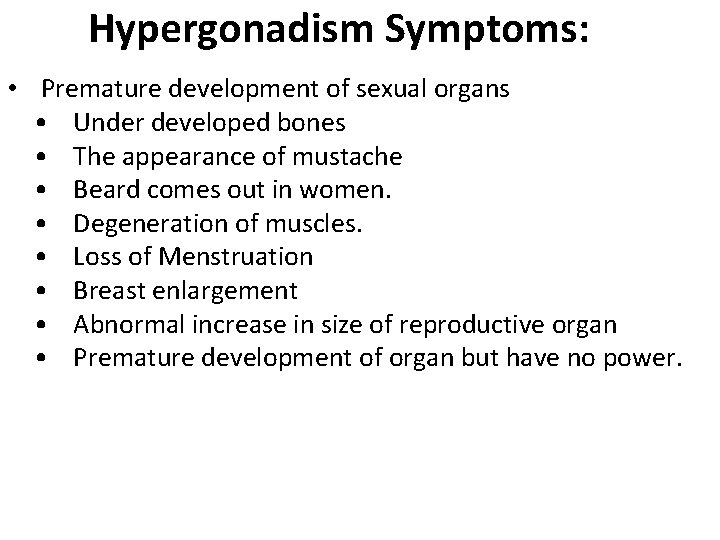
Hypergonadism Symptoms: • Premature development of sexual organs • Under developed bones • The appearance of mustache • Beard comes out in women. • Degeneration of muscles. • Loss of Menstruation • Breast enlargement • Abnormal increase in size of reproductive organ • Premature development of organ but have no power.
Hypergonadism Symptoms: • Sometimes sudden hot flashes of blood comes out in women. • Infertility • Lack of sexual desire in men and women • Loss of beard in men. • Acne • Early baldness • Deepening of voice in women • Irregular menstrual cycle • Coarse body hair in both genders specially