
Views of Value and Competency How Stakeholder and

- Slides: 40
Views of Value and Competency How Stakeholder and Internal Auditor Perspectives Compare
Agenda �Research Project �Results ◦ Competencies ◦ Value ◦ Overall �What Can You Do? �CBOK 2015
The Project � Sponsored by the Institute of Internal Auditors Research Foundation � Championed by Larry Harrington, Vice President of Internal Audit, Raytheon � Researchers: ◦ Vu Pham, Ph. D. , Managing Partner, Spectrum Knowledge, Inc. ◦ Betsy Bosak, Ed. D. , Partner, Spectrum Knowledge, Inc.
Research Questions �How do stakeholders rate internal auditors on the competencies internal auditors use to do their jobs? �How do stakeholders rate the internal audit activity on the value it provides? �How do stakeholders’ perceptions compare to internal auditors’ perceptions about themselves?
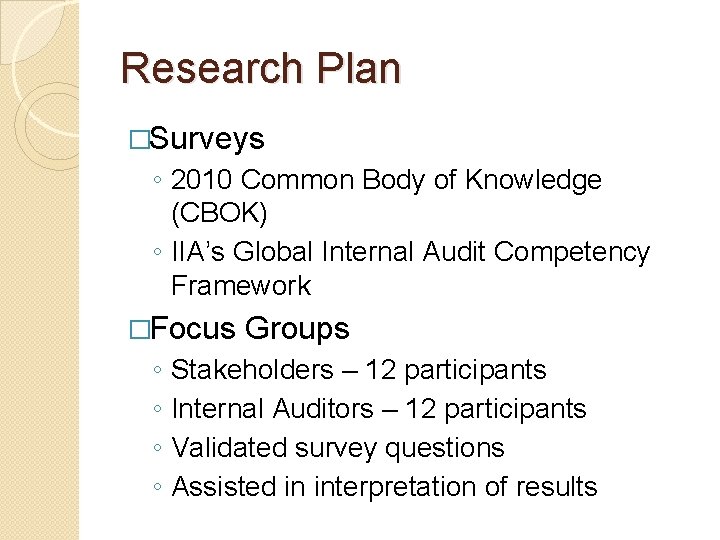
Research Plan �Surveys ◦ 2010 Common Body of Knowledge (CBOK) ◦ IIA’s Global Internal Audit Competency Framework �Focus ◦ ◦ Groups Stakeholders – 12 participants Internal Auditors – 12 participants Validated survey questions Assisted in interpretation of results
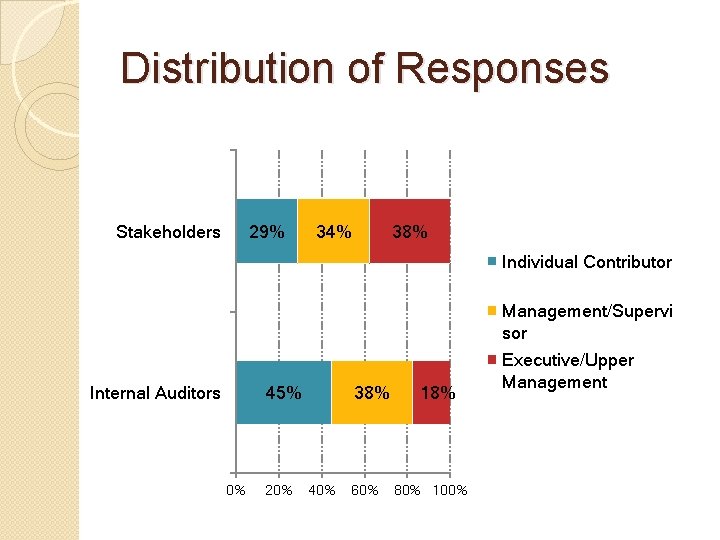
Distribution of Responses Stakeholders 29% 34% 38% Individual Contributor Management/Supervi sor Internal Auditors 45% 0% 20% 38% 40% 60% 18% 80% 100% Executive/Upper Management
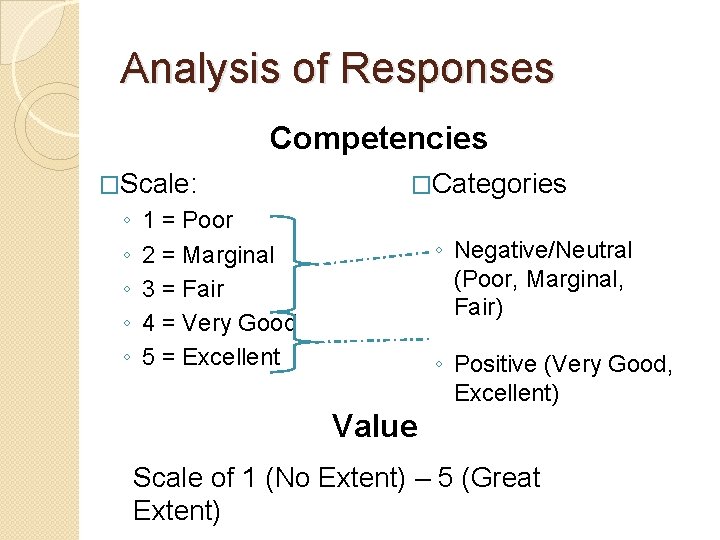
Analysis of Responses Competencies �Scale: ◦ ◦ ◦ �Categories 1 = Poor 2 = Marginal 3 = Fair 4 = Very Good 5 = Excellent ◦ Negative/Neutral (Poor, Marginal, Fair) ◦ Positive (Very Good, Excellent) Value Scale of 1 (No Extent) – 5 (Great Extent)
Competencies
Categories of Competencies �General �Behavioral �Technical
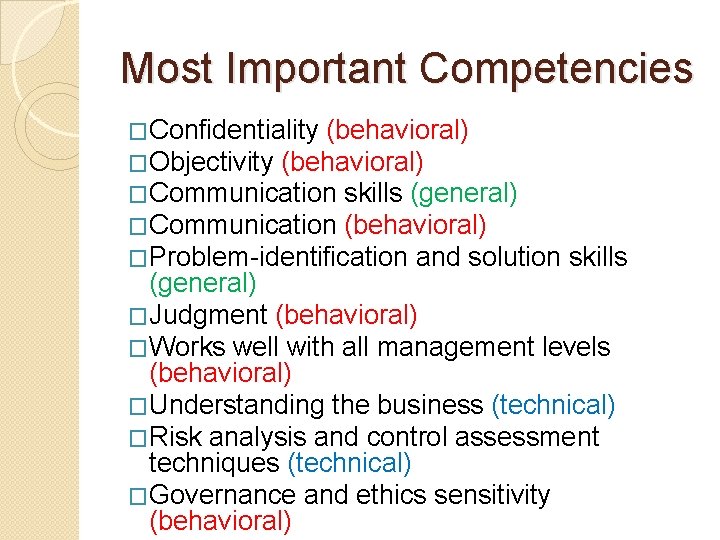
Most Important Competencies �Confidentiality (behavioral) �Objectivity (behavioral) �Communication skills (general) �Communication (behavioral) �Problem-identification and solution skills (general) �Judgment (behavioral) �Works well with all management levels (behavioral) �Understanding the business (technical) �Risk analysis and control assessment techniques (technical) �Governance and ethics sensitivity (behavioral)
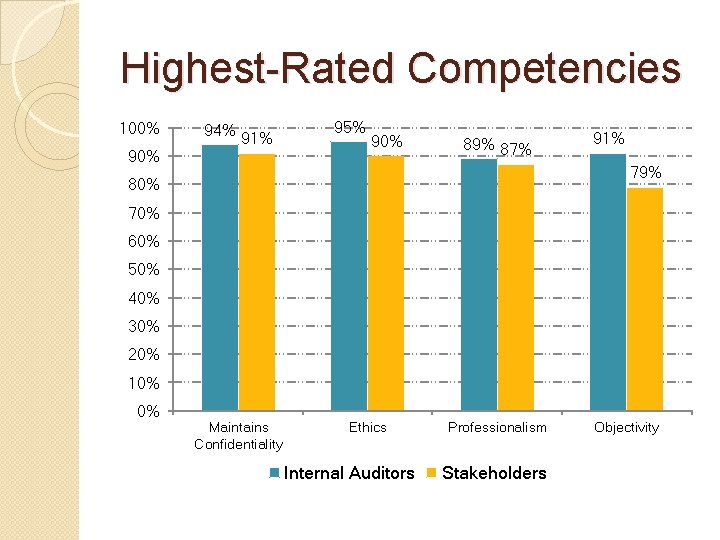
Highest-Rated Competencies 100% 94% 91% 95% 90% 89% 87% 91% 79% 80% 70% 60% 50% 40% 30% 20% 10% 0% Maintains Confidentiality Ethics Internal Auditors Professionalism Stakeholders Objectivity
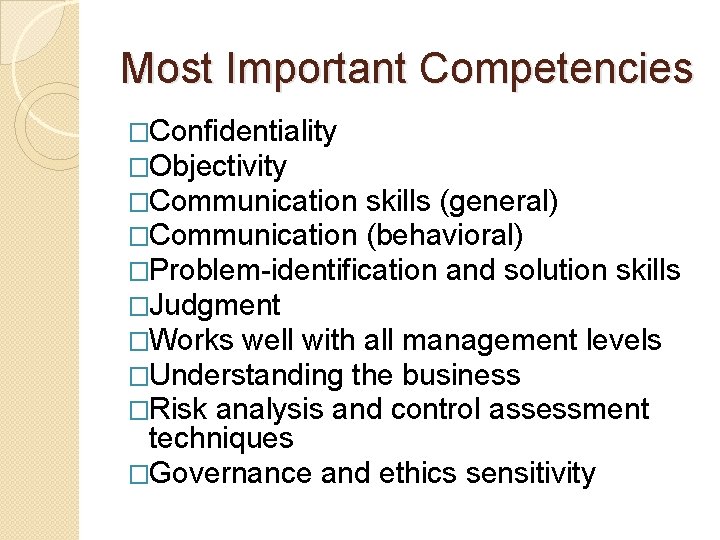
Most Important Competencies �Confidentiality �Objectivity �Communication skills (general) �Communication (behavioral) �Problem-identification and solution skills �Judgment �Works well with all management levels �Understanding the business �Risk analysis and control assessment techniques �Governance and ethics sensitivity
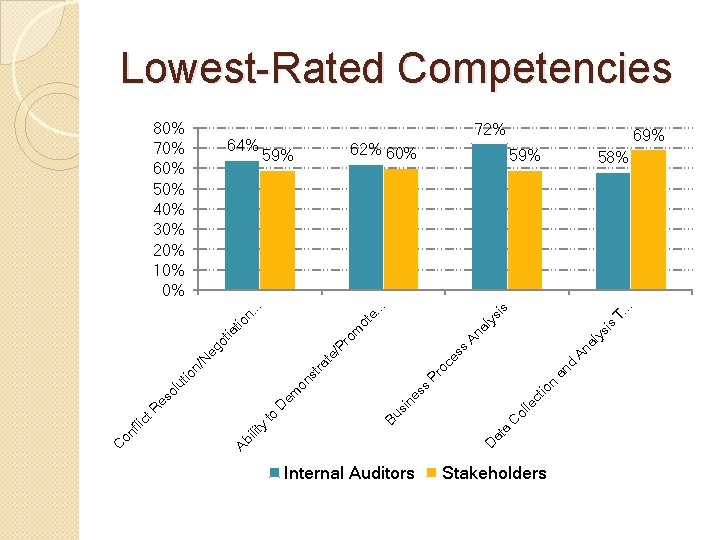
a at D to Internal Auditors C d an ys is T. . . si s al y An An al ss oc e Pr io n ct ol le ss e. . . om ot Pr e/ ra t 59% si ne on st em D . . n. 64% Bu y ilit ot ia tio eg n/ N io ut es ol lic t. R on f 80% 70% 60% 50% 40% 30% 20% 10% 0% Ab C Lowest-Rated Competencies 72% 60% 69% 59% Stakeholders 58%
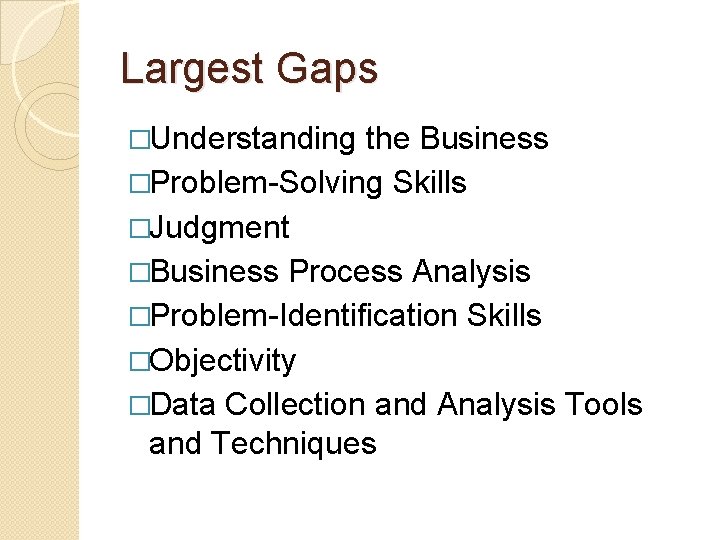
Largest Gaps �Understanding the Business �Problem-Solving Skills �Judgment �Business Process Analysis �Problem-Identification Skills �Objectivity �Data Collection and Analysis Tools and Techniques
A CLOSER LOOK AT THE GAPS
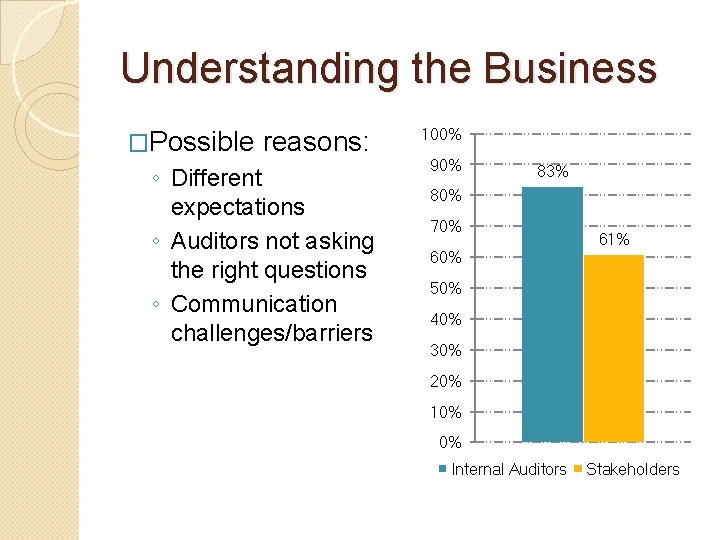
Understanding the Business �Possible reasons: ◦ Different expectations ◦ Auditors not asking the right questions ◦ Communication challenges/barriers 100% 90% 83% 80% 70% 61% 60% 50% 40% 30% 20% 10% 0% Internal Auditors Stakeholders
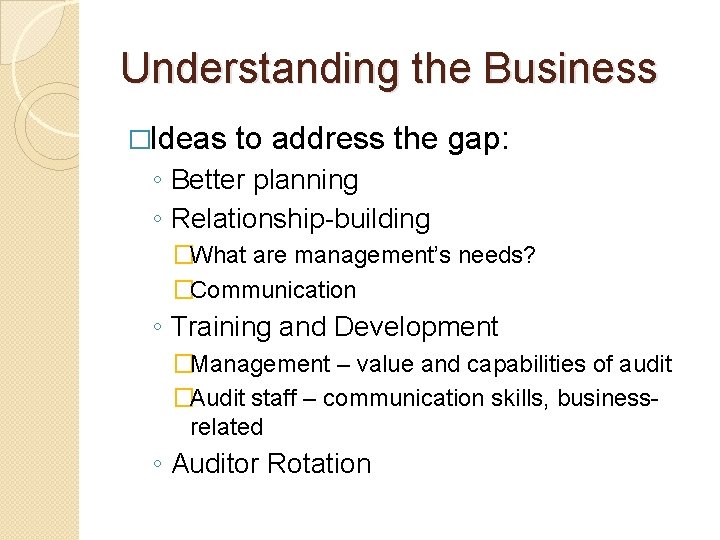
Understanding the Business �Ideas to address the gap: ◦ Better planning ◦ Relationship-building �What are management’s needs? �Communication ◦ Training and Development �Management – value and capabilities of audit �Audit staff – communication skills, businessrelated ◦ Auditor Rotation
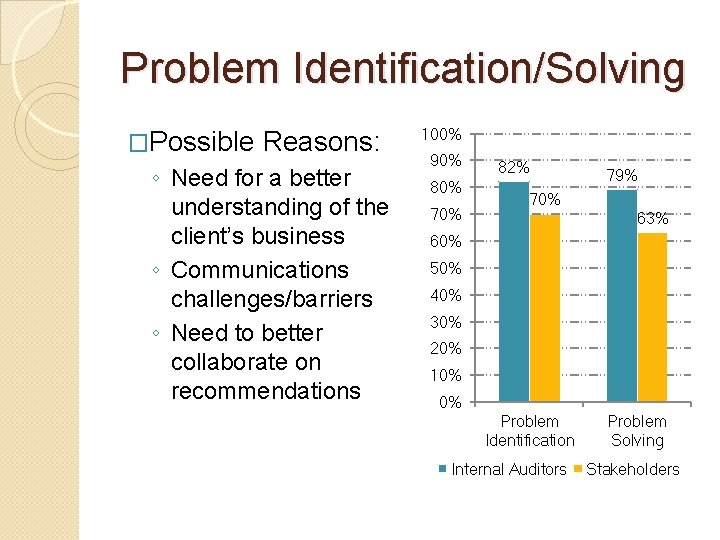
Problem Identification/Solving �Possible Reasons: ◦ Need for a better understanding of the client’s business ◦ Communications challenges/barriers ◦ Need to better collaborate on recommendations 100% 90% 80% 70% 82% 79% 70% 63% 60% 50% 40% 30% 20% 10% 0% Problem Identification Internal Auditors Problem Solving Stakeholders
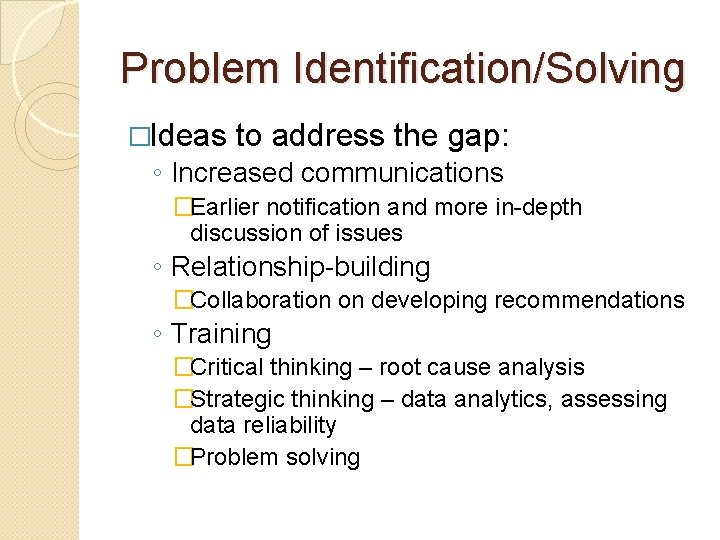
Problem Identification/Solving �Ideas to address the gap: ◦ Increased communications �Earlier notification and more in-depth discussion of issues ◦ Relationship-building �Collaboration on developing recommendations ◦ Training �Critical thinking – root cause analysis �Strategic thinking – data analytics, assessing data reliability �Problem solving
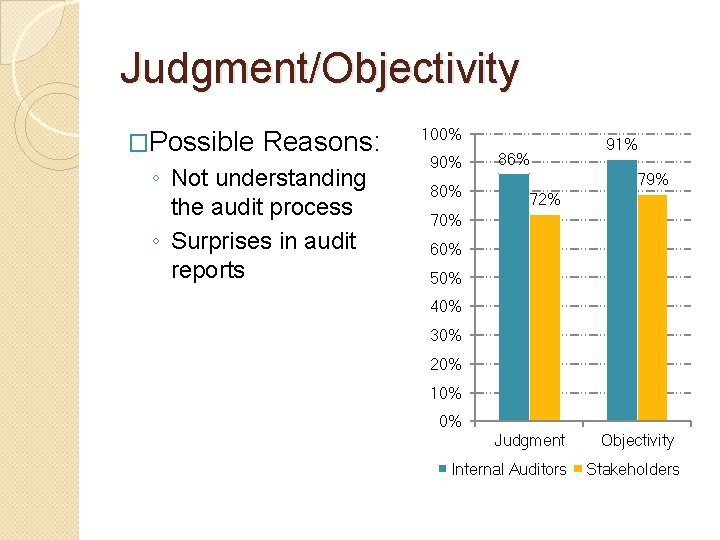
Judgment/Objectivity �Possible Reasons: ◦ Not understanding the audit process ◦ Surprises in audit reports 100% 90% 86% 91% 79% 72% 70% 60% 50% 40% 30% 20% 10% 0% Judgment Internal Auditors Objectivity Stakeholders
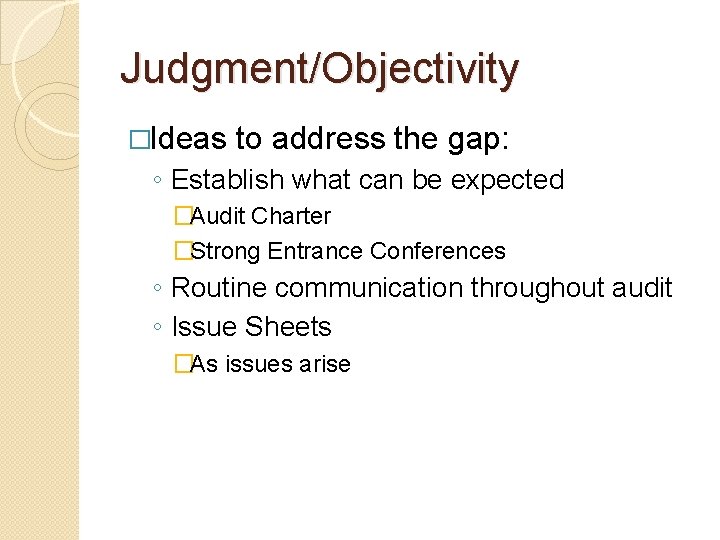
Judgment/Objectivity �Ideas to address the gap: ◦ Establish what can be expected �Audit Charter �Strong Entrance Conferences ◦ Routine communication throughout audit ◦ Issue Sheets �As issues arise
Other Lower-Rated Competencies �Conflict Resolution/Negotiation Skills ◦ Training ◦ Practice �Ability to Demonstrate/Promote the Value of the Internal Audit Function ◦ Participation on task forces ◦ Assignment to special projects ◦ Communications during audits
Putting the Results to Action �Capitalize on the highest rated competencies ◦ What services can you offer that include these? ◦ How do you get the word out? �Identify training opportunities for competencies rated lower
Perceptions of Value
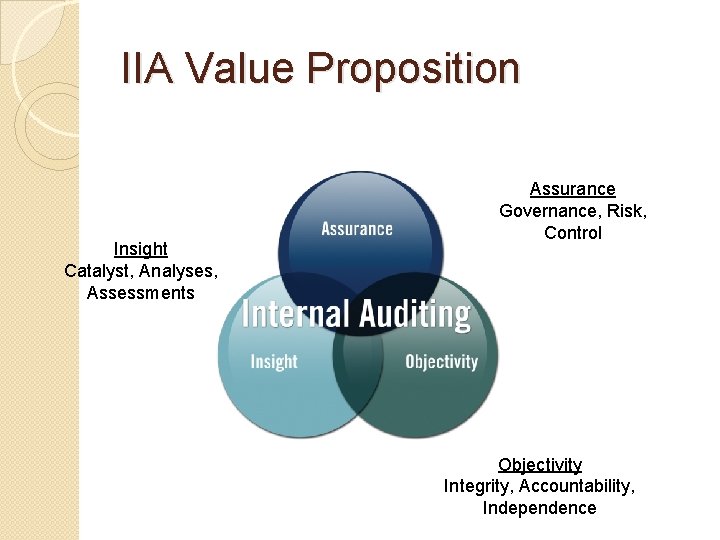
IIA Value Proposition Insight Catalyst, Analyses, Assessments Assurance Governance, Risk, Control Objectivity Integrity, Accountability, Independence
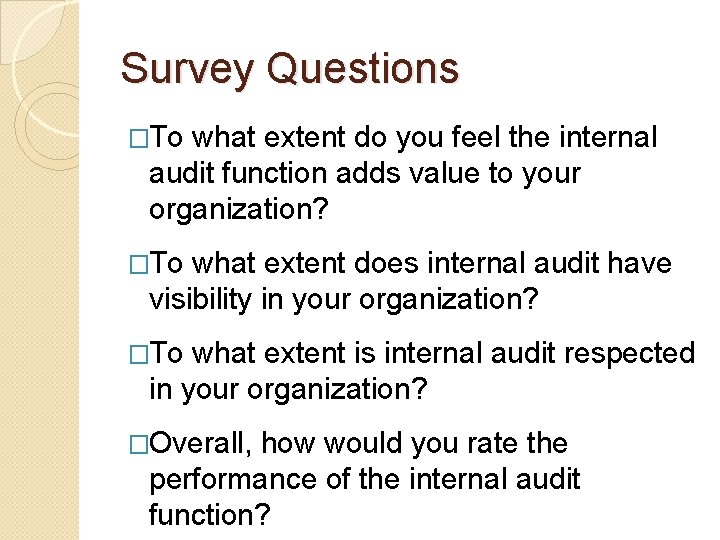
Survey Questions �To what extent do you feel the internal audit function adds value to your organization? �To what extent does internal audit have visibility in your organization? �To what extent is internal audit respected in your organization? �Overall, how would you rate the performance of the internal audit function?
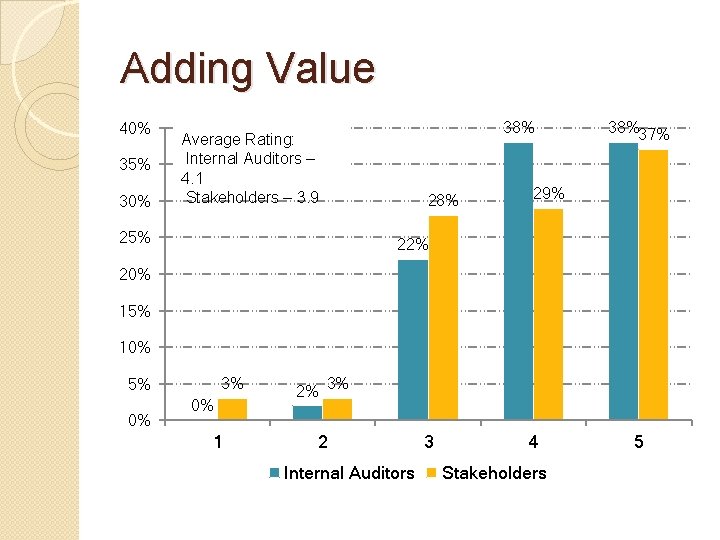
Adding Value 40% 35% 30% 38% Average Rating: Internal Auditors – 4. 1 Stakeholders – 3. 9 25% 28% 38%37% 29% 22% 20% 15% 10% 3% 5% 0% 0% 1 2% 3% 2 Internal Auditors 3 4 Stakeholders 5
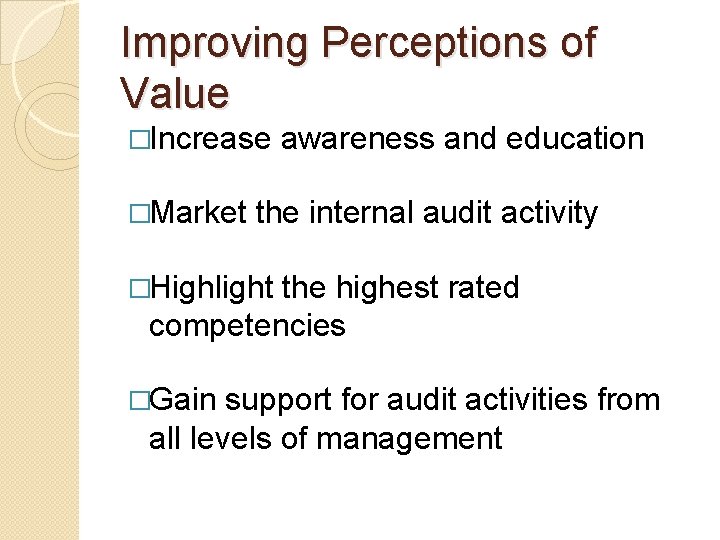
Improving Perceptions of Value �Increase �Market awareness and education the internal audit activity �Highlight the highest rated competencies �Gain support for audit activities from all levels of management
Improving Perceptions of Value �Improve �Build communication client relationships �Provide practical solutions
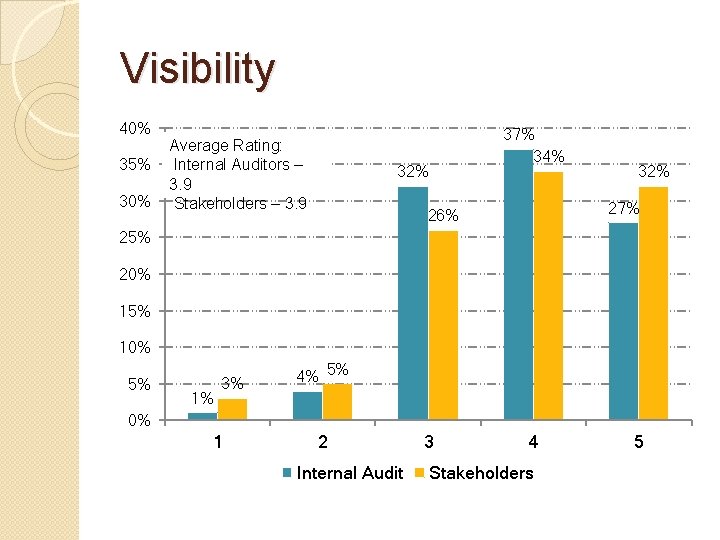
Visibility 40% 35% 30% Average Rating: Internal Auditors – 3. 9 Stakeholders – 3. 9 32% 37% 34% 32% 27% 26% 25% 20% 15% 10% 5% 1% 3% 4% 5% 0% 1 2 Internal Audit 3 4 Stakeholders 5
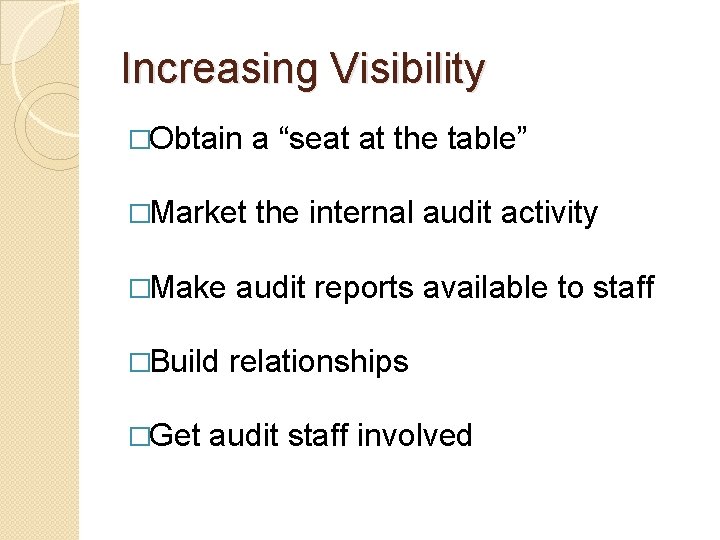
Increasing Visibility �Obtain a “seat at the table” �Market the internal audit activity �Make audit reports available to staff �Build relationships �Get audit staff involved
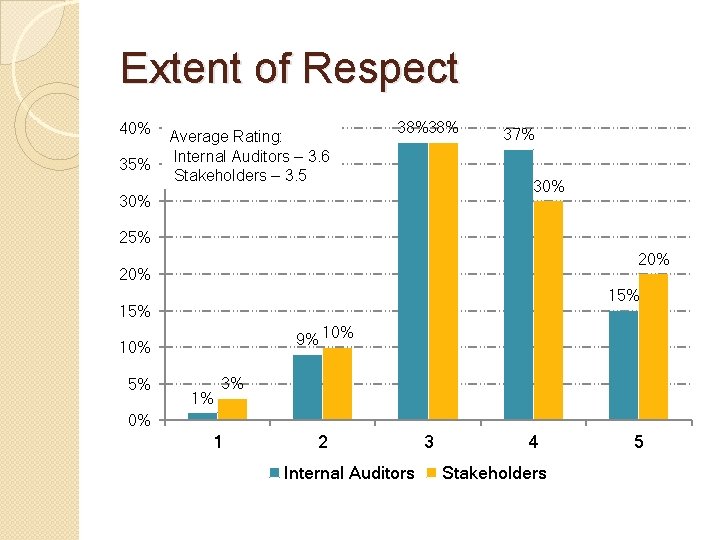
Extent of Respect 40% 35% Average Rating: Internal Auditors – 3. 6 Stakeholders – 3. 5 38%38% 37% 30% 25% 20% 15% 9% 10% 5% 1% 3% 0% 1 2 Internal Auditors 3 4 Stakeholders 5
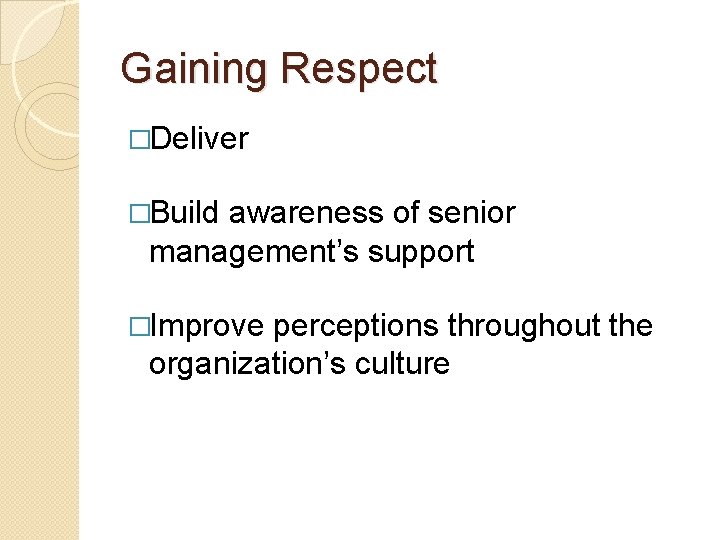
Gaining Respect �Deliver �Build awareness of senior management’s support �Improve perceptions throughout the organization’s culture
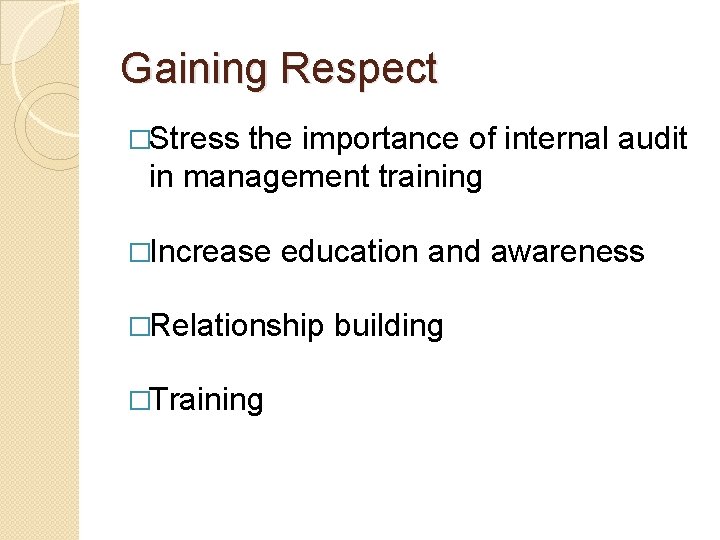
Gaining Respect �Stress the importance of internal audit in management training �Increase education and awareness �Relationship �Training building
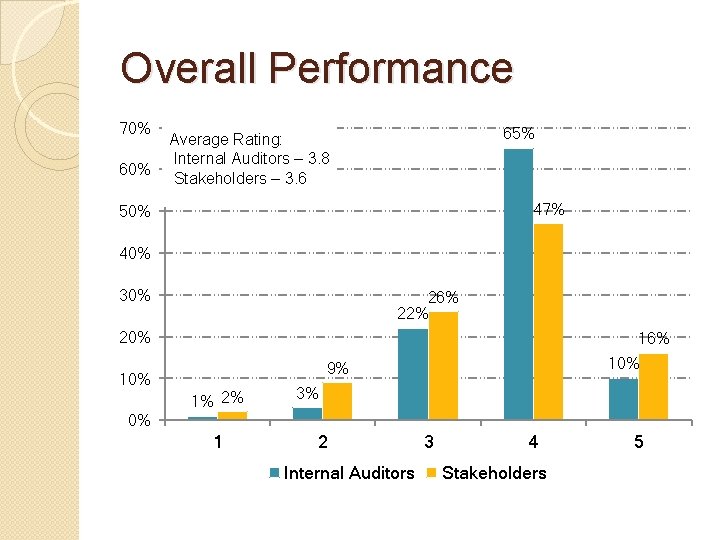
Overall Performance 70% 65% Average Rating: Internal Auditors – 3. 8 Stakeholders – 3. 6 47% 50% 40% 30% 26% 22% 20% 16% 10% 9% 10% 1% 2% 3% 0% 1 2 Internal Auditors 3 4 Stakeholders 5
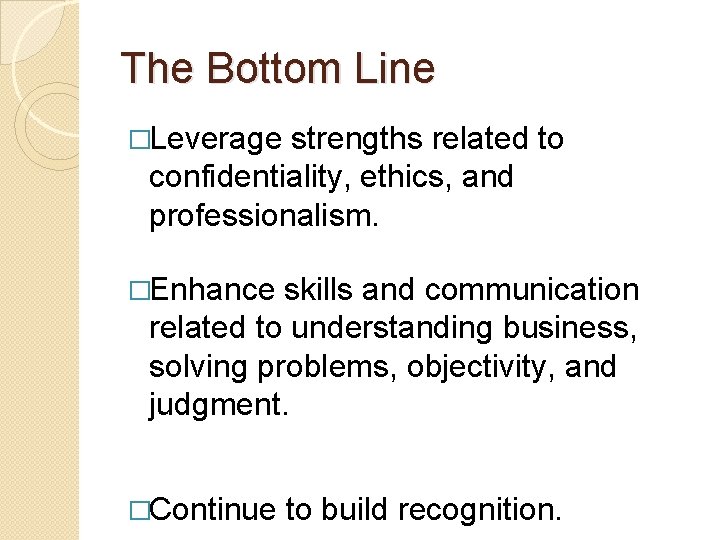
The Bottom Line �Leverage strengths related to confidentiality, ethics, and professionalism. �Enhance skills and communication related to understanding business, solving problems, objectivity, and judgment. �Continue to build recognition.
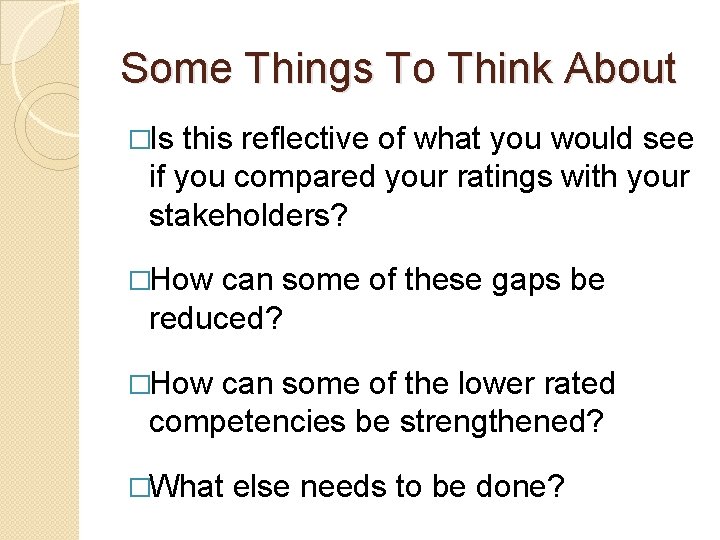
Some Things To Think About �Is this reflective of what you would see if you compared your ratings with your stakeholders? �How can some of these gaps be reduced? �How can some of the lower rated competencies be strengthened? �What else needs to be done?
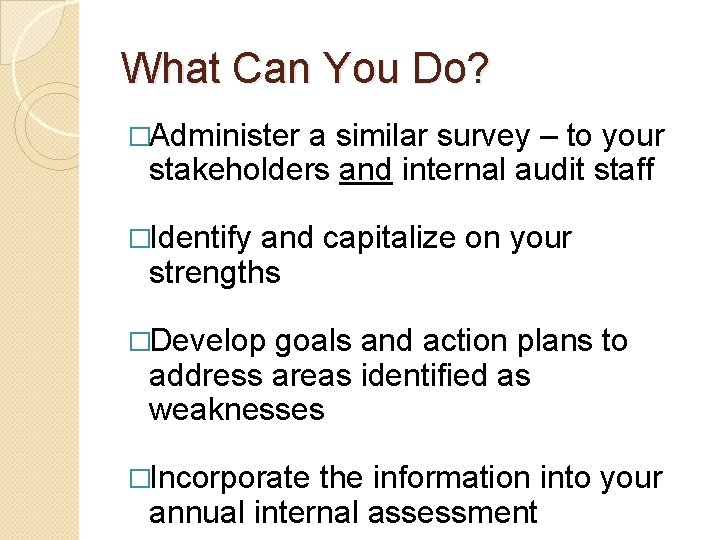
What Can You Do? �Administer a similar survey – to your stakeholders and internal audit staff �Identify and capitalize on your strengths �Develop goals and action plans to address areas identified as weaknesses �Incorporate the information into your annual internal assessment
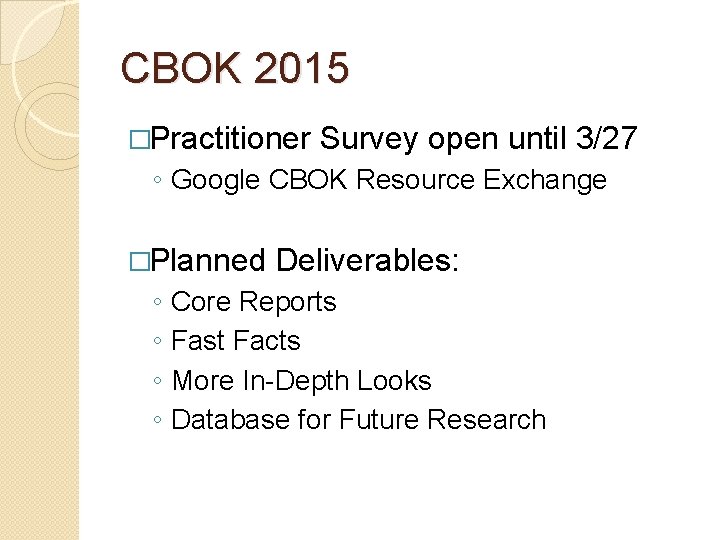
CBOK 2015 �Practitioner Survey open until 3/27 ◦ Google CBOK Resource Exchange �Planned ◦ ◦ Deliverables: Core Reports Fast Facts More In-Depth Looks Database for Future Research
Any Questions? �Contact Information: Karin Hill, CIA, CGAP, CRMA Director of Internal Audit Dept. of Assistive and Rehabilitative Services Karin. Hill@dars. state. tx. us 512 -424 -4021