
View Points Differential String Analysis for Discovering Client

- Slides: 47
View. Points: Differential String Analysis for Discovering Client- and Server-Side Input Validation Inconsistencies Muath Alkhalaf 1 Shauvik Roy Choudhary 2 Mattia Fazzini 2 Tevfik Bultan 1 Alessandro Orso 2 Christopher Kruegel 1 1 UC Santa Barbara 2 Georgia Tech
Web Software is Becoming Increasingly Dominant � Web applications are used extensively in many areas: � We will rely on web applications more in the future: � Web software is also rapidly replacing desktop applications 2
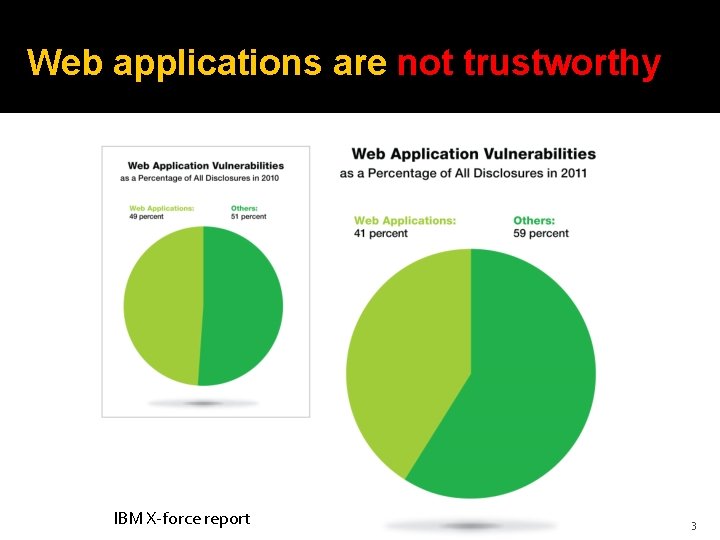
Web applications are not trustworthy IBM X-force report 3
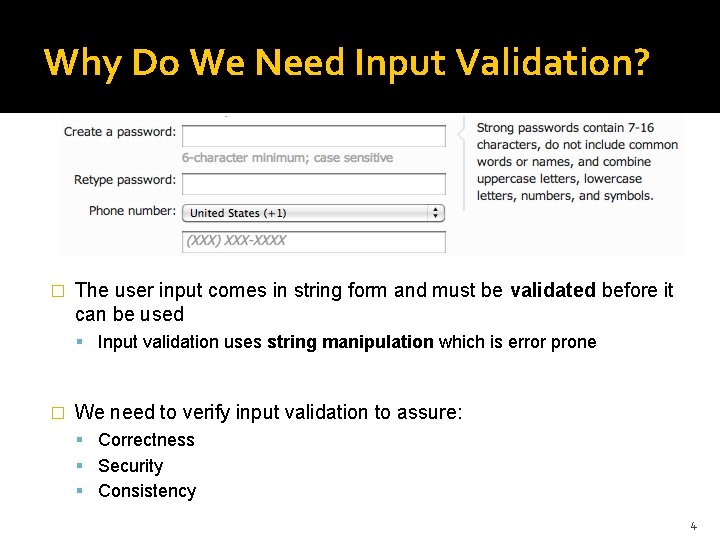
Why Do We Need Input Validation? � The user input comes in string form and must be validated before it can be used Input validation uses string manipulation which is error prone � We need to verify input validation to assure: Correctness Security Consistency 4
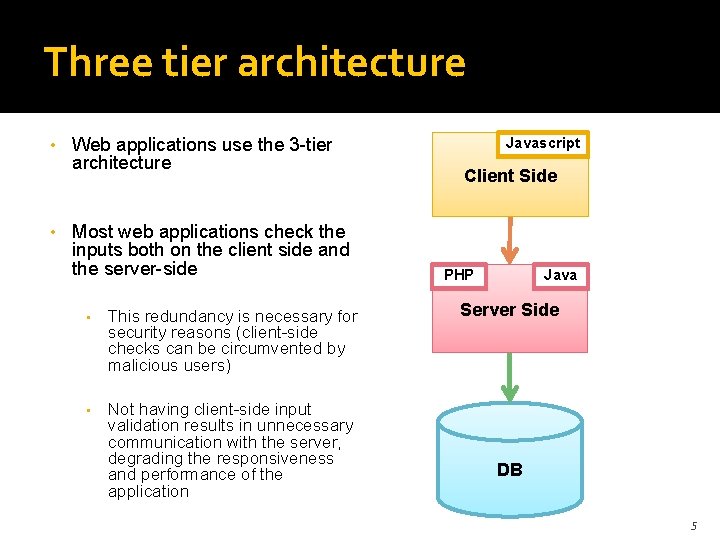
Three tier architecture • • Web applications use the 3 -tier architecture Most web applications check the inputs both on the client side and the server-side • This redundancy is necessary for security reasons (client-side checks can be circumvented by malicious users) • Not having client-side input validation results in unnecessary communication with the server, degrading the responsiveness and performance of the application Javascript Client Side PHP Java Server Side DB 5
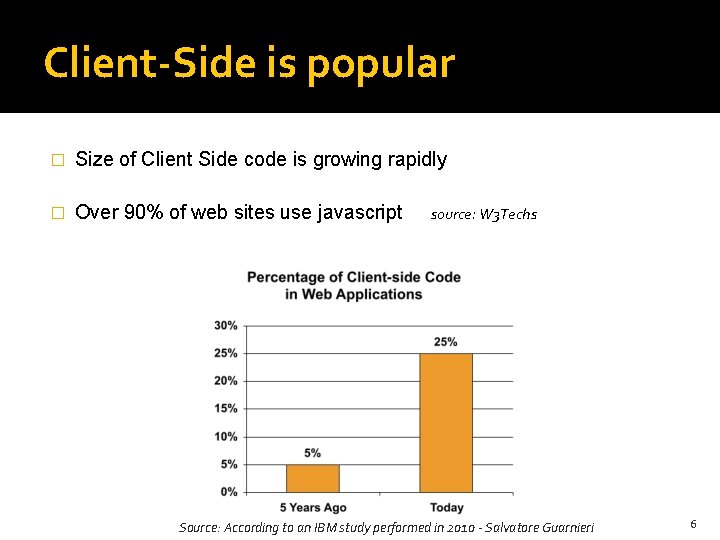
Client-Side is popular � Size of Client Side code is growing rapidly � Over 90% of web sites use javascript source: W 3 Techs Source: According to an IBM study performed in 2010 - Salvatore Guarnieri 6
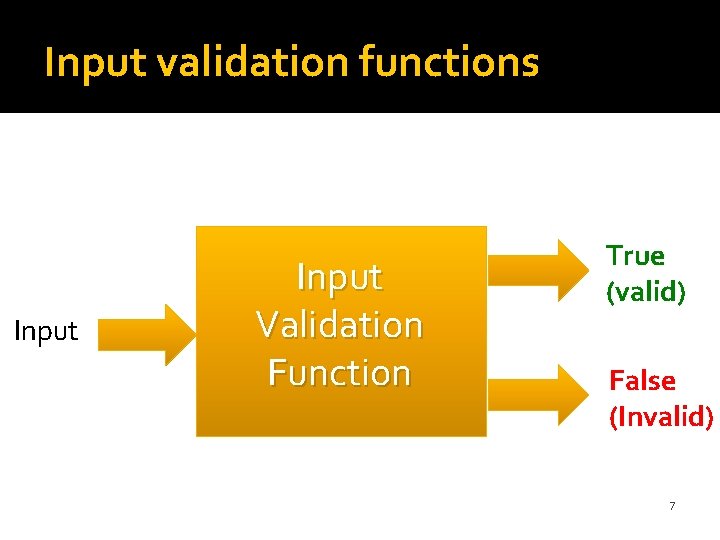
Input validation functions Input Validation Function True (valid) False (Invalid) 7
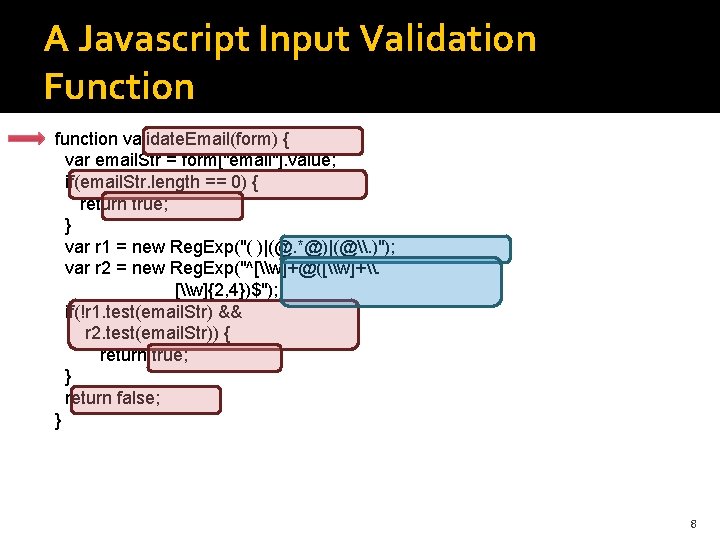
A Javascript Input Validation Function function validate. Email(form) { var email. Str = form["email"]. value; if(email. Str. length == 0) { return true; } var r 1 = new Reg. Exp("( )|(@. *@)|(@\. )"); var r 2 = new Reg. Exp("^[\w]+@([\w]+\. [\w]{2, 4})$"); if(!r 1. test(email. Str) && r 2. test(email. Str)) { return true; } return false; } 8
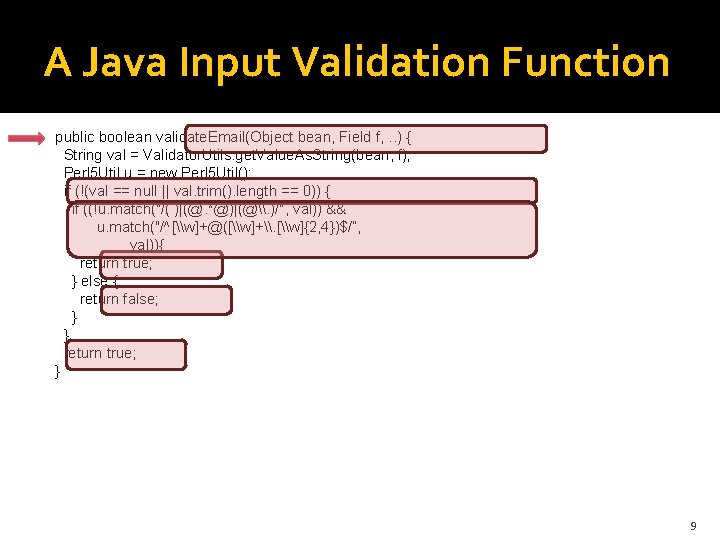
A Java Input Validation Function public boolean validate. Email(Object bean, Field f, . . ) { String val = Validator. Utils. get. Value. As. String(bean, f); Perl 5 Util u = new Perl 5 Util(); if (!(val == null || val. trim(). length == 0)) { if ((!u. match("/( )|(@. *@)|(@\. )/", val)) && u. match("/^[\w]+@([\w]+\. [\w]{2, 4})$/”, val)){ return true; } else { return false; } } return true; } 9
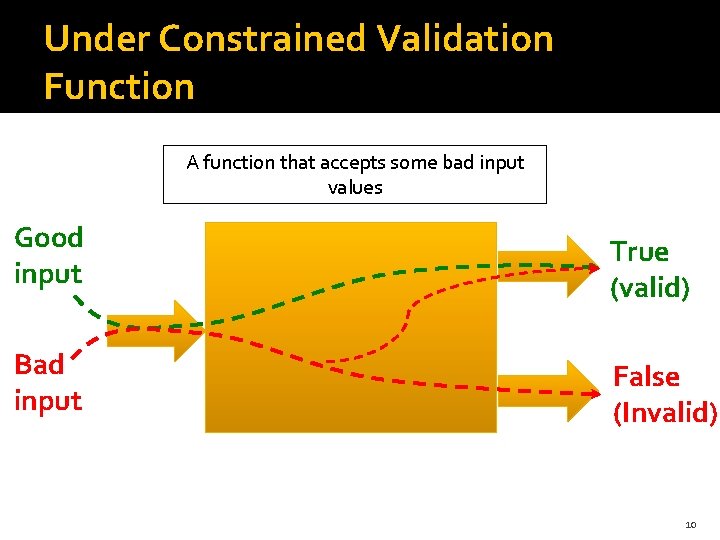
Under Constrained Validation Function A function that accepts some bad input values Good input True (valid) Bad input False (Invalid) 10
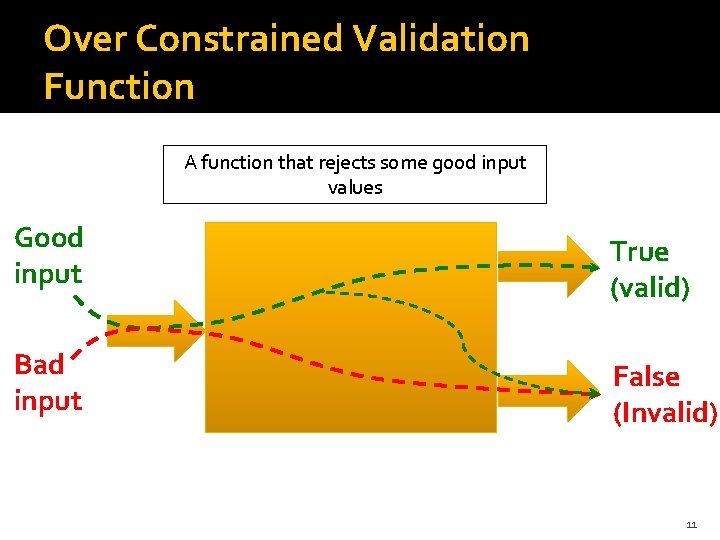
Over Constrained Validation Function A function that rejects some good input values Good input True (valid) Bad input False (Invalid) 11
How to Check Validation Function Correctness? � How can we check the validation functions? � One approach that has been used in the past: Specify the input validation policy as a regular expression (attack patterns, max & min policies) and then use string analysis to check that validation functions conform to the given policy. � Someone has to manually write the input validation policies If the input validation policies are specific for each web application, then the developers have to write different policies for each application, which could be error prone 12
Differential Analysis � The approach we present in this paper does not require developers to write specific policies � Basic idea: Use the inherent redundancy in input validation to check the correctness of the input validation functions 13
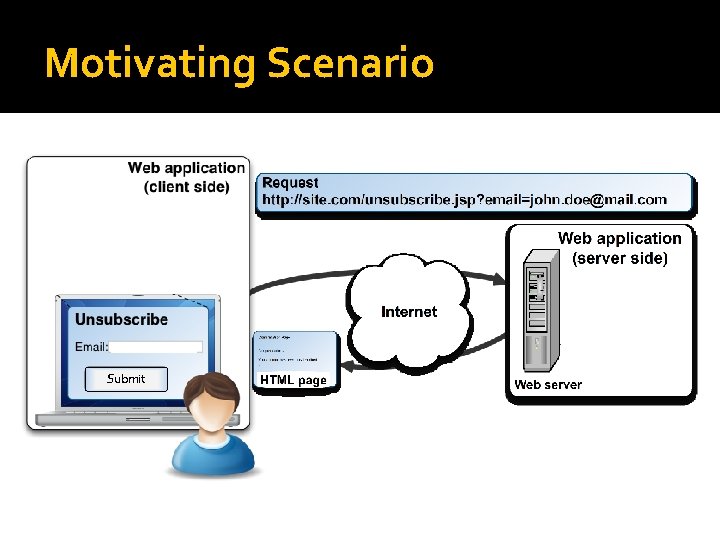
Motivating Scenario Submit
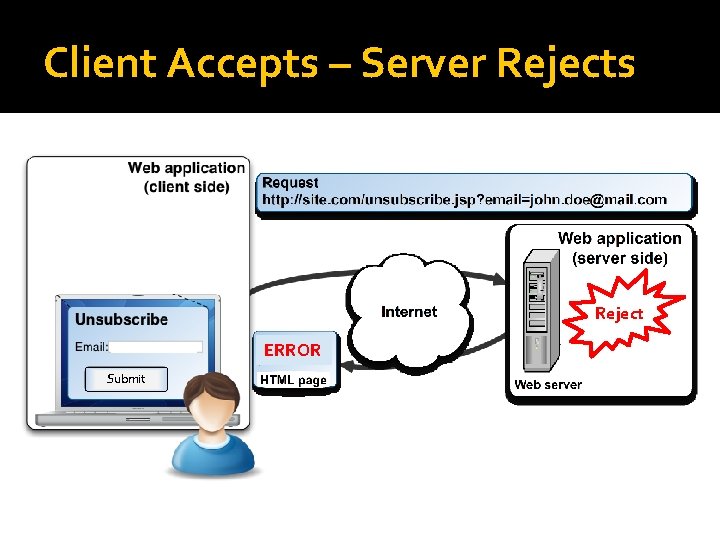
Client Accepts – Server Rejects Reject ERROR Submit
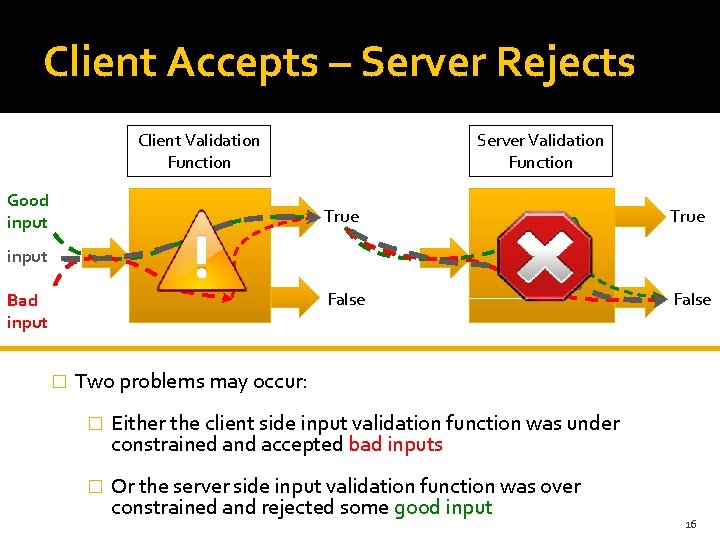
Client Accepts – Server Rejects Client Validation Function Good input Server Validation Function True False input Bad input � Two problems may occur: � Either the client side input validation function was under constrained and accepted bad inputs � Or the server side input validation function was over constrained and rejected some good input 16
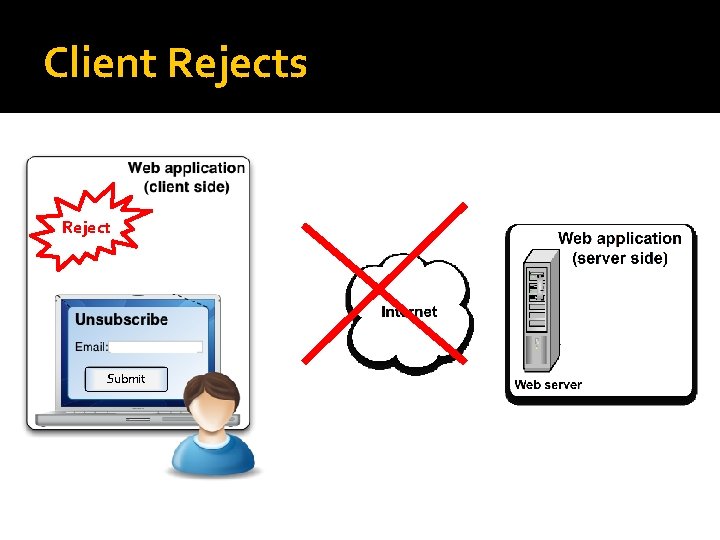
Client Rejects Reject Submit
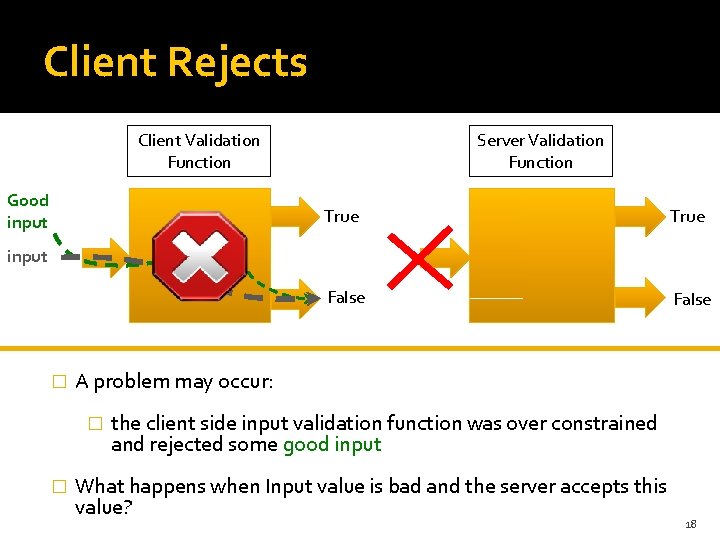
Client Rejects Client Validation Function Good input Server Validation Function True False input � A problem may occur: � � the client side input validation function was over constrained and rejected some good input What happens when Input value is bad and the server accepts this value? 18
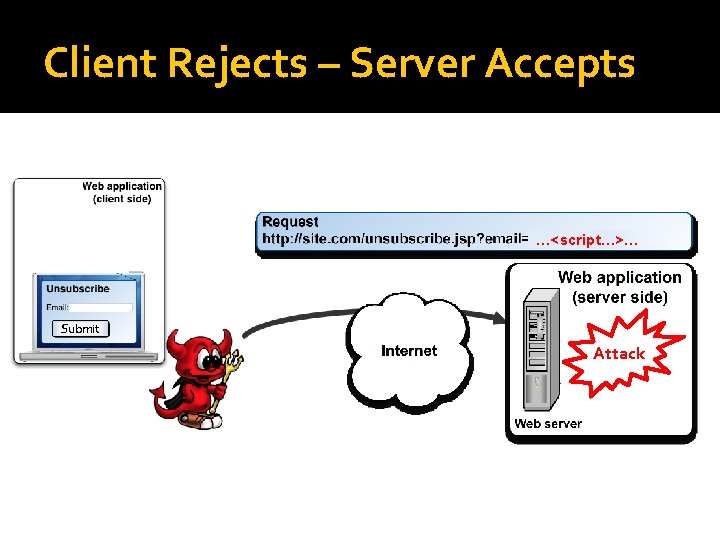
Client Rejects – Server Accepts …<script…>… Submit Attack
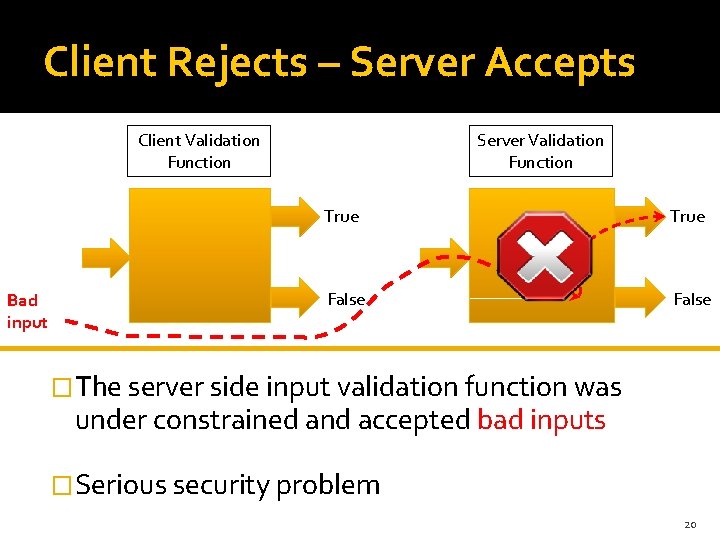
Client Rejects – Server Accepts Client Validation Function Bad input Server Validation Function True False �The server side input validation function was under constrained and accepted bad inputs �Serious security problem 20
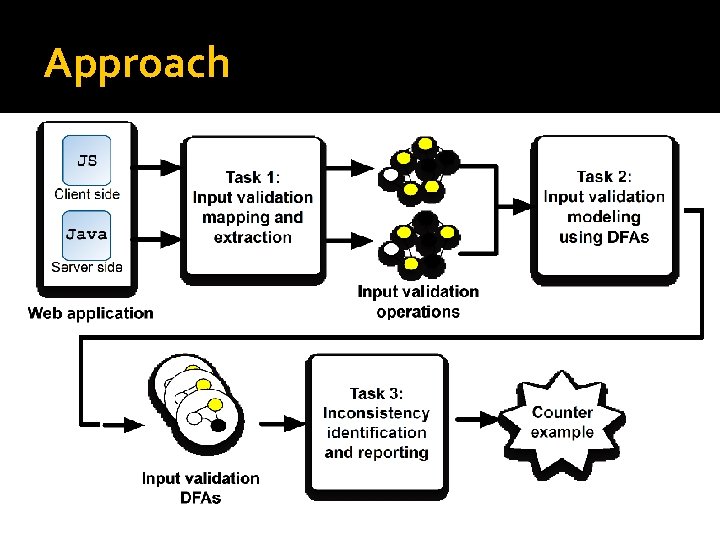
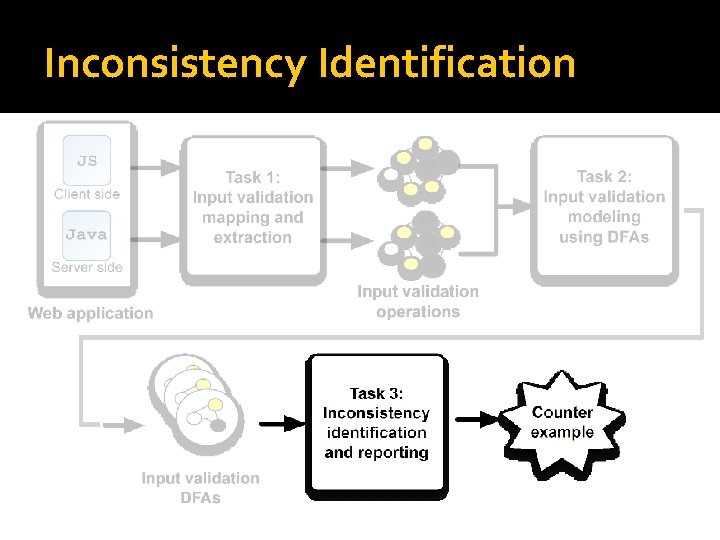
Approach
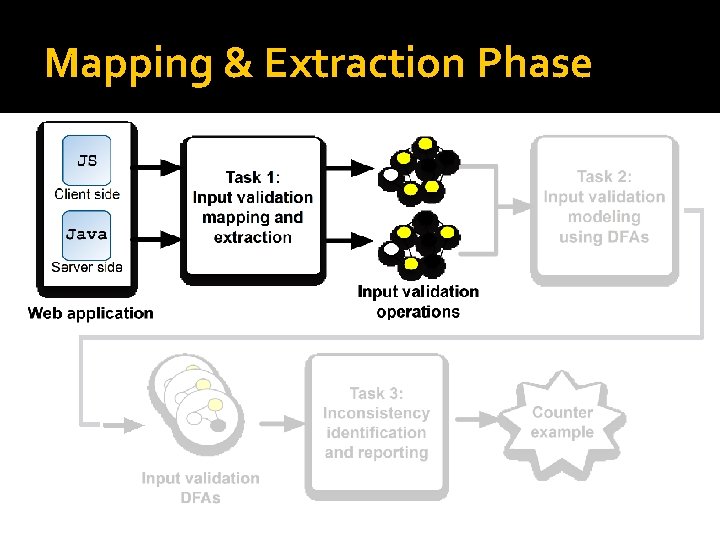
Mapping & Extraction Phase
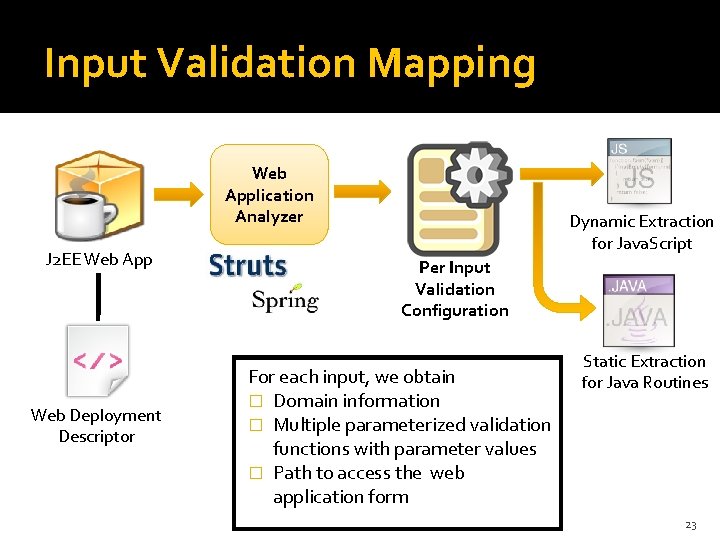
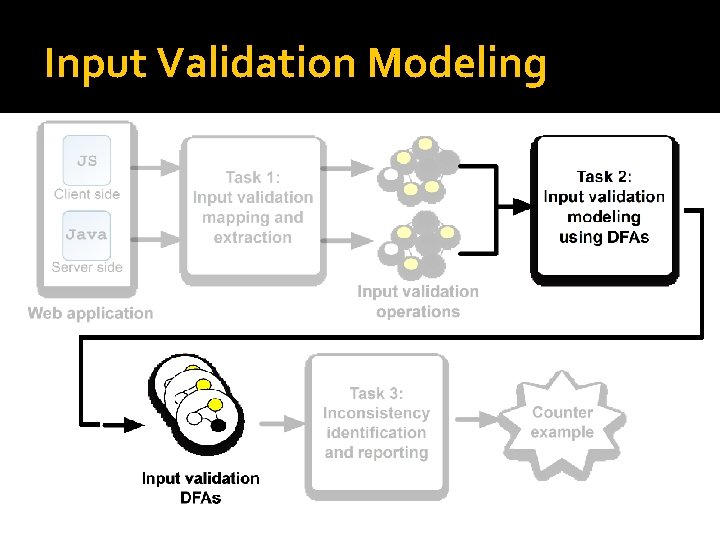
Input Validation Mapping Web Application Analyzer J 2 EE Web App Web Deployment Descriptor Dynamic Extraction for Java. Script Per Input Validation Configuration For each input, we obtain � Domain information � Multiple parameterized validation functions with parameter values � Path to access the web application form Static Extraction for Java Routines 23
Dynamic Extraction for Javascript � Why extraction Lots of event handling, error reporting and rendering code � Why dynamic? Javascript is very dynamic Object oriented Prototype inheritance Closures Dynamically typed eval 24
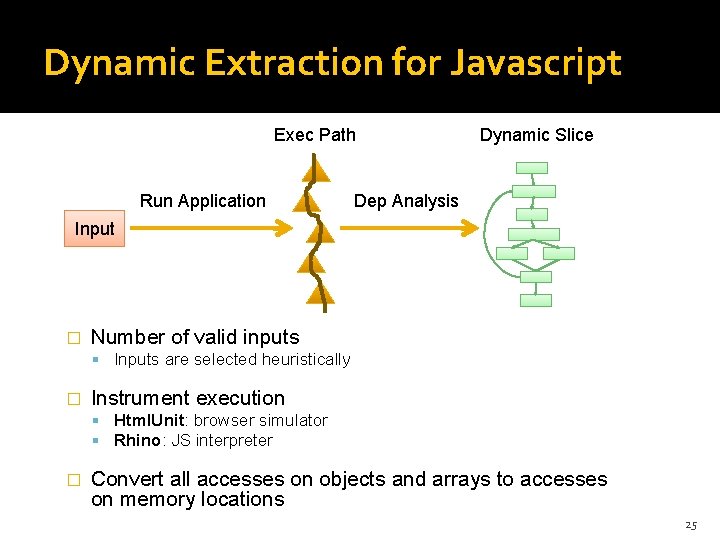
Dynamic Extraction for Javascript Exec Path Run Application Dynamic Slice Dep Analysis Input � Number of valid inputs Inputs are selected heuristically � Instrument execution Html. Unit: browser simulator Rhino: JS interpreter � Convert all accesses on objects and arrays to accesses on memory locations 25
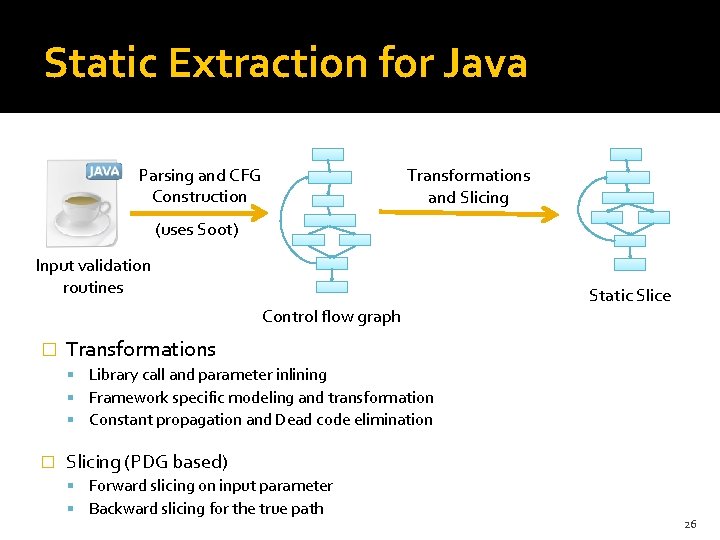
Static Extraction for Java Parsing and CFG Construction Transformations and Slicing (uses Soot) Input validation routines Control flow graph � Static Slice Transformations Library call and parameter inlining Framework specific modeling and transformation Constant propagation and Dead code elimination � Slicing (PDG based) Forward slicing on input parameter Backward slicing for the true path 26
Input Validation Modeling
Compute Client & Server DFAs � Compute two automata for each input field: Client-Side DFA Ac ▪ L(Ac) Over approximation of set of values accepted by client-side input validation function Server-Side DFA As ▪ L(As) Over approximation of set of values accepted by server-side input validation function � We use automata based static string analysis to compute L(Ac) and L(As) 28
Static String Analysis � Static string analysis determines all possible values that a string expression can take during any program execution We use automata based string analysis Associate each string expression in the program with an automaton The automaton accepts an over approximation of all possible values that the string expression can take during program execution � We built our javascript string analysis on Closure compiler from Google and java string analysis on Soot � Flow sensitive, intraprocedural and path sensitive 29
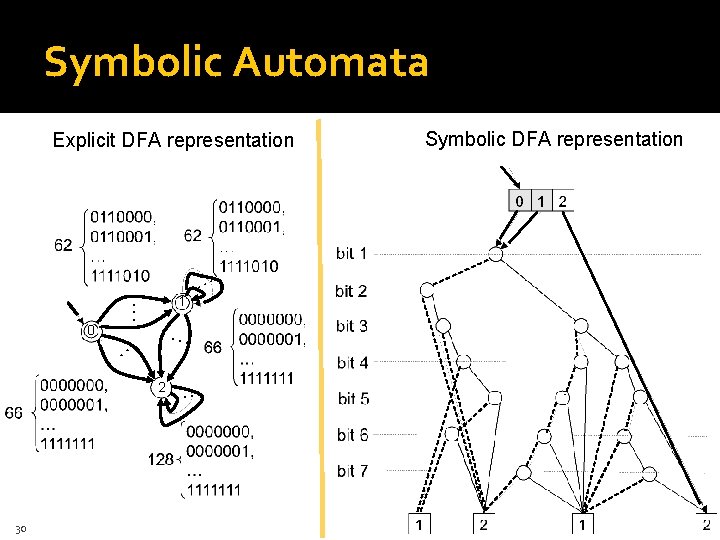
Symbolic Automata Explicit DFA representation . . . 1 . . . 0 . . . 30 . . . 2 Symbolic DFA representation
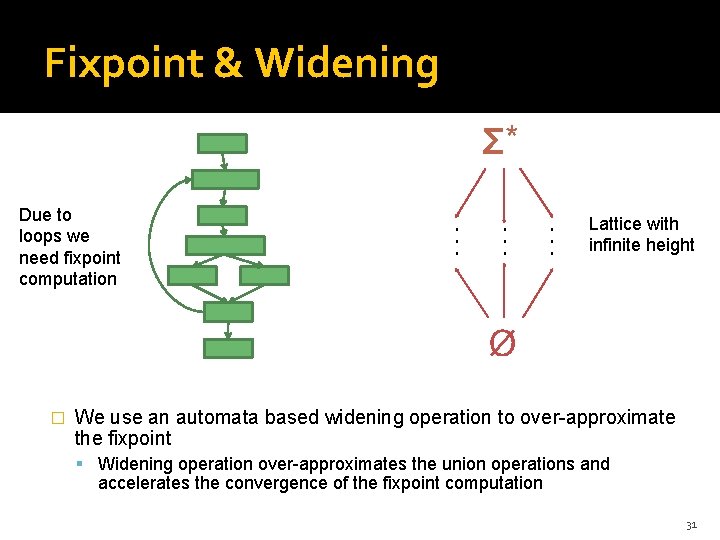
Fixpoint & Widening Σ* Due to loops we need fixpoint computation . . Lattice with infinite height Ø � We use an automata based widening operation to over-approximate the fixpoint Widening operation over-approximates the union operations and accelerates the convergence of the fixpoint computation 31
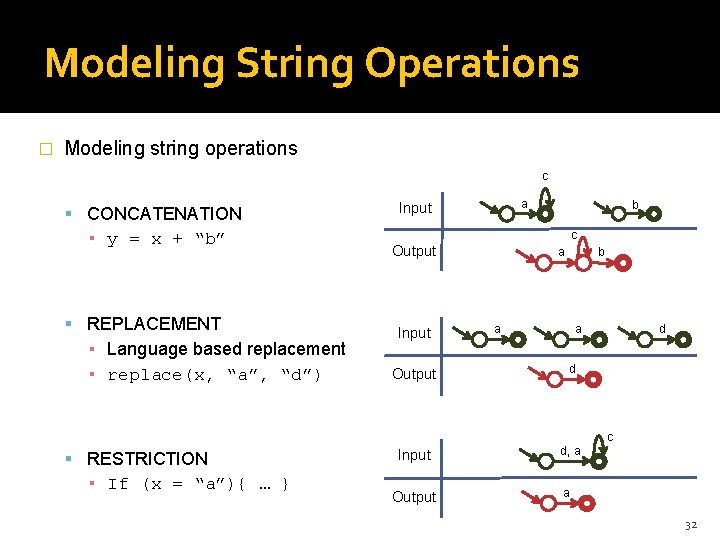
Modeling String Operations � Modeling string operations c CONCATENATION ▪ y = x + “b” REPLACEMENT ▪ Language based replacement ▪ replace(x, “a”, “d”) RESTRICTION ▪ If (x = “a”){ … } a Input b c Output Input b a a a Output d Input d, a Output d c a 32
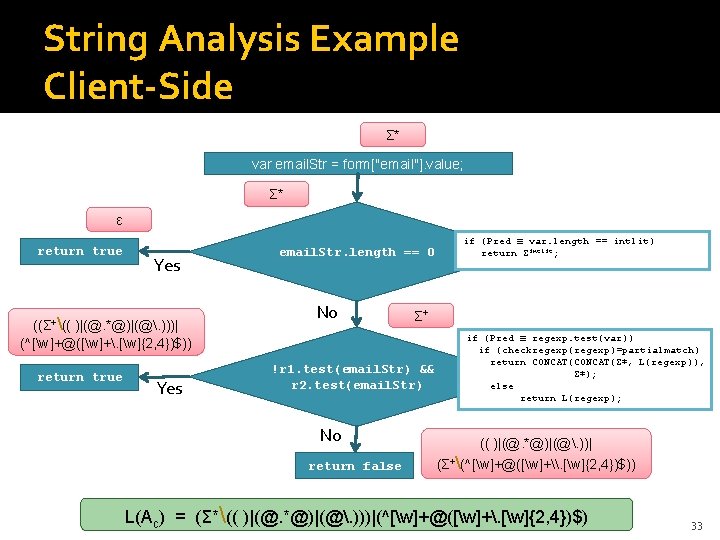
String Analysis Example Client-Side Σ* var email. Str = form["email"]. value; Σ* ε return true Yes ((Σ+(( )|(@. *@)|(@. )))| (^[w]+@([w]+. [w]{2, 4})$)) return true Yes email. Str. length == 0 No Σ+ !r 1. test(email. Str) && r 2. test(email. Str) No return false if (Pred ≡ var. length == intlit) return Σintlit; if (Pred ≡ regexp. test(var)) if (checkregexp(regexp)=partialmatch) return CONCAT(Σ∗, L(regexp)), Σ∗); else return L(regexp); (( )|(@. *@)|(@. ))| (Σ+(^[w]+@([w]+\. [w]{2, 4})$)) L(Ac) = (Σ*(( )|(@. *@)|(@. )))|(^[w]+@([w]+. [w]{2, 4})$) 33
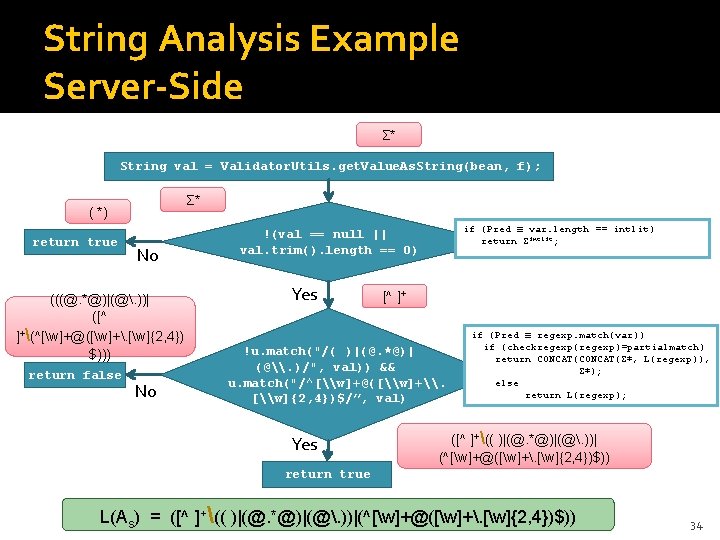
String Analysis Example Server-Side Σ* String val = Validator. Utils. get. Value. As. String(bean, f); Σ* ( *) return true No (((@. *@)|(@. ))| ([^ ]+(^[w]+@([w]+. [w]{2, 4}) $))) return false No if (Pred ≡ var. length == intlit) return Σintlit; !(val == null || val. trim(). length == 0) Yes [^ ]+ !u. match("/( )|(@. *@)| (@\. )/", val)) && u. match("/^[\w]+@([\w]+\. [\w]{2, 4})$/”, val) Yes if (Pred ≡ regexp. match(var)) if (checkregexp(regexp)=partialmatch) return CONCAT(Σ∗, L(regexp)), Σ∗); else return L(regexp); ([^ ]+(( )|(@. *@)|(@. ))| (^[w]+@([w]+. [w]{2, 4})$)) return true L(As) = ([^ ]+(( )|(@. *@)|(@. ))|(^[w]+@([w]+. [w]{2, 4})$)) 34
Inconsistency Identification
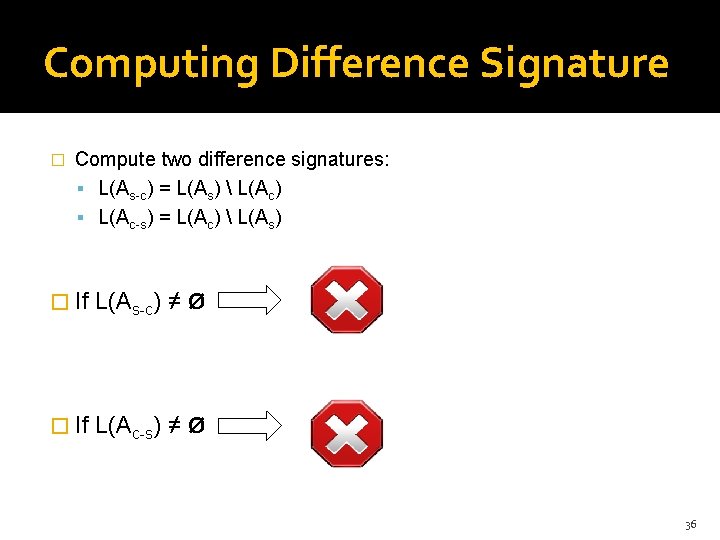
Computing Difference Signature � Compute two difference signatures: L(As-c) = L(As) L(Ac) L(Ac-s) = L(Ac) L(As) � If L(As-c) ≠ Ø � If L(Ac-s) ≠ Ø 36
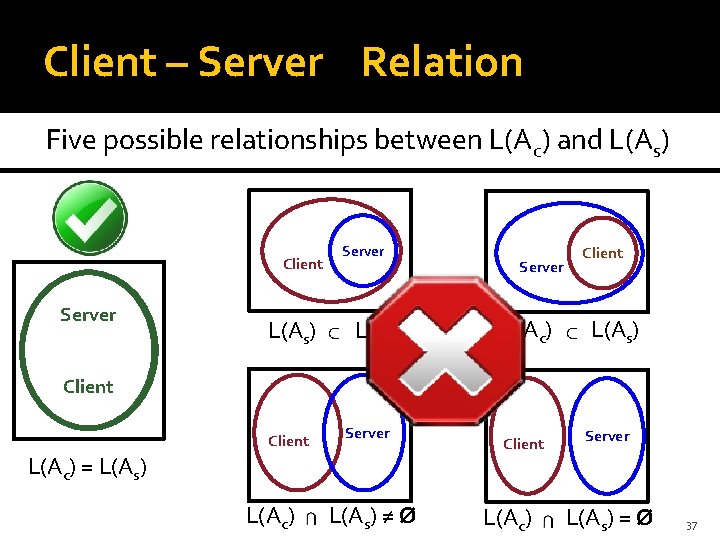
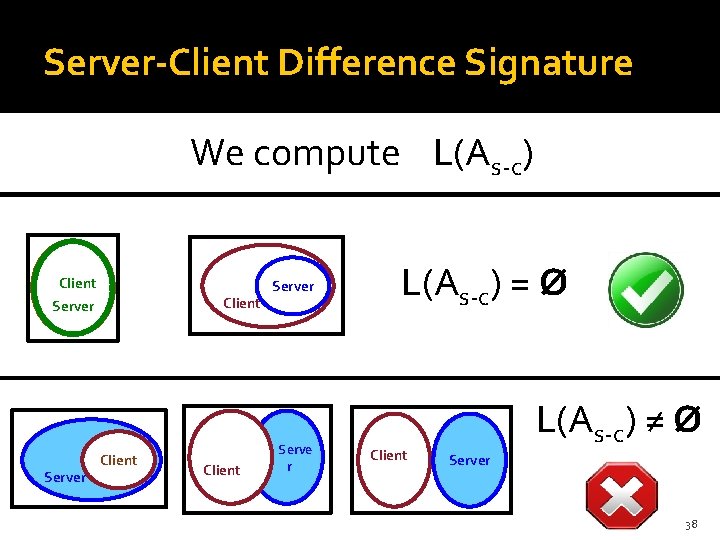
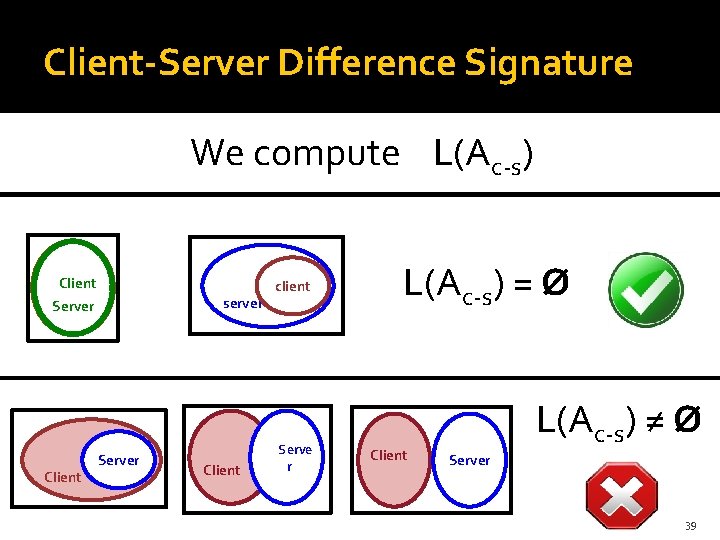
Client – Server Relation Five possible relationships between L(Ac) and L(As) Client Server L(As) Server L(Ac) Client L(As) Client Server L(Ac) = L(As) L(Ac) L(As) ≠ Ø Client L(Ac) Server L(As) = Ø 37
Server-Client Difference Signature We compute L(As-c) Client Server Serve r L(As-c) = Ø Client L(As-c) ≠ Ø Server 38
Client-Server Difference Signature We compute L(Ac-s) Client server Server Client client Serve r L(Ac-s) = Ø Client L(Ac-s) ≠ Ø Server 39
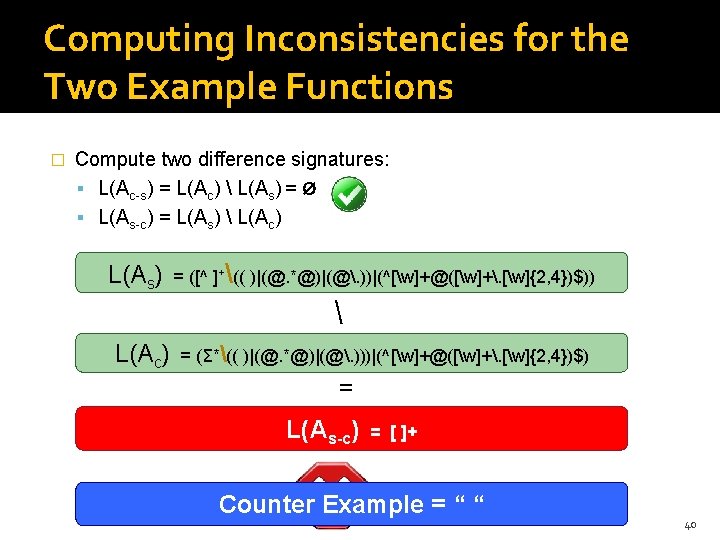
Computing Inconsistencies for the Two Example Functions � Compute two difference signatures: L(Ac-s) = L(Ac) L(As) = Ø L(As-c) = L(As) L(Ac) L(As) L(Ac) = ([^ ]+(( )|(@. *@)|(@. ))|(^[w]+@([w]+. [w]{2, 4})$)) = (Σ*(( )|(@. *@)|(@. )))|(^[w]+@([w]+. [w]{2, 4})$) = L(As-c) = [ ]+ Counter Example = “ “ 40
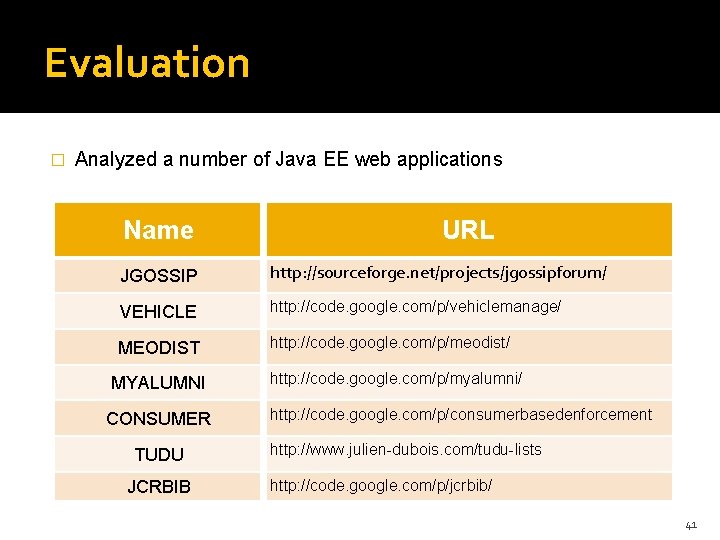
Evaluation � Analyzed a number of Java EE web applications Name URL JGOSSIP http: //sourceforge. net/projects/jgossipforum/ VEHICLE http: //code. google. com/p/vehiclemanage/ MEODIST http: //code. google. com/p/meodist/ MYALUMNI CONSUMER TUDU JCRBIB http: //code. google. com/p/myalumni/ http: //code. google. com/p/consumerbasedenforcement http: //www. julien-dubois. com/tudu-lists http: //code. google. com/p/jcrbib/ 41
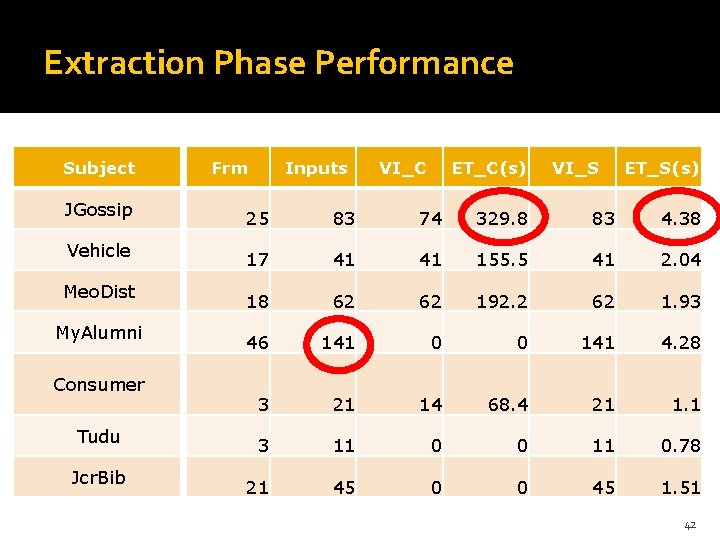
Extraction Phase Performance Subject JGossip Vehicle Meo. Dist My. Alumni Consumer Tudu Jcr. Bib Frm Inputs VI_C ET_C(s) VI_S ET_S(s) 25 83 74 329. 8 83 4. 38 17 41 41 155. 5 41 2. 04 18 62 62 192. 2 62 1. 93 46 141 0 0 141 4. 28 3 21 14 68. 4 21 1. 1 3 11 0 0 11 0. 78 21 45 0 0 45 1. 51 42
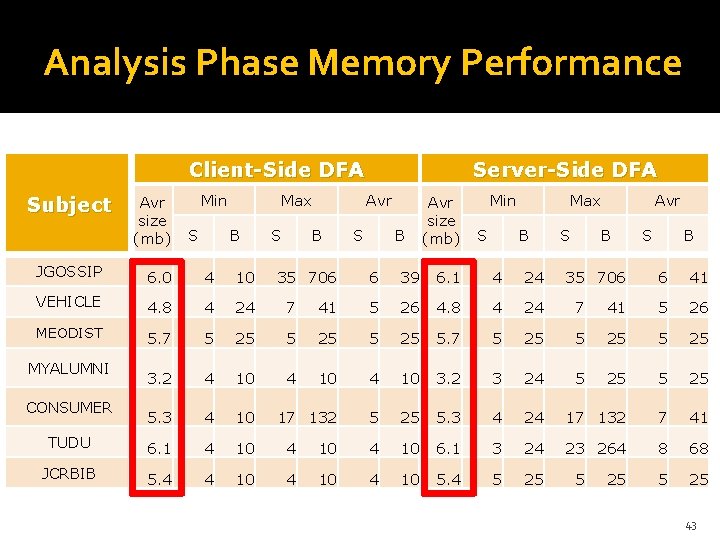
Analysis Phase Memory Performance Client-Side DFA Subject Avr size (mb) Min S Max B S 6. 0 4 10 VEHICLE 4. 8 4 24 7 MEODIST 5. 7 5 25 3. 2 4 10 5. 3 4 10 TUDU 6. 1 4 10 4 JCRBIB 5. 4 4 10 4 MYALUMNI CONSUMER Avr B JGOSSIP Server-Side DFA 35 706 S B Avr size (mb) Min S Max B S Avr B 6 39 6. 1 4 24 35 706 41 5 26 4. 8 4 24 7 5 25 5. 7 5 25 4 10 3. 2 3 24 17 132 5 25 5. 3 4 10 6. 1 10 4 10 5. 4 S B 6 41 41 5 26 5 25 24 17 132 7 41 3 24 23 264 8 68 5 25 43
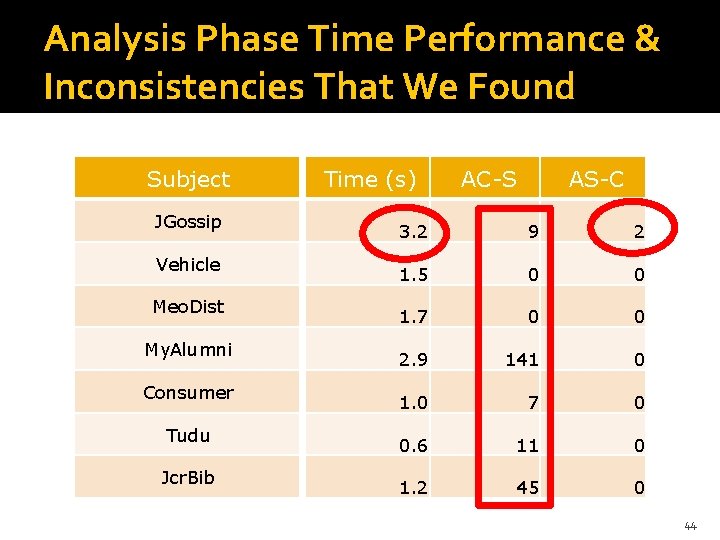
Analysis Phase Time Performance & Inconsistencies That We Found Subject JGossip Vehicle Meo. Dist My. Alumni Consumer Tudu Jcr. Bib Time (s) AC-S AS-C 3. 2 9 2 1. 5 0 0 1. 7 0 0 2. 9 141 0 1. 0 7 0 0. 6 11 0 1. 2 45 0 44
Related Work � String Analysis String analysis based on context free grammars: [Christensen et al. , SAS’ 03] [Minamide, WWW’ 05] Application of string analysis to web applications: [Wassermann and Su, PLDI’ 07, ICSE’ 08] [Halfond and Orso, ASE’ 05, ICSE’ 06] Automata based string analysis: [Xiang et al. , COMPSAC’ 07] [Shannon et al. , MUTATION’ 07] � Input Validation Verification FLAX [ P. Saxena et al. , NDSS’ 10 ] Kudzu [ P. Saxena et al. , SSP’ 10 ] No. Tamper [ P. Bisht et al. , CCS’ 10 ] WAPTEC [ P. Bisht et al. , CCS’ 11 ] [ M. Alkhalaf et al. , ICSE’ 12 ] 45
Questions
Web applications are not trustworthy Extensive string manipulation: � Web applications use extensive string manipulation To construct html pages, to construct database queries in SQL, to construct system commands, etc. � The user input comes in string form and must be validated before it can be used � String manipulation is error prone 47