
VIETNAM WAR Overview Part 1 STARTER Begin reading

VIETNAM WAR: Overview Part 1 STARTER: Begin reading and annotating the worksheet on the Gulf of Tonkin Resolution.
Why does this Unit Matter? • The United States, by most measures, lost the Vietnam War. • Both the outcome of the conflict and its particularly violent nature deeply affected the views of the average US citizen towards war and the Containment Doctrine. • It dealt a serious blow to US credibility among other nations. • It contributed to feelings of distrust towards our federal government, due to the deliberate use of misinformation to generate support for the war effort from an unenthusiastic citizenry.
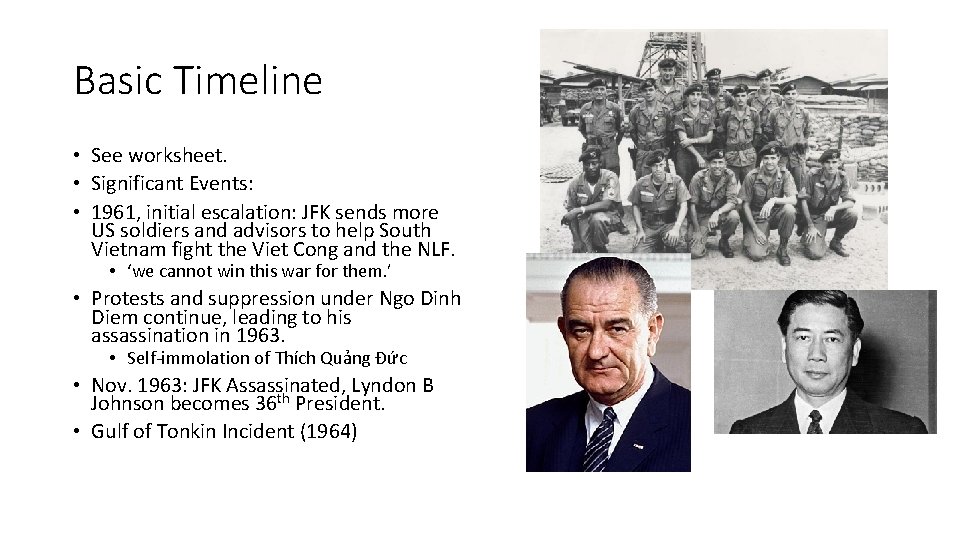
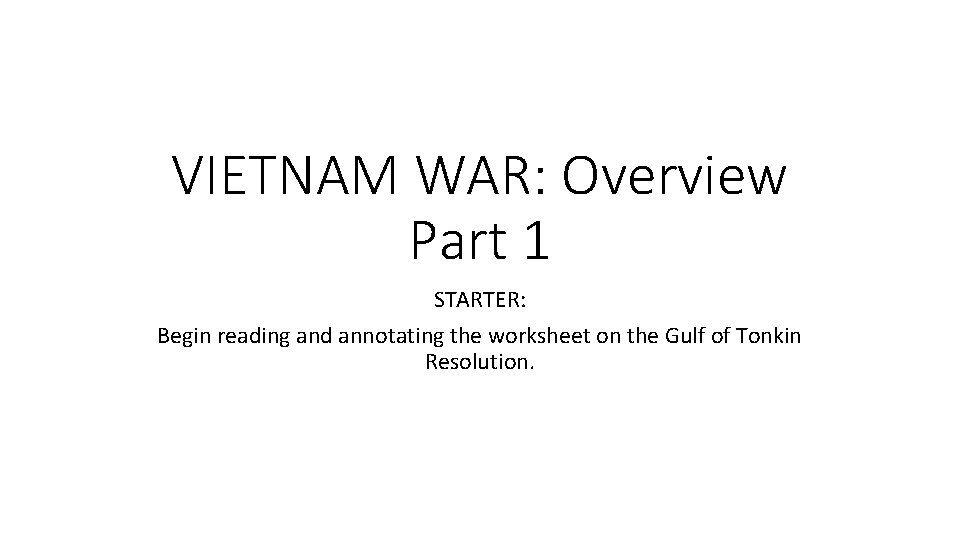
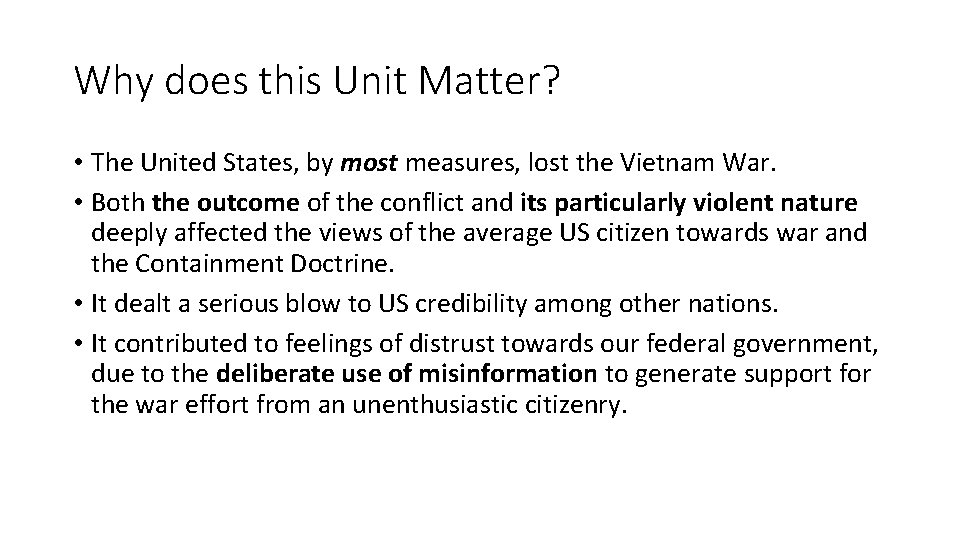
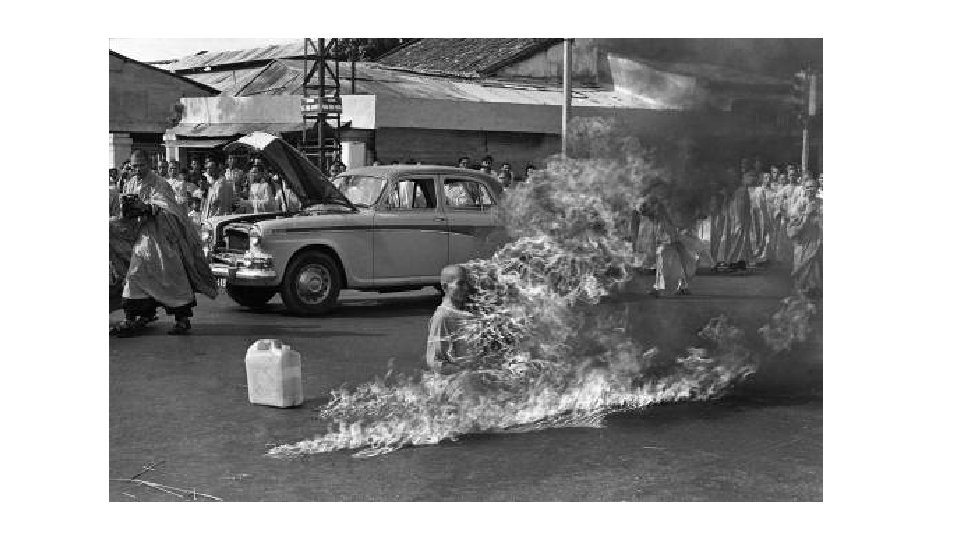
Basic Timeline • See worksheet. • Significant Events: • 1961, initial escalation: JFK sends more US soldiers and advisors to help South Vietnam fight the Viet Cong and the NLF. • ‘we cannot win this war for them. ’ • Protests and suppression under Ngo Dinh Diem continue, leading to his assassination in 1963. • Self-immolation of Thích Quảng Đức • Nov. 1963: JFK Assassinated, Lyndon B Johnson becomes 36 th President. • Gulf of Tonkin Incident (1964)
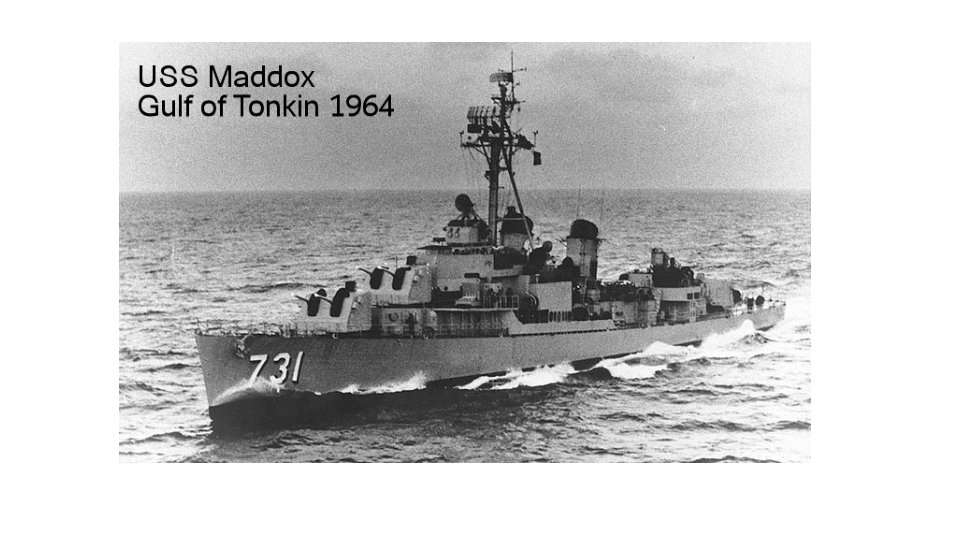
Gulf of Tonkin Incident: August 4 th 1964 • On August 2 nd, 1964, the USS Maddox was attacked by North Vietnamese torpedo boats in the Gulf of Tonkin. • August 4 th 1964, the USS Maddox again reported that it and the USS Turner Joy had been again attacked by torpedo boats operating out of North Vietnam. This is now known to not be true. • “For all I know, our navy was shooting at whales out there. ” --LBJ • US president Lyndon Johnson addressed the nation. He promised to respond to this “new act of aggression” with a congressional revolution and “limited” escalation. • Gulf of Tonkin Resolution: Escalated our involvement, and granted HUGE war powers to the President. • Though not a declaration of war, it authorized Johnson to deploy American military forces in Asia.
Gulf of Tonkin Resolution • Johnson took no major action until after the November 1964 presidential election. Johnson won this election decisively after depicting opponent Barry Goldwater as a warmonger. • The first US combat troops landed in Vietnam in March 1965. US troops operated under restricted terms of engagement. As these were extended, troop numbers also increased, reaching 184, 000 by the end of 1965. • 1965: Operation Rolling Thunder begins. • Many say that the limited and hesitant way that Washington directed the war caused us to lose.
But lets take a step back for a second and consider our GOALS, so we can better understand WHY we fought the war the way we did: Why were we in Vietnam? What we WANTED What we DIDN’T WANT • An independent, non-communist South Vietnam • To thwart the threat of communism spreading through Asia (Domino Theory) • To provoke China or the USSR into WWIII, feat. nuclear annihilation. • “Winning” against North Vietnam was deemed unnecessary. • We also had no need to “conquer” Vietnam for resources—we already had everything they had to offer.
How to Achieve Those Goals • Question: How do we fight in the Nuclear Age? • Problem: All out war has the possibility of leading to nuclear war. • Solution: Gradual Escalation! • Used in the Cuban Missile Crisis (“quarantine” instead of military blockade) • If you slowly increase the level of pain, you’ll eventually reach a breaking point where the enemy would have no choice but to surrender. • But, it would happen slowly enough to not provoke the USSR or China.
Tactic: Gradual Escalation • Gradual Escalation: Using only the level of force absolutely necessary to achieve your limited goal (in this case: Maintain an independent, non-communist South Vietnam. ) • Maintains the appearance of staying on DEFENSE. Methods: • Rolling Thunder: Intense bombing campaign. • Purpose: Slow down the movement of North Vietnamese supplies/soldiers along the Ho-Chi. Minh Trail, raise morale of the South, convince North Vietnam to go along with our aims. • Search and Destroy: sending out large-ish groups of US troops from a fortified position to locate and destroy communist units in the countryside. These missions most commonly involved hiking out into the "boonies" and setting an ambush in the brush, near a suspected Viet Cong trail. • Find the enemy and eliminate as many of them as possible. Eventually they’ll have to cave. • Rather than capturing and holding territory (wars of movement) we’re fighting a war of attrition. (Whoever runs out of supplies/morale/men first loses) • Agent Orange (1961) – Get rid of jungle coverage.
So, What Happened? • You can see in the timeline that we do NOT achieve our goal. South Vietnam is taken over by North Vietnam in 1976, and the country remained purely communist for the next two decades. • People have lots of different ideas about what went wrong with the Vietnam War—or even if anything went wrong at all. Some historians can’t even agree if we won or lost.
Controversy: Many different views on the war Negative • US started out propping up an oppressive colonial power, then BECAME a colonial power. • US let their paranoia regarding communism get in the way of selfdetermination • Domino effect didn’t happen after the war was over, so the war was pointless. “Positive” • The US lost the war because politicians got in the way and tied the army’s hands. • The US won the war, but then we didn’t keep our promise and let Saigon fall. • The War was poorly conducted, but our involvement DID stop the domino effect • Defending freedom is worth any sacrifice.
Unit Plan: • Tactics, weapons, and the general Vietnam War experience. • Vietnam and the Media (how popular opinion affected the war) • Scandals and secrets • Nixon’s Presidency and Vietnamization • The aftermath of the war.
Homework: Next Time • Gulf of Tonkin Resolution Worksheet, Vietnam War Worksheet. • Tactics, Weapons, and the VW Experience
- Slides: 15