
Vietnam War in Retrospect Strategy of Revolutionary War
- Slides: 15
Vietnam War in Retrospect
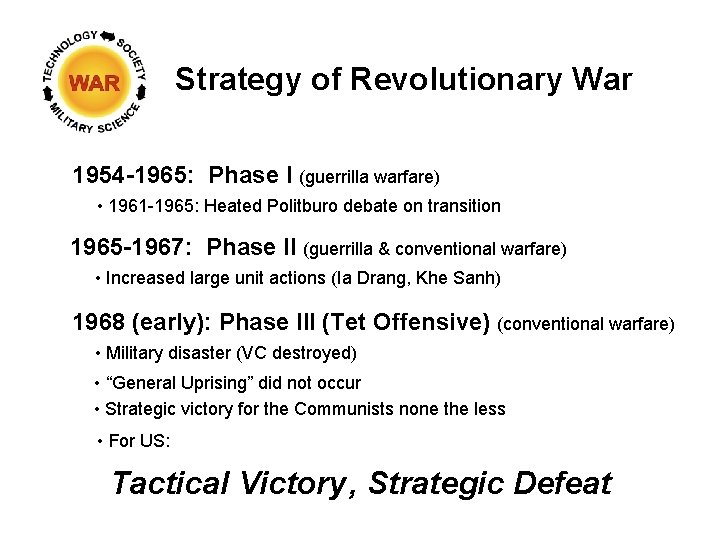
Strategy of Revolutionary War 1954 -1965: Phase I (guerrilla warfare) • 1961 -1965: Heated Politburo debate on transition 1965 -1967: Phase II (guerrilla & conventional warfare) • Increased large unit actions (Ia Drang, Khe Sanh) 1968 (early): Phase III (Tet Offensive) (conventional warfare) • Military disaster (VC destroyed) • “General Uprising” did not occur • Strategic victory for the Communists none the less • For US: Tactical Victory , Strategic Defeat
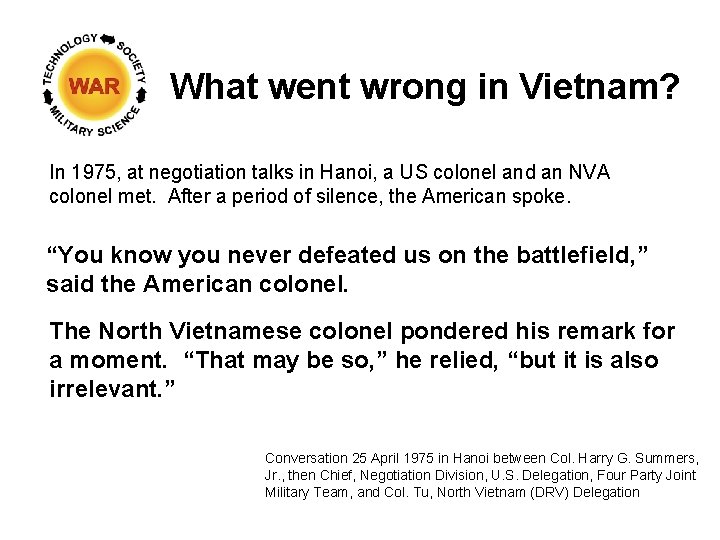
What went wrong in Vietnam? In 1975, at negotiation talks in Hanoi, a US colonel and an NVA colonel met. After a period of silence, the American spoke. “You know you never defeated us on the battlefield, ” said the American colonel. The North Vietnamese colonel pondered his remark for a moment. “That may be so, ” he relied, “but it is also irrelevant. ” Conversation 25 April 1975 in Hanoi between Col. Harry G. Summers, Jr. , then Chief, Negotiation Division, U. S. Delegation, Four Party Joint Military Team, and Col. Tu, North Vietnam (DRV) Delegation
What Went Wrong? US had no clear strategy in Vietnam • Never mobilized the American people • Never committed sufficient force to win • Never defined what “win” meant
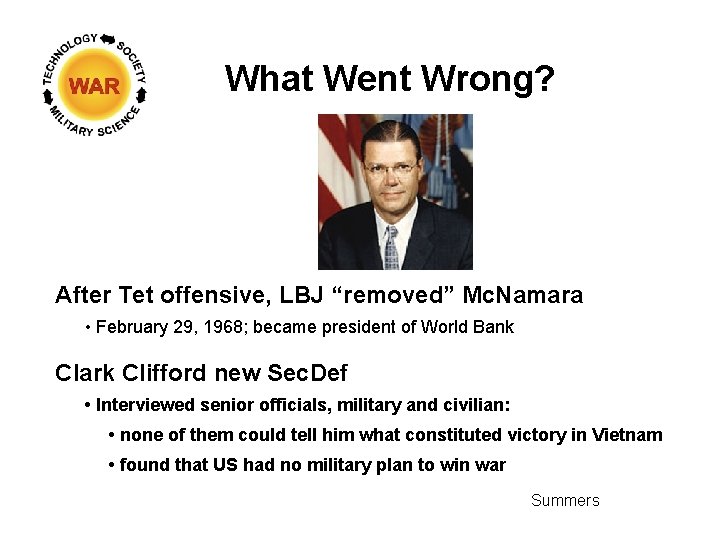
What Went Wrong? After Tet offensive, LBJ “removed” Mc. Namara • February 29, 1968; became president of World Bank Clark Clifford new Sec. Def • Interviewed senior officials, military and civilian: • none of them could tell him what constituted victory in Vietnam • found that US had no military plan to win war Summers
What is War? War is not an extension of politics, as Johnson thought. War begins when politicians cannot achieve their goals through negotiations. Gary Showalter “The Misunderstood Object of War”
Significant Events in Vietnam War Timeline Early 1960’s 7 Aug 64 NVA troops begin moving into South Vietnam Tonkin Gulf Resolution 2 Mar 65 Operation Rolling Thunder (bombing of North) begins 8 Mar 65 Marines land at Da Nang Spring 67 Siege of Khe Sanh begins 31 Jan 68 Tet Offensive begins 20 Jan 69 Nixon becomes president, begins “Vietnamization” 18 -29 Dec 72 Heavy bombing of Hanoi, Haiphong (Operation Linebacker II) 27 Jan 73 US, North Vietnam sign cease-fire in Paris 29 Mar 73 Last US troops leave South Vietnam 29 Jun 73 Congress votes to cut funds for SEA ops after 15 Aug 73 30 Apr 75 Saigon Falls
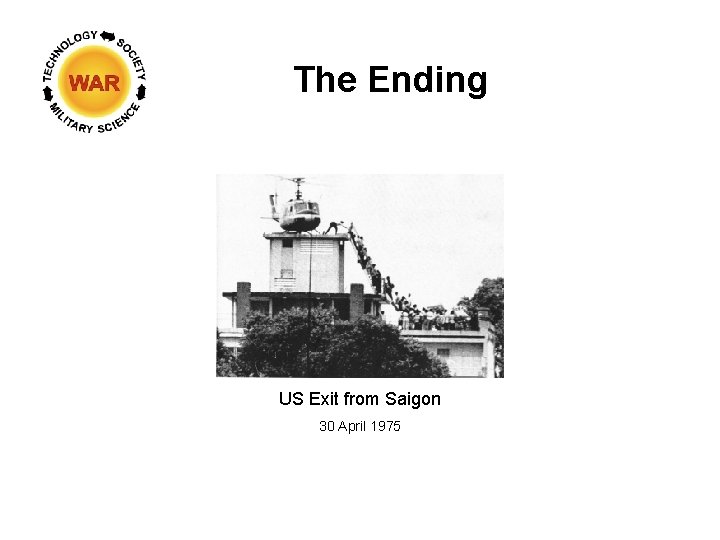
The Ending US Exit from Saigon 30 April 1975
What went wrong in Vietnam? Those who cannot remember the past are doomed to repeat it. -- George Santyana (1863 -1952), 1905
Mc. Namara on Vietnam You. Tube (5: 26) Recorded 2002 Robert Mc. Namara (1916 -2009)
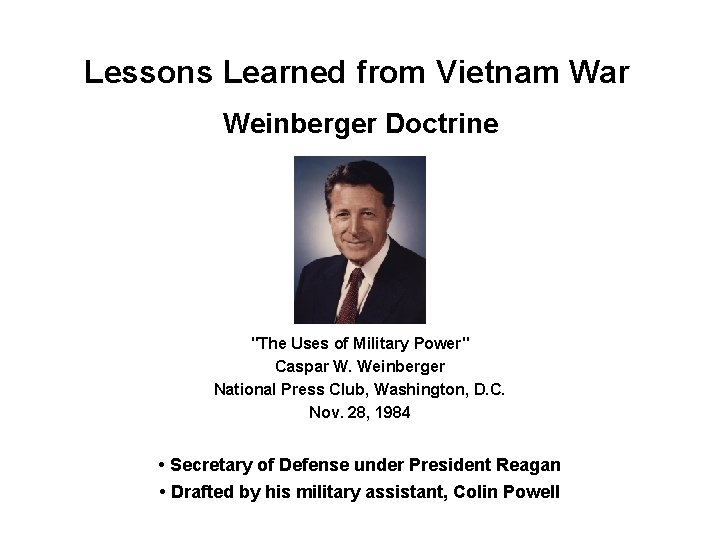
Lessons Learned from Vietnam War Weinberger Doctrine "The Uses of Military Power" Caspar W. Weinberger National Press Club, Washington, D. C. Nov. 28, 1984 • Secretary of Defense under President Reagan • Drafted by his military assistant, Colin Powell
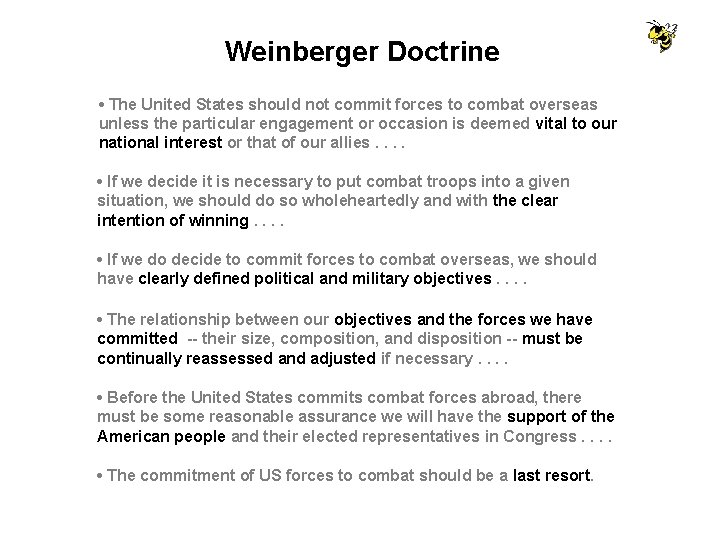
Weinberger Doctrine • The United States should not commit forces to combat overseas unless the particular engagement or occasion is deemed vital to our national interest or that of our allies. . • If we decide it is necessary to put combat troops into a given situation, we should do so wholeheartedly and with the clear intention of winning. . • If we do decide to commit forces to combat overseas, we should have clearly defined political and military objectives. . • The relationship between our objectives and the forces we have committed -- their size, composition, and disposition -- must be continually reassessed and adjusted if necessary. . • Before the United States commits combat forces abroad, there must be some reasonable assurance we will have the support of the American people and their elected representatives in Congress. . • The commitment of US forces to combat should be a last resort.
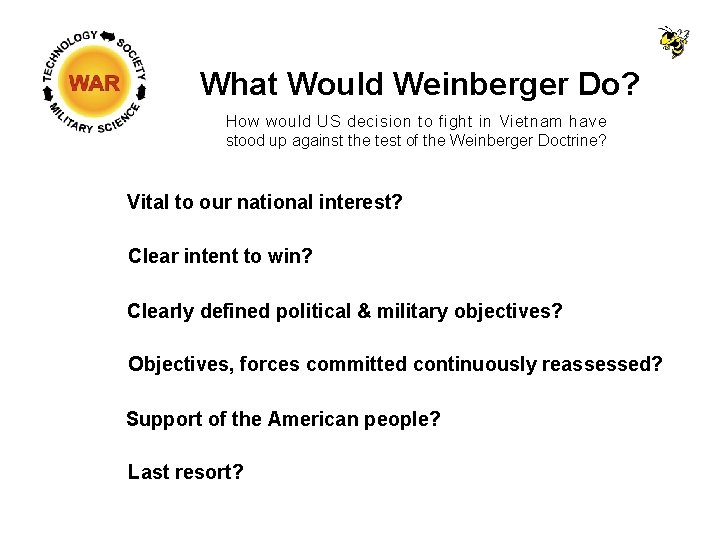
What Would Weinberger Do? How would US decision to fight in Vietnam have stood up against the test of the Weinberger Doctrine? Vital to our national interest? Clear intent to win? Clearly defined political & military objectives? Objectives, forces committed continuously reassessed? Support of the American people? Last resort?
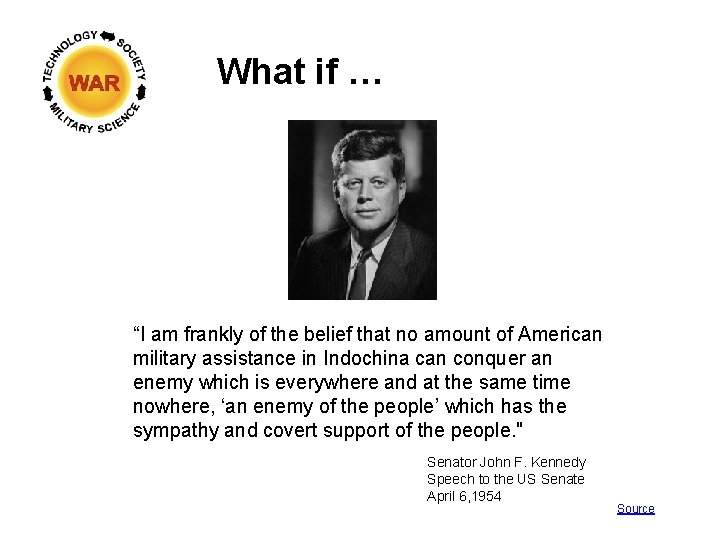
What if … “I am frankly of the belief that no amount of American military assistance in Indochina can conquer an enemy which is everywhere and at the same time nowhere, ‘an enemy of the people’ which has the sympathy and covert support of the people. " Senator John F. Kennedy Speech to the US Senate April 6, 1954 Source
Course Overview Review