
vietnam 1945 to Present Day Vietnam before 1945

vietnam 1945 to Present Day
Vietnam before 1945 • In the early 1900 s, France controlled much of the resource-rich Southeast Asia • French Indochina was made up of what are now Vietnam, Laos and Cambodia • Nationalist independence movements began to develop • A young Vietnamese nationalist, Ho Chi Minh, turned to the Communists for help in his struggle • During the 1930 s, Ho’s Indochinese Communist Party led revolts and strikes against the French • Forced into exile, Ho returned to Vietnam in 1941, a year after Japan seized the country in WW 2, and founded the Vietminh (Independence) League
When world war II ended… • Japanese forces were forced out of Vietnam after their defeat in 1945 • Ho Chi Minh believed that independence would follow but France intended to regain its colony • Vietnamese Nationalists and Communists joined to fight the French armies • French held the major cities, but the Vietminh held widespread support in rural areas • In France, people began to doubt that their colony was worth the lives and money the struggle was costing • In 1954, the French surrendered to Ho
Vietnam and the cold war • The struggle for Vietnam quickly became a part of the Cold War • With the defeat of the French in Vietnam, the US saw a rising threat to the rest of Asia and described it in terms of the domino theory DOMINO THEORY: theory that the Southeast Asian nations were like a row of dominos and the fall of one to communism would lead to the fall of its neighbors
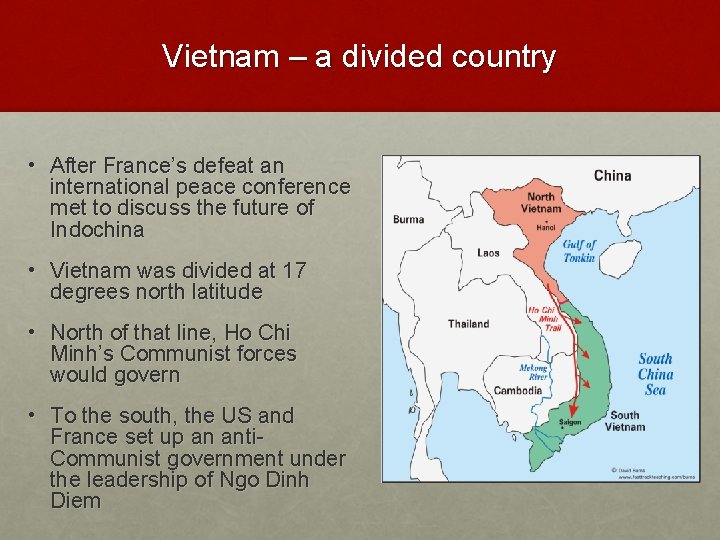
Vietnam – a divided country • After France’s defeat an international peace conference met to discuss the future of Indochina • Vietnam was divided at 17 degrees north latitude • North of that line, Ho Chi Minh’s Communist forces would govern • To the south, the US and France set up an anti. Communist government under the leadership of Ngo Dinh Diem
Rise of opposition • Diem ruled the south as a dictator and opposition to his government grew • Communist guerrillas called Vietcong began to gain strength in the south • Gradually the Vietcong won control of large areas • In 1963, a group of South Vietnamese generals had Diem assassinated, but the new leaders were no more popular • It appeared that a takeover by the Communist Vietcong, backed by North Vietnam, was inevitable
US Involvement • In 1964, Congress authorized LBJ to send US troops to Vietnam • US faced difficulty in unfamiliar terrain, unpopular South Vietnamese government that they were defending and growing support for the Vietcong • Unable to win a decisive ground victory, the US turned to air power and bombed millions of acres of forests and farmlands – only strengthening the peasants’ opposition to the South Vietnamese government • The war grew increasingly unpopular in the US and Nixon began to withdraw troops in 1969 beginning the plan of Vietnamization VIETNAMIZATION: allowed US troops to gradually leave, while the South Vietnamese increased their combat role • The last troops left in 1973 and 2 years later the North Vietnamese army overran South Vietnam • More than 1. 5 million Vietnamese, and 58, 000 Americans, lost their lives
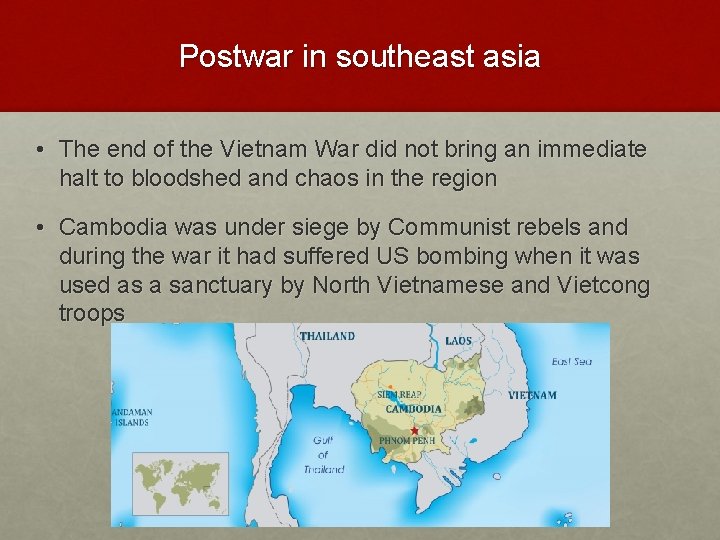
Postwar in southeast asia • The end of the Vietnam War did not bring an immediate halt to bloodshed and chaos in the region • Cambodia was under siege by Communist rebels and during the war it had suffered US bombing when it was used as a sanctuary by North Vietnamese and Vietcong troops
Cambodia in turmoil • In 1975, Communist rebels known as the Khmer Rouge set up a brutal Communist government under the leadership of Pol Pot • In a ruthless attempt to transform Cambodia into a Communist society, Pol Pot’s followers slaughtered 2 million people – almost ¼ of the nation’s population • Known as the Cambodian Genocide, people died from executions and torture, as well as famine and terrible diseases such as malaria • The Khmer Rouge forced relocation of the population from urban centers and used forced labor • Almost 20, 000 mass graves, known as “Killing Fields” have been uncovered • The Vietnamese invaded in 1978 and overthrew the Khmer Rouge • Fighting continued and the Vietnamese withdrew in 1989 • In 1993, under the supervision of the UN, Cambodia adopted a
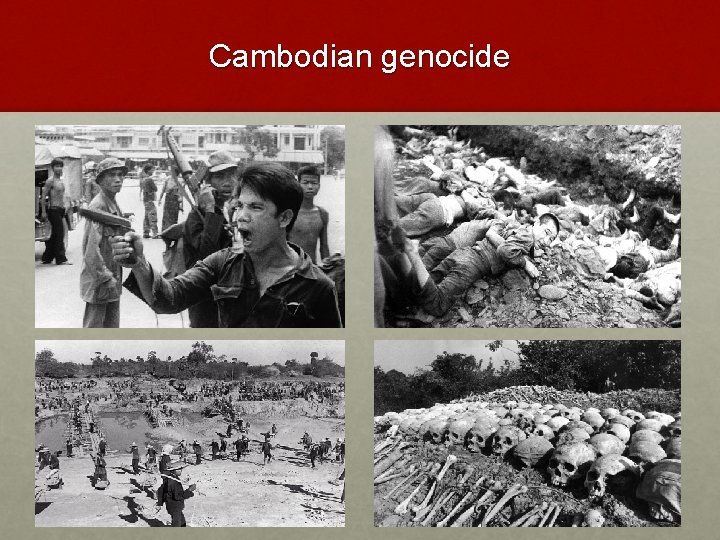
Cambodian genocide
Vietnam after war • After 1975, the victorious North Vietnam imposed tight controls over the South • Communist oppression caused 1. 5 million people to flee Vietnam and most escaped in dangerously overcrowded ships • More than 200, 000 “boat people” died at sea and survivors spent months in refugee camps, with approximately 70, 000 eventually settled in the US or Canada • Communists still govern Vietnam, but the country welcomes foreign investment and the US normalized relations with Vietnam in 1995
Vietnam today • One of the world’s four remaining single-party socialist states officially supporting communism • The Prime Minister acts as head of government, and there is also a President who acts as a ceremonial head of state and a Commander-in-Chief of the military who acts as council • Since 2000, Vietnam’s economic growth rate has been among the highest in the world • In 2011, it had the highest Global Growth Generators Index among 11 major economies • Its successful reforms led to it joining the World Trade Organization in 2007 • Despite successes, Vietnam remains under fire for its human rights violations – including restricting freedom of speech, press, assembly, association and religion • To date, Vietnam holds more than 160 political prisoners who have committed no real “crimes” and police routinely use torture and beatings
- Slides: 12