
VIE Vertical Integration of Computer Electrical and Mechanical
- Slides: 8
VIE: Vertical Integration of Computer, Electrical, and Mechanical Engineering Education Abhijit Chandra, Julie Dickerson, Matt Feldmann, Don Flugrad, Brian Hand, Greg Luecke, Mani Mina, Diane Rover, Mack Shelley, Arun Somani, Akhilesh Tyagi College of Engineering, College of Education Iowa State University NSF Department Level Reform Program 1 Foundation under grant no. EEC-0431924. This work was supported in part by the National Science
VIE Objectives • vie: to invite, challenge, strive, compete • Integrated programs and experiences – Curriculum integration through the learning stream model – Application of the learning stream model to researchbased learning – Integrated information resources to support interdisciplinary learning streams – Extension of the learning stream model to pre-college engineering education • Goal: to vertically integrate educational activities using new program structures, learning resources, and organizational practices 2
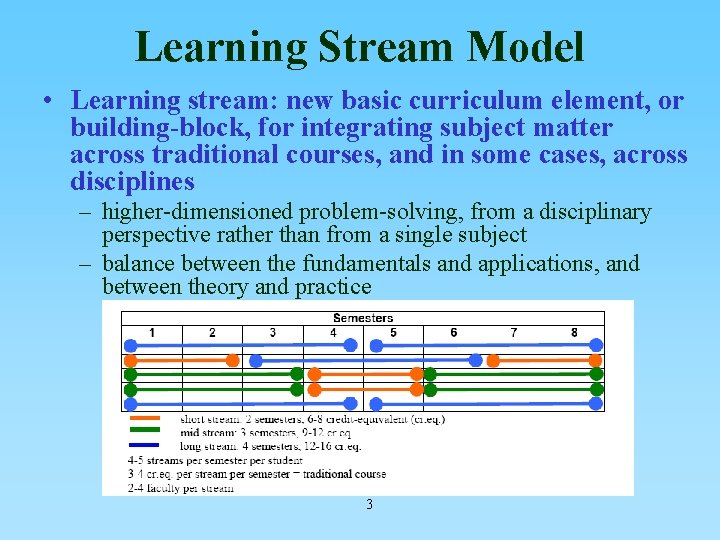
Learning Stream Model • Learning stream: new basic curriculum element, or building-block, for integrating subject matter across traditional courses, and in some cases, across disciplines – higher-dimensioned problem-solving, from a disciplinary perspective rather than from a single subject – balance between the fundamentals and applications, and between theory and practice 3
Learning Stream Pilot • Learning stream in computer engineering – Replaced traditional course sequence of CPRE 210 -211 -305 over three semesters with integrated stream sequence of CPRE 281 X-381 X over two semesters during Fall 2004 and Spring 2005 – CPRE 210, 211, and 305: “stream” of courses with natural progression of learning that focuses on the fundamentals of digital systems design and microprocessors – CPRE 281 X, 381 X: joins course subject matter more cohesively, providing a learning experience that features “just-in-time” learning for students and also closes the knowledge gaps that can occur from disjointed courses and instructor styles • Community of VIE Scholars connected to the VIE Professors – Faculty and students work closely together in understanding the application of design knowledge – Consistency in teaching and learning – Enhanced learning experience for students as faculty mentors can connect more with individual learning styles and capabilities 4
VIE Program Evaluation The evaluation is based on the following research questions: 1. To what extent is student development enhanced by embedding the LS model of discovery-based learning into the curriculum? 2. To what extent are instructors’ knowledge and teaching ability enhanced? 3. To what extent are faculty better interconnected across departments and programs? 4. To what extent are lessons learned from previous learning community experiences transferable to LS implementation? 5. To what extent is research guided by LS experience? Evaluation activities have included: • Pre- and post- surveys of the 281 x and 210 courses taught in Fall 2004 • Plus/delta exercise and focus groups with 281 x and 381 x courses • Comparison of 210/211 with 281 x/381 x student course grades • Faculty survey • Pre-survey of 381 x and 211 courses currently being taught (Spring 2005) 5
Preliminary Evaluation Findings • VIE students feel the program: – Promotes student interaction because of small class size – Promotes student-faculty interaction because of the low faculty-to-student ratio – Encourages deep understanding of course concepts through: • Continuity of faculty instructors from 281 x to 381 x • Laboratory exercises in both courses that are cumulative and connected • The intense nature of two six-credit courses taken in two consecutive semesters • Students agree that the course structure is providing a cohesive learning experience that closes the knowledge gaps that occur from disjointed courses and instructor styles. 6
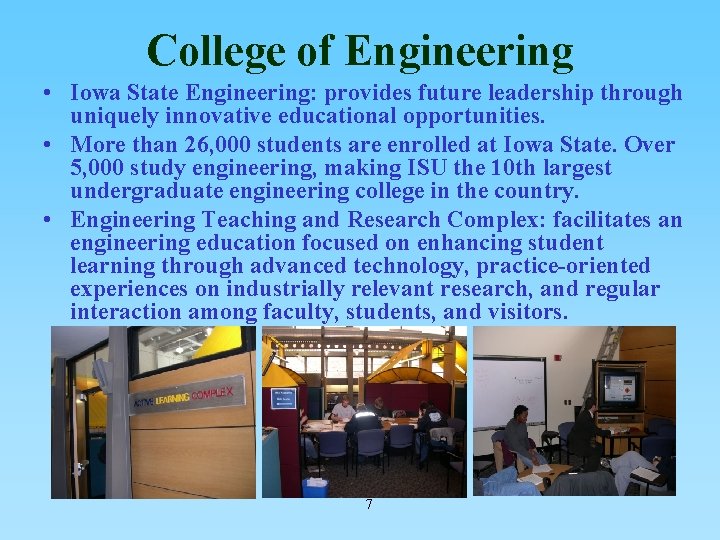
College of Engineering • Iowa State Engineering: provides future leadership through uniquely innovative educational opportunities. • More than 26, 000 students are enrolled at Iowa State. Over 5, 000 study engineering, making ISU the 10 th largest undergraduate engineering college in the country. • Engineering Teaching and Research Complex: facilitates an engineering education focused on enhancing student learning through advanced technology, practice-oriented experiences on industrially relevant research, and regular interaction among faculty, students, and visitors. 7
RISE • Research Institute for Studies in Education: provides leadership in assisting the College of Education to achieve and maintain a reputation of excellence in scholarship. • RISE Areas of Excellence – Research/Contracts and Grants: RISE facilitates a strong College research effort by providing expert consultation and instruction in research design, methodology, and analysis; content and technical assistance in external contract and grant activities, including proposal preparation; and funding for college research and grant seeking activities. – College Research and Planning: RISE coordinates the institutional research and planning activities in the college, partners with faculty and staff to provide information about current and prospective students and graduates and programs, and provides a linkage with other units on and off campus to facilitate collaborative research activities. – External Evaluation: RISE provides external service and outreach through its expertise in program and project evaluation and survey data management and reporting services. http: //www. educ. iastate. edu/rise 8