
Video Transmission Over Varying Bandwidth Links MTP Final
Video Transmission Over Varying Bandwidth Links MTP Final Stage Presentation By: Laxmikant Patil Under Guidance of Prof. Sridhar Iyer
Presentation Outline • Introduction & Motivation • Problem Definition • Related Work • Traffic Pattern based Adaptive Multimedia Multicast (TPAMM) Architecture • Solution Strategy • Simulation & Results • Conclusion • References
Introduction & Motivation Key Terms § Playout Rate: The rate at which video is shown at client § Delay Tolerant Applications: Clients can tolerate some delay before playout starts e. g. DEP offering live courses to remote students, Live concert streaming, MNCs training employees across cities § Startup Latency: Maximum duration of time client is ready to wait before playout starts
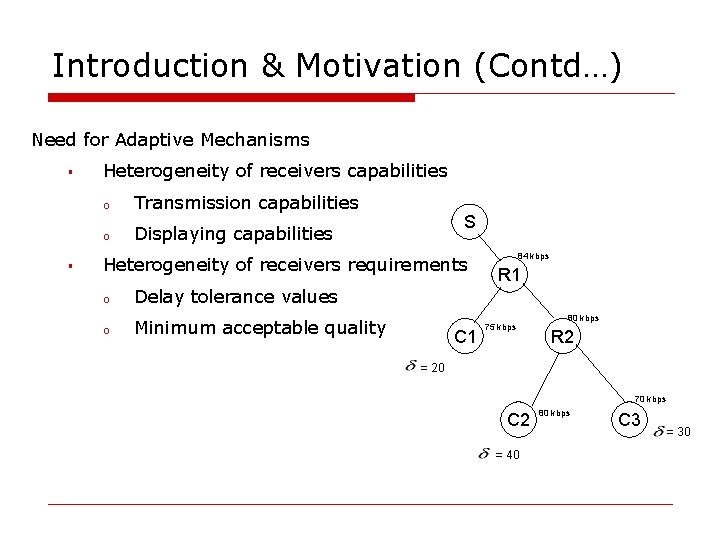
Introduction & Motivation (Contd…) Need for Adaptive Mechanisms § § Heterogeneity of receivers capabilities o Transmission capabilities o Displaying capabilities S Heterogeneity of receivers requirements o Delay tolerance values o Minimum acceptable quality C 1 84 kbps R 1 75 kbps 80 kbps R 2 = 20 70 kbps C 2 = 40 80 kbps C 3 = 30
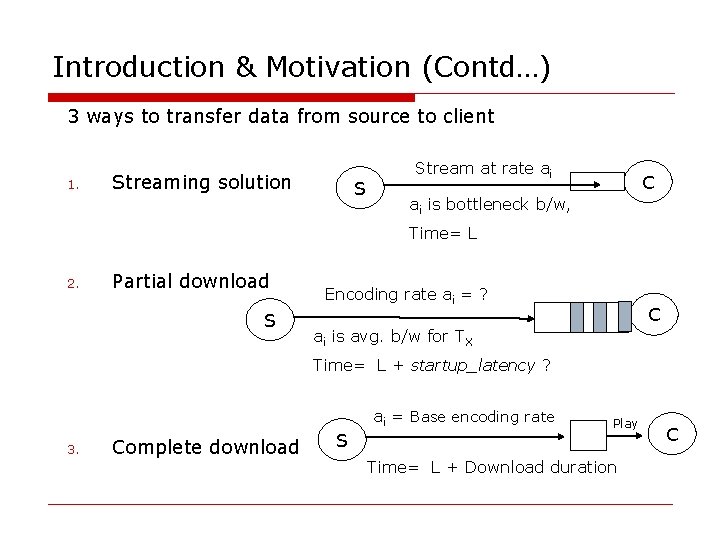
Introduction & Motivation (Contd…) 3 ways to transfer data from source to client 1. Streaming solution S Stream at rate ai C ai is bottleneck b/w, Time= L 2. Partial download S Encoding rate ai = ? C ai is avg. b/w for TX Time= L + startup_latency ? ai = Base encoding rate 3. Complete download S Play Time= L + Download duration C
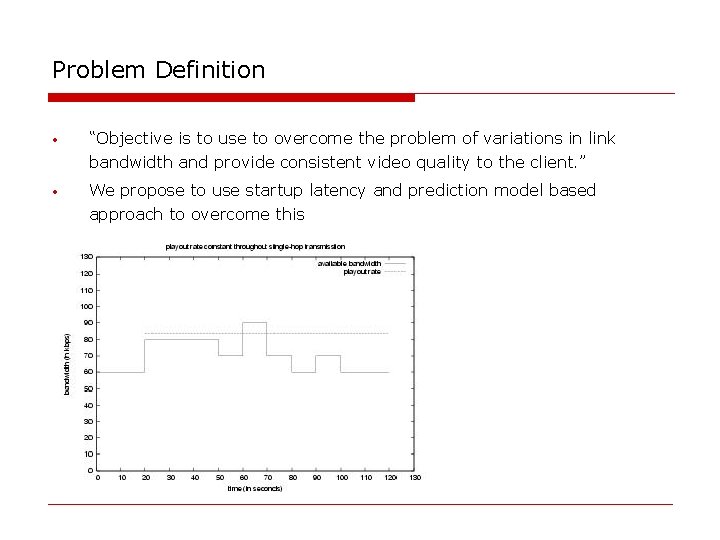
Problem Definition • “Objective is to use to overcome the problem of variations in link bandwidth and provide consistent video quality to the client. ” • We propose to use startup latency and prediction model based approach to overcome this
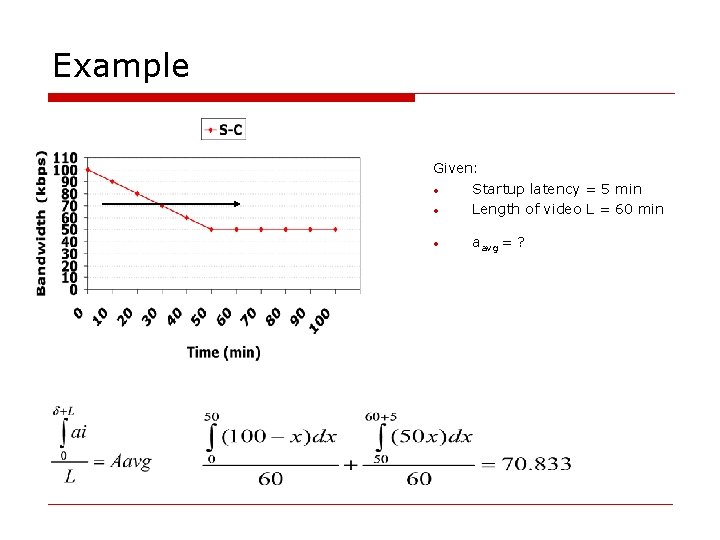
Example Given: • Startup latency = 5 min • Length of video L = 60 min • aavg = ?
Related work • [SAMM] Multilayering: Video is encoded as base layer and enhancement layers. § Client receive number of layers depending on their capabilities § Objective is to decide number of layers & encoding rates of each layer • [KRTCR] Transcoding : Changes the encoding rate of the video file to desired rate § Transcoding only at source § Transcoding at relay nodes • [AIMA] Buffer-based adaptation: uses occupancy of buffer on transmission path as a measure of congestion • [AVMI] Simulcast: Source maintains different quality stream and receiver switches across streams. Combination of single-rate multicast and multiple-unicast.
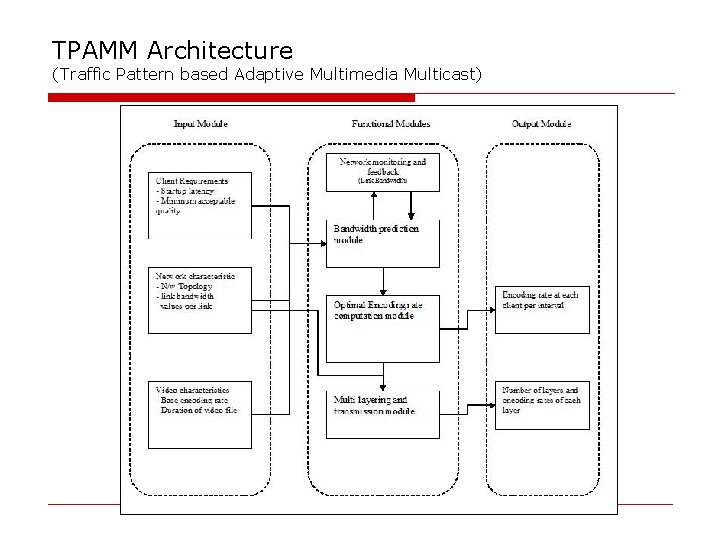
TPAMM Architecture (Traffic Pattern based Adaptive Multimedia Multicast)
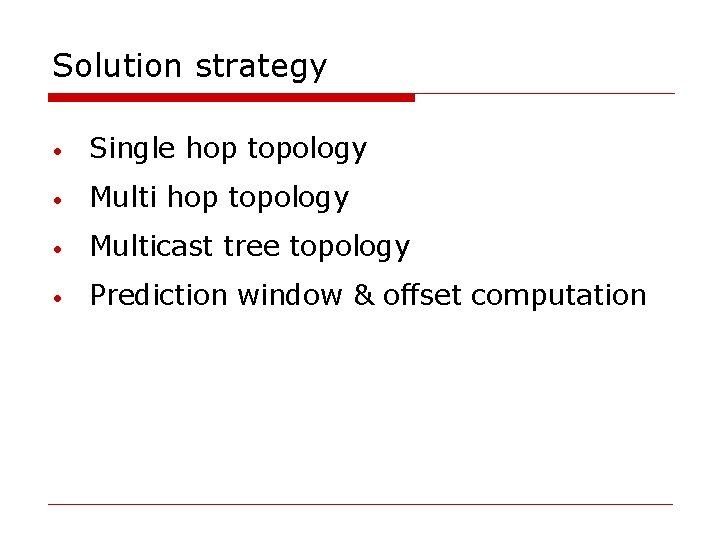
Solution strategy • Single hop topology • Multicast tree topology • Prediction window & offset computation
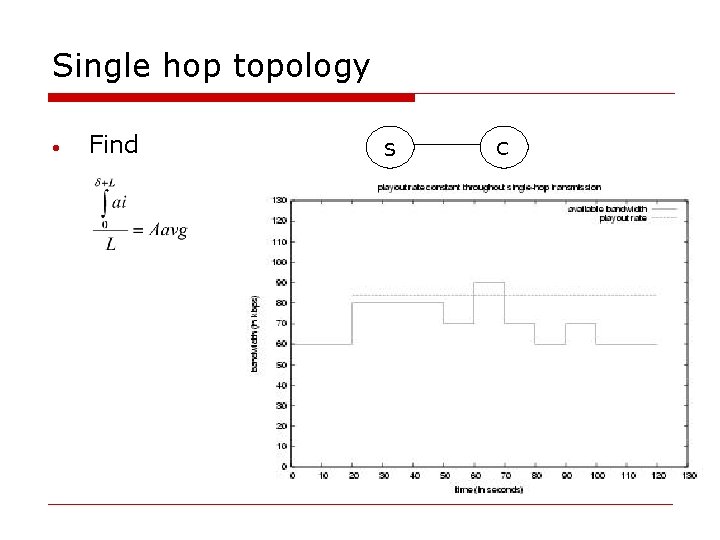
Single hop topology • Find S C
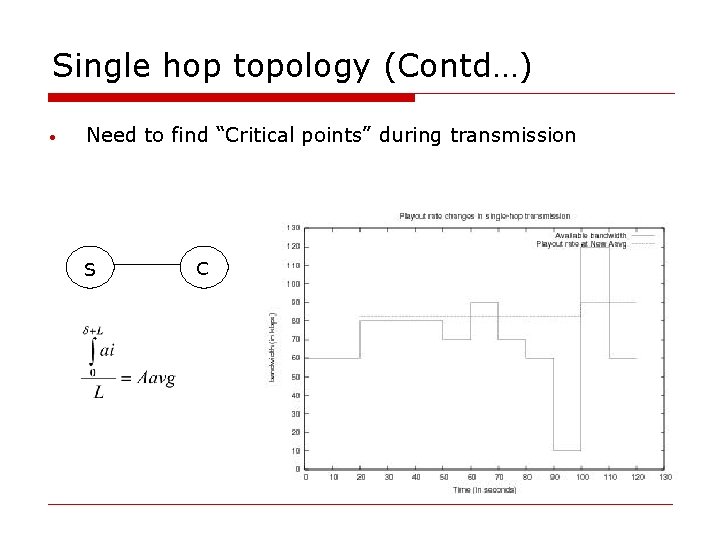
Single hop topology (Contd…) • Need to find “Critical points” during transmission S C
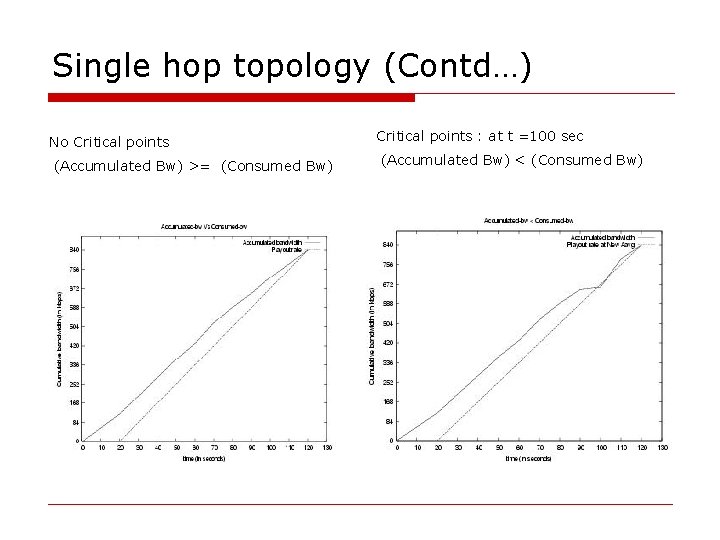
Single hop topology (Contd…) No Critical points (Accumulated Bw) >= (Consumed Bw) Critical points : at t =100 sec (Accumulated Bw) < (Consumed Bw)
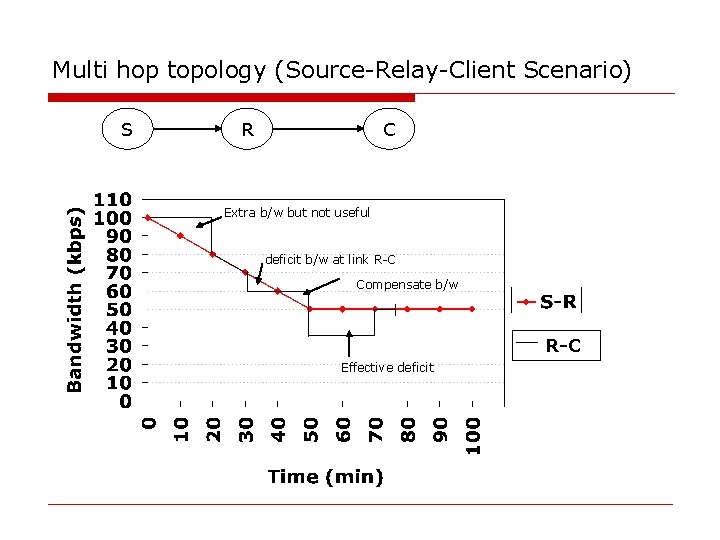
Multi hop topology (Source-Relay-Client Scenario) S R C Extra b/w but not useful deficit b/w at link R-C Compensate b/w R-C Effective deficit
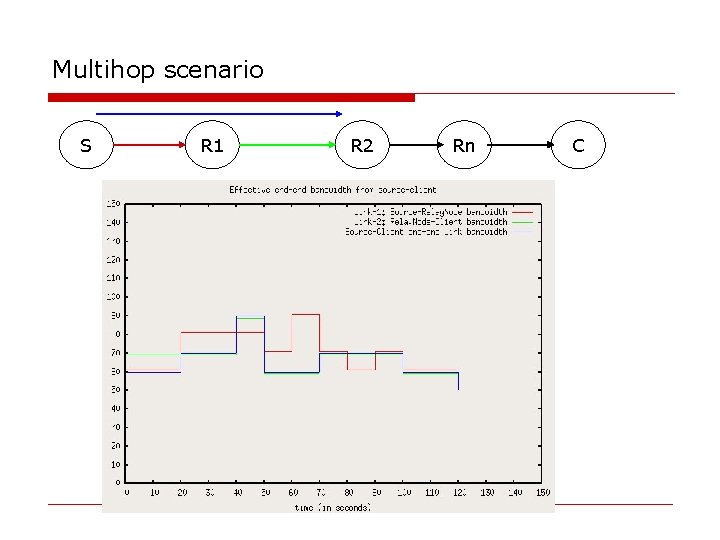
Multihop scenario S R 1 R 2 Rn C
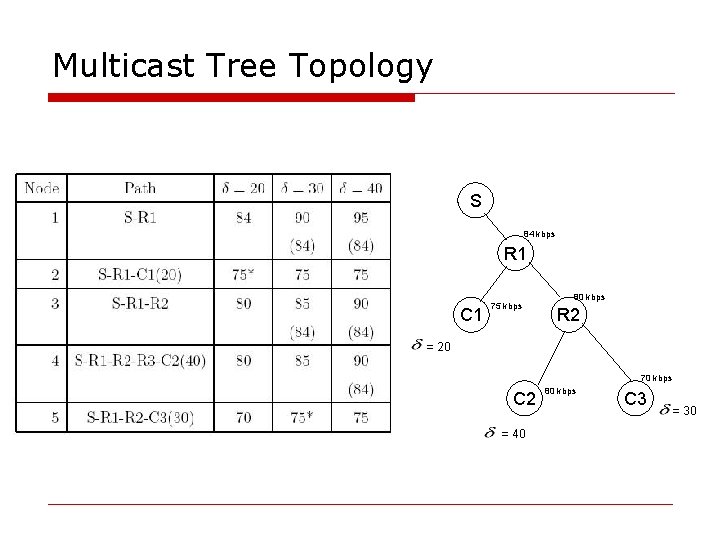
Multicast Tree Topology S 84 kbps R 1 C 1 75 kbps 80 kbps R 2 = 20 70 kbps C 2 = 40 80 kbps C 3 = 30
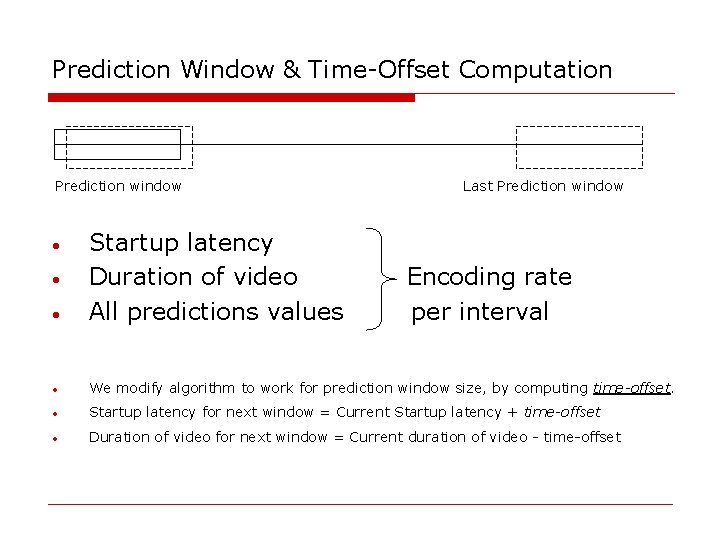
Prediction Window & Time-Offset Computation Prediction window Last Prediction window • Startup latency Duration of video All predictions values • We modify algorithm to work for prediction window size, by computing time-offset. • Startup latency for next window = Current Startup latency + time-offset • Duration of video for next window = Current duration of video - time-offset • • Encoding rate per interval
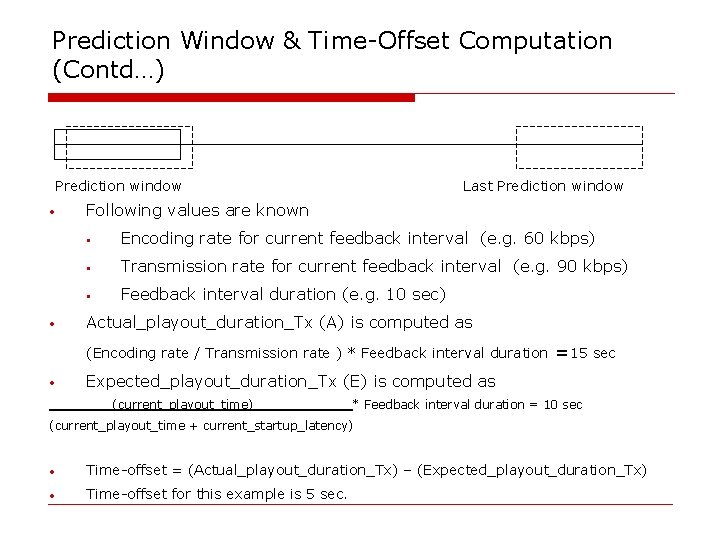
Prediction Window & Time-Offset Computation (Contd…) Prediction window • • Last Prediction window Following values are known § Encoding rate for current feedback interval (e. g. 60 kbps) § Transmission rate for current feedback interval (e. g. 90 kbps) § Feedback interval duration (e. g. 10 sec) Actual_playout_duration_Tx (A) is computed as (Encoding rate / Transmission rate ) * Feedback interval duration • =15 sec Expected_playout_duration_Tx (E) is computed as (current_playout_time) * Feedback interval duration = 10 sec (current_playout_time + current_startup_latency) • Time-offset = (Actual_playout_duration_Tx) – (Expected_playout_duration_Tx) • Time-offset for this example is 5 sec.
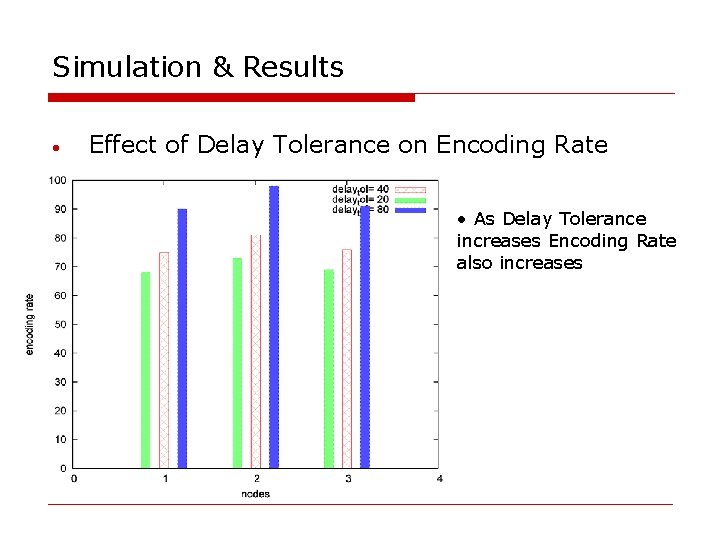
Simulation & Results • Effect of Delay Tolerance on Encoding Rate • As Delay Tolerance increases Encoding Rate also increases
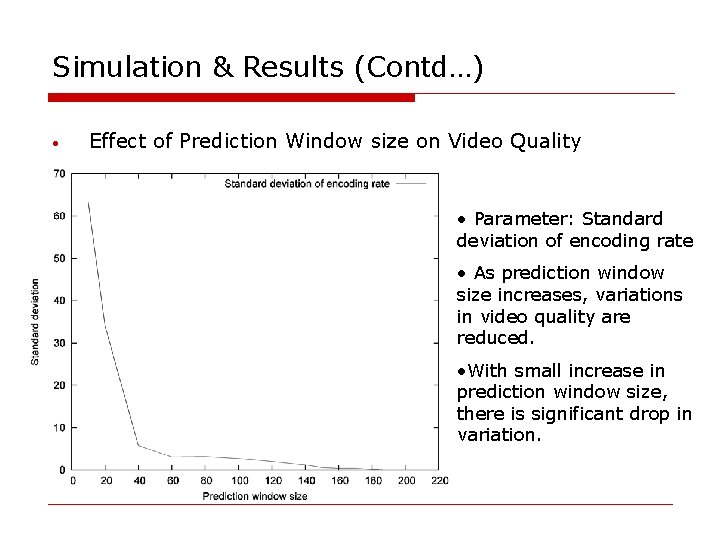
Simulation & Results (Contd…) • Effect of Prediction Window size on Video Quality • Parameter: Standard deviation of encoding rate • As prediction window size increases, variations in video quality are reduced. • With small increase in prediction window size, there is significant drop in variation.
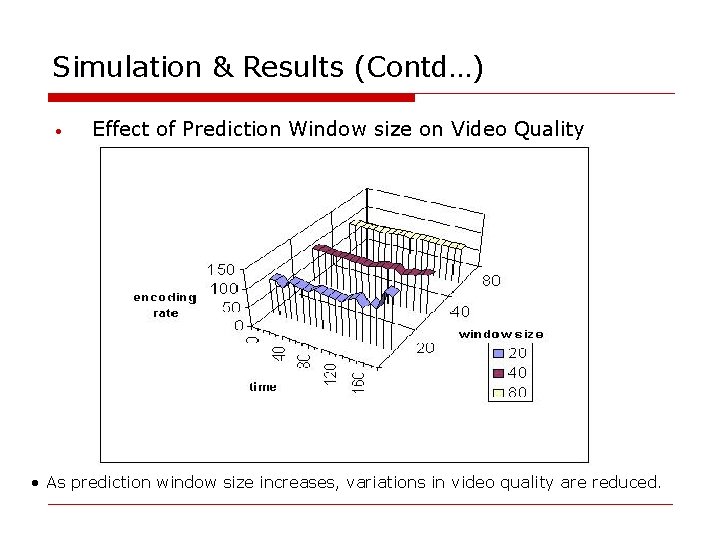
Simulation & Results (Contd…) • Effect of Prediction Window size on Video Quality • As prediction window size increases, variations in video quality are reduced.
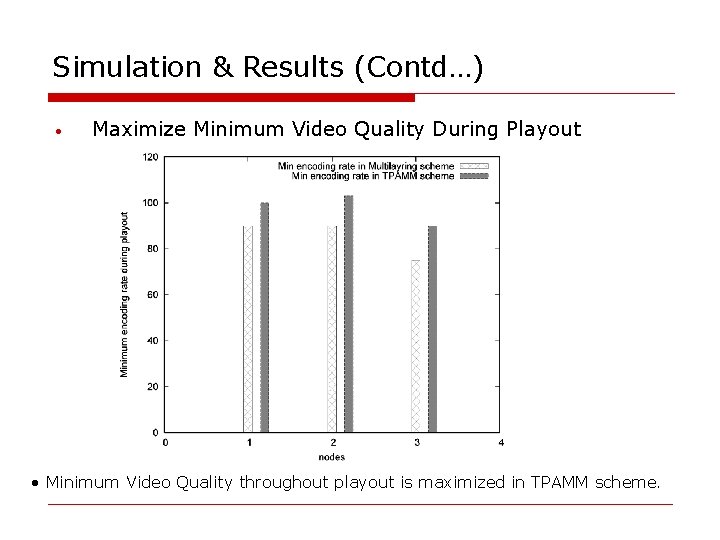
Simulation & Results (Contd…) • Maximize Minimum Video Quality During Playout • Minimum Video Quality throughout playout is maximized in TPAMM scheme.
Conclusion • We have introduced a class of algorithms known as Traffic Pattern based Adaptive Multimedia Multicast (TPAMM) algorithms. • In TPAMM scheme abrupt link bandwidth variations are not reflected at client side, ensuring good user perceived video quality. • TPAMM scheme maximizes the minimum video quality during playout.
References 1. [SAMM] Brett Vickers, Albuquerque and Tatsuya Suda, Sourceadaptive multi-layered multicast algorithm for real-time video distribution. IEEE/ACM Transactions on Networking, 8(6): 720 -733, 2000. 2. [AVMI] Jiangchuan Liu, Bo Li and Ya-Qin Zhang. Adaptive video multicast over the internet. IEEE Multimedia, 10(1): 22 -33, 2003. [KRTCR] Rajeev Kumar, JS Rao, AK Turuk, S. Chattopadhyay and GK Rao A protocol to support Qos for multimedia traffic over internet with transcoding www. ee. iastate. edu/~gmani/tiw 2002/internet-qos. pdf 4. [AIMA] X. Wang and H. Schulzrinne. Comparison of adaptive internet multimedia applications. In IEICE Trans. COMMUN. 1999.
- Slides: 24