
Video 3 Scoring Policies and Test Development Process

- Slides: 9
Video 3: Scoring Policies and Test Development Process New York State 2013 Grades 3 -8 Common Core Mathematics Rubric and Scoring Turnkey Training
Scoring Policies 2
3
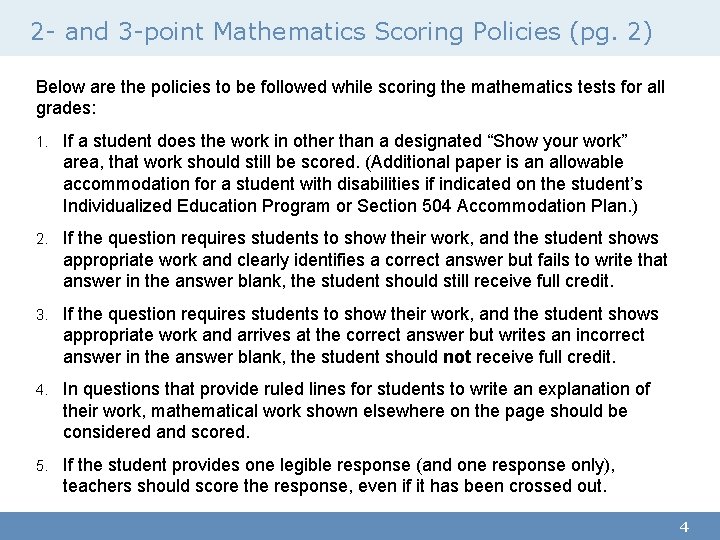
2 - and 3 -point Mathematics Scoring Policies (pg. 2) Below are the policies to be followed while scoring the mathematics tests for all grades: 1. If a student does the work in other than a designated “Show your work” area, that work should still be scored. (Additional paper is an allowable accommodation for a student with disabilities if indicated on the student’s Individualized Education Program or Section 504 Accommodation Plan. ) 2. If the question requires students to show their work, and the student shows appropriate work and clearly identifies a correct answer but fails to write that answer in the answer blank, the student should still receive full credit. 3. If the question requires students to show their work, and the student shows appropriate work and arrives at the correct answer but writes an incorrect answer in the answer blank, the student should not receive full credit. 4. In questions that provide ruled lines for students to write an explanation of their work, mathematical work shown elsewhere on the page should be considered and scored. 5. If the student provides one legible response (and one response only), teachers should score the response, even if it has been crossed out. 4
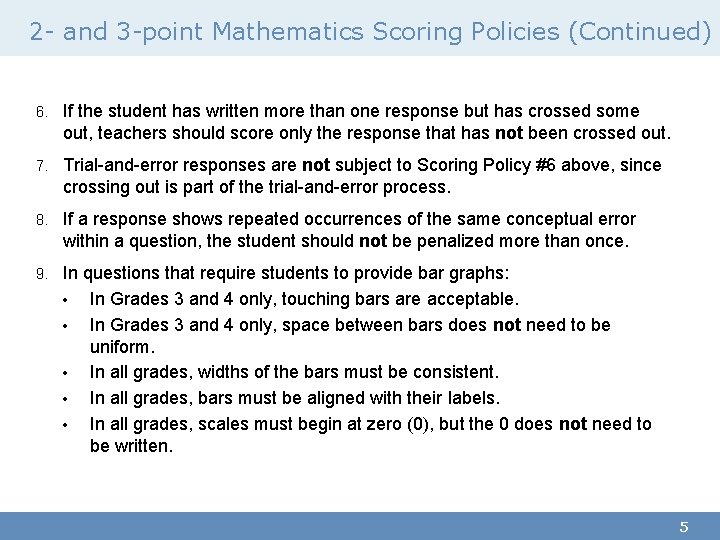
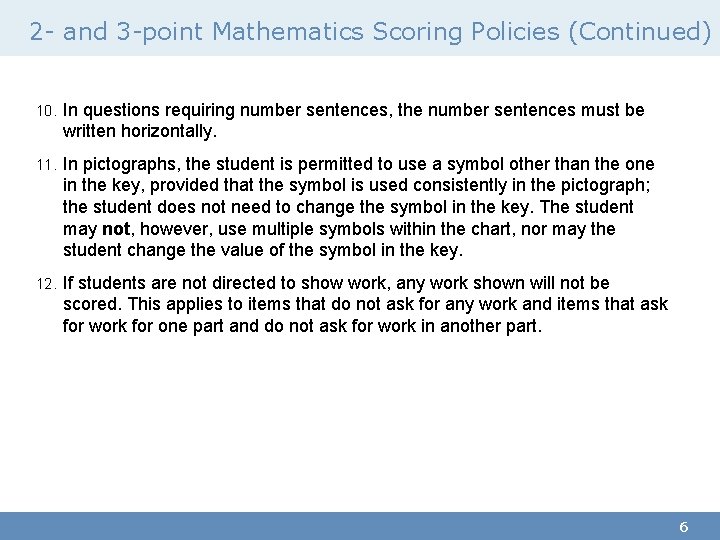
2 - and 3 -point Mathematics Scoring Policies (Continued) 6. If the student has written more than one response but has crossed some out, teachers should score only the response that has not been crossed out. 7. Trial-and-error responses are not subject to Scoring Policy #6 above, since crossing out is part of the trial-and-error process. 8. If a response shows repeated occurrences of the same conceptual error within a question, the student should not be penalized more than once. 9. In questions that require students to provide bar graphs: • In Grades 3 and 4 only, touching bars are acceptable. • In Grades 3 and 4 only, space between bars does not need to be uniform. • In all grades, widths of the bars must be consistent. • In all grades, bars must be aligned with their labels. • In all grades, scales must begin at zero (0), but the 0 does not need to be written. 5
2 - and 3 -point Mathematics Scoring Policies (Continued) 10. In questions requiring number sentences, the number sentences must be written horizontally. 11. In pictographs, the student is permitted to use a symbol other than the one in the key, provided that the symbol is used consistently in the pictograph; the student does not need to change the symbol in the key. The student may not, however, use multiple symbols within the chart, nor may the student change the value of the symbol in the key. 12. If students are not directed to show work, any work shown will not be scored. This applies to items that do not ask for any work and items that ask for work for one part and do not ask for work in another part. 6
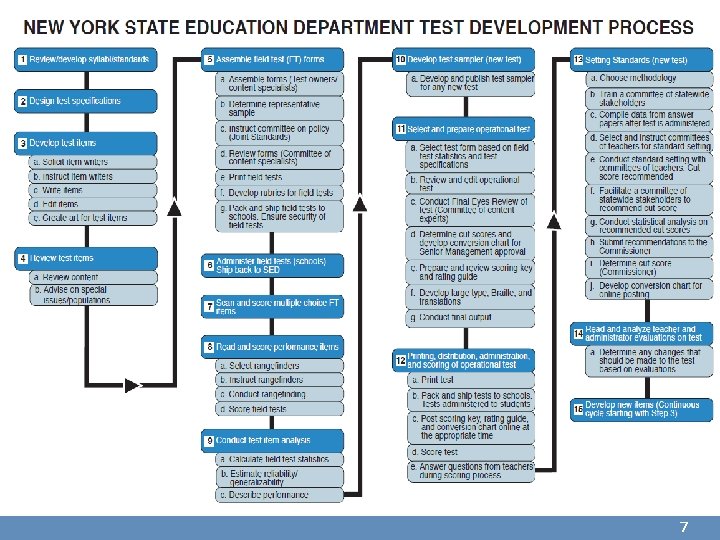
7
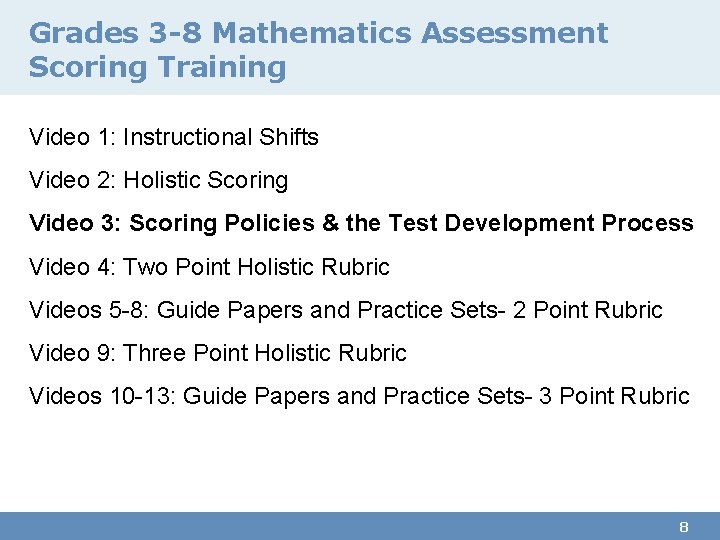
Grades 3 -8 Mathematics Assessment Scoring Training Video 1: Instructional Shifts Video 2: Holistic Scoring Video 3: Scoring Policies & the Test Development Process Video 4: Two Point Holistic Rubric Videos 5 -8: Guide Papers and Practice Sets- 2 Point Rubric Video 9: Three Point Holistic Rubric Videos 10 -13: Guide Papers and Practice Sets- 3 Point Rubric 8
Resources For questions related to assessment: – Email your question to: emscassessinfo@mail. nysed. gov – Check for additional information at the following website http: //www. p 12. nysed. gov/assessment/ei/eigen. html – For questions related to APPR – Email your question to: educatoreval@mail. nysed. gov Additional information regarding the common core shifts can be found at the following website: – http: //engageny. org/resource/common-core-shifts/ 9