
Victory Programs Our Mission Victory Programs opens doors
- Slides: 10
Victory Programs Our Mission Victory Programs opens doors to recovery, hope and community to individuals and families facing homelessness, addiction or other chronic illnesses.
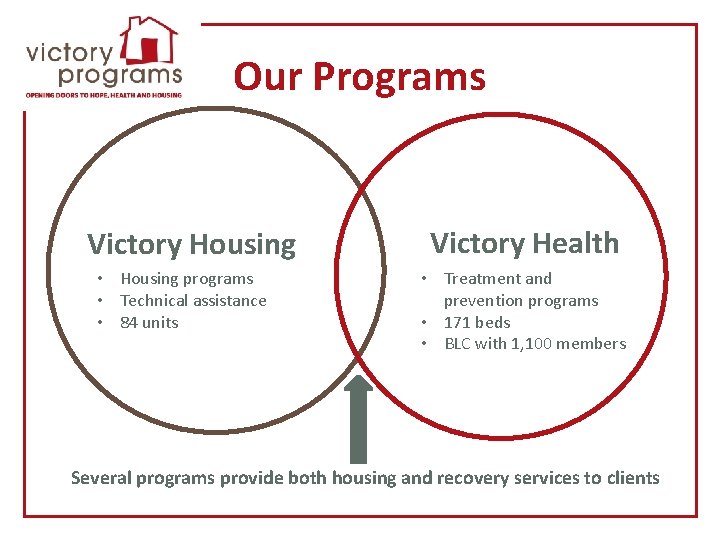
Our Programs Victory Housing • Housing programs • Technical assistance • 84 units Victory Health • Treatment and prevention programs • 171 beds • BLC with 1, 100 members Several programs provide both housing and recovery services to clients
Our Programs Victory Housing • Portis Family Home • Re. Vision Family Home & Urban Farm • Victory Housing on Warren Street • Victory Transitional House • Women’s Hope Transitional Home • Cedar Family Home • Robert Mc. Bride House • Ruah House • Technical Assistance Program (TAP) (non-residential) Victory Health • The Boston Living Center (non-residential) • Joelyn’s Family Home • Living and Recovering Community • New Victories • Shepherd House • Victory House • Women’s Hope
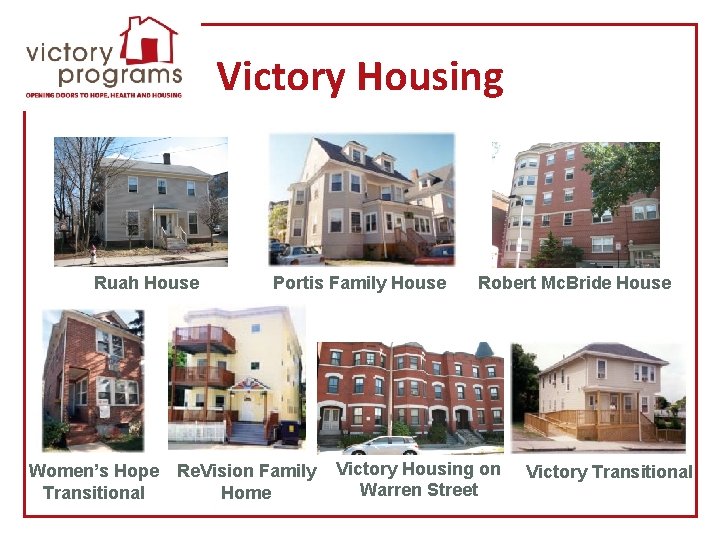
Victory Housing Ruah House Portis Family House Women’s Hope Re. Vision Family Transitional Home Robert Mc. Bride House Victory Housing on Warren Street Victory Transitional
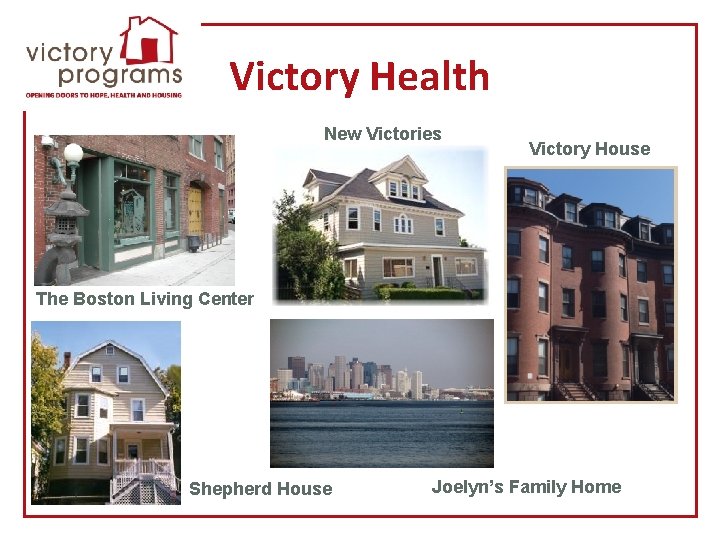
Victory Health New Victories Victory House The Boston Living Center Shepherd House Joelyn’s Family Home
Philosophy of Care All services provided by Victory Programs are individualized and person-driven, focus on strengths, and support people in establishing individualized goals. In order to provide the most effective services, we utilize evidence-based techniques such as Motivational Interviewing (MI).
Standards of Excellence • • • We Communicate Effectively We Respond with Patience We Respect Boundaries We Use Authority Appropriately We Respect Confidentiality We Apply Policies and Procedures in a Fair and Consistent Manner We Do Not Tolerate Discrimination We Individualize Treatment We are Attentive to Clients Needs We Work with Clients from a Strength-Based Perspective
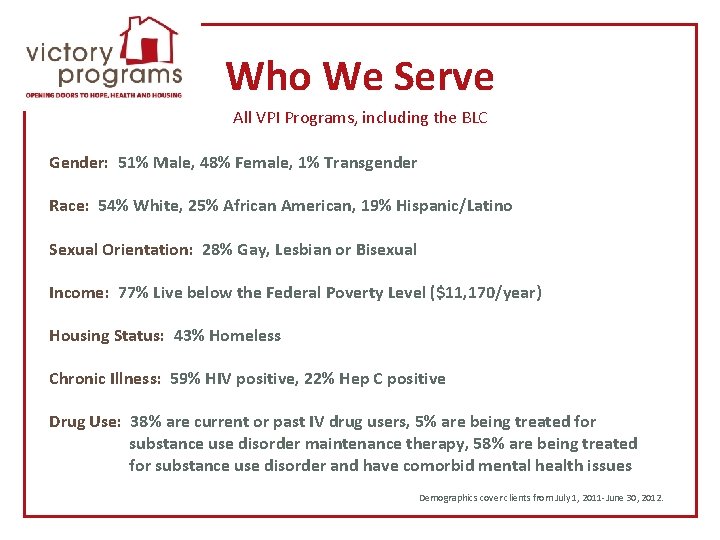
Who We Serve All VPI Programs, including the BLC Gender: 51% Male, 48% Female, 1% Transgender Race: 54% White, 25% African American, 19% Hispanic/Latino Sexual Orientation: 28% Gay, Lesbian or Bisexual Income: 77% Live below the Federal Poverty Level ($11, 170/year) Housing Status: 43% Homeless Chronic Illness: 59% HIV positive, 22% Hep C positive Drug Use: 38% are current or past IV drug users, 5% are being treated for substance use disorder maintenance therapy, 58% are being treated for substance use disorder and have comorbid mental health issues Demographics cover clients from July 1, 2011 -June 30, 2012.
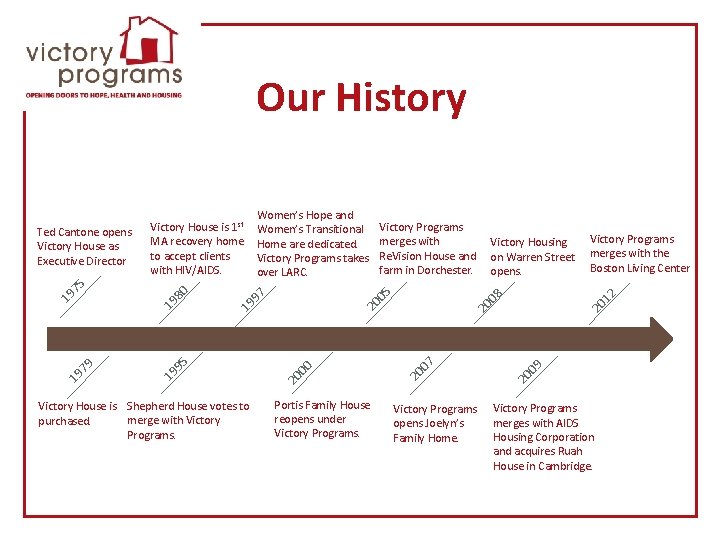
Our History Victory Programs opens Joelyn’s Family Home. Victory Programs merges with the Boston Living Center 12 08 20 09 20 07 20 00 20 Portis Family House reopens under Victory Programs. Victory Housing on Warren Street opens. 20 20 97 Victory House is Shepherd House votes to merge with Victory purchased. Programs. Victory Programs merges with Re. Vision House and farm in Dorchester. 05 Women’s Hope and Women’s Transitional Home are dedicated. Victory Programs takes over LARC. 19 80 19 95 19 19 75 Ted Cantone opens Victory House as Executive Director Victory House is 1 st MA recovery home to accept clients with HIV/AIDS. Victory Programs merges with AIDS Housing Corporation and acquires Ruah House in Cambridge.
Our History Victory Programs began in 1975 as a single program for Vietnam War veterans struggling with alcohol addiction. Over then years we’ve grown through mergers and acquisitions to an agency with 17 individual health and housing programs across Boston and Cambridge. Victory Programs has a long history of innovation, being the first organization in MA to accept clients living with HIV/AIDS, running the first co-ed program in MA for people living with HIV/AIDS and substance abuse issues, and one of the first programs to welcome clients on methadone maintenance.