
Victorian Curriculum F 10 Using picture stories to
- Slides: 47
Victorian Curriculum F– 10 Using picture stories to separate science fact from fiction
Agenda • How can picture stories support science understanding and science inquiry skills? • How can science be supported through other teaching and learning programs?
Victorian Curriculum F-10 • describes a common set of knowledge and skills required by all students for lifelong learning, social development and active and informed citizens • is represented as a continuum of learning or set of progressions defining increasingly complex knowledge, skills and concepts
Victorian Curriculum – Design and Structure Design and structure reaffirms: • the importance of discipline-based learning approach, where the disciplines are regarded as both enduring and dynamic • capabilities are a set of discrete knowledge and skills, not a statement of pedagogies and students benefit from explicit instruction • that knowledge and skills are transferrable across the curriculum and therefore are not duplicated. http: //victoriancurriculum. vcaa. vic. edu. au/overview/curriculumdesign/learning-areas-and-capabilities
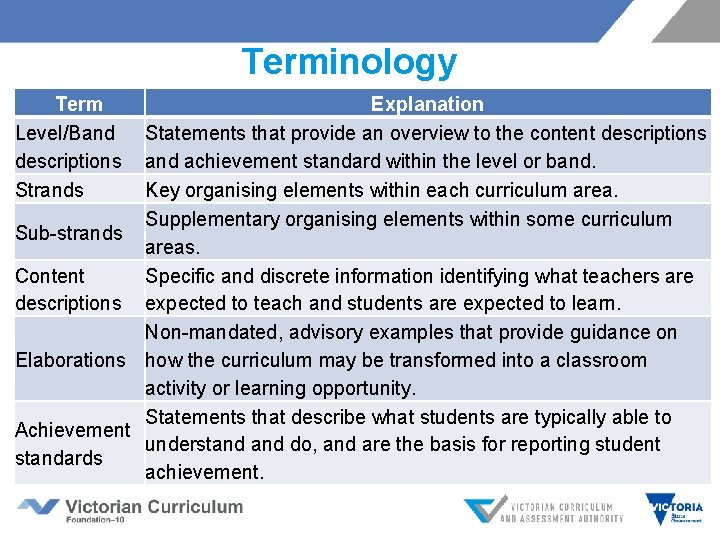
Terminology Term Level/Band descriptions Strands Explanation Statements that provide an overview to the content descriptions and achievement standard within the level or band. Key organising elements within each curriculum area. Supplementary organising elements within some curriculum Sub-strands areas. Content Specific and discrete information identifying what teachers are descriptions expected to teach and students are expected to learn. Non-mandated, advisory examples that provide guidance on Elaborations how the curriculum may be transformed into a classroom activity or learning opportunity. Statements that describe what students are typically able to Achievement understand do, and are the basis for reporting student standards achievement.
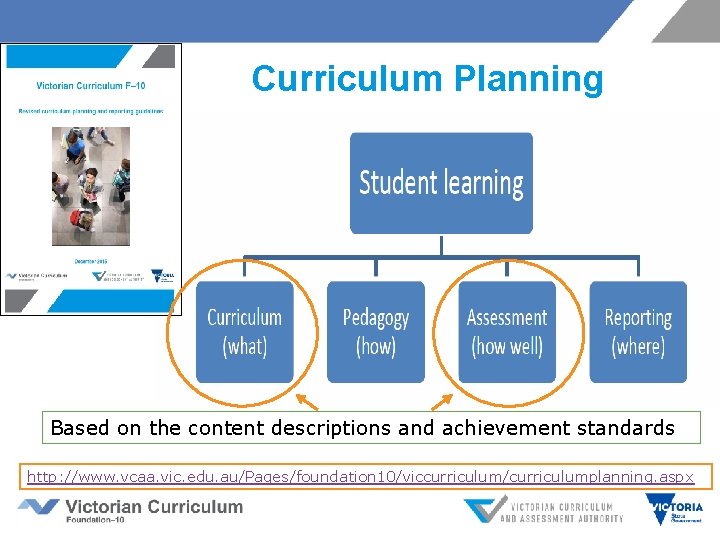
Curriculum Planning Based on the content descriptions and achievement standards http: //www. vcaa. vic. edu. au/Pages/foundation 10/viccurriculum/curriculumplanning. aspx
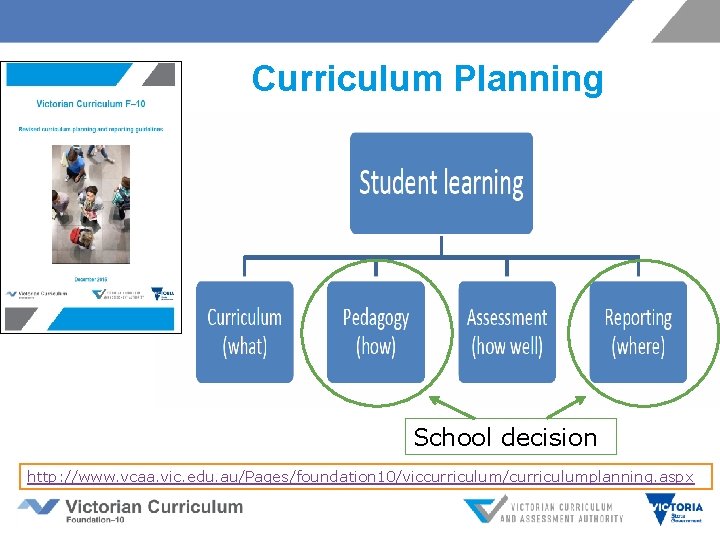
Curriculum Planning School decision http: //www. vcaa. vic. edu. au/Pages/foundation 10/viccurriculum/curriculumplanning. aspx
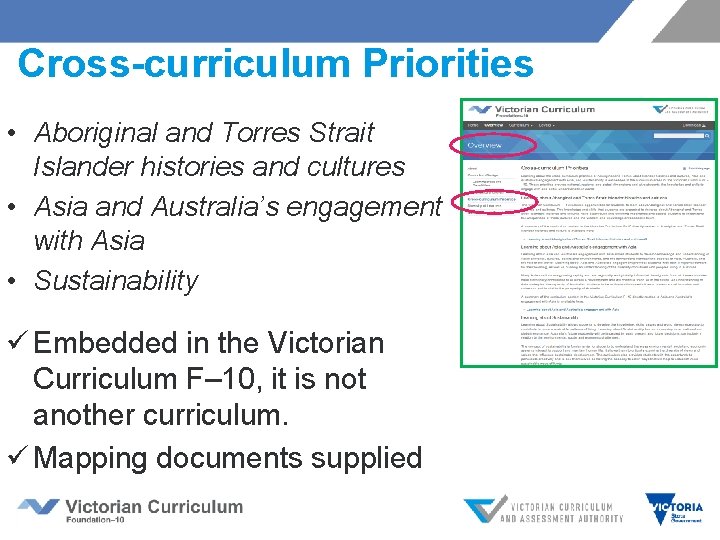
Cross-curriculum Priorities • Aboriginal and Torres Strait Islander histories and cultures • Asia and Australia’s engagement with Asia • Sustainability ü Embedded in the Victorian Curriculum F– 10, it is not another curriculum. ü Mapping documents supplied
How is Science Education delivered in schools? In many different ways! Most schools for F-6 do not have specialist teachers for Science, so it is important for all teachers to be able to provide opportunities for their students to experience learning in science.
Supporting learning • The most important single factor influencing learning is what the learner already knows. Ascertain this and teach him accordingly (Ausubel 1968) • Vygotsky (1978) referred to the ‘zone of proximal development’ the region of ‘just manageable difficulties’ where students can succeed but often only with the support of others for example through scaffolding activities. • … learning is enhanced when teachers pay attention to the knowledge and beliefs that learners bring to the learning task and use this knowledge as a starting point for new instruction (Bransford et al 2000)
Why is curriculum planning so important? • A guaranteed and viable curriculum is the school level factor that has the most impact on student achievement • A guaranteed and viable curriculum is defined as a combination of opportunity to learn and time to learn (What works in schools: Translating research into action Marzano 2003) • It is not enough for a curriculum to be implicit, it must be explicit and it must be coherent • Effective planning and documentation is a significant part of providing a guaranteed and viable curriculum
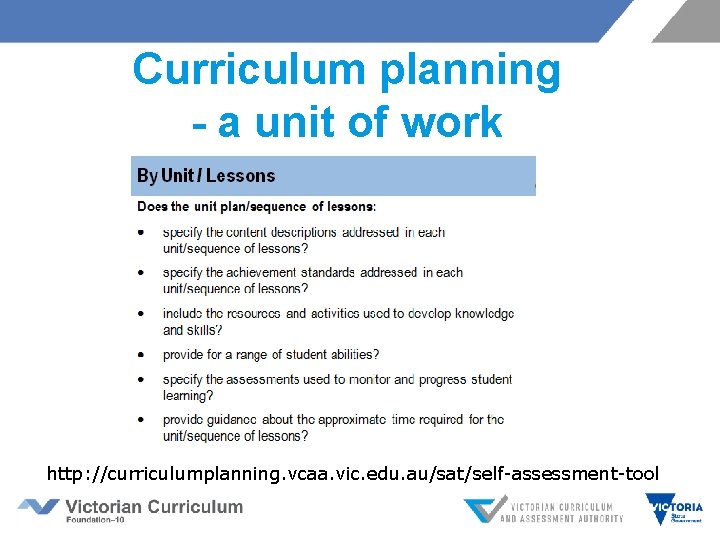
Curriculum planning - a unit of work http: //curriculumplanning. vcaa. vic. edu. au/sat/self-assessment-tool
Working with the curriculum
Looking for opportunities to support and extend student learning SOLO Taxonomy (Biggs and Collis, 1982) q. Prestructural q. Unistructural q. Multistructural q. Relational q. Extended abstract
Picture stories that support student learning • Look for stories that contain opportunities to integrate science into literacy/inquiry units • Look for stories that will hook/engage students into science concepts • Look for stories that allow differentiation of student understanding – unistructural, multistructural, relational, extended abstract
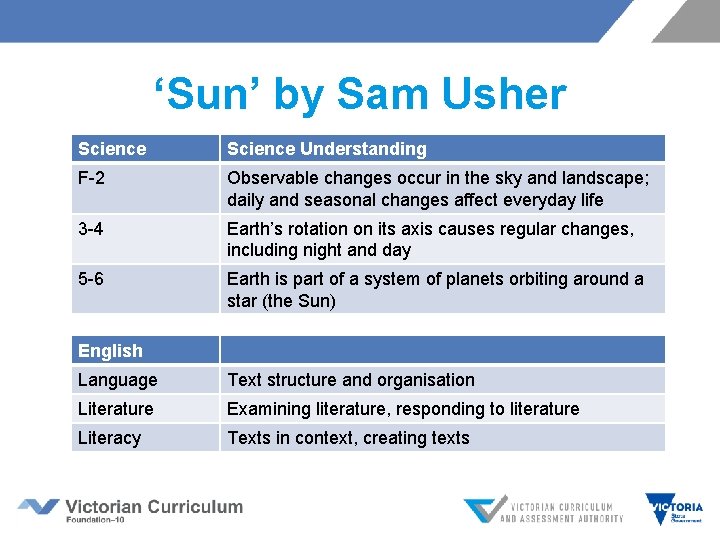
Sun by Sam Usher q. Also in the series – Rain, Snow § § § § ‘hottest day of the year’ ‘hotter than broccoli soup’ ‘hotter than the Atacama Desert’ ‘hotter than the surface of the sun’ ‘The sun beat down’ ‘Grandad navigated’ ‘I hope it’s sunny again tomorrow’
‘Sun’ by Sam Usher Science Understanding F-2 Observable changes occur in the sky and landscape; daily and seasonal changes affect everyday life 3 -4 Earth’s rotation on its axis causes regular changes, including night and day 5 -6 Earth is part of a system of planets orbiting around a star (the Sun) English Language Text structure and organisation Literature Examining literature, responding to literature Literacy Texts in context, creating texts
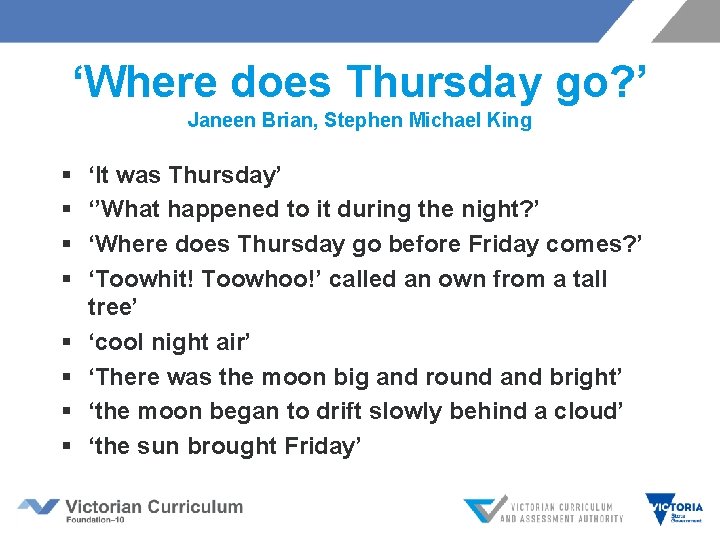
‘Where does Thursday go? ’ Janeen Brian, Stephen Michael King § § § § ‘It was Thursday’ ‘’What happened to it during the night? ’ ‘Where does Thursday go before Friday comes? ’ ‘Toowhit! Toowhoo!’ called an own from a tall tree’ ‘cool night air’ ‘There was the moon big and round and bright’ ‘the moon began to drift slowly behind a cloud’ ‘the sun brought Friday’
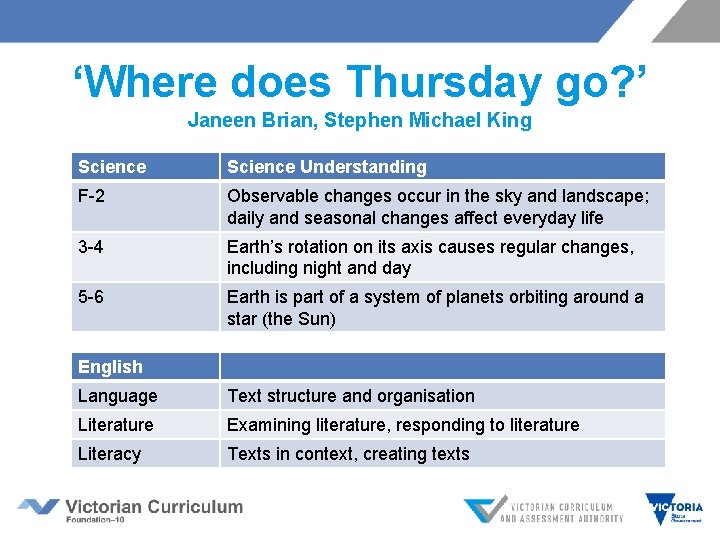
‘Where does Thursday go? ’ Janeen Brian, Stephen Michael King Science Understanding F-2 Observable changes occur in the sky and landscape; daily and seasonal changes affect everyday life 3 -4 Earth’s rotation on its axis causes regular changes, including night and day 5 -6 Earth is part of a system of planets orbiting around a star (the Sun) English Language Text structure and organisation Literature Examining literature, responding to literature Literacy Texts in context, creating texts
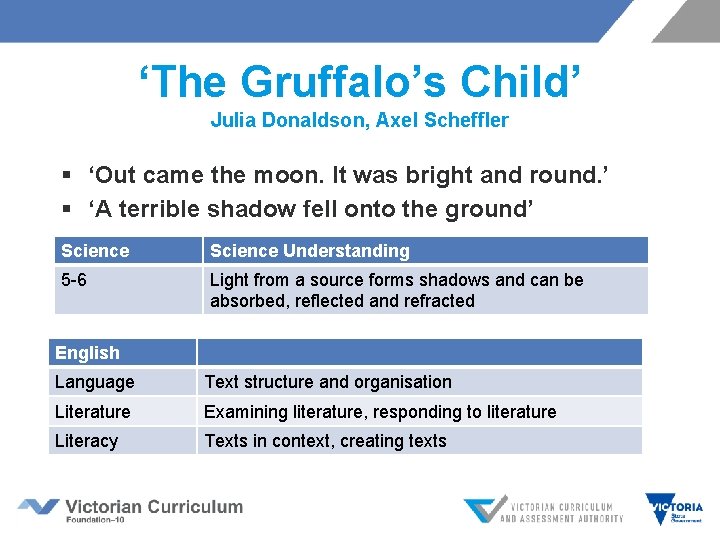
‘The Gruffalo’s Child’ Julia Donaldson, Axel Scheffler § ‘Out came the moon. It was bright and round. ’ § ‘A terrible shadow fell onto the ground’ Science Understanding 5 -6 Light from a source forms shadows and can be absorbed, reflected and refracted English Language Text structure and organisation Literature Examining literature, responding to literature Literacy Texts in context, creating texts
‘Carmichael’s Journey’ Shelly Fussell, Samantha Metcalfe Carmichael the Carnaby’s Black Cockatoo has made his first flight out of the next and joined his parents on the long journey to their coastal feeding grounds. But when they return, they find their home has been destroyed. What will they do? And, more importantly, what can we all do to help?
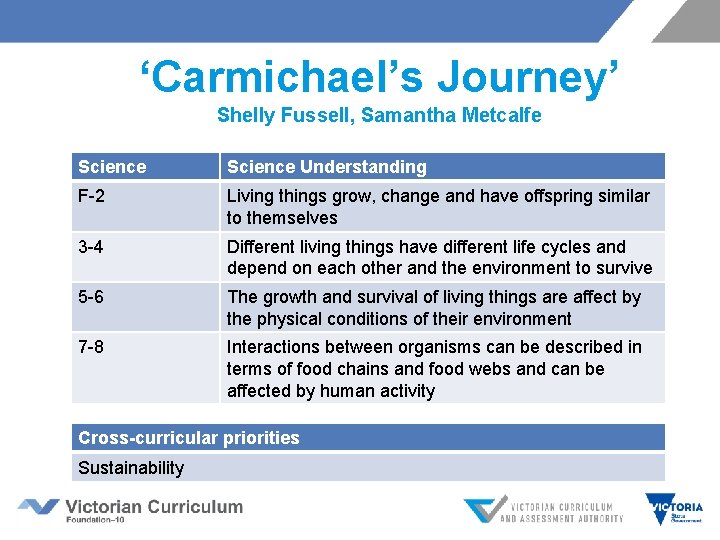
‘Carmichael’s Journey’ Shelly Fussell, Samantha Metcalfe Science Understanding F-2 Living things grow, change and have offspring similar to themselves 3 -4 Different living things have different life cycles and depend on each other and the environment to survive 5 -6 The growth and survival of living things are affect by the physical conditions of their environment 7 -8 Interactions between organisms can be described in terms of food chains and food webs and can be affected by human activity Cross-curricular priorities Sustainability
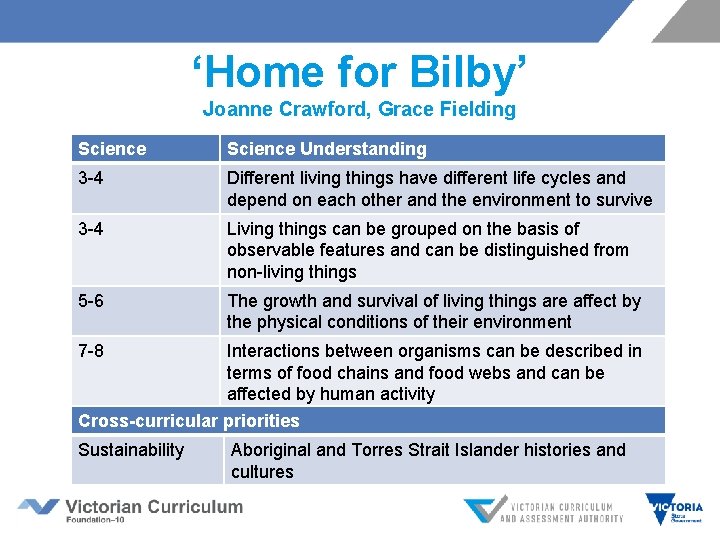
‘Home for Bilby’ Joanne Crawford, Grace Fielding Science Understanding 3 -4 Different living things have different life cycles and depend on each other and the environment to survive 3 -4 Living things can be grouped on the basis of observable features and can be distinguished from non-living things 5 -6 The growth and survival of living things are affect by the physical conditions of their environment 7 -8 Interactions between organisms can be described in terms of food chains and food webs and can be affected by human activity Cross-curricular priorities Sustainability Aboriginal and Torres Strait Islander histories and cultures
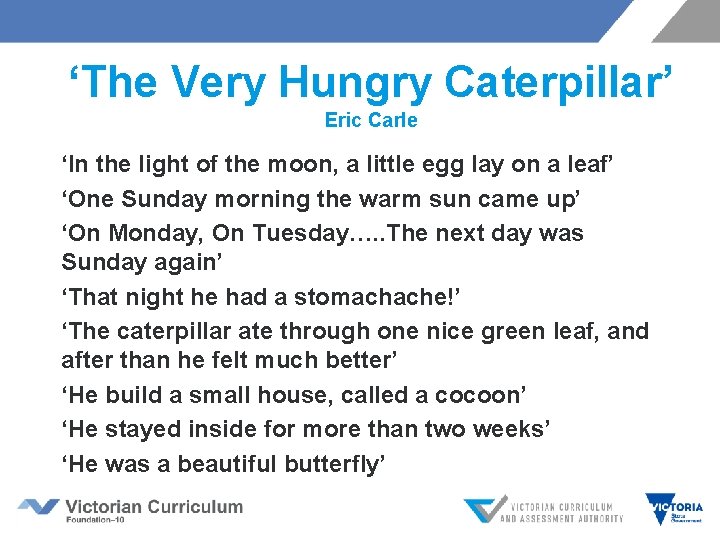
‘The Very Hungry Caterpillar’ Eric Carle ‘In the light of the moon, a little egg lay on a leaf’ ‘One Sunday morning the warm sun came up’ ‘On Monday, On Tuesday…. . The next day was Sunday again’ ‘That night he had a stomachache!’ ‘The caterpillar ate through one nice green leaf, and after than he felt much better’ ‘He build a small house, called a cocoon’ ‘He stayed inside for more than two weeks’ ‘He was a beautiful butterfly’
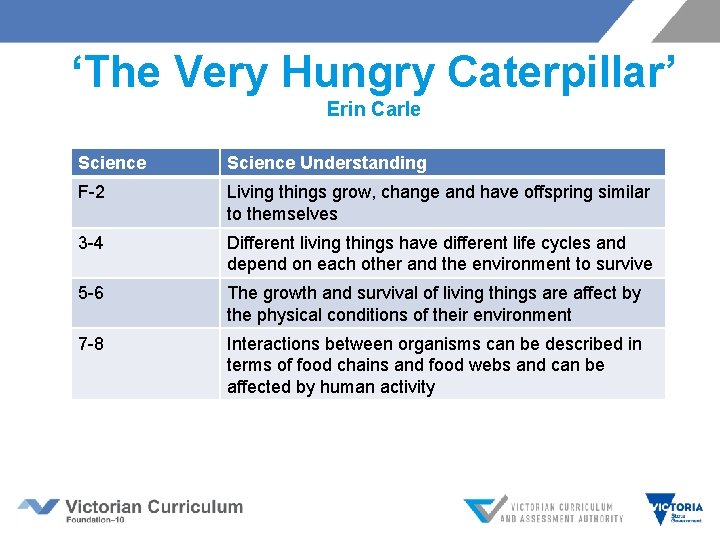
‘The Very Hungry Caterpillar’ Erin Carle Science Understanding F-2 Living things grow, change and have offspring similar to themselves 3 -4 Different living things have different life cycles and depend on each other and the environment to survive 5 -6 The growth and survival of living things are affect by the physical conditions of their environment 7 -8 Interactions between organisms can be described in terms of food chains and food webs and can be affected by human activity
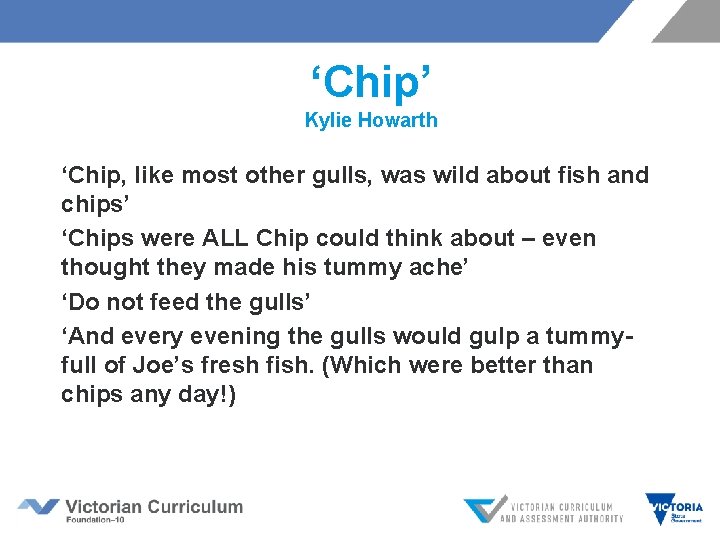
‘Chip’ Kylie Howarth ‘Chip, like most other gulls, was wild about fish and chips’ ‘Chips were ALL Chip could think about – even thought they made his tummy ache’ ‘Do not feed the gulls’ ‘And every evening the gulls would gulp a tummyfull of Joe’s fresh fish. (Which were better than chips any day!)
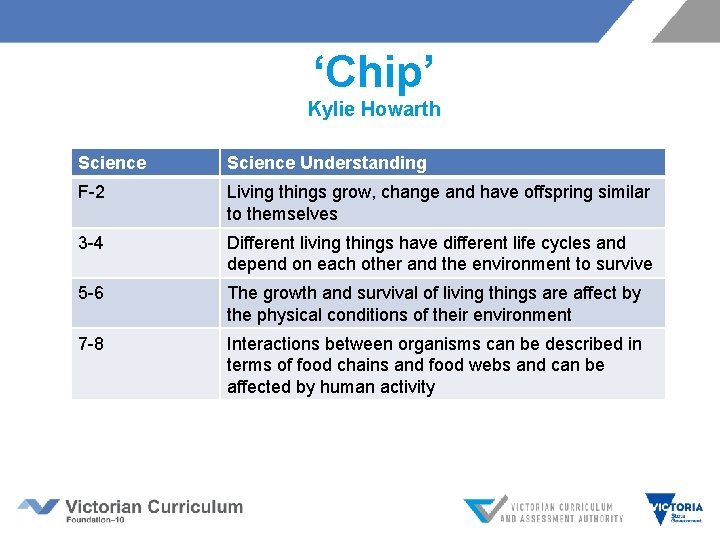
‘Chip’ Kylie Howarth Science Understanding F-2 Living things grow, change and have offspring similar to themselves 3 -4 Different living things have different life cycles and depend on each other and the environment to survive 5 -6 The growth and survival of living things are affect by the physical conditions of their environment 7 -8 Interactions between organisms can be described in terms of food chains and food webs and can be affected by human activity
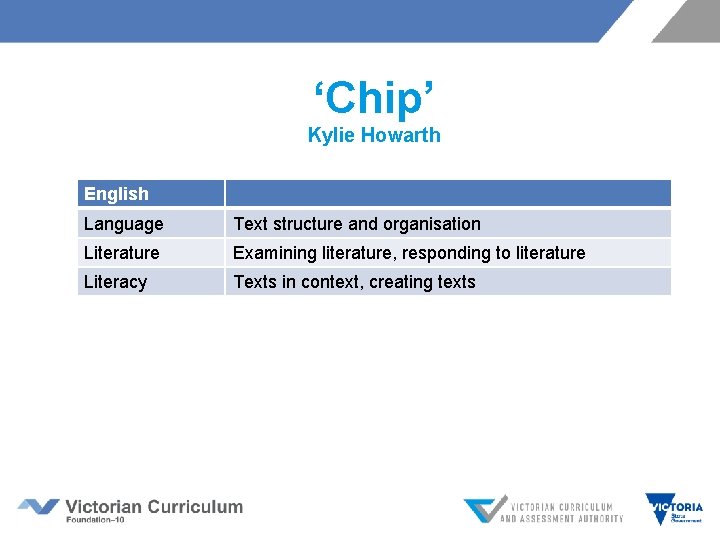
‘Chip’ Kylie Howarth English Language Text structure and organisation Literature Examining literature, responding to literature Literacy Texts in context, creating texts
‘Diary of a Wombat’ Jackie French, Bruce Whatley Days of the week ‘Morning: Slept, Afternoon: Slept, Evening: Ate grass, Night: Ate grass’ ‘Demanded a carrot, the carrot was delish’ ‘Chewed hole in door’ ‘Demanded rolled oats instead’ Animals as anthropomorphic
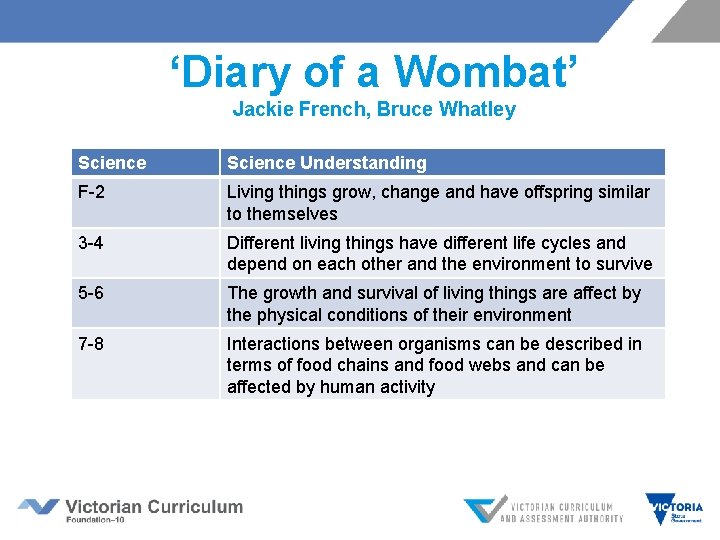
‘Diary of a Wombat’ Jackie French, Bruce Whatley Science Understanding F-2 Living things grow, change and have offspring similar to themselves 3 -4 Different living things have different life cycles and depend on each other and the environment to survive 5 -6 The growth and survival of living things are affect by the physical conditions of their environment 7 -8 Interactions between organisms can be described in terms of food chains and food webs and can be affected by human activity
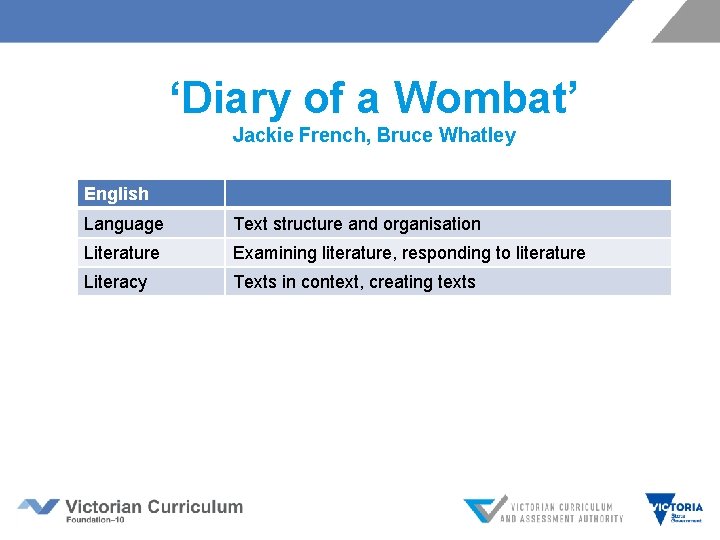
‘Diary of a Wombat’ Jackie French, Bruce Whatley English Language Text structure and organisation Literature Examining literature, responding to literature Literacy Texts in context, creating texts
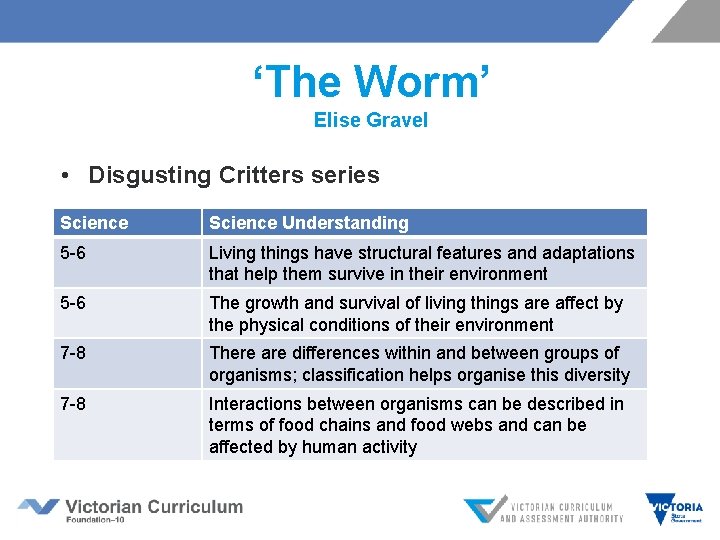
‘The Worm’ Elise Gravel • Disgusting Critters series Science Understanding 5 -6 Living things have structural features and adaptations that help them survive in their environment 5 -6 The growth and survival of living things are affect by the physical conditions of their environment 7 -8 There are differences within and between groups of organisms; classification helps organise this diversity 7 -8 Interactions between organisms can be described in terms of food chains and food webs and can be affected by human activity
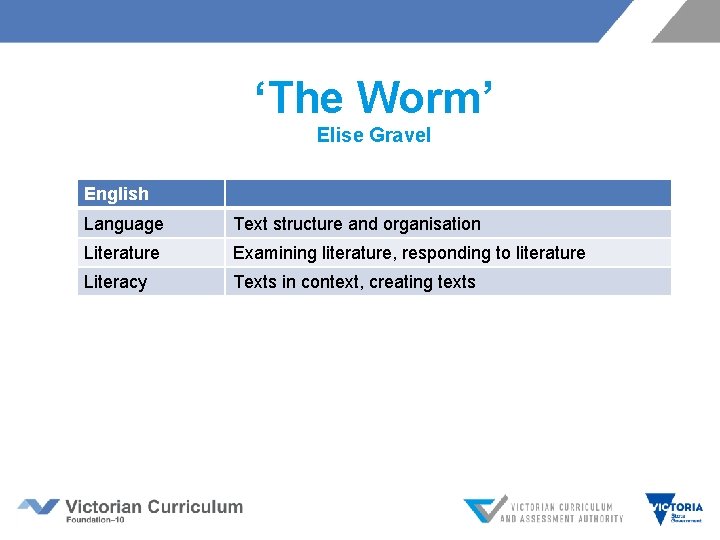
‘The Worm’ Elise Gravel English Language Text structure and organisation Literature Examining literature, responding to literature Literacy Texts in context, creating texts
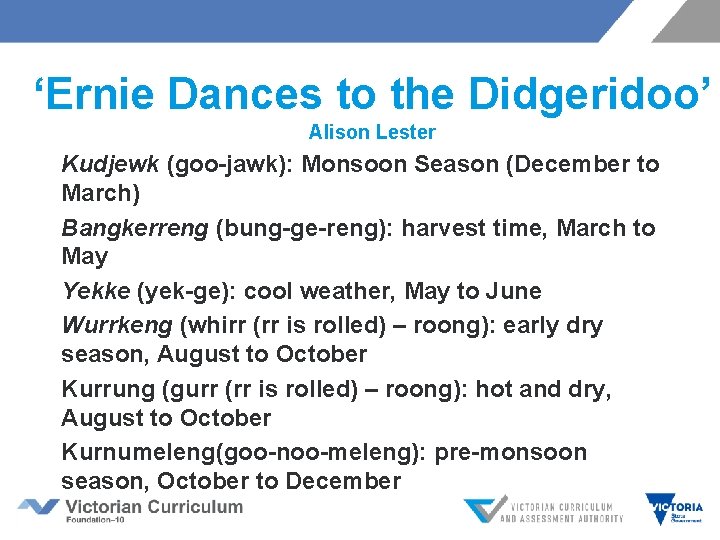
‘Ernie Dances to the Didgeridoo’ Alison Lester Kudjewk (goo-jawk): Monsoon Season (December to March) Bangkerreng (bung-ge-reng): harvest time, March to May Yekke (yek-ge): cool weather, May to June Wurrkeng (whirr (rr is rolled) – roong): early dry season, August to October Kurrung (gurr (rr is rolled) – roong): hot and dry, August to October Kurnumeleng(goo-noo-meleng): pre-monsoon season, October to December
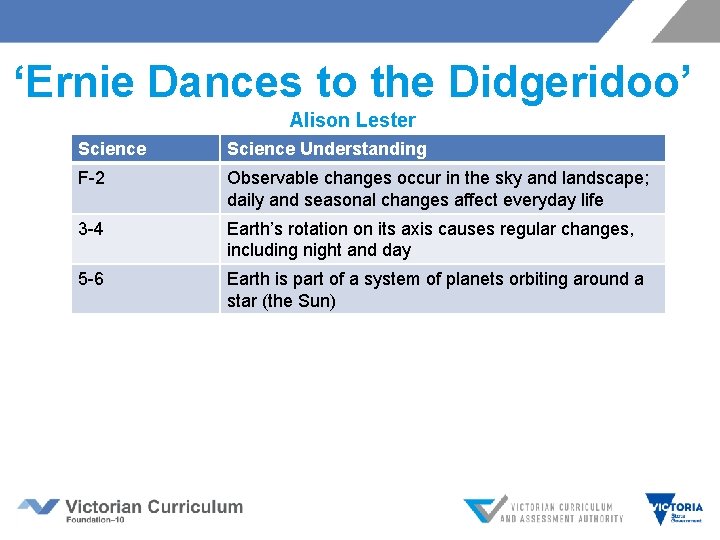
‘Ernie Dances to the Didgeridoo’ Alison Lester Science Understanding F-2 Observable changes occur in the sky and landscape; daily and seasonal changes affect everyday life 3 -4 Earth’s rotation on its axis causes regular changes, including night and day 5 -6 Earth is part of a system of planets orbiting around a star (the Sun)
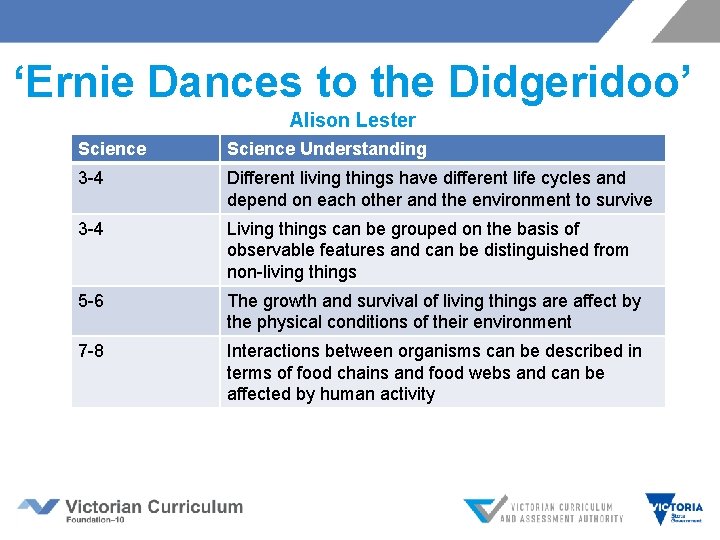
‘Ernie Dances to the Didgeridoo’ Alison Lester Science Understanding 3 -4 Different living things have different life cycles and depend on each other and the environment to survive 3 -4 Living things can be grouped on the basis of observable features and can be distinguished from non-living things 5 -6 The growth and survival of living things are affect by the physical conditions of their environment 7 -8 Interactions between organisms can be described in terms of food chains and food webs and can be affected by human activity
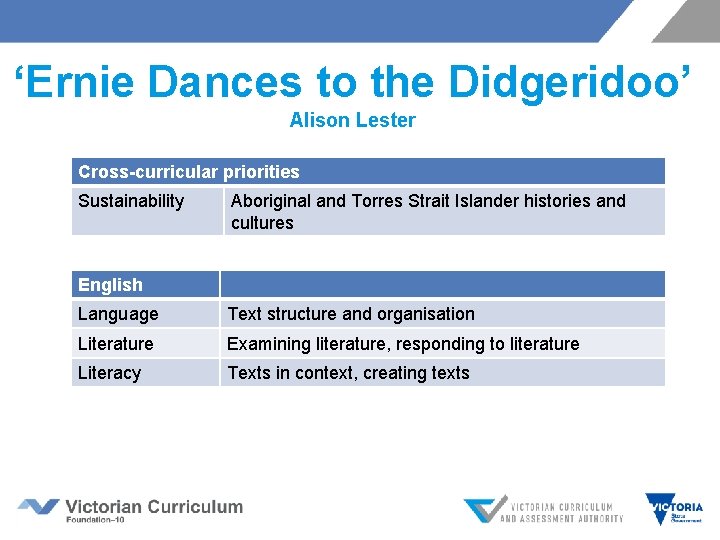
‘Ernie Dances to the Didgeridoo’ Alison Lester Cross-curricular priorities Sustainability Aboriginal and Torres Strait Islander histories and cultures English Language Text structure and organisation Literature Examining literature, responding to literature Literacy Texts in context, creating texts
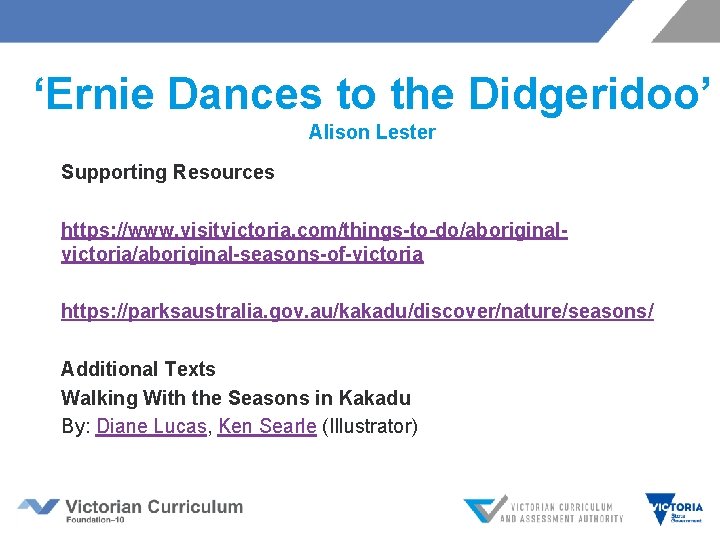
‘Ernie Dances to the Didgeridoo’ Alison Lester Supporting Resources https: //www. visitvictoria. com/things-to-do/aboriginalvictoria/aboriginal-seasons-of-victoria https: //parksaustralia. gov. au/kakadu/discover/nature/seasons/ Additional Texts Walking With the Seasons in Kakadu By: Diane Lucas, Ken Searle (Illustrator)
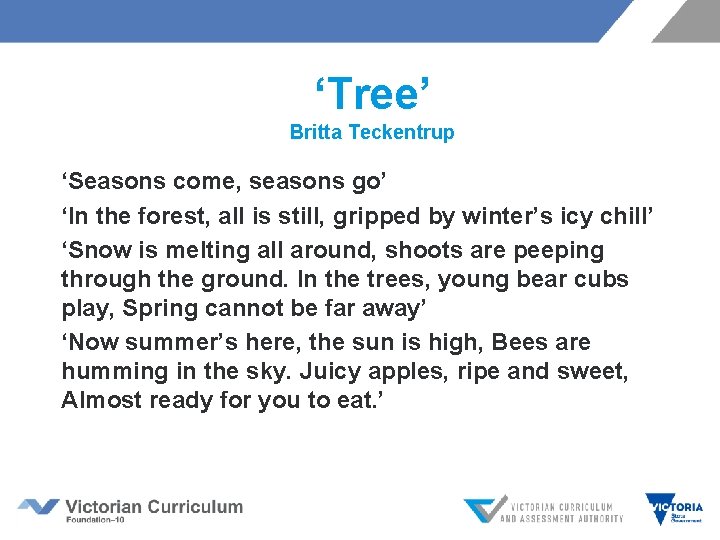
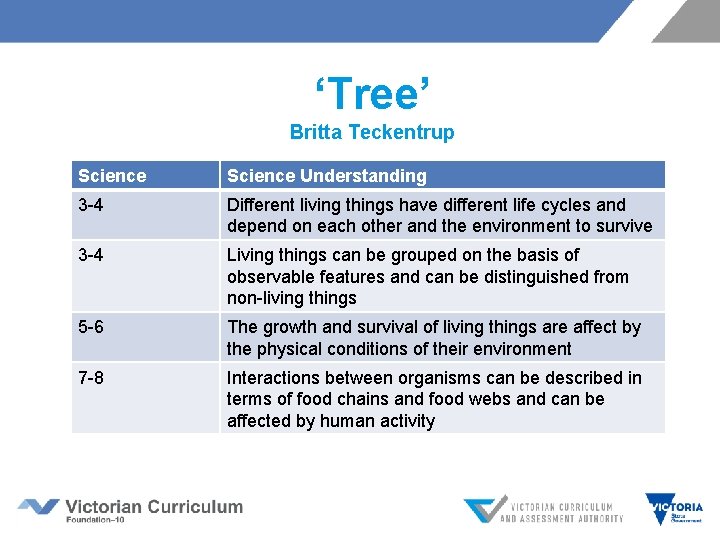
‘Tree’ Britta Teckentrup ‘Seasons come, seasons go’ ‘In the forest, all is still, gripped by winter’s icy chill’ ‘Snow is melting all around, shoots are peeping through the ground. In the trees, young bear cubs play, Spring cannot be far away’ ‘Now summer’s here, the sun is high, Bees are humming in the sky. Juicy apples, ripe and sweet, Almost ready for you to eat. ’
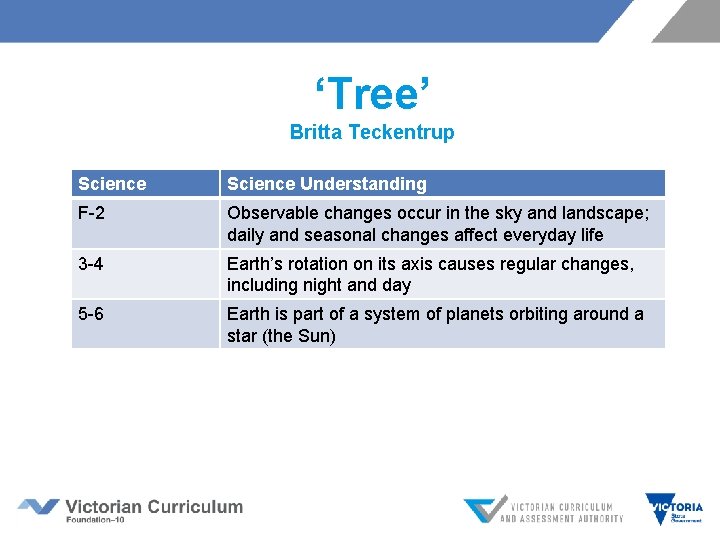
‘Tree’ Britta Teckentrup Science Understanding F-2 Observable changes occur in the sky and landscape; daily and seasonal changes affect everyday life 3 -4 Earth’s rotation on its axis causes regular changes, including night and day 5 -6 Earth is part of a system of planets orbiting around a star (the Sun)
‘Tree’ Britta Teckentrup Science Understanding 3 -4 Different living things have different life cycles and depend on each other and the environment to survive 3 -4 Living things can be grouped on the basis of observable features and can be distinguished from non-living things 5 -6 The growth and survival of living things are affect by the physical conditions of their environment 7 -8 Interactions between organisms can be described in terms of food chains and food webs and can be affected by human activity
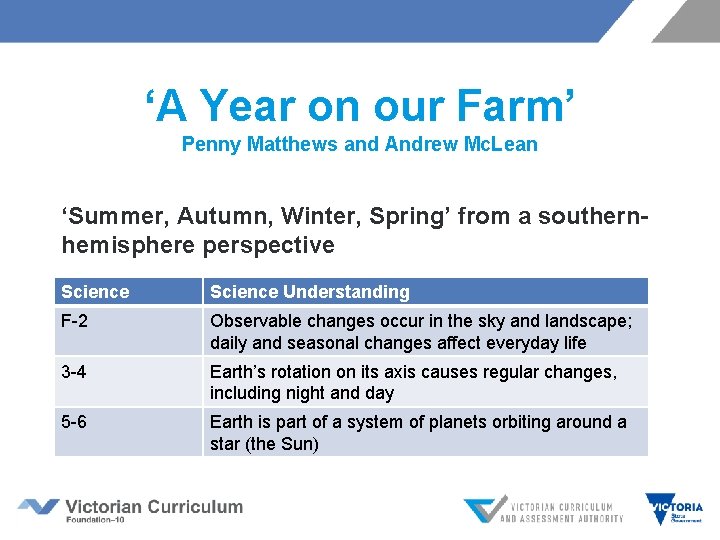
‘A Year on our Farm’ Penny Matthews and Andrew Mc. Lean ‘Summer, Autumn, Winter, Spring’ from a southernhemisphere perspective Science Understanding F-2 Observable changes occur in the sky and landscape; daily and seasonal changes affect everyday life 3 -4 Earth’s rotation on its axis causes regular changes, including night and day 5 -6 Earth is part of a system of planets orbiting around a star (the Sun)
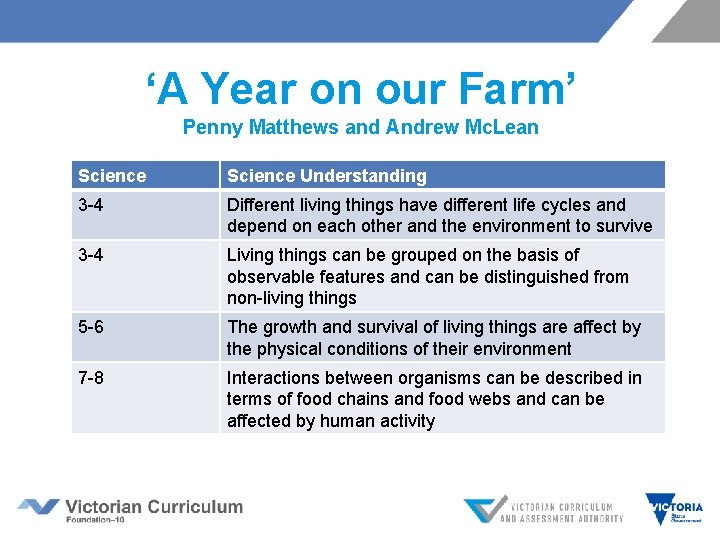
‘A Year on our Farm’ Penny Matthews and Andrew Mc. Lean Science Understanding 3 -4 Different living things have different life cycles and depend on each other and the environment to survive 3 -4 Living things can be grouped on the basis of observable features and can be distinguished from non-living things 5 -6 The growth and survival of living things are affect by the physical conditions of their environment 7 -8 Interactions between organisms can be described in terms of food chains and food webs and can be affected by human activity
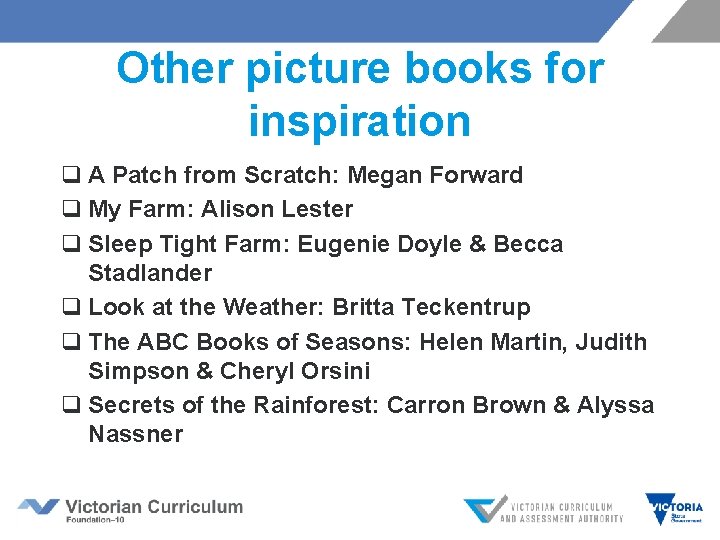
Other picture books for inspiration q A Patch from Scratch: Megan Forward q My Farm: Alison Lester q Sleep Tight Farm: Eugenie Doyle & Becca Stadlander q Look at the Weather: Britta Teckentrup q The ABC Books of Seasons: Helen Martin, Judith Simpson & Cheryl Orsini q Secrets of the Rainforest: Carron Brown & Alyssa Nassner
Other picture books for inspiration q The Hidden Rainforest: Jeannie Baker q Crocodile River: Diana Lawrenson & Danny Snell q Backyard: Ananda Braxton-Smith & Lizzy Newcomb q The Lorax: Dr Seuss q Where the forest meets the sea: Jeannie Baker q The Story of Rosy Dock: Jeannie Baker q What’s Hidden in the Woods? : Aina Bestard q Rainbow Bear: Stephen Michael King
Other picture books for inspiration q. Over and Under the Snow: Kate Messner (e. Book) q. Up in the Garden and Down in the Dirt: Kate Messner (e. Book) q. Over and Under the Pond: Kate Messner (e. Book) q. AND LOTS, LOTS MORE!
Contact Erin Wilson Curriculum Manager, STEM 03 9032 1723 wilson. erin. c@edumail. vic. gov. au