
Victims of Crime Act VOCA Grant Program 2016
- Slides: 50
Victims of Crime Act (VOCA) Grant Program 2016 Competitive Application Criminal Justice Coordinating Council Victim Assistance Unit June 23, 2016
Agenda I. III. IV. V. VIII. IX. X. Welcome Introductions Overview of VOCA Eligibility Grant Awards Reporting Requirements Match and Other Requirements Completing the Application Timeline Q&A
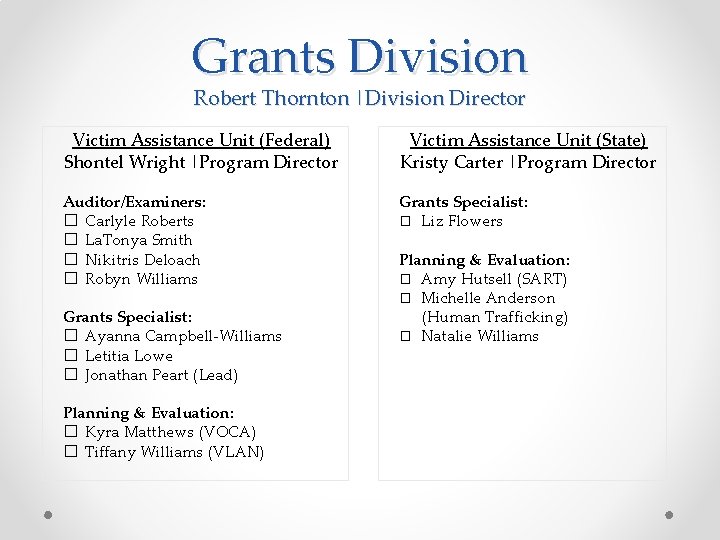
Grants Division Robert Thornton |Division Director Victim Assistance Unit (Federal) Shontel Wright |Program Director Victim Assistance Unit (State) Kristy Carter |Program Director Auditor/Examiners: � Carlyle Roberts � La. Tonya Smith � Nikitris Deloach � Robyn Williams Grants Specialist: � Liz Flowers Grants Specialist: � Ayanna Campbell-Williams � Letitia Lowe � Jonathan Peart (Lead) Planning & Evaluation: � Kyra Matthews (VOCA) � Tiffany Williams (VLAN) Planning & Evaluation: � Amy Hutsell (SART) � Michelle Anderson (Human Trafficking) � Natalie Williams
Overview Ø Office for Victims of Crime (OVC) is part of the Department of Justice’s Office of Justice Programs Ø Provides training and technical assistance opportunities to providers and advocates at all levels of victim services Ø Provides and disseminates information for victim services and criminal justice audiences Ø OVC mission is to enhance the Nation’s capacity to assist crime victims by providing leadership and funding on behalf of crime victims
Overview Office of Victims of Crime (OVC) provides federal funding to: o Support victim assistance and compensation programs, o Provide training for diverse professionals who work with victims, o Develop projects to enhance victims’ rights and services, and o Undertake public education and awareness activities on behalf of crime victims
Overview According to VOCA Program Guidelines, services are defined as those efforts that: 1) Respond to the emotional and physical needs of crime victims, 2) Assist primary and secondary victims of crime to stabilize their lives after victimization, 3) Help victims understand participate in the criminal justice system, and 4) Provide victims of crime with a measure of safety and security.
Overview Ø For the purpose of the VOCA crime victim assistance grant program, a crime victim is a person who has suffered physical, sexual, financial, or emotional harm as a result of the commission of a crime. Ø Funding cannot be used for the investigation of crimes or collection of evidence to further the prosecution of crimes.
Crime Victims Fund (CVF) Ø The CVF was established in 1984 Ø VOCA grants are supported by deposits of criminal fines, forfeited bail bonds, penalty fees, and special assessments collected by U. S. Attorney’s Offices, Federal Courts, and the Bureau of Prisons – not taxpayer dollars.
Purpose of VOCA The purpose of VOCA is to expand enhance direct services to victims of crime. This includes: Ø Responding to the immediate needs of crime victims Ø Reducing the severity of psychological consequences of victimization Ø Helping restore a victim’s sense of dignity and self-esteem Ø Assisting and encouraging victims to participate in the criminal justice system
Purpose of VOCA CJCC uses VOCA funds to: Ø Sustain service provision levels throughout the state Ø Ensure that crime victims across the state have access to advocacy services to ensure their rights under the Georgia Crime Victims Bill of Rights are upheld Ø Ensure all crime victims have access to core services
Eligibility Requirements Ø Provide direct services to crime victims and be operated by a public agency, non-profit organization or a combination of both Ø Be certified as eligible to receive Local Victim Assistance Funding (5%) Ø Established Program: Demonstrate a record of effective services to crime victims Ø New Program: May be eligible if they demonstrate that 25 – 50% of their financial support comes from non-federal sources
Eligibility Requirements Ø Be able to provide a 20% match; 25% of the total match should be in volunteer hours Ø Must actively collaborate with other victim service providers in your service area Ø Must comply with federal laws and rules/guidelines regulating grants and the use of federal funds o OJP Financial Guide o OMB Circulars Ø Can not discriminate when providing services to maintain compliance with Civil Rights Requirements: o EEOP, LEP, etc.
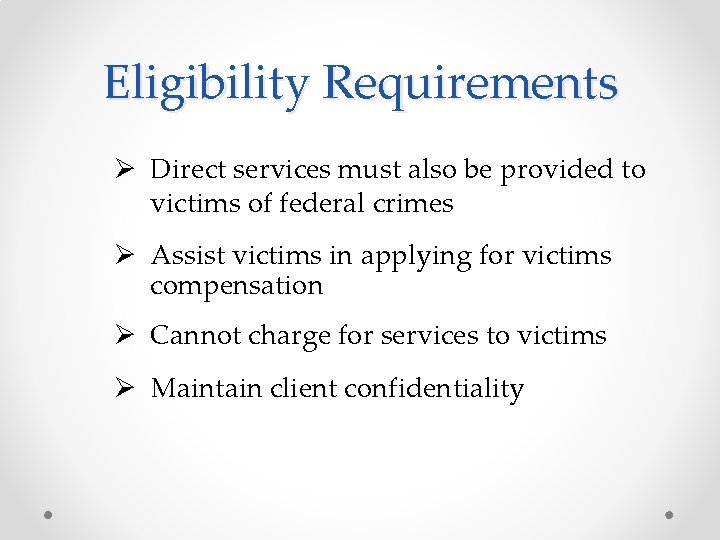
Eligibility Requirements Ø Direct services must also be provided to victims of federal crimes Ø Assist victims in applying for victims compensation Ø Cannot charge for services to victims Ø Maintain client confidentiality
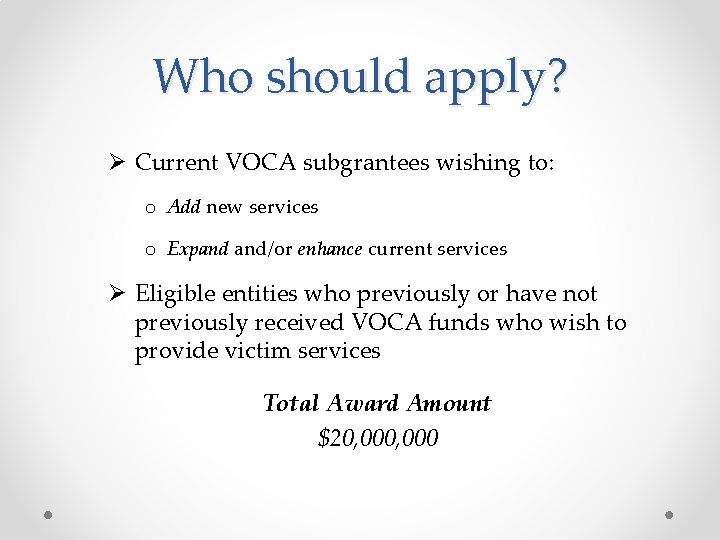
Who should apply? Ø Current VOCA subgrantees wishing to: o Add new services o Expand and/or enhance current services Ø Eligible entities who previously or have not previously received VOCA funds who wish to provide victim services Total Award Amount $20, 000
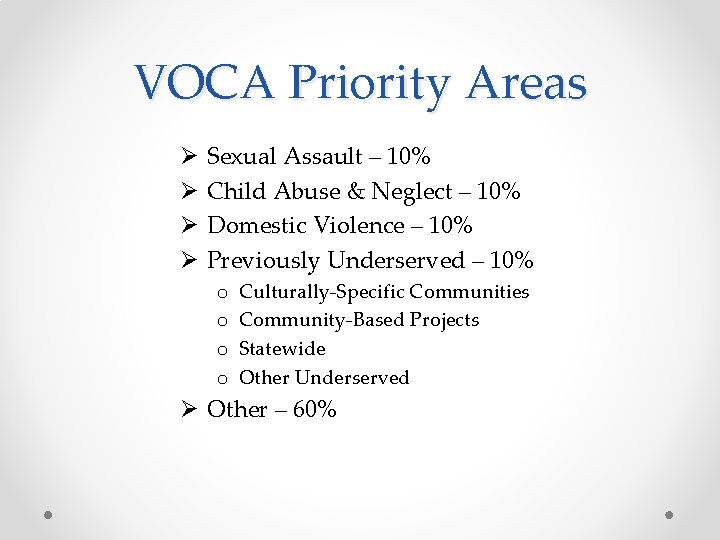
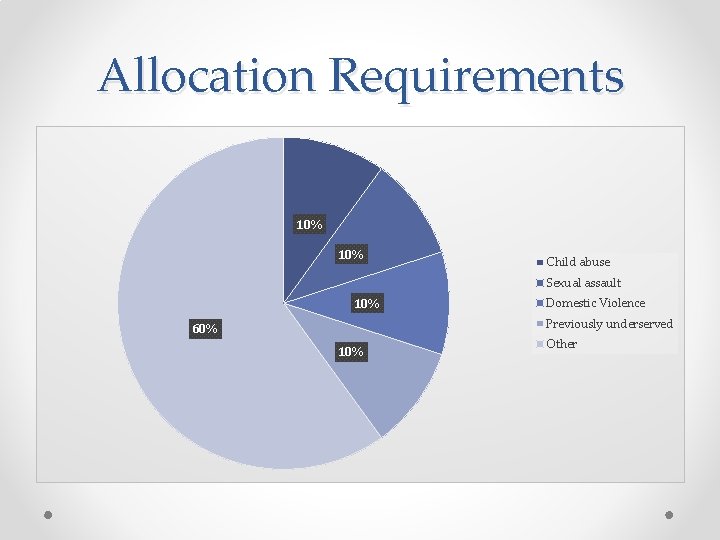
VOCA Priority Areas Ø Ø Sexual Assault – 10% Child Abuse & Neglect – 10% Domestic Violence – 10% Previously Underserved – 10% o o Culturally-Specific Communities Community-Based Projects Statewide Other Underserved Ø Other – 60%
Allocation Requirements 10% Child abuse Sexual assault 10% Domestic Violence Previously underserved 60% 10% Other
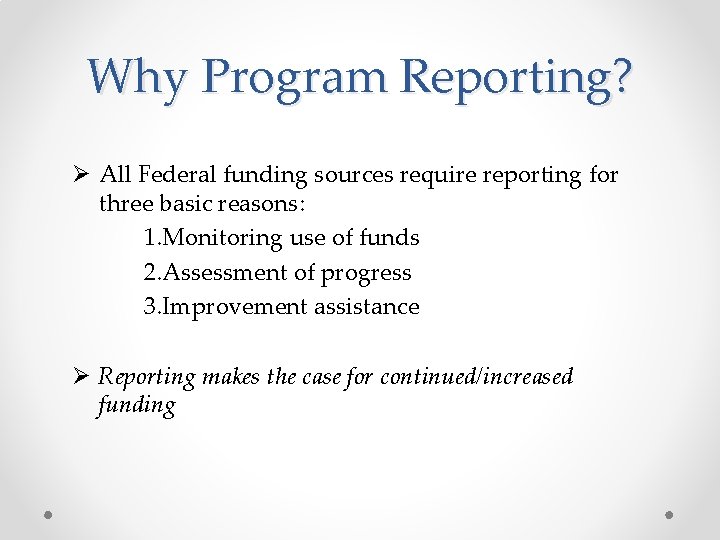
Why Program Reporting? Ø All Federal funding sources require reporting for three basic reasons: 1. Monitoring use of funds 2. Assessment of progress 3. Improvement assistance Ø Reporting makes the case for continued/increased funding
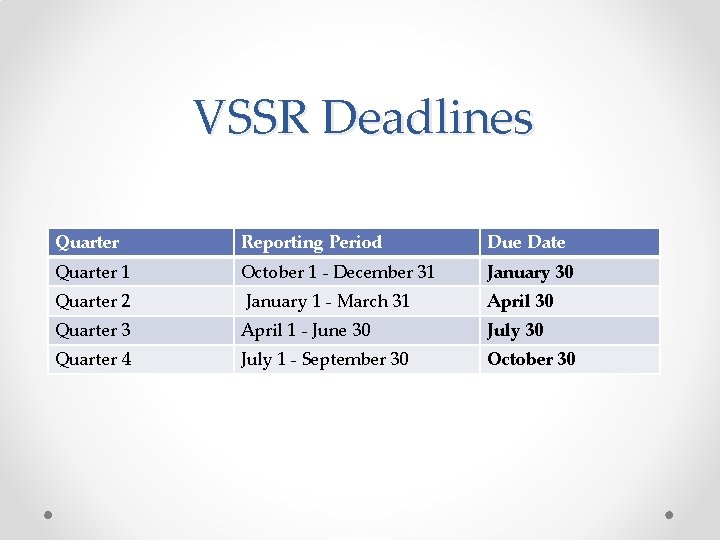
VSSR Deadlines Quarter Reporting Period Due Date Quarter 1 October 1 - December 31 January 30 Quarter 2 January 1 - March 31 April 30 Quarter 3 April 1 - June 30 July 30 Quarter 4 July 1 - September 30 October 30
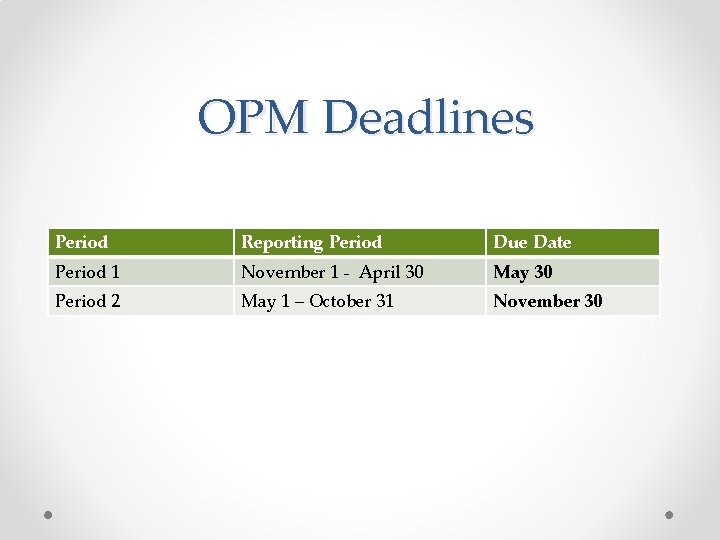
OPM Deadlines Period Reporting Period Due Date Period 1 November 1 - April 30 May 30 Period 2 May 1 – October 31 November 30
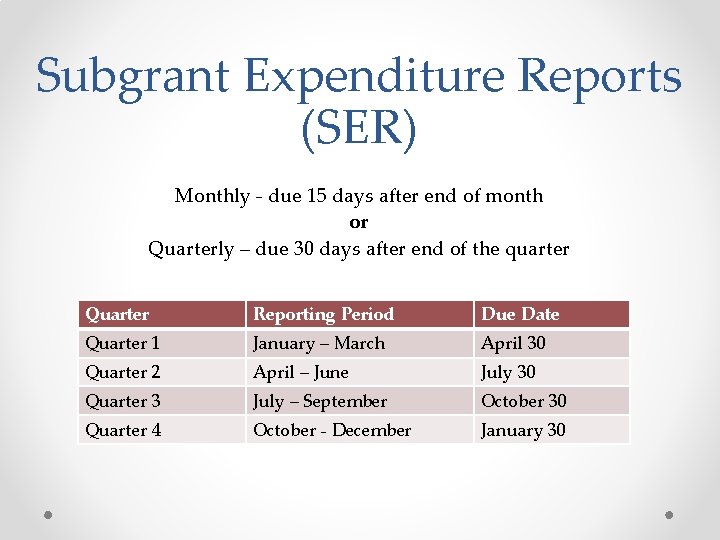
Subgrant Expenditure Reports (SER) Monthly - due 15 days after end of month or Quarterly – due 30 days after end of the quarter Quarter Reporting Period Due Date Quarter 1 January – March April 30 Quarter 2 April – June July 30 Quarter 3 July – September October 30 Quarter 4 October - December January 30
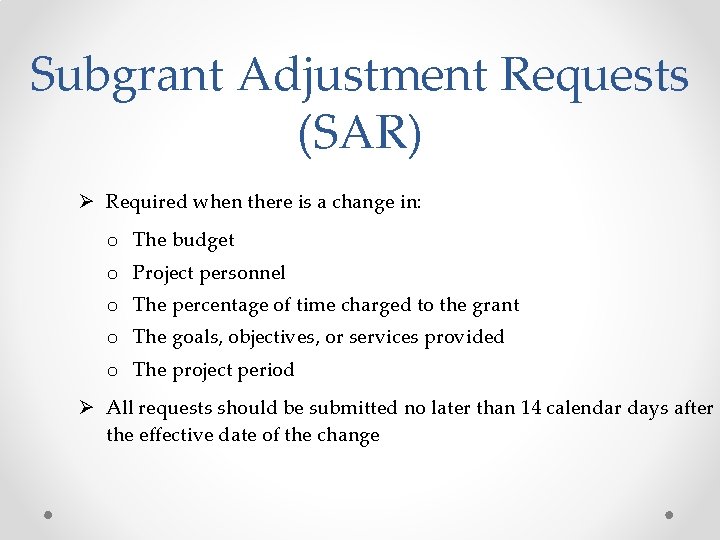
Subgrant Adjustment Requests (SAR) Ø Required when there is a change in: o The budget o Project personnel o The percentage of time charged to the grant o The goals, objectives, or services provided o The project period Ø All requests should be submitted no later than 14 calendar days after the effective date of the change
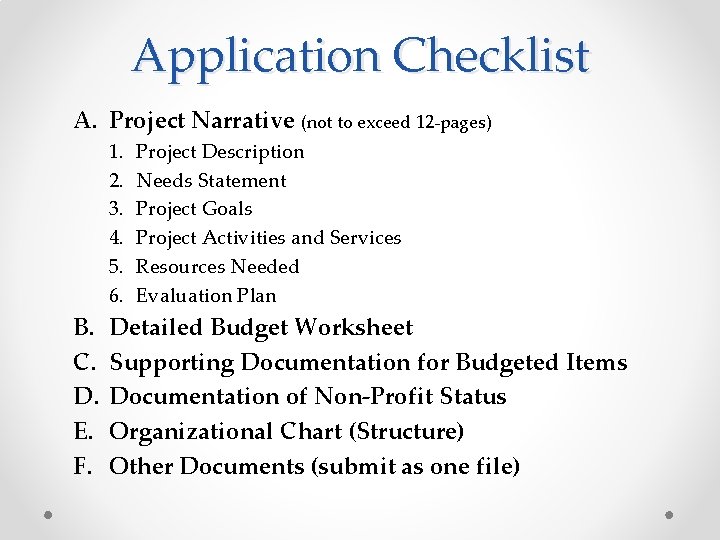
Application Checklist A. Project Narrative (not to exceed 12 -pages) 1. 2. 3. 4. 5. 6. B. C. D. E. F. Project Description Needs Statement Project Goals Project Activities and Services Resources Needed Evaluation Plan Detailed Budget Worksheet Supporting Documentation for Budgeted Items Documentation of Non-Profit Status Organizational Chart (Structure) Other Documents (submit as one file)
Applying for Multiple Grants Ø You will be considered separately for each grant for which you apply Ø You may be awarded all, some, or none of the grants for which you apply Ø Be careful of the grant eligibility requirements
Project Narrative Ø Section 1: Project Description ◦ Agency basic information ◦ Target area and population ◦ Multi-Disciplinary and/or Community Response Teams ◦ Language Access Plan ◦ Credentials/Accolades
Project Narrative Ø Section 2: Needs Statement ◦ Identify specific gaps/problems with supporting data ◦ Discuss how the project will meet needs of target population ◦ Discuss any changes to agency scope/activities/services
Project Narrative Ø Section 3: Project Goals ◦ State and explain project goals ◦ Discuss expected impact of project goals ◦ Describe specific, measurable, actionoriented, reasonable, and timesensitive performance indicators
Project Narrative Ø Section 4: Project Activities and Services ◦ Describe the intended service delivery plan ◦ Outline personnel responsibilities to roll out the plan ◦ Provide a timeline, description, and/or methods related to activities and services ◦ Explain how this plan will meet target population’s needs ◦ Provide justification for why activities and services are necessary
Project Narrative Ø Section 5: Evaluation Plan ◦ Describe data collection process ◦ Explain the meaning of “success” for the project
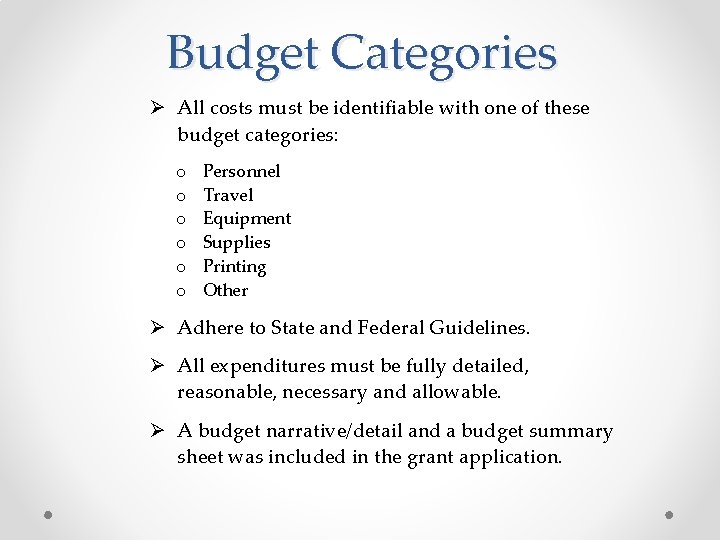
Budget Categories Ø All costs must be identifiable with one of these budget categories: o o o Personnel Travel Equipment Supplies Printing Other Ø Adhere to State and Federal Guidelines. Ø All expenditures must be fully detailed, reasonable, necessary and allowable. Ø A budget narrative/detail and a budget summary sheet was included in the grant application.
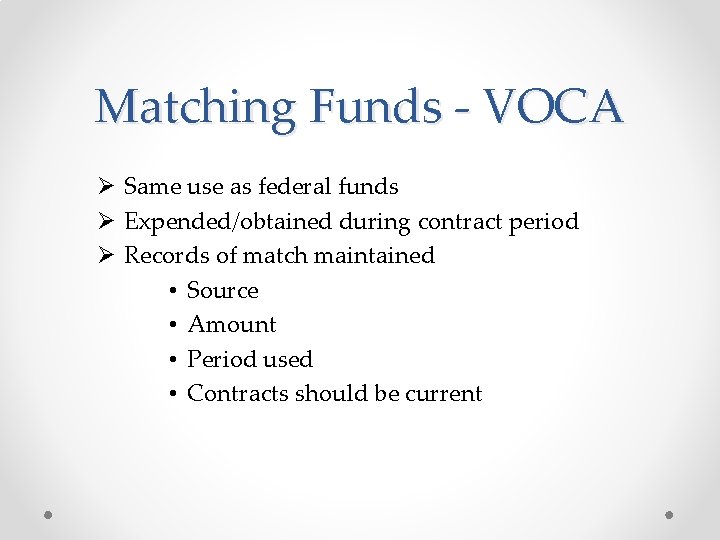
Matching Funds - VOCA Ø Same use as federal funds Ø Expended/obtained during contract period Ø Records of match maintained • Source • Amount • Period used • Contracts should be current
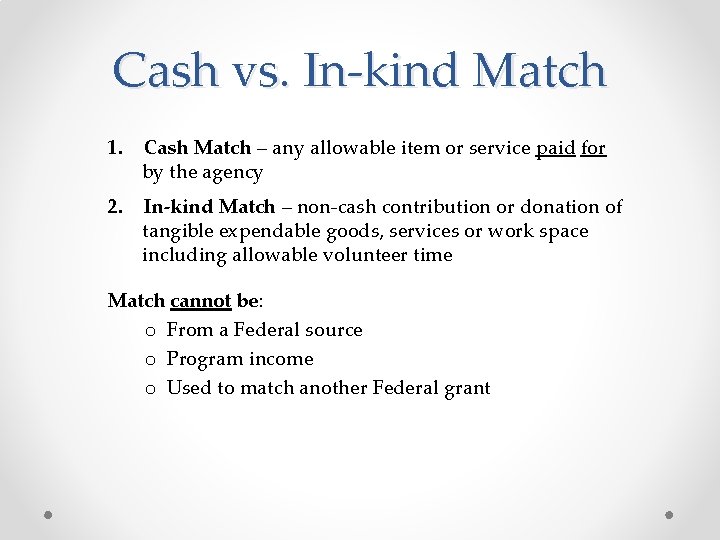
Cash vs. In-kind Match 1. Cash Match – any allowable item or service paid for by the agency 2. In-kind Match – non-cash contribution or donation of tangible expendable goods, services or work space including allowable volunteer time Match cannot be: o From a Federal source o Program income o Used to match another Federal grant
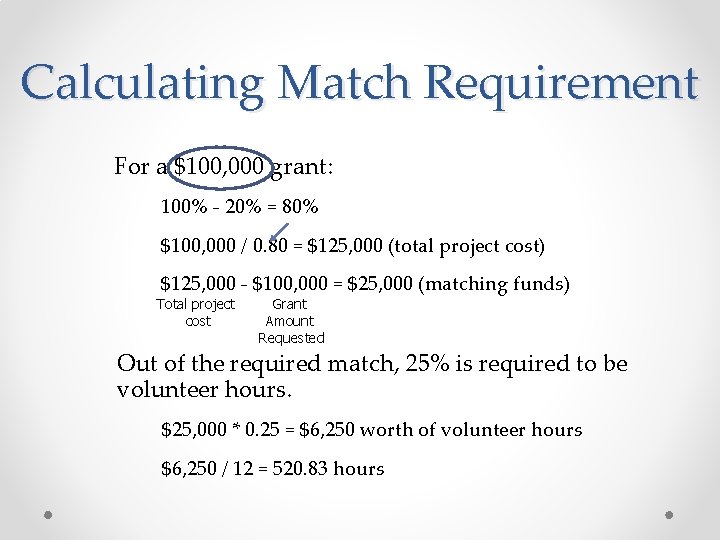
Calculating Match Requirement For a $100, 000 grant: 100% - 20% = 80% $100, 000 / 0. 80 = $125, 000 (total project cost) $125, 000 - $100, 000 = $25, 000 (matching funds) Total project cost Grant Amount Requested Out of the required match, 25% is required to be volunteer hours. $25, 000 * 0. 25 = $6, 250 worth of volunteer hours $6, 250 / 12 = 520. 83 hours
Budget Considerations Ø The default value for volunteer hours is $12. 00 per hour Ø Match may be in-kind or cash, but can only be used for allowable costs under the specific grant guidelines Ø Complete the Detailed Budget Worksheet provided by CJCC
Allowable Costs Ø VOCA funds can only be used for direct services to crime victims. Ø These services include: o Immediate Health & Safety o Mental Health Assistance o Assistance with Participation in Criminal Justice Proceedings o Costs Necessary to Provide Direct Services o Special Services o Personnel Costs
Other Allowable Costs Ø Skills Training for Staff Ø Training and Materials Ø Equipment and Furniture Ø Operating Costs Ø Supervision of Direct Service Providers
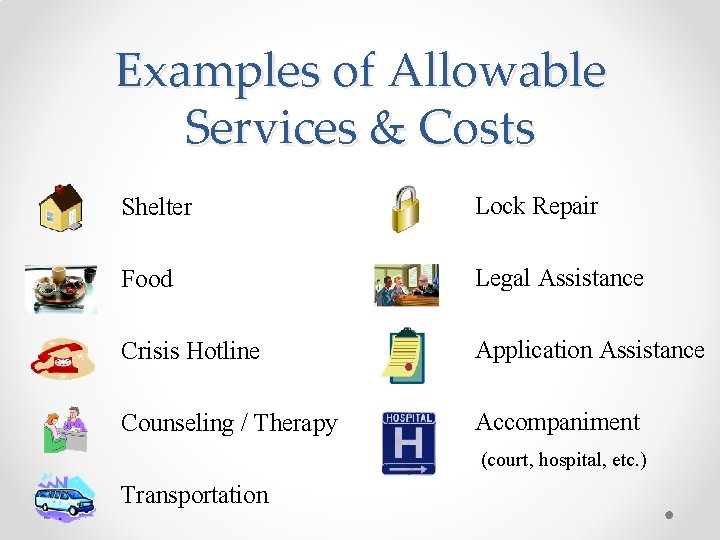
Examples of Allowable Services & Costs Shelter Lock Repair Food Legal Assistance Crisis Hotline Application Assistance Counseling / Therapy Accompaniment (court, hospital, etc. ) Transportation
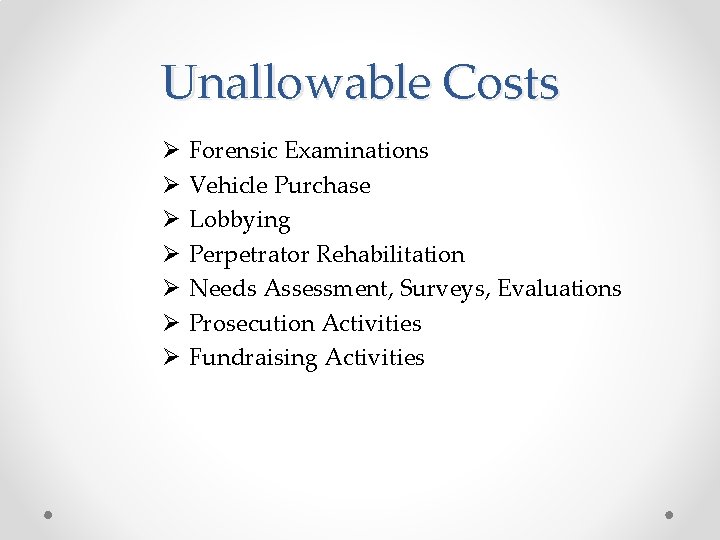
Unallowable Costs Ø Ø Ø Ø Forensic Examinations Vehicle Purchase Lobbying Perpetrator Rehabilitation Needs Assessment, Surveys, Evaluations Prosecution Activities Fundraising Activities
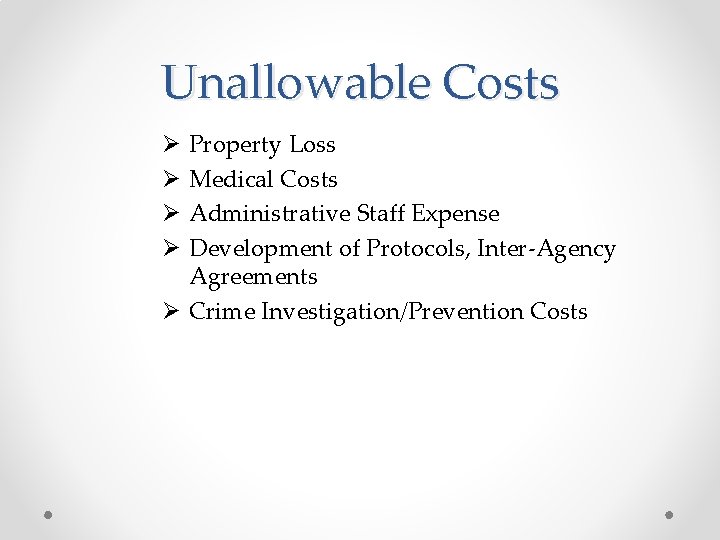
Unallowable Costs Property Loss Medical Costs Administrative Staff Expense Development of Protocols, Inter-Agency Agreements Ø Crime Investigation/Prevention Costs Ø Ø
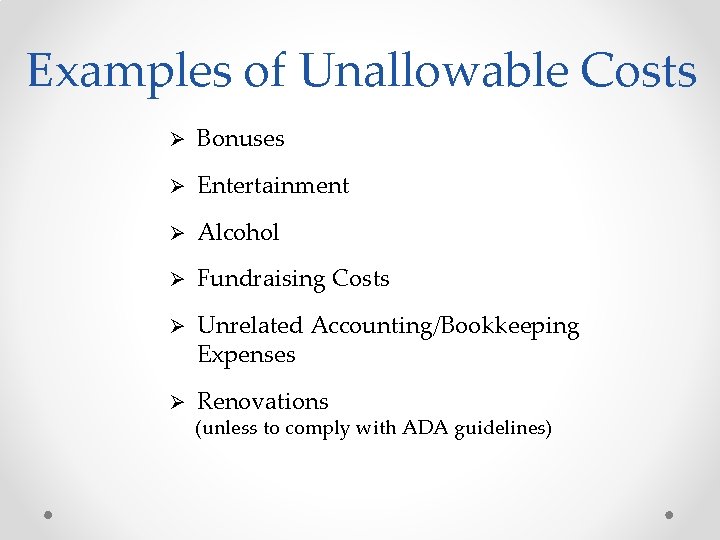
Examples of Unallowable Costs Ø Bonuses Ø Entertainment Ø Alcohol Ø Fundraising Costs Ø Unrelated Accounting/Bookkeeping Expenses Ø Renovations (unless to comply with ADA guidelines)
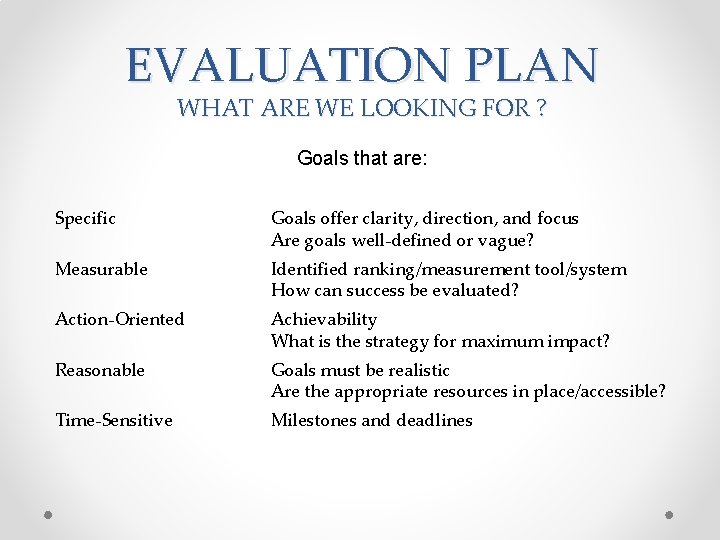
EVALUATION PLAN WHAT ARE WE LOOKING FOR ? Goals that are: Specific Goals offer clarity, direction, and focus Are goals well-defined or vague? Measurable Identified ranking/measurement tool/system How can success be evaluated? Action-Oriented Achievability What is the strategy for maximum impact? Reasonable Goals must be realistic Are the appropriate resources in place/accessible? Time-Sensitive Milestones and deadlines
Required Attachments Ø Ø Ø Project Narrative Detailed Budget Worksheet Supporting Documentation for Budgeted Items Documentation of Non-Profit Status Organization Chart (Structure) o Name o Title o Salary Ø Other Documents, i. e. : o MOUs o Letters of Support
Grant Application
Online Application Instructions Ø Technical difficulties or emergency circumstances? Contact Shontel Wright immediately at Shontel. Wright@cjcc. ga. gov or 404. 657. 1956 Ø Applications must be submitted by 11: 59 pm on Monday, July 25, 2016. Ø There is no commitment on the part of CJCC to fund an application or to fund it at the amount requested.
Common Errors Ø More than one priority area detailed Ø Budget related o Miscalculations o Unallowable and unreasonable costs o Missing Volunteer hours Ø Missing attachments Ø Not answering ALL questions asked
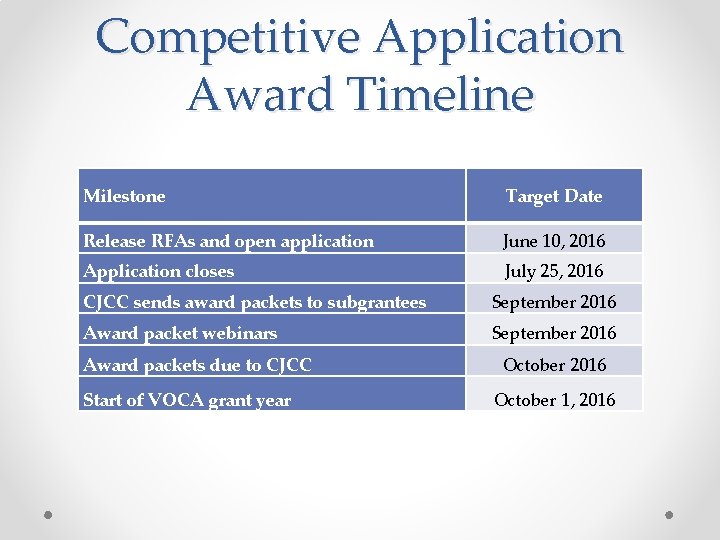
Competitive Application Award Timeline Milestone Target Date Release RFAs and open application June 10, 2016 Application closes July 25, 2016 CJCC sends award packets to subgrantees September 2016 Award packet webinars September 2016 Award packets due to CJCC Start of VOCA grant year October 2016 October 1, 2016
Conclusion • Remember to read the RFA carefully and CONTACT us! We’re here for you! Shontel Wright – shontel. wright@cjcc. ga. gov Kyra Matthews – kyra. matthews@cjcc. ga. gov Jonathan Peart – peart. jonathan@cjcc. ga. gov Ayana Campbell-Williams – ayanna. campbell@cjcc. ga. gov Tiffany Williams – tiffany. williams@cjcc. ga. gov Robyn Williams – robyn. williams@cjcc. ga. gov La. Tonya Smith – latonya. smith@cjcc. ga. gov Carlyle Roberts – carlyle. roberts@cjcc. ga. gov Letitia Lowe – letitia. lowe@cjcc. ga. gov Nikitris Deloach – nikitris. deloach@cjcc. ga. gov • Thank you - we appreciate your service and dedication to victims in Georgia
CJCC Contact Information Website Address: cjcc. georgia. gov Mail: Attn: Grants Division or Victims Compensation Criminal Justice Coordinating Council 104 Marietta Street, NW, Suite 440 Atlanta, GA 30303 -2743 Main Phone: 404 -657 -1956 Victims Compensation Phone: 404 -657 -2222 Fax Number: 404 -657 -1957 Email Subscription: Mail Chimp!
Question and Answer
Victims of Crime Act (VOCA) Workshop Proposals must be submitted online by Monday, July 25, 2016 by 11: 59 pm
Victims of Crime Act (VOCA) Workshop Thank you for joining us!