
Vickers Microindentation Hardness Testing of Brazed Joints in
Vickers Microindentation Hardness Testing of Brazed Joints in Aluminum Patricia B. Roy, Fiona M. O’Connell, Thomas H. Callahan, Edward J. Armellino, and Wayne L. Elban Department of Engineering Loyola University Maryland Baltimore, Maryland 21210 27 th Annual National Educators' Workshop NEW: Update 2012 November 4 – 7, 2012, Fort Wayne, Indiana
Joining Metals by Brazing • Brazing is the joining of two base metals via a filler metal. • Brazing operations apply heat broadly to the base metals. • The filler metal is then placed into contact with the base metals and melts. • The filler metal wicks into the joint via capillary action.
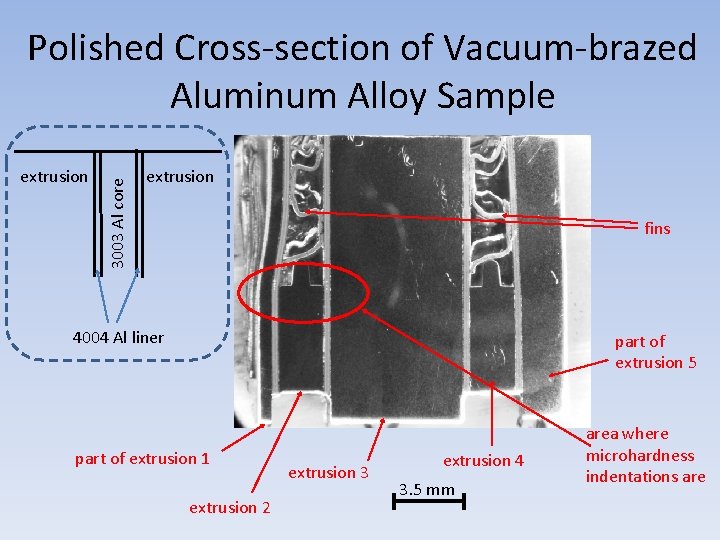
extrusion 3003 Al core Polished Cross-section of Vacuum-brazed Aluminum Alloy Sample extrusion fins 4004 Al liner part of extrusion 5 part of extrusion 1 extrusion 2 extrusion 3 extrusion 4 3. 5 mm area where microhardness indentations are

Learning Goals • To become familiar with: – Vickers microindentation hardness testing, a prominent technique for characterizing the mechanical response of materials – brazing technology – the process of creating a computer-based mechanical property correlation for various materials

Experimental Goals • To measure the Vickers hardness profile across a set of brazed joints in an aluminum alloy; and • To obtain a computer-based mechanical property correlation

Vickers Hardness Testing Taken from “Tukon Microhardness Testers, ” Page-Wilson Crop. (Instron). Bulletin 1830 (1982) • Square-base diamond pyramid indenter • 10 gf to 1, 000 gf applied load for a range of 0 -30 seconds dwell • Resulting indentation formed by plastic deformation • Diagonal length measured optically
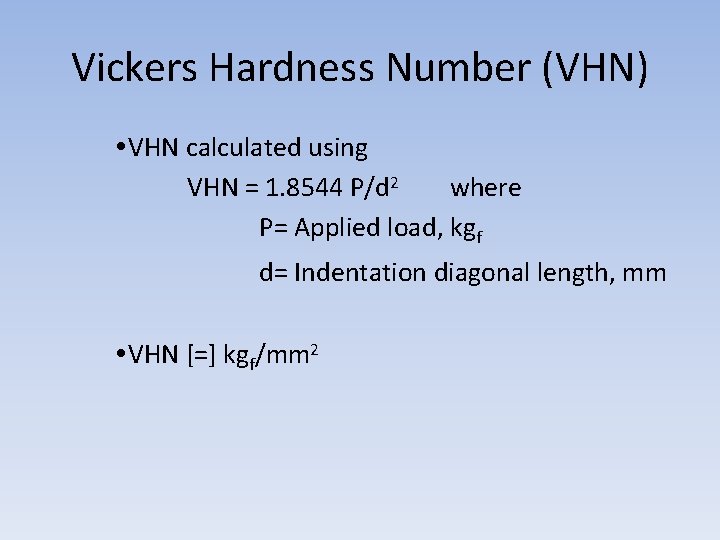
Vickers Hardness Number (VHN) VHN calculated using VHN = 1. 8544 P/d 2 where P= Applied load, kgf d= Indentation diagonal length, mm VHN [=] kgf/mm 2
Experimental • Calibrate using standard reference test block • Perform series of twenty hardness determinations using 10 gf applied load for 25 seconds dwell – Over 5. 875 mm distance perpendicular to four brazed joints to obtain hardness profile
Data Analysis • Compute VHN for each hardness impression • Plot tensile strength versus Knoop hardness number (KHN) using Wilson (Instron) Desk Chart 60 • Obtain tensile strength estimates for VHN determinations
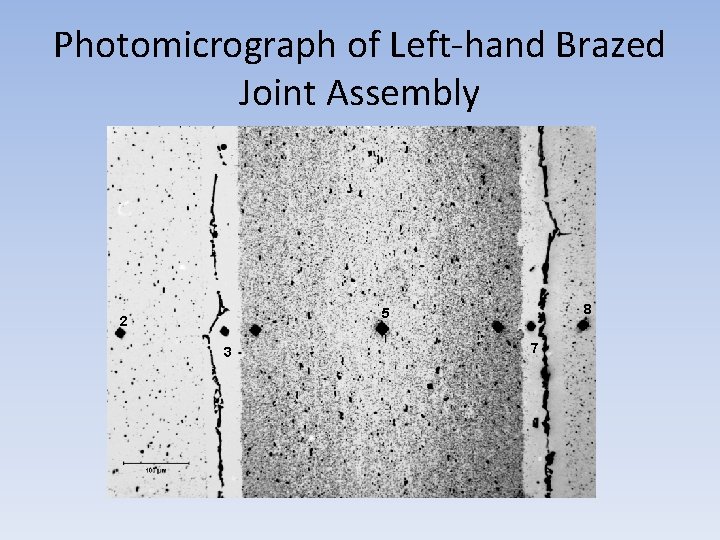
Photomicrograph of Left-hand Brazed Joint Assembly 8 5 2 3 7
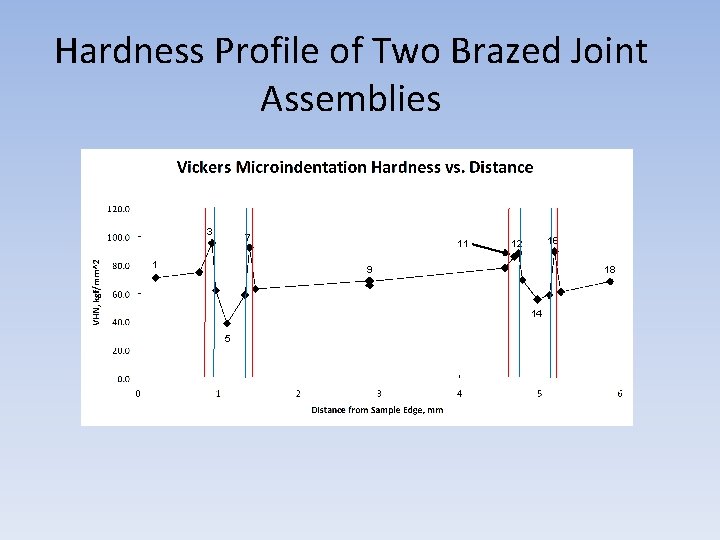
Hardness Profile of Two Brazed Joint Assemblies 3 7 1 11 16 12 9 18 14 5
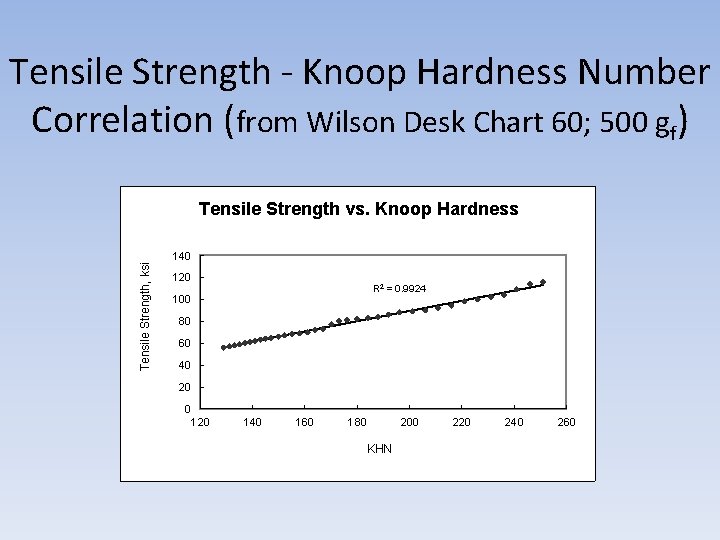
Tensile Strength - Knoop Hardness Number Correlation (from Wilson Desk Chart 60; 500 gf) Tensile Strength vs. Knoop Hardness Tensile Strength, ksi 140 120 R 2 = 0. 9924 100 80 60 40 20 0 120 140 160 180 KHN 200 220 240 260
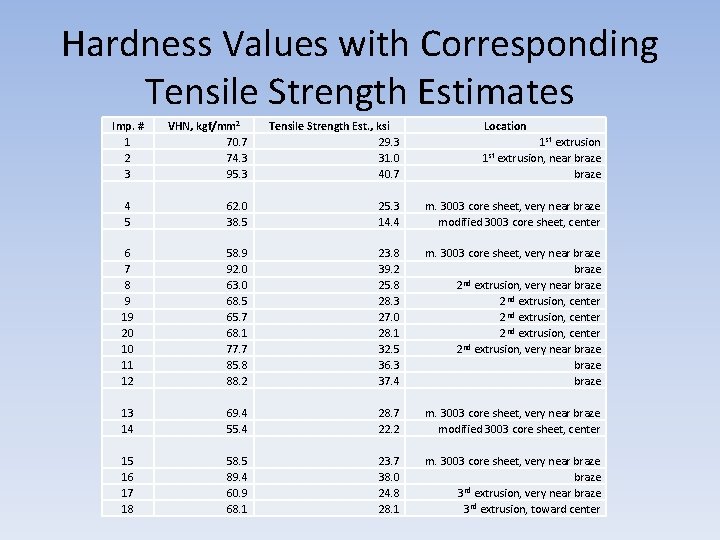
Hardness Values with Corresponding Tensile Strength Estimates Imp. # 1 2 3 VHN, kgf/mm 2 70. 7 74. 3 95. 3 Tensile Strength Est. , ksi 29. 3 31. 0 40. 7 Location 1 st extrusion, near braze 4 5 62. 0 38. 5 25. 3 14. 4 m. 3003 core sheet, very near braze modified 3003 core sheet, center 6 7 8 9 19 20 10 11 12 58. 9 92. 0 63. 0 68. 5 65. 7 68. 1 77. 7 85. 8 88. 2 23. 8 39. 2 25. 8 28. 3 27. 0 28. 1 32. 5 36. 3 37. 4 m. 3003 core sheet, very near braze nd 2 extrusion, very near braze 2 nd extrusion, center 2 nd extrusion, very near braze 13 14 69. 4 55. 4 28. 7 22. 2 m. 3003 core sheet, very near braze modified 3003 core sheet, center 15 16 17 18 58. 5 89. 4 60. 9 68. 1 23. 7 38. 0 24. 8 28. 1 m. 3003 core sheet, very near braze rd 3 extrusion, very near braze 3 rd extrusion, toward center
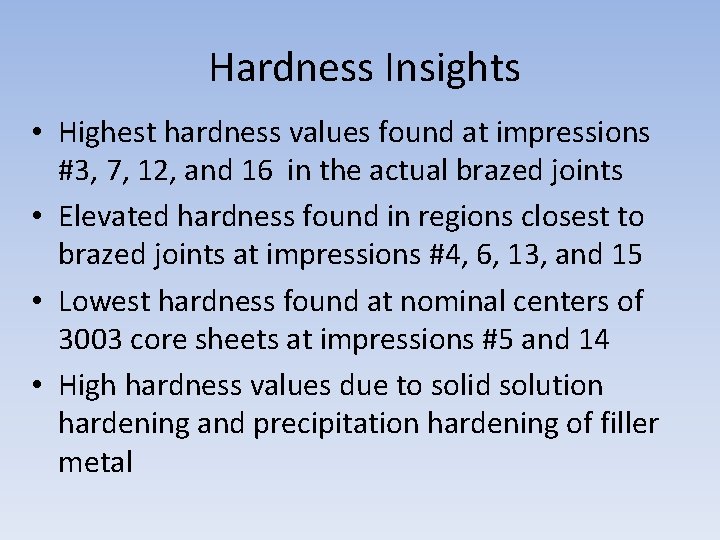
Hardness Insights • Highest hardness values found at impressions #3, 7, 12, and 16 in the actual brazed joints • Elevated hardness found in regions closest to brazed joints at impressions #4, 6, 13, and 15 • Lowest hardness found at nominal centers of 3003 core sheets at impressions #5 and 14 • High hardness values due to solid solution hardening and precipitation hardening of filler metal
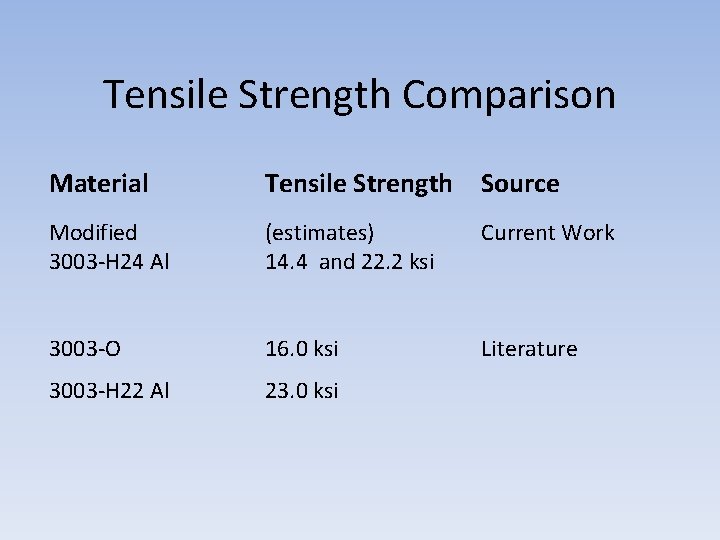
Tensile Strength Comparison Material Tensile Strength Source Modified 3003 -H 24 Al (estimates) 14. 4 and 22. 2 ksi Current Work 3003 -O 16. 0 ksi Literature 3003 -H 22 Al 23. 0 ksi
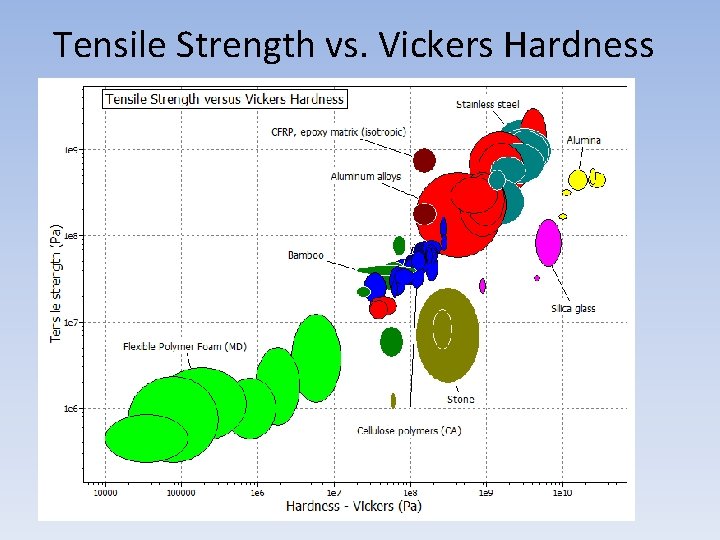
Computer-based Mechanical Property Correlation • Cambridge Engineering Selector (CES) Edu. Pack 2012 software • Plot generated: tensile strength versus Vickers hardness • Labeled materials: – – – – – Alumina Aluminum alloys Bamboo Cellulose polymers (CA) CFRP, epoxy matrix (isotropic)* Flexible polymer foam (MD) Silica glass* Stainless steel Stone* * Has estimated material property
Tensile Strength vs. Vickers Hardness
Mechanical Property Correlation Insights • Expected strong correlation: tensile strength increases with increasing hardness – Tensile strength = highest measured load divided by initial area and typically associated with plastic deformation – Vickers hardness gives measure of a material’s ease to deform plastically in accommodating the indenter

Acknowledgements Dr. S. F. Baumann ALCOA Mill Products Heat Exchanger Products Technical Center 1480 Manheim Pike Lancaster, Pennsylvania 17601 Dr. M. R. Staker Department of Engineering Loyola University Maryland Baltimore, MD 21210

Extra Slides to Follow (for possible discussion issues)
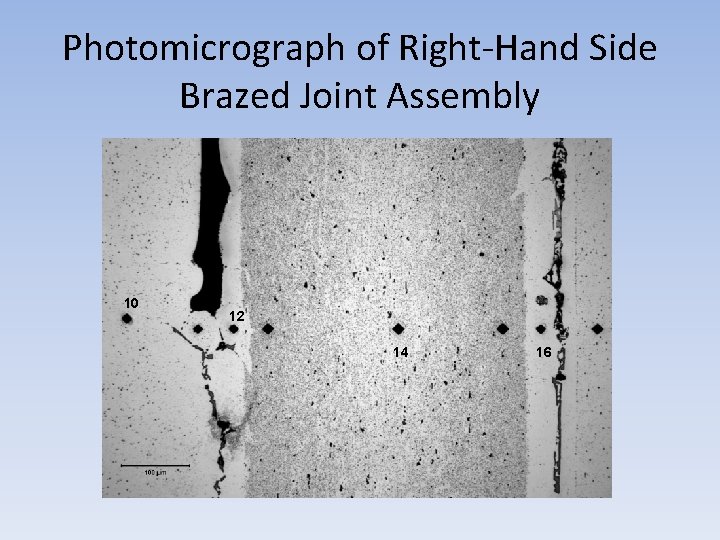
Photomicrograph of Right-Hand Side Brazed Joint Assembly 10 12 14 16
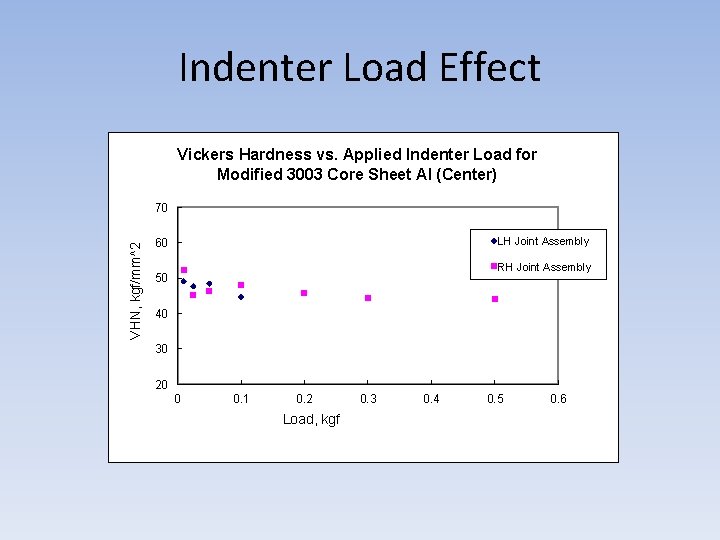
Indenter Load Effect Vickers Hardness vs. Applied Indenter Load for Modified 3003 Core Sheet Al (Center) VHN, kgf/mm^2 70 LH Joint Assembly 60 RH Joint Assembly 50 40 30 20 0 0. 1 0. 2 Load, kgf 0. 3 0. 4 0. 5 0. 6
- Slides: 22