
Vicarious Trauma and Burnout Strategies for Survival Deborah
Vicarious Trauma and Burnout: Strategies for Survival. Deborah A. Sinclair, MSW Adapted by Patti Levin, LICSW, Psy. D
WHY SHOULD WE BE CONCERNED ABOUT VICARIOUS TRAUMA AND BURN-OUT? (also known as Compassion Fatigue)
BURN-OUT • Burn-out is the depletion of our resources, both physical and psychological, caused by our desire to achieve certain standards and expectations that are often impossible to humanly achieve. At some point, we become overwhelmed with the knowledge it’s not possible - and cynicism, pessimism and negativity sets in. Burn-out can happen to anyone at home or on the job.
Symptoms of Burnout • Withdrawal from, and cynicism toward clients and others • Emotional and physical exhaustion • Various psychological symptoms such as irritability, anxiety, sadness, and lowered selfesteem
Early Symptoms of Burnout – 1 st Stage (Livingston-Booth, 1985) • The speeding up of activity: • drink and eat more quickly on the job or on the run • feel under the pressure of time, can’t catch your breathe or catch up on the demands • feel as if you are driven
Later Symptoms of Burnout – 2 nd Stage • • • Disrupted sleep Over-reactions to difficulties Increased irritability A less reliable memory Beginning of physical symptoms such as tension headaches, muscle pain, lowered immune system….
VICARIOUS TRAUMA • Vicarious trauma (VT) is the short and long-term consequences of working with trauma victims/survivors and the painful and disruptive effect this can have on the trauma worker. The effects in all of the following areas – physically, emotionally, behaviorally, cognitively, spiritually – can persist for months and sometimes even years after work with traumatized clients without effective intervention. • With repeated exposure to traumatic imagery, workers may begin to incorporate an accumulation of clients’ traumatic material into their own view of self and the world
DIFFERENCES BETWEEN BURN-OUT • • Cumulative Predictable Builds over time Results in work dissatisfaction • Unaddressed leads to serious health problems and VT • Narrower focus • Harmed by the kind of work we do • Intrusive imagery • Changes the meaning of life • Affects our world view
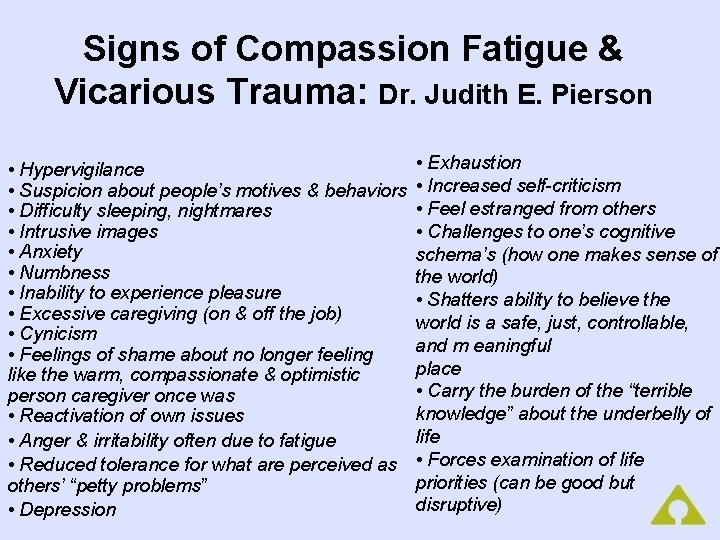
Signs of Compassion Fatigue & Vicarious Trauma: Dr. Judith E. Pierson • Hypervigilance • Suspicion about people’s motives & behaviors • Difficulty sleeping, nightmares • Intrusive images • Anxiety • Numbness • Inability to experience pleasure • Excessive caregiving (on & off the job) • Cynicism • Feelings of shame about no longer feeling like the warm, compassionate & optimistic person caregiver once was • Reactivation of own issues • Anger & irritability often due to fatigue • Reduced tolerance for what are perceived as others’ “petty problems” • Depression • Exhaustion • Increased self-criticism • Feel estranged from others • Challenges to one’s cognitive schema’s (how one makes sense of the world) • Shatters ability to believe the world is a safe, just, controllable, and m eaningful place • Carry the burden of the “terrible knowledge” about the underbelly of life • Forces examination of life priorities (can be good but disruptive)
Especially how it affects our world view • Shattered assumptions about basic beliefs in our world for safety, security, trust, justice • Repeated exposure to the cruelty of others to innocent victims • Heightened awareness of vulnerability and the fragility of life • Powerlessness of victim transferred to worker • Sense of alienation develops

“I love my work but lately I find it contaminating my personal life. I have nightmares about the horrible things I hear about from clients. My sex life has deteriorated, I'm irritable and distractible, I'm afraid for my kids and tend to overprotect them, and I don't trust anybody anymore. I don't know what is happening to me. " Advocate/counselor
And… “It actually feels good to hear that I am not the only one who feels depressed and helpless and that these issues are worth studying. Fortunately, the stress has decreased with experience and time for me, but I still have vivid memories of quite traumatic experiences representing victims of domestic violence who were so betrayed that it was difficult to continue to have faith in humankind. ” A lawyer
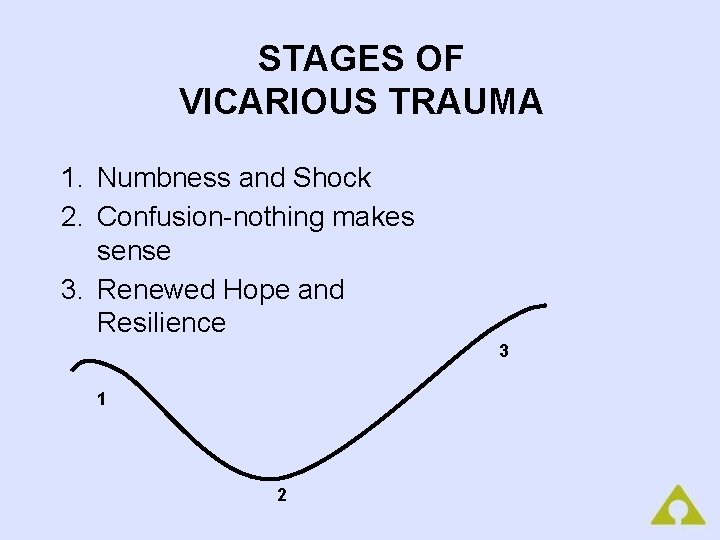
STAGES OF VICARIOUS TRAUMA 1. Numbness and Shock 2. Confusion-nothing makes sense 3. Renewed Hope and Resilience 3 1 2
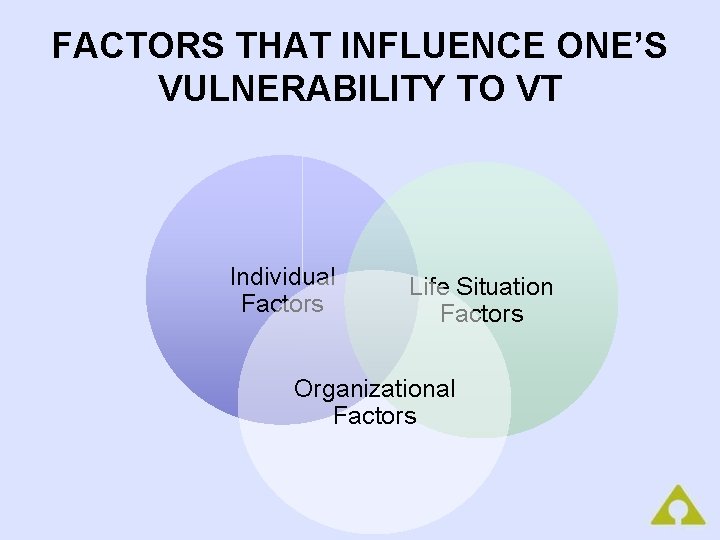
FACTORS THAT INFLUENCE ONE’S VULNERABILITY TO VT Individual Factors Life Situation Factors Organizational Factors
10 Beliefs that Prevent Helpers from Getting Help 1. 2. 3. 4. 5. 6. We should not experience personal problems. . . we know better! We view personal problems as a sign of inadequacy or failure. We think that there is no safe place for us to get help. We should be aware of all helping resources for all problems. We have helping skills and can take care of ourselves. We often intellectualize and/or disassociate from the emotional impact of our problems. 7. We often counsel family, friends, and significant others. . . a violation of boundaries. 8. We feel responsible for and often take the blame if a family member or significant other has a personal problem. 9. We feel embarrassed to seek help from fellow professionals. 10. As a result of the above, we often wait longer than others to let people help and often sabotage our own treatment. Professional helpers often share the above characteristics. Early family experience may have contributed to becoming a caretaker at an early age and continuing that role into adulthood. It may also be a factor of being part of a small community (professional or social) where everyone another.
Prevention – General Principles • Become aware of symptoms of stress before they become severe • Establish clear, realistic stress management goals • Incorporate all the support and planning necessary to make it work • The challenge is to find the optimal level of stress each of us requires in order to thrive.
Personal Strategies • • Good nutrition that fuels us Exercise that strengthens us Rest that renews us Self awareness that makes us wiser Life skills that equip us to cope better Social connection with others Spiritual development that gives us meaning and purpose in our lives
Professional and Organizational Strategies • Supportive policies that recognize the high risk nature of our work • Acknowledgement of the connections between individual and work-related stresses • Meaningful supervision, consultation and peer support • Balancing our workload and creating a variety of tasks • Good boundaries/limit setting • Proactive plans for coping
Professional and Organizational Strategies Cont’d
Summary of Strategies for Dealing with VT • • • Name the problem Normalize the experience Break the silence and shame surrounding it Build a supportive network Provide an opportunity for debriefing (group & individual) • Provide opportunity for VT supervision (help worker to sort out VT, Burn-out and CT reactions) • Provide specialized educational programs • Provide good role models and mentors (Experienced workers need to speak out)
Prevention Strategies • “The first day on the job ensure that coping strategies are in place. ” • Peer support (seek experienced peers) • Limit work hours • Don’t take work home
Coping Strategies and Resilience • • Balance Exercise Humor Positive community activities • Professional development • Faith/spiritual life • Channeling our outrage into social and political change
Positive Impacts of Our Work are many…. “ It is a privilege to be in the presence of survivors – to witness their courage , their strength and their commitment to healing themselves and our world. It is also a privilege to be in the company of all of us here for those very same reasons…. ”
Remember… “To keep the lamp burning we have to keep putting oil in it. ” Mother Teresa
ALWAYS REMEMBER: If your compassion does not include yourself, it is incomplete. - The Buddha耀
RESOURCES CARE FOR CAREGIVERS WORLDWID: http: //www. headington-institute. org/Default. aspx? tabid=2652 COMPASSION FATIGUE: Coping with secondary traumatic stress disorder in those who treat the traumatized ~ Charles Figley Ph. D, Ed Vicarious Traumatization: Towards recognition And resilience-building ~Fred Gusman MSW and Pamela Swales Ph. D National Center for PTSD http: //ncptsd. va. gov/ptsd 101/modules/gusman_ vicarious. html_
- Slides: 26