
VIBRIO AEROMONAS Dr Mohit Bhatia Assistant Professor Department
VIBRIO & AEROMONAS Dr. Mohit Bhatia Assistant Professor Department of Microbiology AIIMS Rishikesh

Learning objectives At the end of the session, students should be able to • Describe morphology and antigens • Describe Pathogenesis & Clinical features • Choose appropriate lab diagnosis and interpret the results • Describe prevention and treatment
General Properties of Vibrio • Curved Gram-negative bacilli • Actively motile by single polar sheathed flagellum • Fermentative, strongly aerobic, oxidase positive • Non-sporing & non-capsulated • Growth stimulated by salt (Na. Cl) • Ubiquitously found worldwide in marine environments, surface waters, river & sewage
VIBRIO CHOLERAE CLASSIFICATION v. Based on Salt Requirement • Non-halophilic vibrios - grow without salt, 1% salt is optimum & cannot grow at higher concentrations - Examples V. Cholerae & V. mimicus • Halophilic vibrios Cannot grow in absence of salt, grow at higher salt concentratin (7– 10%) - Examples – V. parahaemolyticus, V. alginolyticus & V. vulnificus.
VIBRIO CHOLERAE CLASSIFICATION v. Heiberg Classification (1934) • Eight groups based on fermentation of three sugars 1. Mannose 2. Arabinose 3. Sucrose - V. cholerae was placed in Group I
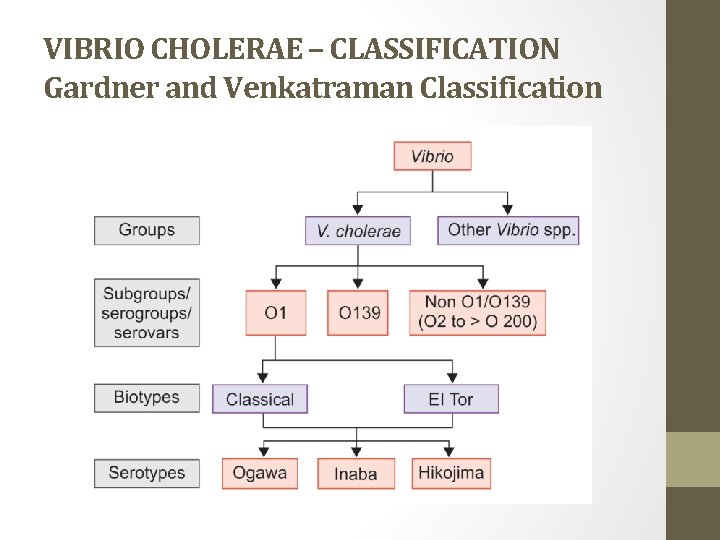
VIBRIO CHOLERAE – CLASSIFICATION Gardner and Venkatraman Classification
Gardner and Venkatraman Classification • O 1 serogroup - Agglutinated by O 1 antisera - Responsible for all pandemics & most of the epidemics of cholera • Non-agglutinable (NAG) vibrios - Not agglutinated by O 1 antiserum - Initially thought to be non-pathogenic (non-cholera vibrios – NCV)
Gardner and Venkatraman Classification • O 139 serogroup - Since 1992 has caused several epidemics and outbreaks coastal India & Bangladesh. • Non O 1/139 serogroups - occasional sporadic outbreaks of diarrhoea & extra intestinal manifestations, but never epidemic cholera
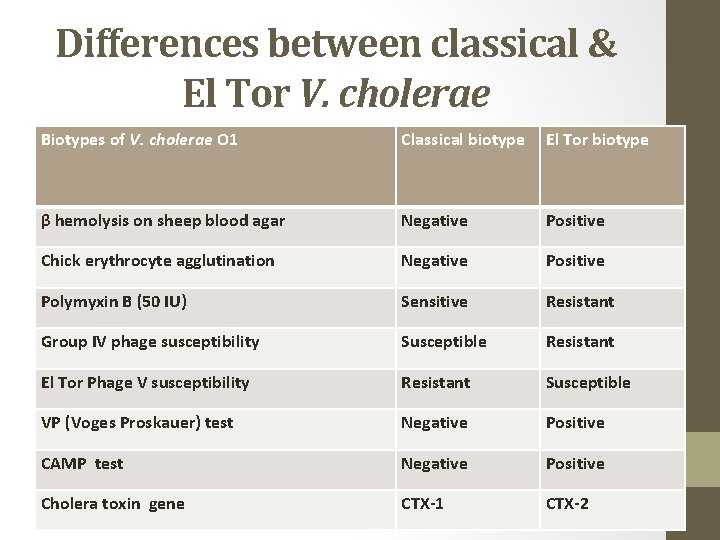
Differences between classical & El Tor V. cholerae Biotypes of V. cholerae O 1 Classical biotype El Tor biotype β hemolysis on sheep blood agar Negative Positive Chick erythrocyte agglutination Negative Positive Polymyxin B (50 IU) Sensitive Resistant Group IV phage susceptibility Susceptible Resistant El Tor Phage V susceptibility Resistant Susceptible VP (Voges Proskauer) test Negative Positive CAMP test Negative Positive Cholera toxin gene CTX-1 CTX-2
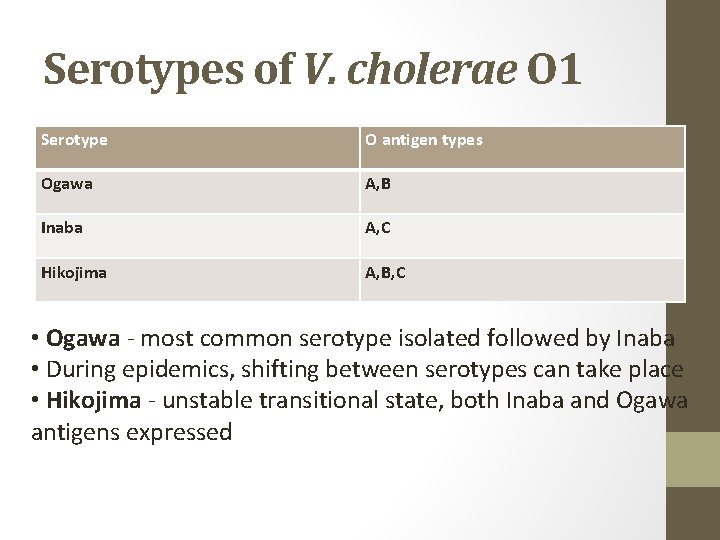
Serotypes of V. cholerae O 1 Serotype O antigen types Ogawa A, B Inaba A, C Hikojima A, B, C • Ogawa - most common serotype isolated followed by Inaba • During epidemics, shifting between serotypes can take place • Hikojima - unstable transitional state, both Inaba and Ogawa antigens expressed
Pathogenesis of Cholera • Transmission - ingestion of contaminated water or food • Infective dose: Acid-labile, High infective dose • Factors promoting transmission – hypochlorhydria • Crossing of protective layer of mucus – active motility - Secreting mucinase and other proteolytic enzymes - Secreting hemagglutinin protease (cholera lectin) • Adhesion and colonization- facilitated by a special type IV fimbria called toxin coregulated pilus (TCP)
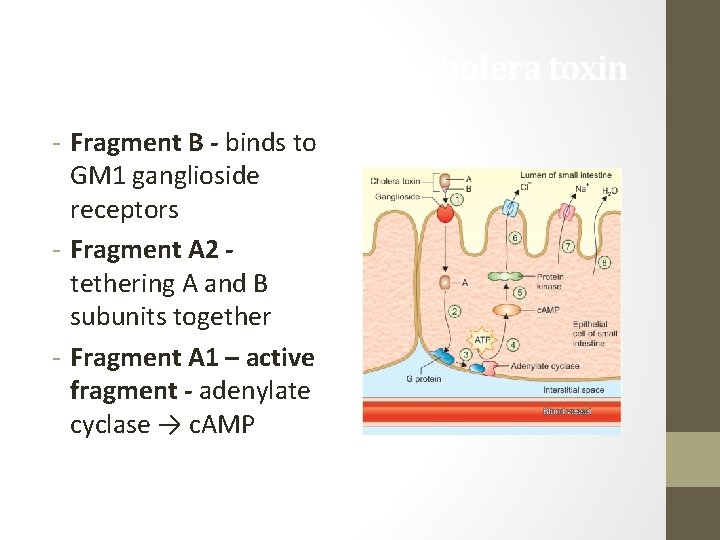
Mechanism of action of cholera toxin - Fragment B - binds to GM 1 ganglioside receptors - Fragment A 2 tethering A and B subunits together - Fragment A 1 – active fragment - adenylate cyclase → c. AMP
Pathogenesis of Cholera • Increase in cyclic AMP - accumulation of sodium chloride in intestinal lumen Water moves passively into the bowel lumen accumulation of isotonic fluid (watery diarrhoea) • Loss of fluid and electrolytes shock (due to profound dehydration) and acidosis (due to loss of bicarbonate)
Pathogenesis of Cholera • Gene for cholera toxin (CTX) - Pathogenicity island encoded filamentous bacteriophage (CTXf) integrated as prophage • Other genes for pathogenicity are clustered together Biosynthesis of TCP, Accessory colonization factors Regulator genes Tox. R gene regulates the expression of CT, TCP and other virulence factors
Other virulence factors • Zona occludens toxin - disrupts the tight junctions between mucosal cells • Accessory cholera enterotoxin- phage packaging and secretion • Vero cell toxin - analogous to Shigella toxin • Accessory colonization factors - adhesion & colonization • Siderophore - required for iron acquisition • Bacterial endotoxin(LPS) - does not contribute to the pathogenesis of cholera. Immunogenic – included in killed vaccines
Clinical Manifestations of Cholera 1. Asymptomatic infection (75% of cases) 2. Mild diarrhoea or cholera (20% of cases) 3. Sudden onset of explosive and life-threatening diarrhoea (cholera gravis – 5%) • IP - 24 to 48 hours • Watery diarrhoea - sudden onset of painless watery diarrhoea • Rice water stool- watery with mucus flakes & inoffensive odour • Vomiting may be present but fever is usually absent
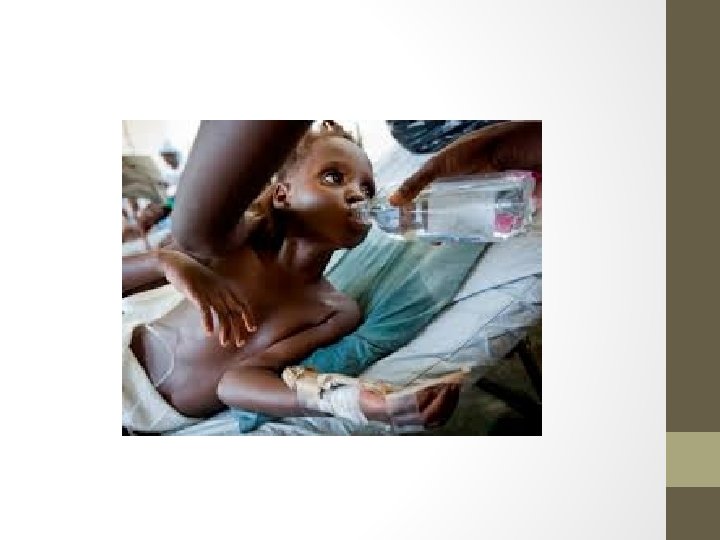
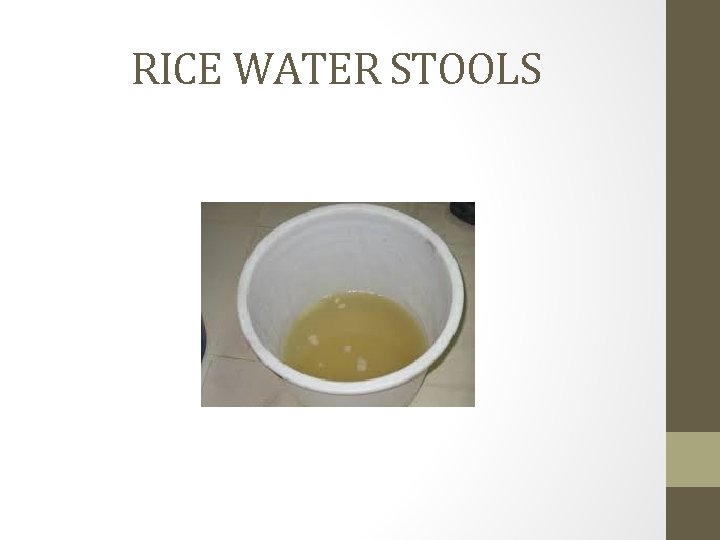
RICE WATER STOOLS
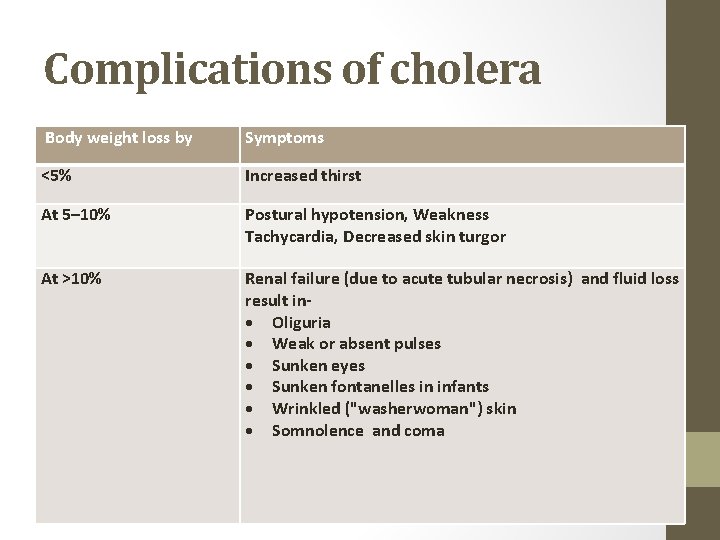
Complications of cholera Body weight loss by Symptoms <5% Increased thirst At 5– 10% Postural hypotension, Weakness Tachycardia, Decreased skin turgor At >10% Renal failure (due to acute tubular necrosis) and fluid loss result in Oliguria Weak or absent pulses Sunken eyes Sunken fontanelles in infants Wrinkled ("washerwoman") skin Somnolence and coma
Epidemiology - History of Pandemics • Cholera can occur—sporadic, limited outbreaks, endemic, epidemic or pandemic • Till 19 th century – confined to its home land (West Bengal & Bangladesh) • 1817 -1923 – 6 pandemics originating from Bengal – Classical Vibrio • 1923 – 1961 – Restricted to homeland
Epidemiology - History of Pandemics • - 1961 – 7 th Pandemic – differed from previous pandemics Only pandemic that originated outside India, i. e. From Caused by El Tor biotype Milder cholera with more carrier rate Rapid spread of El Tor, involving the entire globe including some unusual parts
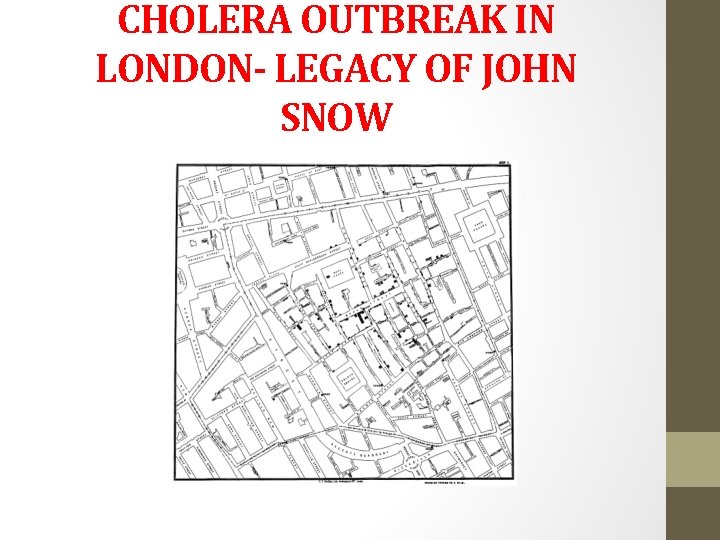
CHOLERA OUTBREAK IN LONDON- LEGACY OF JOHN SNOW
O 139 (Bengal strain) • Isolated first from Chennai in 1992 • O 139 – Not agglutinated by any of the antisera available at that time (O 1 to O 138) • Bengal strain - spread rapidly along the coastal region of Bay of Bengal • Derivative of O 1 El Tor – differs in having a distinct LPS & capsulated • Invasive bacteremia and extra intestinal manifestations • No cross protection between O 1 and O 139 • By 1994 - O 1 El Tor replaced O 139
Current Situation - World • Cholera is a notifiable disease, often under reported • Annual cases >1. 3 -4 million • Annual deaths - 21 000 to 1. 4 Lakh • Majority of cases are due to O 1 El Tor
Current Situation - India • Situation has greatly changed • West Bengal is no longer the home land, all states affected • Both morbidity and mortality have greatly reduced • National Institute of Cholera and Enteric Diseases (NICED), Kolkata - National reference Center for cholera in India
Epidemiological Determinants Reservoirs - Humans the only reservoir • Source - asymptomatic cases or carriers • Incubatory carriers - less common, as cholera has a short incubation period - Convalescent carriers: 2– 3 weeks after recovery - Contact or healthy carriers: infection from subclinical cases shed bacilli for <10 days - Chronic carriers - El Tor has more carrier rate than classical • Cholera season- high temperatures, heavy rainfall & flooding
Epidemiological Determinants • Factors promoting transmission - poor sanitation, poverty, overcrowding, population mobility • • • Factors determining severity disease: Lack of pre-existing immunity Blood group - ‘O’ greater risk ; AB - least risk Malnutrition, People with low immunity - during epidemics - children Habitat- sea water and brackish estuaries
Epidemiological Determinants • Persistence of V. Cholerae - Epidemics - maintained by carriers & subclinical cases - Inter epidemic period - maintained in sea water • - Resistance Acid-labile but stable to alkali Heat-labile but stable to refrigeration Easily killed by drying and sunshine & disinfectants Biotype El Tor more resistant than classical
Laboratory Diagnosis • Specimens: Freshly collected watery stool - cases - Rectal swab - convalescent patients or carriers - Transport/Holding Media Venkatraman-Ramakrishnan (VR) medium - crude sea salt & peptone water (p. H 8. 6– 8. 8) Alkaline salt transport medium - VR medium + boric acid, Na. OH and KCl (p. H 9. 2) Cary-Blair medium - buffered solution of sodium chloride, sodium thioglycollate, disodium phosphate and calcium chloride (p. H 8. 4) Autoclaved sea water
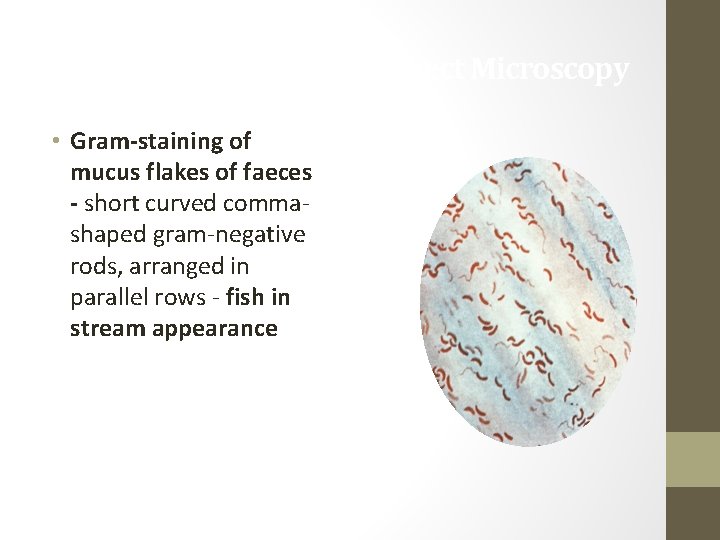
Direct Microscopy • Gram-staining of mucus flakes of faeces - short curved commashaped gram-negative rods, arranged in parallel rows - fish in stream appearance

Laboratory Diagnosis • Motility testing (hanging drop) - darting motility /shooting star/ swarming gnats motility • Motility testing after adding H-antisera - V. Cholerae becomes non-motile when a drop of the watery stool specimen is added with flagellar (H) antiserum
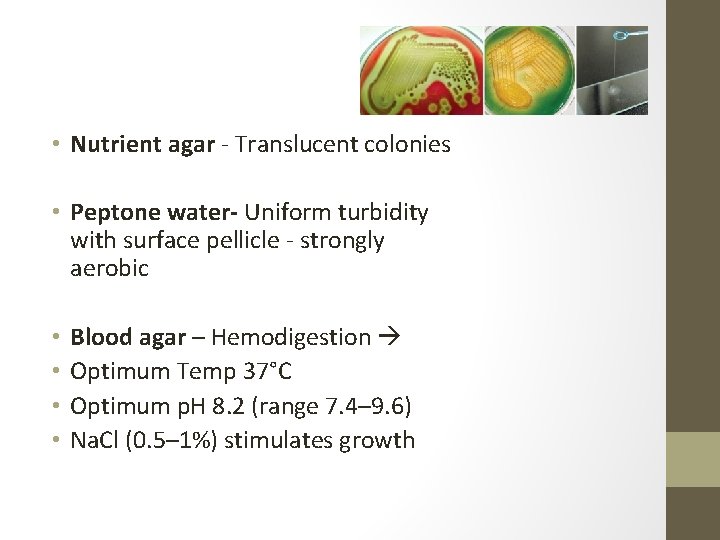
Culture • Nutrient agar - Translucent colonies • Peptone water- Uniform turbidity with surface pellicle - strongly aerobic • • Blood agar – Hemodigestion Optimum Temp 37°C Optimum p. H 8. 2 (range 7. 4– 9. 6) Na. Cl (0. 5– 1%) stimulates growth
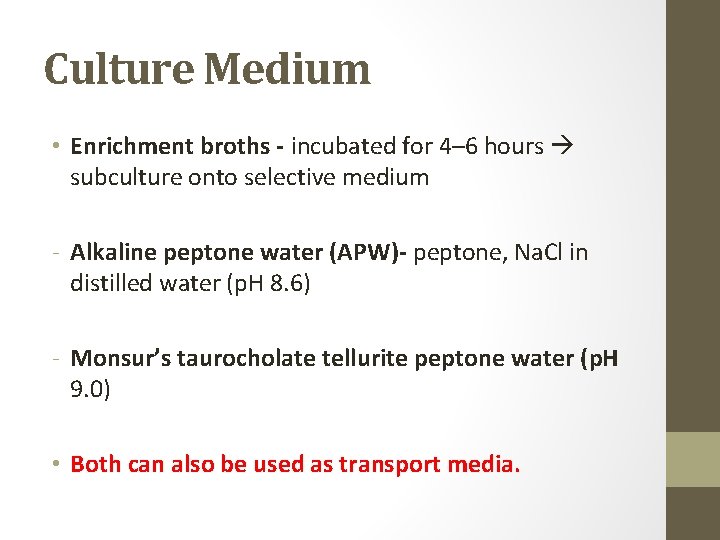
Culture Medium • Enrichment broths - incubated for 4– 6 hours subculture onto selective medium - Alkaline peptone water (APW)- peptone, Na. Cl in distilled water (p. H 8. 6) - Monsur’s taurocholate tellurite peptone water (p. H 9. 0) • Both can also be used as transport media.
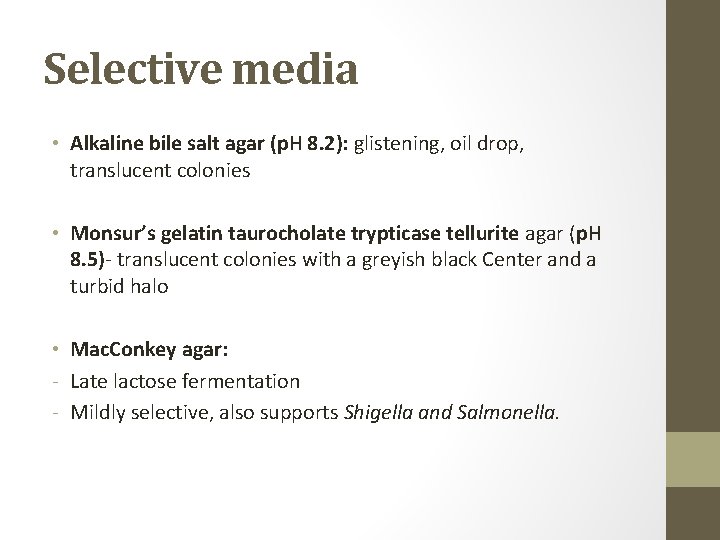
Selective media • Alkaline bile salt agar (p. H 8. 2): glistening, oil drop, translucent colonies • Monsur’s gelatin taurocholate trypticase tellurite agar (p. H 8. 5)- translucent colonies with a greyish black Center and a turbid halo • Mac. Conkey agar: - Late lactose fermentation - Mildly selective, also supports Shigella and Salmonella.
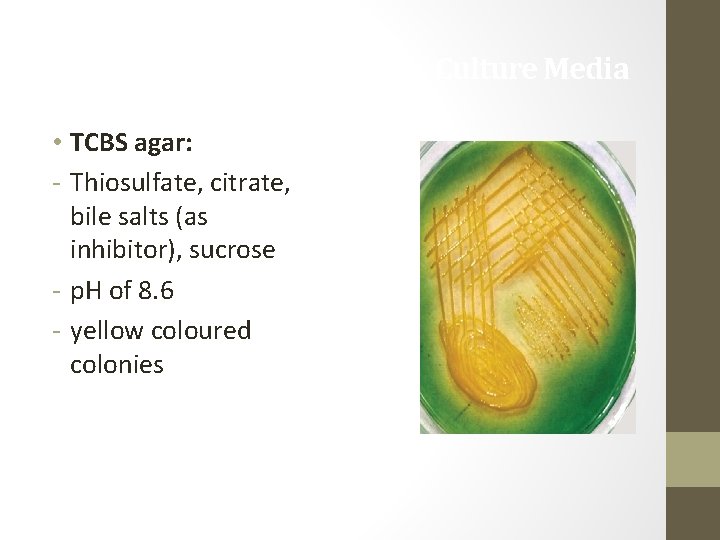
Culture Media • TCBS agar: - Thiosulfate, citrate, bile salts (as inhibitor), sucrose - p. H of 8. 6 - yellow coloured colonies
Biochemical Tests • • Catalase and oxidase positive Indole test—positive Citrate test—variable Urease test—negative Triple sugar iron medium— A/A, gas absent, H 2 S absent MR (methyl red) test—positive VP (Voges-Proskauer) test—positive for El Tor, negative for classical biotype
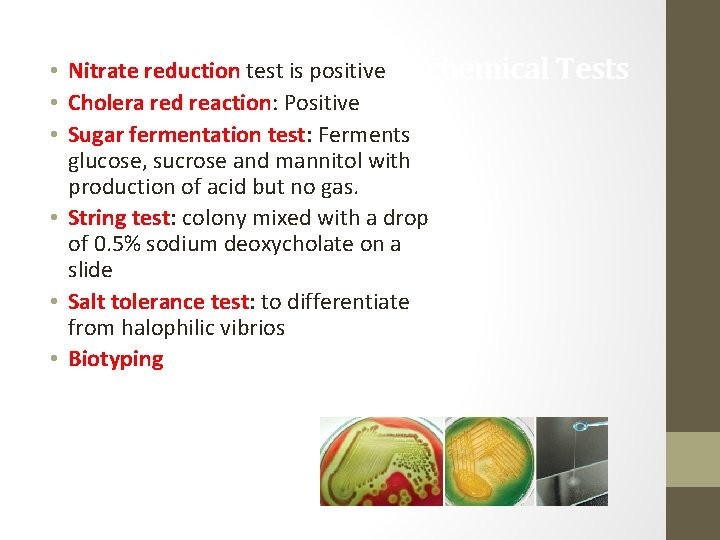
• Nitrate reduction test is positive. Biochemical Tests • Cholera red reaction: Positive • Sugar fermentation test: Ferments glucose, sucrose and mannitol with production of acid but no gas. • String test: colony mixed with a drop of 0. 5% sodium deoxycholate on a slide • Salt tolerance test: to differentiate from halophilic vibrios • Biotyping
Biochemical Tests • - Decarboxylase tests: Vibrio utilizes lysine and ornithine Aeromonas utilizes only arginine Plesiomonas utilizes all, i. e. lysine, arginine and ornithine • Susceptible to O/129 (vibriostatic agent): Vibrio species are susceptible to 10 μg of O/129 disk while Aeromonas and Plesiomonas are resistant
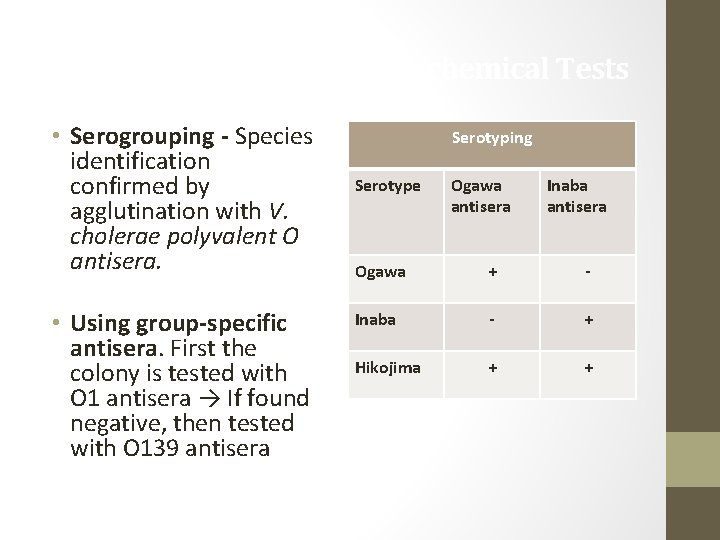
Biochemical Tests • Serogrouping - Species identification confirmed by agglutination with V. cholerae polyvalent O antisera. • Using group-specific antisera. First the colony is tested with O 1 antisera → If found negative, then tested with O 139 antisera Serotyping Serotype Ogawa antisera Inaba antisera Ogawa + - Inaba - + Hikojima + +
Treatment of Cholera Fluid replacement: most important - Mild to moderate fluid loss: oral rehydration solution (ORS) - Severe cases: Intravenous fluid replacement with Ringer’s lactate (or normal saline) ORS • Antibiotics have a minor role as the pathogenesis is toxin mediated • Drug of choice: Macrolides (Erythromycin or Azithromycin) - Alternatives - Doxycycline, tetracycline or ciprofloxacin
Prevention General Measures Safe water, sanitary disposal of faeces Proper food sanitation Prompt outbreak investigation and steps to reduce transmission - Notification - Heath education • - • Chemoprophylaxis - Tetracycline - Household contacts, only during epidemics
Prevention – Oral Vaccines • Killed Whole-cell vaccine: 1. Whole-cell (WC) vaccine - (classical and El Tor, Inaba and Ogawa) 2. Whole-cell recombinant B subunit cholera vaccine (WC/r. BS) (Dukoral) – same WC vaccine + recombinant cholera toxin B subunit • Schedule: Two doses at 7 days gap (> 2 years) • Protection is short lived. Children are better protected • Used during epidemics and outbreaks but not during inter epidemic period
Prevention – Oral Vaccines • Oral live attenuated vaccines (OCV) – Under trial. Use mutant strains lacking gene encoding cholera toxin - V. cholerae O 1 - CVD 103 -Hg. R, Peru-15 and V. cholerae 638 for classical and/or El Tor biotypes - V. cholerae O 139 – CVD-112 and Bengal-15 - CVD 103 -Hg. R vaccine (Orochol) contains a live attenuated strain derived from reference strain 569 B (classical, O 1, Inaba), given as single dose. Its protection starts after 8 days
Non O 1/O 139 V. Cholerae • Biochemically resemble V. cholerae O 1/O 139, but do not agglutinate with O 1 or O 139 antisera. • - Gastroenteritis: Sea food consumption (raw oysters) Stool – watery/partly formed & bloody/ mucoid Abdominal cramps, nausea, vomiting and fever Never cause epidemic cholera. Treatment is same as that of cholera • Extra intestinal manifestations: Otitis media, wound infection & bacteremia - Occupational or recreational exposure to seawater - Tetracycline, ciprofloxacin and third generation cephalosporins
HALOPHILIC VIBRIOS • Can withstand higher salt concentration (>6%) in contrast to V. cholerae, which can tolerate up to 6% • Widespread in marine environments • Cases tend to occur during late summer and early rain fall, when the bacterial counts are highest in the water
Vibrio parahaemolyticus • Clinical Manifestations - Food-borne gastroenteritis – MC presentation Following ingestion of raw or uncooked sea food (e. g. oyster) Watery diarrhoea or rarely as Extra intestinal manifestations - rare, wound infection, otitis and sepsis.
Pathogenesis Virulence factors: Polysaccharide capsule Haemolysin (thermo-stable) Urease enzyme Secretion systems in cell wall - directly inject toxic bacterial proteins into host cells. • Serotype: Most infections are caused due to serotypes O 3: K 6, O 4: K 68, and O 1: K-untypable • -
Laboratory Diagnosis • Similar to that of V. Cholerae with some distinct properties: • Morphology- capsulated, bipolar staining in fresh isolates and pleomorphism in older cultures • Motile by peritrichous flagella • TCBS- green colonies (sucrose no fermenter) • Kanagawa phenomenon - β haemolysis on Wagatsuma agar • Swarming on blood agar • Urease test is positive in few strains • Salt tolerance test - resist maximum of 8% Na. Cl
Treatment V. parahaemolyticus • Mostly self-limiting • Treatment is same as that of cholera • Indications for antibiotic use: Severe gastroenteritis or extra intestinal manifestations associated with underlying diseases, such as diabetes, pre-existing liver disease, iron overload states, or immunosuppression
Vibrio vulnificus • Rare but most severe infection • Clinical Manifestations 1. Primary sepsis - underlying liver disease and iron overload or rarely in renal insufficiency and immunosuppression. 2. Primary wound infection - painful erythematous swelling or cellulitis or even vesicular, bullous or necrotic lesions - Generally affects people without underlying disease
Laboratory Diagnosis • Blood culture • Biochemical Reactions: - Ferments lactose [the only lactose fermenting Vibrio] - Arginine is not dehydrolyzed • Treatment Vibrio vulnificus - Early antibiotic institution- tetracycline, fluoroquinolones, and third-generation cephalosporins - Wound debridement & general supportive care
Vibrio alginolyticus • Occasional cause eye, ear and wound infections • Rarely otitis externa, otitis media and conjunctivitis have been reported, bacteremia in immunocompromised hosts • Most salt tolerant Vibrio (>10%) • Usually self-limiting • Severe infections - tetracycline and drainage
AEROMONAS • Earlier placed in the family Vibrionaceae; now assigned to a separate family, Aeromonadaceae • Pathogenicity: - Tissue adherence mediated by adhesions such as S-layer and fimbriae - Capsular polysaccharide - Exotoxins - Aerolysin, phospholipases, haemolysins, enterotoxin and cytotoxin similar to Shiga toxin - Endotoxin or LPS
Clinical manifestations • >85% human infections caused by A. hydrophila, A. caviae and A. veronii • • • Gastroenteritis and peritonitis Musculoskeletal & wound infections Bacteraemia in immunocompromised Respiratory tract infections Haemolytic uremic syndrome (HUS) - enterotoxin similar to Shiga-S toxin
Laboratory diagnosis • Motile with single polar flagellum • Mac. Conkey agar— non-lactose fermenting colonies • Oxidase and catalase positive • Decarboxylase test —utilizes only arginine • Growth is not stimulated by Na. Cl. • Genotypic classification • Treatment - Ciprofloxacin and levofloxacin - Alternatives - cotrimoxazole and cefepime

- Slides: 56