
Vibrations and Waves How is doing the wave
Vibrations and Waves How is “doing the wave” at the football game like a wave in physics?
Periodic Motion l Motion which repeats in a regular cycle, is periodic motion. ¡ Examples: l clock pendulum l metal block bobbing up and down on a spring l If the force that restores the object to its equilibrium position is directly proportional to the displacement of the object, the motion that results is called simple harmonic motion.
Periodic Motion l Period, T, is the time needed for an object to repeat one complete cycle of the motion. l The amplitude of the motion is the maximum distance that the object moves from equilibrium.
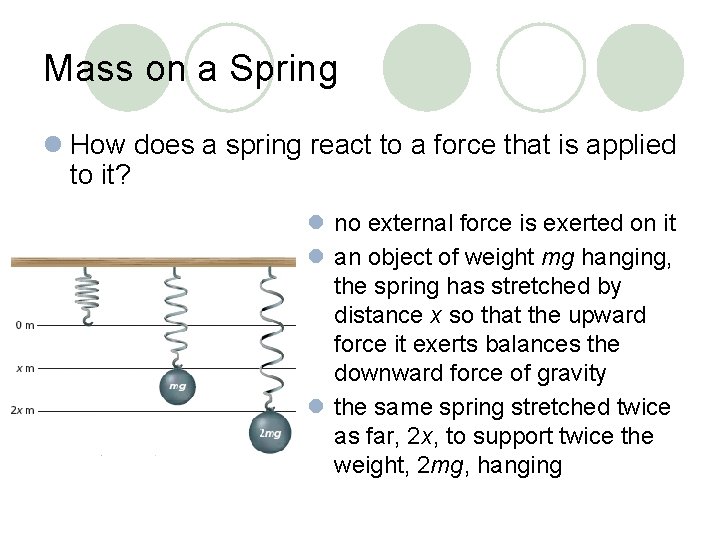
Mass on a Spring l How does a spring react to a force that is applied to it? l no external force is exerted on it l an object of weight mg hanging, the spring has stretched by distance x so that the upward force it exerts balances the downward force of gravity l the same spring stretched twice as far, 2 x, to support twice the weight, 2 mg, hanging
Hooke’s Law l Hooke’s law states that the force exerted by a spring is directly proportional to the amount that the spring is stretched. l Hooke’s Law F = -kx The force exerted by a spring is equal to the spring constant times the distance the spring is compressed or stretched from its equilibrium position.
Hooke’s Law Equation F = -kx l k is the spring constant, which depends on the stiffness and other properties of the spring l x is the distance that the spring is stretched from its equilibrium position. Not all springs obey Hooke’s law, Springs that obey Hooke’s Law are called elastic
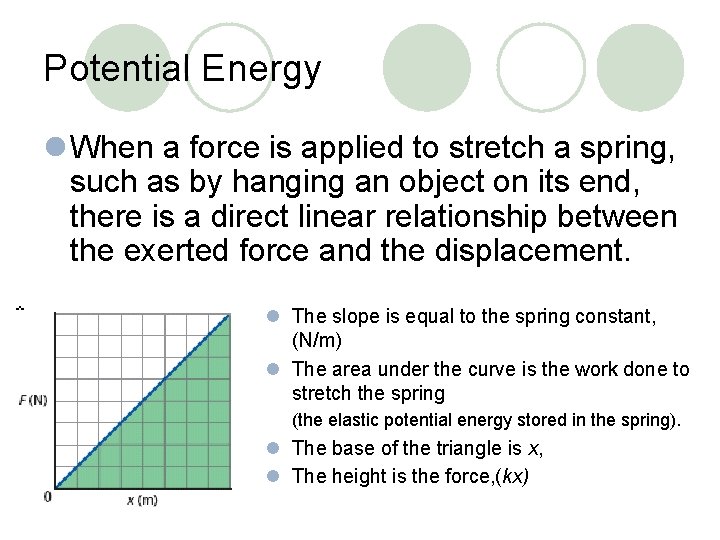
Potential Energy l When a force is applied to stretch a spring, such as by hanging an object on its end, there is a direct linear relationship between the exerted force and the displacement. l The slope is equal to the spring constant, (N/m) l The area under the curve is the work done to stretch the spring (the elastic potential energy stored in the spring). l The base of the triangle is x, l The height is the force, (kx)
Potential Energy in a Spring l Potential Energy in a Spring PEsp = ½ kx 2 The potential energy in a spring is equal to one-half times the product of the spring constant and the square of the displacement. Units: Newton·meters = joules N·m = J
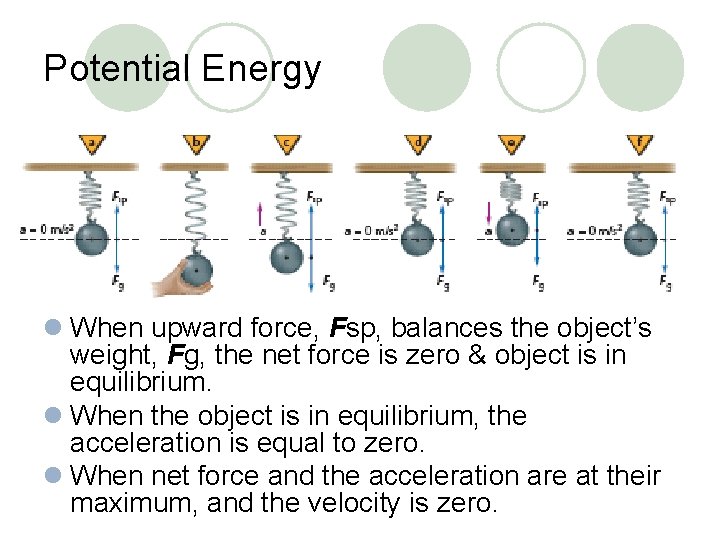
Potential Energy l When upward force, Fsp, balances the object’s weight, Fg, the net force is zero & object is in equilibrium. l When the object is in equilibrium, the acceleration is equal to zero. l When net force and the acceleration are at their maximum, and the velocity is zero.

Pendulums l A simple pendulum consists of a massive object, called the bob, suspended by a string or light rod of length l. l At the left and right positions the net force and acceleration are maximum, and the velocity is zero. l At the middle position the net force and acceleration are zero, and the velocity is maximum. l the net force is a restoring force
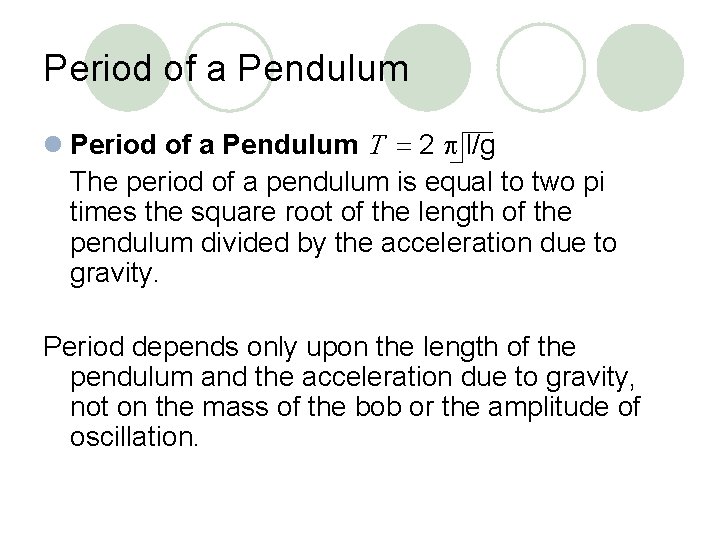
Period of a Pendulum l Period of a Pendulum T = 2 p l/g The period of a pendulum is equal to two pi times the square root of the length of the pendulum divided by the acceleration due to gravity. Period depends only upon the length of the pendulum and the acceleration due to gravity, not on the mass of the bob or the amplitude of oscillation.
Resonance l Resonance occurs when small forces are applied at regular intervals to a vibrating or oscillating object and the amplitude of the vibration increases.
Wave Properties l A wave is a disturbance that carries energy through matter or space. l Water waves, sound waves, and the waves that travel down a rope or spring are types of mechanical waves. l EXAMPLE
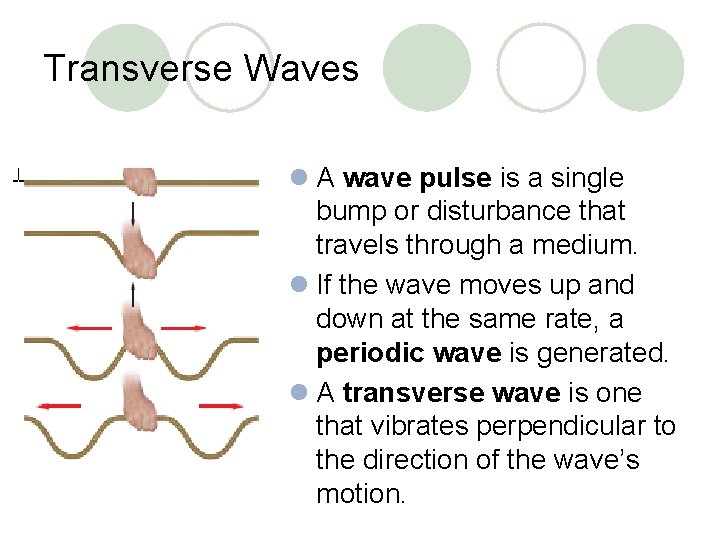
Transverse Waves l A wave pulse is a single bump or disturbance that travels through a medium. l If the wave moves up and down at the same rate, a periodic wave is generated. l A transverse wave is one that vibrates perpendicular to the direction of the wave’s motion.
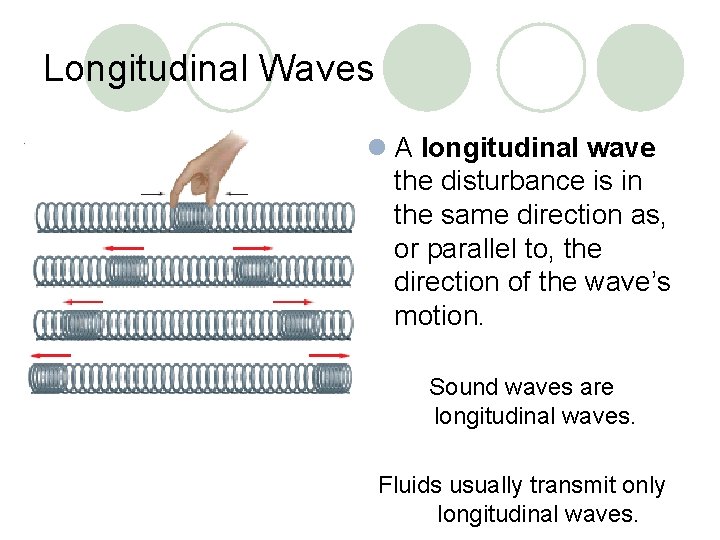
Longitudinal Waves l A longitudinal wave the disturbance is in the same direction as, or parallel to, the direction of the wave’s motion. Sound waves are longitudinal waves. Fluids usually transmit only longitudinal waves.
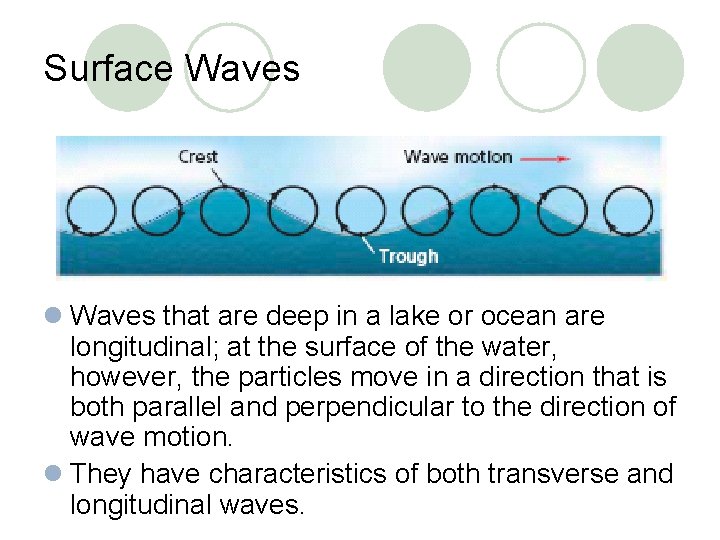
Surface Waves l Waves that are deep in a lake or ocean are longitudinal; at the surface of the water, however, the particles move in a direction that is both parallel and perpendicular to the direction of wave motion. l They have characteristics of both transverse and longitudinal waves.
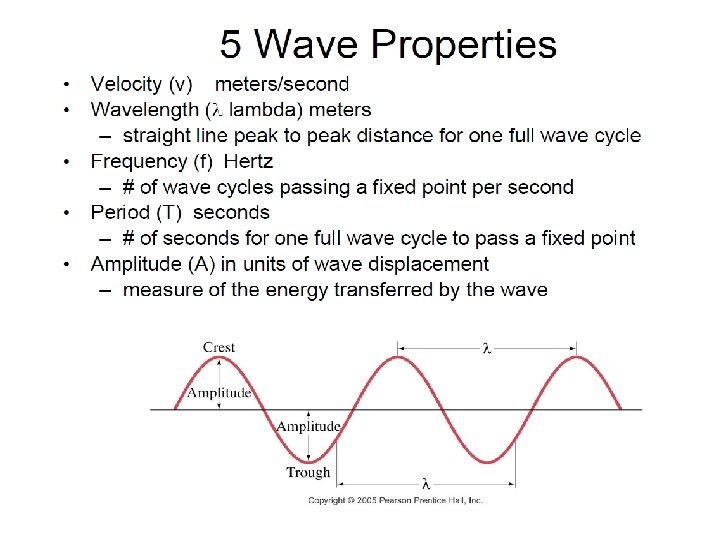
Amplitude l The amplitude of a wave is the maximum displacement of the wave from its position of rest or equilibrium. Amplitude depends on how the wave is generated, but not on its speed. For waves that move at the same speed, the rate at which energy is transferred is proportional to the square of the amplitude.
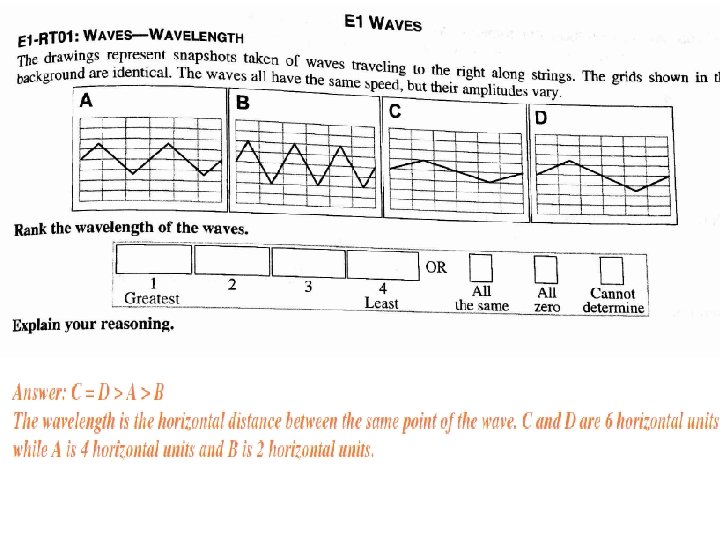
Wavelength Each low point, called a trough, and each high point, called a crest, of a wave. The shortest distance between points where the wave pattern repeats itself is called the wavelength. The Greek letter lambda, l, represents wavelength.
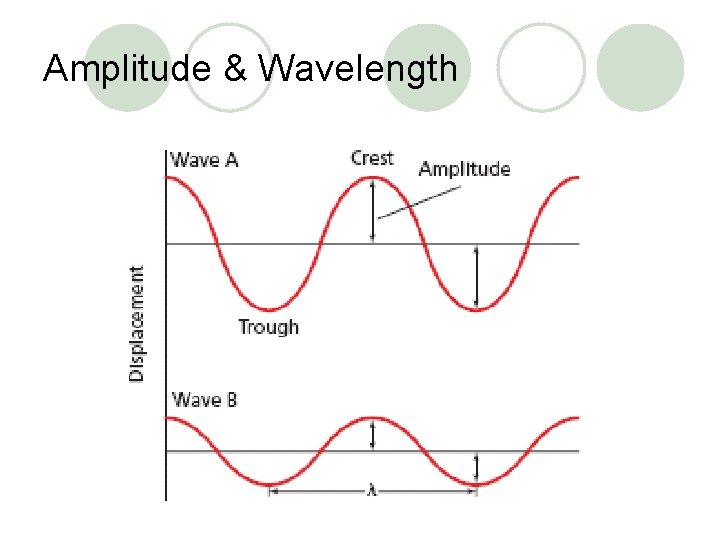
Amplitude & Wavelength
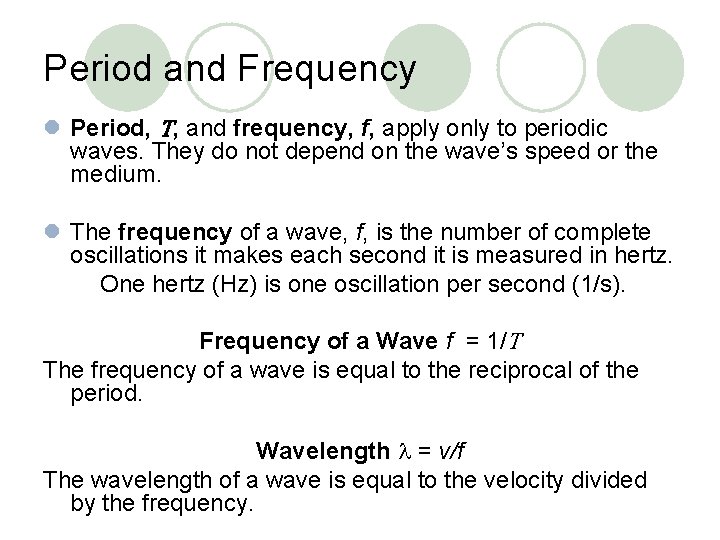
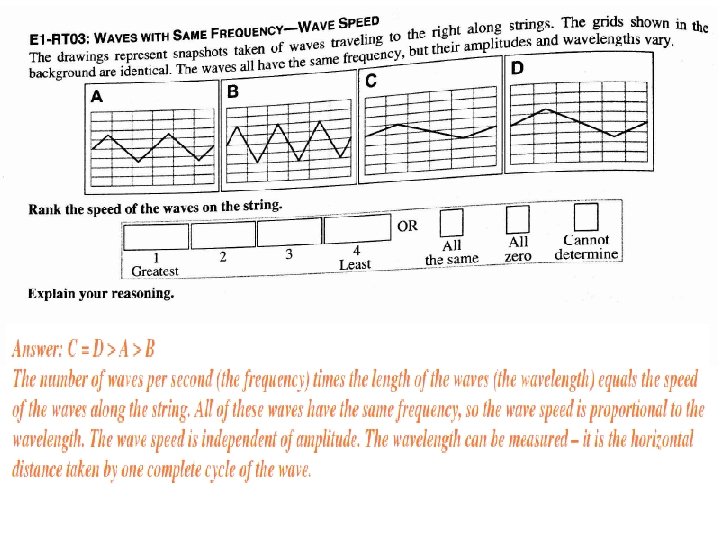
Period and Frequency l Period, T, and frequency, f, apply only to periodic waves. They do not depend on the wave’s speed or the medium. l The frequency of a wave, f, is the number of complete oscillations it makes each second it is measured in hertz. One hertz (Hz) is one oscillation per second (1/s). Frequency of a Wave f = 1/T The frequency of a wave is equal to the reciprocal of the period. Wavelength l = v/f The wavelength of a wave is equal to the velocity divided by the frequency.
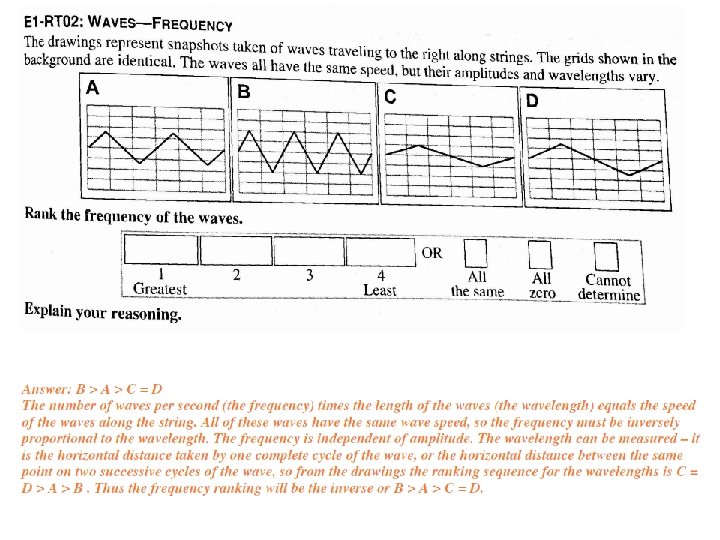
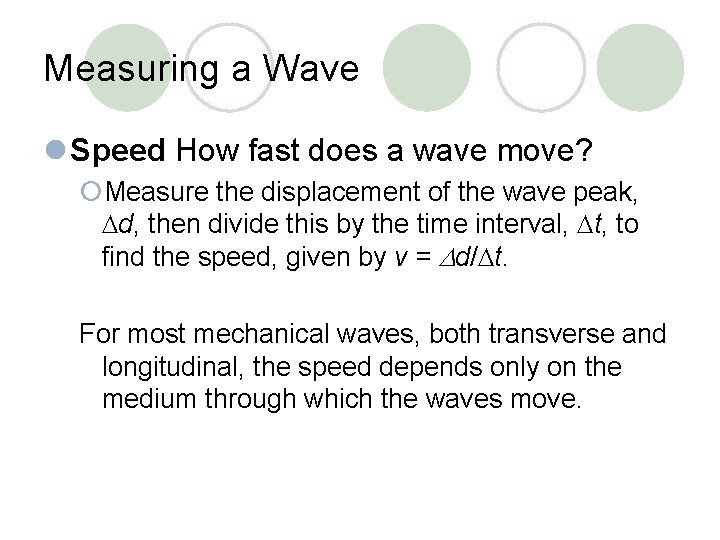
Measuring a Wave l Speed How fast does a wave move? ¡Measure the displacement of the wave peak, Dd, then divide this by the time interval, Dt, to find the speed, given by v = Dd/Dt. For most mechanical waves, both transverse and longitudinal, the speed depends only on the medium through which the waves move.
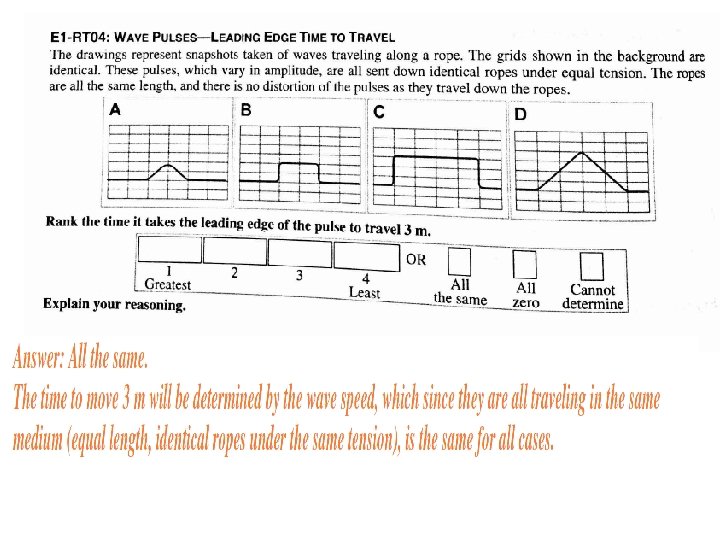
Wave Behavior l Boundaries ¡Reflected ¡Pass through the boundary ¡Change direction l Reminder: ¡Velocity depends on the medium l. Water wave depth of the water affects wave speed l. Sound waves in air, temperature affects wave speed l. Waves in a spring, depends on spring tension and mass per unit length
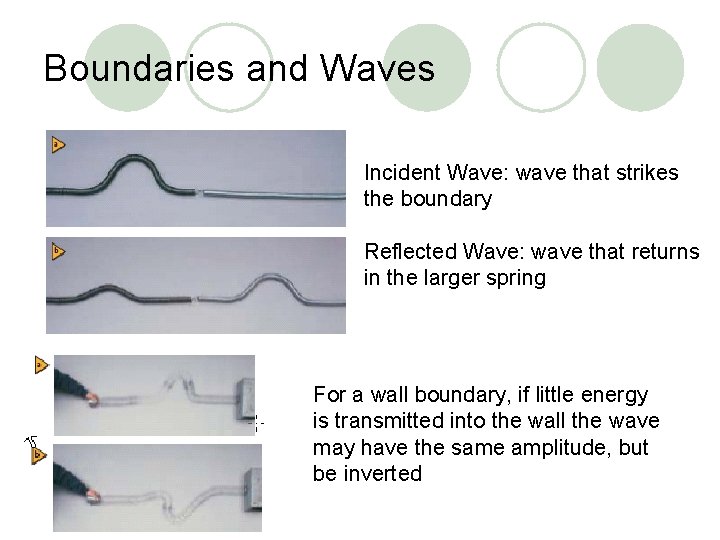
Boundaries and Waves Incident Wave: wave that strikes the boundary Reflected Wave: wave that returns in the larger spring For a wall boundary, if little energy is transmitted into the wall the wave may have the same amplitude, but be inverted
Phase l Any two points on a wave that are one or more whole wavelengths apart are in phase. ¡ Particles in the medium are said to be in phase with one another when they have the same displacement from equilibrium and the same velocity. ¡ Particles in the medium with opposite displacements and velocities are 180° out of phase. A crest and a trough, for example, are 180°out of phase with each other. Two particles in a wave can be anywhere from 0° to 180° out of phase with one another.
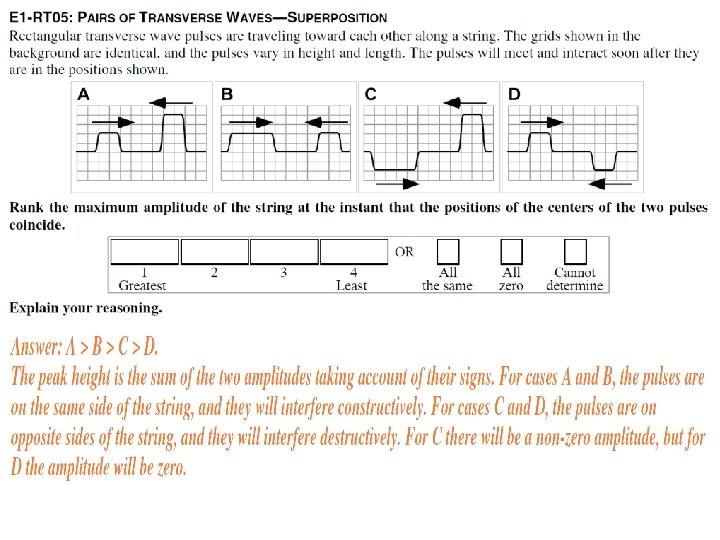
Superposition of Waves l The principle of superposition states that the displacement of a medium caused by two or more waves is the algebraic sum of the displacements caused by the individual waves. l Two are more waves can combine to form a new wave.
Wave Interference l The result of the superposition of two or more waves is called interference. ¡Constructive interference occurs when the waves are in sync (in phase), and they combine ¡Destructive interference occurs when the waves are out of sync, and the cancel some or all of each other out.
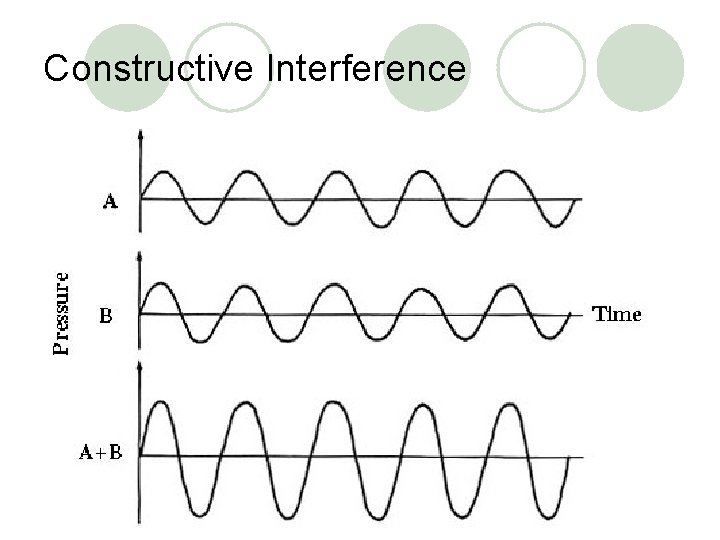
Constructive Interference
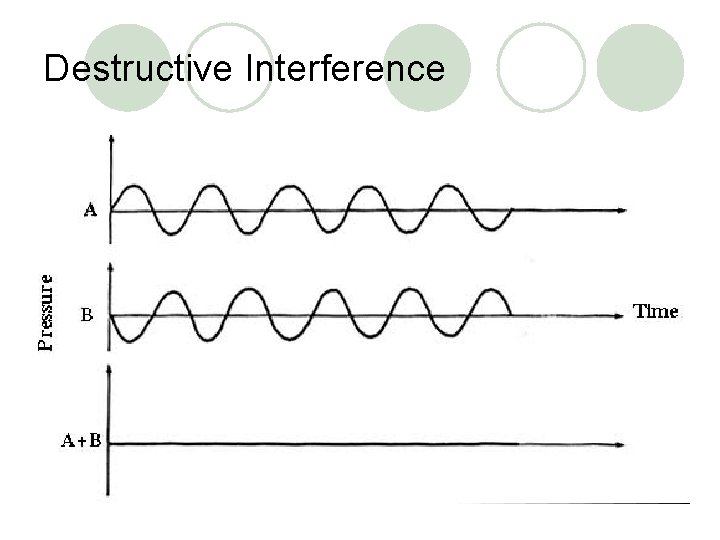
Destructive Interference
Standing Waves l A wave that appears to be stationary is a standing wave. l It is actually two wave moving in opposite directions. ¡Node – part where the amplitude is 0. ¡Antinode – largest amplitude.
- Slides: 35