
Vibrational Spectroscopy Bend O H H Diatomic Molecules
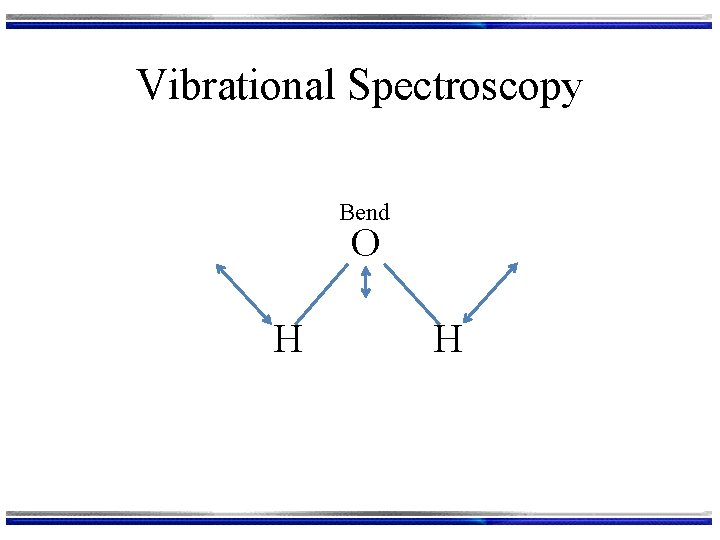
Vibrational Spectroscopy Bend O H H

Diatomic Molecules • So far we have studied vibrational spectroscopy in the form of harmonic and anharmonic oscillators. • Technically these models only apply to diatomic molecules • We will still use them as tools to make analogies for the vibrational behaviour of bigger molecules • The vib. spectra of diatomics are not very useful forensic applications • They are usually gasses • The is only one peak!
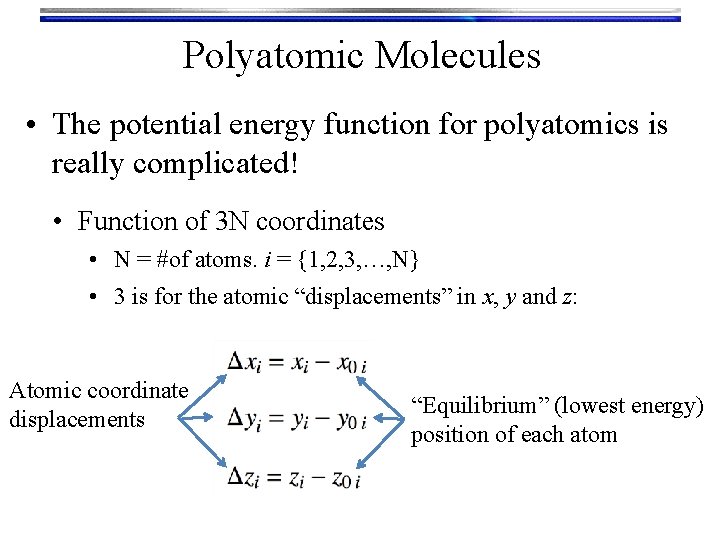
Polyatomic Molecules • The potential energy function for polyatomics is really complicated! • Function of 3 N coordinates • N = #of atoms. i = {1, 2, 3, …, N} • 3 is for the atomic “displacements” in x, y and z: Atomic coordinate displacements “Equilibrium” (lowest energy) position of each atom
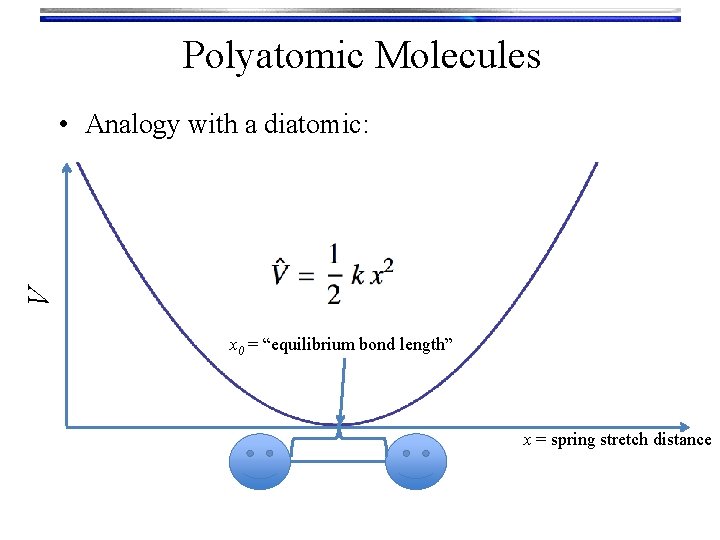
Polyatomic Molecules V • Analogy with a diatomic: x 0 = “equilibrium bond length” x = spring stretch distance
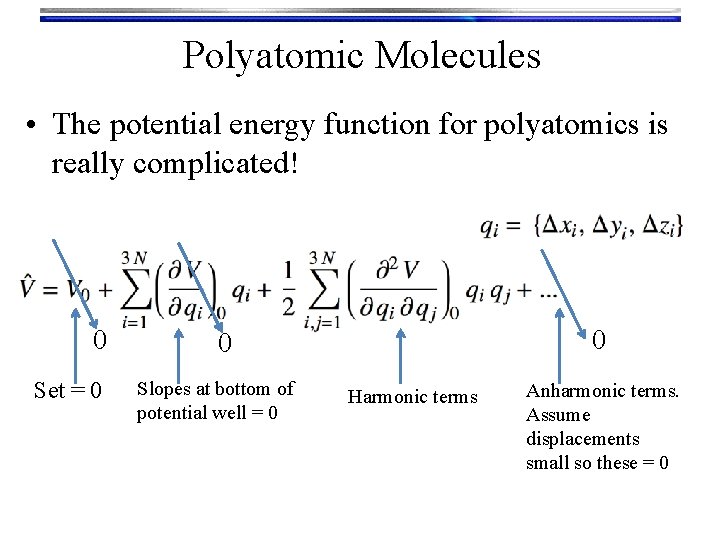
Polyatomic Molecules • The potential energy function for polyatomics is really complicated! 0 Set = 0 0 0 Slopes at bottom of potential well = 0 Harmonic terms Anharmonic terms. Assume displacements small so these = 0
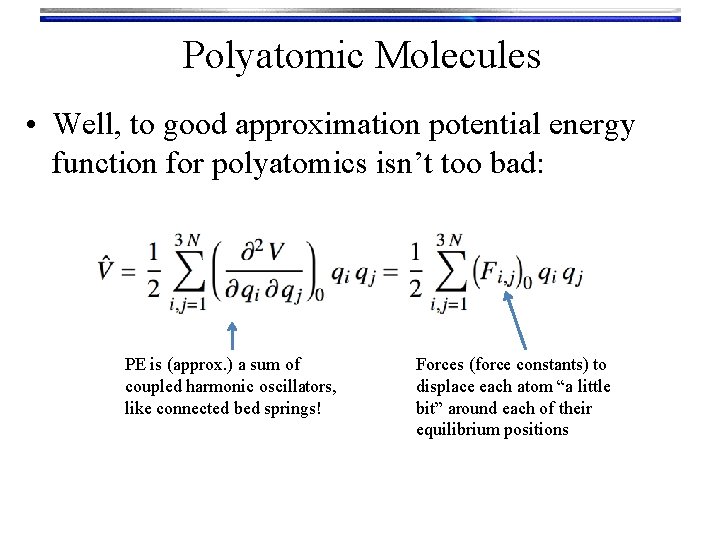
Polyatomic Molecules • Well, to good approximation potential energy function for polyatomics isn’t too bad: PE is (approx. ) a sum of coupled harmonic oscillators, like connected bed springs! Forces (force constants) to displace each atom “a little bit” around each of their equilibrium positions
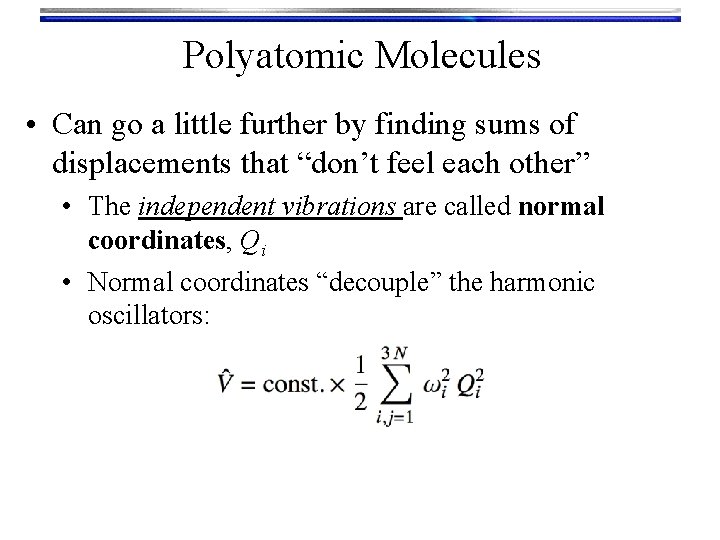
Polyatomic Molecules • Can go a little further by finding sums of displacements that “don’t feel each other” • The independent vibrations are called normal coordinates, Qi • Normal coordinates “decouple” the harmonic oscillators:
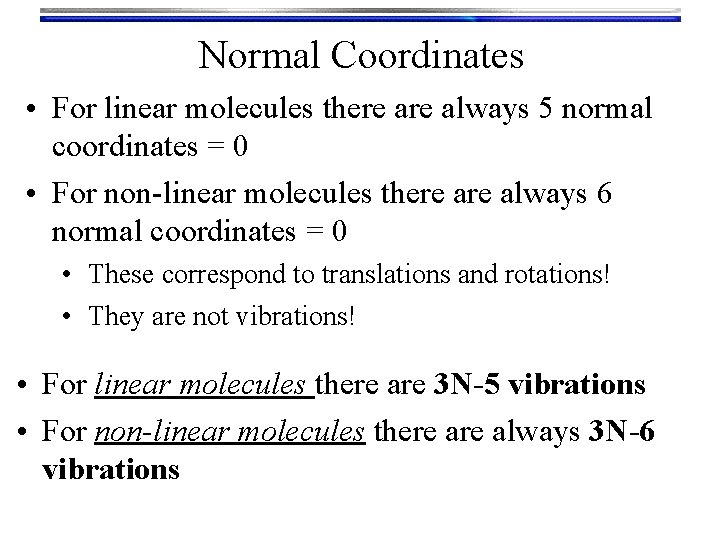
Normal Coordinates • For linear molecules there always 5 normal coordinates = 0 • For non-linear molecules there always 6 normal coordinates = 0 • These correspond to translations and rotations! • They are not vibrations! • For linear molecules there are 3 N-5 vibrations • For non-linear molecules there always 3 N-6 vibrations
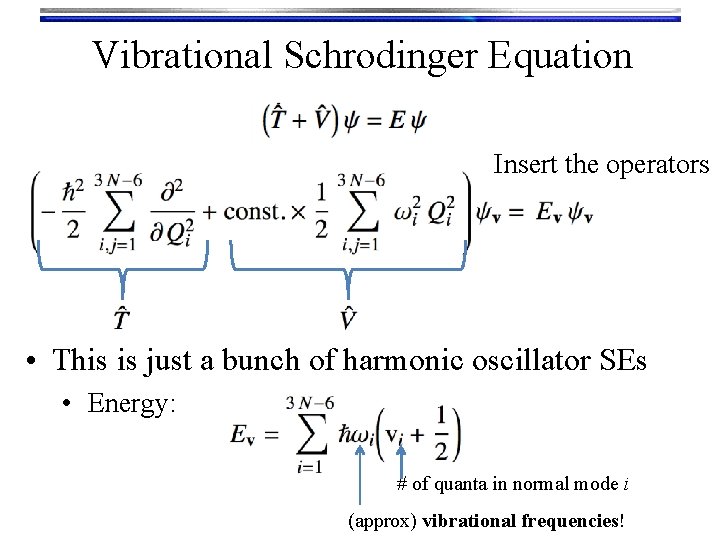
Vibrational Schrodinger Equation Insert the operators • This is just a bunch of harmonic oscillator SEs • Energy: # of quanta in normal mode i (approx) vibrational frequencies!
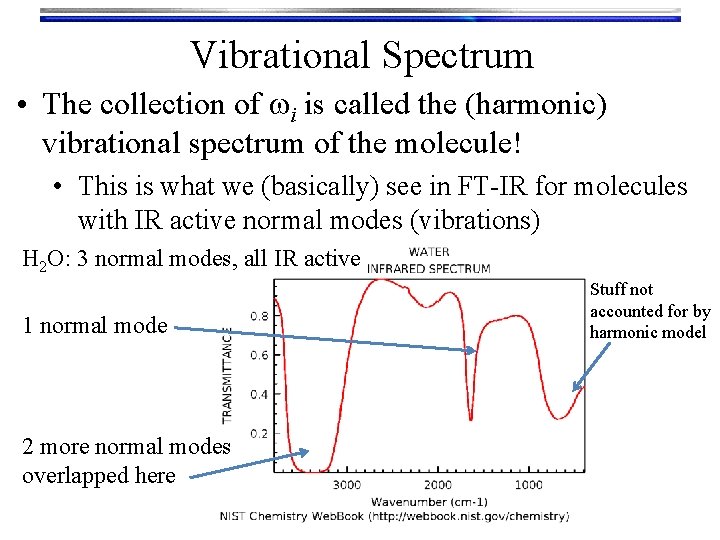
Vibrational Spectrum • The collection of wi is called the (harmonic) vibrational spectrum of the molecule! • This is what we (basically) see in FT-IR for molecules with IR active normal modes (vibrations) H 2 O: 3 normal modes, all IR active 1 normal mode 2 more normal modes overlapped here Stuff not accounted for by harmonic model
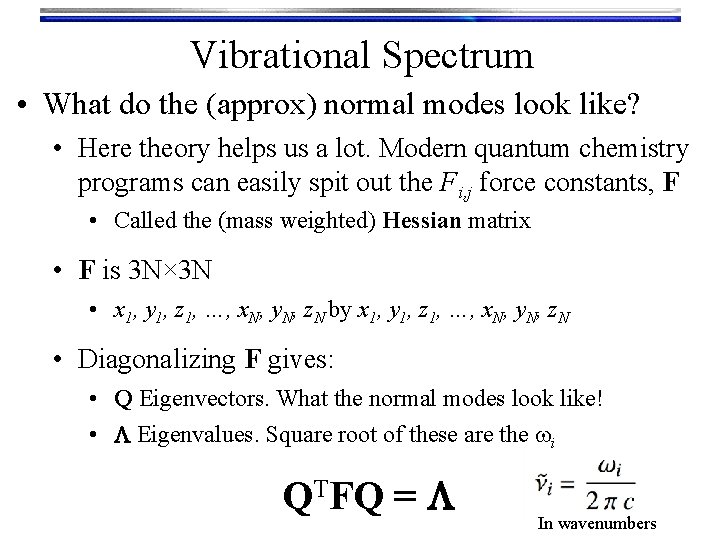
Vibrational Spectrum • What do the (approx) normal modes look like? • Here theory helps us a lot. Modern quantum chemistry programs can easily spit out the Fi, j force constants, F • Called the (mass weighted) Hessian matrix • F is 3 N× 3 N • x 1, y 1, z 1, …, x. N, y. N, z. N by x 1, y 1, z 1, …, x. N, y. N, z. N • Diagonalizing F gives: • Q Eigenvectors. What the normal modes look like! • L Eigenvalues. Square root of these are the wi QTFQ = L In wavenumbers
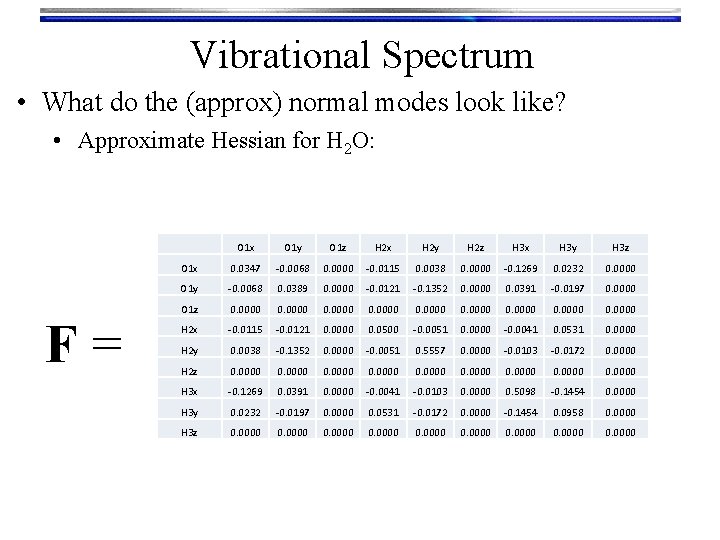
Vibrational Spectrum • What do the (approx) normal modes look like? • Approximate Hessian for H 2 O: F= O 1 x O 1 y O 1 z H 2 x H 2 y H 2 z H 3 x H 3 y H 3 z O 1 x 0. 0347 -0. 0068 0. 0000 -0. 0115 0. 0038 0. 0000 -0. 1269 0. 0232 0. 0000 O 1 y -0. 0068 0. 0389 0. 0000 -0. 0121 -0. 1352 0. 0000 0. 0391 -0. 0197 0. 0000 O 1 z 0. 0000 0. 0000 H 2 x -0. 0115 -0. 0121 0. 0000 0. 0500 -0. 0051 0. 0000 -0. 0041 0. 0531 0. 0000 H 2 y 0. 0038 -0. 1352 0. 0000 -0. 0051 0. 5557 0. 0000 -0. 0103 -0. 0172 0. 0000 H 2 z 0. 0000 0. 0000 H 3 x -0. 1269 0. 0391 0. 0000 -0. 0041 -0. 0103 0. 0000 0. 5098 -0. 1454 0. 0000 H 3 y 0. 0232 -0. 0197 0. 0000 0. 0531 -0. 0172 0. 0000 -0. 1454 0. 0958 0. 0000 H 3 z 0. 0000 0. 0000
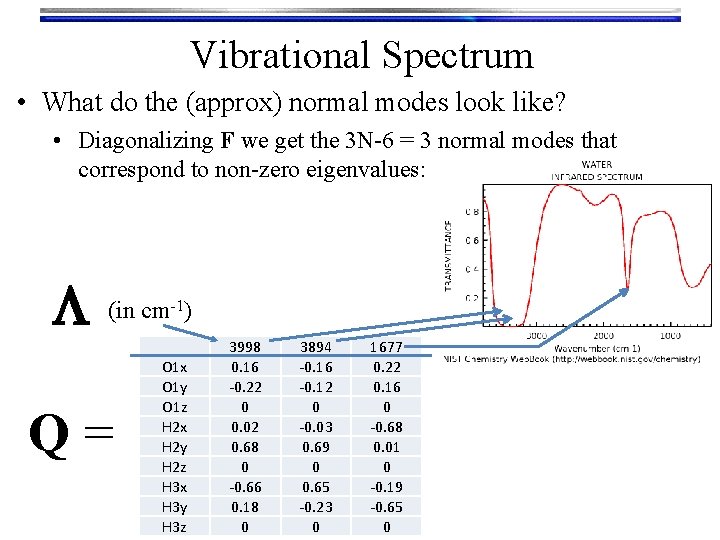
Vibrational Spectrum • What do the (approx) normal modes look like? • Diagonalizing F we get the 3 N-6 = 3 normal modes that correspond to non-zero eigenvalues: L (in cm-1) Q= O 1 x O 1 y O 1 z H 2 x H 2 y H 2 z H 3 x H 3 y H 3 z 3998 0. 16 -0. 22 0 0. 02 0. 68 0 -0. 66 0. 18 0 3894 -0. 16 -0. 12 0 -0. 03 0. 69 0 0. 65 -0. 23 0 1677 0. 22 0. 16 0 -0. 68 0. 01 0 -0. 19 -0. 65 0
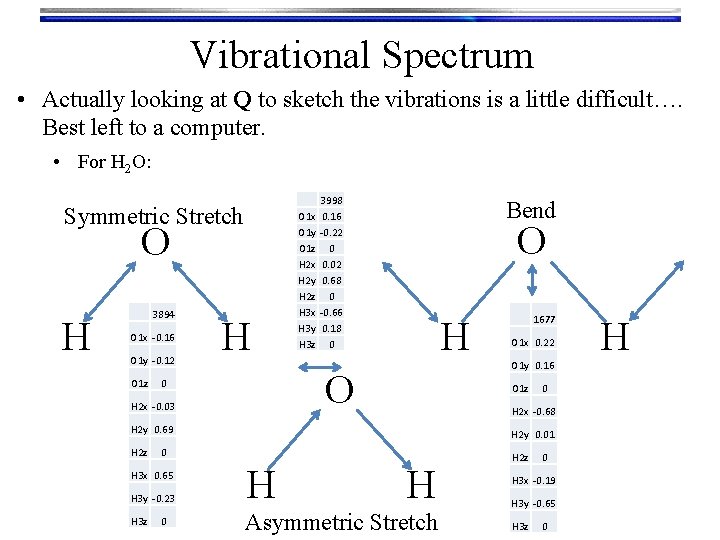
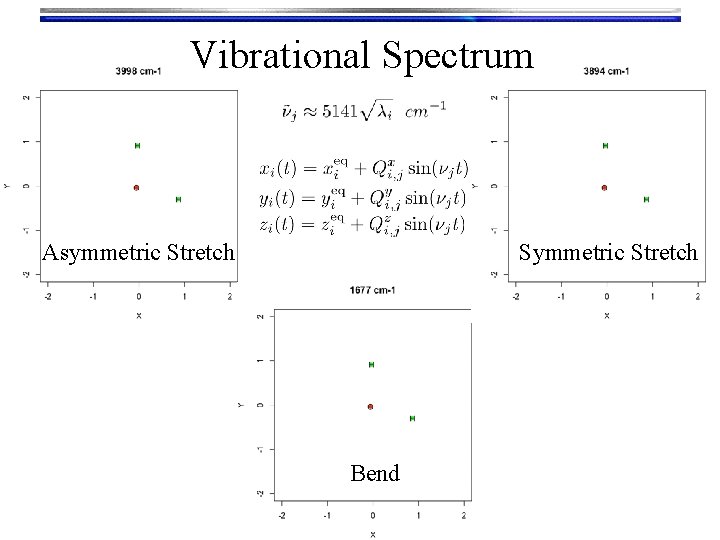
Vibrational Spectrum • Actually looking at Q to sketch the vibrations is a little difficult…. Best left to a computer. • For H 2 O: Symmetric Stretch O H 3894 O 1 x -0. 16 O 1 y -0. 12 O 1 z H O 1 x O 1 y O 1 z H 2 x H 2 y H 2 z H 3 x H 3 y H 3 z 3998 0. 16 -0. 22 0 0. 02 0. 68 0 -0. 66 0. 18 0 Bend O H O 0 H 2 x -0. 03 1677 O 1 x 0. 22 O 1 y 0. 16 O 1 z 0 H 2 x -0. 68 H 2 y 0. 69 H 2 y 0. 01 H 2 z 0 H 3 x 0. 65 H 3 y -0. 23 H 3 z 0 H H Asymmetric Stretch 0 H 3 x -0. 19 H 3 y -0. 65 H 3 z 0 H
Vibrational Spectrum Asymmetric Stretch Symmetric Stretch Bend

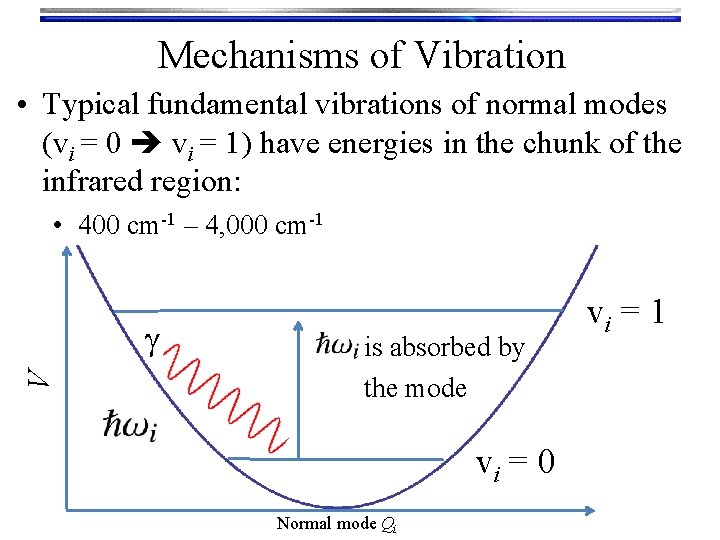
Mechanisms of Vibration • Typical fundamental vibrations of normal modes (vi = 0 vi = 1) have energies in the chunk of the infrared region: • 400 cm-1 – 4, 000 cm-1 V g is absorbed by the mode vi = 0 Normal mode Qi vi = 1
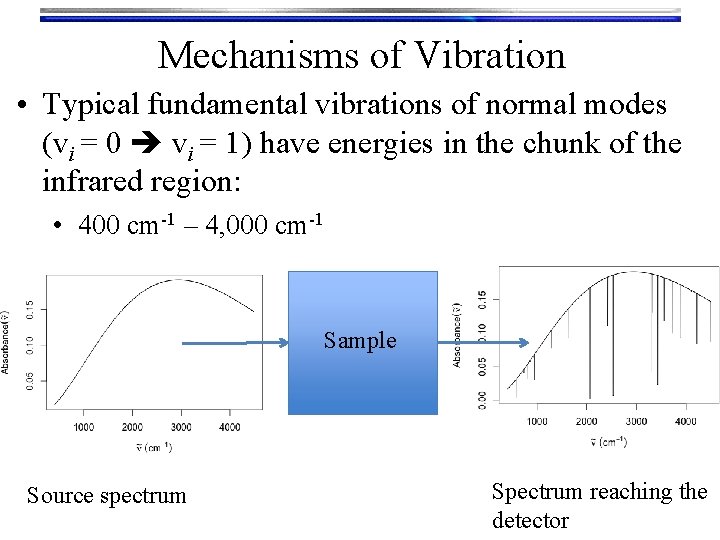
Mechanisms of Vibration • Typical fundamental vibrations of normal modes (vi = 0 vi = 1) have energies in the chunk of the infrared region: • 400 cm-1 – 4, 000 cm-1 Sample Source spectrum Spectrum reaching the detector
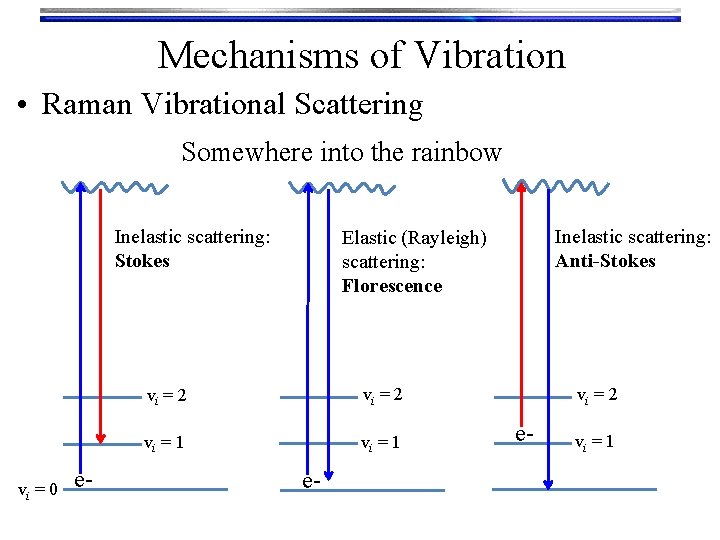
Mechanisms of Vibration • Raman Vibrational Scattering Somewhere into the rainbow Inelastic scattering: Stokes vi = 0 e- Inelastic scattering: Anti-Stokes Elastic (Rayleigh) scattering: Florescence vi = 2 vi = 1 e- vi = 2 e- vi = 1
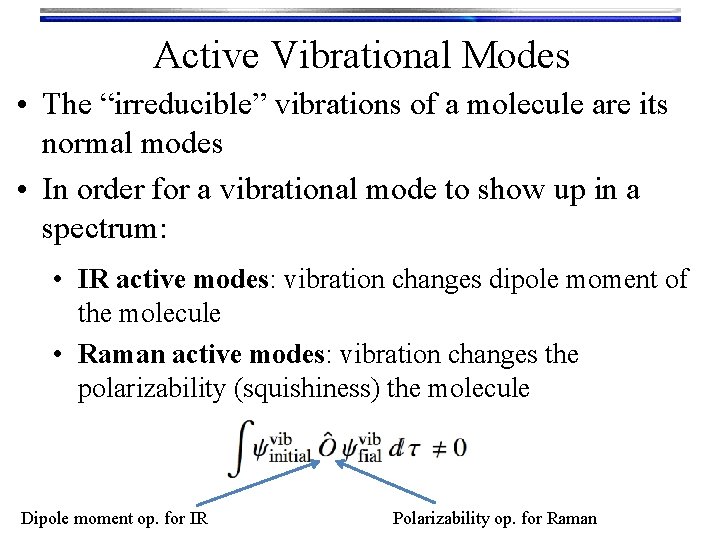
Active Vibrational Modes • The “irreducible” vibrations of a molecule are its normal modes • In order for a vibrational mode to show up in a spectrum: • IR active modes: vibration changes dipole moment of the molecule • Raman active modes: vibration changes the polarizability (squishiness) the molecule Dipole moment op. for IR Polarizability op. for Raman
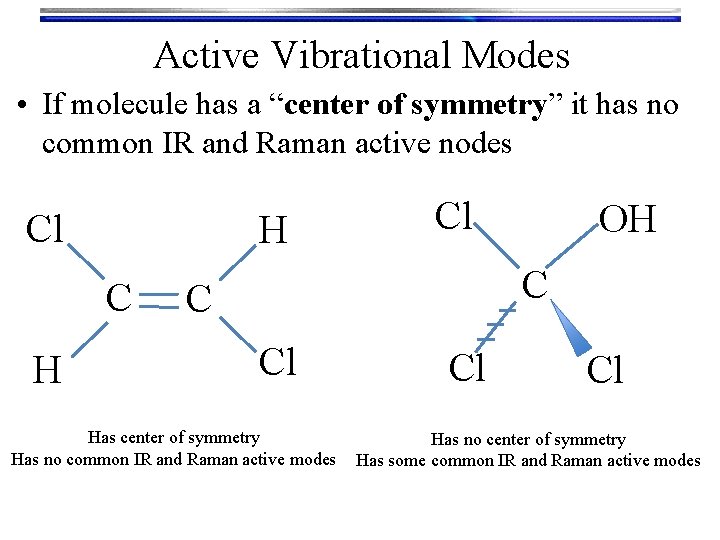
Active Vibrational Modes • If molecule has a “center of symmetry” it has no common IR and Raman active nodes Cl H Cl OH C C Cl Has center of symmetry Has no common IR and Raman active modes Cl Cl Has no center of symmetry Has some common IR and Raman active modes
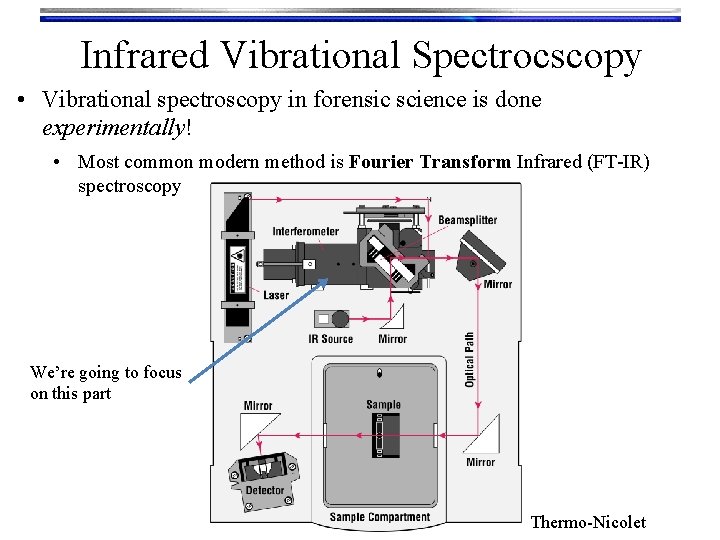
Infrared Vibrational Spectrocscopy • Vibrational spectroscopy in forensic science is done experimentally! • Most common modern method is Fourier Transform Infrared (FT-IR) spectroscopy We’re going to focus on this part Thermo-Nicolet
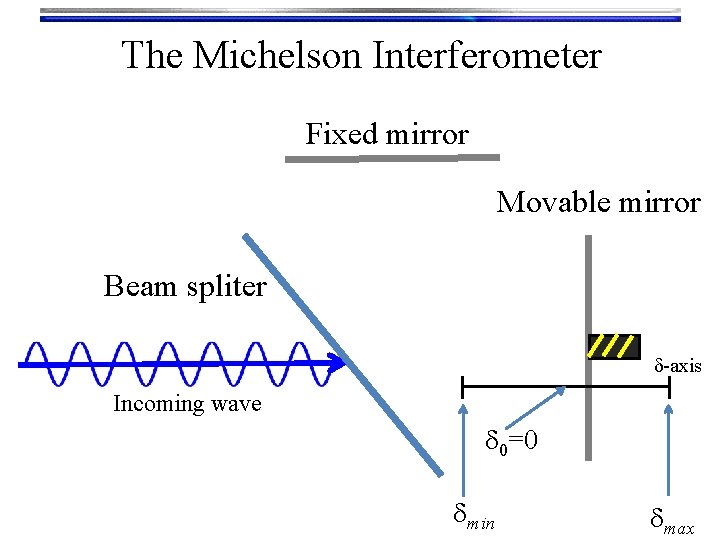
The Michelson Interferometer Fixed mirror Movable mirror Beam spliter d-axis Incoming wave d 0=0 dmin dmax
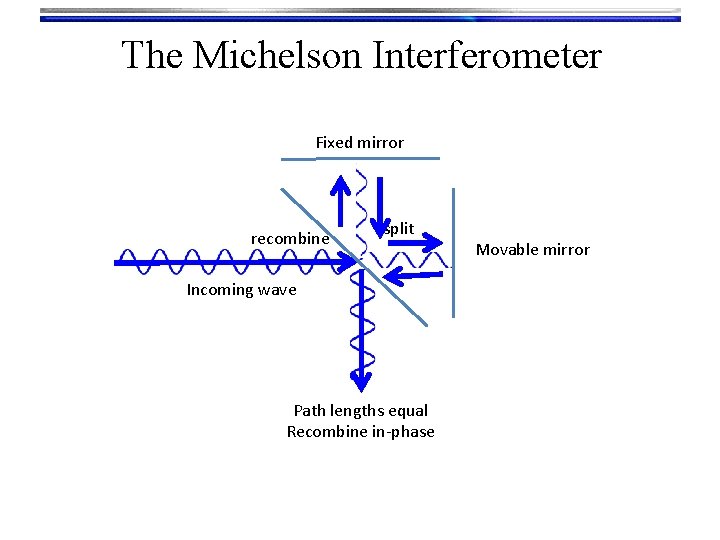
The Michelson Interferometer Fixed mirror recombine split Incoming wave Path lengths equal Recombine in-phase Movable mirror
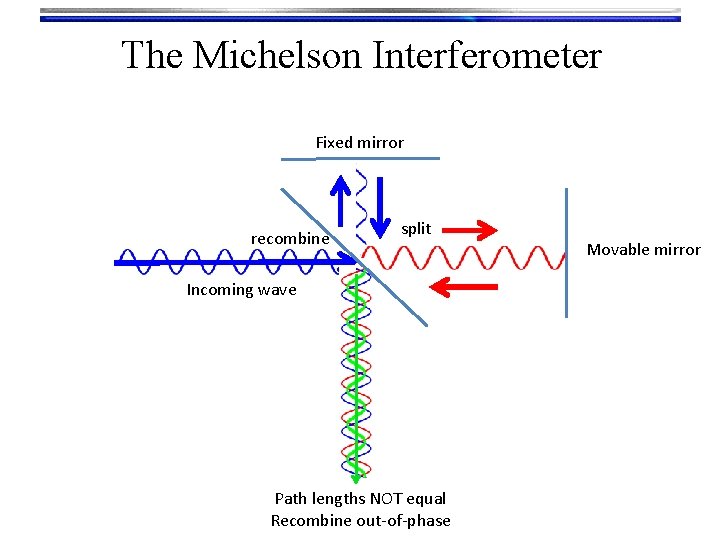
The Michelson Interferometer Fixed mirror recombine split Incoming wave Path lengths NOT equal Recombine out-of-phase Movable mirror
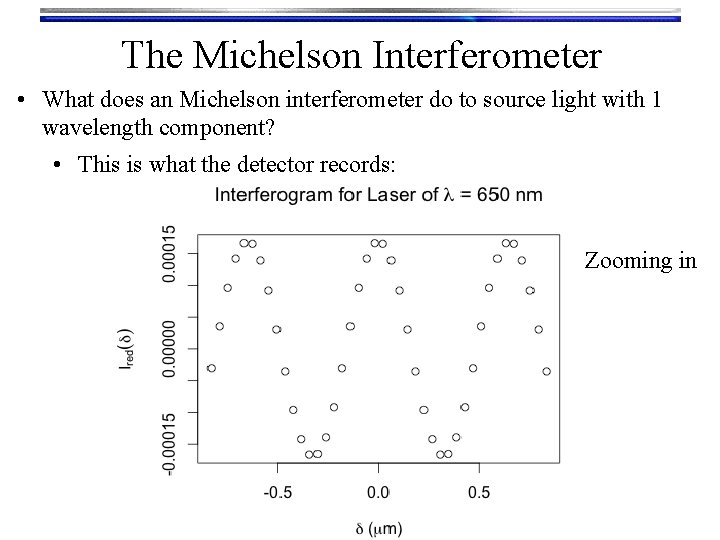
The Michelson Interferometer • What does an Michelson interferometer do to source light with 1 wavelength component? • This is what the detector records: Zooming in
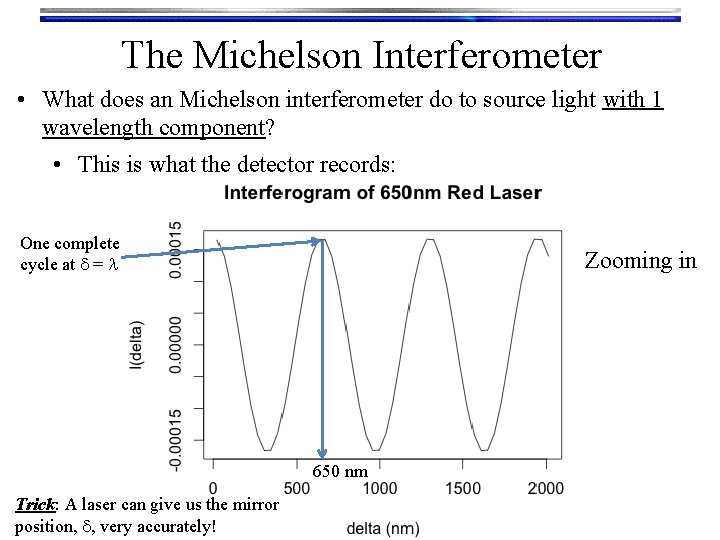
The Michelson Interferometer • What does an Michelson interferometer do to source light with 1 wavelength component? • This is what the detector records: One complete cycle at d = l Zooming in 650 nm Trick: A laser can give us the mirror position, d, very accurately!
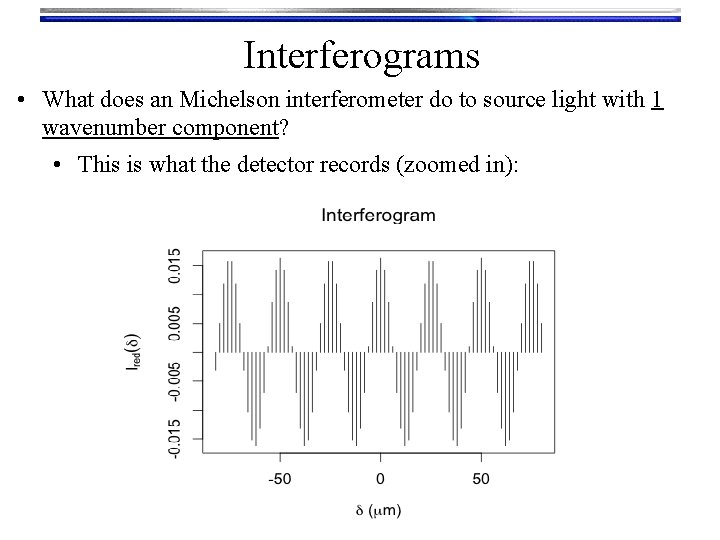
Interferograms • What does an Michelson interferometer do to source light with 1 wavenumber component? • This is what the detector records (zoomed in):
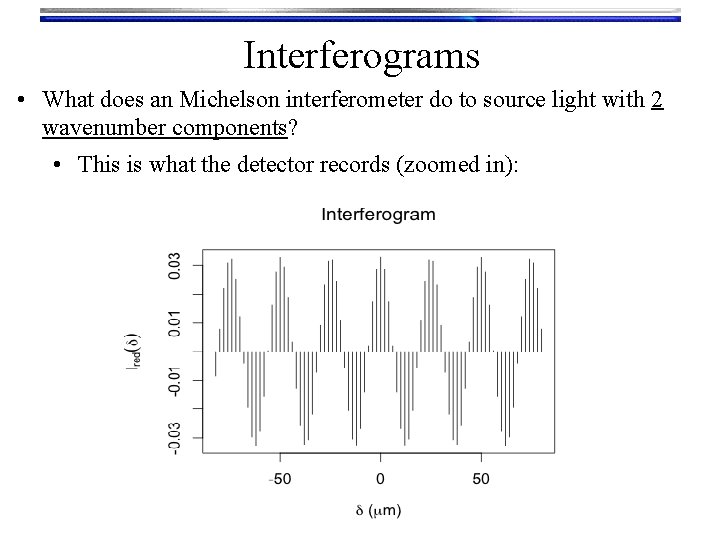
Interferograms • What does an Michelson interferometer do to source light with 2 wavenumber components? • This is what the detector records (zoomed in):
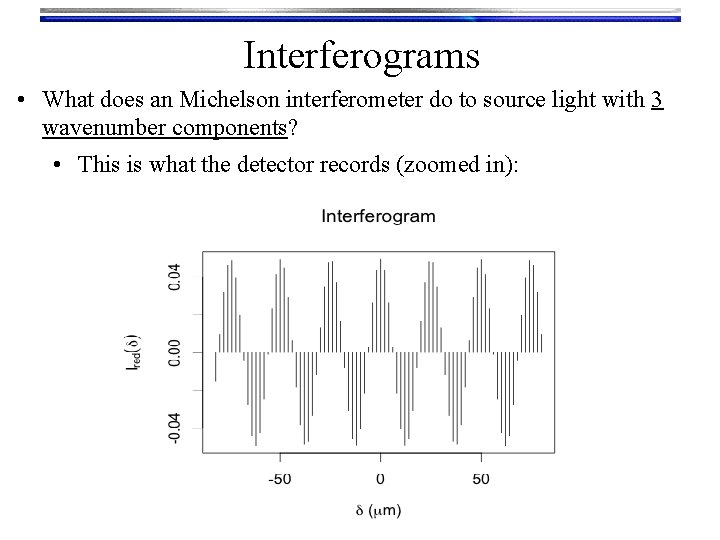
Interferograms • What does an Michelson interferometer do to source light with 3 wavenumber components? • This is what the detector records (zoomed in):
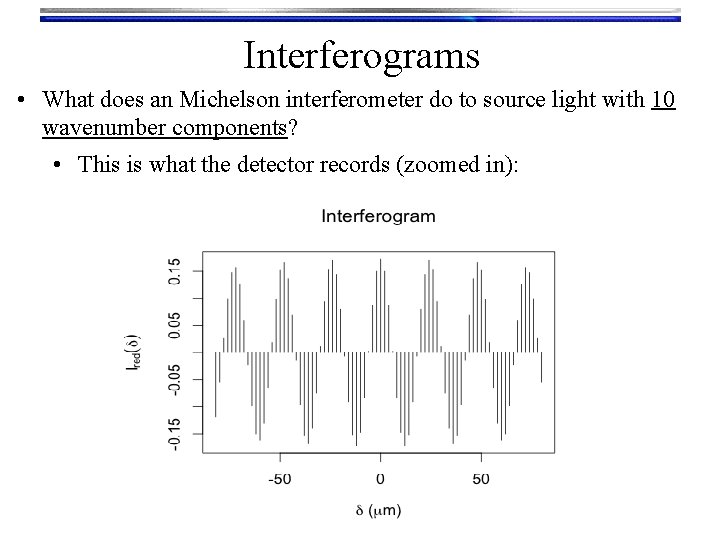
Interferograms • What does an Michelson interferometer do to source light with 10 wavenumber components? • This is what the detector records (zoomed in):
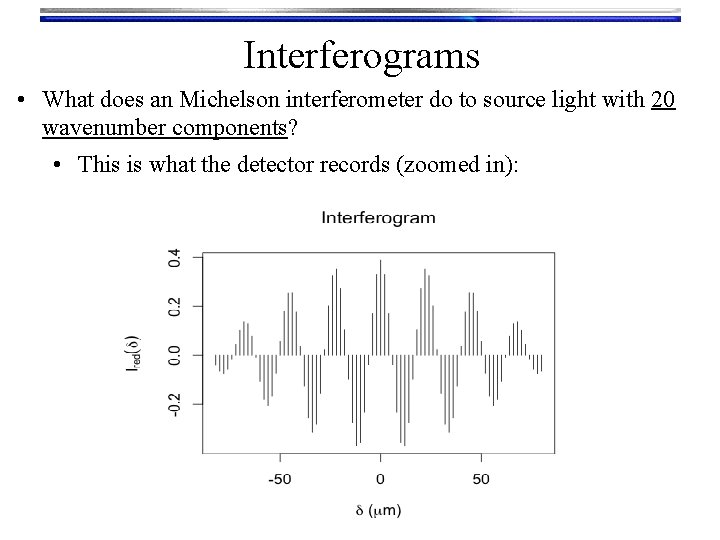
Interferograms • What does an Michelson interferometer do to source light with 20 wavenumber components? • This is what the detector records (zoomed in):
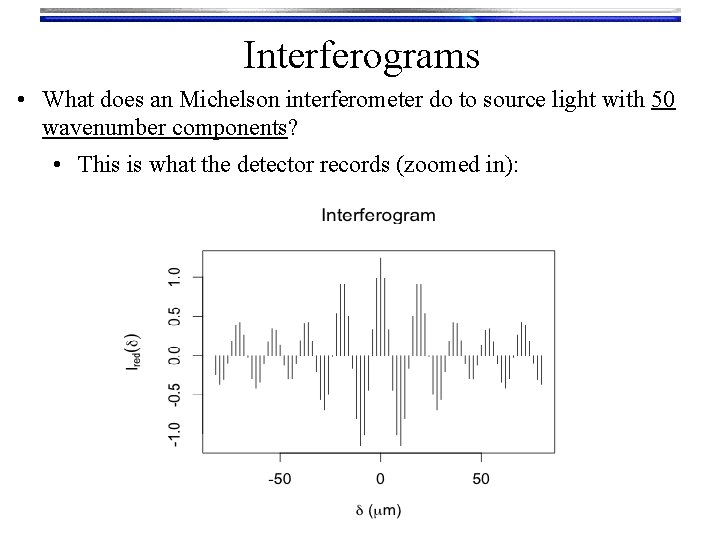
Interferograms • What does an Michelson interferometer do to source light with 50 wavenumber components? • This is what the detector records (zoomed in):
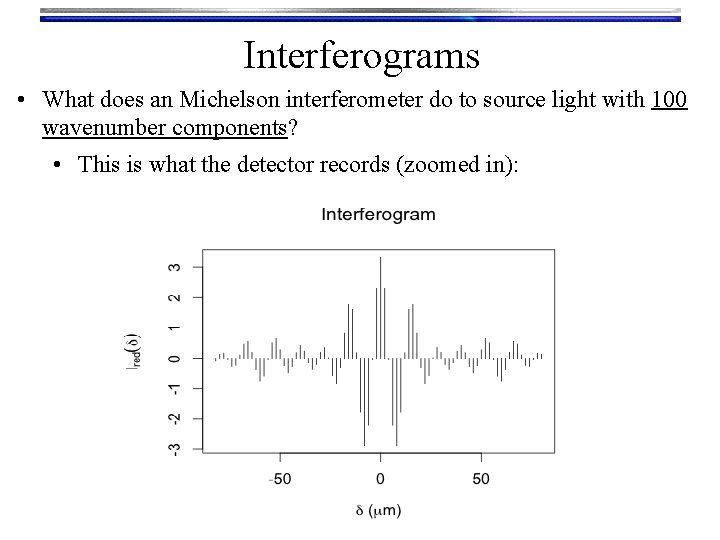
Interferograms • What does an Michelson interferometer do to source light with 100 wavenumber components? • This is what the detector records (zoomed in):
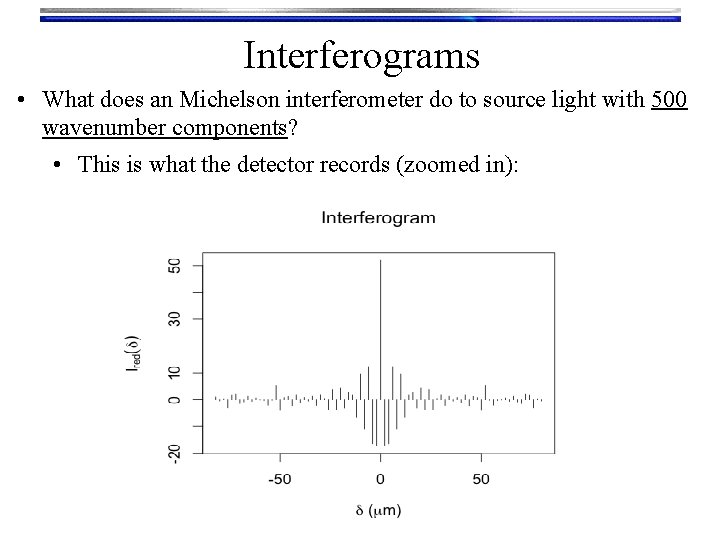
Interferograms • What does an Michelson interferometer do to source light with 500 wavenumber components? • This is what the detector records (zoomed in):
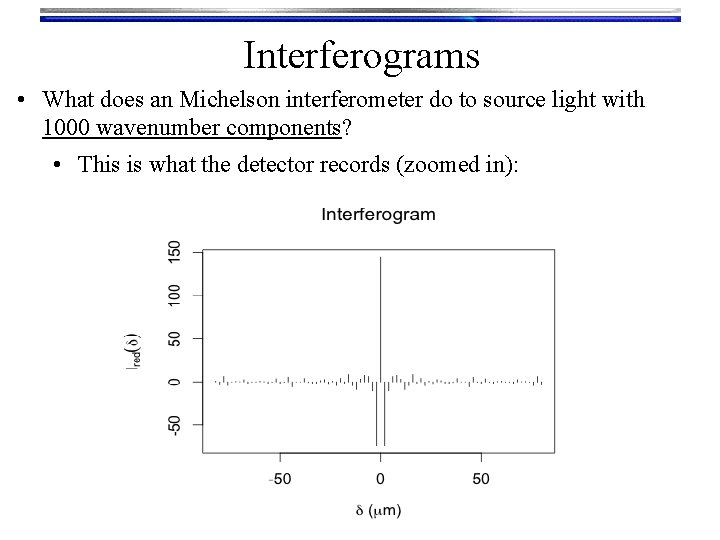
Interferograms • What does an Michelson interferometer do to source light with 1000 wavenumber components? • This is what the detector records (zoomed in):
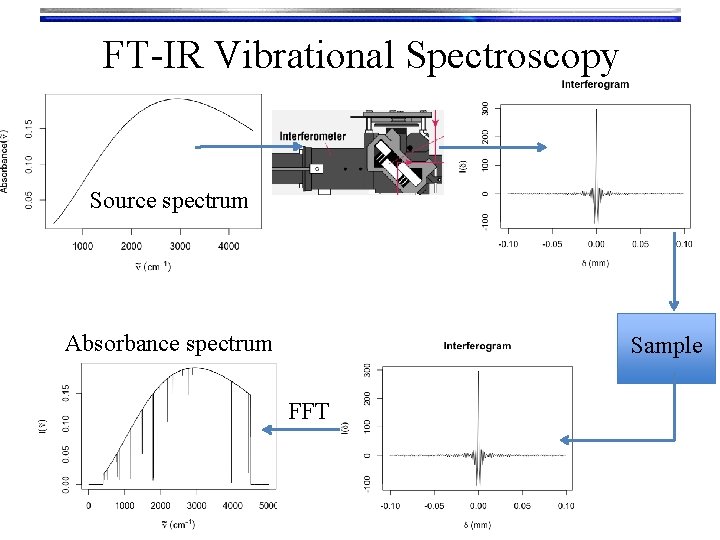
FT-IR Vibrational Spectroscopy Source spectrum Absorbance spectrum Sample FFT
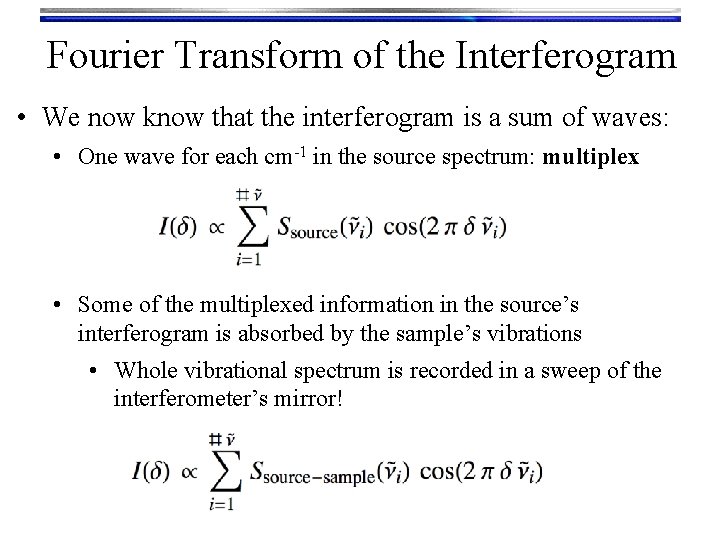
Fourier Transform of the Interferogram • We now know that the interferogram is a sum of waves: • One wave for each cm-1 in the source spectrum: multiplex • Some of the multiplexed information in the source’s interferogram is absorbed by the sample’s vibrations • Whole vibrational spectrum is recorded in a sweep of the interferometer’s mirror!
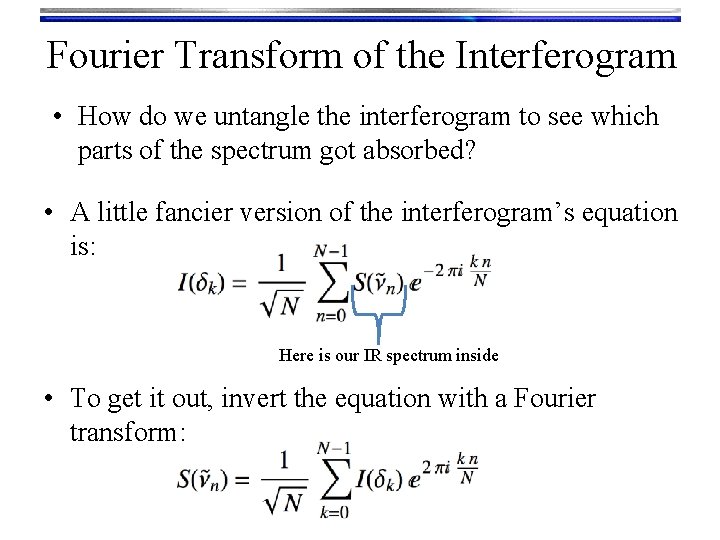
Fourier Transform of the Interferogram • How do we untangle the interferogram to see which parts of the spectrum got absorbed? • A little fancier version of the interferogram’s equation is: Here is our IR spectrum inside • To get it out, invert the equation with a Fourier transform:
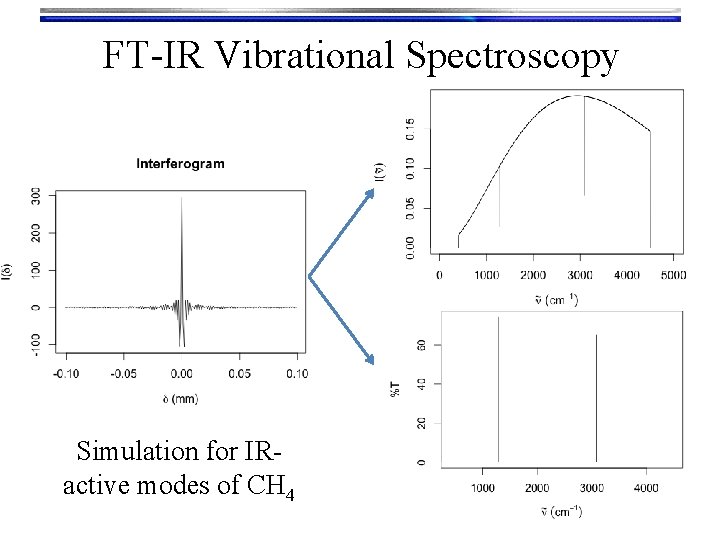
FT-IR Vibrational Spectroscopy Simulation for IRactive modes of CH 4
- Slides: 40