
VI Mutation A B C D Overview Changes
VI. Mutation A. B. C. D. Overview Changes in Ploidy Changes in ‘Aneuploidy’ (changes in chromosome number) Change in Gene Number/Arrangement
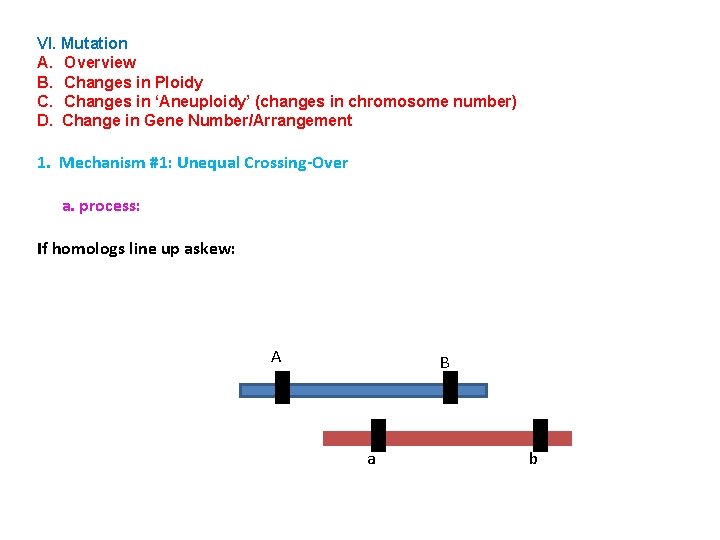
VI. Mutation A. Overview B. Changes in Ploidy C. Changes in ‘Aneuploidy’ (changes in chromosome number) D. Change in Gene Number/Arrangement 1. Mechanism #1: Unequal Crossing-Over a. process: If homologs line up askew: A B a b
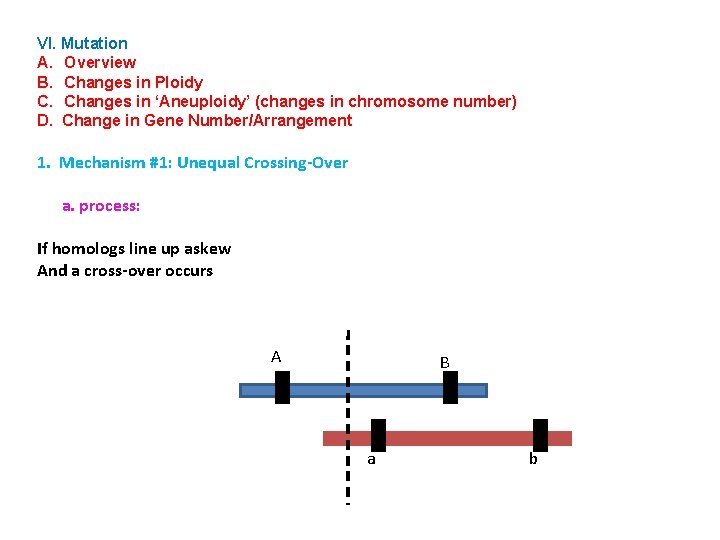
VI. Mutation A. Overview B. Changes in Ploidy C. Changes in ‘Aneuploidy’ (changes in chromosome number) D. Change in Gene Number/Arrangement 1. Mechanism #1: Unequal Crossing-Over a. process: If homologs line up askew And a cross-over occurs A B a b
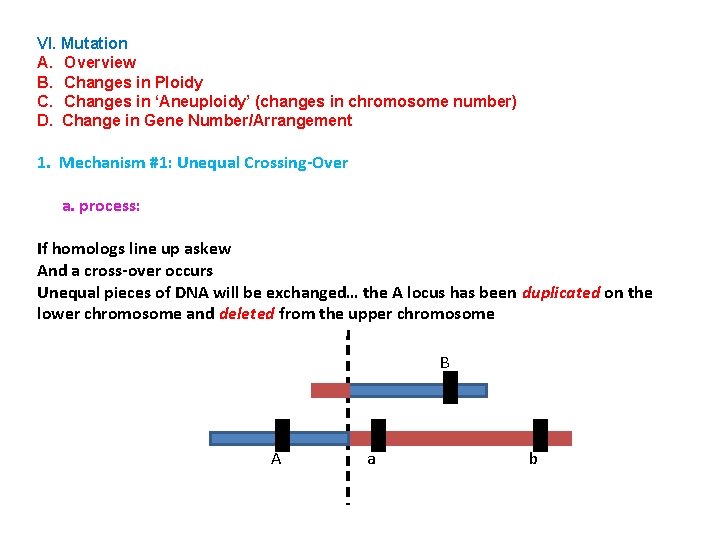
VI. Mutation A. Overview B. Changes in Ploidy C. Changes in ‘Aneuploidy’ (changes in chromosome number) D. Change in Gene Number/Arrangement 1. Mechanism #1: Unequal Crossing-Over a. process: If homologs line up askew And a cross-over occurs Unequal pieces of DNA will be exchanged… the A locus has been duplicated on the lower chromosome and deleted from the upper chromosome B A a b
VI. Mutation A. Overview B. Changes in Ploidy C. Changes in ‘Aneuploidy’ (changes in chromosome number) D. Change in Gene Number/Arrangement 1. Mechanism #1: Unequal Crossing-Over a. process: b. effects: - can be bad: deletions are usually bad – reveal deleterious recessives additions can be bad – change protein concentration
VI. Mutation A. Overview B. Changes in Ploidy C. Changes in ‘Aneuploidy’ (changes in chromosome number) D. Change in Gene Number/Arrangement 1. Mechanism #1: Unequal Crossing-Over a. process: b. effects: - can be bad: - can be good: deletions are usually bad – reveal deleterious recessives additions can be bad – change protein concentration more of a single protein could be advantageous (r-RNA genes, melanin genes, etc. )
VI. Mutation A. Overview B. Changes in Ploidy C. Changes in ‘Aneuploidy’ (changes in chromosome number) D. Change in Gene Number/Arrangement 1. Mechanism #1: Unequal Crossing-Over a. process: b. effects: - can be bad: - can be good: deletions are usually bad – reveal deleterious recessives additions can be bad – change protein concentration more of a single protein could be advantageous (r-RNA genes, melanin genes, etc. ) source of evolutionary novelty (Ohno hypothesis - 1970) where do new genes (new genetic information) come from?
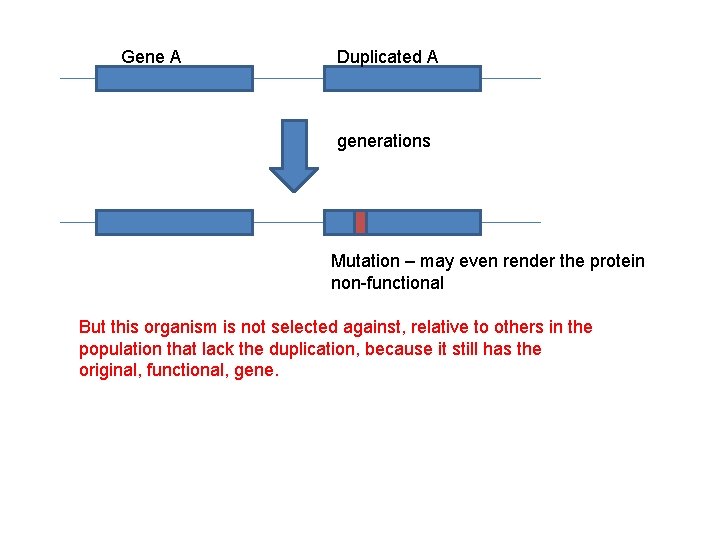
Gene A Duplicated A generations Mutation – may even render the protein non-functional But this organism is not selected against, relative to others in the population that lack the duplication, because it still has the original, functional, gene.
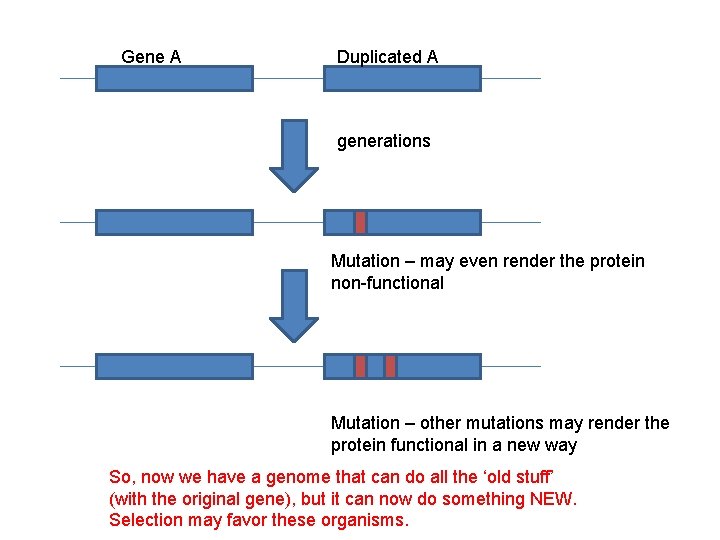
Gene A Duplicated A generations Mutation – may even render the protein non-functional Mutation – other mutations may render the protein functional in a new way So, now we have a genome that can do all the ‘old stuff’ (with the original gene), but it can now do something NEW. Selection may favor these organisms.
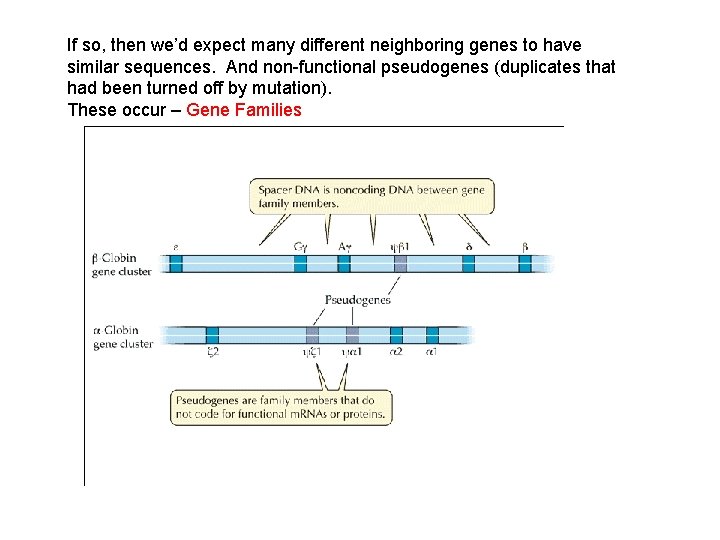
If so, then we’d expect many different neighboring genes to have similar sequences. And non-functional pseudogenes (duplicates that had been turned off by mutation). These occur – Gene Families
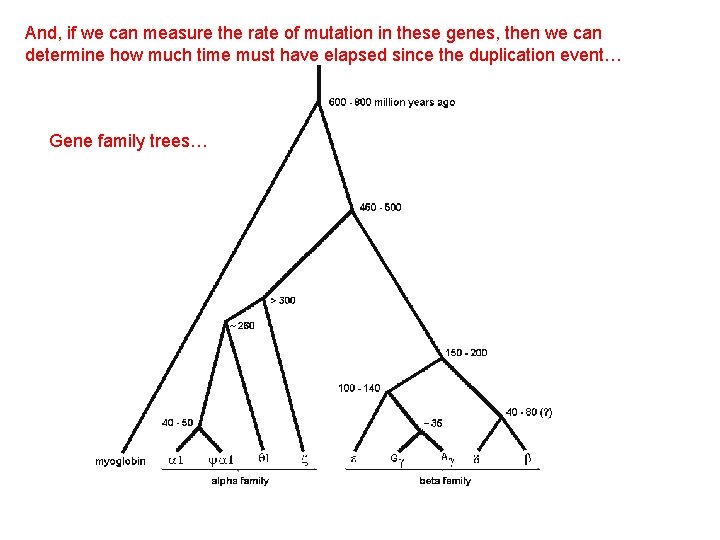
And, if we can measure the rate of mutation in these genes, then we can determine how much time must have elapsed since the duplication event… Gene family trees…
VI. Mutation A. Overview B. Changes in Ploidy C. Changes in ‘Aneuploidy’ (changes in chromosome number) D. Change in Gene Number/Arrangement 1. Mechanism #1: Unequal Crossing-Over 2. Mechanism #2: Inversion (changes the order of genes on a chromosome)
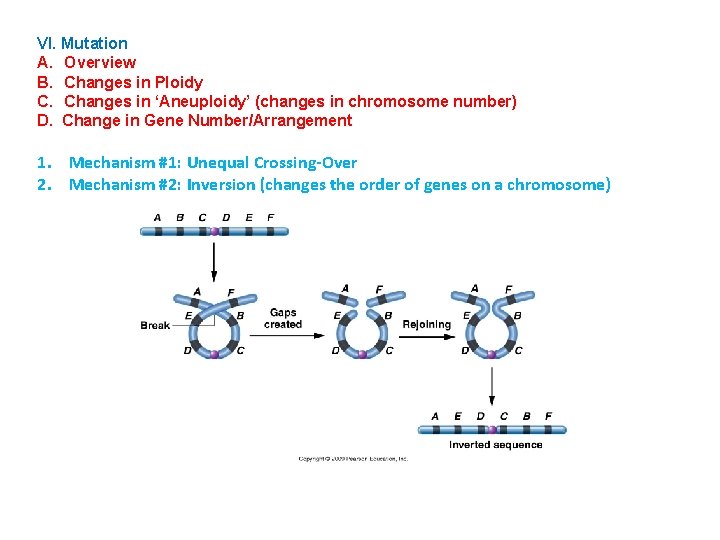
VI. Mutation A. Overview B. Changes in Ploidy C. Changes in ‘Aneuploidy’ (changes in chromosome number) D. Change in Gene Number/Arrangement 1. Mechanism #1: Unequal Crossing-Over 2. Mechanism #2: Inversion (changes the order of genes on a chromosome)
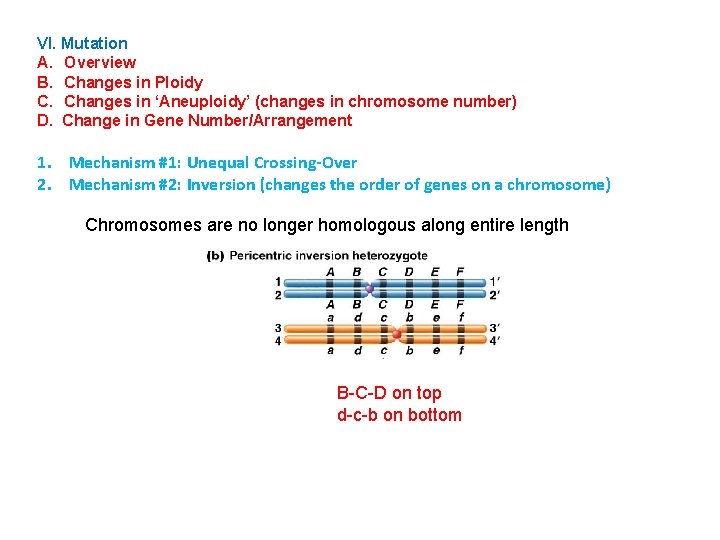
VI. Mutation A. Overview B. Changes in Ploidy C. Changes in ‘Aneuploidy’ (changes in chromosome number) D. Change in Gene Number/Arrangement 1. Mechanism #1: Unequal Crossing-Over 2. Mechanism #2: Inversion (changes the order of genes on a chromosome) Chromosomes are no longer homologous along entire length B-C-D on top d-c-b on bottom
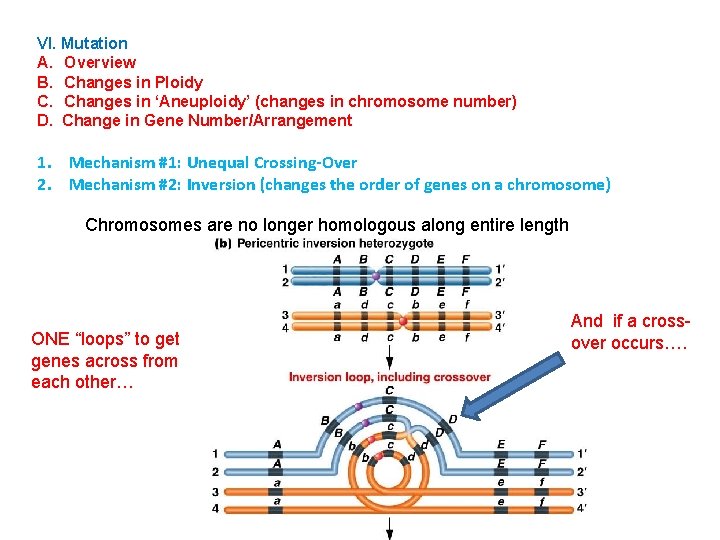
VI. Mutation A. Overview B. Changes in Ploidy C. Changes in ‘Aneuploidy’ (changes in chromosome number) D. Change in Gene Number/Arrangement 1. Mechanism #1: Unequal Crossing-Over 2. Mechanism #2: Inversion (changes the order of genes on a chromosome) Chromosomes are no longer homologous along entire length ONE “loops” to get genes across from each other… And if a crossover occurs….
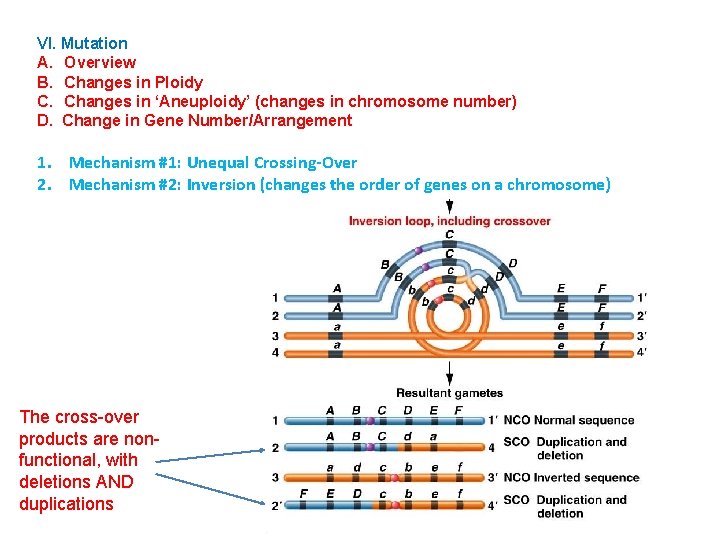
VI. Mutation A. Overview B. Changes in Ploidy C. Changes in ‘Aneuploidy’ (changes in chromosome number) D. Change in Gene Number/Arrangement 1. Mechanism #1: Unequal Crossing-Over 2. Mechanism #2: Inversion (changes the order of genes on a chromosome) The cross-over products are nonfunctional, with deletions AND duplications
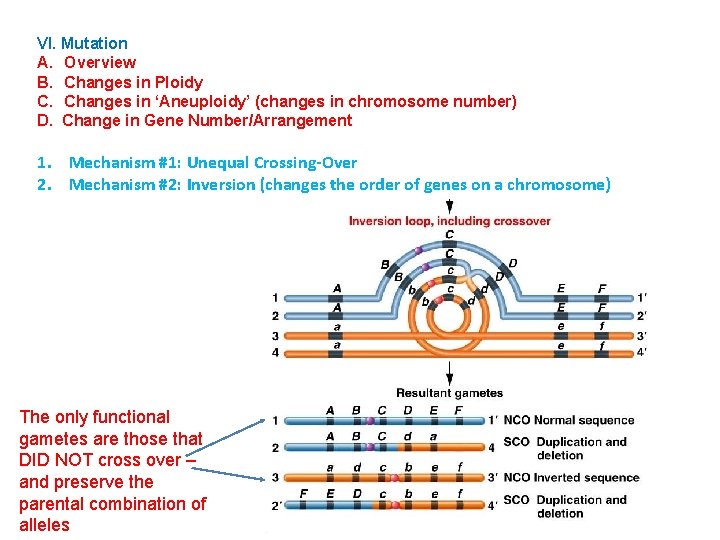
VI. Mutation A. Overview B. Changes in Ploidy C. Changes in ‘Aneuploidy’ (changes in chromosome number) D. Change in Gene Number/Arrangement 1. Mechanism #1: Unequal Crossing-Over 2. Mechanism #2: Inversion (changes the order of genes on a chromosome) The only functional gametes are those that DID NOT cross over – and preserve the parental combination of alleles
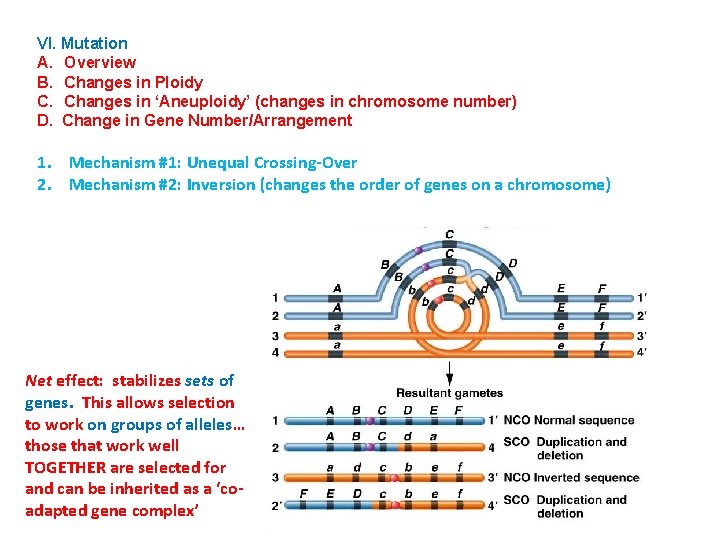
VI. Mutation A. Overview B. Changes in Ploidy C. Changes in ‘Aneuploidy’ (changes in chromosome number) D. Change in Gene Number/Arrangement 1. Mechanism #1: Unequal Crossing-Over 2. Mechanism #2: Inversion (changes the order of genes on a chromosome) Net effect: stabilizes sets of genes. This allows selection to work on groups of alleles… those that work well TOGETHER are selected for and can be inherited as a ‘coadapted gene complex’
VI. Mutation A. Overview B. Changes in Ploidy C. Changes in ‘Aneuploidy’ (changes in chromosome number) D. Change in Gene Number/Arrangement 1. Mechanism #1: Unequal Crossing-Over 2. Mechanism #2: Inversion (changes the order of genes on a chromosome) 3. Mechanism #3: Translocation (gene or genes move to another homologous set)
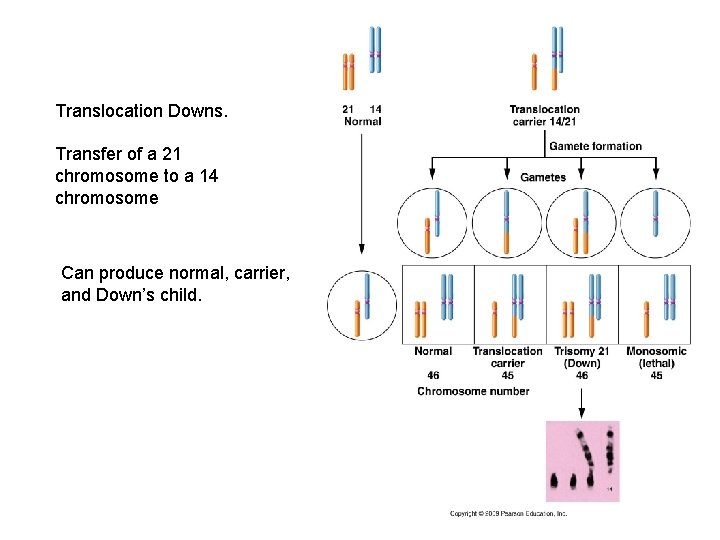
Translocation Downs. Transfer of a 21 chromosome to a 14 chromosome Can produce normal, carrier, and Down’s child.
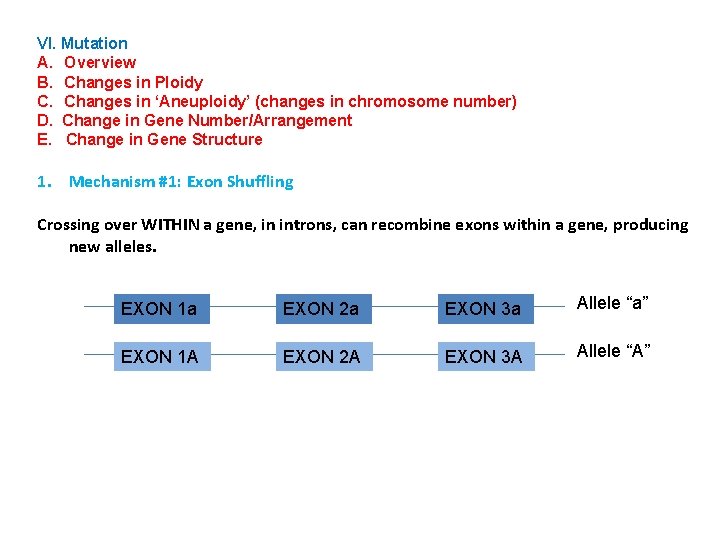
VI. Mutation A. Overview B. Changes in Ploidy C. Changes in ‘Aneuploidy’ (changes in chromosome number) D. Change in Gene Number/Arrangement E. Change in Gene Structure 1. Mechanism #1: Exon Shuffling Crossing over WITHIN a gene, in introns, can recombine exons within a gene, producing new alleles. EXON 1 a EXON 2 a EXON 3 a Allele “a” EXON 1 A EXON 2 A EXON 3 A Allele “A”
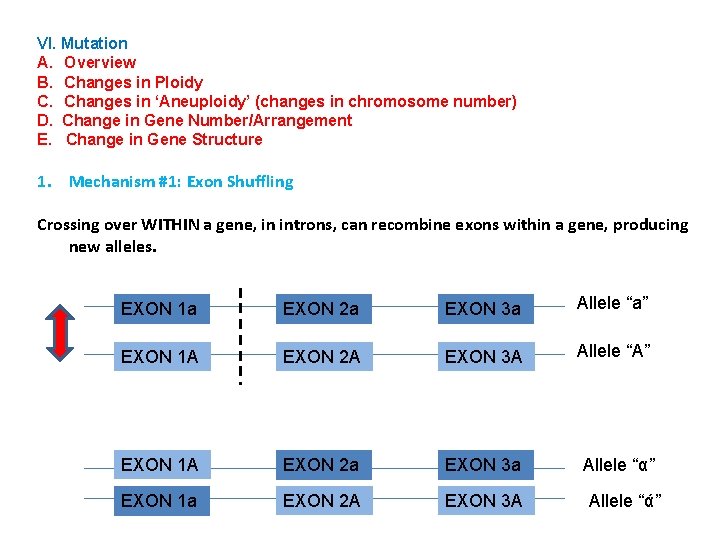
VI. Mutation A. Overview B. Changes in Ploidy C. Changes in ‘Aneuploidy’ (changes in chromosome number) D. Change in Gene Number/Arrangement E. Change in Gene Structure 1. Mechanism #1: Exon Shuffling Crossing over WITHIN a gene, in introns, can recombine exons within a gene, producing new alleles. EXON 1 a EXON 2 a EXON 3 a Allele “a” EXON 1 A EXON 2 A EXON 3 A Allele “A” EXON 1 A EXON 2 a EXON 3 a Allele “α” EXON 1 a EXON 2 A EXON 3 A Allele “ά”
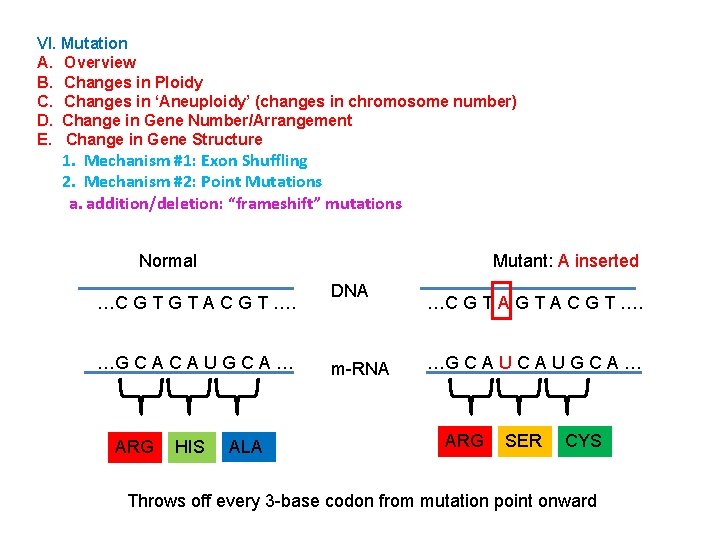
VI. Mutation A. Overview B. Changes in Ploidy C. Changes in ‘Aneuploidy’ (changes in chromosome number) D. Change in Gene Number/Arrangement E. Change in Gene Structure 1. Mechanism #1: Exon Shuffling 2. Mechanism #2: Point Mutations a. addition/deletion: “frameshift” mutations Normal Mutant: A inserted …C G T A C G T …. …G C A U G C A … ARG HIS ALA DNA m-RNA …C G T A C G T …. …G C A U G C A … ARG SER CYS Throws off every 3 -base codon from mutation point onward
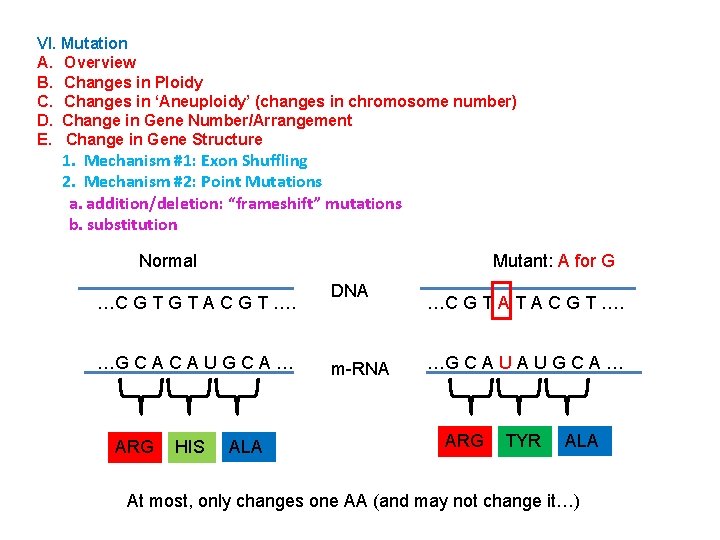
VI. Mutation A. Overview B. Changes in Ploidy C. Changes in ‘Aneuploidy’ (changes in chromosome number) D. Change in Gene Number/Arrangement E. Change in Gene Structure 1. Mechanism #1: Exon Shuffling 2. Mechanism #2: Point Mutations a. addition/deletion: “frameshift” mutations b. substitution Normal Mutant: A for G …C G T A C G T …. …G C A U G C A … ARG HIS ALA DNA m-RNA …C G T A C G T …. …G C A U G C A … ARG TYR ALA At most, only changes one AA (and may not change it…)
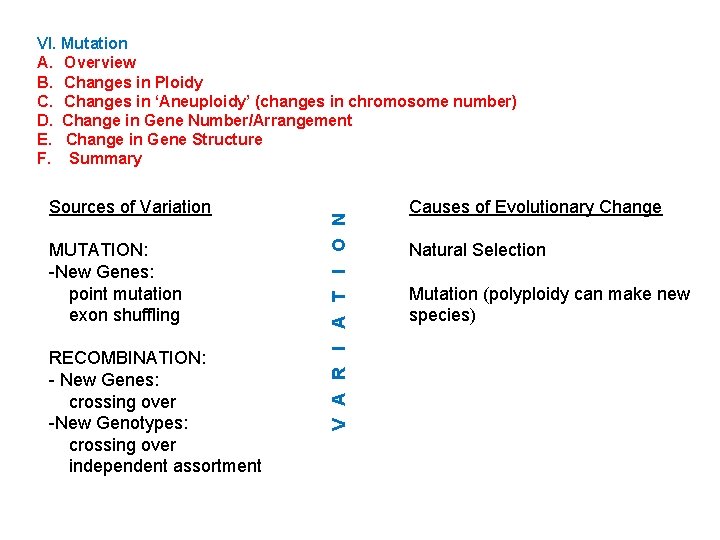
Sources of Variation MUTATION: -New Genes: point mutation exon shuffling RECOMBINATION: - New Genes: crossing over -New Genotypes: crossing over independent assortment V A R I A T I O N VI. Mutation A. Overview B. Changes in Ploidy C. Changes in ‘Aneuploidy’ (changes in chromosome number) D. Change in Gene Number/Arrangement E. Change in Gene Structure F. Summary Causes of Evolutionary Change Natural Selection Mutation (polyploidy can make new species)
- Slides: 25